What's inside
- Key Takeaways
- Quick Picks
- How We Chose These Picks
- Comparison
- How Does Atmos Actually Create Height in a Soundbar?
- Which Ceilings and Rooms Flatter Bounced Height?
- How Do You Connect and Set Up an Atmos Bar?
- Should You Plan an Upgrade Path or Buy the Finished System?
- What Should You Feed an Atmos Bar?
- How Much Bar Does Your Television Size Imply?
- Do You Need Rear Speakers for Atmos to Feel Real?
- Common Mistakes
- Final Recommendation
- Frequently Asked Questions
- Related Guides
As an Amazon Associate I earn from qualifying purchases. This post may contain affiliate links at no extra cost to you.
widgetverdict.com is reader-supported. When you buy through links on our site, we may earn an affiliate commission.
Shopping for the best atmos soundbars starts with a confession the category rarely makes in its headlines: Dolby Atmos is a format, not a guarantee. Six bars can all carry the same logo while delivering height effects in wildly different ways — one folds the ceiling channels into a compact cabinet and simulates the bounce, another spreads thirteen drivers across a wide flagship chassis, a third hands you battery-powered surround speakers to place behind the sofa, and a fourth skips the separate subwoofer entirely and streams its Atmos wirelessly into a single all-in-one bar. The logo tells you the decoder is present. It says nothing about how the sound reaches the ceiling, and the ceiling is the whole point.
Height is what separates Atmos from ordinary surround. A rain scene should patter above the actors rather than inside the television’s speakers, a helicopter should cross the room overhead, and dialogue should stay anchored to the screen while all of that weather happens around it. How a bar manufactures that vertical dimension is the real buying decision. Up-firing drivers bounce sound off a flat ceiling. Virtual processing fakes height from drivers that all face forward. Detachable rears add genuine surround envelopment that no front-only bar can fully imitate. Each route has rooms where it shines and rooms where it quietly fails, and the six reviews below are organised around those rooms rather than around brand loyalty.
Ceiling geometry deserves its paragraph before any money moves. Bounced height effects need a ceiling that is flat, reasonably low and free of beams, coffers and steep vaults; a cathedral ceiling scatters the reflection and the effect dissolves. Rooms with awkward ceilings are not excluded from Atmos — they simply get more from wide, processing-led bars and from systems whose surround speakers create envelopment at ear level instead. Read the picks with your own ceiling in mind, because the same bar can be the right answer under plasterboard and the wrong one under oak beams.
One more piece of honesty frames the whole guide. Channel counts and driver arrangements are stated here only where a listing states them, in the listing’s own terms. When the Sonos Arc Ultra’s title says 9.1.4, the review says 9.1.4. When a bar’s title names up-firing speakers, as the Hisense does, the review credits them. When a title stays silent about its internal layout, the review judges the bar by the features it does declare — its subwoofer arrangement, its streaming, its dialogue tools — rather than inventing an architecture for it.
Budget framing helps before the reviews begin, because this category’s tiers buy genuinely different things rather than graded versions of one thing. At the sensible end, the money buys decoding, a centre channel and honest height hardware. In the middle, it buys ecosystems — calibration, television teamwork, streaming polish. At the top, it buys either flagship single-bar engineering or a complete physical surround system. Knowing which of those purchases your household is actually making prevents the commonest disappointment in the category: paying flagship money for an ecosystem when the room needed speakers, or buying speakers when the household would have valued the ecosystem every single day.
Key Takeaways
- Atmos is a decoding format, not a performance promise: the six picks create height through up-firing drivers, wide driver arrays, detachable surrounds or wireless all-in-one processing.
- The Sonos Arc Ultra is the single-bar flagship, its listing stating a 9.1.4 arrangement and Sound Motion technology.
- JBL’s Bar 1300XMK2 is the only pick with detachable portable surround speakers and a wireless 12-inch subwoofer.
- Samsung’s S60D delivers wireless Dolby Atmos in an all-in-one 5.0ch design with no separate subwoofer box to place.
- The Hisense AX3120Q names up-firing speakers and a 3.1.2ch layout, the most explicit height hardware at the value end.
- Flat, low ceilings reward bounced height effects; vaulted or beamed ceilings push the choice toward wide bars and ear-level surround.
Quick Picks
| Pick | Badge | Why it makes the cut |
|---|---|---|
| Sonos Beam Gen 2 | Compact Atmos bar | Atmos and a 5-driver array in a small cabinet, with eARC, AirPlay 2 and room to add Sonos rears and a Sub Mini later. |
| Sonos Arc Ultra | Flagship single bar | A stated 9.1.4 arrangement and Sound Motion technology make it the most ambitious one-box Atmos statement here. |
| JBL Bar 1300XMK2 | Full detachable system | Detachable portable surrounds, a wireless 12-inch subwoofer and DTS:X alongside Atmos for a genuine system feel. |
| Hisense AX3120Q | Value Atmos system | 3.1.2 channels with up-firing speakers and a wireless subwoofer, plus Roku TV Ready pairing and seven EQ modes. |
| Samsung S60D | All-in-one wireless Atmos | 5.0ch wireless Dolby Atmos with no separate subwoofer, Q-Symphony for Samsung TVs and SpaceFit Sound Pro calibration. |
| Amazon Fire TV Soundbar Plus | Built-in subwoofer | 3.1 channels with a subwoofer built into the bar and a clear-dialogue focus, sized for straightforward TV rooms. |
How We Chose These Picks
Atmos support in the listing was the entry ticket, verified pick by pick; a bar that merely plays television sound well, however musical, does not belong in this guide. Beyond that ticket, the six were chosen to represent the distinct engineering answers to the height question, because comparing six near-identical bars would teach a buyer nothing. There is a compact virtualised bar, a wide flagship array, a detachable-surround system, a value system with declared up-firing drivers, an all-in-one that receives Atmos wirelessly, and a built-in-subwoofer bar aimed at simple rooms. Together they map the category’s real forks.
Subwoofer strategy was treated as a first-class difference rather than a footnote. Two picks carry wireless subwoofers in separate cabinets, one builds its subwoofer into the bar, one is designed to work with an optional Sonos subwoofer, and one — the Samsung — is a 5.0ch all-in-one with no subwoofer in the system at all. Bass expectations follow those architectures, and the reviews set them accordingly instead of pretending a single cabinet and a 12-inch wireless subwoofer are interchangeable answers to the same question.
Television pairing shaped the selection too. The Hisense declares itself Roku TV Ready, the Samsung’s Q-Symphony is built for Samsung televisions, the Fire TV Soundbar Plus speaks Amazon’s ecosystem language, and the two Sonos bars lean on HDMI eARC plus their own app-driven world. A soundbar is half of a two-device marriage, and a guide that ignores which television each bar was designed to wed would be reviewing only half of each product.
Dialogue tools earned explicit credit wherever a listing names them — JBL’s PureVoice, the Fire TV bar’s clear-dialogue positioning — because the commonest real-world complaint about film sound is not weak height effects but buried speech. A bar that keeps voices forward while rain falls overhead solves the problem households actually have, and the rankings reflect that priority.
Claims were also weighed by their verifiability. A stated channel count, a named subwoofer size and a declared up-firing driver can be checked against the product that arrives; vague promises of cinematic immersion cannot. Where two picks competed for the same room, the one whose listing committed to specifics in writing tended to win the recommendation, because a buyer can hold a manufacturer to a printed specification and to nothing else.

Sonos Beam Gen 2 — Compact Atmos bar
Small rooms were supposed to sit the Atmos era out, and the Beam Gen 2 is the product that refused to let them. Its listing describes a 5-driver array with 3D surround in a compact black cabinet, decoding Dolby Atmos from a footprint that fits under televisions in bedrooms, dens and modest lounges where a metre-wide flagship would look like a runway. The height effect here is processed rather than bounced — no up-firing drivers are claimed — and judged on those terms it is persuasive: films gain a sense of space and altitude that the bar’s size gives no right to promise, while dialogue stays centred and clear at the low volumes small rooms actually use.
Connection and streaming are thoroughly modern. HDMI eARC carries the television’s sound in full quality, Ethernet offers a wired network option beside WiFi, and AirPlay 2 covers Apple households’ music. Alexa is built in for voice control. The Sonos app ecosystem is the bar’s second product: multiroom grouping, streaming services under one roof, and a upgrade path the listing states outright — it works with the Sonos Sub Mini and Sonos rear speakers, so the compact bar bought this year can grow into a fuller system without being replaced. That growth path is the Beam’s deepest argument against its rivals here, none of which offer quite the same modular ladder.
Limits follow the physics. A compact cabinet cannot move air like a separate subwoofer, so the biggest film moments lean on restraint rather than impact unless the Sub Mini joins later. The processed height effect flatters most ceilings because it does not depend on reflection, yet it will never place a sound behind you the way JBL’s detachable rears can. Buyers with a large, open lounge should read down the page. Buyers with a real room of ordinary size, a television up to mid-large dimensions and an appetite for Atmos without furniture rearrangement have found their pick.
Music deserves a mention because compact bars live double lives. The Beam’s WiFi streaming and AirPlay 2 make it a credible room speaker between films, and Sonos’s tuning favours a balanced, unexaggerated presentation that suits long listening. In the small rooms it serves, one box handling both the film and the playlist is not a compromise; it is the tidiest possible answer.
Everyday television is where this bar quietly outclasses bigger rivals. Newsreaders, panel shows and drama dialogue sit in the Beam’s favourite register, presented at a scale that matches a modest screen rather than overwhelming it, and the Sonos app’s speech and night settings — governed from the sofa — tame loud adverts and whispered scenes without a remote hunt. Households upgrading from television speakers will feel the Beam less as a cinema accessory and more as the sound the set should have shipped with, which is exactly the role a compact bar should audition for.
- Format: Dolby Atmos soundbar, compact cabinet
- Drivers: 5-driver array with 3D surround per listing
- TV connection: HDMI eARC
- Streaming and network: WiFi, Ethernet, AirPlay 2
- Voice: Alexa built in
- Expansion: works with Sonos Sub Mini and Sonos rear speakers
Strengths
- Genuine Atmos decoding in a cabinet small enough for bedrooms and dens.
- A stated upgrade path to a Sub Mini and rear speakers protects the purchase.
- eARC, Ethernet and AirPlay 2 cover wired, wireless and Apple households alike.
Trade-offs
- Height is processed rather than produced by up-firing drivers.
- Bass depth is cabinet-limited until an optional subwoofer is added.
- Large open-plan rooms will outgrow its scale quickly.
Best for: compact lounges, bedrooms and dens adding Atmos without surrendering furniture space.
Not suited for: big open rooms chasing cinema-scale impact from a single purchase.

Sonos Arc Ultra — Flagship single bar
The Arc Ultra is Sonos answering a pointed question: how much surround can one wide cabinet honestly hold? Its listing states a 9.1.4 arrangement for TV and music — a channel claim no other single bar in this guide attempts — built around what Sonos calls Sound Motion technology, its method for extracting serious bass movement from a bar-sized enclosure. The result, in positioning terms, is the flagship statement of the one-box philosophy: no separate subwoofer supplied, no surround speakers in the box, just a long bar engineered to fill a main lounge with height, width and low-end authority on its own.
Judged against its own sibling, the Ultra’s case is scale. The Beam Gen 2 serves the smaller room with processed cleverness; the Arc Ultra serves the principal television of the house, the one in front of the big sofa, with a driver complement aimed at genuine envelopment. Alexa is built in, and the listing names its expansion partners — it works with the Sonos Sub 4 and Era 300 speakers — so even this flagship is a starting point rather than a ceiling for households that later want dedicated rears and a heavyweight subwoofer. That ladder matters at this tier, because flagship buyers are precisely the people who upgrade in stages.
The honest costs are size and commitment. A wide flagship bar demands a wide stand or wall and a television of matching presence; perched under a small screen it looks and sounds top-heavy. Its one-box bass, however advanced the Sound Motion engineering, still answers to cabinet physics, and listeners chasing the deepest film rumble will end up adding the Sub 4 the listing gestures toward. None of that dents the central claim: among single bars that decode Atmos, this is the most complete specification in the guide, and main rooms with flat ceilings will hear height effects with a conviction the compact class cannot match.
Music at flagship scale is the other half of its brief, and the listing’s “for TV and Music” phrasing is deliberate. A bar this wide stages stereo and streamed music with a breadth small cabinets cannot imitate, which suits the main room’s double duty as the house’s listening room. Households whose biggest screen and best speakers share one address will recognise the Arc Ultra as the pick designed for that address.
Durability is part of what flagship money buys in a main-room Atmos bar. A main-room bar is typically the longest-serving audio purchase in the house, outlasting televisions and streaming sticks alike, and the Ultra’s combination of a current flagship specification, eARC connectivity and named expansion partners is structured for that decade-long service. Buying the top of a maker’s range is rarely the frugal move in year one; spread across the years a main room actually keeps a soundbar, it often becomes the economical one, because nothing about the purchase needs redoing when the next television arrives.
- Format: Dolby Atmos soundbar, flagship width
- Channels: 9.1.4 per listing
- Bass technology: Sound Motion per listing
- Use: TV and music per listing
- Voice: Alexa built in
- Expansion: works with Sonos Sub 4 and Era 300
Strengths
- The most ambitious single-bar channel arrangement in this guide, stated in its listing.
- Sound Motion technology targets real bass from the bar itself.
- A clear flagship expansion path through Sub 4 and Era 300 speakers.
Trade-offs
- Its width demands a large television and a stand or wall to match.
- Deepest film bass still points toward adding the optional subwoofer.
- Flagship pricing territory — check price on Amazon against the room it must fill.
Best for: main lounges with large televisions, flat ceilings and a one-box preference.
Not suited for: small screens, narrow furniture and rooms where a bar must stay discreet.
JBL Bar 1300XMK2 — Full detachable system
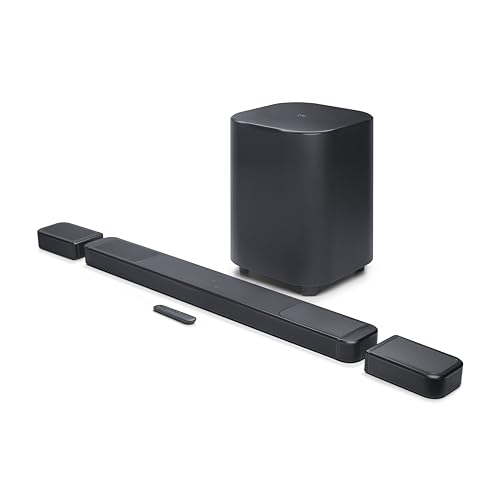
Rain that should fall behind the sofa cannot be faked convincingly from up front alone. The Bar 1300XMK2 simply puts speakers there. JBL’s flagship system pairs its Atmos bar with detachable, portable Bluetooth surround speakers that lift off the bar’s ends and take up positions behind the sofa for film night, then dock back to recharge and restore the bar’s clean single-unit look. That mechanical honesty changes what Atmos can do in a living room: effects genuinely arrive from behind and above the listener instead of being suggested from the front wall, and the difference is not subtle in action scenes, games or concert films.
The low end is equally uncompromised. A wireless 12-inch subwoofer — the largest driver specified anywhere in this guide — handles the floor-shaking duties, freeing the bar itself to concentrate on dialogue and height. DTS:X support sits alongside Dolby Atmos, so the system decodes both major object-based formats rather than asking your library to pick a side. PureVoice dialogue technology addresses the buried-speech problem directly, and WiFi streaming covers music without waking the television. As a specification, it is the most complete system in the guide by a clear margin.
Ownership, though, has chores attached. Detachable speakers must be docked to recharge, positioned for films and retrieved afterwards; households that love the ritual get a true surround system with no speaker cable anywhere, while households that know they will leave the rears docked forever are paying for a feature they will rarely deploy — though the system remains a powerful bar-and-sub combination even with the surrounds parked. The subwoofer’s cabinet also needs a home, ideally a corner of the room where its output loads evenly. Buyers should measure for it rather than discover it.
Positioned plainly, this is the pick for the household that wants the full Atmos event — height, rear envelopment, serious bass, both formats — and accepts a little ceremony to get it. Renters and cable-averse rooms benefit most, because the entire surround field assembles without a single wire crossing the floor. It is the guide’s maximalist answer, and it knows it.
Gaming households should note what genuine rears do for play. Directional audio in games is information, not decoration: footsteps, vehicles and weather arrive from their actual directions when speakers physically occupy those positions, and no front-bar processing reproduces that certainty. Paired with the subwoofer’s weight for engines and impacts, the 1300XMK2 is the closest any pick here comes to a dedicated home-theatre rig, while still folding back into a tidy bar when the session ends and the room returns to being a lounge.
- Format: Dolby Atmos soundbar system with detachable speakers
- Surrounds: portable Bluetooth detachable speakers per listing
- Subwoofer: wireless, 12-inch per listing
- Formats: Dolby Atmos and DTS:X 3D audio
- Dialogue: PureVoice technology per listing
- Streaming: WiFi streaming for movies and music
Strengths
- Real rear speakers deliver envelopment no front-only processing can match.
- The 12-inch wireless subwoofer is the guide’s most serious bass hardware.
- Both Dolby Atmos and DTS:X are decoded, covering mixed film libraries.
Trade-offs
- Detachable surrounds need docking and repositioning as a regular habit.
- The large subwoofer cabinet requires a planned place in the room.
- Its full-system scale is wasted on rooms that only stream dialogue-led television.
Best for: film-first households wanting genuine surround and height with zero speaker cable.
Not suited for: set-and-forget rooms where detachable speakers would never leave their docks.

Hisense AX3120Q — Value Atmos system
Specifications in the Hisense listing read like a checklist the value tier was not supposed to complete: a 3.1.2 channel layout, up-firing speakers named outright, a wireless subwoofer, Dolby Atmos and DTS:X decoding, Bluetooth 5.3, HDMI eARC, app control and seven EQ modes. The up-firing drivers matter most. Height here is produced by dedicated speakers aimed at the ceiling rather than by processing alone, which gives flat-ceilinged rooms the bounced reflection effect that defines the format’s party trick, at a tier where rivals usually offer simulation or silence on the subject.
The 3.1.2 architecture is equally deliberate. A dedicated centre channel carries dialogue — the .1 is the wireless subwoofer handling the low end — so speech sits in its own lane instead of competing with effects, and the two height channels ride above. Roku TV Ready status pairs the bar neatly with Roku televisions, and Hisense’s Hi-Concerto feature speaks to Hisense TV pairing, so the bar was designed with specific television families in mind rather than as a orphan accessory. App control plus a conventional remote covers both kinds of household: the phone-first and the remote-first.
Seven EQ modes invite scepticism and deserve a fair hearing. Presets cannot rewrite physics, but in real rooms they solve real problems — a night mode that tames dynamics, a dialogue emphasis for late viewing, a music shape for daytime streaming. The honest limits sit elsewhere: value-tier cabinets and drivers concede refinement to the Sonos flagships, particularly in music’s midrange and in the polish of the app experience, and bounced height still depends on your ceiling cooperating. Under a flat ceiling, though, the AX3120Q delivers the format’s defining effects with declared hardware, and that is a remarkable amount of Atmos per unit of money — check price on Amazon, because its value argument is written in the gap between its specification and its tier.
Consider it the guide’s proof that the height era has reached the sensible end of the market. A buyer shopping for up-firing drivers, a centre channel, a wireless subwoofer and both object formats no longer has to shop at flagship level, and the rooms this bar will serve — ordinary lounges with ordinary ceilings — are exactly the rooms where bounced Atmos works best.
Family rooms will appreciate the control story. App control lets the household’s phone owners adjust volume and EQ from anywhere in the room, the included remote serves everyone else, and the seven EQ modes give a quick answer to the two recurring family complaints — speech too quiet at night, bass too lively for the neighbours — without a menu expedition. A value bar lives or dies by how gracefully it handles ordinary evenings rather than demo scenes, and the AX3120Q’s controls are arranged for ordinary evenings.
- Channels: 3.1.2ch per listing
- Height: up-firing speakers per listing
- Subwoofer: wireless subwoofer included
- Formats: Dolby Atmos and DTS:X
- Connections: HDMI eARC, Bluetooth 5.3
- Pairing and control: Roku TV Ready, Hi-Concerto, app control and remote, 7 EQ modes
Strengths
- Declared up-firing speakers give flat-ceiling rooms real bounced height.
- A dedicated centre channel and wireless subwoofer complete the classic system layout.
- Roku TV Ready pairing and app control make setup friendly in two ecosystems.
Trade-offs
- Bounced height effects fade under vaulted, beamed or very high ceilings.
- Music refinement trails the Sonos flagships in this guide.
- Seven EQ presets help rooms, but none substitutes for careful placement.
Best for: flat-ceilinged lounges wanting declared height hardware without flagship spending.
Not suited for: awkward-ceiling rooms, where bounced height cannot reach the listener cleanly.

Samsung S60D — All-in-one wireless Atmos
The S60D asks the neatest question in this guide: what if the subwoofer simply was not there? Samsung’s bar is a 5.0 channel all-in-one whose listing leads with wireless Dolby Atmos — the television’s Atmos signal arriving without an HDMI cable between set and bar in compatible Samsung setups — and whose design puts every driver in a single cabinet. No subwoofer box crouches beside the sofa, no second power outlet is surrendered, no cable crosses the room. For flats, minimalist lounges and anyone whose room has no honest place for a subwoofer, that absence is not a missing feature; it is the feature.
Samsung’s television marriage runs deep here. Q-Symphony lets the bar work together with a Samsung TV’s own speakers rather than muting them, SpaceFit Sound Pro calibrates the bar’s output to the room’s acoustics, and Adaptive Sound adjusts presentation to content. Game Mode Pro courts console players, and Alexa is built in. The feature set assumes a Samsung household and rewards it: owners of the brand’s televisions get a bar that behaves like an extension of the set rather than a foreign accessory, right down to the wireless Atmos link that keeps the installation to a power cable.
Bass honesty is required. A 5.0 system with no subwoofer will render film low end with shape and clarity rather than physical pressure; explosions read as events, not as weather in the chest. Households that measure a film night by sofa vibration should take the JBL or the Hisense, both of which bring dedicated subwoofers. Households that prize dialogue, height atmosphere and a room that still looks like a room will find the trade deliberate and well judged. The all-in-one cabinet also travels between rooms and houses with an ease no multi-box system can match.
Wireless Atmos deserves its own sentence of caution and credit. The credit: a cable-free link between television and bar is a genuine installation luxury. The caution: it is a Samsung-ecosystem feature, so buyers with other television brands should plan on a conventional wired connection and judge the bar on its all-in-one sound, which stands up perfectly well on those terms.
Apartments make the S60D’s case most warmly. Thin walls punish subwoofers at any hour past ten, and a bar whose low end is present but contained lets film night run late without negotiating with the neighbours. The single cabinet also suits rented rooms where drilling, cable runs and furniture rearrangement are all discouraged: the bar arrives, sits under the television, and the room is finished. Minimalism here is not an aesthetic pose; it is a practical response to how a large share of viewers actually live.
- Channels: 5.0ch all-in-one per listing
- Atmos: wireless Dolby Atmos audio per listing
- Subwoofer: none — all-in-one design
- TV pairing: Q-Symphony, for Samsung TV speaker teamwork
- Calibration: SpaceFit Sound Pro, Adaptive Sound
- Extras: Game Mode Pro, Alexa built in
Strengths
- A single cabinet with no subwoofer to place, power or hide.
- Wireless Atmos and Q-Symphony reward Samsung TV owners directly.
- Room calibration through SpaceFit Sound Pro suits real, imperfect lounges.
Trade-offs
- No subwoofer means film bass is shaped rather than physically felt.
- Its signature wireless features assume a Samsung television.
- Height atmosphere is processing-led within one cabinet’s driver layout.
Best for: Samsung households and tidy rooms where a separate subwoofer has no home.
Not suited for: bass-led film nights that need a dedicated subwoofer’s pressure.

Amazon Fire TV Soundbar Plus — Built-in subwoofer
Amazon’s entry takes the opposite route from Samsung’s: instead of abolishing the subwoofer, it folds one into the bar. The Fire TV Soundbar Plus is a 3.1 channel system with a built-in subwoofer and Dolby Atmos decoding, its listing emphasising clear dialogue as a headline virtue. The architecture is a single cabinet again — one power cable, one unit under the television — but the internal subwoofer gives the low end a dedicated driver to work with, so film sound carries more weight than a purely full-range bar of similar size typically manages.
The centre channel implied by the 3.1 layout is the quiet hero. Dialogue-led households — news, drama, sport commentary, late-night viewing at modest volume — feel a dedicated centre as an everyday improvement rather than a film-night luxury, and Amazon’s clear-dialogue positioning shows the bar was tuned with that audience in view. The Fire TV branding signals its intended partner: Fire TV televisions and Amazon’s streaming household, where setup and control speak the same language as the rest of the home’s devices.
Placed honestly in this company, the Plus is the straightforward room’s bar. It does not claim up-firing drivers, detachable surrounds or a wireless subwoofer’s depth, and its height presentation should be expected to be the most modest of the six — Atmos decoded and rendered within one cabinet’s means. What it offers instead is completeness without ceremony: centre-channel dialogue, a built-in low-end driver, the format’s decoding, and a single box that a non-technical household can install in minutes and never think about again.
That simplicity has a constituency larger than enthusiasts admit. Guest rooms, parents’ houses, first flats and holiday homes all need television sound that simply works, with speech on top and enough body underneath. The Plus is built to that brief, and within an Amazon-centred home it is the path of least resistance to noticeably better TV sound.
Second televisions are its natural habitat. The set in the kitchen-diner, the spare room or the teenager’s den rarely justifies a multi-box system, yet its speakers are usually the weakest in the house. A single bar with a centre channel and its own low-end driver transforms exactly those screens, and because there is nothing else to place or pair, the transformation survives room reshuffles and house moves intact. Buy it for the main room only if the main room is modest; buy it for a secondary room without a moment’s hesitation.
- Channels: 3.1 channel per listing
- Subwoofer: built into the bar
- Format: Dolby Atmos
- Dialogue: clear dialogue positioning per listing
- Line: Fire TV Soundbar Plus, newest model per listing
- Cabinet: single all-in-one unit
Strengths
- A built-in subwoofer gives single-cabinet sound a dedicated low-end driver.
- The centre channel and clear-dialogue tuning serve everyday television, not just films.
- One-box installation suits non-technical households and secondary rooms.
Trade-offs
- Height presentation is the most modest of the six picks.
- A built-in subwoofer cannot equal a separate cabinet’s depth or placement freedom.
- Its ecosystem language suits Fire TV homes more than other platforms.
Best for: Fire TV households and simple rooms wanting dialogue clarity plus built-in bass.
Not suited for: height-effect showcases and rooms ready for separate subwoofers or surrounds.
Comparison
| Pick | Layout per listing | Subwoofer | Height route | Signature extra |
|---|---|---|---|---|
| Sonos Beam Gen 2 | 5-driver array | Optional Sub Mini | Processed 3D surround | AirPlay 2 and Ethernet |
| Sonos Arc Ultra | 9.1.4 | Optional Sub 4 | Wide flagship array | Sound Motion technology |
| JBL Bar 1300XMK2 | Bar plus detachable surrounds | Wireless 12-inch | Up-firing bar with real rears | DTS:X and PureVoice |
| Hisense AX3120Q | 3.1.2ch | Wireless subwoofer | Up-firing speakers | Roku TV Ready, 7 EQ modes |
| Samsung S60D | 5.0ch | None — all-in-one | Wireless Atmos processing | Q-Symphony, SpaceFit Sound Pro |
| Fire TV Soundbar Plus | 3.1 channel | Built into the bar | Single-cabinet rendering | Clear dialogue focus |
How Does Atmos Actually Create Height in a Soundbar?
Three mechanisms appear across the six picks, and knowing which one a bar uses predicts its behaviour in your room. Up-firing drivers — declared by the Hisense and built into the JBL system’s design class — angle sound at the ceiling so the reflection arrives from above; the effect is genuinely spatial and genuinely dependent on a flat, reflective ceiling at a sensible height. Wide multi-driver arrays, the Arc Ultra’s route, combine forward and angled drivers with processing to widen and lift the soundstage, trading pinpoint ceiling reflections for scale and consistency. Processed height, used by the compact Beam, the all-in-one Samsung and the Fire TV bar, synthesises altitude cues from forward-facing drivers; it works under any ceiling, including vaulted ones, at the cost of some physical conviction.
Source material completes the picture. Atmos effects only exist where the film or programme was mixed with them, and streaming services deliver Atmos on selected titles rather than across whole catalogues. A bar can only render what it receives, which is why dialogue clarity and general sound quality — the virtues every hour of viewing uses — deserve as much weight in the decision as the height spectaculars that arrive on film night.
Which Ceilings and Rooms Flatter Bounced Height?
Flat ceilings between roughly two and a half and three and a half metres are the sweet spot for up-firing designs: low enough for the reflection to stay coherent, high enough to feel overhead rather than merely loud. Beams, coffers, skylights and steep vaults break the reflection into scatter, and in those rooms the wide-array and processed picks hold their value better because they never depended on the bounce. Open-plan spaces dilute everything — sound has no walls to work with — and there the JBL’s real surround speakers and a substantial subwoofer earn their keep by creating the field physically.
Seating position matters as much as architecture. Bounced height converges on a listening zone rather than covering a whole room evenly, so the main sofa should sit in the bar’s forward throw, not off to a side wall. Households that watch from scattered chairs across a wide room will hear a flatter picture from any single bar, and should weight the picks with genuine surround speakers accordingly.
How Do You Connect and Set Up an Atmos Bar?
HDMI eARC is the connection that matters: it carries the full Atmos signal from the television to the bar, lets the TV remote govern volume, and keeps the installation to one cable for the wired picks. Set the television’s audio output to passthrough or eARC mode rather than letting the set re-encode the stream, and confirm the bar’s indicator or app shows an Atmos input when an Atmos title plays — the one-minute check that separates a working setup from an expensive stereo. Samsung’s wireless route removes even that cable for compatible televisions, though the same input confirmation applies.
Placement is the second half of setup. A bar should sit at the front edge of its stand, unobstructed, with nothing covering its upward path to the ceiling where up-firing drivers are fitted. Subwoofers — the JBL’s and Hisense’s wireless units — sound most even near a front corner, and a few minutes of moving one along the front wall while a familiar scene plays teaches more than any diagram. Run any built-in calibration, like Samsung’s SpaceFit, after furniture is in its final position, not before.
Should You Plan an Upgrade Path or Buy the Finished System?
Two philosophies divide the guide. The Sonos bars and, in its single-cabinet way, the Samsung invite staged ownership: start with the bar, add a subwoofer or rears when budget and appetite grow. The JBL and Hisense systems arrive complete — surrounds and subwoofer in the box — and ask nothing further of the wallet. Staged buying suits households whose rooms or budgets will change; complete systems suit households that want the decision finished. Neither is wiser in the abstract. The honest question is whether future-you will actually buy the add-ons, because a bar bought as a first step and never followed up must still satisfy as a final state — and on that test the Arc Ultra and Beam both hold up, which is precisely why they anchor their tiers.
What Should You Feed an Atmos Bar?
The bar is only the last link in a chain that starts at the mix. Streaming services carry Atmos on selected films and prestige series, usually on their higher subscription tiers, and the same title can arrive with Atmos from one service and plain surround from another. Discs remain the most reliable source of full-quality object audio, and games increasingly mix in three dimensions as a matter of course. None of this requires a new hobby; it requires one habit, which is checking that the title you are about to watch actually carries the format, in the app’s own audio details, before blaming the hardware for a flat presentation.
Broadcast and ordinary streaming television mostly arrive without height information, and here the picks divide by temperament. Bars with capable processing — the Sonos pair, the Samsung with its Adaptive Sound — present ordinary content at a scale that flatters it without pretending it is something else. The JBL and Hisense systems spread non-Atmos material across their physical speakers in a way that fills the room honestly. A household whose viewing is ninety percent ordinary television should weigh that everyday behaviour heavily, because the bar will spend ninety percent of its life doing exactly that job.
Volume habits belong in the same conversation. Height effects and surround envelopment are mixed at cinema reference levels, and at the low volumes of late-night viewing they recede first — one reason dialogue tools and night-friendly EQ, named in the Hisense and JBL listings, matter more to real households than any specification aimed at a showroom. Choose the bar whose quiet-volume manners suit your evenings, not only the one whose loudest scene impresses.
How Much Bar Does Your Television Size Imply?
Soundstage width should roughly match picture width. A compact bar under a very large screen produces a curious mismatch — a huge image speaking in a small voice from its centre — while a flagship-width bar under a modest screen crowds the stand and concentrates sound where the picture is not. The Beam Gen 2 pairs naturally with small-to-mid-size screens, the Arc Ultra with the largest televisions in the guide’s homes, and the mid-width systems — JBL, Hisense, Samsung, Amazon — with the broad middle of the market where most lounges actually live.
Furniture imposes the second constraint. Measure the stand’s width and the gap between the television’s feet before falling for any bar, and check that the bar’s height will not creep into the screen’s lower edge or block its remote sensor, a petty annoyance that owners curse nightly. Wall-mounting solves the height problem for several of these designs and suits the single-cabinet picks particularly well, since no subwoofer placement then competes for floor space. Ten minutes with a tape measure is the cheapest insurance in the entire purchase.
Do You Need Rear Speakers for Atmos to Feel Real?
Height and surround are different axes, and confusing them leads to mismatched purchases. Height effects — rain, aircraft, a cathedral’s echo — are the format’s signature and can be suggested convincingly from the front of the room. Surround envelopment — the sense that the scene continues behind your head — is what rear speakers add, and only the JBL system in this guide supplies them physically. A viewer whose favourite material is dialogue-led drama and prestige television may never miss rears; a viewer raised on action cinema and immersive games will feel their absence in every set-piece, however good the height processing is.
The middle position is staged ownership. The Sonos bars’ named expansion partners exist precisely so a household can live with the front-only presentation, learn whether it craves more, and add rears later with the question already answered by experience. That is a more reliable route than guessing in a showroom, because the craving for surround is personal: some listeners find envelopment thrilling, others find it distracting during conversation scenes. Buy the front stage you love first, in whichever brand’s ecosystem phrases the upgrade most simply, and let the room teach you the rest.
One practical note completes the picture: rear speakers, detachable or add-on, need somewhere sensible to sit — stands, shelves or side tables at roughly ear height behind the seating. Rooms where the sofa backs directly onto a wall leave rears with nowhere honest to go, and in those rooms a strong front presentation is not a compromise but the correct engineering answer. Survey the space behind your sofa before coveting any surround system, this guide’s included.
Common Mistakes
Treating the Atmos logo as a performance grade is the founding error. The logo certifies decoding; the height experience depends on drivers, room and ceiling, and a processed compact bar under a vaulted ceiling can deliver less altitude than its specification implies while a modest up-firing system under flat plaster delivers more. Match the mechanism to the room before matching the badge to the budget.
Starving the bar of its signal comes next. An Atmos bar fed through an old optical connection or a television set to downmix will play stereo politely forever, and its owner will conclude the format is a myth. Use eARC where the bar offers it, set the television to pass the stream through untouched, and verify the Atmos indicator on a known title before judging the purchase.
Subwoofer placement by furniture convenience rather than by ear leaves wireless systems sounding boomy in one seat and thin in another. The corner that looks tidy is not always the corner that loads the room evenly, and ten minutes of experimentation is the cheapest upgrade in home audio. Finally, burying an up-firing bar inside a cabinet or behind a television’s frame blocks the very drivers the format depends on; height speakers need open air above them the way front speakers need open air in front.
Final Recommendation
Let the room cast the deciding vote. A main lounge with a large screen and a flat ceiling belongs to the Arc Ultra as a one-box flagship, or to the JBL Bar 1300XMK2 when genuine rear surround and the deepest bass matter more than tidiness — those two are the guide’s ceiling, reached by different roads. A smaller room that wants Atmos without bulk belongs to the Beam Gen 2, with its growth path as insurance. A flat-ceilinged lounge shopping the value tier belongs to the Hisense AX3120Q, whose declared up-firing drivers and wireless subwoofer deliver the format’s signature effects at a fraction of flagship money — check price on Amazon to see the current gap. A Samsung household allergic to extra boxes belongs to the S60D, and a Fire TV home wanting one simple cabinet with clear speech belongs to the Soundbar Plus.
Atmos rewards buyers who think in rooms rather than in logos. Decide how your ceiling behaves, whether a subwoofer has a home, and whether surrounds will ever leave their docks, and the six picks sort themselves with unusual honesty. The right bar will not just make films louder or wider; it will put weather over the actors’ heads and keep every word they say within easy reach — and on the nights the mix is great, you will stop noticing the equipment entirely, which is the highest compliment any of these bars can earn.
A closing word on timing: soundbars are among the most stable purchases in home technology, because rooms change slowly and good speakers age gracefully. The bar chosen carefully today — matched to a ceiling, a television and a household’s habits — will still be the right bar when the next television arrives and the one after that. Buy for the room you have, in the tier your viewing justifies, and the format will repay the attention every time the rain starts falling overhead.
Frequently Asked Questions
Do I need a special television for an Atmos soundbar?
You need a television that can pass an Atmos signal, ideally through HDMI eARC, which most recent sets offer and both Sonos bars and the Hisense use. Samsung’s S60D can receive Atmos wirelessly from compatible Samsung televisions. Older sets may still feed the bar a lesser signal, so the television’s audio settings matter as much as the bar itself.
Will up-firing speakers work with my vaulted ceiling?
Poorly, as a rule. Bounced height relies on a flat ceiling reflecting sound down to the sofa. In vaulted, beamed or very high rooms, the wide-array Arc Ultra, the processed Beam Gen 2 or the JBL system with real surround speakers will give a more convincing result than any purely bounced design.
Is a separate subwoofer necessary for Atmos?
No. The Samsung S60D is a 5.0ch all-in-one and the Fire TV Soundbar Plus builds its subwoofer in, and both decode Atmos fully. A separate subwoofer — the JBL’s 12-inch wireless unit or the Hisense’s wireless sub — adds physical depth to film bass, which is a preference about impact, not a requirement of the format.
What is the difference between the Beam Gen 2 and the Arc Ultra?
Scale and intent. The Beam is a compact 5-driver bar for smaller rooms, expandable with the Sub Mini and Sonos rears. The Arc Ultra is the flagship: a stated 9.1.4 arrangement with Sound Motion technology for the main room, expandable with the Sub 4 and Era 300. Same ecosystem, different room sizes.
Do detachable surround speakers need charging?
Yes. The JBL Bar 1300XMK2’s portable surrounds dock on the bar to recharge and are lifted off and placed behind the seating for films. The habit takes seconds, and the bar and its wireless subwoofer work as a powerful front system even while the surrounds stay docked.
Which pick is best for dialogue clarity?
Several compete: the Hisense and Fire TV bars carry dedicated centre channels in 3.1 layouts, JBL names its PureVoice dialogue technology, and the Sonos bars are tuned for speech-forward presentation. If buried dialogue is your chief complaint, start with the centre-channel systems and the JBL.
Can an Atmos bar improve ordinary, non-Atmos programmes?
Yes, within honest limits. Every pick here presents ordinary television sound at a scale, clarity and bass weight far beyond television speakers, and several apply processing that widens the presentation. What no bar can do is invent height information a mix never contained, so judge everyday performance by dialogue and balance rather than by expecting weather effects over the news.
Where should the wireless subwoofer go?
Start near a front corner of the room, on the same wall as the television, then slide it along that wall while a familiar bass-heavy scene repeats. The position where bass sounds even at the main seats — present but not booming in one spot and absent in another — is the right one, and it is found by ear faster than by any rule. Keep the subwoofer’s driver and any port clear of curtains and cabinet doors, which can buzz sympathetically and masquerade as distortion.
Related Guides
Brand loyalties run deep in this category, so the best Bose soundbars guide walks that single maker’s range from its compact TV speaker to the Smart Ultra. Shoppers taken with the detachable-surround idea will find the full best JBL soundbars line compared model by model, from the compact Bar 2.0 to the Bar 1000MK2. And the best Sony soundbars roundup covers the BRAVIA Theater Bar ladder for households whose television already wears that badge.


