What's inside
- Key Takeaways
- Quick Picks
- How Did We Sort Three Families Into One Shortlist?
- What Is the Difference Between the Classic Pro Line and the Pro X Line?
- Why Do the MMX Headsets Belong in a Different Conversation?
- How Does Each of the Six Earn Its Place in Its Family?
- How Do the Six Picks Compare Across the Three Families?
- How Do You Choose Between the Closed and Open Studio Models?
- Where Do Buyers Most Often Go Wrong in This Catalogue?
- Final Recommendation
- Why Does This Maker’s Service Culture Change the Purchase Maths?
- How Should a Gaming Setup Be Built Around the MMX Models?
- How Does a Home Studio Actually Use the Studio Models Across a Week?
- Should You Buy the Classic Studio Models Used?
- How Do You Care for Velour, Cables, and Booms Across Years?
- Which Buyer Should Choose the Rival House or Another Category Entirely?
- What Should You Verify in the First Month With Any Pick Here?
- How Do the Studio Models Handle Glasses and Long Sessions?
- Frequently Asked Questions
- Related Guides
As an Amazon Associate I earn from qualifying purchases. This post may contain affiliate links at no extra cost to you.
[widgetverdict.com] is reader-supported. When you buy through links on our site, we may earn an affiliate commission.
Where to buy: All six picks below link to verified Amazon listings at their names. The best beyerdynamic headsets come from a German maker whose range, like its great Japanese rival’s, is really three families wearing one badge — and this guide keeps them separate, because confusing them is the only genuinely bad purchase available here. First, the studio headphones: the DT 770 Pro and DT 990 lines, closed and open respectively, which have recorded and mixed more music than any marketing department could claim. Second, the true gaming headsets: the MMX models, with engineered boom microphones and, in the newest, wireless freedom. Third, a broadcast specialist: the DT 108, a single-ear headset with a hypercardioid microphone, built for commentators who must hear the room with one ear and the producer with the other. Choose your family first and the model chooses itself; choose by the badge alone and you may bring a mixing tool to a voice chat.
Key Takeaways
- The DT 770 Pro (80 Ohm) is the closed-back tracking standard: velour pads, a 3m cable, and a sound that plays from a phone yet improves with an amp.
- The DT 770 Pro X modernises that standard with a 48 Ohm driver that needs no amp, a detachable cable, and tuning that refuses boosted bass.
- The DT 990 Pro X is the open-back sibling: a wide, natural mix reference whose sound is audible to others by design.
- The MMX 150 is the wired gaming headset, with a META Voice microphone and an augmented mode that lets the room back in.
- The MMX 130 Wireless goes open-back and cordless, with Bluetooth 6.0, a low-latency dongle under 30 ms, and an 80-hour replaceable battery.
- The DT 108 is a single-ear broadcast headset at 400 Ohms — a professional instrument for commentary, not a listening headphone.
Quick Picks
| Pick | Badge | Why it made the list |
|---|---|---|
| beyerdynamic DT 770 Pro (80 Ohm) Closed-Back Studio Headphones | Best studio classic | The tracking standard for recording and podcasting, with velour pads and decades of session history. |
| beyerdynamic DT 770 Pro X (48 Ohm) Closed-Back Studio Headphones | Best modern closed-back | No amp needed, accurate sound without boosted bass, room-noise blocking, and a detachable cable. |
| beyerdynamic DT 990 Pro X (48 Ohm) Open-Back Studio Headphones | Best open-back reference | A wide, natural mix reference with detachable cable and velour pads, easy to drive at 48 Ohms. |
| beyerdynamic MMX 150 Closed Over-Ear Gaming Headset | Best wired gaming headset | META Voice microphone and augmented mode on a closed design that works across gaming devices. |
| beyerdynamic MMX 130 Wireless Open-Back Gaming Headset | Best wireless gaming headset | Bluetooth 6.0, a sub-30 ms dongle, an 80-hour replaceable battery, and a detachable META Voice mic at 265 g. |
| beyerdynamic DT 108 Single-Ear Headset with Microphone | Best for broadcast commentary | A dynamic hypercardioid microphone on a single-ear 400 Ohm headset built for production talkback. |
How Did We Sort Three Families Into One Shortlist?
By job, ruthlessly. A pick had to be the strongest representative of its family’s actual work: tracking and mixing for the studio models, voice-led play for the MMX line, and professional commentary for the DT 108. That rule kept the list honest in both directions — no gaming headset was asked to justify itself as a mixing tool, and no studio headphone was forgiven its missing microphone because its sound is lovely. Buyers cross-shopping the families get the comparison that matters, which is between jobs, not between badges. It also means a reader whose job appears nowhere in the three families should leave this guide empty-handed and consider that a successful visit, because a shortlist that cannot say no to the wrong buyer is not a shortlist at all.
We also tracked the generational story inside the studio family, because it is the most useful buying information in the guide. The classic DT 770 Pro assumes a studio chain; the Pro X models assume a laptop. Impedance figures in the listing titles — 80, 48, 48 — tell that story in numbers, and the sections below translate it into purchasing advice. Readers weighing this house against its Japanese rival will find the other side of the argument in the audiophile survey linked later in this guide, and cockpit-minded readers may enjoy how the same seal-versus-electronics debate plays out in our best aviation anr headsets shortlist, where the headphones also have to earn their keep in a working machine.
Finally, we honoured this maker’s defining virtue: serviceability. Beyerdynamic designs for repair, sells parts, and keeps models in production across decades. Every pick below was assessed partly on that arc, because a headset bought from this house is usually a long relationship rather than a seasonal fling. The assessment shows up in small places throughout the sections — a cable praised for detaching, a battery praised for being replaceable, a pad treated as a part rather than a decoration — and readers who learn to spot those places will find they have learned how to read every headphone guide, not only this one.
What Is the Difference Between the Classic Pro Line and the Pro X Line?
Drive requirements and cable philosophy, mostly. The classic DT 770 Pro at 80 Ohms was voiced for studio consoles and interfaces; its listing title concedes it plays from a phone or laptop while being best with an amp, and its 3m fixed cable assumes a desk that does not move. The Pro X generation re-engineers the same silhouettes around modern sources: 48 Ohm drivers that reach full voice from ordinary devices, detachable cables that treat the most common failure as a spare part, and tunings revisited for listeners who mix on laptops in untreated rooms.
Neither generation makes the other obsolete. Studios with proper chains gain nothing by replacing classics that have served for years, and the classic’s price and proven pads remain persuasive. New buyers without an amplifier, however, should read the Pro X brief as written for them personally, because it was. The mistake is buying the classic for its fame and feeding it from a phone, then blaming the headphone for a mismatch its own listing title disclosed.
The open-versus-closed question cuts across both generations unchanged. Closed designs isolate and contain; open designs stage and breathe. Beyerdynamic sells both because studios need both, and the sections below keep that axis as visible as the generational one.
Why Do the MMX Headsets Belong in a Different Conversation?
Because their design centre is the voice leaving the room, not the sound entering it. A gaming headset’s microphone must survive a excited shout at midnight without clipping into mush, must reject the keyboard and the roommate, and must do so for hours on a head that is also dodging, aiming, and emoting. The META Voice microphone programme is this maker’s answer, and the augmented mode on the MMX 150 — which admits ambient sound at the touch of control — answers the other gaming reality: players who must hear a doorbell, a partner, or a child without lifting a cup.
The studio models cannot do this work, and pretending otherwise to sell a famous silhouette would be the dishonest move this guide exists to avoid. What the MMX models borrow from the studio line is the acoustic discipline — drivers voiced by people who mix records — and what they add is everything voice-led play requires. Judge them against other gaming headsets and they are formidable; judge them as mixing tools and you have brought the wrong ruler to the wrong bench.
How Does Each of the Six Earn Its Place in Its Family?

beyerdynamic DT 770 Pro (80 Ohm) Closed-Back Studio Headphones — Best studio classic
If a recording studio has one headphone hanging by the door, it is very often this one. The DT 770 Pro’s listing title is a working summary: 80 Ohm, closed-back, plays from a phone or laptop yet best with an amp, the tracking standard for recording and podcasting, velour ear pads, 3m cable. Tracking standard is the operative phrase. A singer wearing the 770 hears the backing track with conviction while the microphone hears none of it, and that two-way seal of approval, repeated across decades of sessions, is a credential no launch campaign can buy.
The 80 Ohm version is the people’s variant of the line — the one that forgives ordinary sources while rewarding proper ones. Its bass has the closed-back authority podcasters love on their own voices, its treble keeps detail honest without the open model’s air, and the velour pads are the comfort benchmark this entire batch of guides keeps circling back to. The fixed 3m cable is the design’s one dated note, assuming a workstation and punishing commuters.
Buy it as the classic it is and it will serve the way classics do: without novelty, without fuss, and with parts available when the pads eventually tire. Buyers whose source is only ever a laptop should cross-shop the Pro X directly below before committing, because the newer generation was engineered for precisely that desk.
- Impedance: 80 Ohm, per the listing title
- Design: Closed-back studio headphones, per the listing title
- Source guidance: Plays from phone or laptop, best with an amp, per the listing title
- Ear pads: Velour, per the listing title
- Cable: 3m cable, per the listing title
Strengths
- The proven tracking seal that studios trust around live microphones.
- Velour comfort that defines the class standard.
- Forgiving impedance with room to grow into amplification.
Trade-offs
- Fixed cable is the design’s oldest assumption.
- Closed-back warmth builds across marathon sessions.
- No microphone, whatever its podcasting fame suggests.
Best for: Recording musicians, podcasters, and home studios that want the established tracking tool.
Not suited for: Laptop-only listeners who will never add an amp and want a detachable cable today.

beyerdynamic DT 770 Pro X (48 Ohm) Closed-Back Studio Headphones — Best modern closed-back
The Pro X reads the classic’s listing title and answers every dated line. No amp needed, says this title, at 48 Ohms. Accurate studio sound without boosted bass. Blocks room noise when recording. Detachable cable. Velour pads. That is not a spec sheet; it is a rebuttal, aimed at the laptop producer who mixes in a bedroom, records in a flat with a radiator, and cannot hear their own work over the building. The closed back earns its keep in exactly those rooms, sealing the session in and the household out.
The tuning statement matters most. Where the classic 770 flatters low end, the Pro X promises accuracy without the boost — a deliberate courtship of the mixing buyer who found the original’s enthusiasm charming on playback and treacherous at the desk. Combined with the detachable cable, the package feels like the classic rebuilt by someone who read twenty years of owner feedback and acted on all of it.
What does the classic still hold? Price, an ocean of used availability, and the peculiar confidence of a design every studio on earth already owns. New buyers starting from zero, with modern sources and no amplifier, should nonetheless start here: this is the closed-back beyerdynamic the present tense would design, because it just did.
- Impedance: 48 Ohm, per the listing title
- Amplifier need: No amp needed, per the listing title
- Tuning: Accurate studio sound without boosted bass, per the listing title
- Cable: Detachable cable, per the listing title
- Ear pads: Velour pads, per the listing title
Strengths
- Full voice from ordinary laptops and phones, no amp purchase implied.
- Detachable cable fixes the classic’s main longevity weakness.
- Honest tuning serves mixing in real, noisy rooms.
Trade-offs
- Less low-end charm for listeners who loved the original’s warmth.
- Newer model, so the used market and folklore are thinner.
- Closed design still trades staging for isolation, as physics requires.
Best for: Laptop producers and recordists who want the 770 idea rebuilt for modern sources.
Not suited for: Bargain hunters who can feed the classic properly and prefer its price and history.

beyerdynamic DT 990 Pro X (48 Ohm) Open-Back Studio Headphones — Best open-back reference
The 990 Pro X is the open window of the family. Its listing title promises no amp needed at 48 Ohms, open-back sound that others can hear by design, a wide natural mix reference, a detachable cable, and velour pads. Wide and natural are the words mixers use when a headphone stops sounding like a headphone, and the open architecture is how the trick is done: the recording’s space survives, instruments take positions, and the engineer judges balances in something resembling a room rather than a cup.
The generational update matters here as much as in its closed sibling. The classic 990 Pro demanded amplifier-class drive at high impedance; the Pro X asks for nothing special, which moves the open-back reference experience from the studio’s rack to the listener’s laptop without an intervening purchase. The detachable cable completes the modernisation, and the velour pads keep the family’s comfort signature intact.
Its limits are the open design’s eternal ones, disclosed in its own title with unusual honesty: others can hear your music, and you can hear their television. In a quiet room of your own, that trade buys the most spacious sound in this guide. In a shared room, it buys an argument. Choose the room first and the headphone follows — a principle our glasses-and-seal discussions in the aviation guides echo, since fit to environment decides satisfaction there too, as best aviation headsets for glasses argues from the cockpit side.
- Impedance: 48 Ohm, per the listing title
- Design: Open-back studio headphones, per the listing title
- Character: Wide natural mix reference, per the listing title
- Cable: Detachable cable, per the listing title
- Ear pads: Velour pads, per the listing title
Strengths
- The family’s widest, most natural presentation for mixing and listening.
- Modern drive requirements suit ordinary sources.
- Detachable cable and velour comfort complete the update.
Trade-offs
- Sound leaks both ways, by design and without apology.
- Useless around live microphones that would capture the bleed.
- Bass arrives as texture rather than closed-back pressure.
Best for: Mixers and home listeners with a quiet room who prize space and natural balance.
Not suited for: Tracking musicians, shared-room listeners, or anyone recording near a live mic.
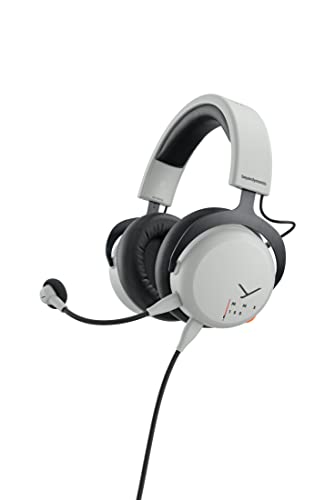
beyerdynamic MMX 150 Closed Over-Ear Gaming Headset — Best wired gaming headset
The MMX 150 is where this maker’s studio discipline walks into the gaming room and behaves itself. Its listing title names a closed over-ear gaming headset in grey, with an augmented mode, a META Voice microphone, and excellent sound for all gaming devices. The microphone is the headline a gaming buyer should read first: META Voice is engineered for the intelligibility of a human voice under excitement, rejecting the room so that teammates hear the call-out rather than the household behind it.
Augmented mode is the feature players did not know they needed until a delivery driver rang mid-match. It admits ambient sound on demand, so the real room — partner, child, doorbell — re-enters without the headset leaving your head. Combined with the closed design’s isolation the rest of the time, it resolves gaming’s oldest domestic tension in a single control. The wired connection keeps latency at zero and compatibility universal across the devices the title promises.
Judge it within its family. It will not mix a record like the 990 Pro X, and it is not trying to; it will carry a voice through a five-hour session with a clarity the studio models cannot offer at any price, because they have no microphone to offer it with. Players who also produce should own both conversations separately, as this guide’s structure keeps insisting.
- Microphone: META Voice microphone, per the listing title
- Ambient feature: Augmented mode, per the listing title
- Design: Closed over-ear gaming headset, per the listing title
- Compatibility: All gaming devices, per the listing title
- Colour: Grey, per the listing title
Strengths
- Voice clarity engineered for team communication under excitement.
- Augmented mode keeps the real room reachable mid-session.
- Studio-bred drivers give games a better class of sound.
Trade-offs
- Wired connection ties the player to the desk or controller.
- Closed design runs warm across marathon sessions.
- Not a mixing tool, whatever the badge’s studio heritage.
Best for: Team players and streamers who want wired reliability and a serious microphone.
Not suited for: Listeners seeking an open-back music reference, who belong two picks up.

beyerdynamic MMX 130 Wireless Open-Back Gaming Headset — Best wireless gaming headset
The MMX 130 Wireless is the boldest specification in this guide, and its listing title earns the claim: open-back design, Bluetooth 6.0, a low-latency dongle under 30 ms, an 80-hour replaceable battery, a detachable META Voice microphone, and a weight of 265 g. Read those as answers to wireless gaming’s four standing objections. Lag, answered by the dongle. Battery anxiety, answered by eighty hours. Battery mortality, answered by replaceability — a rare and honourable word in wireless audio. And the muffled, closed-in feel of gaming headsets, answered by going open-back, so the game world stages widely and the real room never fully disappears.
The detachable microphone deserves emphasis, because it converts the headset into a respectable wireless headphone for music and calls when the boom comes off — the one pick in this guide that can honestly moonlight across families. At 265 g it also respects the long session, sitting lightly through the hours when heavier flagships start negotiating with your neck.
The open back cuts both ways in a gaming room: a household will hear your session’s soundtrack, and a loud household will enter your quiet scenes. Players in shared, noisy homes should take the closed MMX 150 instead. Players with a room of their own get the most liberated gaming audio this maker currently sells, with a battery philosophy the whole industry should be embarrassed not to share.
- Design: Open-back wireless gaming headset, per the listing title
- Wireless: Bluetooth 6.0, per the listing title
- Latency: Under 30 ms low-latency dongle, per the listing title
- Battery: 80-hour replaceable battery, per the listing title
- Weight: 265 g, per the listing title
Strengths
- Replaceable 80-hour battery solves wireless gaming’s mortality problem.
- Low-latency dongle keeps competitive play honest.
- Detachable microphone lets it moonlight as a wireless headphone.
Trade-offs
- Open back leaks sound to and from a shared room.
- Newest platform, so long-term folklore is still being written.
- Premium positioning within the gaming family.
Best for: Wireless players with a room of their own who hate charging and love staging.
Not suited for: Players in noisy shared spaces who need closed-back isolation to concentrate.

beyerdynamic DT 108 Single-Ear Headset with Microphone — Best for broadcast commentary
The DT 108 is the guide’s specialist instrument, and its listing title is a professional’s shorthand: single-ear headset, dynamic hypercardioid microphone, 400 Ohms, black. Single-ear, because a commentator, a camera operator, or a stage manager must hear the venue with one ear and the production talkback with the other — a requirement no stereo headphone can meet. Hypercardioid, because that microphone must reject a stadium’s worth of surrounding noise while accepting one voice at close range. And 400 Ohms, because this headset plugs into professional intercom and broadcast systems whose standards were set long before USB existed.
Nothing about the DT 108 courts the home buyer, and that is its integrity. It is built to be issued by a production company, worn by whoever is on shift, repaired when it breaks, and issued again — the same service philosophy as the studio classics, pushed to its industrial conclusion. Broadcasters have kept this pattern in service for decades because the job it does has never changed, and a tool matched exactly to an unchanging job becomes infrastructure.
Home users should buy it only if their work genuinely is that job: commentary, production communication, or intercom-driven environments with the matching connectors and drive. Everyone else should admire it the way one admires a lighthouse lamp — as the correct answer to a question they do not have — and return to the five picks above, one of which is certainly the answer to theirs.
- Design: Single-ear headset, per the listing title
- Microphone: Dynamic hypercardioid microphone, per the listing title
- Impedance: 400 Ohms, per the listing title
- Colour: Black, per the listing title
- Intended systems: Professional broadcast and intercom chains — confirm connectors in the maker’s documentation
Strengths
- The exact tool for commentary and production talkback work.
- Hypercardioid rejection thrives in genuinely loud venues.
- Industrial serviceability measured in decades.
Trade-offs
- Single-ear listening is wrong for music by definition.
- Professional impedance and connectors exclude casual setups.
- Utilitarian in every dimension a consumer would judge.
Best for: Commentators, production crews, and intercom professionals who need one ear on the room.
Not suited for: Any form of home listening, gaming, or music enjoyment whatsoever.
How Do the Six Picks Compare Across the Three Families?
| Pick | Family | Microphone | Signature trait |
|---|---|---|---|
| DT 770 Pro (80 Ohm) | Studio, closed | None | The tracking standard, velour comfort |
| DT 770 Pro X (48 Ohm) | Studio, closed | None | No-amp drive, detachable cable |
| DT 990 Pro X (48 Ohm) | Studio, open | None | Wide natural mix reference |
| MMX 150 | Gaming, wired | META Voice | Augmented mode for room awareness |
| MMX 130 Wireless | Gaming, wireless | Detachable META Voice | 80-hour replaceable battery |
| DT 108 | Broadcast | Dynamic hypercardioid | Single-ear professional talkback |
The microphone column once again does the sorting. Three picks speak, three only listen, and the single-ear specialist speaks to a production rather than to a public. Start from your column and the row selects itself. Then check the family column against your room one final time, because every disappointment this guide has catalogued — bleed, leakage, a missing boom discovered live — was a family chosen in haste and a room considered too late.
How Do You Choose Between the Closed and Open Studio Models?
Interrogate your room and your microphone, in that order. If a live microphone ever shares your sessions — vocals, podcasting, streaming with a separate mic — the closed models are the only candidates, because open-back bleed into a recording cannot be edited out by any software yet sold. If your room contains other people living their lives, closed is again the answer, for their sake as much as yours. The open 990 Pro X requires a room that is yours and a session with no microphone open, and in exchange for those conditions it gives the most natural presentation in the guide. Run the interrogation at the hour you actually work, too, because a room that is a library at midnight may be a thoroughfare at six in the evening, and the headphone must fit the room as it is during your sessions rather than as it is in your imagination.
Then interrogate your source. A laptop-only buyer should let the Pro X generation’s 48 Ohm ease settle the matter within whichever architecture survives the room test. A buyer with a proper interface or amplifier may let taste and price arbitrate between classic and X, knowing both will be driven honestly. What no buyer should do is choose by silhouette, because the two architectures look like siblings and behave like opposites. Photographs will not save you here; the closed and open models share a face, and only the room — its microphones, its other occupants, its noise — can tell you which of the twins belongs in it.
Where Do Buyers Most Often Go Wrong in This Catalogue?
The classic error is buying the DT 990’s open back for tracking and discovering bleed on the first vocal take. The second is buying a studio model for voice chat and discovering, mid-game, that fame is not a microphone. The third is feeding the classic line from a phone and judging the maker by the mismatch — the listing titles disclose drive requirements with unusual honesty, and ignoring them is a choice, not a misfortune.
Fourth, gamers overlook the MMX 130’s replaceable battery when comparing prices, pricing it against sealed rivals whose clocks run out permanently. Fifth, home buyers romanticise the DT 108’s professional aura into a purchase their setup cannot even plug in. Sixth, listeners forget that velour pads are consumables: a tired pair of pads on a classic DT model quietly rewrites its sound, and fresh pads are the cheapest restoration in this entire guide’s universe. The audiophile context for that pad-and-chain discipline is laid out in our survey of best audiophile headsets, where the same German classics anchor the wired end of the argument. A seventh mistake completes the set: buying any model in this family as a fashion object, in a colour or a collaboration, when the entire value of the house lies in tools that outlast fashion — the grey, the black, and the decades are the aesthetic, and they have never once apologised for it.
Final Recommendation
Pick your family and the rest is refinement. Studio buyers with a live microphone or a shared room take a 770 — the Pro X if your sources are modern and your cables must detach, the classic if your chain is proper and your budget prefers history. Studio buyers with a quiet room and no open mic take the 990 Pro X and its wide, honest stage. Players take the MMX 150 for wired certainty or the MMX 130 Wireless for freedom with a battery that can be replaced rather than mourned. Producers and commentators already know the DT 108 is theirs. Whichever you choose, register the pads as consumables, keep a spare cable where the design allows, and expect the relationship to run for years — because the deepest compliment this maker’s owners pay is also the simplest: they stop reading guides like this one, put the headset on, and get back to the session.
Why Does This Maker’s Service Culture Change the Purchase Maths?
Most headphone purchases are wagers on a sealed object: when the pads flatten, the cable frays, or the battery fades, the wager ends. Beyerdynamic’s catalogue is built on the opposite premise — that a headphone is an assembly of replaceable parts riding on a durable core. Pads unclip, cables unplug on the modern models, headbands and sliders appear in parts lists, and the MMX 130 extends the philosophy to the one component the wireless industry prefers to seal away: the battery itself. A buyer comparing prices across brands should compare lifespans too, because a headset that can be refreshed for the cost of pads at year four competes against rivals that must be replaced whole.
The long production runs compound the effect. A model that stays in the catalogue for decades accumulates compatible parts, third-party knowledge, and a used market where a buyer can enter cheaply and maintain confidently. The DT 770 Pro’s ubiquity is partly this flywheel made visible: studios buy it because parts exist, and parts exist because studios buy it. New models like the Pro X pair borrow against that flywheel’s credibility, and the honest buyer notes both the borrowing and the collateral behind it.
Practically, the advice is simple. Budget a pad refresh into any pick here, keep the receipt and the model documentation where future-you can find them, and treat the maker’s parts catalogue as part of the product you bought — because in every way that matters to your wallet, it is.
How Should a Gaming Setup Be Built Around the MMX Models?
Start with the microphone’s environment, because voice quality is decided more by the room than by the capsule. A boom positioned at the corner of the mouth, a keyboard placed so its clatter sits behind the microphone’s rejection zone, and a chair that does not squeak into every call-out will lift either MMX model further than any software enhancement. Set the input level so your loudest laugh stays below distortion, then leave it alone; teammates forgive a quiet player and mute a clipping one.
Choose the connection philosophy by your play. The MMX 150’s wire is a feature wherever the desk is permanent: zero latency, zero charging, and a headset that is ready at the exact moment a friend appears online. The MMX 130’s dongle serves the same certainty wirelessly for players whose setup moves — couch to desk, console to PC — and its Bluetooth covers the phone-and-tablet hours in between. In both cases, enable the augmented or ambient awareness deliberately rather than discovering it mid-session, and decide in advance which sounds in your home are allowed to interrupt a match.
Finally, protect the long session. Take the headset off during loading screens and lobby waits, let the pads breathe, and keep a glass of water closer than the energy drinks; the best gaming headset in this guide cannot compensate for a player who has worn any headset, unbroken, for six hours. Comfort is a system, and the MMX line’s contribution is to make its half of that system forgettable.
How Does a Home Studio Actually Use the Studio Models Across a Week?
Walk the calendar. Monday is writing and rough mixes, where the 990 Pro X’s open stage helps a producer place parts in a virtual room and judge whether an arrangement breathes. Wednesday is vocals, and the room changes tools without changing brands: a closed 770 on the singer, the microphone hearing only the voice, the producer checking takes on the same sealed platform the singer heard. Friday is the mix check, back to the open model, then a deliberate pass on the closed one, because a mix that survives both presentations survives most of the world’s playback systems too.
That weekly rhythm is why studios so often own the pair rather than a winner. The closed and open models are not rivals competing for one hook on the wall; they are the two halves of a verification system, each exposing the other’s blind spots. A home producer building toward that system should buy the half their current work lacks — tracking first if recording is the bottleneck, open reference first if mixing is — and let the second half arrive when the work asks for it.
The Pro X generation slots into this rhythm by removing the amplifier from the shopping list, which for a laptop studio collapses the whole system into two headphones and a chair. The classic line slots in wherever an interface already lives. Either way, the family’s consistency means the ears trained on Monday are the same ears that judge on Friday, and that consistency is worth more than any single model’s specification sheet.
Should You Buy the Classic Studio Models Used?
Few headphones reward the used market like the DT classics, because their failure points are visible, replaceable, and cheap. Inspect a used example as a parts list: pads first, since a compressed set rewrites the sound and a fresh set restores it; cable second, at the connector and along its length; headband and yokes third, for the cracks that announce a dropped life. Play a bass-heavy test track at honest volume and listen for rattle, the one symptom that suggests driver damage rather than consumable wear. A used 770 that passes those checks and receives fresh pads is, functionally, most of a new one.
The newer models shift the calculus. Pro X detachable cables make their used examples even safer bets, while the MMX 130’s battery, though replaceable, should be priced as a future part rather than assumed immortal. The DT 108 trades in a professional niche where condition reports and system compatibility matter more than cosmetics; buy it from production suppliers who can state its connector and history plainly.
In every case the maker’s parts ecosystem is the used buyer’s insurance policy, and it is the deepest reason this family’s classics hold their value while lesser headphones become disposable. Buy the wear you can replace, avoid the damage you cannot, and the second-hand route becomes the connoisseur’s route rather than the gambler’s.
How Do You Care for Velour, Cables, and Booms Across Years?
Velour pads ask for the gentlest regime in this guide: a soft brush to lift dust, an occasional careful wash only where the maker permits it, and replacement the moment the pile stops springing back, because a flat velour pad changes both the seal and the sound it was tuned around. Store any of these headphones on a stand that leaves the pads uncompressed, and keep the studio models away from the two atmospheres that age them fastest — kitchen grease and workshop dust.
Cables live or die at their connectors. Coil loosely, unplug by the housing rather than the cord, and let the detachable designs do their safety work when a chair rolls over a run of cable. On the MMX models, treat the boom as a hinge with a memory: move it by its base, park it in its resting position rather than wherever the last game left it, and check the windscreen’s condition whenever callers start describing your voice as distant, since a clogged screen muffles more microphones than electronics ever fail.
None of this exceeds a few minutes a month, and all of it is the difference between the decade-long ownership this maker designs for and the two-year churn its sealed rivals assume. The ritual is the product, in the end: buy the serviceable thing, service it lightly and regularly, and let the years accumulate on the right side of the ledger.
Which Buyer Should Choose the Rival House or Another Category Entirely?
This maker’s virtues — serviceability, studio discipline, velour comfort — are real, and they are not everyone’s first need. Listeners who want a warmer, more forgiving everyday sound with the same closed-back practicality will find the Japanese rival’s benchmark tuned closer to their pleasure, and the two-household comparison is a taste decision, not a quality verdict. Listeners who want noise cancelling for travel should leave both studio houses entirely, because no passive seal in this guide competes with a modern cancelling flagship in an aircraft cabin, and pretending otherwise would waste the reader’s money on the wrong physics.
Gamers, similarly, should be honest about their platform’s centre of gravity. The MMX models reward players who value voice clarity and acoustic discipline; players who want surround processing gimmicks, RGB theatre, or console-specific licensing features will find their tribe elsewhere and should not be argued out of it. And the DT 108’s presence in this guide should tempt exactly nobody outside production work — its inclusion is a map of the family’s full territory, not an invitation.
What remains, after those honest exits, is the core constituency this maker has served for generations: people who record, mix, commentate, and play with their voices, and who expect the tool on their head to be repairable long after its fashion has passed. For that constituency, the six picks above are not a shortlist so much as a family portrait, and the only wrong choice is the one made by badge instead of by job.
What Should You Verify in the First Month With Any Pick Here?
Run the job, not the demo. Track a real vocal if you bought a closed model, and check the recording for bleed at your true listening level rather than a polite one. Mix a real song if you bought the open model, then play that mix in a car and on a phone, because a reference headphone’s promise is translation and translation is only ever proven elsewhere. Play a week of real matches if you bought an MMX, and ask your most honest teammate — not the polite one — how your voice actually sounds at the end of a long session.
Verify the ownership details while they are still free to change. Confirm the pad part number for your model and file it. Test the detachable cable’s spare availability if your model has one. On the wireless pick, run the battery through one full cycle so its real rhythm in your hands replaces the headline figure in your head. Small verifications, done in the first month, are what separate the owners who describe these headphones as infrastructure from the owners who describe them as purchases.
And keep the box until the month closes. Not from indecision, but from method: a tool judged against its real job, in its real room, with its real consumables identified, has been bought properly — and a tool that fails that honest month should go back while going back is easy, to be replaced by the sibling in this same family whose job description fits better.
How Do the Studio Models Handle Glasses and Long Sessions?
The velour pad is this family’s quiet gift to spectacle wearers. Where a leatherette cushion presses a temple arm along a firm edge, velour distributes the contact over a softer, more forgiving surface, and the moderate clamps of the DT line avoid the vice grip that turns the second hour into a countdown. The seal still breaks where the arm crosses — physics is not negotiated away by fabric — but the closed models’ isolation has margin to spare, and the open model never depended on a seal in the first place. Pilots and producers alike will recognise the trade from the aviation fit discussion: comfort over hours is a system of small mercies, and velour is one of the reliable ones.
Heat is the remaining long-session tax on the closed models, and the honest mitigations are behavioural: lift a cup during breaks, let the pads air between sessions, and keep a second pair of pads in rotation during marathon weeks so each set recovers its loft. The open 990 Pro X largely escapes the tax by design, which is one more reason mixing engineers gravitate to it for the long judgement sessions and reserve the closed models for the shorter, louder work of tracking.
A final note on the family’s oldest member in spirit, the broadcast single-ear design, because its survival teaches the guide’s whole lesson in miniature. The DT 108 has outlived entire categories of fashionable audio not by adapting to them but by fitting one unchanging job so exactly that the job itself protects it. Every pick in this guide will be happiest in the hands of a buyer who chose it the same way — by the job, in the room, with the chain it will actually meet — and that discipline, more than any impedance figure or microphone pattern, is what this maker’s century of production keeps trying to teach its customers.
One habit protects every purchase in this guide: write down, on the day the headset arrives, the job you bought it for and the two sounds by which you will judge it — a vocal take, a familiar mix, a teammate’s voice at midnight. Tools this long-lived drift into other jobs by accident, and a headset judged forever against a job it was never bought for will always seem to fall short. Judged against its own job, honestly and on schedule, each of these six has been satisfying professionals for exactly as long as its design has existed, which is the only track record that has ever mattered in a working room.
Frequently Asked Questions
Does the DT 770 Pro have a microphone?
No. The DT 770 Pro and its Pro X sibling are studio monitor headphones for listening, tracking, and mixing. The beyerdynamic products with microphones in this guide are the MMX gaming headsets and the DT 108 broadcast headset. The assumption is understandable — podcasters are photographed in 770s constantly — but in those photographs the microphone is a separate object on a stand in front of them, and a buyer who needs that voice path integrated should start at the MMX sections rather than at the studio classics, however iconic the silhouette has become.
Which should I buy, the DT 770 Pro or the DT 770 Pro X?
Buy the Pro X if you listen mainly from a laptop or phone and value a detachable cable; its 48 Ohm design needs no amplifier. Buy the classic if you already own a good interface or amp, prefer its price and long track record, and accept the fixed 3m cable. If the decision still stalls, let the cable arbitrate: a buyer who has already lost one headphone to a frayed cord should not buy another fixed-cable design out of nostalgia, while a buyer whose classic would live its whole life plugged into one interface can take the older model’s savings with a completely clear conscience.
Can I use the DT 990 Pro X for recording vocals?
Not while the singer wears it near the microphone — its open back leaks the backing track into the recording. Use a closed model for tracking and keep the 990 Pro X for mixing and listening, which is the division of labour the family was designed around. The leak is not subtle or fixable in software; it prints the click and the backing into the vocal take at low level, where it survives every edit and announces itself in the quietest moment of the finished song, which is why studios treat the closed-versus-open rule as a law rather than a preference.
Is the MMX 130’s battery really replaceable?
Yes — its listing title states an 80-hour replaceable battery, which is rare in wireless headsets and the strongest longevity signal in the gaming category. Confirm the replacement procedure and part availability in the maker’s documentation when you buy. The figure matters beyond convenience: an 80-hour cell is charged perhaps monthly in ordinary play, and charge cycles, not calendar years, are what age a battery — so the combination of a large cell and a replaceable design attacks wireless mortality from both directions at once, which is more than any rival philosophy in this guide’s gaming family currently attempts.
What is the DT 108 actually for?
Professional commentary and production communication, where one ear must hear the venue and the other the talkback feed. Its 400 Ohm impedance and broadcast connectors assume professional intercom systems; it is not a consumer listening product. Think of the camera operator tracking a play while a director speaks, the stage manager calling cues over a show’s roar, or the commentator who must hear the crowd’s reaction as part of the story being told — in each case the free ear is not a missing feature but the entire point of the instrument.
Do beyerdynamic pads and parts stay available?
Serviceability is this maker’s signature: pads, cables, and many components are sold as parts, and long production runs keep knowledge and stock deep. That ecosystem is a material part of what any pick in this guide costs and returns over its life. Owners should still buy the first spare set of pads while the model is current rather than trusting the catalogue’s memory a decade later — even the best parts culture rewards the buyer who treats the first refresh as part of the original purchase and stores the spares with the headphone’s documentation.
Related Guides
Readers deciding between this house and its Japanese rival will find the mirror argument in the Audio-Technica guide linked in spirit throughout this batch — and the open-versus-closed debate continued in the audiophile survey linked above, where the 990’s philosophy meets its warmest competition. Read both houses’ guides before buying either house’s flagship; the rivalry has run for decades precisely because both answers are right for somebody, and the only expensive mistake available is choosing a side without ever hearing the other’s argument stated fairly.



[…] German rival whose studio line competes model-for-model with the M-series is mapped in our guide to best beyerdynamic headsets, and readers torn between the two houses should read both before […]