What's inside
- Key Takeaways
- Quick Picks
- How did we choose these six magnetic chargers?
- What is the difference between MagSafe, Qi2 and a plain magnetic ring?
- How do the six magnetic chargers compare side by side?
- Do you need a magnetic case, and which phones snap on without one?
- How do you set up a magnetic charging spot that works every night?
- What mistakes do buyers make with magnetic chargers?
- How does heat behave on a magnetic pad, and should it change how you charge?
- Final Recommendation
- Frequently Asked Questions
- Related Guides
As an Amazon Associate I earn from qualifying purchases. This post may contain affiliate links at no extra cost to you.
widgetverdict.com is reader-supported. When you buy through links on our site, we may earn an affiliate commission.
Where to buy: the six magnetic pads, stands and two-packs below all link to checked Amazon listings, and two of them are sold as pairs, which each section states before it praises anything else.
The best magnetic chargers solve an alignment problem that ordinary wireless charging never admitted it had. A plain charging pad asks you to place a phone on an invisible sweet spot, and a phone set down a few millimetres off that spot charges slowly, warms up, or quietly stops while its owner sleeps through the evidence. Magnets fix the geometry: the phone snaps into the one position where the coils line up, every time, in the dark, with one hand. That small click is the entire appeal, and it is a real one. But the word magnetic on a listing covers two very different technologies, and confusing them is the most expensive mistake in this category. On one side sits the Apple MagSafe ecosystem and the newer Qi2 standard, where the magnetic ring is part of a charging specification that pairs alignment with a negotiated faster charge. On the other side sits a plain magnetic ring added to an ordinary wireless pad, which holds an Android phone in place perfectly well but charges it at whatever pace the underlying pad and phone agree on, magnets or no magnets. The ring aligns; it does not accelerate. Everything in this guide is organised around that distinction.
The six picks divide along it honestly. Four are pads built around the iPhone and its MagSafe ring, one of them a stand with a small light for the bedside. One is aimed squarely at Samsung Galaxy and Google Pixel owners, sold as a two-pack. One claims a higher headline wattage across both phone families at once. Cable length turns out to matter more than the marketing suggests — most of these pads carry a six-foot lead, which is the difference between a pad that lives where you sit and a pad that lives where the socket happens to be. Read with your own phone in mind, and with one question answered before you start: does your phone carry a magnetic charging standard of its own, or would it be relying on a case and a ring to pretend? The answer decides which half of this guide is actually addressed to you.
One more piece of honesty before the picks. The wattage figures in these titles — 15W on most, a higher figure on one — are manufacturer-stated numbers that describe what the pad can deliver to a phone able to accept it, under the conditions the maker assumes. A phone that negotiates a lower rate charges at the lower rate, and no pad can argue it upward. Where a listing title does not name the underlying charging standard at all, the pick sections say so rather than dressing a plain magnetic pad in borrowed certification language.
Key Takeaways
- Magnetic alignment and magnetic fast charging are different things: a ring can hold a phone in place without the phone and pad sharing a fast-charge standard.
- MagSafe iPhones snap on natively; most Android phones need a magnetic case, and then charge at the pace their own wireless standard allows.
- Four picks here are iPhone-centred pads, one is a Galaxy and Pixel two-pack, and one stand adds a sleep-friendly light for bedside use.
- Most pads in this guide carry a six-foot cable, long enough to reach a sofa arm or a bedside table from a low socket.
- Headline wattage is a manufacturer figure tied to a compatible phone; it is a ceiling, not a promise to every handset.
- Two picks are two-packs, so compare them per pad and per room, not per box.
Quick Picks
| Pick | Badge | Why it earns its place |
|---|---|---|
| Magnetic Wireless Charger Pad 6FT (2-Pack) | The iPhone pair | Two six-foot MagSafe-style pads in one box, one for the bedside and one for the desk. |
| MFi Certified Magnetic Wireless iPhone Charger 15W | The certified single | An MFi certified 15W pad with a six-foot cable for buyers who want the credential in the title. |
| Magnetic Wireless Charger for Samsung Galaxy (2-Pack) | The Android pair | Two 15W magnetic pads written for Galaxy and Pixel phones, with the magnet strength called out. |
| Magnetic Wireless Charger Stand 15W | The bedside stand | A 15W stand that props the phone upright and adds a sleep-friendly light and an AirPods spot. |
| Magnetic Wireless Phone Charger 25W (2-Pack) | The high-headline pair | Two pads claiming a 25W ceiling across Galaxy, iPhone and Pixel families alike. |
| Magnetic Wireless Charger Fast Charging Pad | The dual-port pad | A MagSafe-style pad whose title adds dual charging ports to the usual snap-on arrangement. |
How did we choose these six magnetic chargers?
Every pick had to be magnetic in its actual design — a pad or stand the phone attaches to — rather than a plain wireless pad with the word added for search traffic. Beyond that entry ticket, the guide deliberately spans the category’s real divisions: iPhone-first pads against an Android-first pack, singles against two-packs, a flat pad against a stand, and a certified listing against uncertified ones, because readers arrive at this keyword from both phone ecosystems and with very different levels of concern about credentials. The sections keep each listing’s claims at the strength its own title supports. Where a title says MFi certified, the section discusses certification. Where a title says only that a magnet is strong, the section discusses holding power and declines to invent a charging standard behind it.
That discipline produces an uneven-looking guide on purpose. Some picks can be described in the language of standards and negotiated wattage; others can only honestly be described as well-aligned pads whose charging pace depends on the phone placed on them. Presenting both kinds in the same vocabulary would flatter the second kind and mislead its buyers, so the vocabulary changes where the evidence changes, and the comparison table at the end keeps the distinction visible in a single column.
What is the difference between MagSafe, Qi2 and a plain magnetic ring?
Start with the oldest layer. Wireless charging itself runs on induction: a coil in the pad creates a field, a coil in the phone harvests it, and the two coils work efficiently only when they sit closely aligned. The Qi standard governs that conversation, and for years it had no opinion about magnets at all, which is why early wireless charging involved so much nudging, checking and waking to a phone that had charged to a disappointing fraction overnight. Magnets entered as a positioning aid and then became something more interesting.
MagSafe, on the iPhone side, is Apple’s system in which a ring of magnets in the phone and a matching ring in the accessory guarantee alignment, while the charging itself is specified to deliver up to the rates Apple publishes for compatible phones and pads. The important idea is that the magnet ring and the charging specification travel together: snap an iPhone onto a proper MagSafe pad and the alignment and the negotiated charge arrive as one designed behaviour. Qi2 is the industry standard that grew from the same insight, adding a magnetic power profile to the Qi specification so that phones and chargers from different makers can share the alignment-plus-negotiation behaviour rather than each inventing a private version. A phone built with Qi2 carries the ring natively; a pad built to Qi2 speaks the matching protocol.
The third thing wearing the same vocabulary is neither of those. It is an ordinary wireless pad, charging at standard Qi behaviour, fitted with a ring of magnets strong enough to hold a phone — usually an Android phone wearing a magnetic case, since most Android handsets carry no ring of their own. The holding is genuinely useful. A phone that cannot slide off the sweet spot charges more consistently than one resting loose, and consistency is worth having. But the negotiation behind the glass is unchanged: the phone charges at the pace its own wireless hardware allows, the magnet contributes nothing to the wattage, and a buyer who reads magnetic as a speed claim will be disappointed by physics that never promised otherwise. None of this makes ring-only pads bad products. It makes them alignment products, to be bought for alignment, priced as alignment, and praised — as several sections below praise them — for exactly that.
A practical test follows from all of this. Before buying any magnetic charger, establish which of the three things your phone is. An iPhone of the generations these titles list carries MagSafe natively and needs no case to snap on. An Android phone with built-in Qi2 likewise carries its ring. Everything else is in case territory: the magnetic case supplies the ring, the phone supplies whatever charging pace it has, and the pad’s job narrows to holding the assembly steady and feeding it honestly. Buyers who run that test first rarely regret a purchase in this category; buyers who skip it are the ones writing puzzled reviews about magnets that held beautifully and charged ordinarily.

Magnetic Wireless Charger Pad 6FT (2-Pack) — The iPhone pair
- Pack contents: two pads in one box — this is a 2-pack (per listing title)
- Cable: 6FT lead on the pads (per listing title)
- Intended phones: iPhone generations from the 12 through the 16 Pro Max, per the title’s own list
- Also named in the title: AirPods models, charged on the same pad
- Charging standard wording: the title says MagSafe; a Qi2 designation does not appear in the listing title, so check the full listing if that specific standard matters to you
The defining fact of this pick is arithmetic: two pads, each on a six-foot cable, in a single box. Magnetic charging creates location habits — the phone snaps onto the bedside pad at night and the desk pad during work — and a two-pack furnishes both locations at once with matched hardware, instead of the common pattern where one good pad is bought, loved, and then endlessly carried between rooms until the convenience that justified it has been carried away too. Six feet of cable per pad is the quiet enabler here. Bedsides and desks rarely sit beside their sockets, and a pad that reaches the place a person actually sets a phone down is a pad that gets used at full alignment rather than stretched into a compromise position.
The title addresses iPhone owners directly, listing the generations from the 12 onward that carry the MagSafe ring natively, and adds AirPods as secondary citizens of the same pad. That second role is worth taking seriously: earbuds cases charge wirelessly at modest rates and are even harder to align by eye than phones, so a magnetic pad that centres them earns a nightly second job. A household pad that serves the phone at speed and the earbuds whenever they land on it covers most of what a bedside surface is asked to do.
The honest limits sit where this guide’s introduction said they would. The title speaks the MagSafe language and lists Apple’s phones, and Android owners should read it as addressed elsewhere — a Galaxy phone in a magnetic case would be held by the ring but is not the guest this listing invited. Nor does the title attach a certification claim of the kind the next pick carries, so buyers for whom that paperwork matters have their comparison laid out cleanly within this very guide. Judged on its own terms — two long-cabled pads for an iPhone household’s two favourite surfaces — it is the straightforward centre of the category.
Strengths
- Two pads furnish the bedside and the desk in one purchase, matched.
- Six-foot cables reach real furniture positions instead of hugging the socket.
- AirPods named in the title give the pad a second nightly job.
Trade-offs
- Written for iPhones; Android households are better served by the Galaxy pick below.
- No certification claim appears in the title for buyers who shop by credentials.
- Flat pads only — no upright viewing angle for video calls or a clock display.
Best for: an iPhone household furnishing two charging spots at once, bedside and desk. Not suited for: Android phones as the primary device, or a bedside where an upright stand is wanted.
Count your household’s snap-on spots before ordering this listing; if the honest count is two, the pair format is the whole argument, and it holds up.
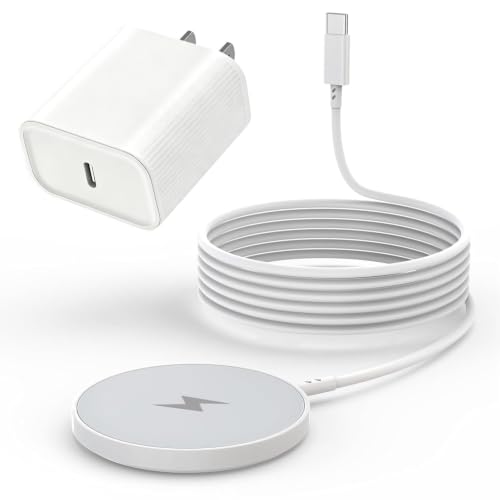
MFi Certified Magnetic Wireless iPhone Charger 15W — The certified single
- Certification: Apple MFi Certified, stated at the front of the listing title
- Output: 15W, manufacturer-stated in the title
- Cable: 6FT lead (per listing title)
- Intended phones: iPhone generations from the 12 through the 17 series named in the title, plus AirPods
- Underlying standard beyond the title’s wording: the listing title does not use the term Qi2, so confirm the detail on the listing page if your buying decision turns on it
This pick’s first three words do its selling: Apple MFi Certified. The MFi programme is Apple’s licensing scheme for accessories, and a maker who puts the certification in the title is inviting a particular kind of buyer — the one who has been burned by a bargain pad that charged erratically, showed warnings on the phone, or aged badly, and who has decided that the credential is worth shopping for explicitly. Whether that peace of mind should outrank a second pad or a lower commitment is a genuine judgement call, and this guide’s role is narrower: to note that among six listings, this is the one that leads with the paperwork, and that its remaining specification is entirely respectable — 15W as the stated ceiling, a six-foot cable, and a phone list that runs to the newest iPhone generations its title names.
Fifteen watts deserves its own sentence of calibration. It is the figure the title claims for compatible iPhones, and it represents the brisk end of what magnetic pads of this generation promise — the overnight charge becomes a couple of hours, and the desk top-up during a working morning becomes meaningful rather than symbolic. It remains, like every number in this category, a ceiling negotiated with the phone: an older or warmer phone will take less, and the pad cannot be argued with. Buyers arriving from the world of wired fast charging should also set expectations correctly, because even a well-aligned magnetic pad trades a little efficiency for its convenience, and the cable in the drawer will still win a pure race.
As a single pad, this pick asks to be placed deliberately rather than multiplied. It suits the one spot where charging behaviour matters most — the main bedside, the primary desk — with the two-packs in this guide furnishing the secondary spots around it. That division of labour, certified pad at the centre and simpler pads at the edges, is how many careful households actually end up arranged, and this listing is built to be the centre.
Strengths
- MFi certification stated in the title, for buyers who shop by credential.
- 15W stated ceiling with a generous six-foot cable.
- Phone list in the title runs to the newest iPhone generations named.
Trade-offs
- A single pad, so a two-spot household buys twice or mixes picks.
- iPhone-only in its stated intent; Android owners get no promises here.
- The title does not use the term Qi2, which some comparison shoppers specifically hunt for.
Best for: an iPhone owner who wants one certified pad at the main charging spot. Not suited for: a mixed Android household, or furnishing several rooms from one box.
Open this listing if the certification is the first thing you look for on any accessory; this is the one pick in the guide that was clearly written for you.

Magnetic Wireless Charger for Samsung Galaxy (2-Pack) — The Android pair
- Pack contents: two pads in one box — this is a 2-pack (per listing title)
- Output: 15W, manufacturer-stated in the title
- Cable: 6FT leads (per listing title)
- Intended phones: Galaxy S and Z series and Google Pixel models, as listed in the title
- Magnet claim in the title: strong magnet; whether your specific phone needs a magnetic case to use it is a detail the listing title leaves open, so check the listing against your handset and case before ordering
Here is the guide’s Android address, and it is written in the right order: the phones first, the magnet second, the wattage as a stated figure rather than a spell. Two pads with six-foot cables, aimed at the Galaxy S and Z families and at Google’s Pixel line, with the title’s own emphasis falling on magnet strength. That emphasis is the honest centre of the Android magnetic experience. Most of the handsets named carry no magnetic ring of their own, which means the snap that iPhone owners take for granted arrives — when it arrives — through a magnetic case, and the pad’s ring and the case’s ring must hold the combined assembly steady through the night, the nudge of a bedside table, and the vibration of an alarm. A maker who leads with holding power understands the assignment.
The charging side needs the introduction’s distinction kept firmly in view. Fifteen watts is the title’s figure, and for the Galaxy and Pixel phones whose own wireless charging supports brisk rates, a well-aligned pad is how that rate gets delivered consistently instead of occasionally. For any handset whose wireless pace is more modest, the pad delivers the modest pace — reliably, nightly, without the misalignment losses that plague loose placement, which is itself a real improvement worth paying for. What the magnet cannot do is promote a phone into a faster class than its hardware occupies, and this section declines to pretend otherwise on the listing’s behalf.
The two-pack format suits the Android household’s geography exactly as the iPhone pair suits its own: bedside and desk, or two bedsides in a couple’s shared house where both phones are Galaxies. Matched pads also simplify the case question — one magnetic case standard, learned once, working in both rooms. Buyers should settle that case question before the pads arrive, since the entire snap-on experience depends on it, and the listing’s photographs and detail page are the place to confirm how the maker expects your specific handset to attach.
Strengths
- Written for Galaxy and Pixel owners rather than adapted from an iPhone listing.
- Strong-magnet emphasis matches the real Android need: holding through a case.
- Two long-cabled pads cover the household’s two main spots.
Trade-offs
- Most named handsets need a magnetic case for the snap, an extra purchase to plan.
- Charging pace remains whatever each phone’s own wireless hardware allows.
- No certification language appears in the title for credential-led shoppers.
Best for: a Galaxy or Pixel household with magnetic cases, furnishing two spots. Not suited for: caseless Android phones expecting a native snap, or iPhone owners, who are better served above.
Settle your case situation first, then read this listing; with the right cases in the house, the pair’s strong-ring pitch makes complete sense.

Magnetic Wireless Charger Stand 15W — The bedside stand
- Form: stand, holding the phone upright rather than flat (per listing title)
- Output: 15W, manufacturer-stated in the title
- Intended phones: iPhone generations from the 12 through the newest series the title names
- Extra in the title: a sleep-friendly light, and charging for AirPods at the same station
- Cable length: the listing title is silent on lead length, so measure your bedside run and confirm the figure on the listing page before ordering
Every other pick in this guide lays the phone down; this one stands it up, and that single ergonomic decision reorganises the bedside. An upright phone is a clock, an alarm face, a video-call screen and a glanceable notification surface, where a flat phone is a slab that must be lifted to be read. For the large population whose phone serves as the alarm clock — and whose mornings begin with reaching toward it half awake — a stand that holds the phone at reading angle while it charges is not a styling preference but the difference between a charging spot that cooperates with the routine and one that merely stores the phone overnight. The magnetic attachment matters doubly here, because a stand asks its ring to hold the phone against gravity all night rather than merely centring it on a surface, and a phone found on the floor at dawn is the failure mode this design must avoid.
The title adds a sleep-friendly light, a small phrase that signals the maker has thought about where stands actually live. Bedside electronics fail socially when they glow: a bright charging indicator can be the most luminous object in a dark room. A light designed to be gentle about its presence — and a station that also charges AirPods, per the title — describes a product aimed at the whole nightstand ecosystem rather than at the phone alone. The 15W stated ceiling matches the guide’s other iPhone pads, so the stand asks no charging compromise for its posture; the phone charges at the category’s normal brisk pace while also serving as the room’s clock.
Its boundaries are the stand’s own geometry. A stand occupies a fixed footprint and a fixed angle, travels badly compared with a flat pad that slips into a bag, and commits its owner to landscape-or-portrait habits the maker chose. It is also, per its title, an iPhone-addressed product. None of that dents its case for its intended post. Bedsides are stationary, angle-fixed places by nature, and a charger designed for the one spot where the phone spends every night standing guard is a charger designed with unusual honesty about actual behaviour.
Strengths
- Upright angle turns the charging phone into a usable clock and call screen.
- Sleep-friendly light shows bedside manners the flat pads do not need.
- AirPods charging at the same station clears a second device off the nightstand.
Trade-offs
- Fixed stand travels poorly; frequent travellers should take a flat pad instead.
- Cable length is not given in the title, so the bedside run needs checking.
- Addressed to iPhones in its title, like most stand designs in this category.
Best for: a bedside where the phone doubles as the alarm clock and nightstand display. Not suited for: a travel kit, or a desk where the phone must lie flat under a monitor.
If your phone already serves as your clock, judge this listing by your nightstand alone; it is the only pick designed from that furniture outward.

Magnetic Wireless Phone Charger 25W (2-Pack) — The high-headline pair
- Pack contents: two pads in one box — this is a 2-pack (per listing title)
- Output: 25W, manufacturer-stated in the title, the highest headline figure in this guide
- Intended phones: Galaxy, iPhone and Pixel families all named in one title
- Charging standard detail: the listing title states a wattage and the word MagSafe but does not spell out the conditions each phone family needs to reach that figure, so the full listing is required reading before expecting it
- Cable length: not given in the listing title; confirm it on the listing page if your sockets sit far from your furniture
This is the guide’s maximalist listing: two pads, three phone families, and a headline figure of 25W that stands above the 15W claims surrounding it. It deserves a careful, unexcited reading, because everything interesting about it lives in the gap between a ceiling and a typical night. A 25W figure describes what the pad can deliver to a phone equipped and configured to accept that much through magnetic charging — a class that, on the evidence of the titles in this guide alone, is narrower than the list of phones the title names. Galaxy, iPhone and Pixel handsets span several generations of wireless hardware between them, and each phone will negotiate its own rate with the pad and take what its design allows. Owners of the newest, fastest-charging handsets are the plausible beneficiaries of the higher ceiling; owners of older phones will charge at their familiar pace, held nicely in place while they do it.
Read that way — as headroom rather than as a promise — the pick has a real constituency. Households are mixed and getting more so: an iPhone and a Galaxy sharing one kitchen counter, a Pixel at the desk. A pair of pads that attaches magnetically to all of them, through the appropriate cases where cases are needed, and that carries enough ceiling for the fastest phone in the house, simplifies the family’s charging geography into one product bought once. The two-pack format doubles that simplification across two rooms. This is the pick for the reader who found the ecosystem-specific sections above too narrow and kept asking why one pad could not simply serve the whole house.
The cautions are the mirror of the pitch. A listing that promises broadly must be verified specifically: your phone’s exact model, its case, and the conditions attached to the headline figure all live in the listing detail rather than its title, and the ten minutes spent reading them is the price of the broad claim. Buyers whose household is single-ecosystem will generally be better served by the pad written for their phones alone, where the claims are narrower because the audience is. Breadth is this pick’s virtue and its homework, in equal measure.
Strengths
- Highest stated ceiling in the guide, as headroom for the newest handsets.
- One listing spans Galaxy, iPhone and Pixel for genuinely mixed households.
- Two pads cover two rooms with a single, uniform setup.
Trade-offs
- The 25W figure will not be reached by many of the phones the title names.
- Conditions behind the headline live in the listing detail, not the title.
- Cable length goes unstated in the title, an odd omission for a two-room pitch.
Best for: a mixed-ecosystem household wanting one pad type in two rooms, with a recent flagship phone. Not suited for: an older single-brand household expecting the headline wattage to apply to its phones.
Read this listing’s detail page with your exact phone model in hand; the headline is a ceiling, and your handset decides how close to it you will ever get.

Magnetic Wireless Charger Fast Charging Pad — The dual-port pad
- Form: flat magnetic pad in the MagSafe style (per listing title)
- Phones the title addresses: the iPhone line beginning with the 12 series and running to its newest entries, with AirPods models alongside
- Distinguishing claim in the title: dual charging ports
- Output figure: the listing title says fast charging without attaching a wattage number, so any buying decision based on speed needs the figure from the full listing
- Cable arrangement: bound up with the dual-port claim; the listing title does not describe the lead length, so verify the physical setup on the listing page
The last pick earns its place on a phrase none of the others carry: dual charging ports. The title does not elaborate, and this section will not elaborate on its behalf — but the phrase points at a flexibility the single-purpose pads lack, some arrangement by which the pad connects or is fed in more than one way, and for buyers whose sockets, cables and devices refuse to standardise, that kind of adaptability is often the difference between a charger that fits the house and one that fits the brochure. It is paired with the guide’s familiar iPhone address — the title lists the generations from the 12 onward and the AirPods line — and with the words fast charging standing where a number would normally sit.
That missing number is the section’s main duty to report. Every other pick in this guide states its ceiling in its title; this one asks the buyer to go and find it. There are innocent reasons a listing might be written that way, and the pad may perform perfectly respectably, but a guide that has spent its length insisting on the difference between ceilings and impressions cannot wave a numberless fast claim through. Treat this pick as a research task with a promising shape: open the listing, find the wattage, find what the dual ports actually are, and judge the answers against the fully specified rivals above. If the answers are good, the flexibility is a genuine differentiator in a category of lookalike discs. If the answers are vague, the guide has five other picks whose titles did the work for you.
Positioned honestly, then, this is the tinker’s pick — for the buyer who enjoys verifying a specification and whose charging corner involves enough cable variety that a dual-port arrangement solves a problem the rest of us do not have. It is also a useful reminder, placed deliberately at the end of the pick list, of how to read every listing in this category: the claims a title makes plainly can be compared, and the claims it leaves open must be chased. Magnets, at least, it certainly has.
Strengths
- Dual charging ports promise connection flexibility the other pads do not claim.
- Full iPhone generation range named in the title, with AirPods alongside.
- A flat pad’s simplicity for buyers whose setup the standard discs do not fit.
Trade-offs
- No wattage figure in the title, so speed cannot be compared without homework.
- The dual-port arrangement itself is unexplained in the title.
- Cable details are likewise absent from the title’s description.
Best for: a buyer with a varied cable setup who will verify the unspecified figures on the listing. Not suited for: a shopper who wants every specification settled by the title before clicking.
Approach this listing as a set of questions with a product attached; if its detail page answers them well, the dual-port idea earns its keep.
How do the six magnetic chargers compare side by side?
| Pick | Stated output | Form and pack | Addressed to |
|---|---|---|---|
| Magnetic Pad 6FT (2-Pack) | Not numbered in title | Flat pads, pair, 6FT cables | iPhone and AirPods |
| MFi Certified Charger 15W | 15W | Flat pad, single, 6FT cable | iPhone and AirPods |
| Galaxy Magnetic Charger (2-Pack) | 15W | Flat pads, pair, 6FT cables | Galaxy and Pixel |
| Magnetic Stand 15W | 15W | Upright stand, single | iPhone and AirPods |
| Magnetic Phone Charger 25W (2-Pack) | 25W | Flat pads, pair | Galaxy, iPhone and Pixel |
| Fast Charging Pad | Not numbered in title | Flat pad, dual ports | iPhone and AirPods |
Read the table by audience first and numbers second. The addressed-to column decides whether a pick can serve your phone at all; the output column then ranks the survivors by stated ceiling, remembering that a ceiling is reached only by a phone built to reach it. The two unnumbered rows are not mistakes in the table — they faithfully reflect titles that chose other words over wattage, and they mark the picks where the listing page, not this guide, must finish the specification.
Do you need a magnetic case, and which phones snap on without one?
The native list is short and knowable. iPhones from the generation the titles here begin with — the 12 series onward — carry the MagSafe ring inside the phone and snap onto every iPhone-addressed pick in this guide with no case at all, or through a case that is itself MagSafe-compatible and thin enough to pass the magnetic grip through. Android phones built with Qi2 carry their own ring in the same spirit. That is, at the time these listings were written, close to the whole of the native club, and every other phone in the world joins the magnetic world through its case.
A magnetic case is a case with a ring of magnets or a metal-magnetic arrangement built into its back, positioned to match the charger’s ring. Fit is everything: a ring offset from the phone’s charging coil recreates the misalignment problem in a new costume, so cases should come from makers who position the ring for your exact handset model rather than from the generic shelf. Thickness matters too — every millimetre between pad and coil softens both the grip and the charge — which is why wallet cases, card sleeves and pop grips stacked on the back are the natural enemies of magnetic charging. The honest routine for an Android owner is: choose the case for the ring, keep the back of the phone flat and bare of attachments, and let the pad do the rest.
There is one more population to warn kindly: owners of phones with no wireless charging at all. Magnets cannot add a coil. A magnetic case on such a phone will stick beautifully to every pad in this guide and charge not at all, a fact that sounds obvious written down and yet accounts for a steady trickle of bewildered returns across the category. Check that your handset charges wirelessly before you check anything else in this guide; it is the one specification that decides whether the rest of the page applies to you.
How do you set up a magnetic charging spot that works every night?
Begin with the cable run, because these pads live or die by it. The six-foot leads on most picks here exist so the pad can sit where the phone is set down — the centre of the nightstand, the arm of the sofa, the clear corner of the desk — rather than at the cable’s maximum stretch, where a pad under tension slowly migrates and takes its alignment with it. Route the lead so it arrives at the pad with slack to spare, keep the pad’s own position fixed once chosen, and resist coiling the surplus tightly behind furniture where it will be kicked and compressed. A magnetic pad’s whole promise is that placement stops being a decision; a wandering pad quietly reinstates the decision every night.
Then strip the phone’s back. Cases belong in the previous section’s discussion; attachments belong here. Anything between the phone and the pad — a card, a grip, a metal plate left from a car mount — weakens the hold and the charge together, and the bedside habit worth building is a bare-backed phone, or a properly ringed case, meeting a clear pad. Keep the pad’s surface clean as well: grit trapped between pad and phone is a slow abrasive on glass backs, and a weekly wipe is the entire maintenance schedule this category asks for.
Finally, match the spot to the phone’s overnight job. A flat pad suits the phone that sleeps face-down and ignored; the stand suits the phone that works as a clock. Phones that run warm while charging appreciate air around them, so a pad sealed under bedding or wedged behind cushions is a setup to reconsider — the same breathing-room advice this guide gives every charger it covers. Set up once, with slack, a clear back and a little air, and magnetic charging delivers its one great luxury: never thinking about charging placement again.
What mistakes do buyers make with magnetic chargers?
The founding mistake is the one this guide opened with: reading magnetic as a speed specification. A ring-only pad bought in that belief charges an Android phone at the phone’s ordinary pace and gets blamed for honesty it never abandoned — the listing promised a magnet, and a magnet is what arrived. The second mistake is the caseless expectation, the Android owner who skips the case question entirely and discovers that a phone with no ring and no magnetic case slides on a magnetic pad exactly as it slides on any other surface. The third is stacking the phone’s back with cards and grips and then rating the pad’s grip poorly, when the pad was asked to hold a phone through a wallet.
Two quieter mistakes follow. One is chasing the highest headline wattage for a phone that cannot use it, paying for ceiling that will never be approached; the table above exists to prevent exactly that purchase. The other is ignoring cable length until the pad arrives, then living with a disc that reaches the nightstand’s edge but not its centre. Both mistakes are information failures rather than product failures, and both are curable in the listing detail before money moves — which is the closest thing this category has to a universal rule.
How does heat behave on a magnetic pad, and should it change how you charge?
Every wireless charger warms the phone more than a cable does, because the energy lost crossing the gap between the coils leaves as heat in the phone’s back and the pad’s face. Magnets improve this picture in one specific way: a well-aligned phone wastes less energy than a misaligned one, so the snap that defines this category is also its main thermal defence. The badly placed phone on a plain pad is the worst case in wireless charging — slow and warm at once — and it is precisely the case magnetic alignment abolishes. What magnets cannot abolish is the baseline warmth of induction itself, and a phone that feels gently warm on any pick in this guide is behaving normally, not failing.
The practical habits that follow are few and cheap. Charge on a hard, open surface rather than on bedding, where a phone and pad can insulate each other through the night. Take a thick case off if a particular phone runs noticeably hot on a particular pad, since the extra distance is doing thermal as well as magnetic harm. And do not stack charging methods in your mind as rivals with a winner: the cable remains the cool, fast tool for a phone that must be filled quickly before leaving the house, while the magnetic pad is the calm, overnight and at-desk tool whose convenience is the entire point. Households that assign each method its proper shift stop worrying about either.
Overnight charging deserves one specific reassurance and one specific caution. The reassurance is that modern phones manage their own batteries actively once full, drawing only what they need to stay topped up, so a phone resting on a magnetic pad until morning is not being force-fed for eight hours. The caution is environmental rather than electrical: a pad wedged between a mattress and a wall, or a phone buried under a pillow that slid off its stand, traps the ordinary warmth of charging in a place with no air to carry it away. The stand pick’s upright posture and the flat pads’ open faces are both fine in the open; no charger of any kind belongs sealed inside soft furnishings. Keep the spot ventilated and the category’s thermal story stays a dull one, which is what everyone should want it to be.
There is also a slower, quieter consideration that thoughtful buyers raise: whether years of slightly warmer charging age a battery faster than years of cooler wired charging. The honest answer available from the listings themselves is that no title in this guide makes a battery-longevity claim, and this guide will not manufacture one. What can be said from the mechanics alone is that alignment reduces waste heat, that heat is the variable owners can actually influence through surface, case and ventilation choices, and that the convenience of a pad used nightly probably replaces far more chaotic charging habits — random cables, borrowed bricks, phones run flat daily — than it disturbs. Judge the category by the habits it creates in your house, and keep those habits airy.
Final Recommendation
Decide your ecosystem first and your furniture second, and the guide sorts itself. iPhone households furnishing two spots take the opening two-pack; the iPhone owner who shops by credential takes the MFi certified single for the main spot; the bedside that wants a clock takes the stand and its gentle light. Galaxy and Pixel owners with magnetic cases take the Android pair and its strong-ring pitch, while the genuinely mixed household — three brands, two rooms, one patience — takes the high-headline pair and reads its detail page properly. The dual-port pad waits for the verifier whose cable drawer justifies it. Whichever you choose, remember what the magnet actually bought you: not speed, which was always your phone’s to give, but certainty — the click in the dark, the coil centred every single time, and a phone that is charged in the morning because placement stopped being a nightly act of faith.
Frequently Asked Questions
Will a magnetic charger work with my Android phone?
If your phone charges wirelessly, a magnetic pad will charge it, and a magnetic case made for your model will let the ring hold it in alignment. What the magnet will not do is raise your phone’s charging speed beyond what its own wireless hardware supports. Phones with built-in Qi2 get the full designed behaviour; others get reliable alignment at their normal pace, which is still a genuine improvement over loose placement.
Is Qi2 the same thing as MagSafe?
They are close relatives rather than twins. MagSafe is Apple’s own system for its phones and accessories. Qi2 is the industry standard that adopted the same core idea — a magnetic ring guaranteeing alignment while the charge is negotiated — so that other makers’ phones and chargers can share it. An iPhone works with both families of accessory in practice, but the names describe different standards bodies and different certification programmes, and a listing that claims one has not automatically claimed the other.
Why does my phone charge more slowly on a magnetic pad than on a cable?
Because induction moves energy across a small gap and loses some of it as heat along the way, while a cable delivers power by direct contact. Magnetic charging trades that efficiency for placement you cannot get wrong. The gap narrows with good alignment — which is the magnet’s contribution — but a wired connection remains the fastest way to fill a phone, and this guide’s pads are best understood as the convenient option rather than the record-setting one.
Can I charge AirPods on these pads?
Several titles in this guide name AirPods explicitly, and wireless-charging earbud cases are natural second citizens of a magnetic pad: small, hard to centre by eye, and undemanding about speed. The magnet centres the case, the case sips, and the pad earns a second job. Check your case model charges wirelessly at all, since not every earbud case does.
Does a thicker case stop magnetic charging from working?
It weakens both halves of the experience. Distance between the pad’s ring and the phone softens the magnetic hold, and distance between the coils reduces charging efficiency, so a thick or attachment-laden case can turn a crisp snap into a vague lean and a brisk charge into a slow one. Cases designed for magnetic charging keep the ring built in and the back slim; those are the ones to pair with any pick here.
What does MFi certified actually tell me?
It tells you the accessory has been through Apple’s licensing programme for products made for its devices — the credential the certified pick in this guide puts at the front of its title. It is a statement about the accessory’s provenance and its maker’s relationship with the platform, and buyers who value that provenance shop for it deliberately. It is not, by itself, a wattage figure or a speed guarantee; those still live in the specification.


