What's inside
- Where to Buy These Cameras
- Key Takeaways
- Quick Picks
- How We Chose These Picks
- Comparison
- How to Choose an Inexpensive 360 Camera
- Why is the previous generation so often the smartest buy in 360?
- What do you actually give up at the inexpensive tier?
- How long should an inexpensive 360 camera last?
- Can an inexpensive 360 camera grow with its owner?
- Common Mistakes
- Final Recommendation
- Frequently Asked Questions
- Related Guides
As an Amazon Associate I earn from qualifying purchases. This post may contain affiliate links at no extra cost to you.
widgetverdict.com is reader-supported. When you buy through links on our site, we may earn an affiliate commission.
Inexpensive is a relative word in a category whose flagships carry flagship prices, and the best inexpensive 360 cameras earn the label by strategy rather than by cheapness. Three strategies work. The first is the current lightweight: a new model engineered down to a fighting weight and a fighting price while keeping the modern headline — here, Insta360’s X4 Air, at a stated 165 grams with 8K capture. The second is the value combo: a complete kit from a challenger brand, two batteries included, at the category’s sensible tier — here, AKASO’s 360 Standard Combo at 5.7K. The third is the proven previous generation: yesterday’s flagship, its ecosystem mature and its price softened by time — here, Insta360’s X3. Those three are this guide’s linked recommendations, and they are the only cameras in it we suggest most readers buy.
The other three reviews are prose, and deliberately so. The Insta360 X5 and the DJI Osmo 360 appear as step-ups — the cameras a reader should know about before deciding the saving is worth it, described fully but carrying no purchase link in this guide, because an inexpensive guide that links its flagships has misunderstood its assignment. Samsung’s Gear 360 appears as history, a pioneer whose era has closed. Readers who want the linked, full treatment of the step-ups will find it in our consumer 360 guide, linked at the foot of this page; readers who want value should stay here, where the discipline is that every linked pick must justify itself against cheaper afternoons and dearer rivals alike.
Two temptations were refused while building this shortlist, and naming them protects the reader. The first is padding the value tier with 360 meeting cameras and panoramic webcams, which wear the same number and none of the purpose; they are conference furniture, not action cameras, and none appears here. The second is padding it with novelty spherical toys and rotating phone gadgets, whose footage is a party trick rather than a record. A short inexpensive list of real cameras serves a buyer better than a long one diluted with almost-cameras.
Prices, as in all our guides, are absent — inexpensive here describes each camera’s position within its category, established by generation, brand tier and stated specification, and the listings carry the current figures. What a title states is what the reviews use: the X4 Air’s 165 grams and 8K, the AKASO’s dual 48MP sensors and twin batteries, the X3’s 5.7K with Active HDR and its single-lens mode. On those stated facts, an honest value argument can be built.
A word about what this guide refuses to do with the word inexpensive: it does not mean the least a sphere can cost, and it does not promise that the linked three are cheap in any absolute sense. Spherical cameras are intricate instruments, and their honest floor sits well above a novelty gadget’s. What is promised is narrower and more useful — that every linked pick here delivers the complete modern grammar of the format at the lowest tier where that grammar is whole, and that nothing in the list is present merely because its price was low.
Where to Buy These Cameras
The three linked picks carry Amazon links in the Quick Picks table and in their reviews, where the current listing and combo contents can be confirmed. The three prose-only entries — the two step-ups and the historical model — carry no purchase link here by design; their full linked reviews live in our consumer 360 camera guide for readers who decide to climb.
Key Takeaways
- Only three picks are linked buys: the Insta360 X4 Air, the AKASO 360 Standard Combo and the Insta360 X3.
- The X4 Air states 8K capture at just 165g, with replaceable lenses — flagship grammar in the lightest body here.
- The AKASO combo includes two batteries and states 72MP spherical stills from dual 48MP sensors.
- The X3 is the proven previous generation: 5.7K, Active HDR, a 4K single-lens mode and a mature ecosystem.
- The X5 and the DJI Osmo 360 are covered in prose as step-ups, so the saving can be judged against what it forgoes.
- The Samsung Gear 360 is covered in prose as history, not as a budget buy — old is not the same as inexpensive.
Quick Picks
| Pick | Badge | Why it earns its place |
|---|---|---|
| Insta360 X4 Air 360 Camera | Lightweight current-model buy | A stated 165g body with 8K capture, replaceable lenses, FlowState stabilisation, a wind guard and the invisible stick effect. |
| AKASO 360 Action Camera Standard Combo | Complete-kit value combo | 5.7K spherical video, dual 48MP sensors, 72MP stills, horizon lock, AI tracking and two batteries in one standard combo. |
| Insta360 X3 360 Camera | Proven previous generation | 5.7K spherical video with Active HDR, a 4K single-lens mode, FlowState, a 2.29-inch touchscreen and AI editing, at a previous-generation position. |
| Insta360 X5 | The step-up, covered in prose | Prose-only step-up: 8K, replaceable lenses, a stated three-hour battery and a low-light lead, for readers weighing the climb. |
| DJI Osmo 360 Essential Combo | The imaging step-up, covered in prose | Prose-only step-up: a stated 1-inch imaging system, native 8K, a 4K/120fps boost mode and a 1.2m stick kit included. |
| Samsung Gear 360 Camera | Historical note, not a bargain | Prose-only history: the pioneer of consumer 360, included so that age is never mistaken for value. |
How We Chose These Picks
The shortlist was built by asking what inexpensive can honestly mean for a spherical camera. It cannot mean the cheapest spherical object sold, because the category’s floor is crowded with novelties whose footage disappoints by the second day. It must mean the lowest expenditure at which the real grammar of 360 — reframing, invisible-stick shots, horizon stability, an app worth editing in — is fully present. Each linked pick was required to demonstrate that grammar in its own title: a reframing slogan, a stabilisation name, a tracking or editing claim, a stick effect. Cameras that could not were not inexpensive; they were merely cheap, and the distinction is the whole guide.
Generation strategy was the second tool. In a fast category, last cycle’s flagship is the informed buyer’s classic move: the X3’s specification was the ceiling not long ago, its bugs are known, its accessories are everywhere, and its price has been disciplined by its own successor. The X4 Air represents the opposite move — a current model designed down to a weight and tier — and the AKASO the third move, a challenger brand’s complete kit. Presenting all three strategies lets a reader choose the kind of saving that suits their temperament, rather than pretending one route down the price ladder exists.
The step-ups were selected as carefully as the picks. A value guide that hides the flagships flatters its recommendations; a value guide that links them betrays its readers. The middle course taken here — full prose reviews of the X5 and the Osmo 360, without purchase links — lets a reader price the difference in stated features: replaceable lenses and three hours of battery on one side, a 1-inch imaging system on the other, against the three linked cameras’ own stated virtues. If the step-up wins that argument for a particular reader, our consumer guide will sell it to them properly.
The Gear 360’s inclusion follows the same honesty in the opposite direction. It would be easy, and wrong, to present a legacy pioneer as a bargain. Its review therefore appears in prose, framed as history, so that no reader mistakes age for value — a confusion the second-hand market encourages and this guide refuses to.
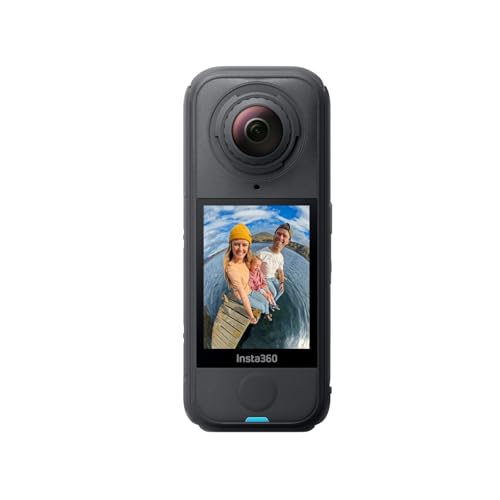
Insta360 X4 Air 360 Camera — Lightweight current-model buy
The X4 Air’s title contains the most surprising pairing in this guide: 8K and 165 grams. Spherical cameras have historically been dense little bricks, and a camera stated at 165g changes where 360 can live — on a cap, on a chest strap that forgets it is there, on a stick held at arm’s length for an hour without the shoulder filing a complaint, in a jacket pocket that already holds a phone and keys. For the traveller and the rider, weight is not a comfort specification; it is the difference between a camera that comes and a camera that is left, and a left camera captures nothing at any resolution.
What the lightness has not cost, on stated evidence, is the grammar. The invisible selfie stick effect is present. Replaceable lenses are present — the flagship X5’s signature durability feature, here in the value tier, and the point deserves emphasis: the commonest fatal accident in this category is a scratched protruding lens, and a replaceable one converts it into a spare-part errand at exactly the price level where a write-off hurts most. FlowState stabilisation is named. A built-in wind guard covers the audio. The maker’s slogan for the whole philosophy — shoot first, frame later — is printed in the title as the operating instruction it is.
The AI-powered app completes the value argument in the place value arguments are usually lost. An inexpensive camera with a miserable editor is expensive by the hour; a camera whose app tracks subjects, templates the reframe and exports cleanly makes its owner faster than a flagship owner fighting worse software. The title claims the app’s intelligence without detailing it, and the documentation and a pre-purchase trial of the free app will show how much of the claim a given phone can cash.
The silences should be respected as firmly as the claims. No battery duration is stated, no sensor size is given, and no waterproof depth accompanies — indeed, no waterproof claim appears in the title at all, which water-minded buyers must note carefully and check in the documentation before a single swim is planned. Value buyers are accustomed to one compromise hidden in a long title; here the compromise is simply unpublished, and the honest response is a question to the listing, not an assumption in either direction.
As the guide’s first recommendation, the X4 Air is the pick for the buyer who wants the current generation’s language — 8K, replaceable lenses, AI editing — at the tier where a mistake is affordable and a scratch is repairable. It is the rare value model that asks its owner to forgive it nothing except the questions its title leaves open.
A note for cyclists, who may be this camera’s perfect first owners. Bar and chest mounts punish weight twice — once in comfort, once in vibration — and a 165g spherical camera is easier to stabilise by position than a heavy one is by software. The stated FlowState system then handles what position cannot. A rider can also forget, in the best sense, that a camera this light is recording, which produces the unselfconscious footage that heavier, more obvious rigs tend to edit out of a group ride’s behaviour before a single frame is shot.
- Weight stated: 165g, lightweight
- Video stated: 8K 360 camera
- Lens stated: Replaceable lenses
- Stabilisation stated: FlowState stabilization
- Audio stated: Built-in wind guard
- Workflow stated: Invisible selfie stick effect; shoot first and frame later; AI-powered app
- Battery / sensor / waterproofing: Not stated in the listing title — verify with the manufacturer documentation
Strengths
- 165g makes it the carry-everywhere spherical camera in this guide.
- Replaceable lenses protect a value purchase from the fatal scratch.
- 8K capture funds confident reframing and vertical crops.
Trade-offs
- No waterproof claim appears in the title for swimmers to rely on.
- Battery duration is unstated, leaving endurance to the documentation.
- No sensor size is given beside the 8K headline.
Best for: travellers, riders and first-time 360 buyers who want current features in the lightest, kindest-priced form. Not suited for: swimmers and divers, since the title states no waterproofing to plan around.
Confirm the X4 Air’s box contents on its Amazon listing: check price on Amazon.
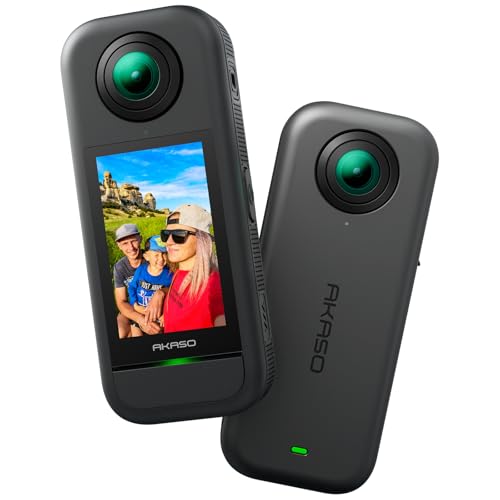
AKASO 360 Action Camera Standard Combo — Complete-kit value combo
AKASO’s route to inexpensive is completeness. Where a flagship’s price buys sensor and resolution, the Standard Combo’s price buys the whole working kit in one box: 5.7K spherical video with a named stabilisation system, dual 1/2-inch sensors of 48MP, 72MP spherical photographs, the invisible selfie stick effect, 360-degree horizon lock, AI tracking and — the line this guide keeps underlining — two rechargeable batteries. A buyer comparing headline prices between brands should compare equipped prices instead, because the second battery, the stick and the case that other ecosystems sell separately are where value comparisons are actually won and lost.
Horizon lock is the feature a new spherical owner feels first. A 360 camera records the world’s rolling as faithfully as its scenery, and footage in which the horizon see-saws with every pedal stroke is footage nobody re-watches. Locking the horizon inside the reframed frame is what separates holiday spheres from seasick ones, and AKASO states it plainly rather than leaving it to a settings menu’s rumour. AI tracking then removes the second beginner burden, the manual reframe, by holding a chosen subject while the frame is directed.
The 72MP stills figure, reported as the title states it, gives the combo a second life as a location recorder. A spherical photograph at that stated resolution is an archive: ordinary frames can be cropped from it for years, in orientations the photographer never considered on the day. For travellers who shoot a place once and mine it often, that archive function can justify the camera before a single video is reframed.
The tier’s compromises are visible in the same title. The sensors are 1/2-inch units in a guide whose step-ups state a 1-inch system; the video ceiling is 5.7K where the X4 Air states 8K; no waterproof claim, screen description or battery duration in hours appears. None of those gaps prevents a daylight, social-delivery season of genuinely good spherical footage, which is the season this combo is priced for. They do mark the boundary at which a demanding buyer should stop saving and start stepping up — a boundary this guide draws in prose two reviews from now.
For the household buying one spherical camera to learn on, lend around and take on the year’s trips, the AKASO combo is the arithmetic pick: the fewest second orders, the most complete first month, and a specification stated with a candour that lets its buyer know exactly which tier they chose and why it was enough.
Gift-buyers should register this combo’s particular mercy: it minimises the recipient’s homework. A camera given with one battery teaches its owner to ration; a camera given with two, a tracking system to do the reframing and a horizon that locks itself teaches its owner to shoot. For a teenager’s first spherical camera or a parent’s first travel sphere, that difference in first-month experience is the difference between a hobby and a drawer, and it is bought here without leaving the value tier — the strongest practical argument in this review.
- Spherical video stated: 5.7K 360 video
- Stabilisation stated: 360-SuperSmooth; 360-degree horizon lock
- Sensors stated: 1/2-inch, 48MP (dual)
- Photos stated: 72MP 360 photo
- Tracking stated: AI tracking; invisible selfie stick effect
- Batteries stated: 2 rechargeable batteries (Standard Combo)
- Waterproofing / battery hours: Not stated in the listing title — verify with the manufacturer documentation
Strengths
- Two batteries and a full feature kit minimise second orders.
- Horizon lock makes first spherical footage watchable immediately.
- 72MP spherical stills double the camera as a location archive.
Trade-offs
- Smaller sensors and a 5.7K ceiling sit a tier below the step-ups.
- No waterproof claim is stated in the title.
- Endurance is given as a battery count, not as hours.
Best for: households and learners who want one complete box and a gentle first season in 360. Not suited for: night shooters and aggressive croppers, whose needs live in the step-up tier.
Review the Standard Combo’s inventory on the AKASO listing: check price on Amazon.

Insta360 X3 360 Camera — Proven previous generation
The X3 is the connoisseur’s value play, and its logic deserves stating in full because it generalises beyond this guide. When a category moves fast, the outgoing flagship becomes the best-engineered inexpensive camera available: its design was the ceiling, its faults have been found and documented by an army of owners, its accessories fill every marketplace, and its price is set not by its cost but by its successor’s existence. The X3’s title still reads like a flagship’s — 5.7K spherical video with Active HDR, a 4K single-lens mode, FlowState stabilisation, a 2.29-inch touchscreen, AI editing, waterproofing, and named parishes of motorcycle, wintersports and vlogging.
The single-lens mode is the feature that most separates it from the other two linked picks. A household’s only camera must sometimes be ordinary: the school play, the house viewing, the interview. The X3 shoots a plain 4K wide frame without any reframing session, which means the value buyer is not purchasing a specialist that sulks at ordinary work. The AKASO cannot make that claim in its title, and the X4 Air’s title does not make it either; on stated evidence, the previous generation is the most versatile camera in this guide.
Active HDR addresses the spherical scene’s permanent condition — half the world in glare, half in shade — and the touchscreen, at 2.29 inches, is a real operating surface rather than a status window, which matters on a camera whose settings live behind glass. Waterproofing is claimed without a depth figure, and no battery duration is stated; both checks go to the documentation, as they do for most of this guide.
The honest costs of buying a generation back are two, and neither is image quality. The first is time: software support, app features and accessory development migrate toward current models, so the X3’s remaining years of full attention are fewer than the X4 Air’s. The second is the lens question — no replaceability is stated, in a guide where the current lightweight states it proudly — so a guard habit is part of this purchase. Buyers who accept those two costs knowingly are making the most literate value decision in the category.
For the motorcyclist, skier or travelling vlogger whose budget has a hard ceiling and whose standards do not, the X3 remains the recommendation this guide expects to age best: a complete, dual-mode, thoroughly understood camera whose only real fault is having been succeeded.
Wintersports, named in the X3’s title, deserve their sentence in a value context. Cold is where inexpensive cameras traditionally confess — batteries fading, screens lagging, gloves defeating small buttons — and a previous flagship’s mature hardware, with a real touchscreen and a documented owner base in exactly those conditions, is a safer January bet than an untested novelty at any price. Value, in the cold, is reliability that has already been wintered by somebody else.
- Spherical video stated: 5.7K 360 with Active HDR
- Single-lens mode stated: 4K single-lens camera
- Stabilisation stated: FlowState stabilization
- Screen stated: 2.29-inch touchscreen
- Editing stated: AI editing
- Uses stated: Motorcycle, wintersports, vlogging
- Battery duration / waterproof depth: Not stated in the listing title — verify with the manufacturer documentation
Strengths
- A former flagship specification at a previous-generation position.
- The 4K single-lens mode covers ordinary filming without reframing.
- The deepest accessory and knowledge ecosystem in this guide.
Trade-offs
- Software attention will migrate to newer models over its life.
- No lens replaceability is stated, so guards are a necessary habit.
- 5.7K capture crops less forgivingly than the 8K picks.
Best for: demanding buyers on a hard budget who value versatility and a proven ecosystem. Not suited for: buyers who want the longest possible runway of software support.
See the X3’s listing for its current bundles and contents: check price on Amazon.
Insta360 X5 — The step-up, covered in prose
This review carries no purchase link, and the reason is the guide’s whole ethic: the X5 is what the saving forgoes, described fairly so the forgoing is informed. Its title states 8K spherical video with a leading low-light claim, a triple AI chip design, the invisible selfie stick effect, a built-in wind guard, stabilisation — and two specifications that directly answer the linked picks’ weaknesses: rugged, replaceable lenses, and a three-hour battery. No linked pick in this guide states a battery duration at all; the flagship states three hours. No linked pick except the featherweight X4 Air offers lens replacement; the flagship builds its identity on it.
A reader should therefore climb to the X5 for specific, nameable reasons: a season of knocks on lifts and trails, evenings that run long, night scenes that matter, crops that must stay sharp. A reader whose shooting is daylight, gentle and social will find those reasons absent from their own diary, and the saving rational. Both readers have now made the same decision properly — by comparing stated mechanisms against a real life, rather than by comparing prices against a vague anxiety.
The full linked review of the X5, with its purchase routes, sits in the flagship spherical roundup elsewhere on this site. It is referenced here so that the step-up is a door, not a dead end — but it is a door this inexpensive guide deliberately leaves for the reader to open, rather than pushing them through it.
One concrete season makes the step-up case better than any abstraction. A rider filming a winter of evening commutes — dark at both ends, wet at most middles — will hit the value tier’s edges weekly: the light, the battery, the lens that cannot be swapped after the inevitable knock. For that rider the X5 is not an indulgence but the correct first purchase, and this guide would rather lose its own recommendation to that diary than win it against the evidence. Value is a fit, not a virtue.
- Spherical video stated: 8K 360 degrees
- Lens stated: Rugged and replaceable lens
- Battery stated: 3-hour battery
- Low-light claim stated: Leading low light; triple AI chip design
- Audio stated: Built-in wind guard
- Coverage here: prose step-up entry, deliberately unlinked
Strengths
- Replaceable lenses and a three-hour battery answer the two open questions of the value tier.
- 8K capture with a low-light lead covers night and cropping together.
- It is the current flagship reference point of the category.
Trade-offs
- It costs flagship money, which is the entire subject of this guide.
- Its advantages are wasted on gentle, daylight, social shooting.
- No sensor size is stated beside its low-light claim.
Best for: readers whose diary contains knocks, long evenings and night scenes worth paying to capture properly. Not suited for: value buyers whose shooting is daylight and social — the linked picks exist for them.
Covered in prose only here; its linked review and purchase options are in our consumer 360 camera guide.
DJI Osmo 360 Essential Combo — The imaging step-up, covered in prose
The second step-up argues from a single dimension. The Osmo 360’s title states 1-inch 360-degree imaging — the largest imaging system in either of our 360 guides — with native 8K spherical video, a 4K at 120 frames per second boost mode across a 170-degree field, and a 1.2m invisible selfie stick kit inside its Essential Combo. Sensor size is the specification this guide trusts above all others for low light and dynamic range, and on that axis the Osmo does not merely lead the value tier; it plays a different sport from it.
The boost mode is the step-up’s second argument, aimed at creators whose feeds mix spherical spectacle with conventional slow motion. None of the linked picks states a high-frame-rate mode of that kind — the X3’s single-lens mode runs at 4K without a stated 120fps — so a creator whose signature shots are slow is being asked, by this prose review, a precise question: is that signature worth the climb? If yes, the Osmo is where it lives. If the diary says otherwise, the saving stands.
As with the X5, the full linked treatment sits in the flagship spherical roundup, and this inexpensive guide’s discipline is maintained: description without a basket. The Osmo’s title, it should be noted for fairness, states no battery duration and no lens-replacement policy, so the step-up is not superior in every column — it is superior in the imaging column, which for some creators is the only column that exists.
Event filmmakers should weigh the Osmo’s stated combination with particular care, because weddings, performances and journeys shot once cannot be reshot at a higher tier later. Where a single spherical camera must cover a day that matters, the largest stated sensor and a slow-motion mode are insurance bought in advance — and insurance, unlike resolution, is rational to purchase before the need is proven. That is the honest limit of the value argument, and this guide states it rather than hiding from it.
- Imaging stated: 1-inch 360-degree imaging
- Spherical video stated: Native 8K 360-degree video
- Boost mode stated: 4K/120fps and 170-degree boost video
- Included stated: 1.2m invisible selfie stick kit
- Coverage here: described in prose as the imaging step-up, without a link
Strengths
- The largest stated imaging system in the category, at 1 inch.
- A slow-motion boost mode none of the linked picks states.
- The stick kit is included in its combo.
Trade-offs
- Flagship pricing is the point at issue in an inexpensive guide.
- No battery duration is stated in its title.
- Lens replacement is not mentioned beside the explicit claim of the X5.
Best for: image-quality-first creators for whom the sensor dimension outranks every saving. Not suited for: budget-led buyers, for whom its premium buys dimensions their delivery will not show.
Covered in prose only here; readers who decide to climb will find its linked review with purchase options in the flagship 360 roundup on this site.
Samsung Gear 360 Camera — Historical note, not a bargain
The Gear 360 closes this guide as a warning wearing a tribute’s clothes. Its title — a real 360-degree high-resolution VR camera, US version with warranty — belongs to the category’s first consumer generation, when Samsung put spherical capture beside its phones and taught the public that the format existed. As history, it is honourable. As a purchase in an inexpensive guide, it must be handled with complete clarity: a legacy camera is not a value camera. Its ecosystem assumptions, software support and unstated-by-modern-standards specification belong to its era, and a reader who buys one cheaply has bought an artefact, not a saving.
The distinction matters because the second-hand market blurs it daily. Old flagships in fast categories do not become bargains; they become hobbies — for collectors who value the founding design, for educators teaching stitching and projection on hardware that risks nothing, for tinkerers who enjoy reviving formats. Those are legitimate pleasures, and this prose review exists to name them accurately rather than to let a low price impersonate a recommendation.
Every other camera in this guide, linked or step-up, is a current instrument with a living ecosystem. The Gear is the control case that proves the guide’s definition of inexpensive: not the least money that buys a sphere, but the least money that buys the modern grammar, supported and whole. Readers who want the pioneer itself should pursue it knowingly, as one buys any piece of history — for what it was, not for what it would do.
There is a final, practical reason the Gear earns its paragraphs. Readers will meet it — in marketplaces, in relatives’ drawers, in bundle listings beside modern cameras — and a guide that never mentions it leaves those meetings to the seller’s description. Forewarned by three honest paragraphs, a reader can greet the pioneer with affection and a closed wallet, which is exactly the relationship this category’s history deserves from the people it now serves so much better.
- Claim stated: Real 360-degree high-resolution VR camera
- Version stated: US Version with Warranty
- Resolution / sensor / battery: Not stated in the listing title — verify with the manufacturer documentation
- Status in this guide: Prose-only historical entry — not a value recommendation
Strengths
- A founding design of genuine interest to collectors and educators.
- It teaches the origins of the category more vividly than any description.
- Its simplicity suits format archaeology and classroom handling.
Trade-offs
- Its ecosystem and support belong to an earlier phone era.
- No modern specification is stated in its title.
- A low second-hand price does not make it an inexpensive camera in the sense used by this guide.
Best for: collectors, educators and tinkerers pursuing the pioneer knowingly. Not suited for: any reader seeking a working value 360 camera for travel or sport.
Covered in prose only here, as a historical entry; it carries no recommendation and no purchase link in this guide.
Comparison
| Product | Status here | Video stated | Why it sits where it sits |
|---|---|---|---|
| Insta360 X4 Air | Linked pick | 8K | 165g, replaceable lenses, current generation |
| AKASO 360 Combo | Linked pick | 5.7K | Two batteries, horizon lock, complete kit |
| Insta360 X3 | Linked pick | 5.7K | Previous flagship, single-lens mode, ecosystem |
| Insta360 X5 | Prose step-up | 8K | Replaceable lens, 3-hour battery, low-light lead |
| DJI Osmo 360 Combo | Prose step-up | Native 8K | 1-inch imaging, 4K/120fps boost mode |
| Samsung Gear 360 | Prose history | High resolution (era claim) | Pioneer artefact, not a bargain |
The status column is this guide’s argument in one glance. Three cameras are buys, two are yardsticks and one is a museum piece, and confusing those roles is how value guides fail their readers. A buyer who reads the table honestly knows exactly what the linked three offer, exactly what the prose two would add, and exactly why the sixth is present at all — which is all the equipment a good decision needs.
How to Choose an Inexpensive 360 Camera
Choose your saving strategy before you choose your camera, because the three linked picks embody three different ones. The current lightweight (X4 Air) suits buyers who want modern features and the longest support runway. The challenger kit (AKASO) suits buyers who want the fewest second orders and the gentlest learning curve. The previous flagship (X3) suits buyers who want proven versatility and do not mind a shorter runway. A reader who cannot say which strategy is theirs will drift toward whichever product page they opened last, which is marketing’s favourite outcome and this guide’s least favourite.
Then interrogate the one specification your shooting cannot forgive. For a swimmer, it is the waterproof statement — present in the X3’s title as a claim, absent from the other two linked titles, and to be confirmed in depth and mechanism in the documentation before any water is trusted. For a night rider, it is sensor and low-light evidence, where this tier is thin and the step-ups begin to glow. For a creator, it is the app, which should be downloaded and tried before the camera is ordered, since it is free and the camera is not.
Budget the whole first month, not the camera. A stick for the picks that lack one, lens guards for the picks whose lenses are not replaceable, a card where none is stated, a second battery where the box holds one — the equipped prices of the three linked picks converge more than their headline prices diverge, and the AKASO’s two-battery completeness looks cleverer with every line of that arithmetic. Inexpensive is a property of the kit, never of the body alone.
Finally, set your step-up trigger in advance. If the season proves that spherical filming is your medium — if the reframes pile up, the evenings lengthen, the crops deepen — the prose reviews above have already told you what the climb buys and which flagship answers which frustration. Deciding the trigger now, while the saving is being enjoyed, turns a future upgrade from a surrender into a plan.
Keep the total honest in one more direction: your time. An inexpensive camera whose app fights you will tax every clip, while the stated AI assistance in all three linked titles — editing, tracking, a powered app — is a running rebate on the scarcest resource any creator owns. When two value picks tie on hardware, buy the one whose software you enjoyed in the trial, and do not apologise for deciding on that ground; at this tier, software is the specification that touches every single day of ownership.
Write the decision down in one sentence before ordering — the strategy, the unforgivable specification, the equipped total — because a sentence survives the product pages’ weather better than a feeling does, and it will still make sense when the camera arrives.
Why is the previous generation so often the smartest buy in 360?
Because the category’s progress is real but unevenly distributed. Between one generation and the next, resolution climbs and features accumulate, yet the core experience — capture the sphere, reframe it in an app, publish the cut — changes far less than the launch presentations suggest. The outgoing model’s experience therefore survives its demotion almost intact, while its price absorbs the full force of the successor’s arrival. The X3 in this guide is the standing example: a specification that headlined recently, an ecosystem at maximum maturity, and a market position set by a newer sibling rather than by any failure of its own.
There are two clocks to check before taking the deal. The support clock: how long will the maker keep the app and firmware current for this model, judged by how it treated the generation before? And the wear clock, for used examples: spherical lenses live exposed lives, so a second-hand previous flagship should be inspected lens-first, with the same suspicion a buyer would bring to any used optics. New-old stock, where it exists, threads both needles at once.
The strategy fails gracefully, which is part of its charm. If the previous generation delights, the saving funded the trips that filled it. If it frustrates in a specific, nameable way — low light, cropping, battery — the frustration is a precise specification for the upgrade, bought a season later with evidence instead of hope. Few purchases in consumer electronics offer so kind a failure mode.
The X4 Air, notably, collapses the distinction this topic describes: a current model priced and weighted like a learner’s camera, carrying the flagship’s replaceable lenses. Strategies in a maturing category blend over time, and the wise buyer re-derives them from the current titles — as this guide has done — rather than inheriting last year’s map of where the value lives.
What do you actually give up at the inexpensive tier?
On the stated evidence of this guide, four things — and it is a service to name them without drama. Sensor size: the linked tier’s stated dimensions top out at the AKASO’s dual 1/2-inch units, while the step-up Osmo states a full inch, with the low-light and dynamic-range consequences that follow. Battery certainty: no linked title states a duration, where the X5 states three hours. Lens insurance: only the X4 Air matches the flagships’ replaceability. And headroom: 5.7K capture crops less forgivingly than 8K when the edit punches in.
What is not given up matters equally. The grammar is whole at this tier — reframing, invisible-stick shots, horizon stability, tracked edits, spherical stills worth archiving. The footage is publishable on every platform its audience uses. The cameras are current or proven, supported and accessorised. A buyer is not purchasing a lesser kind of 360 at this level; they are purchasing the same kind with narrower margins, and margins only matter at the edges of the light, the day and the crop.
The practical question is therefore autobiographical. How many of your sessions actually reach those edges? A season of daylight rides and holiday spheres never touches them, and the saving is pure. A winter of night commutes lives inside them, and the step-up is not a luxury but the tool. Answer from your diary, as this guide keeps advising, and the tier chooses itself.
How long should an inexpensive 360 camera last?
Physically, years — the failure modes are specific rather than general. Lenses scratch, batteries tire, and sticks bend long before sensors die, which is why this guide scores replaceability and battery counts so heavily at the value tier: they are longevity specifications wearing other names. A camera with a replaceable lens and a second battery has already answered its two likeliest deaths. A camera without them asks its owner to supply the answers through guards, care and gentle handling, which many owners, to be fair, do successfully for years.
Digitally, the honest horizon is set by the app. A 360 camera is a peripheral to its editing software, and when the software’s support moves on, the camera’s footage becomes archaeology — still openable, increasingly inconvenient. Current and recent models from makers with living ecosystems, which describes all three linked picks, carry the longest digital horizons available at the tier. The Gear 360’s prose review shows the end of that road, which is why it stands in this guide as a signpost rather than a shortcut.
The owner’s habits arbitrate between the physical and digital clocks. Rinsed after salt water, stored dry, lenses inspected in ten-second rituals, batteries rotated rather than abandoned — a value camera kept this way will usually outlive its software, which is the best outcome a purchase can have: the tool retired by progress, not by neglect.
Can an inexpensive 360 camera grow with its owner?
Partly — and knowing which part is the mark of a good value purchase. The skills grow entirely: reframing judgement, stick technique, seam awareness and editing speed transfer to any future flagship unchanged, because the grammar is the grammar at every tier. The accessories grow mostly: sticks, mounts and cases bought for the linked picks here will serve a step-up in most ecosystems, which is another reason to equip the first camera fully rather than minimally. What does not grow is the file ceiling — the sensor and resolution bought today bound every future crop — and that single fixed quantity is why this guide insists on matching the tier to the diary rather than to the hope.
There is a household pattern worth planning around. The value camera bought for one person’s season often becomes the family’s second sphere — lent to teenagers, mounted riskily where the flagship would be coddled, taken to the beach without a negotiation. A camera with replaceable lenses or a proven ecosystem survives that second career best, which quietly favours the X4 Air and the X3 in this guide for families whose gear circulates. Buying the first camera as a future second camera is not pessimism; it is fleet management at household scale.
And when the step-up day comes, the value camera’s last service is information. Its owner knows, from a season of evidence, whether the binding constraint was light, battery, resolution or lenses — the four frustrations the two prose step-ups answer differently. An upgrade chosen from evidence is cheaper than one chosen from advertising, even when the hardware costs more, because it is chosen once.
Common Mistakes
Padding the shortlist with the wrong species. Meeting cameras and novelty gadgets wear the 360 label at tempting prices. They share no grammar with the cameras here — no reframing, no action mounting, no sphere worth editing — and their cheapness is the most expensive kind, the kind that must be bought twice.
Mistaking old for inexpensive. The Gear 360’s prose review exists to break this equation. A legacy camera’s low price buys an artefact with an ageing ecosystem. Value lives in current lightweights, challenger kits and recent previous generations — the three strategies this guide links.
Comparing body prices instead of equipped prices. Sticks, guards, cards and second batteries are part of a 360 purchase. The AKASO’s two-battery box and the step-ups’ included stick kit change their true prices materially. Add the kit before ranking the cameras.
Skipping the app trial. The reframing app is half the product and it is free to test. Download it before ordering any pick here, open its sample footage, and perform one reframe. Ten minutes of that is worth more than any paragraph in this guide, including this one.
Assuming inexpensive means waterproof. Of the three linked picks, only the X3’s title claims waterproofing at all, and it states no depth. Water plans must be built from documentation, never from a category’s general reputation or a product photograph of a camera near a pool.
Final Recommendation
The inexpensive tier of 360, chosen honestly, is not a compromise to apologise for — it is the category’s grammar at its most accessible, and the three linked picks divide it cleanly. The X4 Air for the traveller who counts grams and wants the current language; the AKASO combo for the household that wants one complete box and a gentle first season; the X3 for the demanding buyer on a hard ceiling who values a dual-mode, proven machine. The step-ups wait in prose, fairly described, for the season that outgrows this tier — and the Gear stands at the door as a reminder that the only bad value in 360 is a camera bought under a misunderstanding. Buy the grammar, equip it fully, and spend the saving on the journeys the sphere was invented to remember; that is the closing advice of this guide, and it is meant literally.
One practical closing test separates the three linked picks in most households. Imagine the camera’s tenth outing rather than its first: the X4 Air is in a jacket pocket, forgotten until the moment arrives; the AKASO is on the family stick with its second battery warm in reserve; the X3 is doing double duty, spherical at noon and ordinary at dusk. Whichever of those tenth outings resembles your life is the camera your life is asking for — and a decision made from the tenth outing rarely needs remaking at the twentieth.
And if the budget stretches after all, stretch it on the kit before the body — the second battery and the stick will be remembered longer than the badge.
Frequently Asked Questions
Which inexpensive 360 camera should a beginner buy?
The AKASO Standard Combo is the gentlest start — two batteries, horizon lock and AI tracking in one box — while the X4 Air suits a beginner who already knows weight matters to them, and the X3 suits one who wants a dual-mode camera for ordinary filming too. All three are linked in this guide with their reasoning attached.
Why are the X5 and the DJI Osmo 360 not linked here?
Because this is an inexpensive guide, and they are the step-ups. They are reviewed in full prose so readers can judge what the saving forgoes — replaceable lenses and three battery hours on one side, a 1-inch imaging system on the other — and their linked reviews live in our consumer 360 camera guide for readers who decide to climb.
Is a used Gear 360 a good budget buy?
Not as a working camera recommendation. It is a legacy pioneer whose ecosystem belongs to an earlier era, covered here in prose as history. Collectors and educators may enjoy it knowingly; a buyer who wants to film trips and rides should choose one of the three linked current picks.
Does the X4 Air really shoot 8K at 165 grams?
Both figures are stated in its title — 8K 360 capture and a lightweight 165g body — alongside replaceable lenses and FlowState stabilisation. Its title does not state a sensor size or battery duration, so those two questions belong to the listing and documentation before purchase.
Are inexpensive 360 cameras waterproof?
Only the X3 among the linked picks claims waterproofing in its title, and it states no depth. The X4 Air and AKASO titles make no waterproof claim at all. Any water use should be planned from the manufacturer documentation for the specific model, not from the category’s reputation.
What accessories should I budget for with a value 360 camera?
An invisible selfie stick if the box lacks one, lens guards for any pick whose lenses are not replaceable, a memory card where none is stated, and a second battery where the box holds only one. Equipped that way, each linked pick here is ready for its signature shots on the first weekend.
Related Guides
Cameras that trade the sphere for the sky are compared in our guide to best astronomy cameras For the desk where all that spherical footage gets reframed, our roundup of best curved monitors And for a closer look at one popular desk size for editing, our guide to best 27-inch-curved-monitors


