What's inside
- Key Takeaways
- Quick Picks
- How We Chose These Picks
- Why Does Maximum Height Matter More Than Any Other Number Here?
- What Should a Tall Buyer Check Before Trusting a Stated Range?
- Which of These Desks and Frames Actually Reach Tall-Person Heights?
- How Do the Six Stack Up on Range, Surface and Stated Load?
- How Should a Tall Person Set Up a Standing Desk Once It Arrives?
- Frame Only or Complete Desk: Which Route Suits a Tall Buyer Better?
- How Much Space Does a Tall Standing Setup Need Around the Desk?
- Does the Low End of the Range Matter to Someone Who Is Tall?
- What Mistakes Do Tall Buyers Keep Making With Standing Desks?
- Final Recommendation
- Frequently Asked Questions
- Related Guides
As an Amazon Associate I earn from qualifying purchases. This post may contain affiliate links at no extra cost to you.
widgetverdict.com is reader-supported. When you buy through links on our site, we may earn an affiliate commission.
Where to buy: Amazon stocks all six desks and frames reviewed here, and each name in the Quick Picks table links directly to its listing. Tall buyers should read the height-range notes under each pick before ordering, because three of the six are frames that ship without any desktop at all.
Finding the best standing desks for tall person use is mostly an argument about a handful of inches at the top of the travel range. A desk that tops out at 47 inches can leave a six-foot-three user typing with forearms angled down and shoulders creeping up, while a desk that reaches 49.2 inches lets the elbows rest level and the monitor sit where the neck wants it. The standard desk market quietly assumes a standard body, and once you stand well clear of six feet, that assumption shows up in your wrists by the second hour of the afternoon.
Every desk and frame in this guide uses three-stage lifting columns, and that third stage is the whole point. Two-stage legs save money by travelling a shorter distance, which is exactly the distance a tall user cannot spare. Three-stage columns also tend to start lower, so the same desk that rises high enough for standing still drops to a sensible seated height for a partner, a child doing homework, or the same tall owner on a day when sitting is the plan. Range at both ends matters more than any single headline number.
The six picks split into two families. Three are complete desks with tops included: the FLEXISPOT E6 MAX at 55 x 28 inches, the HUANUO at a generous 70 x 35, and the SANODESK at 55 x 28 with an extra-deep one-piece top. The other three are frames only — a VIVO, the FLEXISPOT E6 Essential, and a UNICOO — which means the lifting legs, motors and controller arrive in the box and the desktop does not. Frame-only buying is not a flaw; it is how a tall user ends up with a top that is genuinely wide and deep enough, sourced separately, instead of accepting whatever panel the bundle included. It does mean a second purchase and a second delivery, and each frame review below says so plainly.
Load capacity appears in every title here, and it is quoted throughout this guide as the manufacturer’s own published figure. Treat those numbers as ceiling claims for a evenly loaded desk, not as an invitation to stack a tower PC, two monitors, a printer and a sleeping cat at one corner. Height, though, remains the deciding axis, and readers who care more about width and knee room than maximum lift may prefer the companion guide to Best Office Desks for Large People, which approaches generous sizing from the other direction.
Key Takeaways
- Three-stage legs are non-negotiable at this end of the market: the stated ranges here reach 49.2 inches at the top on the HUANUO, the FLEXISPOT E6 Essential frame and the SANODESK.
- Three picks are complete desks (FLEXISPOT E6 MAX, HUANUO, SANODESK) and three are frames only (VIVO, FLEXISPOT E6 Essential, UNICOO) that need a desktop bought separately.
- Manufacturer-stated capacities run from 220 lb on several models to 264 lb on the VIVO and UNICOO frames and 352 lb on the E6 MAX.
- The HUANUO’s 70 x 35 inch top is the largest surface in the guide; the two 55 x 28 complete desks suit smaller rooms.
- Memory presets number three on the VIVO frame and four on the HUANUO, SANODESK and UNICOO, which matters in shared households.
- Nothing in any title promises a maximum user height, so judge fit from the travel range and your own elbow height, not from marketing aimed at tall people.
Quick Picks
| Pick | Badge | Why it earns its place |
|---|---|---|
| FLEXISPOT E6 MAX Standing Desk | Tallest complete package | A dual-motor, three-stage 55 x 28 desk in Mousse White with an extended height range and the guide’s highest stated capacity at 352 lb. |
| HUANUO 70 x 35 Electric Standing Desk | Widest top, stated ceiling | A dual-beam frame under a 70 x 35 top, a printed range of 23.6 to 49.2 inches, a brushless motor rated under 55 dB and four presets. |
| VIVO Electric Dual Motor Standing Desk Frame, DESK-V103E | Frame only, widest top support | Three-stage dual-motor legs rated for 264 lb that accept tops up to 85 x 43 inches, with three memory presets — desktop not included. |
| FLEXISPOT E6 Essential Standing Desk Frame | Frame only, full stated range | A dual-motor three-stage base spanning 23.6 to 49.2 inches with a stated 220 lb capacity — desktop not included. |
| SANODESK Dual Motor Standing Desk, 55 x 28, White | Deep one-piece top | A complete desk with a one-inch-thick single-piece 55 x 28 top, three-stage legs running 23.6 to 49.2 inches and four presets. |
| UNICOO Dual Motor Electric Standing Desk Frame | Frame only, white finish | White three-stage legs rated for 264 lb, sized for tops 43 to 78.7 inches wide, with four memory presets — desktop not included. |
How We Chose These Picks
The first filter was mechanical: only three-stage lifting columns were admitted, because the extra stage is what buys the top-end travel a tall user actually needs. Two-stage desks were set aside no matter how attractive the rest of the specification looked. The second filter was honesty in the title itself. Models that print a full height range earned more trust than models that gesture at an extended range, and both kinds appear below with the difference flagged rather than smoothed over.
Capacity was the third consideration, read strictly as a manufacturer-stated figure. A frame rated at 264 lb and a complete desk rated at 352 lb are not promising identical experiences — the complete desk’s rating already accounts for its own top, while the frame’s rating must absorb whatever slab the buyer bolts on. That distinction runs through the reviews, because a heavy solid-wood desktop can consume a surprising share of a frame’s allowance before a single monitor lands on it.
Finally, the guide deliberately mixes complete desks and bare frames. Tall users are disproportionately likely to outgrow bundled desktops, so three of the six places went to frames that accept oversized tops. Anyone who would rather furnish a small room with furniture that disappears when closed might look at Best Secretary Desks for Small Spaces instead, though nothing there rises to meet a standing worker.
Why Does Maximum Height Matter More Than Any Other Number Here?
Stand at a desk that is two inches too low and the body compensates in a predictable sequence. The wrists extend because the keyboard sits below elbow height. The shoulders rise to meet the hands. The head tilts down toward a monitor whose stand ran out of travel several inches ago. None of this announces itself as pain on day one; it accumulates as end-of-day tightness that people blame on the chair, the mattress or getting older. The desk’s top-end range is where that sequence either starts or never gets the chance.
Working out your own number takes a tape measure and thirty seconds. Stand in the shoes you work in, bend your elbow to a right angle with your upper arm hanging relaxed, and measure from the floor to the underside of your forearm. That figure is roughly where the desktop should meet you for typing. Add the height of a keyboard tray if you use one, subtract nothing for optimism. If the result lands above 48 inches, most of the mainstream desk market is already out of the running, and the desks in this guide are the ones still standing — literally — at that height.
Shoes deserve a footnote in this arithmetic, because they change the measurement more than people expect. A tall user who works in trainers with a thick sole stands effectively half an inch taller than the same user in socks on a hard floor, and a desk with travel to spare absorbs that difference without complaint. Desks bought exactly at the limit of a barefoot measurement have nowhere to go when footwear, a thicker mat or a change of chair enters the picture. Buying range is buying forgiveness for all the small variables nobody measures twice.
There is a related trap in seated measurements carried over from an old fixed desk. If your previous desk was too low — and for a tall person it almost certainly was — your chair, your monitor arm and your habits have all silently adapted to that wrong height. Copying the old setup’s geometry onto a new adjustable desk preserves the problem at greater expense. Measure your body, not your furniture; the body is the one constant the new desk has to fit.
Monitor position is the second half of the equation. A tall user’s screen needs to rise with the desk, and at maximum extension the gap between desktop and eye level grows. A monitor arm with generous lift, or a stand with real travel, stops being an accessory and becomes part of the height budget. When you compare the ranges below, mentally reserve a few inches of the desk’s travel for getting the screen up, not just the keyboard.
What Should a Tall Buyer Check Before Trusting a Stated Range?
Ranges are measured to the top of the desktop on complete desks, but frame-only ranges describe the frame itself, and the thickness of whatever top you add sits on top of that figure — which, for a tall buyer, is a rare case of the fine print working in your favour. A frame quoted at 49.2 inches wearing a one-inch top delivers a working surface at roughly 50 inches. The opposite trap waits at the bottom of the range: a thick top raises the minimum seated height too, which matters if shorter household members share the desk.
Stability at full extension deserves equal suspicion. Any lifting column wobbles more at the top of its travel than at the bottom, and tall users live at the top of the travel. Dual-beam frames and dual motors help, as does keeping the heaviest equipment near the centre of the top rather than cantilevered at the edges. The reviews below note where a title gives a clue about structure — the HUANUO’s dual-beam frame, for instance — and stay silent where the title offers nothing to go on.
Floor surface is the unglamorous third check. A desk at 49 inches on thick carpet behaves differently from the same desk on hardwood, because the feet settle and the columns start their travel from a slightly uneven base. Level the feet after installation, then run the desk through its full range twice before loading it with equipment.
Which of These Desks and Frames Actually Reach Tall-Person Heights?
Three of the six print their full travel range in the title and three do not, and the reviews keep that distinction visible. Where a range is stated, it is quoted exactly; where a maker only claims an extended range, the review says that instead of borrowing a number from a sibling model.

FLEXISPOT E6 MAX Standing Desk — Tallest complete package
The E6 MAX is the pick for a tall buyer who wants one delivery and no separate desktop hunt. Its title promises an extended height range from a dual-motor, three-stage frame, and pairs that claim with the strongest capacity figure in this guide: 352 lb, as published by FLEXISPOT. The top is a finished 55 x 28 inch surface in Mousse White, a soft off-white that suits the modern home offices this desk is styled for, and because the top is included, the stated capacity can be read at face value rather than discounted by the weight of a slab you supply yourself.
What the title does not do is print the actual top-end figure, and that omission is the honest weakness here. HUANUO, SANODESK and the E6 Essential frame all commit to 49.2 inches in writing; the E6 MAX asks you to trust the words “extended height range” from a three-stage design. Three-stage architecture makes a high ceiling plausible, and the E6 family name carries the expectation, but a buyer whose forearm measurement lands at 49 inches should confirm the exact maximum in the manufacturer documentation before ordering rather than assuming a sibling model’s number applies.
Within its 55-inch width, the desk suits a disciplined two-monitor setup with a laptop docked to one side. It is not the surface for a three-screen trading sprawl, and the soft white finish will show coffee rings and pen marks more readily than a dark laminate. Treat the finish kindly and it returns the favour by making a small room feel less crowded than a black desk of the same footprint.
- Top: 55 x 28 inches, Mousse White, included
- Drive: dual motor, three-stage lifting columns
- Height range: described in the title as an extended range; the exact maximum is not printed there, so confirm it in FLEXISPOT’s own documentation
- Capacity: 352 lb, manufacturer-stated
- Format: complete desk, top and frame together
Strengths
- The 352 lb manufacturer-stated capacity is the highest in this guide, leaving real headroom for multiple monitors and a desktop PC on the surface.
- A complete desk: no second purchase, no compatibility guessing between frame width and top.
- The Mousse White finish and three-stage legs suit a bright home office where a black industrial frame would dominate.
Trade-offs
- The title never prints the maximum height, which is the one number a tall buyer cannot afford to take on faith.
- At 55 inches wide, the top crowds quickly once a second monitor and speakers arrive.
- The pale finish shows marks that a darker top would hide.
Best for: a tall user who wants a single-box complete desk and whose required typing height sits comfortably below the top of a three-stage range.
Not suited for: a setup whose owner has measured a required surface height right at 49 inches and needs that figure guaranteed in writing before buying.
Check the E6 MAX’s listing for the current configuration options, and confirm the maximum height in the maker’s documentation while you are there.

HUANUO 70 x 35 Electric Standing Desk — Widest top, stated ceiling
HUANUO does the one thing tall buyers keep asking for: it prints the range. The title states 23.6 to 49.2 inches, extra-low to extra-high, from a three-stage frame built with a dual-beam structure rather than a single crossbar. Underneath sits a brushless motor the maker rates at under 55 dB, with four memory presets on the controller. On top sits the largest surface in this guide, 70 x 35 inches — wide enough for three monitors and deep enough that the far edge stays useful instead of becoming a shelf for forgotten paperwork.
The stated capacity is 220 lb, again a manufacturer figure, and on a top this size it deserves respect rather than dismissal: a 70-inch span invites loading, and the rating is the maker’s line for the whole loaded surface. The desk ships in two packages, which the title discloses honestly. Two boxes means the delivery may arrive on two different days, and assembling a desk whose top is still in transit is a special kind of frustration — wait for both boxes before opening the tools.
The dual-beam frame is the structural story. At full 49.2-inch extension, a wide top acts like a sail for every small nudge, and a second beam is a direct answer to that leverage. Nothing in the title speaks to wobble in so many words, so this remains an inference from the structure rather than a tested claim, but it is the right structure for the problem tall users describe most.
- Top: 70 x 35 inches, included
- Height range: 23.6 to 49.2 inches, as printed in the title
- Drive: brushless motor, rated under 55 dB by the maker; dual-beam three-stage frame
- Capacity: 220 lb, manufacturer-stated
- Memory: four presets; ships in two packages
Strengths
- The full height range is printed in the title, including the 49.2-inch ceiling tall buyers are shopping for.
- The 70 x 35 top is the roomiest surface here, in both width and depth.
- A dual-beam frame addresses stability at full extension, where wide desks need it most.
Trade-offs
- The 220 lb stated capacity is the joint-lowest in the guide despite the biggest top, so heavy multi-PC loads need restraint.
- Two-package shipping can split the delivery across different days.
- A 70-inch desk is a commitment in a small room; it will not tuck into an alcove.
Best for: a tall user with a wide multi-monitor layout who wants the maximum height stated in writing and has the floor space a 70-inch top demands.
Not suited for: a compact spare bedroom where a 70-inch span would block drawers, doors or the walkway to them.
The HUANUO listing carries the frame and finish options; verify the two-package delivery note against your building’s parcel arrangements.
VIVO Electric Dual Motor Standing Desk Frame, DESK-V103E — Frame only, widest top support
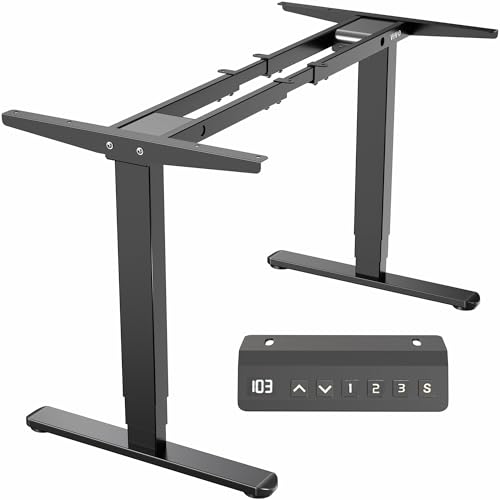
This is a frame, full stop: the VIVO DESK-V103E box contains three-stage dual-motor legs and a controller, and no desktop whatsoever. You supply the top. In exchange, the frame accepts tops up to 85 x 43 inches — the most generous compatibility in this guide — and carries a manufacturer-stated capacity of 264 lb. For a tall buyer who has already found the perfect slab, perhaps a solid door blank, a butcher-block counter or a custom-cut panel, this is the route to a desk no bundle sells.
Three memory presets live on the controller, one fewer than several rivals, which only matters in households cycling between three-plus users or distinct seated, standing and perch heights. The title does not print the frame’s height range, so the same discipline applies as with the E6 MAX: the three-stage design implies generous travel, but the exact ceiling belongs in VIVO’s documentation, and a tall buyer should read it there before pairing the frame with a top.
Budget honestly for the whole project. The frame’s price is only part of the spend; a quality 72-inch top, finishing materials if the top is raw, and the screws and inserts for mounting all belong in the same calculation. The reward for that effort is a desk whose surface is exactly the size, depth and material you chose — for tall users with long arms and deep monitor setups, that control over depth alone can justify the extra work.
- Format: frame only — desktop must be bought separately
- Top compatibility: up to 85 x 43 inches, per the title
- Drive: dual motor, three-stage legs, height and length adjustable
- Capacity: 264 lb, manufacturer-stated
- Memory: three presets
- Height range: not printed in the title; check VIVO’s documentation for the exact figures
Strengths
- Accepts the largest tops in the guide, up to 85 x 43 inches, so width and depth stop being compromises.
- A 264 lb manufacturer-stated rating leaves room for a substantial solid top plus equipment.
- Length adjustability lets the same frame serve a modest top now and a wider one later.
Trade-offs
- No desktop in the box: a second purchase, a second delivery and a mounting job are all mandatory.
- The title omits the height range, so the key tall-buyer figure needs confirming elsewhere.
- Three presets is one fewer than most rivals here.
Best for: a tall user who already owns, or plans to commission, an oversized desktop and wants a frame that will not limit its dimensions.
Not suited for: a same-day setup — this frame needs a desktop sourced, delivered and mounted before it can hold a laptop.
On the VIVO listing, match the frame’s stated top-size window against the desktop you intend to mount before the frame ships.
FLEXISPOT E6 Essential Standing Desk Frame — Frame only, full stated range
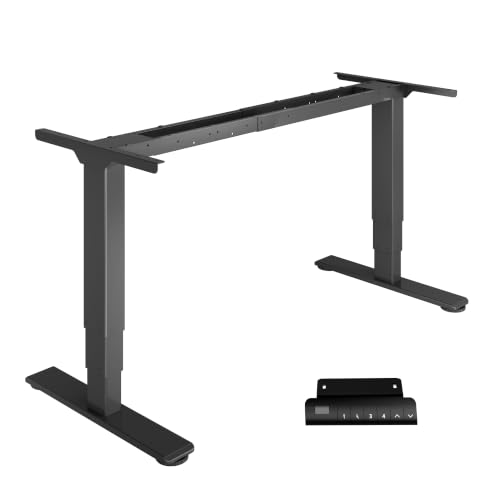
The E6 Essential is FLEXISPOT’s frame-only route into the same three-stage territory as its complete desks, and unlike its E6 MAX sibling it prints the numbers: a 23.6 to 49.2 inch height range and a 220 lb manufacturer-stated capacity, driven by dual motors. What arrives is the base — legs, motors, controller — in black. The desktop is entirely your problem, and for the right buyer that is precisely the appeal.
Because the frame’s stated range describes the frame, the top you choose adds its own thickness to the working height. Bolt on a one-inch panel and the effective surface ceiling rises to roughly 50 inches, territory almost no complete desk reaches. The same arithmetic raises the floor of the range, so a very thick top — a two-inch slab, say — eats into the low end that shorter household members might need for seated work. Pick the top’s thickness as deliberately as its width.
The 220 lb rating is the joint-lowest in this guide, and with a frame that figure must cover the top itself. A heavy solid-oak desktop could claim a third of the allowance before monitors, a PC tower and books arrive. Lighter tops — quality laminate, bamboo, or a hollow-core door skinned well — keep more of the rating available for equipment. None of this makes the frame weak; it makes the pairing decision part of the purchase.
- Format: frame only — desktop must be bought separately
- Height range: 23.6 to 49.2 inches for the frame, as printed in the title; your top’s thickness adds to the working height
- Drive: dual motor, three-stage legs
- Capacity: 220 lb, manufacturer-stated, including the weight of the top you add
- Finish: black
Strengths
- The full 49.2-inch ceiling is stated in the title, and a top’s thickness pushes the real surface higher still.
- Dual motors and three-stage legs match the mechanical specification of complete desks costing more.
- Freedom to pair the base with any top material, width or edge profile you prefer.
Trade-offs
- Frame only: the desktop, and its cost, are entirely separate.
- The 220 lb stated capacity must absorb the top’s own weight, penalising very heavy slabs.
- A thick top raises the minimum height, which can shut shorter users out of comfortable seated positions.
Best for: a tall user who wants a guaranteed 49.2-inch frame ceiling and a self-chosen desktop, and who will keep that desktop reasonably light.
Not suited for: a project built around a very heavy solid-stone or thick hardwood top that would consume the frame’s stated capacity on its own.
The E6 Essential listing is where to confirm which top widths the frame’s rails accept before you commit to a panel.

SANODESK Dual Motor Standing Desk, 55 x 28, White — Deep one-piece top
SANODESK’s entry in this guide is a complete desk whose headline details all sit in the title: dual motors, three-stage legs with an extended range printed as 23.6 to 49.2 inches, four memory presets, and a 55 x 28 inch top that is a single piece a full inch thick. That last detail matters more than it sounds. Many desks in this size class splice the top from two panels, leaving a seam exactly where forearms rest; a one-piece top removes the seam, the slight lip and the long-term risk of the halves ageing at different rates.
The manufacturer-stated capacity is 220 lb, shared with several picks here, and the maker draws attention to the top’s depth relative to its footprint — the brand calls it extra deep, and at 28 inches it matches the E6 MAX while the one-inch thickness gives the surface a solidity that thinner panels lack when you lean on an edge mid-thought. The desk ships in two boxes, so the same patience about split deliveries applies as with the HUANUO.
In white, with clean legs and no crossbar clutter mentioned in the title, this is the pick that disappears into a bright room. Its 55-inch width is the joint-smallest complete top in the guide, so the trade is clear: you give up the HUANUO’s sprawl and take the tidiest one-piece surface instead. For a tall writer or coder running a single large monitor, that exchange is often the right one.
- Top: 55 x 28 inches, one piece, one inch thick, white, included
- Height range: 23.6 to 49.2 inches, as printed in the title
- Drive: dual motor, three-stage legs
- Capacity: 220 lb, manufacturer-stated
- Memory: four presets; ships in two boxes
Strengths
- A one-piece, inch-thick top with no centre seam under your forearms.
- The full height range, including the 49.2-inch ceiling, is stated in the title.
- Four memory presets suit a desk shared between standing, seated and a second user.
Trade-offs
- The 55-inch width is modest beside the HUANUO’s 70 inches.
- Two-box shipping can separate the top and frame by a day or more.
- The 220 lb stated capacity is mid-pack rather than generous.
Best for: a tall single-monitor user who values a seamless, solid-feeling top and a stated 49.2-inch ceiling over maximum width.
Not suited for: a three-monitor array with studio speakers, which will outgrow a 55-inch surface within a week.
Check the SANODESK listing for the box contents and delivery split, especially if the desk is heading to an upper floor.

UNICOO Dual Motor Electric Standing Desk Frame — Frame only, white finish
UNICOO’s frame is the white-finished alternative in a category that defaults to black steel. The title describes dual-motor, three-stage legs with four memory presets, a manufacturer-stated capacity of 264 lb, and compatibility with tops from 43 to 78.7 inches wide. Like the VIVO and the E6 Essential, it is a frame only: no desktop is included, and the working desk exists only once you have sourced and mounted a top yourself.
The white finish is more than decoration. Pale frames under a pale top produce the floating, low-visual-weight look that small bright rooms need, and most frame makers simply do not offer it. The capacity matches the VIVO’s 264 lb, which gives a buyer pairing this frame with a mid-weight top a comfortable margin for dual monitors and a tower PC kept on the surface.
Two cautions mirror its frame-only siblings. The title does not print a height range, so the tall buyer must confirm the ceiling in UNICOO’s documentation rather than inferring it from the three-stage design — inference is how a desk ends up two inches short. And the stated capacity includes whatever top you mount, so the same slab-weight arithmetic applies. Within those limits, the combination of white finish, four presets and the joint-highest frame capacity here makes this the aesthetic pick of the three bare frames.
- Format: frame only — desktop must be bought separately
- Top compatibility: 43 to 78.7 inches wide, per the title
- Drive: dual motor, three-stage steel legs
- Capacity: 264 lb, manufacturer-stated, including the top you add
- Memory: four presets
- Finish: white
- Height range: not printed in the title; confirm the exact figures in the maker’s documentation
Strengths
- A white frame, rare in this class, for bright rooms and pale desktops.
- Four memory presets, one more than the VIVO frame offers.
- A 264 lb manufacturer-stated rating matches the strongest frames in the guide.
Trade-offs
- Frame only: the desktop is a separate purchase and a separate mounting job.
- No height range in the title, so the tall-buyer ceiling needs confirming before purchase.
- White legs show scuffs from shoes and vacuum cleaners more than black ones do.
Best for: a tall user building a light-toned workstation around a self-chosen top, who wants four presets and a strong stated capacity.
Not suited for: a buyer unwilling to verify the maximum height in the manufacturer’s documentation before ordering a frame.
The UNICOO listing holds the frame’s full dimension sheet; read the height figures there against your own forearm measurement.
How Do the Six Stack Up on Range, Surface and Stated Load?
| Pick | Format | Top or top window | Height evidence in title | Stated capacity | Presets |
|---|---|---|---|---|---|
| FLEXISPOT E6 MAX | Complete desk | 55 x 28 in included | Extended range claimed, figure not printed | 352 lb | Not stated in title |
| HUANUO | Complete desk | 70 x 35 in included | 23.6–49.2 in printed | 220 lb | 4 |
| VIVO DESK-V103E | Frame only | Tops up to 85 x 43 in | Range not printed | 264 lb | 3 |
| FLEXISPOT E6 Essential | Frame only | Top supplied by buyer | 23.6–49.2 in printed | 220 lb | Not stated in title |
| SANODESK | Complete desk | 55 x 28 in one-piece included | 23.6–49.2 in printed | 220 lb | 4 |
| UNICOO frame | Frame only | Tops 43–78.7 in wide | Range not printed | 264 lb | 4 |
Read the table by evidence, not by hope. Three picks commit to 49.2 inches in print; three ask you to verify. Capacities are manufacturer-stated in every case, and the frame figures must carry the weight of a top the maker never saw, which is why the E6 MAX’s 352 lb on a complete desk and the VIVO’s 264 lb on a frame are not directly interchangeable claims. If your own measurements say the ceiling is the whole decision, start from the three printed ranges and work outward.
How Should a Tall Person Set Up a Standing Desk Once It Arrives?
Begin with the unloaded desk. Run the columns through the full range twice, listening for grinding or uneven lifting, and level the feet before any equipment goes on. Save nothing to memory yet. Then place the monitor roughly where it will live and set the desk so the keyboard sits at your measured forearm height; stand for ten minutes of real typing before deciding the number is right, because the first two minutes at any new height feel strange regardless of whether the height is correct.
Set the screen next. The top of the display should sit near eye level, which at tall-person desk heights usually means the monitor needs its own lift — an arm or a taller stand — rather than resting flat on the desktop. If the screen stays low, the neck bends even when the elbows are perfect, and the desk gets blamed for a stand’s shortcomings. Readers whose work is mostly long-form writing may also enjoy the quieter end of the desk world covered in Best Writing Desks for Writers, though those fixed surfaces will not rise to meet anyone.
Give the arrangement a week before judging it. Shoulders that spent years adapting to a low desk do not unwind in an afternoon, and the first days at a correct height can feel oddly effortful precisely because different muscles are doing the work. Adjust in quarter-inch steps rather than dramatic leaps, keep a note of the heights that felt right at different times of day, and resist the urge to declare the experiment finished on day two. If, after a week, one position consistently wins, that position has earned its preset.
Programme the presets only after a full day of small adjustments. One preset for standing, one for seated, and if the controller allows it, one a touch higher for the late-afternoon slump when posture shortens and the desk needs to meet you halfway. Route cables with enough slack for full extension — a cable that goes taut at 49 inches will eventually pull something off the desk, and it is always the most expensive thing on it.
Frame Only or Complete Desk: Which Route Suits a Tall Buyer Better?
The complete desks in this guide — the E6 MAX, the HUANUO and the SANODESK — answer the height question and the surface question in a single purchase. Their tops are sized by the maker, their capacities already account for those tops, and the desk works the day it is assembled. For a tall buyer whose forearm measurement falls comfortably inside a printed range and whose monitor count is modest, that simplicity is worth real money, because every hour spent sourcing a separate desktop is an hour spent not working at the new height.
The frames answer a different frustration: bundled tops are rarely deep enough. A tall user with long forearms pushes the keyboard forward, pushes the monitor back, and runs out of desktop at 28 inches of depth long before running out of height. A frame like the VIVO, which accepts tops up to 43 inches deep, lets that user commission a 32- or 36-inch-deep surface and reclaim the viewing distance the bundle never offered. Depth, for this buyer, is not a luxury dimension; it is the difference between a screen at arm’s length and a screen in their lap.
Frames also future-proof the purchase. Tops get scarred, stained and outgrown; motors and columns, treated well, outlast several desktops. A frame buyer who changes rooms, changes monitors or simply changes taste can unbolt one surface and mount another, keeping the lifting machinery that cost the real money. The complete-desk buyer who outgrows a 55-inch top replaces the whole unit. Neither route is wrong, but they suit different relationships with furniture: buy the complete desk if you want the problem solved, buy the frame if you want the problem solved your way and are willing to do the joinery arithmetic yourself.
One more consideration belongs in this decision, and it is delivery logistics. Complete desks arrive as one product but often in two heavy boxes, as both the HUANUO and SANODESK titles disclose. Frames arrive lighter and smaller, but the desktop you source separately may arrive on a pallet, flat-packed from a different retailer, or not at all if the size you want is out of stock. A tall buyer ordering against a deadline — a new job starting, a back that has declared a deadline of its own — should confirm the top is actually obtainable before the frame, not after.
How Much Space Does a Tall Standing Setup Need Around the Desk?
Height changes a desk’s footprint in ways the dimensions on the box do not capture. A surface at 49 inches meets the body at elbow level, so the chair that tucks underneath at seated height must roll clear when the desk rises; leave room behind the working position for the chair to live while you stand, or it becomes a shin-level obstacle course. Anti-fatigue mats, if you use one, need a home off the floor path for the same reason.
Overhead clearance deserves a tape measure too. A monitor on a tall arm, at a tall desk, in a room with a sloped ceiling or a low beam, can run out of vertical room surprisingly fast, and the collision happens at the exact moment the setup finally feels right. Measure from floor to the lowest obstruction above the desk and subtract the desk’s maximum height and the monitor’s height on its stand or arm; the remainder is your margin, and it should be positive. Tall buyers in attic rooms and basement offices learn this once, memorably.
Cable reach is the third spatial tax. At full extension, the desk is roughly four feet in the air, and every cable running to a floor-level socket or a tower on the ground must span that distance plus the horizontal run, with slack to spare. Plan the socket side of the desk before assembly, mount a power strip under the top so only one cable makes the journey to the wall, and the desk can travel its full range without unplugging anything — including, on one memorable configuration this guide’s research turned up, the router for the whole house.
Finally, think about the doorway the desk arrived through, because one day it leaves through it. A 70-inch one-piece top that entered the room before the frame was assembled may not exit around a tight landing once life changes. The two-piece and three-piece tops elsewhere in the wider market exist partly for this reason. It is a melancholy note on which to plan a purchase, but tall furniture in small houses rewards the buyer who thinks about the exit as well as the entrance.
Does the Low End of the Range Matter to Someone Who Is Tall?
It is tempting to shop only at the ceiling, but a standing desk spends much of its life at seated height, and tall bodies have opinions there too. Long legs need knee room: a desk that drops to 23.6 inches, as the HUANUO, SANODESK and the E6 Essential frame all state, gives a tall seated user a surface low enough to keep forearms level without hunching, provided the under-desk space is free of crossbars, control boxes and stored equipment at thigh height. Check where the frame’s motor housings and cable trays sit before assuming the full width of the top is usable knee space.
Chair pairing changes the seated equation. A tall user in a tall chair, with the seat set high enough for long femurs, may find a desk’s minimum height perfectly matched; the same desk at its minimum can sit too high for a shorter partner in a standard chair. This is the practical argument for the four-preset controllers on the HUANUO, SANODESK and UNICOO frame: two seated heights and two standing heights cover a two-person household without anyone re-measuring. With the VIVO frame’s three presets, one of those four positions has to be shared or re-saved, a small daily friction worth knowing about in advance.
There is also the question of what lives under the desk permanently. A PC tower on a floor stand, a subwoofer, a footrest — each one narrows the corridor your knees expect, and at tall-person leg lengths the corridor was never wide. Frames with a dual-beam structure, like the HUANUO, place their bracing with this in mind, but the honest test is your own tape measure: the distance from the floor to the lowest under-desk obstruction, compared against your seated thigh height, tells you more than any product photograph staged with a model of average build.
So the low end matters, not as a headline but as a daily comfort check. The desks that state 23.6 inches at the bottom and 49.2 at the top are offering a genuinely wide working envelope, and for a tall user who alternates between sitting and standing through a long day, that envelope — not either endpoint alone — is the product.
What Mistakes Do Tall Buyers Keep Making With Standing Desks?
The first is buying a two-stage desk because the room, the finish or the brand appealed, then discovering the ceiling sits at 47 inches. No accessory fixes a column that runs out of travel. The second is trusting the phrase “for tall people” in marketing copy while ignoring the range: this guide includes three products whose titles never print a range at all, and the reviews flag each one, because the correct response is verification, not faith.
The third mistake is forgetting the desktop’s own weight and thickness on a frame-only build. Thickness raises your working surface, which helps; weight eats the stated capacity, which does not. The fourth is setting the desk once, on delivery day, and never revisiting the height — bodies, chairs, shoes and monitors all change, and the presets exist precisely so the desk can change with them. Finally, tall buyers often place the PC tower on the floor and discover at full extension that every cable has become a tripwire under tension. Mount the tower under the top or leave generous cable slack.
Final Recommendation
For most tall buyers, the HUANUO is the easiest recommendation in this guide: the range is printed, the ceiling is 49.2 inches, and the 70 x 35 top ends the daily negotiation for surface space. The SANODESK matches that ceiling in a tidier 55-inch footprint with a one-piece top, and the E6 MAX counters with the strongest stated capacity if its undocumented maximum checks out in FLEXISPOT’s own literature. Frame buyers should start with the VIVO for maximum top freedom, the E6 Essential for a printed range, or the UNICOO for a white finish — in each case after confirming the figures the titles leave out.
A tall person’s desk is right when the body stops filing complaints: elbows level, shoulders down, screen up, and a column that still has travel in reserve. Measure yourself first, buy the range second, and the desk will feel less like furniture and more like it was built at your scale all along.
One last word on patience: the two-box desks and the frame-plus-top projects both take longer to become furniture than the delivery estimate suggests. Build in an unhurried afternoon for assembly, a second pair of hands for any top over 60 inches, and a day of small adjustments before the presets are set. Height this generous is worth the slow start.
Frequently Asked Questions
How tall a desk does a person over six feet actually need?
Measure your own forearm height while standing — elbow bent at a right angle, upper arm relaxed — and treat that as the target surface height. For many people between six-foot-two and six-foot-six it lands between 47 and 50 inches, which is why the 49.2-inch ceilings in this guide matter and why two-stage desks that stop near 47 inches leave taller users short.
Does a frame-only desk end up taller than a complete desk?
It can. A frame’s stated range describes the frame; the desktop you mount adds its own thickness on top of that. The FLEXISPOT E6 Essential frame quotes 49.2 inches, and a one-inch top takes the working surface to roughly 50 inches. The same thickness also raises the minimum height, so check both ends of the range against everyone who will use the desk.
Are the load capacities in this guide tested figures?
No. Every capacity quoted here is the manufacturer’s own published number, taken from the product title, and should be read as a ceiling for an evenly loaded desk. On frames, that figure must also carry the desktop you add. Keep heavy equipment near the centre of the top and stay well inside the stated limit.
Why do three picks not state a height range?
Because their titles do not print one. The FLEXISPOT E6 MAX claims an extended range, while the VIVO and UNICOO frames say nothing about range in the title at all. All three use three-stage legs, which suggests generous travel, but suggestion is not specification — confirm the exact maximum in the manufacturer’s documentation before ordering.
Is a wider desk better for a tall person?
Width and height solve different problems. Height fixes elbows and shoulders; width fixes elbow room and monitor count. Tall users with long arms often appreciate depth even more than width, because depth buys viewing distance. The HUANUO’s 70 x 35 top is the only pick here that maximises all three dimensions at once.
Should a tall buyer care about motor noise ratings?
Only mildly, and only in shared spaces. The HUANUO is the one pick whose title addresses noise at all, rating its brushless motor at under 55 dB. A height adjustment lasts a few seconds, so even a louder motor is a brief event rather than a working condition; it matters if the desk shares a room with a sleeping baby, a recording setup or a partner on calls, and barely at all in a solo office. Treat a printed noise figure as a tiebreaker between otherwise equal desks, never as a reason to give up height range.
Can a shorter partner share one of these desks?
Yes, and the low end of the range is why. Models stating a 23.6-inch minimum drop low enough for shorter seated users, and memory presets let each person keep a setting. Just remember that a thick aftermarket top on a frame raises that minimum, so households with very different heights should weigh top thickness carefully.
Related Guides
- Best Office Desks for Large People
- Best Secretary Desks for Small Spaces
- Best Writing Desks for Writers


