What's inside
- Key Takeaways
- Quick Picks
- How We Chose These Picks
- What Makes a Desk a Writing Desk Rather Than an Office Desk?
- How Much Surface Does a Writer Actually Need?
- Why Does Timber Wording Deserve Such Suspicion?
- Where Should a Writing Desk Live in a Small Home?
- Which of These Desks Will Serve a Daily Writing Habit Best?
- How Do the Six Compare on Size, Drawers and Timber?
- How Should a Writer Set Up One of These Desks?
- Does the Desk Care Whether You Write by Hand or on a Laptop?
- Walnut, Natural or Oak: Which Finish Serves the Writing Life?
- How Long Should a Wooden Writing Desk Stay in a Writer’s Life?
- What Belongs in a Writing Desk’s Drawers?
- How Does a Writing Desk Survive a Shared, Lived-In Room?
- What Mistakes Do Writers Keep Making When Buying a Desk?
- Final Recommendation
- Frequently Asked Questions
- Related Guides
As an Amazon Associate I earn from qualifying purchases. This post may contain affiliate links at no extra cost to you.
widgetverdict.com is reader-supported. When you buy through links on our site, we may earn an affiliate commission.
Where to buy: All six desks are sold through Amazon; the Quick Picks table links each name to its listing, and the detailed reviews repeat those links. Five of the six cluster tightly around 47 inches wide, so the deciding details are drawers, timber and finish — read the reviews with your own manuscript habits in mind.
The best writing desks for writers are not office desks that happen to hold a laptop. They are a distinct, older furniture species: a flat, uncluttered writing plane, a couple of shallow drawers for the tools of the trade, wood under the forearms instead of laminate, and nothing — no monitor bridge, no cable tray civilisation, no CPU tower — between the writer and the page. Every pick in this guide is a wooden writing desk in that tradition, sized for the rooms writers actually write in, which are usually bedrooms, spare corners and the quiet end of living rooms.
The field is remarkably consistent in size and remarkably varied in everything else. Four desks measure about 47 inches across, the ChooChoo narrows to 39.4 inches for genuinely tight rooms, and the Furnifact’s title declines to give dimensions at all, which its review notes rather than repairs. Timber claims differ in ways worth reading carefully: several titles state solid wood outright, others say wooden or wood, and this guide repeats each maker’s own wording instead of upgrading it. A writer choosing among near-identical footprints is really choosing a finish, a drawer arrangement and a tone of voice for the room.
What none of these desks tries to be is a workstation. There are no monitor arms in this guide, no standing mechanisms, no gaming wings. Writers who need a full multi-screen office should look elsewhere; writers who need a surface that invites a notebook, a laptop and a long morning will recognise these immediately. Families setting up a first proper study desk for a child, rather than a writer’s retreat for an adult, will find the sizing logic different in Best School Desks for Home Learning.
Key Takeaways
- Every pick is a wooden writing desk with drawers and a flat, open writing surface — no standing mechanisms, no workstation hardware.
- Four desks cluster at about 47 inches wide; the ChooChoo is the compact outlier at 39.4 inches; the Furnifact title states no dimensions.
- Solid wood is claimed in the titles of the SUSVQLXG, ODCVKRT and ADORZ; the guide repeats each maker’s exact timber wording and upgrades none of it.
- Drawer counts are modest by design — one or two shallow drawers for tools and paper, not filing systems.
- Finishes divide the field: walnut appears three times in different characters, alongside natural wood colour, natural oak and an elegant brown.
- These desks suit laptops and longhand; none is built for multi-monitor office arrays.
Quick Picks
| Pick | Badge | Why it earns its place |
|---|---|---|
| SUSVQLXG 47in Solid Wood Desk | Solid wood, two drawers | A 47 x 22 inch solid wood writing desk in walnut with two drawers, sized for small spaces. |
| ODCVKRT Solid Wood Desk with Drawers | Natural wood colour | A solid wood desk with drawers at 47 inches, finished in a natural wood colour for bright rooms. |
| IronHaul Solid Wood Desk, Walnut | Single-drawer simplicity | A 47.2-inch solid wood writing desk in walnut with one drawer and an easy-assembly promise. |
| ADORZ Walnut Writing Desk, 47 Inch | French country character | A French country solid wood writing desk in walnut with drawers, at 47 inches. |
| ChooChoo 39.4in Farmhouse Desk | Smallest footprint | A 39.4-inch farmhouse desk in natural oak with two drawers, doubling as a vanity where space demands. |
| Furnifact Brown Wood Desk with Drawers | Elegant brown finish | A brown wooden writing desk with drawers, presented by its maker as an elegant study table. |
How We Chose These Picks
The first filter was fidelity to the form: a candidate had to be a writing desk in the traditional sense — flat surface, drawers, wood construction, domestic scale. Desks that were really gaming stations, standing desks or executive workstations in disguise were excluded, however good they might be at those jobs. What survived is a guide with a narrow, honest brief, and the reviews judge each desk against a writer’s day rather than an office worker’s.
The second screen was timber honesty. Where a title says solid wood, the review says solid wood. Where a title says only wood or wooden, the review repeats that and no more, because the difference between solid timber, veneer and engineered board decides how a desk ages, how it can be repaired, and how it feels under a pen in year five. Writers keep desks for decades; the wording matters.
The third consideration was size realism. Writers’ rooms are small, and five of these six desks are explicitly small-space friendly, with the ChooChoo’s 39.4 inches marking the compact extreme. The Furnifact’s missing dimensions are flagged in its review as a pre-purchase check. Writers whose manuscripts come with a need to pace and rearrange the room entirely might also glance at Best Roll-Around Computer Desks for Home, though nothing there has this guide’s drawers or timber.
What Makes a Desk a Writing Desk Rather Than an Office Desk?
The writing surface itself. An office desk is a platform for equipment; a writing desk is a plane for work, and the difference shows in the details: an unbroken surface at a comfortable height, an edge your forearms can rest against for hours, and a depth — around 22 inches on the SUSVQLXG — that holds a laptop and an open notebook in the same field of view without stacking either. There is no raised shelf stealing the back of the desk, no modesty panel crowding the knees, nothing between the writer’s elbows and the far corners.
Drawers play a specific role in this form. They are shallow and few, because their job is custody of tools — pens, paper, the notebook archive, the charger — not storage of the household’s paperwork. One or two drawers, as on every pick here, keep the surface clear by giving the clutter of writing a home inches from the hand. A writer who needs filing capacity needs a different piece of furniture standing nearby, not a writing desk pretending to be a cabinet.
The third trait is psychological, and writers will recognise it even if furniture catalogues never mention it: a dedicated writing desk holds one activity. The laptop that lives here is for the manuscript; the chair that faces here is for the work. In small homes where every other surface multitasks, that single-purpose clarity is the desk’s real feature, and it is why the form has outlived every office fashion of the last century.
How Much Surface Does a Writer Actually Need?
Less than office culture claims, arranged better. The working kit of most writers is a laptop or a notebook, a reference book or two, a drink, and elbow room. A 47-inch top holds all of it with margins; the SUSVQLXG’s stated 47 x 22 inches is a fair picture of the class. What matters more than the total is the uninterrupted rectangle in front of the chair — roughly the width of your shoulders plus a book — kept clear as a matter of policy. Desks fail writers not by being small but by being cluttered with things that belong in the drawers.
The ChooChoo’s 39.4 inches tests the lower bound honestly. At that width, a laptop and an open notebook coexist, but a reference book joins them only by rotation, and the writer who spreads research across the surface will feel the walls. For drafting, revising on screen and journaling, it is enough, and in a room where 47 inches simply does not fit, enough is the correct size. Writers with genuinely sprawling methods — index cards, timelines, annotated printouts — should measure their sprawl before romanticising compactness.
One more surface question hides in the dimensions: the knee opening beneath. A writing desk’s drawers hang below the top, and the space left for the writer’s legs decides whether long sessions feel free or fenced. Shallow drawers, as this form traditionally uses, preserve that space; it is one more reason the category’s restraint about storage is a design virtue rather than a missing feature, and why a writer should sit at the desk, in the first days, with the same attention they would give a new chair.
Depth deserves the same realism. Twenty-two inches suits a laptop and notebook; writers who use a separate keyboard with a large monitor should note that none of these desks is designed around that rig, and their shallow tops will push a big screen close. That is not a flaw in the desks; it is the boundary of the category, and it is better stated in a buying guide than discovered in a bedroom.
Why Does Timber Wording Deserve Such Suspicion?
Because “wood” is doing heavy lifting in furniture listings. Solid wood means the top and frame are timber through their thickness: it can be sanded, refinished, repaired, and it ages by deepening rather than peeling. Veneer means a thin timber skin over a core — often beautiful, sometimes more stable than solid stock, but finite under a sander. Engineered board with a wood-effect finish is a third thing again. All three appear in the wild under the single word “wooden”, which is why this guide quotes each title’s exact claim and treats the SUSVQLXG, ODCVKRT and ADORZ’s explicit “solid wood” as information, while leaving the IronHaul — which also says solid wood in its full title — and the less specific listings to speak in their own words in the reviews.
For a writer, the practical stakes are tactile and long-term. A solid top takes the impression of a pen through a single sheet, which some writers count as charm and others prevent with a writing mat. A solid edge can be re-rounded after a decade of forearm wear; a veneered edge chips into its core. And a solid desk can be handed on. None of this makes non-solid construction a disqualification — the Furnifact and ChooChoo are judged on their own stated terms — but a buyer paying solid-wood attention should receive solid-wood goods, and the title is the first place to verify which is on offer.
Where Should a Writing Desk Live in a Small Home?
Where the light is, is the romantic answer, and it is mostly right. A desk under or beside a window gets daylight for the morning pages and a view for the thinking pauses, and every pick in this guide is small enough to claim a window wall in most rooms. The practical answer adds two qualifications: avoid the wall that carries the room’s traffic, because a writer’s chair back in a walkway is a feud waiting to happen, and avoid direct sun on the surface at your working hours, because walnut fades unevenly and screens glare.
Bedrooms are the classic placement, and several of these desks are explicitly pitched at them — the ODCVKRT and ADORZ titles both name the bedroom. A bedroom writing desk doubles as a dressing table in a pinch, which the ChooChoo embraces openly by listing vanity use in its title. Dual duty is honest in small homes; the writer’s requirement is only that the morning routine clears the surface back to writing readiness without a negotiation.
The living room corner is the third placement, and it favours the desks with the most furniture-like finishes — the ADORZ’s French country walnut, the Furnifact’s elegant brown — over anything that reads as office equipment. A writer working in a shared room also needs the household’s agreement about the desk’s single purpose, or the surface will accumulate everyone else’s overflow within a week. Writers who stand to think, meanwhile, will find their other furniture answer in Best Standing Desks for Tall People — a different species entirely, but a complementary one.
Which of These Desks Will Serve a Daily Writing Habit Best?
Six desks, six near-identical footprints, six different answers — the reviews below separate them by timber claim, drawers, finish and the rooms they suit.

SUSVQLXG 47in Solid Wood Desk — Solid wood, two drawers
The SUSVQLXG is the most completely specified desk in this guide, and that completeness earns it the first review. Its title states the essentials a writer wants confirmed: solid wood construction, two drawers, a 47 x 22 inch footprint (listed as 47.2 inches in the variant note), and a walnut finish, pitched at small spaces and bedroom or study use. Nothing needs to be inferred. The desk you are imagining from that description is the desk being sold.
Two drawers is the right count for the form, and their placement under a 22-inch-deep top keeps the writing plane fully clear while the tools of the trade sit within a hand’s reach. Walnut, even as a finish tone, gives the surface a seriousness that suits a manuscript desk: dark enough to rest the eyes, warm enough not to read as office furniture. At 47 inches wide, the top takes a laptop, an open A4 notebook and a reference book in the same glance, which is the working test that matters.
The maker’s title also lists gaming and student computer use among its pitches, which tells you the desk is not precious about its heritage — it is a small solid-wood desk that writes well and does other quiet jobs too. Writers furnishing a first dedicated corner could stop the search here and be well served; the remaining reviews exist for those whose rooms demand a particular finish, a smaller footprint or a stronger stylistic accent.
- Construction: solid wood, stated in the title
- Size: 47 x 22 inches (47.2-inch variant noted)
- Drawers: two
- Finish: walnut
- Positioning: small spaces, home office, bedroom or study, per the maker
Strengths
- The fullest specification in the guide: size, timber and drawer count all stated outright.
- Two drawers keep the writing plane clear without turning the desk into storage furniture.
- A 22-inch depth fits laptop and notebook in one field of view.
Trade-offs
- Walnut darkness will show dust and pale paper scraps more than pale finishes do.
- At 47 inches, sprawling research layouts will overflow it.
- No cable or monitor provisions — it is a writing desk, with the category’s limits intact.
Best for: a writer setting up a dedicated corner who wants solid wood, two drawers and every key dimension confirmed before buying.
Not suited for: a three-device workstation with a large separate monitor, which needs a deeper office desk.
The SUSVQLXG listing confirms the variant sizes; check the 47-inch configuration against your wall before ordering.

ODCVKRT Solid Wood Desk with Drawers — Natural wood colour
The ODCVKRT matches the SUSVQLXG’s core promise — solid wood, drawers, a 47-inch-class footprint for small spaces — and changes the light in the room while doing it. Its finish is a natural wood colour, the pale tone of unfinished-looking timber, and in a small bedroom or a north-facing study that paleness is a functional feature: the desk reflects the room’s scarce light instead of absorbing it, and it sits quietly beside pale walls and bedding where a walnut desk would plant a dark rectangle.
The title’s phrasing deserves a close read, because it is a good example of this guide’s timber discipline. ODCVKRT says “solid wood desk with drawers” plainly, and the review repeats the claim as stated. The drawer count is not numbered in the title — drawers, plural, is what is promised — so a buyer for whom exactly two drawers is a requirement should confirm the configuration on the listing. That is a small check, and the desk’s overall proposition survives it easily.
Positioned by its maker for gaming, study and home office use in bedrooms and small spaces, the ODCVKRT is the generalist of the solid-wood pair: a writer’s desk that can host a student’s homework or a spare-room laptop without changing its nature. Writers who work in the morning will appreciate the pale top for a practical reason — pencil and pale paper remain legible on it in weak light, where dark walnut swallows faint graphite.
- Construction: solid wood, stated in the title
- Size: 47-inch class, per the title’s variant note
- Drawers: drawers stated; the exact count is not numbered in the title, so confirm it on the listing
- Finish: natural wood colour
- Positioning: small spaces, bedroom, study and home office, per the maker
Strengths
- Solid wood construction with a light, room-brightening natural finish.
- A 47-inch footprint that fits the small rooms writers actually use.
- Equally at home as a study or spare-room desk between manuscripts.
Trade-offs
- The exact drawer count needs confirming on the listing.
- Pale finishes record ink and coffee evidence more visibly than walnut does.
- The light tone may read too plain in a formally furnished room.
Best for: a writer in a small, dim room who wants solid wood and a pale finish that lends light rather than taking it.
Not suited for: a purchase that must have its drawer configuration guaranteed in the title itself.
On the ODCVKRT listing, count the drawers in the photographs and confirm the finish against your room’s light.

IronHaul Solid Wood Desk, Walnut — Single-drawer simplicity
IronHaul’s desk is the minimalist of the walnut trio: a solid wood writing desk at 47.2 inches in a walnut colour, with a single drawer and an easy-to-assemble promise in its title. One drawer sounds like a compromise until you consider what a writing desk’s drawer is for. It holds the current project’s tools and nothing else. A single, presumably generous drawer enforces the discipline that two drawers merely suggest — the desk cannot become a filing system, so the surface stays a surface.
The brand name promises sturdiness, and the title’s language — a sturdy wooden writing study desk — leans the same way, though this review treats those as the maker’s character claims rather than specifications. What is specified is the solid wood construction and the size, and on those the IronHaul stands level with the SUSVQLXG while asking less of the room’s attention: one drawer, clean lines, walnut tone, assembled without drama.
Easy assembly is worth its sentence. Desks in this class often arrive as a top, legs and drawer hardware, and a design that goes together without a wrestling match matters in the small rooms these desks target, where there is no spare floor to spread parts across. The writer who orders on Monday and drafts on Wednesday is this desk’s natural owner — particularly one moving into a first flat, a new city or a rented room where the desk must be furniture today, not a project.
- Construction: solid wood, stated in the title
- Size: 47.2 inches
- Drawers: one
- Finish: walnut colour
- Assembly: described by the maker as easy to assemble
Strengths
- A single drawer enforces the clear-surface discipline writing desks exist for.
- Solid wood at the joint-largest stated width in the guide.
- Easy assembly suits rented rooms and first flats.
Trade-offs
- One drawer will not hold a paper-heavy practice; archives must live elsewhere.
- The title offers no depth figure, so check the listing before assuming laptop-plus-notebook room.
- Walnut colour is a finish tone; confirm how it photographs against your other furniture.
Best for: a writer who keeps tools minimal and wants solid wood, walnut warmth and a painless setup.
Not suited for: a writer whose process runs on paper archives that must live inside the desk itself.
The IronHaul listing should confirm the top’s depth; pair that figure with your notebook-and-laptop layout before deciding.

ADORZ Walnut Writing Desk, 47 Inch — French country character
The ADORZ is the desk for the writer whose room has a point of view. Its title describes a French country solid wood writing desk with drawers, in walnut, at 47 inches — a combination that promises more styling than the guide’s plainer models: the gentle, rural-French shaping that softens a desk’s silhouette and lets it sit in a bedroom or living room as furniture first and workstation second. For writers who believe the room’s mood feeds the work, that styling is not decoration; it is the feature.
Beneath the styling, the fundamentals match the class: solid wood stated outright, drawers for the tools, a 47-inch top for the laptop-and-notebook arrangement. French country design traditionally favours slightly shaped legs and softened edges, which have a practical dividend at a writing desk — forearms meet rounded wood rather than sharp corners during long sessions, and the desk’s corners are kinder to hips in a small room’s tight circulation.
The ADORZ will divide taste, and its review should say so plainly. In a minimalist or industrial room it will look like a visitor; in a room with curtains, cushions and other wooden furniture it disappears into the scheme while still giving the writer a dedicated plane. Writers furnishing a cottage-style spare room, a bed-and-breakfast’s guest desk or a romantic bedroom corner are its natural buyers, and they will not find its character anywhere else in this guide.
- Construction: solid wood, stated in the title
- Size: 47 inches
- Drawers: drawers stated in the title
- Style and finish: French country, walnut
- Positioning: home office, study workspace or bedroom, per the maker
Strengths
- French country styling gives a small room a considered, furnished feel.
- Solid wood construction matches the guide’s best timber claims.
- Shaped, softened forms are comfortable at the edges during long writing sessions.
Trade-offs
- The styling is a commitment; minimalist rooms will not absorb it.
- The title does not state depth or an exact drawer count.
- Ornamental shaping can complicate placing the desk flush in a tight corner.
Best for: a writer furnishing a traditional or cottage-style room who wants the desk to contribute to the décor.
Not suited for: a stark modern interior where a French country silhouette would clash with everything else in it.
On the ADORZ listing, look closely at the leg shaping and confirm the desk’s depth against your chair and wall.

ChooChoo 39.4in Farmhouse Desk — Smallest footprint
The ChooChoo is the guide’s honest answer to the smallest rooms: a farmhouse-style wooden desk at 39.4 inches with two drawers, in natural oak. That width gives up real estate the 47-inch models enjoy, and its review should not pretend otherwise — a laptop and an open notebook fit; a laptop, a notebook and a spread of research do not. What the ChooChoo returns for that sacrifice is access: it fits the alcove, the box room, the landing and the bedroom corner where no 47-inch desk can go, and a writing desk that exists beats a larger one that remains a plan.
Two drawers at this width is generous provisioning, and the farmhouse styling — natural oak, a relaxed rural character — suits the casual rooms where compact desks usually land. The maker also lists makeup vanity use in the title, which is honest dual-purpose marketing for small homes: the desk can hold a manuscript in the morning and a mirror in the evening, provided the writer’s tools retire to the drawers in between. Purists may sniff; small-space realists will recognise their own lives.
Natural oak is the palest finish in the guide alongside the ODCVKRT’s natural wood colour, and it behaves the same way in dim rooms — lending light, showing ink. Farmhouse styling is also the most forgiving of wear: a desk designed to look gently lived-in does not record every scuff as damage. For a first writing desk, bought young and used hard, that forgiveness is worth more than a pristine showroom finish.
- Size: 39.4 inches — the smallest in the guide
- Drawers: two
- Finish and style: natural oak, farmhouse
- Dual use: listed by the maker as a writing desk and a makeup vanity
- Construction: described as a wooden desk in the title
Strengths
- The only footprint here that fits genuinely tight rooms and alcoves.
- Two drawers despite the narrow width.
- Farmhouse oak forgives wear and brightens dim corners.
Trade-offs
- Thirty-nine inches crowds a laptop-plus-research working style.
- Vanity dual duty means the surface must be cleared between roles.
- The title does not claim solid wood, so set timber expectations by its wording.
Best for: a writer in a very small room whose choice is a compact desk or no desk at all.
Not suited for: a researcher-writer who spreads books, printouts and cards across the surface while drafting.
Measure your alcove, then check the ChooChoo listing’s depth figure — at this width, every inch of depth counts double.
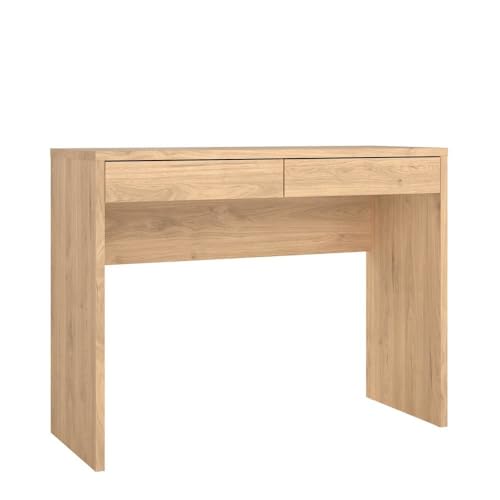
Furnifact Brown Wood Desk with Drawers — Elegant brown finish
Furnifact’s writing desk closes the guide with the least specified and most atmospheric proposition: a brown wood desk with drawers, presented in its title as an elegant computer study table for a bedroom or work from home. The word “elegant” is the maker’s own, and the desk’s pitch is clearly to the eye — a warm brown wooden desk that furnishes a room gracefully while providing the flat surface and drawers the writing form requires.
The title gives no dimensions, and this review treats that absence as the desk’s defining practical fact. Every other pick can be measured against a wall from its title alone; the Furnifact must be measured from its listing, and a buyer should do exactly that before anything else, because an elegant desk of the wrong size is a returning-desk. The same caution applies to its timber wording — “wood desk” is the claim as stated, neither upgraded nor disparaged here — and to the drawer count, which the title leaves at “drawers”.
What can be judged from the title is intent. Furnifact also made this guide’s walnut secretary desk, and the house style across both is traditional, warm and furniture-minded. A writer whose room is already furnished in browns, whose desk will stand in a bedroom and be seen by guests, and who is willing to do ten minutes of listing homework for the measurements, may find this the most congenial surface here. Elegance is a legitimate criterion for an object you will face for thousands of mornings; it simply cannot substitute for a tape measure.
- Drawers: drawers stated in the title
- Finish: brown wood
- Positioning: home office, study table, bedroom or work from home, per the maker
- Dimensions: not stated in the title — take the exact size from the listing before ordering
- Construction: described as a wood desk in the title; confirm the material detail on the listing
Strengths
- A warm, elegant brown presentation aimed squarely at furnished bedrooms.
- Drawers included, keeping the writing plane clear in the class’s usual way.
- Traditional furniture-minded styling from the same maker as the guide’s walnut secretary desk.
Trade-offs
- No dimensions in the title; the listing check is unavoidable.
- Drawer count and timber specifics are likewise unstated in the title.
- Buyers wanting a fully documented specification will find the other picks easier to vet.
Best for: a writer furnishing a brown-toned bedroom who values the desk’s elegance and will verify its size on the listing.
Not suited for: a buyer working to a fixed alcove measurement who needs the footprint confirmed in the title itself.
The Furnifact listing’s dimension panel is the whole decision here; read it first, then judge the elegance.
How Do the Six Compare on Size, Drawers and Timber?
| Pick | Stated size | Drawers | Timber wording in title | Finish |
|---|---|---|---|---|
| SUSVQLXG | 47 x 22 in | 2 | Solid wood | Walnut |
| ODCVKRT | 47 in class | Stated, count not numbered | Solid wood | Natural wood colour |
| IronHaul | 47.2 in | 1 | Solid wood | Walnut colour |
| ADORZ | 47 in | Stated | Solid wood | Walnut, French country |
| ChooChoo | 39.4 in | 2 | Wooden desk | Natural oak, farmhouse |
| Furnifact | Not stated in title | Stated | Wood desk | Brown |
Read the timber column as a lesson in listing language. Four titles claim solid wood in so many words; two describe their desks as wooden or wood without the claim, and the guide has kept those wordings separate rather than blending them into a single reassuring story. Sizes are similarly uneven — five desks can be planned from their titles, one cannot — and the comparison table exists so those differences are visible at a glance rather than buried in prose.
How Should a Writer Set Up One of These Desks?
Begin with the surface and a rule: nothing lives on it permanently except the current work. Laptop or notebook in the centre of your seated position, reference material to the side of your non-writing hand, drink at the far corner where an elbow cannot find it. The drawers take everything else — pens and paper in the top or the single drawer, archives and cables in the second where one exists. A writing desk set up this way is ready in the time it takes to sit down, and readiness is half of a daily habit.
Consider the desk’s first morning as part of the setup. Assemble it where it will live if the room allows, because a 47-inch wooden desk carried through a doorway afterwards is a two-person negotiation. Wipe the surface, stock the drawers before the first session rather than during it, and let the desk’s first use be a real piece of work rather than an afternoon of arrangement — furniture that begins as a desk tends to remain one, while furniture that begins as a project tends to remain that too.
Chair and light come next. The chair should let your forearms rest level on the surface with your feet flat; writing desks sit at a fairly standard height, but your body is the variable, so test the pairing during the return window rather than assuming. Light should arrive over the shoulder opposite your writing hand for longhand, or from the side for screen work, and a small lamp with a warm bulb suits these wooden surfaces better than overhead glare.
Sound deserves one sentence of planning. A wooden desk in a quiet room is an honest acoustic surface — a fountain pen whispers, a mechanical keyboard announces itself to the household, and a mug set down hard at midnight carries. Writers who work while others sleep will find a desk mat and a felt pad under the laptop doing quiet, unglamorous good, and the drawers’ contents will stop rattling their accompaniment to every keystroke.
Finally, give the desk its boundary ritual. Writers who open the laptop, place the notebook and pour the drink in the same order each morning are building a starting signal that survives bad nights and blank pages. The desk’s single-purpose nature does the rest: sit here, and the work is the thing that happens here.
Does the Desk Care Whether You Write by Hand or on a Laptop?
Only in the details of depth and surface care. Longhand writing happens in a small, intense zone: a notebook, a pen, forearms planted, the rest of the desk almost irrelevant. Every pick here serves that zone well, and the hand-writer’s real decisions are about protecting the top — pen pressure through a single sheet can emboss wood, which is either a patina or a vandalism depending on temperament — and about light, since paper has no brightness slider. A writing mat solves the first; a window or a good lamp solves the second.
Typing rearranges the same surface differently. The laptop claims the centre, its screen sets the eye line, and the notebook migrates to the side as a satellite rather than the main instrument. Depth starts to matter more, because the laptop’s screen sits at the back of its own base, closer to the eyes than a notebook’s page ever gets. The SUSVQLXG’s stated 22 inches handles this arrangement comfortably; the desks whose titles withhold their depth should have that figure checked by laptop writers in particular, since a shallow top plus a large laptop equals a screen nearer than anyone prefers for eight hours.
Writers who alternate — drafting by hand, revising on screen, a common and honourable method — need the desk to convert gracefully between the two layouts, which is an argument for the clearest surfaces and the most accessible drawers in the guide. The conversion takes thirty seconds when the tools have homes; it takes ten minutes and a mood when they do not. Judge each desk by how quickly it can stop being one kind of writing surface and become the other.
Walnut, Natural or Oak: Which Finish Serves the Writing Life?
Walnut, in its three appearances here, is the finish of the traditional study: dark, serious, kind to the eyes during long sessions because it does not bounce light back at them. Its costs are housekeeping and mood — dust shows, pale paper scraps show, and in a small dim room a walnut desk can deepen the gloom it was meant to dignify. The SUSVQLXG and IronHaul wear it plainly; the ADORZ bends it into French country curves. Writers who work at night, under a lamp, often find walnut the most restful surface in this guide.
The pale finishes — the ODCVKRT’s natural wood colour and the ChooChoo’s natural oak — reverse every term of that bargain. They lend light to dim rooms, make pencil graphite and faint print easy to read, and record every ink spot and coffee ring as evidence. Farmhouse oak in particular is designed to absorb wear gracefully, ageing toward a lived-in look rather than a damaged one. Writers who draft in pencil, in morning light, in small north-facing rooms, will feel the pale desks working with them.
The Furnifact’s elegant brown splits the difference, warmer than walnut’s near-black depths, darker than oak’s pallor, and chosen by its maker to furnish rather than to disappear. There is no correct answer, only a correct match: the finish should agree with the room’s light, the writer’s hours and the household’s tolerance for visible evidence of work. A desk is faced more hours than most paintings; choose the colour you can face back.
How Long Should a Wooden Writing Desk Stay in a Writer’s Life?
Decades, if the category’s history is any guide. Writing desks are among the most inherited objects in domestic life, because their job never becomes obsolete: a flat surface and two drawers were sufficient in 1850 and are sufficient now. That longevity argues for buying the timber claim seriously — the solid wood titles in this guide are the ones that can be refinished, repaired and handed on — and for choosing a finish that will not date the piece to a single season’s fashion. The farmhouse and French country styles are the most period-marked here; the plain walnut and natural desks are the most timeless, which is either a virtue or a blandness depending on the buyer.
Longevity also argues for honesty about size. A desk bought for a box room at twenty-five may serve a study at forty, and the 47-inch models travel between those lives more gracefully than the 39.4-inch ChooChoo, which is a specialist for small spaces and proud of it. None of this means buying big against a small room — a desk that does not fit serves no life stage at all — but where two sizes both fit, the larger one usually serves longer.
And longevity reframes the drawers. One drawer, the IronHaul’s discipline, suits a young minimalist; two drawers accumulate a life’s worth of pens, notebooks and small archives more forgivingly. Writers rarely become less papered as they age. The desk that will still be right in twenty years is the one whose storage and surface both have a little mercy in reserve.
What Belongs in a Writing Desk’s Drawers?
Less than you think, arranged by the writing day rather than by category. The drawer you open hourly — the top one, or the IronHaul’s only one — should hold the instruments: pens that work, the current notebook’s companions, the charger, the reading glasses, the small tools whose absence breaks a session’s spell. A drawer that requires excavation has failed at its one job, which is to keep the surface clear without hiding anything you need in the next hour.
The second drawer, where the SUSVQLXG and ChooChoo provide one, is the archive of the near past: finished notebooks, the printed draft awaiting revision, the reference booklet for the current project. It should be emptied on a rhythm — each finished project promoting its papers to a shelf or a box elsewhere — because a writing desk’s storage is a waiting room, not a terminus. Writers who let the second drawer become permanent storage for a decade of paper will find the desk slowly turning into the filing cabinet it was chosen not to be.
How Does a Writing Desk Survive a Shared, Lived-In Room?
By negotiation conducted in advance. The desk’s claim is a clear surface and a single purpose; the household’s claim is that every horizontal plane in a small home eventually holds the post, the keys and someone else’s charging phone. The desks here help structurally — drawers swallow the writer’s own clutter so the surface starts each day defensible — but the boundary itself is social. A household that agrees the writing desk is out of bounds for overflow gets a writer who starts work in minutes; a household that treats it as a spare shelf gets a daily clearing ritual that taxes exactly the willpower the writing needs.
Children and animals test the arrangement in their own ways. A desk in a shared room will be drawn on, leaned on and, by cats, slept on with complete conviction. The farmhouse ChooChoo and the pale ODCVKRT forgive the evidence best; walnut shows every pale scratch like a chalk mark. A writing mat and a lidded drawer for the good pens are the practical defences, and the rest is temperament — most writers find that a desk which bears the marks of the household’s life is not diminished by them.
What Mistakes Do Writers Keep Making When Buying a Desk?
The first is buying a workstation when they needed a writing desk — a deep, cable-managed command centre that turns every session into office work and slowly teaches the writer to avoid it. The second is the reverse romance: choosing a beautiful antique-style desk too small for their actual method, then drafting at the kitchen table while the lovely desk holds a plant. Measure your working sprawl, not your aspirations.
The third mistake is skimming the timber wording. “Wooden” and “solid wood” are different promises at different prices, and this guide’s own table shows both wordings side by side. The fourth is neglecting the drawers’ shallowness — these are tool drawers, not filing cabinets, and the writer who needs archives within reach should plan a separate home for them. And the fifth is placing the desk in the room’s dead corner, facing a wall two feet away, when the window wall was available: writers stare into the middle distance more than any profession except lighthouse keepers, and the desk should give that stare somewhere pleasant to land.
Final Recommendation
The SUSVQLXG is the guide’s safest pair of hands: solid wood, two drawers, a fully stated 47 x 22 inch footprint in walnut. Choose the ODCVKRT for the same timber promise in a light natural finish, the IronHaul for single-drawer discipline and easy assembly, and the ADORZ when the room wants French country character. The ChooChoo owns the smallest rooms outright, and the Furnifact rewards the buyer who will verify its size and then enjoy the most elegant brown in the guide.
A writing desk succeeds when it disappears under the work — when the sentence, not the furniture, is what the morning is about. Pick the timber and finish your room can live with, keep the surface clear enough to begin in a breath, and let the drawers hold everything that is not the page.
It is worth saying plainly what this category asks of its buyer: a little faith in slowness. These desks will not raise themselves to your height, charge your phone or manage your cables, and they are not trying to. They offer a well-made plane of wood, in a quiet corner, on which the oldest writing technology there is — a person, a page, an hour — still works exactly as it always has. For the writer that is not a limitation. It is the entire invitation.
Frequently Asked Questions
Is 47 inches wide enough for full-time writing?
For the great majority of writers, yes. Forty-seven inches holds a laptop, an open notebook and a reference book simultaneously, with the drawers absorbing everything else. Writers whose method involves spreading many physical documents at once are the exception, and they should measure their working layout before choosing any desk in this guide — including the 47-inch models.
What is the real difference between the three walnut desks?
Drawers and character. The SUSVQLXG states two drawers and a 22-inch depth; the IronHaul states one drawer and easy assembly; the ADORZ adds French country styling to its drawers. All three claim solid wood in their titles. The choice is between specification completeness, minimalism and décor, in that order.
Can these desks handle a desktop monitor setup?
They are not designed for it. Their tops are shallower than office desks — 22 inches where stated — so a large monitor on a stand sits close, and none of the titles mentions monitor arms, cable trays or tower storage. A laptop-based writer is the intended user; a multi-screen worker should buy an office desk instead.
Does solid wood really matter for a writing desk?
It matters for longevity and repair. A solid top can be refinished after years of pen pressure and coffee rings, and solid edges survive knocks that expose the core of lesser constructions. It matters less for the first year of use, where all six desks here will feel perfectly serviceable. Buy solid wood when the desk is a decade-long companion; the titles that claim it are the SUSVQLXG, ODCVKRT, IronHaul and ADORZ.
Which desk suits handwriting rather than a laptop?
All six were shaped by longhand tradition, but the one-piece flat tops with the clearest surfaces — the SUSVQLXG and the IronHaul — suit notebook work best, ideally with a writing mat to protect the wood from pen pressure. The ChooChoo’s smaller top still fits a journal and a pen comfortably, which is all handwriting truly needs.
How should a writer choose between the ChooChoo and a 47-inch desk?
By the room’s tape measure first and the writing method second. If the wall or alcove cannot take 47 inches, the question answers itself and the ChooChoo’s 39.4 inches with two drawers is a genuinely capable desk, not a consolation. If both fit, choose by sprawl: screen-and-notebook writers will never miss the extra inches, while writers who spread books and printouts will feel the ChooChoo’s edges daily. Buy for the method you actually practise on an ordinary Tuesday, not the tidy method you practise in January.
Why does the Furnifact review keep mentioning its missing dimensions?
Because the title omits them, and a writing desk is bought to fit a specific corner more often than almost any other furniture. The desk may be excellent; the guide simply refuses to invent a size for it. Its listing carries the measurements, and checking them takes less time than returning a desk that guesses wrong.
Related Guides
- Best School Desks for Home Learning
- Best Roll-Around Computer Desks for Home
- Best Standing Desks for Tall People


