What's inside
- Key Takeaways
- Quick Picks
- How We Chose These Picks
- What Can You Actually Do With OpenWrt That Stock Firmware Forbids?
- How Do the Two VPN Traditions — Server and Client — Show Up in These Picks?
- What Should a First-Time OpenWrt Buyer Know Before the Box Arrives?
- Which Open Source Routers Repay a Model-by-Model Examination?
- How Does OpenWrt Change a Busy Household’s Traffic Manners?
- What Does a Homelab Owner Get From These Machines That Other Buyers Miss?
- How Does This Category’s Value Compare With Sealed Rivals?
- How Should an OpenWrt Router Be Maintained Across the Years?
- What Should the First Weekend With an OpenWrt Router Look Like?
- Which Pick Fits Each Kind of Open-Source Buyer?
- Can an OpenWrt Router Anchor a Larger Home Without a Branded Mesh Kit?
- How Do the Six Open Source Routers Divide by Ambition?
- What Goes Wrong When People Buy Their First Open-Platform Router?
- Final Recommendation
- Frequently Asked Questions
- Related Guides
As an Amazon Associate I earn from qualifying purchases. This post may contain affiliate links at no extra cost to you.
widgetverdict.com is reader-supported. When you buy through links on our site, we may earn an affiliate commission.
Where to buy: Open-source-friendly routers sell through the usual online marketplaces and the makers’ own stores, and each model below links to the Amazon listing checked for this guide; before ordering, note which of the two camps a model belongs to — a router that ships with OpenWrt already installed, or one merely ready to accept it — because that distinction, printed in the listings, decides your first evening with the machine.
Searching for the best open source routers means shopping for a philosophy as much as for hardware. A router running OpenWrt — the community-built, Linux-based operating system for network devices — can be inspected, configured and extended in ways no sealed consumer firmware permits: custom firewall rules, a vast library of installable packages, traffic control of professional granularity, and updates governed by an open project’s release rhythm rather than by a manufacturer’s marketing calendar. The six picks below all open that door, but they open it from very different houses: two GL.iNet flagships built for whole homes, the official OpenWrt One hardware from the Banana Pi project, a value WiFi 6 router from Cudy that welcomes the firmware, and two GL.iNet travel routers that carry the same freedom in a coat pocket.
One clarification belongs at the front, because the category’s language is slippery. “Open source router” can mean three things: hardware that ships with OpenWrt installed and supported by its maker, hardware whose maker blesses OpenWrt installation without shipping it, and hardware the community has adopted regardless of the maker’s feelings. This guide’s picks live in the first two camps, which are the camps a buyer can rely on. Where a listing says “pre-installed OpenWrt”, the freedom is the factory state. Where it says “OpenWRT-Ready”, the freedom is an invitation, and the first-evening flashing procedure is part of the purchase. The reviews keep the two situations clearly separated.
The audience splits just as clearly. Some readers want OpenWrt because they intend to use it — the packages, the rules, the VPN servers, the graphs. Others want it as an insurance policy: a router whose software future cannot be orphaned by one company’s decisions, because the community maintains the platform. Both are honourable reasons, and the picks serve both, but they serve them differently — the tinkerer should weight the OpenWrt One and the Flint 2 heavily, while the insurance-buyer can take any pick here and run its stock arrangement with a clear conscience.
Key Takeaways
- Every pick either ships with OpenWrt installed or is explicitly OpenWrt-ready in its listing — the two honest forms of “open source router”.
- The GL.iNet Flint 2 (GL-MT6000) is the whole-home flagship: 8-stream WiFi 6, dual 2.5G ports and pre-installed OpenWrt with OpenVPN and WireGuard.
- The GL.iNet Flint 3 (GL-BE9300) adds tri-band WiFi 7 with 6GHz and five 2.5G ports for the newest devices.
- The Banana Pi OpenWrt One is the project’s own official hardware, with mainline support — the purist’s board.
- The Cudy WR3000S is the value route: AX3000 WiFi 6, five gigabit ports and OpenWRT readiness at a mainstream tier.
- The Opal and Beryl AX prove the philosophy travels: full OpenWrt VPN routers at 145g and pocket scale.
Quick Picks
| Pick | Badge | Why it earns its place |
|---|---|---|
| GL.iNet Flint 2 (GL-MT6000) | The OpenWrt flagship | 8-stream WiFi 6 with dual 2.5G ports and pre-installed OpenWrt, OpenVPN and WireGuard for whole homes. |
| GL.iNet Flint 3 (GL-BE9300) | The WiFi 7 flagship | Tri-band WiFi 7 with 6GHz, five 2.5G ports and VPN-router positioning for 8K streaming and calls. |
| Banana Pi OpenWrt One | The official hardware | The OpenWrt project’s own WiFi 6 router with mainline support, MediaTek MT7981B and 1GB DDR4. |
| Cudy WR3000S (AX3000) | The value OpenWrt-ready pick | AX3000 WiFi 6 with five gigabit ports, VPN server and client, Cudy Mesh support and cloud control. |
| GL.iNet Opal (GL-SFT1200) | The pocket travel router | AC1200 dual-band OpenWrt with three gigabit ports and 30+ VPN services at 145g. |
| GL.iNet Beryl AX (GL-MT3000) | The WiFi 6 travel router | WiFi 6 travel router with 2.5G WAN, gigabit LAN, USB 3.0 and OpenWrt VPN duties. |
How We Chose These Picks
The first filter was the openness itself, verified from the listings rather than from reputation: a model had to state OpenWrt pre-installed, OpenWrt support or OpenWRT readiness in its own title, because a buying guide should grade the promise a buyer can read, not the folklore a forum remembers. That filter produced a field dominated by GL.iNet, which has built its entire brand on shipping OpenWrt-based routers, joined by the OpenWrt project’s official hardware and by Cudy’s value line. The second filter was role separation across the six: a whole-home flagship for each wireless generation, the purist’s board, the value single, and two travel machines that differ by a full WiFi generation from each other.
The third filter was honesty about who should not buy in this category at all. OpenWrt rewards curiosity and punishes indifference; a household that wants the network to vanish should buy a sealed mesh kit and never think about firmware again. Every review below therefore grades two things at once — the hardware, and the relationship with open software that the hardware invites — because in this category the second is half the product. Readers whose openness interest is really about deep proprietary control rather than community firmware will find a different answer in Best Synology Routers, where the platform is polished, closed and administrated rather than open.
What Can You Actually Do With OpenWrt That Stock Firmware Forbids?
Start with the package ecosystem, because it is the difference between a router and a small server that also routes. From OpenWrt’s repositories an owner can add network-wide advertisement and tracker blocking, dynamic DNS clients, sophisticated traffic shaping that tames bufferbloat on busy lines, detailed per-device monitoring, mesh protocols, captive portals, and VPN servers and clients in several flavours — and can remove any of it just as cleanly. The firewall is a real firewall, expressed in rules the owner writes and can read. The interface offers both a web panel and full command-line access for those who want it, and every configuration can be exported, versioned and restored, so the network’s entire personality becomes a file its owner possesses.
The second freedom is temporal. A sealed router’s software life ends when its maker loses interest; an OpenWrt device’s life is governed by the project’s support for its chipset, which routinely outlasts the maker’s attention by years. Security updates arrive on the community’s rhythm. Features arrive the same way. That is why the OpenWrt One’s “mainline support” phrase matters so much in its listing: mainline means the device is supported by the project’s own core builds rather than by a fragile side branch, which is the strongest longevity statement any router in this guide can make. Freedom, in this category, is mostly a synonym for not being stranded.
How Do the Two VPN Traditions — Server and Client — Show Up in These Picks?
OpenWrt routers treat VPN as a first-class duty in both directions, and the listings here reflect that. As clients, these machines can route some or all of a network’s traffic through a commercial VPN service — the GL.iNet travel routers are famous for exactly this, with the Opal’s listing naming more than thirty supported services — which covers every device behind the router, including televisions and gadgets that cannot run VPN software themselves. As servers, they let their owner reach home from anywhere: the Flint 2’s listing names OpenVPN and WireGuard pre-installed, the Cudy WR3000S names both VPN server and client roles, and WireGuard in particular has become the modern default for its speed and simplicity of configuration.
The travel routers deserve a special word here, because their VPN story is a safety story. A laptop on hotel or café WiFi is a machine on a stranger’s network; a pocket router that first joins that network itself, then wraps everything behind it in an encrypted tunnel to a trusted endpoint, converts a public room into a private one for every device the traveller owns — phone, laptop, tablet — with a single sign-in at the router instead of a negotiation per device. That is the use case that built GL.iNet’s reputation, and it explains why two of this guide’s six picks weigh less than a paperback. Whole-home buyers should read the same features differently: for them, the VPN server is the headline, because reaching the home network — its files, its cameras, its machines — from a hotel room is the trick a sealed router makes hardest.
What Should a First-Time OpenWrt Buyer Know Before the Box Arrives?
Three things, none of them frightening. First, the stock experience on the GL.iNet machines is deliberately gentle: GL.iNet ships its own friendly interface layered over OpenWrt, so a beginner can run the router as an appliance on day one and descend into the full OpenWrt interface — a click away — only when curiosity or a specific project demands it. The freedom is staged, not forced. Second, the community is the manual: OpenWrt’s documentation and forums are deep, current and written by the people who build the platform, and the correct first skill is searching them before changing a setting, because almost every beginner’s question has been asked and answered thoroughly. Third, back up before you experiment. OpenWrt makes configuration export easy; the owners who enjoy the platform for years are the ones who snapshot before each adventure, so every experiment has an undo.
One expectation deserves setting in the other direction. Open hardware does not mean unlimited hardware: these are routers, with router processors and router memory, and the package ecosystem will happily let an owner install more ambition than a travel router’s chip can serve. The Flint flagships carry the headroom for heavier packages; the pocket machines should be loaded with the traveller’s essentials — VPN, a tidy firewall, perhaps network-wide blocking — and left otherwise lean. Matching the software appetite to the silicon is the category’s one real skill, and it is learnable in an evening. Readers comparing this open route against the mainstream’s newest sealed flagships will find those in Best TP-Link Routers.
Which Open Source Routers Repay a Model-by-Model Examination?

GL.iNet Flint 2 (GL-MT6000) — The OpenWrt flagship
The Flint 2 is the machine most readers of this guide should picture first: a whole-home WiFi 6 router whose listing states 8-stream WiFi 6 at 6 Gbps aggregate — up to 1148 Mbps and 4804 Mbps across its bands — dual 2.5G multi-gig ports, pre-installed OpenWrt, and OpenVPN and WireGuard support, wrapped in a design its maker positions for gaming. The hardware choices are coherent in a way that signals intent. Dual 2.5G ports mean the OpenWrt experiments — a VPN server feeding remote workers, a NAS behind real firewall rules, traffic shaping on a multi-gig line — are not rationed by a gigabit choke point at the busiest sockets, and eight streams give a device-dense house genuine simultaneous capacity.
GL.iNet’s layered interface is the Flint 2’s diplomatic achievement: the household gets a friendly router, the owner gets full OpenWrt underneath, and neither audience has to care about the other. For the tinkerer, this is the pick with headroom — packages, rules and VPN duties a travel router cannot carry. For the insurance-buyer, it is a well-specified WiFi 6 flagship whose software cannot be orphaned. The honest limits are generational: no 6GHz band, so WiFi 6E and 7 devices visit as WiFi 6 guests, and its gaming positioning should be read as capacity and low-latency wired potential rather than as any promise about distant servers.
- Wireless: 8-stream WiFi 6, up to 1148 + 4804 Mbps per band figures in the listing title
- Wired ports: dual 2.5G multi-gig ports stated
- Firmware: OpenWrt pre-installed, per the title
- VPN: OpenVPN and WireGuard named
- Positioning in title: gaming router
- Model code: GL-MT6000
Strengths
- Pre-installed OpenWrt on flagship-grade hardware removes the flashing step entirely.
- Dual 2.5G ports keep VPN and NAS duties off the gigabit ceiling.
- Eight streams serve a device-dense house with real simultaneous capacity.
Trade-offs
- No 6GHz band, so the newest devices connect as WiFi 6 clients.
- Its headroom invites package enthusiasm that still needs matching to the silicon.
- Households that never open OpenWrt pay for depth they will not use.
Best for: a tinkering or insurance-minded household wanting whole-home OpenWrt with multi-gig ports and VPN duties. Not suited for: a 6GHz-or-nothing buyer whose newest devices demand the extra band — the Flint 3 below is that machine.
Read the Flint 2’s listing as two products in one box — a WiFi 6 flagship and an open platform — because that is exactly how its owners use it.

GL.iNet Flint 3 (GL-BE9300) — The WiFi 7 flagship
The Flint 3 moves GL.iNet’s flagship formula onto the newest standard: its listing describes a tri-band WiFi 7 router with the 6GHz band, five 2.5G ports, VPN-router positioning and a 9 Gbps wireless class framed around 8K streaming, low-latency gaming and video calls. Five multi-gig ports is a wired statement few flagships of any brand make — the desk behind this router can run a NAS, a workstation, a console and a switch uplink without a single gigabit straggler — and the tri-band layout gives WiFi 7 clients their wide 6GHz road while the older bands absorb the household’s long tail of gadgets.
Within this guide’s philosophy, the Flint 3’s role is precise: it is the pick for the buyer who refuses to choose between the newest radios and an open platform. That combination was, until recently, nearly impossible to buy, because open-firmware hardware traditionally trailed the standards by a generation. The same GL.iNet pattern applies — a friendly layer over the open system — so the machine can serve a household while its owner explores. Its premium over the Flint 2 buys the 6GHz band, the extra ports and the longer runway; buyers whose devices are all WiFi 6 vintage should weigh honestly whether that runway will be used before the next replacement cycle makes it moot.
- Wireless: tri-band WiFi 7 with 6GHz, 9 Gbps class, per the listing title
- Wired ports: 5 × 2.5G ports stated
- Positioning in title: VPN router for 8K streaming, low-latency gaming and video calls
- Firmware family: GL.iNet’s OpenWrt-based platform, as with the range
- Model code: GL-BE9300
Strengths
- Tri-band WiFi 7 with 6GHz ends the open-platform generation lag.
- Five 2.5G ports give the wired core uniform multi-gig speed.
- VPN-router positioning suits households that tunnel in both directions.
Trade-offs
- Its premium buys bands and ports a WiFi 6 household cannot yet use.
- No 10G port, so the fastest wired estates still meet a 2.5G ceiling per link.
- The newest platform in an open ecosystem means the community’s polish is still maturing around it.
Best for: a future-leaning household wanting WiFi 7 radios, a uniform multi-gig wired core and an open platform in one box. Not suited for: a WiFi 6 household counting value — the Flint 2 delivers the same philosophy a generation cheaper.
Count your 2.5G devices before reading the Flint 3’s listing; its five-port back panel is the argument, and your desk decides whether it lands.

Banana Pi OpenWrt One — The official hardware
The OpenWrt One is the most conceptually interesting device in this guide: the OpenWrt project’s own official router hardware, built with Banana Pi, running WiFi 6 on a MediaTek MT7981B system-on-chip with 1GB of DDR4 memory, and — the listing’s key phrase — mainline support. Mainline means the project’s core builds support this board directly and durably, the opposite of the fragile, one-maintainer ports that strand so much open-firmware hardware. For the purist, that phrase outweighs every speed figure in this guide: this is the reference device, the one the platform’s own developers test against, and its software future is as close to guaranteed as open source can make it.
Its buyer should be equally clear about what it is not. The OpenWrt One is a developer-and-enthusiast board in router form, not a polished family appliance with a friendly layer over the top; the listing’s spare language — an RJ45 port is the only connectivity it bothers to name — signals a machine specified for people who will read the project’s documentation with pleasure. Its WiFi 6 radios serve a modest home or a lab bench rather than a device-dense household, and its natural habitats are the homelab, the network student’s desk, and the home of an owner who values the platform’s purity over a flagship’s muscle. In those habitats it has no rival in this guide.
- Wireless: WiFi 6, per the listing title
- Chipset: MediaTek MT7981B SoC stated
- Memory: 1GB DDR4 RAM stated
- Support model: official OpenWrt hardware with mainline support, as stated
- Wired: RJ45 port named in the title; full port layout is a documentation check
- Maker: Banana Pi (youyeetoo listing)
Strengths
- Mainline support is the strongest software-longevity promise in this guide.
- The project’s own hardware aligns its incentives perfectly with its users.
- An honest, documented platform for learning OpenWrt at its source.
Trade-offs
- No friendly consumer layer; the documentation is the interface’s companion.
- Its radio scale suits a modest home or a lab, not a device-dense household.
- The spare listing means port and accessory details require a documentation check before purchase.
Best for: an enthusiast, student or homelab owner who wants OpenWrt on the hardware the project itself blesses. Not suited for: a family wanting an appliance — the Flint 2 wraps the same platform in household manners.
Purists should read the OpenWrt One’s listing for the words “mainline support” and buy those two words; everyone else should know they are buying a board, not an appliance.

Cudy WR3000S (AX3000) — The value OpenWrt-ready pick
The Cudy WR3000S brings this category’s philosophy to the mainstream price tier: its listing states an AX3000 WiFi 6 router with 2402 plus 574 Mbps band figures, five gigabit Ethernet ports, OpenWRT readiness, MU-MIMO, Cudy Mesh support, VPN server and client roles, cloud control, and claimed coverage of 1,400 sq. ft. for up to 200 devices. Five gigabit ports deserves emphasis at this tier, where four is the norm and three is the economy — a wired television, console, desktop and NAS can all plug in without a switch. The 200-device claim is the usual architecture statement rather than a stress test, but it correctly signals a router aimed at the gadget-estate era.
The word “ready” carries this pick’s one condition, and the review must state it plainly: OpenWRT-Ready means the door is open, not that the buyer walks through it on day one. Owners content with Cudy’s stock firmware — which already offers VPN server and client duties that many sealed rivals omit — can run it as an ordinary router indefinitely. Owners who want the full OpenWrt platform will perform the installation themselves, following the project’s documentation for this model, with the usual backup-first discipline. Either way, the hardware underneath is the value story: current-generation radios, a full port count and mesh compatibility, at the tier where this guide’s flagships cost multiples.
- Wireless class: AX3000 WiFi 6, 2402 + 574 Mbps band figures, per the listing title
- Wired ports: 5 × gigabit Ethernet ports stated
- Firmware: OpenWRT-Ready, as stated — installation is the owner’s step
- VPN: server and client roles both named
- Claimed coverage / devices: 1,400 sq. ft. / 200 devices, manufacturer figures
- Extras in title: MU-MIMO, Cudy Mesh support, cloud control
Strengths
- Five gigabit ports is wired generosity the mainstream tier rarely matches.
- Stock firmware already includes VPN server and client roles.
- OpenWRT readiness gives the hardware a second software life on demand.
Trade-offs
- OpenWrt is an installation project here, not the factory state.
- Gigabit ports cap multi-gig plans and fast local links.
- Its claimed coverage suits flats and small houses, not sprawling floor plans alone.
Best for: a value-minded flat or small house wanting current radios, full ports and an open firmware door. Not suited for: anyone expecting OpenWrt to be running before the kettle boils — the Flint models ship with the platform already home.
Read the WR3000S’s listing for its ports first and its readiness second; the hardware justifies the purchase before the philosophy is even opened.
GL.iNet Opal (GL-SFT1200) — The pocket travel router
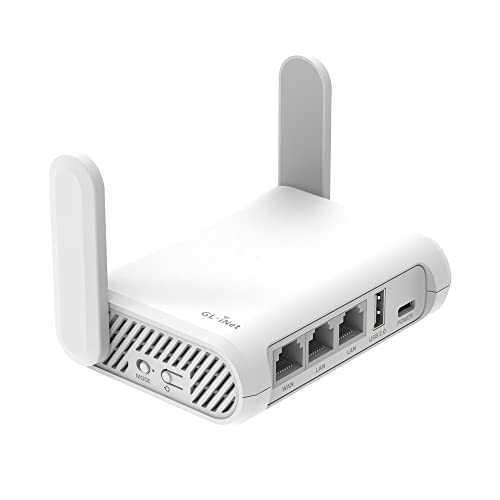
The Opal is the travel router in its classic form: an AC1200 dual-band machine weighing 145 grams, with three gigabit ports, OpenWrt underneath, and OpenVPN and WireGuard support across more than thirty VPN services, per its listing. Its job description fits in one sentence — arrive at a hotel, a rental or a conference, join the house network once through the Opal, and let every device you own connect to your own small, encrypted, familiar network instead. The pocket weight is not a gimmick; it is the difference between a router that lives in the travel kit permanently and one that gets left behind on busy mornings.
Its limits are the honest physics of its size and generation. AC1200 dual-band radios serve a hotel room and its handful of devices gracefully and a family suite adequately; they are not a whole-home answer, and the Opal should never be bought as one. Its three gigabit ports, generous for a travel machine, let a laptop dock properly wired at a rental desk while the radios serve the phones. Travellers whose kit has moved to WiFi 6 should step to the Beryl AX below; travellers whose kit is a phone, a laptop and a streaming stick will find the Opal’s cheaper, lighter formula precisely fitted to the bag it disappears into.
- Wireless class: AC1200 dual-band WiFi 5 generation, per the listing title
- Wired ports: 3 gigabit ports stated
- Weight: 145g, as stated — pocket class
- Firmware: OpenWrt, per the title
- VPN: OpenVPN and WireGuard, with 30+ VPN services named
- Model code: GL-SFT1200
Strengths
- 145 grams makes it a permanent resident of any travel kit.
- One sign-in at the router replaces per-device negotiations with strange networks.
- Three gigabit ports are generous wired manners for a pocket machine.
Trade-offs
- AC1200 radios are a generation behind the Beryl AX’s WiFi 6.
- It is a room-scale router; whole-home ambitions embarrass it.
- Hotel networks with elaborate captive portals can still demand patience at first join.
Best for: a frequent traveller with a phone-and-laptop kit who wants every trip’s network private and familiar. Not suited for: a family of five in a large rental leaning on it as a house router — that load belongs to the Beryl AX at minimum.
If your travel kit is already packed to the gram, the Opal’s listing weight is its headline; read the VPN service list second and buy both.

GL.iNet Beryl AX (GL-MT3000) — The WiFi 6 travel router
The Beryl AX is the travel formula modernised: a WiFi 6 pocket router whose listing states 574 Mbps on 2.4GHz plus 2402 Mbps on 5GHz, a 2.5G WAN port, a gigabit LAN port, USB 3.0, and OpenWrt with VPN duties. The 2.5G WAN is the specification that surprises — multi-gig wired internet at a rental desk or a conference table, fed into a machine that fits beside a phone — and the WiFi 6 radios serve a traveller’s current kit at its native standard rather than a generation down. USB 3.0 adds the travel router’s quiet party trick of sharing storage or a tethered connection, duties the listing’s owners will configure through the open platform.
Between the two travel picks, the Beryl AX is the one to buy for the next several years of trips: its radios match the devices travellers now carry, its WAN matches the wired connections increasingly found in good rentals and workspaces, and its OpenWrt depth supports the full tunnel-home arrangement — not merely a commercial VPN, but a WireGuard road back to the Flint-guarded home network, so a hotel room inherits the house’s own rules and reaches its files. The Opal remains the lighter, cheaper answer for lighter kits. The Beryl is the answer for the traveller whose road kit has become a genuine mobile office.
- Wireless class: WiFi 6 dual-band, 574 + 2402 Mbps band figures, per the listing title
- Wired ports: 2.5G WAN and gigabit LAN stated
- USB: USB 3.0 port stated
- Firmware: OpenWrt, per the title
- VPN: OpenWrt VPN duties named in the title
- Model code: GL-MT3000
Strengths
- WiFi 6 radios serve current travel kits at their native standard.
- A 2.5G WAN port is rare wired ambition in a pocket machine.
- USB 3.0 widens its tricks — shared storage and tethering among them.
Trade-offs
- One LAN port means a second wired device needs a small switch or the radios.
- Its premium over the Opal buys radios a light kit may not yet own.
- Room-scale coverage, like every travel router, is a feature — not a flaw to discover at home.
Best for: a mobile professional whose travel kit is a real office and whose rentals increasingly offer fast wired internet. Not suited for: a minimalist traveller counting grams and devices — the Opal’s lighter formula fits that bag better.
Road warriors should read the Beryl AX’s listing from the WAN port outward; it is the rare travel router specified for the connections the road now offers.
How Does OpenWrt Change a Busy Household’s Traffic Manners?
The complaint that brings many owners to this category is not raw speed but unfairness: one person’s cloud backup swells until another person’s call stutters, on a line that speed tests insist is fast. The underlying disease is bufferbloat — bloated queues inside the network that trade latency for throughput — and OpenWrt’s traffic-shaping packages are the category’s most loved medicine, because they let the router arbitrate the line intelligently, keeping interactive traffic crisp while bulk transfers take the capacity that remains. Sealed routers increasingly offer a gaming mode that gestures at the same idea; OpenWrt offers the actual machinery, configurable to the household’s line and legible to its owner.
The same legibility extends to visibility. An OpenWrt owner can watch traffic per device and per destination with a precision that turns household mysteries into short investigations: the camera that phones home constantly, the console whose update explains Tuesday’s lag, the gadget whose chatter justifies its exile to a restricted segment. None of this requires professional training — it requires a platform that shows its working, and a willingness to look. Households that will never look should not buy the microscope; households tired of guessing will find these features, once lived with, very hard to surrender.
What Does a Homelab Owner Get From These Machines That Other Buyers Miss?
A second network, honestly labelled. Homelab owners run experiments — a small server, a self-hosted service, a test environment — that should never share a trust level with the family’s banking laptops, and OpenWrt’s segmentation lets one router maintain that border properly: the lab on its own segment with its own rules, reachable where the owner permits and invisible where they do not. The Flint 2’s dual 2.5G ports suit this life particularly, because lab traffic between a server and a workstation can run at multi-gig pace inside its own lane. The OpenWrt One serves the same owner as the lab’s dedicated citizen — a documented, mainline board on which experiments cannot endanger the household’s main router at all.
The lab case also explains this category’s loyalty economics. A sealed router is replaced when its maker moves on; an OpenWrt machine is re-roled — flagship to lab router, lab router to travel spare, travel spare to a relative’s flat — because its software keeps renewing its competence. Owners in this world measure a router’s life in roles rather than years, and the six picks here are unusually re-roleable: even the travel machines can end their days as a dedicated VPN endpoint on a home network. That afterlife is part of the purchase price’s justification, and it never appears on a sealed rival’s box.
How Does This Category’s Value Compare With Sealed Rivals?
Honestly, and better than outsiders expect. The Cudy WR3000S stands comparison with any sealed value router on hardware — five gigabit ports and AX3000 radios are competitive anywhere — while adding the open door its sealed rivals lack; a shopper cross-shopping the value tier in Best Tenda Routers will find similar hardware money buying a platform whose future belongs to its maker instead. The GL.iNet flagships price against the mainstream’s sealed flagships and justify the comparison in ports and platform rather than in app polish. The travel pair have no sealed equivalent of consequence at all, because the pocket VPN router is a category the open world essentially invented.
Where sealed rivals win, they win on ceremony: glossier apps, gentler first evenings, support desks that answer telephones. An open-platform buyer trades some of that ceremony for sovereignty, and should make the trade knowingly. The category’s value argument is therefore not that these routers are cheaper — several are not — but that each unit of money buys more years, more roles and more say. For the right owner that is the best arithmetic in networking; for the wrong owner it is an invitation to administer a system they never wanted, at a price that included the invitation.
How Should an OpenWrt Router Be Maintained Across the Years?
With rhythm rather than heroics. Check for platform updates on a calm schedule — quarterly suits most households — and read the release notes before applying them, because an open project’s notes are written for owners who read. Keep a rolling pair of configuration backups, one before each update and one after the network has proven itself for a week, stored somewhere that is not the router itself. Prune the package list annually with the same fresh eyes this site recommends for client lists: every installed service is a small ongoing responsibility, and the router that runs six things its owner uses beats the one that runs sixteen things its owner has forgotten.
Finally, keep the household’s documentation as open as its firmware. A single page — where the backups live, which packages were installed and why, what the firewall’s exceptions are for — turns the network from one person’s memory into a household asset that survives holidays, absences and the owner’s distraction. Open platforms reward documented owners disproportionately, because everything about the system can be written down truthfully. That page, more than any package, is what separates the OpenWrt households that thrive for a decade from the ones that factory-reset in frustration in year two.
What Should the First Weekend With an OpenWrt Router Look Like?
Saturday morning belongs to restraint. Set the router up as an appliance: update its firmware, reuse the household’s existing network name and password so every device rejoins without a re-pairing marathon, place it well, and take the first configuration backup before changing anything interesting. Then run one — exactly one — project from the list that brought you to this category. For most households the best first project is the VPN server, because its payoff is immediate and testable from a phone on mobile data: reach the home network from outside, open a file, close the tunnel, and feel the platform’s point land. The second-best first project is traffic shaping on a line that suffers at peak hours, tuned conservatively and judged across a week of evenings.
Sunday belongs to documentation and one more backup. Write the page described in the maintenance section — what was installed, what was changed, where the backups live — while the weekend’s decisions are still memorable, and export the configuration again now that the network is in its intended shape. Resist the third project. The owners who love this platform in year three are the ones who built it in layers, each layer understood before the next began; the owners who reset in frustration are the ones who installed a dozen ambitions in a weekend and could not say which one broke the printer. OpenWrt’s freedom is permanent, so there is no deadline on using it — next weekend exists, and the router will be exactly as configurable then.
Which Pick Fits Each Kind of Open-Source Buyer?
Run the six past the category’s four temperaments and the shortlist writes itself. The sovereignty buyer — motivated by not being stranded, intending to run the router as an appliance with the open door kept as insurance — belongs on the Flint 2, or the Flint 3 if the household’s devices already speak WiFi 7, because both wrap the insurance in a layer the household never has to think about. The practising tinkerer, who has a list of packages in mind already, belongs on the same Flints for their headroom, with the OpenWrt One as the second machine their lab will inevitably acquire. The student of networking belongs on the OpenWrt One first and foremost, because learning the platform on its own reference hardware makes every document read like it was written about their desk — which it was.
The remaining two temperaments divide by itinerary. The value buyer, whose openness is opportunistic — glad of the door, unwilling to pay flagship money for it — is the Cudy WR3000S’s exact reader, and should run its capable stock firmware until a specific project justifies the installation weekend. The traveller divides by luggage philosophy: the Opal for the one-bag minimalist whose network needs are a phone, a laptop and privacy; the Beryl AX for the mobile professional whose road office has outgrown minimalism. What none of the four temperaments should do is buy across them — the student does not need the flagship’s streams, the sovereignty buyer does not need the reference board’s purity — because in this category the fit between temperament and machine is the entire purchase.
Can an OpenWrt Router Anchor a Larger Home Without a Branded Mesh Kit?
Yes, by composition rather than by kit. The open world’s answer to the far bedroom is to add another OpenWrt device as an access point — wired back to the anchor where cabling allows, configured with the same network names, and governed by the same owner’s rules — or, where cable is impossible, to use the mesh protocols the platform supports between compatible devices. The Cudy’s listing even names its maker’s own mesh support for buyers who prefer the paved road. Either way, the architecture stays legible: one router governs, additional radios extend, and no proprietary cloud mediates between the owner and their own hallway.
The trade against a branded mesh kit is ceremony, again. A kit’s nodes marry themselves, steer clients with one brain and update as a fleet; a composed OpenWrt system asks its owner to make those decisions — placement, channels, which device anchors which segment — and rewards the asking with control that kits reserve for themselves. Large homes in this category therefore tend to standardise: a Flint as the anchor and governor, a second open unit as the far-room extension, everything documented on the household’s one page. It is more work than a kit and more durable than a kit, which is this entire category’s bargain stated in a single floor plan.
A final word on security, because openness cuts both ways and this guide should say so. An open platform’s code can be inspected by anyone — which means its flaws are found by a global community and patched on that community’s rhythm, but also that its owner inherits responsibilities a sealed platform hides: keeping the system updated, choosing packages from the project’s own repositories, and understanding that a powerful firewall configured carelessly is worse than a simple one configured well. The picks here mitigate the burden differently — GL.iNet’s layer keeps defaults sane for households, the OpenWrt One assumes a reader of documentation — but none of them removes it. Sovereignty, in networking as elsewhere, is a chore with excellent benefits.
How Do the Six Open Source Routers Divide by Ambition?
| Model | Role | Wireless | Wired highlights from the title | OpenWrt status |
|---|---|---|---|---|
| GL.iNet Flint 2 (GL-MT6000) | Whole-home flagship | WiFi 6, 8-stream | Dual 2.5G ports | Pre-installed |
| GL.iNet Flint 3 (GL-BE9300) | WiFi 7 flagship | Tri-band WiFi 7, 6GHz | 5 × 2.5G ports | GL.iNet OpenWrt-based platform |
| Banana Pi OpenWrt One | Official hardware | WiFi 6 | RJ45 named; see documentation | Official, mainline support |
| Cudy WR3000S (AX3000) | Value single | WiFi 6 AX3000 | 5 × gigabit ports | OpenWRT-Ready |
| GL.iNet Opal (GL-SFT1200) | Travel | AC1200 dual-band | 3 × gigabit ports | Pre-installed |
| GL.iNet Beryl AX (GL-MT3000) | Travel | WiFi 6 dual-band | 2.5G WAN, gigabit LAN, USB 3.0 | Pre-installed |
The status column is this table’s soul, and it divides the six into three honest grades: pre-installed, where the platform is the factory state; official mainline, where the platform’s own project guarantees the future; and ready, where the door is open and the walking through it is yours. None of the grades is a criticism — the Cudy’s readiness at its price is a gift, and the Opal’s pre-installation at 145 grams is an achievement — but a buyer should know which grade they are purchasing, because it decides whether the open chapter begins on the first evening or the first free weekend.
What Goes Wrong When People Buy Their First Open-Platform Router?
The commonest failure is enthusiasm without a snapshot: the new owner installs packages, edits firewall rules and follows three forum threads in the first evening, breaks something at midnight, and cannot retrace the evening’s steps because no configuration backup exists. Export before every adventure; the platform makes it easy, and the habit converts disasters into five-minute restorations. The second failure is loading a small machine like a flagship — a travel router asked to run a VPN, a blocker, a monitoring suite and a file service simultaneously will serve all four badly, and the owner blames the platform for arithmetic the silicon announced in advance.
Two quieter mistakes follow. Owners sometimes treat community documentation as fine print and guess at settings that the wiki explains precisely, particularly around firewall zones, where a guessed rule can quietly open what the owner meant to close; in an open system, reading is a security practice. And households occasionally buy an open router as a protest purchase — against subscriptions, against sealed platforms — without actually wanting to administer anything, then resent the machine for inviting involvement. The protest is honourable and the GL.iNet layer makes it survivable, but the honest appliance-buyer should still choose an appliance. Openness is this category’s entire reason to exist; a reader who does not want it should not pay for it in attention, however little it costs in money.
Final Recommendation
Choose by the depth of involvement you actually want. Whole-home buyers who will use the platform should take the Flint 2, whose pre-installed OpenWrt, dual 2.5G ports and eight streams carry years of projects; buyers who want the newest radios with the same philosophy should step to the Flint 3. Purists and students belong on the OpenWrt One, where mainline support makes the platform itself the product. Value buyers should take the Cudy WR3000S and its open door, and travellers should divide by kit: the Opal for light bags, the Beryl AX for mobile offices. If one pick must represent the category, it is the Flint 2 — the machine that proves an open router can be a household’s flagship rather than its hobby, with the freedom kept in reserve for the day it is wanted.
Frequently Asked Questions
Is OpenWrt difficult for a beginner to live with?
On the GL.iNet machines, no: their own interface runs the router as an appliance, and the full OpenWrt environment waits underneath for the day you want it. On the OpenWrt One, the platform is the whole experience, which beginners can certainly learn — the documentation is excellent — but should choose deliberately rather than by accident.
Can I break the router by installing the wrong package?
You can break the configuration, which is why backups precede adventures in every piece of advice this guide gives. A saved configuration restores in minutes, and OpenWrt’s recovery practices are well documented by the community. Permanent hardware damage from ordinary package experiments is not the realistic risk; lost evenings are, and snapshots insure against those.
Does running OpenWrt void the maker’s warranty or support?
On routers that ship with OpenWrt or state readiness in their listings, the open platform is part of the product’s own proposition, and GL.iNet’s entire brand rests on it. The precise warranty terms remain each maker’s to state, so read the current terms for your model — but a buyer of these six is not sneaking anything past anyone.
Which pick is best as a dedicated VPN router for the whole home?
The Flint 2 for most homes: pre-installed OpenVPN and WireGuard, dual 2.5G ports and the processing headroom to tunnel a household’s traffic without becoming the bottleneck. The Flint 3 steps that answer up for WiFi 7 households, and the Cudy covers the same duties at a value tier with its server and client roles.
Can a travel router really replace hotel WiFi sign-ins for all my devices?
That is its designed trick: the router joins the property’s network once, including through most sign-in pages, and your devices join only the router. Every device then shares the router’s VPN tunnel if you run one, and the per-device negotiation with a stranger’s network happens exactly once per stay.
How long will these routers keep receiving software updates?
Longer than sealed rivals, as a structural matter: OpenWrt support follows the chipset and the project’s builds rather than a marketing calendar, and the OpenWrt One’s mainline status is the strongest form of that promise. No open project guarantees eternity, but the difference between community-governed support and a discontinued product line is the difference this whole category exists to sell.
Can these routers run network-wide ad and tracker blocking?
Yes — that is one of the package ecosystem’s most popular uses, and the flagship Flints carry it comfortably for a whole household. The travel machines can run lighter versions for a room’s worth of devices. As with every package, match the ambition to the silicon and keep a configuration backup from before the installation.
Do I need to use the command line to run an OpenWrt router?
No. OpenWrt’s web interface covers the configuration most owners ever touch, and GL.iNet’s own layer covers the household basics in friendlier language still. The command line exists for those who want it — and some advanced packages are happier there — but it is a door, not a toll. Owners routinely run these routers for years through the web panels alone.
Can one of these routers replace my internet provider’s supplied router entirely?
Usually, yes, subject to how your connection is delivered. Where the provider’s box is a combined modem-router, the common arrangement is to set it to a bridge or modem-only mode where it offers one and let the OpenWrt machine govern — or to place the OpenWrt router behind it for everything except the line itself. Either way the household’s rules, VPN and visibility live on the open machine, which is the point of the purchase.
What is the difference between OpenWrt pre-installed and OpenWRT-Ready?
Pre-installed means the router leaves its maker already running the platform — the GL.iNet machines and the OpenWrt One in this guide — so the open chapter begins at setup. Ready means the maker blesses installation on hardware that ships with its own firmware, as with the Cudy WR3000S, so the buyer performs one documented installation step to get there. Both are legitimate; they differ in whose evening does the work.
Related Guides
For deep, polished control on a closed platform, read Best Synology Routers. For the mainstream’s newest sealed flagships, see Best TP-Link Routers. And for value hardware where the firmware question is answered very differently, Best Tenda Routers completes the comparison.


