What's inside
- Key Takeaways
- Quick Picks
- How We Chose These Picks
- Comparison Table
- What Should You Do If One Drive in Your 3TB Array Just Failed?
- How Do You Migrate a Whole Array From 3TB Drives to Larger Ones?
- Why Did 3TB Disappear, and What Does That Teach About Buying Storage?
- How Do You Read a Drive’s Health Report Before Trusting It?
- Should a Household Replace Its Two-Bay Box Instead of Feeding It New Drives?
- How Should a NAS Backup Be Built Around Drives This Size?
- How Do You Stagger Replacements So an Array Never Grows Old All at Once?
- What Mistakes Do Owners of Ageing NAS Arrays Keep Making?
- Final Recommendation
- Frequently Asked Questions
- Related Guides
As an Amazon Associate I earn from qualifying purchases. This post may contain affiliate links at no extra cost to you.
widgetverdict.com is reader-supported. When you buy through links on our site, we may earn an affiliate commission.
Here is the honest truth this guide is built on, stated before any product is named: the 3TB NAS drive is nearly extinct, and pretending otherwise would waste your money. Search for the best 3tb nas hard drives today and you will find a ghost category — a capacity the market has quietly stepped over, with 4TB models replacing 3TB SKUs on shelf after shelf until the older size survives mainly as old stock, refurbished pulls, and listings that turn out to be something else when the box arrives. Manufacturers stopped treating 3TB as a living size because 4TB costs them barely more to make, uses the same modern platters, and sells for a clearer premium. So this roundup does the genuinely useful thing instead of the merely literal thing: it ranks the NAS drives that bracket the 3TB mark — the 2TB and 4TB models you can actually buy new today, plus the 8TB step-up for growing archives — and explains exactly when each one serves a buyer who came here looking for three honest terabytes of network storage.
How to shop this guide, given that unusual situation: the linked picks lead to their Amazon pages, where you can check price on Amazon and confirm the capacity printed on the listing matches the drive in the review, a check that matters more than usual in a category where mislabelled leftovers circulate. The prose-only picks include the drives we would consider if a genuine 3TB-class unit or a close alternative crosses your path through other channels, with the vetting each of those routes demands. Nobody should ever pay a scarcity premium for a nominal 3TB drive when a current 4TB model sits beside it; that single sentence is the whole market in miniature.
Why did 3TB exist at all, and why does it linger so stubbornly in search boxes? It was once the sweet spot: the largest capacity built from mature platter technology before densities jumped, and a generation of two-bay and four-bay NAS units shipped into homes sized around it. Owners of those systems now search for replacement drives in kind, and upgraders remember the size fondly. The kindest service a guide can do that audience is to say plainly that the ecosystem moved on — replacement-in-kind is no longer the sensible play, because a 4TB drive costs little more, works in the same bays, and restarts the reliability clock with fresh hardware and a full warranty.
Key Takeaways
- Genuine new 3TB NAS drives have effectively left the market; the honest shortlist brackets the size with current 2TB and 4TB models, and this guide says so rather than pretending otherwise.
- A 4TB NAS drive is the direct heir: same bays, same class, a little more room, current production, and a full warranty — buy it instead of hunting 3TB leftovers.
- The 2TB WD Red Plus remains the right answer for small two-bay systems whose data honestly fits, and for replacing one member of an older matched pair.
- Mixing a new 4TB drive into a 3TB RAID set works, but the array treats it as 3TB until every member grows — plan the migration rather than discovering it.
- Any 3TB drive offered today deserves age and health checks before trust: manufacture date, power-on hours, and a passed extended self-test.
- Refurbished 3TB units are acceptable only as members of redundant sets with verified backups, never as sole guardians of irreplaceable data.
Quick Picks
| Pick | Badge | Why it earns a place |
|---|---|---|
| Seagate IronWolf 4TB NAS Hard Drive | The 3TB heir | The current-production drive that takes the old 3TB role and adds a terabyte of headroom. |
| WD Red Plus 2TB NAS Hard Drive | Small-array staple | A conventional-recording NAS drive for compact two-bay systems and matched-pair replacements. |
| Seagate IronWolf 8TB NAS Hard Drive | Archive step-up | For owners whose “3TB problem” is really that they outgrew the size entirely. |
| WD Red Plus 4TB NAS Hard Drive | Western Digital’s bracket entry | The Red family’s 4TB answer for buyers loyal to its firmware and support ecosystem. |
| Toshiba N300 4TB NAS Hard Drive | Third-brand NAS option | A 7,200rpm NAS line for multi-bay systems, from the industry’s other major maker. |
| Genuine 3TB NAS drives (legacy stock) | The literal answer, with caveats | What to check if you insist on the exact size for a like-for-like replacement. |
How We Chose These Picks
Selection began with an audit of what “3TB NAS” even means in today’s catalogue, and the audit’s conclusion drives this whole guide: the living products are the neighbours. We therefore chose the strongest current NAS drives at 2TB and 4TB from the two dominant families, added the 8TB model for owners whose real problem is growth, and reserved prose for the third brand’s NAS line, Western Digital’s 4TB Red variant that our pool did not cover, and the legacy 3TB question itself. Every linked pick uses conventional recording, carries a genuine always-on NAS rating, and is built for multi-bay vibration — the three non-negotiables for this duty.
We also weighted how each candidate behaves inside real arrays built by real households. A replacement drive must resync without drama beside older, slower members; a new matched set should come from staggered batches when possible; health reporting should speak the NAS operating system’s language. Warranty handling mattered in proportion to the category’s oddity: with 3TB gone, buyers are making a five-year commitment to a size class, and the maker’s support record is part of the product. Drives whose NAS credentials were marketing rather than engineering — desktop drives in NAS costumes — were excluded without ceremony.
Finally, we priced honesty into the ranking itself. The IronWolf 4TB leads not because 4TB is a magic number but because it is where the market’s centre of gravity now sits: current production, broad availability, conventional recording, and a capacity that answers the 3TB question with room to spare. The guide’s structure — brackets first, the ghost size addressed head-on in its own review — is the shape the truth happens to have.
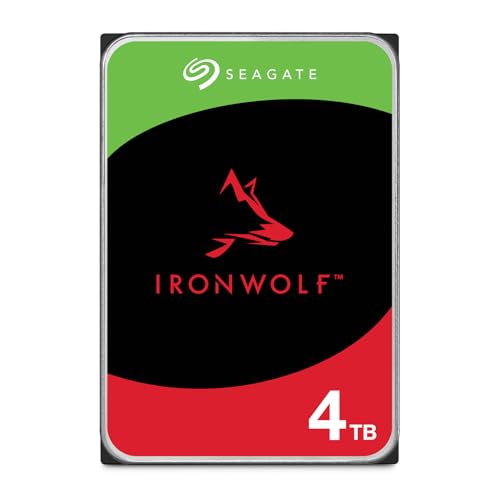
Seagate IronWolf 4TB NAS Hard Drive — The 3TB heir
If you arrived wanting three terabytes, this is the drive the market intends you to buy, and it makes the intention easy to accept. The IronWolf 4TB carries everything a home NAS drive should: conventional recording that tolerates the constant churn of synchronised folders and camera feeds, rotational-vibration compensation for life in a crowded enclosure, firmware that answers RAID controllers promptly instead of vanishing into retries, and an always-on rating that treats your box’s 24-hour life as the design brief. It is, in every way that affects your data, the modern answer to the question the old 3TB models used to answer.
The extra terabyte over the size you searched for is not a trivial bonus. In a mirrored pair it is a terabyte of protected headroom — roughly the difference between pruning the photo archive every spring and forgetting about capacity for years. In a parity array it compounds across bays. And because the drive is current production, you are buying a fresh reliability clock and a full warranty rather than the remaining life of a size the industry retired. Owners replacing a failed 3TB member of an array should note the one mechanical truth: the set will use this drive at the old member’s capacity until all members are 4TB, at which point most NAS platforms let the array grow into the new room.
Seagate’s health-management hooks into the major NAS operating systems give this drive a communication channel its desktop cousins lack, translating internal telemetry into warnings written for humans. In a four-bay household server it is the set-and-forget choice; in a two-bay it is the drive that lets a small system feel finished rather than provisional. Its spin class runs cooler and quieter than performance desktop drives, which suits a box that lives in a hallway or a study, and its power draw keeps a small UPS’s runtime honest.
The case against it is only the case against any heir: it is not literally the thing you searched for, and if your heart is set on a matched 3TB badge for reasons of symmetry, no specification will move you. Everyone else — which is to say, everyone whose goal is a reliable NAS rather than a museum — should buy this class of drive, in this capacity, and let the 3TB era close with the dignity of a size that served well and was honourably succeeded.
- Capacity: 4TB
- Form factor: 3.5-inch, NAS-optimised
- Recording technology: conventional magnetic recording
- Interface: SATA 6Gb/s
- Design features: rotational vibration sensors, RAID-tuned firmware, health management
- Duty rating: always-on, multi-bay
Strengths
- Current production with a full warranty and fresh reliability clock.
- Conventional recording suits nonstop household server churn.
- Health reporting integrates with major NAS platforms.
Trade-offs
- Arrays use it at 3TB until every member drive grows.
- Costs more than the leftover 3TB stock it replaces.
- Cooler spin class prioritises stamina over desktop snap.
Best for: a two- or four-bay home NAS owner replacing a failed drive or building fresh, who wants the current size the industry actually supports. Not suited for: a collector determined to keep a legacy array at exactly 3TB per member regardless of age.

WD Red Plus 2TB NAS Hard Drive — Small-array staple
The lower bracket matters because not every NAS is an archive-in-waiting. A two-bay box guarding a family’s documents, a modest photo library, and device backups may never outgrow two mirrored terabytes, and for that household the WD Red Plus 2TB is the correctly sized, correctly engineered answer. The Plus designation is doing real work in the name: it marks Western Digital’s conventional-recording NAS tier, the line built for always-on small arrays, as distinct from the plain Red models whose recording technology made them poor citizens in RAID rebuilds. This is the Red the community learned to specify by its full name, and the specification is earned.
In service, the Red Plus virtues are quiet ones. It runs cool in compact enclosures with modest fans, reports its health in terms NAS platforms understand, and behaves predictably during resyncs beside a twin. Its workload rating comfortably covers the small-array duty cycle — backups arriving nightly, a handful of users, a camera or two — and its long production history means its firmware manners are thoroughly mapped. For owners replacing one failed member of an older 2TB pair, it is also the least disruptive purchase in this entire guide: same size, same class, no array geometry changes to plan.
The honest limits are capacity and ceiling. Two terabytes mirrored is one terabyte-plus of usable, protected room in a mirror — fine for documents and photographs, tight for video archives — and a household that discovers media serving will outgrow it within a couple of years. The drive’s spin class favours cool stamina over speed, which a NAS should, but owners tempted to borrow it for a desktop will find it polite rather than brisk. Buy it sized for the data you have and the growth you can defend in a sentence; if that sentence includes the words “and then films,” buy the 4TB class instead.
As the bracket’s lower anchor, the Red Plus 2TB earns its place by being the drive a small NAS actually needs rather than the drive a catalogue wants to sell. It is also the standing reminder that this guide’s honesty cuts both ways: just as nobody should chase a dead 3TB size upward in price, nobody should buy capacity their household will never use merely because the market’s centre moved.
- Capacity: 2TB
- Form factor: 3.5-inch, NAS-optimised
- Recording technology: conventional magnetic recording
- Interface: SATA 6Gb/s
- Positioning: small NAS systems, up to mid-size bays
- Duty rating: always-on household and small-office arrays
Strengths
- Proper conventional-recording NAS engineering at a modest size.
- Cool, quiet running suits compact two-bay enclosures.
- Ideal like-for-like replacement for older 2TB array members.
Trade-offs
- Mirrored usable space is tight for video-heavy households.
- Easy to outgrow if media serving enters the picture.
- Stamina-tuned pace feels merely polite in a desktop.
Best for: a two-bay NAS guarding documents, photos, and device backups for a household whose archive grows slowly. Not suited for: a budding media server whose library already leans against the terabyte line.

Seagate IronWolf 8TB NAS Hard Drive — Archive step-up
Some readers searching for 3TB drives are not replacing a failure or building small; they are standing in front of a full NAS wondering how the archive ate three terabytes so quickly. For them the useful answer is not the neighbouring size but the decisive one. The IronWolf 8TB doubles the heir’s capacity in the same NAS-rated, conventional-recording, vibration-aware package, and it converts the storage conversation from annual pruning to long-term planning. A mirrored pair holds a serious media library and a family’s full history; a parity set across four bays becomes infrastructure a household can build on for the rest of the decade.
The drive’s behaviour under server duty is the reason to choose it over a cheap desktop 8TB. It ingests while it streams, reports errors in the prompt dialect RAID controllers expect, and tolerates the shared vibration of a full enclosure as a designed condition rather than an insult. Its health-management integration gives the NAS platform the telemetry to warn you early, which matters more as capacities grow: the bigger the drive, the longer its rebuild, and the more valuable a week’s warning becomes. Power and heat stay civilised for its size class, keeping small enclosures and small UPS units within their comfort.
Responsibilities scale with terabytes, and this guide will not let the point go unmade: an 8TB member makes parity rebuilds long affairs, so dual parity or a disciplined external backup of the irreplaceable material stops being advice and becomes architecture. The purchase also deserves a growth audit — if your archive took five years to reach 3TB, an 8TB step buys a decade; if it took eighteen months, buy the size and the redundancy together, because you are building a library with momentum.
Within this roundup’s honest framing, the 8TB IronWolf is the answer for the reader whose 3TB search was really a growth problem wearing a replacement problem’s clothes. It is the most expensive direction here and, for the archive that needs it, the cheapest outcome over time — because the only thing costlier than buying capacity ahead of need is migrating an array twice.
- Capacity: 8TB
- Form factor: 3.5-inch, NAS-optimised
- Recording technology: conventional magnetic recording
- Interface: SATA 6Gb/s
- Design features: rotational vibration sensors, health management, always-on rating
- Typical roles: media archives, growing family servers, small-business storage
Strengths
- Archive-scale capacity with full NAS credentials.
- Steady behaviour while ingesting and streaming simultaneously.
- Early-warning health reporting suits long rebuild windows.
Trade-offs
- Long rebuilds demand dual parity or strong external backups.
- Capacity premium is wasted on slowly growing collections.
- Physical and electrical demands exceed compact entry NAS units.
Best for: a media archivist whose library outgrew the 3TB era in eighteen months and shows no sign of slowing. Not suited for: a documents-only two-bay box that would leave most of the drive empty for years.
WD Red Plus 4TB NAS Hard Drive — Western Digital’s bracket entry
Households loyal to Western Digital’s NAS ecosystem will notice the gap in our linked picks and ask the fair question: where is the Red at 4TB? It exists, it is the correct counterpart to the IronWolf that leads this guide, and it appears in prose for a procedural reason — our verified pool for this round did not include its listing, and we link only what we have verified. The drive itself needs no apology: conventional recording, small-array NAS firmware, cool manners in compact enclosures, and a support ecosystem many owners already know from their existing Red-based systems.
The practical differences between the two great NAS families at this size are narrower than forum arguments suggest. Both record conventionally, both report health to the major NAS platforms, both are rated for continuous duty in multi-bay company. The Red Plus line’s character leans toward the small end of the market — its spiritual home is the two-bay and four-bay box — while Seagate’s line stretches further up the bay counts. A household replacing drives inside an existing Red array should keep the family: matched firmware behaviour during resyncs is worth more than any marginal specification advantage a switch could offer.
Buying route is the whole discussion here. Source the Red Plus 4TB from a retailer you trust, read the full model name twice — the Plus is the tier you want, for the recording-technology reasons this guide repeats — and verify the capacity and warranty on arrival. Do that, and you own the equal of our lead pick wearing the other badge, which in this mature category is a compliment to both makers.
We flag one habit that matters more with this drive than most: because the Red family’s naming has confused buyers before, photograph the label when the drive arrives and keep the invoice with the NAS records. If a warranty conversation ever happens, the household that can produce model, serial, and purchase date in one minute gets the replacement; the household that cannot gets a research project.
- Capacity: 4TB
- Form factor: 3.5-inch, NAS-optimised
- Recording technology: conventional magnetic recording
- Interface: SATA 6Gb/s
- Positioning: small and mid-size NAS arrays
- Duty rating: always-on
Strengths
- Full NAS credentials in Western Digital’s ecosystem.
- Natural replacement inside existing Red-based arrays.
- Cool, composed behaviour in compact enclosures.
Trade-offs
- Not linked here; requires careful shopping for the Plus tier.
- Family naming has historically confused capacity and tier.
- Oriented to smaller arrays than high-bay systems.
Best for: an owner refreshing an existing WD Red array who wants to stay within the family’s firmware and support. Not suited for: a buyer who wants to click a verified listing in this guide and be done.
Toshiba N300 4TB NAS Hard Drive — Third-brand NAS option
Toshiba’s N300 is the NAS line from the industry’s third maker, and it brings one specification the other families reserve for their upper tiers: a 7,200rpm spin across much of the range, giving arrays a livelier feel in metadata-heavy work and media indexing. It is covered in prose because our pool did not verify a listing for it this round, but the drive’s credentials are genuine — NAS-rated workload allowances, vibration handling for multi-bay life, and positioning aimed at systems that run around the clock for households and small businesses alike.
The faster spin cuts two ways in a NAS context. Indexing a huge photo library, serving several streams, and running the household’s sync services concurrently all feel a touch more responsive; in exchange the drives run a little warmer and more audibly than the cooler classes, which matters if the NAS lives in a bedroom-adjacent cupboard. Enclosures with honest airflow erase most of the objection. Small offices that treat the NAS as a working file server rather than an archive often prefer exactly this temperament, because their array spends its day answering people rather than sleeping between backups.
Toshiba’s challenge in this category is neither engineering nor price but presence: fewer retailers stock the N300 prominently, support conversations are less commonly documented in community forums, and a buyer may wait longer for a like-for-like replacement. None of that disqualifies the drive; it merely prices in a little patience. Owners who deliberately diversify brands across an array — a legitimate strategy against batch-wide flaws — often land on the N300 as the second family’s representative, and it holds that role honourably.
Choose the N300 when its 7,200rpm character matches a working-server NAS, when a trusted retailer stocks it on clear terms, or when your array strategy calls for a second brand done properly. Skip it when the NAS must be inaudible in a quiet home or when next-day replacement availability is part of your peace of mind.
- Capacity: 4TB
- Form factor: 3.5-inch, NAS-optimised
- Rotational speed: 7,200rpm
- Interface: SATA 6Gb/s
- Positioning: home and small-business NAS, working file servers
- Duty rating: always-on, multi-bay
Strengths
- 7,200rpm pace enlivens indexing and busy file service.
- Genuine NAS workload and vibration credentials.
- Useful second brand for diversified arrays.
Trade-offs
- Warmer and more audible than cooler NAS classes.
- Thinner retail presence slows replacement logistics.
- Less community documentation than the big two families.
Best for: a small office whose NAS serves files actively all day and benefits from the faster spin. Not suited for: a bedroom-cupboard NAS where acoustic manners outrank responsiveness.
Genuine 3TB NAS Drives (Legacy Stock) — The literal answer, with caveats
This final pick is not a product so much as a situation, and it deserves a review of its own because some readers will pursue it regardless: the remaining genuine 3TB NAS drives in the world. They exist as unsold old stock, manufacturer-recertified units, and pulls from decommissioned systems, wearing familiar badges — IronWolf and Red drives were both made at this size, alongside Toshiba’s earlier NAS lines. A unit from that population can be a perfectly serviceable array member. It can also be a five-year-old drive with a hard life behind it and a listing written to obscure the fact, and the difference between those two objects is entirely in the vetting.
The vetting ritual is non-negotiable and takes an hour. Before purchase, demand the manufacture date and refuse anything whose seller will not provide it; a “new” 3TB drive manufactured years ago has spent those years ageing on a shelf, which is better than ageing in a server but is not the same as fresh. On arrival, read the full SMART report: power-on hours should match the story you were sold, the reallocated-sector count should be zero or near it, and the drive must pass its extended self-test before it meets your data. Then, and only then, introduce it to the array — as one member of a redundant set, with a verified backup standing behind the whole arrangement.
Economics deliver the final verdict on the literal route. A genuine 3TB unit priced near the current 4TB models is a bad purchase wearing nostalgia’s clothes, because the 4TB drive brings a fresh warranty and a longer future for similar money. The legacy size only makes sense at a clear discount, for a specific purpose: replacing one member of a matched 3TB set to keep an old array whole for another year or two, where the alternative is migrating every drive at once. Even then, treat the purchase as buying time, not as a strategy — the migration to current sizes is coming for every 3TB array still spinning, and planning it beats being surprised by it.
Our closing word on the ghost size is affectionate but firm. The 3TB NAS drive served a generation of home servers well, and the systems built on it deserve honourable maintenance. Honourable maintenance, in 2026, means fresh drives at living sizes, verified backups, and no scarcity premiums paid to the past.
- Capacity: 3TB (legacy production)
- Form factor: 3.5-inch, NAS models from retired lines
- Recording technology: conventional in the NAS variants
- Availability: old stock, recertified units, system pulls
- Required checks: manufacture date, power-on hours, extended self-test
- Appropriate role: one member of a redundant legacy array, at a discount
Strengths
- Exact like-for-like fit for surviving 3TB arrays.
- Can be economical when honestly discounted.
- NAS engineering of its era remains fundamentally sound.
Trade-offs
- Age and history vary wildly between individual units.
- Warranty is short, expired, or seller-dependent.
- Often priced near current 4TB drives, which destroys the case.
Best for: an owner keeping a matched 3TB array alive one more season with a vetted, discounted replacement. Not suited for: any new build, any sole-copy storage, or any listing priced like a current drive.
Comparison Table
| Drive | Capacity | Recording | Status | Best role |
|---|---|---|---|---|
| Seagate IronWolf | 4TB | Conventional | Current production | The default 3TB replacement |
| WD Red Plus | 2TB | Conventional | Current production | Small arrays, matched replacements |
| Seagate IronWolf | 8TB | Conventional | Current production | Growing archives |
| WD Red Plus | 4TB | Conventional | Current production | Existing Red arrays |
| Toshiba N300 | 4TB | Conventional | Current production | Busy small-office NAS |
| Legacy 3TB NAS drives | 3TB | Conventional (NAS variants) | Discontinued | Vetted stopgap for old arrays |
What Should You Do If One Drive in Your 3TB Array Just Failed?
First, breathe: a redundant array with one failed member is degraded, not dead, and the correct tempo is prompt but unpanicked. Confirm which physical drive failed — by bay, by serial number, by the NAS interface’s identification, in that order — because pulling the wrong drive from a degraded array is the one unforced error that turns an errand into a disaster. Photograph the bay layout before touching anything. If the NAS offers a hot spare or an empty bay, the new drive can begin resyncing while the failed unit still sits in place, which is the gentlest sequence of all.
The replacement decision is where this guide’s thesis becomes practical. Buy the current 4TB class unless a vetted, discounted 3TB unit is genuinely available today; waiting a week for a legacy bargain while the array runs degraded trades real risk for small savings. Accept that the array will use the new drive at the old capacity for now. When the next member eventually fails — plan on the possibility rather than being ambushed by it — replace it at 4TB as well, and once every member has grown, expand the volume into the new space and enjoy the terabyte the market’s evolution quietly granted you.
While the resync runs, do the two things degraded arrays beg for: verify your external backup is current, and then leave the NAS alone. A rebuild is the hardest work an array ever does, and piling backups, streams, and scrubs on top of it lengthens the vulnerable window. When the resync completes, run a full consistency check, update your drive inventory notes with the new member’s serial and date, and reset the health alerts. The incident then closes as what it should be — a maintenance event, remembered in a notebook, not a story told with feeling.
How Do You Migrate a Whole Array From 3TB Drives to Larger Ones?
The graceful migration replaces one drive at a time, letting the array resync fully between swaps, and it suits households whose NAS must stay online throughout. Budget days, not hours: each swap at these capacities can take the better part of a day to rebuild, and the array is at its most fragile during each rebuild, so the external backup gets verified before the first drive is pulled and refreshed after the last. Replace the oldest or least healthy member first — SMART reports make that ranking easy — and keep each retired drive, labelled and untouched, until the whole migration plus a week of normal service has passed; those retired drives are your rollback and, afterwards, your cold spares and backup media.
The alternative migration builds fresh: a new set of drives, a new volume, and a copy of everything across, with the old array intact until the copy verifies. It costs more hardware at once but risks less, finishes faster, and leaves the old array as a complete fallback rather than a pile of pulled drives. Households whose NAS holds a business’s records should choose this route without debate; households with a media library that can be re-acquired can accept the graceful route’s slower risk. Either way, the moment the new array is live is the moment to re-examine the backup arrangement, because migrations have a way of quietly consuming the spare capacity the backup used to live on.
Whichever route you take, finish with documentation: new serials, install dates, batch notes, and the array’s new geometry, written where the next maintainer — future you, at midnight, again — will find them. Storage systems fail; documented storage systems get repaired.
Why Did 3TB Disappear, and What Does That Teach About Buying Storage?
The size vanished for manufacturing reasons that had nothing to do with buyers. Drive makers build capacities from platter densities, and when a new platter generation arrives, the arithmetic of the whole range shifts: the densities that once yielded 3TB now yield 4TB from the same part count, and keeping the old size in production means deliberately building a worse-value product. Retailers completed the execution by refusing to stock a size whose price sat awkwardly close to its bigger sibling. The lesson generalises beyond this guide: storage sizes are waypoints, not fixtures, and the buyer who standardises on a ecosystem’s current centre — its bays, its interface, its recording standards — rather than on a specific capacity will never be stranded the way 3TB loyalists briefly were.
There is a second, quieter lesson about search itself. People keep searching for 3TB NAS drives because their systems, their spare shelves, and their memories are indexed to the size, and the market keeps the phrase alive with leftover listings that profit from the confusion. Whenever a technology category’s vocabulary outlives its catalogue, buyers pay a confusion tax to whoever keeps the old words on the shelf. The defence is the habit this guide models: ask what the living products are, buy from among them, and let the vocabulary catch up.
How Do You Read a Drive’s Health Report Before Trusting It?
SMART data is the drive’s own diary, and a handful of entries tell most of the story. Power-on hours translate directly into age: a drive claiming to be new old stock should show hours in the single digits, while a pull from a working NAS will honestly show tens of thousands. Reallocated sectors are spots the drive has already retired for cause; a small, stable count on an old drive is a wrinkle, a growing count on any drive is a countdown. Pending sectors — areas the drive suspects but has not yet judged — deserve the most suspicion, because they often resolve into reallocations during the stress of a rebuild, which is precisely when you least want surprises.
The extended self-test is the diary’s sworn statement. It walks the entire surface and the mechanics through their paces over a few hours, and a drive that cannot complete it has told you everything a benchmark never will. Run it on any legacy 3TB candidate before it joins an array, run it on any new drive during its return window, and schedule it periodically on the array you depend on. NAS platforms automate most of this; the owner’s job is to read the results rather than admire the feature list, and to act on the first bad report rather than the fifth.
Temperature history and start-stop counts round out the picture. A drive that lived hot shows it in its maximum recorded temperatures, and one that power-cycled constantly in a desktop before being sold as NAS stock shows that too. None of these numbers alone convicts or acquits a drive; together they form the character reference that separates a vetted bargain from a stranger’s problem. In a category built on ageing hardware, that character reference is the product you are actually buying.
Should a Household Replace Its Two-Bay Box Instead of Feeding It New Drives?
The 3TB question sometimes conceals a platform question. A two-bay NAS from the size’s heyday may still be receiving security updates — or may have been abandoned by its maker years ago, which changes the calculation entirely: new drives in an unsupported box protect the data from disk failure while leaving it exposed to every network threat discovered since support ended. Check the enclosure’s update status before spending on drives. A supported box deserves fresh drives and years more service; an abandoned one argues for migrating to a current enclosure, at which point the drive choice resets to this guide’s living sizes with a clean conscience.
Capacity geometry informs the same decision. A two-bay mirror caps usable space at one drive’s capacity, so a household whose archive is galloping may find that moving to a four-bay box with parity buys more room per drive than any capacity step within two bays. Conversely, a household whose data is documents and photographs can run a two-bay mirror of 4TB drives for a decade without a second thought. The enclosure is the strategy; the drives are merely its current executors, and the 3TB era’s end is a natural moment to re-examine the strategy while the executors are being replaced anyway.
Power and noise complete the platform audit. Older enclosures idle thirstier and cool louder than current ones, and a NAS runs every hour of the year, so the electricity and the cupboard hum are real costs of loyalty to old hardware. None of this pressures anyone to replace a working, supported box — it merely ensures the decision to keep it is made with the full ledger open, drives included.
How Should a NAS Backup Be Built Around Drives This Size?
The classic formula asks for three copies of anything important, on two different kinds of storage, with one copy living somewhere else. A NAS array, however redundant, is only ever the first of those copies, because every drive in it shares the box, the building, and the network. The second copy is the easiest win in this entire guide: an external drive — quite possibly one of your retired 3TB units, vetted and labelled — that connects for a scheduled copy and then goes back into a drawer, unreachable by ransomware, power events, and curious deletions alike. The third copy, offsite, can be a second external drive rotated to a relative’s house or a cloud tier for the truly irreplaceable folders; it need not hold the media library, only the material that cannot be re-acquired.
Sizing the backup around bracket capacities is straightforward once the array’s own size settles. A mirrored pair of 4TB drives presents about four terabytes to protect, which a single large external drive or a small rotation of retired units can hold with room for versions. Versioning matters more than elegance: a backup that keeps several generations of your documents rescues you from the slow corruptions and mistaken edits that a mirror faithfully reproduces. Set the NAS’s backup job to retain history, test a restore of one ordinary file each season, and the arrangement graduates from intention to infrastructure.
Snapshots inside the NAS deserve their own sentence, because they are the layer owners most often mistake for the whole cake. A snapshot rolls back a deleted folder or a ransomware event beautifully — provided the box itself survives and stays honest. Treat snapshots as the fastest layer, the external copy as the truest layer, and the offsite element as the final word, and a household NAS built from this guide’s picks becomes genuinely hard to lose data from, which is the entire point of the exercise.
How Do You Stagger Replacements So an Array Never Grows Old All at Once?
Arrays bought as a matched set share a birthday, and shared birthdays in storage mean shared old age: drives from one batch, run under identical conditions, tend to fail in the same season. The staggered discipline breaks that symmetry deliberately. Once an array is established, replace its members on a rolling rhythm — the oldest drive each year or two, regardless of apparent health, retiring the removed unit to backup duty — so the set always contains a spread of ages and batches. The cost is a modest, predictable trickle instead of a frightening lump; the benefit is that a rebuild is never asked of a set of equally tired survivors.
Record-keeping makes the rhythm possible. A simple note — bay, model, serial, install date, source — turns replacement from archaeology into administration, and a calendar reminder set at each installation turns the next refresh into an appointment rather than an emergency. Households that adopt this rhythm during the current 3TB migration get a second dividend: the migration itself staggers naturally, one drive at a time, and the array that emerges at 4TB already has the age diversity that protects it for the decade ahead.
What Mistakes Do Owners of Ageing NAS Arrays Keep Making?
Paying the scarcity premium is the signature error: a leftover 3TB drive priced beside current 4TB models, bought because the number matches. Matching numbers feel safe and are not; matching class, recording technology, and health are what safety is made of, and a fresh 4TB drive delivers all three while the leftover delivers a familiar label. The second error is replacing a failed member with the cheapest desktop drive that fits the bay, importing desktop error-recovery behaviour into a RAID set — a mismatch that tends to announce itself during the very rebuild it was bought for.
Neglecting the array’s supporting cast runs third. Ageing NAS systems often sit on ageing power supplies, tired enclosure fans, and batteries in their UPS units that died unnoticed two summers ago; a drive refresh performed without checking those companions rebuilds the library on a rotten foundation. When you open the box to swap drives, clean the fans, confirm the temperatures, and test the UPS under load. The drives will outlast the box if the box is maintained; if it is not, they will not get the chance.
The final error is emotional and completely human: treating the array’s data as safe because the array is redundant. RAID is an availability technology, not a backup, and every household that has lost a redundant array to theft, fire, ransomware, or a controller failure learned the distinction at retail price. The migration this guide describes is the perfect moment to establish the external copy, because for one shining interval you own enough drives to hold everything twice.
Final Recommendation
Let the 3TB size rest. For nearly every reader, the Seagate IronWolf 4TB is the correct purchase: it is the living heir to the role, current, conventional-recording, and backed by a full warranty, and it quietly grants a terabyte of growing room as compensation for the size that vanished. Small arrays that honestly fit should take the WD Red Plus 2TB; archives in motion should step to the IronWolf 8TB; Red-loyal households should source the Red Plus 4TB carefully, and busy small offices should consider the Toshiba N300’s faster spin. Reserve genuine 3TB units for one vetted job — keeping an old matched array whole a little longer, at a discount, behind a verified backup.
The market moved a terabyte upward and called it the same price; the wise response is not nostalgia but acceptance, documented array notes, and a backup that lives outside the box. Do those things and your NAS stops being a museum of a discontinued size and goes back to being what it was always meant to be — the quietest, most reliable memory your household owns.
Frequently Asked Questions
Can I still buy a brand-new 3TB NAS drive?
Effectively, no — not as current production from the major makers. What remains is old stock, recertified units, and pulls, any of which may be serviceable after the vetting this guide describes, but none of which should be priced or trusted like a fresh drive. The living sizes are 2TB, 4TB, and above. If a retailer does offer you a sealed 3TB unit, the manufacture date on its label is the deciding document: a drive sealed recently as part of a final production run is a different proposition from one sealed half a decade ago, and the price should tell the same story as the date — if it does not, walk toward the 4TB shelf.
Will a 4TB drive work in my NAS that shipped with 3TB drives?
Yes, in essentially every case: the bays, interface, and NAS operating systems accept larger members readily. In a redundant set the new drive contributes at the smallest member’s capacity until all members are replaced, after which the volume can expand. Check your NAS maker’s capacity documentation only if the system is very old. One related comfort for owners of mixed generations: the NAS does not care that the new drive’s badge differs in size from its neighbours, and neither does the data. What the system cares about is that each member is healthy, correctly classed for array duty, and given time to resync completely before the next change is made — patience during each step is the whole technique.
Is it safe to mix a 4TB drive with 3TB drives in one array?
Safe and common, provided the new drive is a proper NAS model with conventional recording. Match the class, not the badge size. The array’s geometry follows the smallest member, rebuild behaviour stays predictable, and the mixture is the standard first step of the migration described above. Mixed arrays can live in that state indefinitely if life intervenes — there is no deadline by which the remaining members must grow — so a household can replace drives as failures or budgets dictate, over months or years, and the array will simply carry its mixed ages with the same quiet competence it asks of you.
Why do some listings still show 3TB drives at high prices?
Because scarcity and search habit create a market for the exact phrase, and some sellers price leftovers for the buyer who insists on the number. Compare any such listing against the current 4TB equivalent before paying: if the prices are neighbours, the fresh drive wins on warranty, age, and future support every time. The same comparison protects you in the opposite direction, incidentally — if a supposed current-model listing is priced far below every competitor, treat the bargain as a question rather than a gift, and check the seller, the model number, and the warranty terms with extra care, because in a category full of ageing stock, an implausible price usually has an explanation and it is rarely generosity.
How long do NAS drives typically last in home service?
Planning around a four-to-six-year working life is realistic for quality NAS drives in a cool, clean, UPS-protected box, with wide individual variation. That is why staggered replacement — refreshing members across years rather than all at once — keeps an array perpetually middle-aged instead of letting it grow old as a cohort. Treat any drive approaching the top of that range the way you would a car approaching a major service interval: not with alarm, but with a scheduled plan, a checked spare or replacement budget, and a verified backup, so that its eventual retirement is an appointment you keep rather than a surprise you survive.
What should I do with my retired 3TB drives?
After the migration has survived a week of normal service, retired drives make excellent cold backup media: write a copy of the irreplaceable archive, label the drive with its contents and date, and store it away from the NAS. Drives with any SMART blemishes should be wiped and recycled instead — a backup you cannot trust is just a rumour. Before wiping any retired drive that ever held personal or business data, use a proper erasure tool or the maker’s secure-erase function and let it run to completion; a quick format is a filing gesture, not a destruction method, and drives leaving your household — sold, donated, or recycled — should leave with nothing recoverable on them. The five minutes of ceremony is the last act of competent ownership.
My NAS has one 3TB drive and no redundancy. What is the smartest next purchase?
A second drive and a mirroring arrangement, before any capacity ambition: a single-drive NAS is one failure away from being a story, whatever its size. Buy the current 4TB class as the new member, let the system mirror your data onto it, and you have both redundancy and the first step of the size migration in a single purchase. After the mirror is healthy, the external backup copy becomes the next priority, ahead of any further capacity.
Does a NAS drive’s spin speed matter for home use?
Less than its class and recording technology, and mostly at the margins: faster-spinning NAS lines like the Toshiba N300 feel livelier when the box indexes large libraries or serves several users at once, while cooler classes run quieter and sip power in enclosures with small fans. For the backup-and-archive duty most home systems perform overnight, any proper NAS drive’s pace is sufficient, and the choice should be made on acoustics, heat, and support instead.
Related Guides
Keep going with best 10tb hard drives for the next capacity class up, best 3.5 inch hard drives for the full desktop and NAS landscape, and best 1 tb hard drives if your array’s needs turn out to be smaller than you feared.



[…] your storage research with best 7200rpm hard drives for a speed-first comparison, best 10tb hard drives when capacity planning gets serious, and best […]