What's inside
- Key Takeaways
- Quick Picks
- How did we narrow the field to these six onboard chargers?
- What does bank count really mean, and how many do you need?
- How much current per bank does a deep-cycle battery actually want?
- Why does onboard, sealed construction matter more than raw specs?
- How does maintainer duty change a deep-cycle battery’s lifespan?
- What changes when the boat lives on a trailer instead of a dock?
- The six marine chargers, reviewed in detail
- Which marine charger fits which battery bank?
- What mistakes sink marine charging setups?
- How should an onboard charger be installed and lived with?
- Final Recommendation
- Frequently Asked Questions
- Related Guides
As an Amazon Associate I earn from qualifying purchases. This post may contain affiliate links at no extra cost to you.
widgetverdict.com is reader-supported. When you buy through links on our site, we may earn an affiliate commission.
Where to buy: Amazon carries the NOCO onboard range and the independent multi-bank units below, usually alongside the ring terminals, extension cables and mounting hardware a permanent installation needs. Order the charger and the installation bits together; a charger that arrives Friday is no use if the cable run waits until Tuesday.
The best marine deep cycle battery chargers solve a problem that does not exist on land: batteries that live in a damp, vibrating hull, get drained hard by trolling motors and electronics, and then sit for a week or a month before anyone turns a key again. A garage charger clipped on for an afternoon is the wrong tool for that life. The right tool is an onboard charger, bolted down, wired to each battery bank, sealed against water, and plugged into shore power the moment the boat is back at the dock or on the trailer, where it charges, then maintains, indefinitely.
This guide compares six onboard chargers built for exactly that duty. Four come from NOCO’s GEN and GENPRO lines, in one, two and three-bank versions, and two are independent multi-bank units that compete on bank count and price position. Every figure we rely on, bank count, total amps, amps per bank, waterproof rating, battery chemistries named, comes from the listing titles themselves. Where a title is silent, about cable length or mounting pattern for instance, we flag the silence rather than filling it with a sibling model’s numbers, because on a boat the wrong assumption gets drilled into a transom.
Key Takeaways
- Bank count is the first decision: one charger bank per battery, so a single starting battery needs one bank, while a 24V trolling setup built from two 12V batteries in series needs two.
- Amps per bank set recharge pace. The titles here state totals from 5A on a single bank up to 10A per bank on the three-bank GENPRO and the independent 10X3 unit.
- All six picks are onboard, waterproof designs rated IP68 in their titles except the Smart 2-Bank, whose title claims waterproof construction without printing an IP number.
- Every title names both lead-acid and lithium support, so mixed fleets of AGM house batteries and a lithium trolling battery can share one charger family.
- Temperature compensation and overcharge protection appear across the NOCO titles, the features that make leave-it-plugged-in maintenance safe.
- Maintainer behaviour matters as much as charge speed for boats that sit; these chargers are built to stay connected, not to be clipped on and removed.
Quick Picks
| Pick | Badge | Why it earns its place |
|---|---|---|
| NOCO GEN5X1 | Single-bank onboard standard | A 12V 5A one-bank onboard charger and maintainer, IP68 sealed, for the single-battery boat that still deserves permanent charging. |
| NOCO GEN5X2 | Two banks, five amps each | The two-battery answer in this range: ten amps shared as five per bank, looking after a starting battery beside one deep-cycle, or a paired trolling setup. |
| NOCO GEN5X3 | Three banks, moderate current | Three banks at a calm five amps apiece, sized for a starting battery plus the two halves of a 24V trolling system on a weekly rhythm. |
| NOCO GENPRO10X3 | Three banks, ten amps each | The recovery specialist: thirty amps across three banks, ten apiece, for tournament and charter boats that fish again at dawn. |
| Smart 2-Bank Marine Battery Charger 10A | Independent two-bank with desulfator | A 10A two-bank waterproof charger, 5A per bank, naming a desulfator mode for AGM, lithium and deep-cycle batteries. |
| 3-Bank Marine Battery Charger 10X3 30A | Independent three-bank, full current | A 30A three-bank unit at 10A per bank, IP68 rated, built to stay connected around the clock. |
How did we narrow the field to these six onboard chargers?
We required three things before a charger could be considered. It had to be an onboard design, made to mount permanently and live in the boat’s environment rather than visit it. It had to state its bank count and output plainly in its title, because those two numbers decide fit. And it had to name both lead-acid and lithium in its supported chemistries, since modern boats increasingly mix an AGM starting battery with lithium deep-cycle power, and a charger that forces a fleet-wide chemistry choice is a charger that dates quickly.
We also read the titles the way an installer reads them, hunting for the words that predict regret. Waterproof without a number. Banks without a per-bank figure. Chemistry lists that name a family but not the battery in your compartment. Those silences are distributed unevenly across these six listings, and the spec boxes below preserve them faithfully, because a guide that rounds every claim up to the category’s best is not a guide at all, it is a brochure. Where a maker stated a protection or a rating outright, we credit it in plain terms; where they did not, the box says so, and the pick’s prose explains what that silence should mean for your mounting position or your winter plans.
Beyond those gates we looked for spread, not duplication. The six split into three pairs: single and dual-bank for smaller boats, moderate-current three-bank units, and full-current three-bank units, with a NOCO and an independent option at the top end. Portable chargers were excluded entirely, however good, because this category’s keyword is deep-cycle marine duty and the honest answer to that duty is fixed installation. Owners whose charging needs live elsewhere, on a bench or in a camper, will find the same bank-and-current logic applied to shore-powered leisure batteries in Best Inverter Chargers for Van Life, and to small two-wheeled packs in Best Scooter Battery Chargers.
What does bank count really mean, and how many do you need?
A bank is one independent charging output, wired to one 12V battery or one 12V leg of a system. The charger does not see your boat’s electrical layout as a whole; it sees individual batteries, each needing its own charge profile, its own recovery from a different depth of discharge. Your starting battery might end a trip nearly full from the alternator while the trolling batteries come home exhausted. Separate banks let one charger pamper the first and work hard on the second at the same time, which is the entire technical point of multi-bank hardware.
Counting banks is therefore a battery-counting exercise, done at the battery box rather than from memory of the boat’s spec sheet. One battery, one bank: the GEN5X1’s world. Starting battery plus a single house or trolling battery, two banks. The common tournament layout, one starting battery plus two trolling batteries wired in series for a 24V motor, needs three banks, because each 12V battery in that series pair is still charged as an individual 12V unit by its own bank. Owners regularly undercount here, buying a two-bank charger for a three-battery boat and leaving one battery to a portable unit, which defeats the plug-in-and-forget purpose of going onboard.
Series wiring deserves one more sentence, because it confuses buyers into shopping for a 24V charger. These six are 12V chargers per bank; the three-bank models charge a 24V trolling system by attending to its two 12V batteries separately, plus the starting battery on the third bank. That is the standard onboard arrangement, and it is why bank count, not system voltage, is the number to match when you order.
How much current per bank does a deep-cycle battery actually want?
Divide the title’s total amps by its banks and you get the number that governs your evenings. Five amps per bank, the rating shared by the GEN5X1, GEN5X2, GEN5X3 and the Smart 2-Bank, is a steady, battery-kind pace: a deep-cycle battery drained by a day of trolling recovers overnight, and the gentle rate suits smaller batteries and boats that sit at the dock between weekends with the charger maintaining anyway. Ten amps per bank, on the GENPRO10X3 and the independent 10X3, halves the recovery window in practical terms and suits big-capacity batteries, short turnarounds, and boats that fish consecutive days.
Worked examples make the arithmetic tangible. Picture a bass boat home at eight in the evening, trolling pair well drained, due at the ramp again at five. On 5A banks the recovery is a long night’s work with little margin for a late plug-in or a deeply flattened battery; on 10A banks the same evening holds slack, and slack is what real schedules consume. Now picture the same boat fishing one Saturday a fortnight. Both chargers finish before Sunday breakfast, and the faster one has sold its owner nothing but unused capacity. Neither picture is an argument; together they are the whole argument, because the correct charger is the one whose pace matches the tighter of your two calendars, the fishing one and the storage one.
The honest trade is time against temperament. A battery that has all week to recover gains little from 10A banks; a charter boat turning around at dawn gains everything. Lithium deep-cycle batteries, which all six titles claim to support, generally accept charge more eagerly than lead-acid, so the higher-current banks pair naturally with lithium trolling setups, while an all-AGM boat on a weekly rhythm will live happily at 5A per bank. Match the current to the turnaround you actually face, and remember that maintainer duty, the other ninety percent of an onboard charger’s life, is identical in concept across all six: full is full, and the charger’s job becomes watchful holding rather than pushing.
Temperature compensation, named in every NOCO title here, is the quiet feature doing safety work in that holding phase. Batteries accept and hold charge differently in a cold spring bilge and a hot August engine space, and compensation adjusts the charger’s behaviour to the conditions it senses. Combined with the overcharge protection the titles also name, it is what separates a charger designed to be left connected for a season from a workshop unit that merely tolerates being forgotten for a weekend.
Why does onboard, sealed construction matter more than raw specs?
A boat is a hostile shelf. Spray, rain through open hatches, washdowns, condensation and constant vibration all reach wherever a charger sits, and a portable unit with a fan vent and crocodile clips is not built for permanent residence in that weather. The IP68 ratings printed in five of these six titles describe sealed units intended to be mounted and left, with connections made once, properly, at installation. That permanence changes the ownership experience completely: charging stops being a task and becomes a state the boat returns to whenever shore power is near.
Installation permanence also disciplines the wiring. Ring terminals torqued onto battery posts, cables routed away from bilge water and chafe, the AC inlet placed where the shore cord reaches without strain, these are one-time efforts that pay out on every trip. The Smart 2-Bank’s title claims waterproof construction without an IP number; we note that distinction in its spec box rather than rounding it up to IP68, and buyers mounting in an exposed position should weigh it. Owners comparing charger families for other small vehicles will recognise the same sealed-versus-portable divide in Best Hearing Aid Chargers at a very different scale, where the charging case is likewise the product’s protective home.
How does maintainer duty change a deep-cycle battery’s lifespan?
Ask a battery dealer what kills deep-cycle batteries and the answer is rarely the dramatic one. Batteries seldom die mid-lake in a blaze of failure; they fade across winters, losing a slice of capacity each time they sit discharged, until a morning arrives when the trolling motor feels weak by ten o’clock. The mechanism is mundane: a lead-acid battery left at partial charge grows sulfate crystals on its plates, and while a healthy charge cycle softens fresh sulfation, months of sitting let it harden into permanence. Capacity lost that way does not come back, whatever a charger’s marketing implies.
That is the entire economic case for the maintainer half of these six products. The charging half gets the glory, amps and banks, but the holding half quietly defends the purchase price of the whole battery bank, season after season. A charger that keeps every bank at a correct, temperature-aware float or storage state converts your batteries from consumables with a two-season temper into equipment with a long, predictable life. When you compare the cost of any pick here against the cost of replacing a three-battery bank a year early, the maintainer features in the titles, temperature compensation above all, stop looking like fine print.
Lithium deep-cycle batteries play by different rules, they tolerate partial storage well and do not sulfate, but they bring their own requirement: a charger whose lithium profile respects the battery maker’s voltage limits and does not apply lead-acid habits like equalisation. Every title here names lithium support, and the owner’s responsibility is to select or confirm the correct profile per bank at installation. The charger provides the capability; the installer provides the correctness, and confusing those two responsibilities is how expensive batteries get charged on the wrong curve by a charger that knew better.
What changes when the boat lives on a trailer instead of a dock?
Dock-kept boats plug into shore power as a reflex. Trailer boats live a more interrupted life, garaged, driveway-parked, sometimes stored across town, and their charging setup has to survive that geography. An onboard charger still wins, because it travels with the batteries it serves; the adaptation is on the AC side, where a well-placed inlet lets an extension cord from the garage do the dock’s job. The discipline that matters is the plug-in moment: the cord should connect the same day the boat comes home, while the trip is still being unpacked, because a deep-cycle battery left flat for the fortnight before someone remembers it has already begun the sulfation clock described above.
Trailer storage adds two more considerations. First, ventilation and access: a charger maintaining batteries in a closed garage needs the same common-sense clearances as any electrical equipment, and the batteries themselves should be checked occasionally rather than sealed away and forgotten until spring. Second, winter. In cold climates the choice is between maintaining in the boat with power available, or removing batteries to a maintained indoor spot; both are defensible, and both beat the third option, abandonment in a frozen hull, which is how a remarkable share of marine batteries actually die. Whichever pattern you choose, one of these six chargers is the tool that makes it a system instead of an intention.
The six marine chargers, reviewed in detail
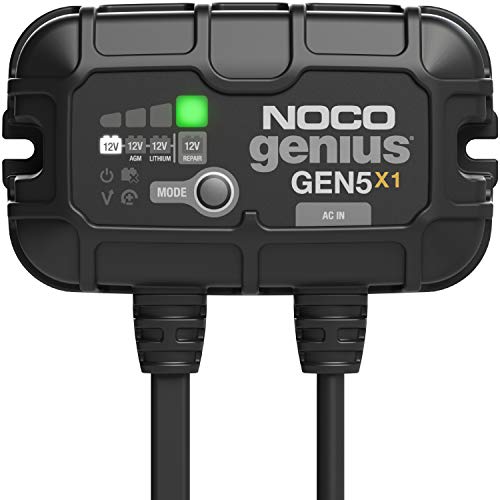
NOCO GEN5X1 — One bank, properly sealed, for the single-battery boat
Plenty of boats run one battery and run it hard: a jon boat with a single deep-cycle feeding a trolling motor and a fish finder, a small centre console whose starting battery also carries the electronics, a sailboat with one house bank. Those boats are routinely served worst by charging, because their owners assume a single battery does not justify installed hardware and fall back on clips and guesswork. The GEN5X1 is the correction. Its title describes a 12V 5A one-bank onboard marine battery charger and maintainer, IP68 waterproof, with overcharge protection and temperature compensation, for lead-acid and lithium batteries.
Five amps on one bank is a well-matched pairing for a lone deep-cycle battery in weekly service. The battery comes home drained, the charger works through the evening at a pace that does not bully it, and the maintainer side then holds it correctly for the days or weeks until the next launch. The feature list in the title, temperature compensation in particular, is the full-size NOCO behaviour rather than a stripped entry model, which means the single-battery owner is not asked to accept second-class care for having a smaller boat.
There is also a simplicity dividend that should not be undersold. A one-battery boat with this charger fitted has a one-step shutdown routine: connect the shore cord, walk away. No clips to position, no portable unit to fetch from a locker, no doubt in February about whether the battery was left charged or flat. Small boats live on spontaneity, the free afternoon, the surprise calm evening, and a battery that is always ready is what makes that spontaneity real rather than theoretical. The GEN5X1 sells readiness disguised as a modest black box.
The limits are arithmetic. One bank is one bank: add a second battery, for a bigger trolling motor or a separate house load, and this unit cannot grow with you, and its 5A pace is the range’s gentlest for a very large single battery facing short turnarounds. Buy it as the right-sized answer to a one-battery boat you intend to keep that way, and it will quietly be the most reliable component on board.
- Banks: 1 bank, charges 1 battery at once
- Total output: 12V 5A, so 5A on its single bank
- Sealing: IP68 waterproof per the title
- Chemistries named in title: lead-acid and lithium
- Protections named in title: overcharge protection, temperature compensation
- Cable length and mounting pattern: the listing title gives neither figure, so check the manufacturer documentation against your battery box before drilling anything
Strengths
- Full onboard treatment, sealed IP68 housing and temperature compensation, for a one-battery boat.
- Maintainer behaviour is designed for the long dockside sits that define small-boat ownership.
- Lead-acid and lithium support covers a future battery upgrade without a charger change.
Trade-offs
- No second bank exists when the boat inevitably gains another battery.
- Five amps is the gentlest pace here for a large battery on a tight turnaround.
- Fixed installation is wasted if the single battery lives out of the boat in winter storage elsewhere.
Best for: one-battery boats, jon boats, small consoles and single-house-bank sailboats that sit between outings.
Not suited for: any boat with two or more batteries to maintain, or a big single battery that must recover between consecutive days.
Single-battery boats deserve installed charging too, and the GEN5X1 is sized exactly for them; view the GEN5X1 on Amazon and measure your battery box before it ships.
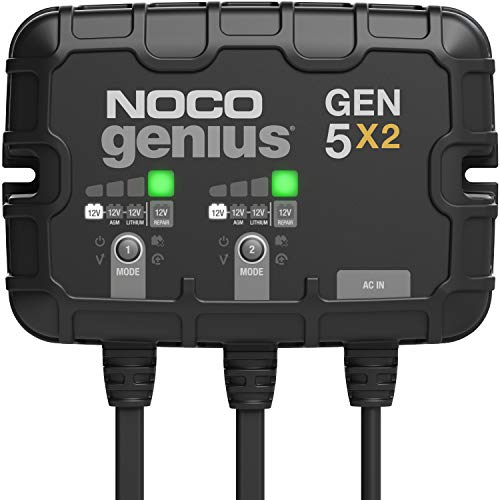
NOCO GEN5X2 — The two-bank default for starting plus deep-cycle
The GEN5X2 occupies the most common ground in recreational boating: two batteries, two jobs. One starts the engine, one runs the trolling motor or the house loads, and they live utterly different lives on the water. Its title states a 12V 10A two-bank onboard charger and maintainer, charging two batteries at once, sealed to IP68, with temperature compensation and overcharge protection, across lead-acid and lithium chemistries. Ten amps across two banks means 5A apiece, the same per-bank pace as the GEN5X1, now applied independently to each battery’s very different state of discharge.
That independence is the product. The starting battery, topped by the alternator on the run home, needs little more than supervision; the deep-cycle battery needs a night’s real work. A single-output charger with a splitter treats them as one battery and serves both badly. The GEN5X2’s banks let the charger be gentle where gentleness is right and busy where work exists, and because it is sealed and mounted, that judgement happens every time the shore cord connects, without the owner staging an intervention.
Consider the pairing it enables with a modest solar panel, a combination many two-battery boats drift toward. The panel handles the mooring or the week at anchor; the GEN5X2 handles the dock and the driveway. Because the charger is a maintainer as much as a charger, the handover between those two sources needs no ceremony, the boat is simply always being looked after by something. Owners who add solar later, and many do, find the onboard charger was the correct first investment, since it defines the battery care standard the panel then supplements.
Growth is its ceiling. A two-bank boat that becomes a three-bank boat, the day a 24V trolling motor arrives, outgrows it entirely, and the 5A per bank pace shares the GEN5X3’s gentleness rather than the GENPRO’s urgency. For the stable two-battery layout it is aimed at, though, this is the natural centre of the range: correct bank count, sensible current, full sealing, both chemistries.
- Banks: 2 banks, charges 2 batteries at once
- Total output: 12V 10A, working out to 5A per bank
- Sealing: the title rates the housing IP68 waterproof
- Chemistries in title: both lead-acid and lithium are named
- Protections in title: overcharge protection with temperature compensation
- Bank lead lengths: not printed in the listing title, so confirm reach in the manufacturer documentation if your two batteries sit far apart
Strengths
- Independent banks match the classic starting-plus-deep-cycle layout exactly.
- Five amps per bank is a kind overnight pace for typical recreational batteries.
- IP68 sealing and fixed mounting end the clip-on charger ritual for good.
Trade-offs
- A third battery, from a 24V trolling upgrade, leaves one battery unserved.
- Per-bank current is moderate, so very large batteries recover slowly.
- Both banks are 12V, so it cannot be reconfigured as a single higher-voltage output.
Best for: two-battery boats pairing a starting battery with one deep-cycle or house battery.
Not suited for: three-battery layouts with a 24V trolling pair, or high-capacity banks on daily turnaround.
For the standard two-battery boat this is the reference pick; find the GEN5X2 on Amazon and confirm the bank lead reach suits your battery spacing.
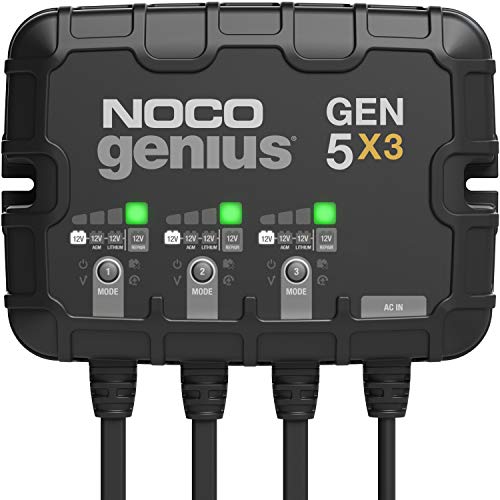
NOCO GEN5X3 — Three banks at a gentler per-bank pace
The GEN5X3 extends the GEN5X formula to the layout serious anglers actually run: a starting battery and a two-battery 24V trolling system. Its title states a 12V 15A three-bank onboard charger and maintainer charging three batteries at once, in an IP68 waterproof housing, with temperature compensation and overcharge protection, spanning lithium and lead-acid. Fifteen amps over three banks is 5A each, so this is the three-bank version of the range’s steady pace, not its fast one, and that distinction is the whole decision between this pick and the GENPRO below.
For a weekend rhythm, 5A per bank is genuinely enough. The boat fishes Saturday, plugs in Saturday night, and by Sunday morning every battery has been attended to; by the following weekend the maintainer side has held them correctly all week. The GEN5X3 also suits owners who prefer a gentler charge as a matter of philosophy for expensive AGM banks, and boats stored on shore power for months, where recovery speed is irrelevant and correct holding is everything.
One underappreciated virtue of the 5A pace is diagnostic. A charger working gently through the night gives a failing battery time to reveal itself, refusing to reach the maintainer state, running warm, lagging its siblings, and an owner glancing at the bank indicators over coffee learns something true about the fleet. High-current hardware can mask a tired battery’s decline by brute force for longer. This is a minor point beside bank count, but on a three-battery boat where one weak unit quietly drags a series pair, early honesty about which battery is fading has real value.
Where it falls behind is the compressed calendar. Fish two long days back to back, drain the trolling pair deeply, and 5A banks may hand you a morning start with the deep-cycles short of full. Tournament anglers and guides should read that sentence twice before saving the difference against the GENPRO10X3. Everyone else gets the same bank count, sealing and protections with a calmer output stage.
- Banks: 3 banks, charges 3 batteries at once
- Total output: 12V 15A, working out to 5A per bank
- Sealing: IP68 waterproof housing per the title
- Chemistries in title: lead-acid plus lithium
- Protections in title: temperature compensation and overcharge protection
- Charge profile details per chemistry: beyond naming lead-acid and lithium, the listing title does not itemise profiles, so verify the lithium profile in the manufacturer documentation for your exact batteries
Strengths
- Three independent banks cover the starting-plus-24V-trolling layout in one sealed unit.
- Gentle 5A-per-bank pace suits AGM banks and weekly fishing rhythms.
- Temperature compensation supports safe long-term connection through the off-season.
Trade-offs
- Back-to-back hard days can outrun 5A-per-bank recovery on the trolling pair.
- Large-capacity lithium banks take a long evening to refill at this pace.
- No bank can be borrowed for a fourth battery, such as a dedicated electronics battery.
Best for: three-battery boats on a weekly rhythm, including 24V trolling setups stored on shore power.
Not suited for: tournament or charter use needing full recovery overnight after deep daily drains.
If your three batteries live on a weekend clock, the GEN5X3 matches it precisely; pull up the GEN5X3 on Amazon and check it against your battery count, not your ambitions.
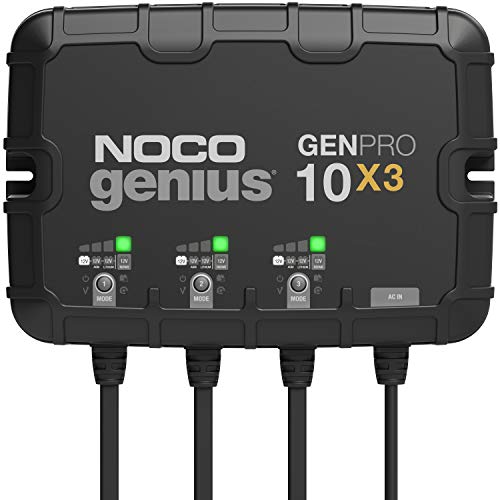
NOCO GENPRO10X3 — Ten amps per bank for boats that turn around fast
The GENPRO10X3 is the GEN5X3’s answer to a harder question: same three banks, same boat layout, half the patience. Its title states a 12V 30A three-bank onboard charger and maintainer, charging three batteries at once, IP68-sealed, with temperature compensation and overcharge protection, for lithium and lead-acid banks alike. Thirty amps over three banks is 10A per bank, double the per-bank current of the GEN5X line, and that doubling is aimed at a specific working pattern: deep daily discharge, short nights, repeat.
Tournament anglers pre-fishing and competing on consecutive days, guides running clients, and any boat whose trolling batteries are large lithium units will feel the difference in the only place it matters, the state of charge at dawn. Lithium banks in particular can use the higher current productively, and the title’s chemistry list includes them explicitly. The GENPRO keeps the family’s sealing and protections, so the speed does not come at the cost of the leave-it-connected behaviour that makes onboard charging worthwhile in the first place.
There is a fleet-planning angle to the GENPRO that guides understand instinctively. When the charger stops being the bottleneck, battery rotation becomes a solved problem and the operation’s attention moves to worthier things, weather, water, clients. The mental tax of wondering whether the trolling batteries will make a second day disappears, and that disappearance, repeated across a season, is what the premium actually purchases. Recreational owners sometimes mock that logic right up until their first three-day trip, after which the mockery tends to stop.
The honest costs are size of commitment and fit. A 30A charger is the heavyweight here, and a boat that fishes gentle weekends will never sample its advantage; the GEN5X3 serves that owner identically in practice. Buy the GENPRO when your calendar, not your optimism, demands recovery speed, and it will feel less like an upgrade and more like removing a recurring problem from the boat.
- Banks: 3 banks, charges 3 batteries at once
- Total output: 12V 30A, working out to 10A per bank
- Sealing: an IP68 waterproof rating is printed in the title
- Chemistries in title: the title names lead-acid and lithium
- Protections in title: overcharge protection, with temperature compensation
- Physical dimensions and weight: the listing title states neither, so confirm the footprint in the manufacturer documentation against your mounting space before ordering
Strengths
- Ten amps per bank is the fastest recovery in the NOCO group here.
- Three banks still cover starting plus a 24V trolling pair in one unit.
- Full IP68 sealing and temperature compensation keep the maintainer side season-safe.
Trade-offs
- Weekend-only boats pay for recovery speed they will never use.
- The flagship output suits big batteries; small banks gain little from 10A banks.
- Three banks remain the ceiling for growing electrical systems.
Best for: tournament, guide and charter boats, and large lithium trolling banks on consecutive-day schedules.
Not suited for: relaxed weekly use where 5A per bank already finishes by morning.
When dawn readiness is non-negotiable, the GENPRO10X3 is the NOCO to buy; compare the GENPRO10X3 on Amazon against your turnaround hours, not your best-case ones.

Smart 2-Bank Marine Battery Charger 10A — The independent two-bank with a desulfator
This independent unit enters the two-bank contest with one feature the NOCO titles do not name: a desulfator. Its title describes a smart two-bank marine battery charger, 10A total at 5A per bank, 12V, waterproof, and a lithium LiFePO4 charger, maintainer and desulfator for AGM, lithium and deep-cycle batteries. The chemistry list is the most explicit of the six, naming AGM and LiFePO4 directly, which will reassure owners whose battery manuals use exactly those words and who found the broader lead-acid phrasing elsewhere slightly abstract.
The desulfator claim deserves a careful reading rather than either hype or dismissal. Sulfation is a real ageing mechanism in lead-acid batteries that sit undercharged, and a charger that includes a desulfation mode is at least aimed at the right enemy for boats that rest all winter. What the title cannot tell you is how effective that mode is on a given tired battery, so treat it as a maintenance feature for batteries you keep correctly charged, not a resurrection promise for neglected ones. No charger here can repeal chemistry.
Position it in the market and its pitch sharpens. This is the pick for an owner who has read their battery manuals closely, who knows their banks are AGM or LiFePO4 by name, and who wants the charger’s stated chemistries to match that vocabulary exactly. The desulfator adds a second, maintenance-minded argument aimed at the lead-acid half of such a fleet. Neither argument is about raw pace, where it merely equals the GEN5X2, and that is fine: two-bank buyers are choosing a care philosophy as much as an output figure.
Two honest gaps separate it from the GEN5X2. Its title says waterproof without printing an IP rating, so an exposed mounting position is a judgement call the NOCO’s IP68 does not ask you to make. And temperature compensation is not named in its title, a feature the NOCOs state outright and one that matters for unattended seasonal connection. Against that, it matches the NOCO’s bank count and per-bank current while naming its chemistries more precisely. It is a credible alternative with a different evidence profile, and the spec box records that profile exactly as the title presents it.
- Banks: 2 banks
- Total output: 10A, stated as 5A per bank, 12V
- Sealing: waterproof per the title; no IP rating is printed in the listing title, so do not assume IP68 equivalence for exposed mounting
- Chemistries named in title: AGM, lithium including LiFePO4, deep-cycle batteries
- Extra mode named in title: desulfator, alongside charger and maintainer functions
- Temperature compensation: not mentioned in the listing title, so check the manufacturer documentation if unattended winter connection is planned
Strengths
- The most explicit chemistry list here, naming AGM and LiFePO4 outright.
- A desulfator mode aimed at the sit-all-winter ageing pattern of lead-acid banks.
- Matches the two-bank, 5A-per-bank format of the category’s default layout.
Trade-offs
- No IP number in the title, so exposed mounting carries more uncertainty.
- Temperature compensation is not claimed in the title.
- Two banks cap it at the same growth ceiling as the GEN5X2.
Best for: two-battery boats with AGM or LiFePO4 banks whose owners value the desulfator mode and explicit chemistry naming.
Not suited for: exposed mounting positions where a stated IP68 rating is required, or three-battery layouts.
If the desulfator and the explicit LiFePO4 naming speak to your battery manuals, this is your two-bank alternative; look over the Smart 2-Bank charger on Amazon with those title claims in hand.

3-Bank Marine Battery Charger 10X3 30A — Full-current three-bank charging outside the big brand
The second independent pick goes straight at the flagship specification. Its title describes a three-bank marine battery charger, 10X3 30A at 10A per bank, 12V, charging three batteries at once, IP68 waterproof, designed to be charged 24/7, with overcharge and temperature protection, for lead-acid and lithium. Read plainly, that is the GENPRO10X3’s headline numbers, bank count, per-bank current, sealing and protections, from an independent maker, including the temperature protection the other independent pick’s title omits.
The 24/7 phrasing in the title is worth pausing on, because it states the onboard philosophy in the maker’s own words: this unit is intended to live connected. For a boat kept on a lift, a trailer or a dock with power, that is the correct design intent, and the overcharge and temperature protections named alongside it are the mechanisms that make permanent connection a sane plan rather than a worry. On paper, then, this pick concedes nothing to the flagship except brand depth.
Installation planning mirrors the flagship’s, because the electrical job is identical: three banks to wire, a sealed unit to mount, an AC feed to arrange. Buyers cross-shopping the two should therefore decide on the ownership questions, manual clarity, support reachability, the confidence that a replacement exists in five years, rather than re-litigating a specification table that reads the same on both sides. That is an unusual position for an independent product to earn, and it is earned here strictly at title level, which is the only level this guide is willing to certify.
Brand depth is, however, a real thing on a boat. Documentation quality, warranty handling and long-term parts support are the currencies an established maker trades in, and none of them appear in a listing title, ours included. The fair summary is that the title-level evidence for this charger is complete, banks, current, sealing, protections, chemistries, and a buyer comfortable judging on specifications can choose it with open eyes. A buyer who values the support ecosystem should weigh that intangibility honestly rather than pretending the spec sheets differ where they do not.
- Banks: 3 banks, charges 3 batteries at once
- Total output: 30A, stated as 10A per bank, 12V
- Sealing: IP68 waterproof according to the title
- Chemistries in title: lead-acid and lithium are both listed
- Protections in title: overcharge and temperature protection, with 24/7 connected use stated as the design intent
- Desulfator or repair mode: not mentioned in the listing title, so do not assume one is fitted when comparing against units that name it
Strengths
- Matches the flagship pattern: three banks at a full 10A per bank.
- IP68 sealing plus temperature protection are both stated outright.
- Explicit 24/7 connected design intent suits lift- and dock-kept boats.
Trade-offs
- Independent brand, so documentation and support depth are less proven than NOCO’s.
- No desulfator mode is named for reviving tired lead-acid banks.
- Full-current banks are surplus for small batteries on a weekly rhythm.
Best for: three-battery boats wanting 10A-per-bank recovery and stated IP68 sealing from an independent maker.
Not suited for: ownership that ranks established brand support above title-level specifications.
Specification for specification, this is the flagship’s closest rival; examine the 10X3 30A charger on Amazon and decide whether brand depth or the spec sheet weighs more for you.
Which marine charger fits which battery bank?
| Charger | Banks | Total / per bank | Sealing in title | Chemistries in title |
|---|---|---|---|---|
| NOCO GEN5X1 | 1 | 5A / 5A | IP68 | Lead-acid, lithium |
| NOCO GEN5X2 | 2 | 10A / 5A | IP68 | Lead-acid, lithium |
| NOCO GEN5X3 | 3 | 15A / 5A | IP68 | Lead-acid, lithium |
| NOCO GENPRO10X3 | 3 | 30A / 10A | IP68 | Lead-acid, lithium |
| Smart 2-Bank 10A | 2 | 10A / 5A | Waterproof, no IP number | AGM, lithium LiFePO4, deep-cycle |
| 3-Bank 10X3 30A | 3 | 30A / 10A | IP68 | Lead-acid, lithium |
What mistakes sink marine charging setups?
Undercounting banks is the classic error, and it usually happens at the exciting moment of a trolling motor upgrade. The 24V motor arrives, the second trolling battery joins the first, and the faithful two-bank charger is suddenly one bank short. The orphaned battery then lives on a portable charger, gets forgotten twice, sulfates quietly, and dies a season early while its sibling thrives. Count the batteries you will own after the upgrade you are already planning, and buy that bank count now.
The second mistake is treating a maintainer as optional garnish. Deep-cycle batteries do not merely rest between trips; stored undercharged, they age measurably, and a winter of sitting flat can take a visible bite out of a bank’s capacity. Every charger here is built to stay connected precisely because the holding phase protects the investment. Boats without dock power should still bring batteries home to a maintained charge rather than leaving them in a cold hull to fade.
A quieter mistake is buying the charger for the boat you have while planning the electrical upgrade that makes it wrong. Solar additions rarely change bank counts, but a second fish finder battery, a bigger trolling motor or a dedicated electronics battery all do. Chargers are decade-long fittings in a way batteries are not; the bank you will need in three seasons is a legitimate part of today’s purchase, and stepping from two banks to three during the original installation is far cheaper than rewiring a finished compartment later. When genuinely torn between two bank counts, buy the larger and leave a bank capped and ready.
Third, owners mix chemistries carelessly. These titles all claim lead-acid and lithium support, which is broad, but support is selected per bank through the charger’s settings or detection, and the owner must ensure each bank is configured for the battery actually wired to it. An AGM starting battery and a lithium trolling battery on the same charger is a legitimate, common layout, provided each bank is set for its own battery. Read the manual’s chemistry section at installation, not after a battery behaves strangely.
How should an onboard charger be installed and lived with?
Mount the unit where air can move around it and spray cannot pool on it, close enough to the batteries that the bank leads run short and tidy. Connect each bank to its own battery with clean, tight terminals, route cables clear of bilge water and moving parts, and give the AC side a proper inlet or a strain-relieved run to where the shore cord lands. Label each bank lead with the battery it serves; the next person to work in that compartment, possibly you in February, will be grateful.
Two installation errors deserve naming because they are common and consequential. The first is sharing a bank across two batteries with a jumper because the charger has fewer banks than the boat has batteries; that single shortcut dissolves the independence the whole product exists to provide, and the weaker battery will drag the pair. The second is mounting the charger where bilge water can reach it during a stuffing-box leak or a heavy rain through an open hatch. Sealed ratings are generous, but installation judgement should never spend them deliberately. Choose the driest, highest sensible spot in the compartment and let the IP68 rating be insurance rather than a plan.
Living with it is then mostly a habit of plugging in. Connect shore power when the boat comes home, glance at the charger occasionally when passing, and let the maintainer phase do the long quiet work. Before a trip, the batteries should already be full; the pre-launch check becomes a look, not a charging session. Once a season, inspect terminals for corrosion, confirm the mounting has not vibrated loose, and verify each bank still wakes when its battery is connected. That is the entire maintenance contract, and it is dramatically lighter than the portable-charger ritual it replaces. Owners who make the switch consistently report the same surprise: the charger they notice least is the one doing the most, because its work happens in the background of every single week the boat is home, not in a scramble the night before a trip.
Final Recommendation
Match banks to batteries and current to calendar, and the choice makes itself. One-battery boats take the GEN5X1; the standard two-battery layout takes the GEN5X2, or the Smart 2-Bank where its desulfator and explicit LiFePO4 naming fit your manuals; three-battery boats on a weekly rhythm take the GEN5X3; three-battery boats on a working calendar take the GENPRO10X3 or the independent 10X3. A marine battery bank is too expensive to feed with clips and hope, and the day an onboard charger is bolted in is the day a boat’s batteries stop dying of neglect and start simply wearing out on schedule, years later than they would have. Batteries forgive a great deal except being forgotten, and every pick above exists to make forgetting impossible in practice, on real docks, in real weather, across real winters. If you take one sentence from this guide to the chandlery, take the counting rule: one bank per battery, current per bank matched to your tightest turnaround, and a maintainer you are willing to leave connected all winter without a second thought.
Frequently Asked Questions
Can one of these chargers handle my 24V trolling motor?
Yes, by banks rather than by voltage. A 24V trolling system is two 12V batteries in series, and a three-bank charger gives each of those batteries its own 12V bank while the third bank tends the starting battery. That is why the GEN5X3, GENPRO10X3 and 10X3 units are the three-battery picks here.
Should I choose 5A or 10A per bank?
Choose by turnaround. Five amps per bank refills a recreational deep-cycle battery overnight and suits weekly use. Ten amps per bank earns its place when batteries are large, deeply drained, or needed again the next morning, the tournament and charter pattern.
Can I leave an onboard charger plugged in all winter?
That is the use these units are designed for. Every title here describes a charger and maintainer, the NOCOs and the 10X3 name temperature protection or compensation, and the 10X3 states 24/7 connection outright. Maintained storage is far kinder to a deep-cycle battery than sitting discharged in a cold boat.
What if my boat mixes an AGM starter with lithium trolling batteries?
All six titles claim lead-acid and lithium support, and the Smart 2-Bank names AGM and LiFePO4 explicitly. The owner’s job is configuration: ensure each bank is set for the chemistry of the battery wired to it, following the manual, rather than assuming one global setting covers a mixed system.
Does an onboard charger replace my engine alternator’s charging?
No, and it is not meant to. The alternator works while you run; the onboard charger works while you are plugged in, and its maintainer phase covers the long periods when the engine never turns at all. Boats that run far and sit briefly lean on the alternator; boats that sit for weeks between outings, which is most recreational boats, are kept alive by the charger on the dock. The two systems complement each other, and the battery bank feels the difference most in the off-season, when only one of them is on duty.
My batteries are different sizes. Does that matter to the charger?
Each bank works independently, so a large trolling battery and a smaller starting battery can share one multi-bank charger without either compromising the other. What matters is matching per-bank current to the largest battery’s recovery needs: a big bank on a 5A output simply takes longer, which is fine on a weekly rhythm and limiting on a daily one.
Is IP68 sealing actually necessary inside a boat?
Battery compartments are wetter than they look, between washdowns, spray, condensation and the occasional hatch left open in rain. Five of these six titles state IP68; the Smart 2-Bank states waterproof without a number. For an enclosed, dry mounting position the difference may never matter, but for exposed compartments the printed rating is the safer evidence.
Related Guides
Battery care follows you off the water. Read Best Scooter Battery Chargers for the small-pack version of voltage matching, Best Inverter Chargers for Van Life for chargers that also invert, and Best Hearing Aid Chargers for charging cases at the opposite end of the size scale.