What's inside
- Key Takeaways
- Quick Picks
- How did we choose these six integrated units?
- What separates an inverter charger from a plain inverter?
- How much inverter, and how much charger, does a van actually need?
- How do solar and alternator charging fit alongside an inverter charger?
- What does living with one of these units actually feel like?
- The six inverter chargers, reviewed in detail
- What separates these six inverter chargers at a glance?
- What mistakes do van builders make with inverter chargers?
- How should an inverter charger be installed in a van?
- Final Recommendation
- Frequently Asked Questions
- Related Guides
As an Amazon Associate I earn from qualifying purchases. This post may contain affiliate links at no extra cost to you.
widgetverdict.com is reader-supported. When you buy through links on our site, we may earn an affiliate commission.
Where to buy: Amazon carries all six combined units below, from the two Renogy high-frequency models to the long-running Tripp Lite line, and it is worth ordering your heavy-gauge DC cabling and fusing in the same basket, because an inverter charger is only ever as good as the cables feeding it. These are hardwired, install-once components, so plan the whole electrical shopping list before the first box arrives.
The best inverter chargers for van life are not inverters with a bonus feature. An inverter charger is a single integrated machine that does three jobs in one case: it inverts 12V battery power into 120V household power when you are off-grid, it charges the leisure battery at serious current when shore power or a generator appears, and it transfers between those two states automatically through a built-in transfer switch, so the van’s sockets never notice the change. A plain inverter does only the first job. Vans that plug in at campsites, marinas, driveways or worksites live or die by the second and third jobs, which is why this category exists separately from the inverter shelf.
The six units below span the working range of that idea: two Renogy high-frequency models at 3000W and 2000W with unusually strong built-in chargers, two AIMS units at the same two power classes with deep surge ratings, the hardwired Tripp Lite APS2000 from a line built for RVs and fleet vehicles, and an ECO-WORTHY 3000W unit whose adjustable charging current is its signature. Every watt, surge figure and charger amp in this guide comes from the listing titles. Where a title does not state something a buyer needs, such as charger adjustability on a rival model or a transfer time, we mark it unstated rather than borrowing a number from a sibling product.
Key Takeaways
- An inverter charger is three devices integrated: inverter, high-current battery charger and automatic transfer switch. A plain inverter alone cannot refill your battery from shore power.
- Continuous watts size your loads; peak or surge watts cover motor starts. The titles here state continuous ratings of 2000W or 3000W, with peaks from 4000W to 9000W.
- Charger current is the van-life number: the Renogy pair state 100A and 80A chargers, the AIMS pair 65A and 85A, and the ECO-WORTHY adjusts from 25A to 100A.
- All six are 12V DC to 120V AC pure sine wave units per their titles except the Tripp Lite, whose title does not use the words pure sine, a distinction its spec box records honestly.
- Transfer switching is what makes campsite hook-up seamless: plug in, and charging begins while the sockets stay live, with the ECO-WORTHY naming a 30ms UPS-mode transfer.
- Installation is part of the product: these are hardwired or heavy-cable installs that belong near the battery bank, with fusing and cable gauge treated as non-negotiable.
Quick Picks
| Pick | Badge | Why it earns its place |
|---|---|---|
| Renogy 3000W Inverter Charger | Strongest charger in class | A 3000W pure sine high-frequency unit with a 100A built-in charger, UPS transfer switch, Bluetooth and LCD remote, peaking at 6000W. |
| Renogy 2000W Inverter Charger | Mid-power, full features | The 2000W sibling with an 80A charger, 4000W peak, Bluetooth and LCD remote, for vans whose loads stop short of the big class. |
| AIMS 2000W Inverter Charger | Surge-heavy workhorse | A 2000W pure sine unit with a 6000W surge rating, a 65A smart charger and an auto transfer switch aimed at off-grid and RV duty. |
| AIMS 3000W Inverter Charger | Deepest surge reserve | A 3000W pure sine unit with a 9000W surge, an 85A smart charger and auto transfer, the heaviest motor-starting margin here. |
| Tripp Lite APS2000 Inverter/Charger | Hardwired fleet veteran | A 2000W hardwired inverter/charger with auto transfer switching, from a line specified for RVs, trucks, fleet and emergency vehicles. |
| ECO-WORTHY 3000W Inverter Charger | Adjustable charge current | A 3000W pure sine 2-in-1 with charging current adjustable from 25A to 100A and a 30ms UPS mode, for mixed battery banks. |
How did we choose these six integrated units?
Our first gate was definitional: the product had to be a true inverter charger, with a built-in battery charger and transfer switching stated or clearly described in its title, not a plain inverter wearing hopeful keywords. That single rule removed most of the category’s noise. The second gate was title evidence: continuous watts, and wherever printed, peak watts and charger amps, had to be readable from the listing itself, because those three numbers are the purchase. Units that hid them were excluded however strong their reputations.
We also weighted the numbers by how van life actually consumes them. Inverter watts are spent in minutes, a kettle, a hob, a tool; charger amps are spent in hours, across every plugged-in night of the van’s life; surge watts are spent in seconds that decide whether a motor starts or a unit trips. A guide that treated the three figures as equivalent bullet points would mislead by symmetry. The pick sections therefore judge each unit first by the figure its buyer will feel most often, and the comparison table keeps the three in separate columns where they belong.
Within the survivors we built deliberate contrasts. Two power classes, 2000W and 3000W, because van loads cluster there. Two design philosophies, the newer high-frequency Renogy and ECO-WORTHY units with remotes and adjustable charging, against the AIMS and Tripp Lite school of heavy surge ratings and fleet-proven hardwired installation. The result lets a reader choose by the way they actually camp: hook-up heavy, boondock heavy, motor heavy, or battery-bank heavy. Van electrical systems pair these units with the batteries our Best Solar Trickle Chargers guide maintains and the tool batteries our Best DeWalt 20V Chargers guide charges on the bench, and the sizing discipline across all of them is the same: match the machine to the bank and the load, in numbers, before aesthetics.
What separates an inverter charger from a plain inverter?
Everything that happens when you plug in. A plain inverter sits idle at a campsite pedestal while a separate charger, often a small one bought as an afterthought, trickles the battery back at a pace set by its own modest rating. An inverter charger treats the arrival of shore power as its main event: the transfer switch routes the incoming AC to your sockets, the built-in charger wakes at 65A, 80A, 100A, currents no accessory charger in a van drawer approaches, and the battery bank refills during an overnight stop rather than across a long weekend. Unplug in the morning and the transfer happens in reverse, the inverter resuming so smoothly that, on the ECO-WORTHY’s stated 30ms UPS mode, connected electronics ride through the swap.
Cost accounting supports the integration too, though this guide quotes no prices. Priced as a system, a separate quality inverter plus a separate high-current charger plus the cabling and switching to make them cooperate routinely exceeds the combined unit, and the comparison worsens when the separate charger’s current is honest: accessory chargers in the drawer class deliver a fraction of the 65A to 100A figures printed across these titles. The inverter charger is not the expensive way to buy these three functions. Bought separately and properly, the functions cost more and fit worse; bought cheaply and separately, the charging function quietly shrinks until a hook-up night stops meaning a full battery.
The integration also disciplines the installation. One unit, one set of heavy DC cables, one fused run to the battery, one AC input and output to wire, instead of an inverter and a charger negotiating separate spaces, separate cabling and separate failure points in the most space-starved vehicle most people will ever wire. In a van, where every component competes for the same under-bed volume, consolidation is not a luxury feature; it is how a full electrical system fits at all.
There is one honest boundary to the concept. An inverter charger still needs a battery bank worth charging and loads worth inverting; it cannot rescue an undersized battery or make a 2000W unit run a 3000W ambition. It also draws standby power when inverting, as all inverters do, so boondockers size their banks with that overhead in mind. The category’s promise is narrower and better than magic: one machine, correctly sized, that makes the boundary between plugged-in and off-grid effectively disappear.
How much inverter, and how much charger, does a van actually need?
Size the inverter by your largest simultaneous AC ambition, not by the sum of every appliance you own. A 2000W unit, three of our six, runs the classic van load-out comfortably: a kettle or induction hob used with judgement, a microwave, power tools, chargers, a small air conditioner in favourable cases. A 3000W unit buys headroom for overlapping loads, the hob while the microwave runs, the bigger air conditioner, the workshop-grade tool, and it buys it at the cost of heavier cabling and a battery bank that can actually feed 3000W without sagging. Peak figures matter for motors: the AIMS pair’s 6000W and 9000W surge ratings describe the brief, brutal current of a compressor or pump starting, a load that trips lesser units despite sitting well inside their continuous rating.
Size the charger by your battery bank and your stopping pattern. The rule of thumb installers use is charger current as a healthy fraction of bank capacity, and the practical translation is simpler: a big lithium bank that arrives at a hook-up nearly empty wants the Renogy 3000W’s 100A or the ECO-WORTHY’s adjustable up-to-100A to be full by morning, while a modest bank on a gentle touring rhythm is honestly served by the AIMS 2000W’s 65A. Adjustable current, the ECO-WORTHY’s signature, earns its keep in mixed situations: a small or ageing bank that should be charged gently today, a larger replacement bank next year, a borrowed generator with limited output tonight. Fixed-current units ask you to size once and correctly; the adjustable unit forgives a future you have not finished planning.
Scale is worth a moment’s perspective. The battery bank behind these units holds thousands of times the energy of the tiny cells discussed in Best Hearing Aid Chargers, yet the governing principle is identical at both ends of the charging world: the charger must be specified for the battery it serves, in numbers its maker prints, and no confidence should be borrowed from a neighbouring product. Vans simply raise the stakes of the same discipline, from a disappointing gadget to a dead electrical system two hundred miles from a pedestal.
One more sizing truth belongs here: the charger only charges when AC exists. Vans that rarely plug in should weight the inverter side and their solar or alternator charging more heavily, while vans that tour by hook-ups, seasonal workers, festival crews, anyone living the pedestal-to-pedestal life, should weight charger amps almost equally with inverter watts. The six picks divide cleanly along that line, and the pick sections say which side each one favours.
How do solar and alternator charging fit alongside an inverter charger?
An inverter charger is the shore-power pillar of a van’s charging system, rarely the only one. Solar feeds the bank silently through the driving and parked hours, a DC-to-DC charger harvests the alternator’s surplus on the road, and the inverter charger waits for the moments when a pedestal or generator offers bulk current no panel roof can match. The three sources are complements with different tempers: solar is patient, alternator charging is opportunistic, and the inverter charger is the heavy lifter that resets the system on demand. Builders who understand that division stop asking any one source to be the whole answer.
Seasonality rearranges the pillars’ importance in a way planners should anticipate. Summer touring leans on solar, with the inverter charger as an occasional top-up at a site with hook-up; winter travel inverts the relationship, short grey days starve the panels while heaters and lights feast on the bank, and the shore-powered charger becomes the system’s lifeline, with campsite nights chosen partly for their pedestals. A unit sized only for the summer pattern disappoints in January. The strong chargers in this guide, the Renogy pair above all, are winter insurance as much as they are convenience, and full-timers in northern latitudes should read their amp figures with the dark months in mind.
Coordination matters more than capacity. Each source must be configured for the same battery chemistry and compatible voltage targets, or the bank spends its life being argued over by its own chargers. Lithium banks make this easier in one way, they accept charge eagerly from every direction, and harder in another, their makers publish charge limits that every source must respect, including the 100A headline of the largest unit here. The commissioning habit is simple: set each charger’s profile deliberately, write the settings in the van’s manual folder, and revisit them whenever the bank changes. The inverter charger is usually the most configurable of the three sources, which quietly makes it the system’s reference point.
There is also a redundancy argument that long-distance travellers feel in their bones. When the inverter charger’s shore side is the only bulk source and it fails in a remote place, the van limps on solar and alternator scraps. When it is one of three sources, its failure is an inconvenience with a parts order attached. None of the six units here can be carried as a spare, they are too large and too wired-in, so resilience comes from the architecture around them. Design the system so no single box is irreplaceable, and the inverter charger becomes what it should be: the strongest pillar, not the only one.
What does living with one of these units actually feel like?
The honest answer is that a well-chosen inverter charger disappears. The van plugs in and the battery fills; the van unplugs and the fridge never flickers; the kettle works at a trailhead and the tools charge at a site. Owners notice the unit only at the boundaries of its competence, the air conditioner that needs the 3000W class, the compressor that tests the surge rating, the enormous bank that drinks the 100A charger dry-eyed and asks for the whole night anyway. That disappearance is the product. Every feature in these titles, transfer switches, remotes, adjustable currents, exists to move the owner’s attention from the electrical system to the trip.
The units differ in how they ask to be lived with. The Renogy pair, with Bluetooth and a wall-mounted LCD remote, invite casual monitoring, the state of charge checked like the weather. The AIMS and Tripp Lite school ask for a visit to the unit, which suits owners who prefer their systems physical and their information at the source. The ECO-WORTHY asks to be re-told as the system changes, its adjustable current a standing invitation to keep the configuration honest. None of these is a defect. They are temperaments, and matching the unit’s temperament to the owner’s is the last sizing decision, after watts, amps and surge have had their say.
The six inverter chargers, reviewed in detail

Renogy 3000W Inverter Charger — The strongest charging spec in this line-up
Renogy’s flagship here makes its argument in one number: 100A. Its title describes a 3000W pure sine wave inverter charger, high frequency, with Bluetooth, converting 12V DC to 120V AC, with a built-in 100A battery charger and UPS transfer switch, an LCD remote, and a 6000W peak, aimed at RVs, campers and off-grid cabins. Read as a van product, that is the complete sentence: full-size inverting power, the strongest charger current in this guide, automatic transfer, and the monitoring, Bluetooth plus a wired LCD remote, that lets the unit live under a bed while its information lives on the wall.
The charger is the headline because of what it does to a hook-up night. A large lithium bank that carried the van through days of boondocking can be refilled at up to 100A during a single pedestal stop, which rearranges trip planning: one powered night restores the whole system. High-frequency design, stated in the title, is the modern construction school for these units, generally associated with lighter weight than old low-frequency iron, a practical virtue in a vehicle where payload is a budget spent across every system. The 6000W peak covers motor starts at double the continuous rating.
Picture the week this unit was built for. Three nights wild, the bank worked hard by a fridge, lights, devices and a diesel heater’s fan; then a campsite night where the 100A charger refills in hours what solar would need days to replace; then back out again. That rhythm, deep use punctuated by complete resets, is the signature pattern of serious van travel, and it is precisely the pattern a strong inverter charger exists to serve. Weaker charging stretches the powered stop into a chore; this unit compresses it back into a night’s sleep.
Its demands are the flagship’s usual ones. Feeding 3000W and charging at 100A requires serious DC cabling, correct fusing and a battery bank sized to accept that charge current; a small bank cannot drink at 100A whatever the charger offers, and lithium makers’ charge limits govern. Buyers with modest banks and modest loads are paying for ceiling they will never touch, and Renogy sells them the 2000W sibling below for exactly that reason. For the full-time, big-bank, hook-up-aware van, this is the most completely specified unit in the guide.
- Inverter: 3000W continuous pure sine wave, 6000W peak, 12V DC to 120V AC
- Charger: built-in 100A battery charger, the highest stated here
- Transfer: UPS transfer switch built in
- Monitoring: Bluetooth plus LCD remote, both stated in the title
- Design: high frequency, stated in the title
- Charger current adjustability: the listing title does not describe an adjustable range for this model, so confirm charging configuration options in the manufacturer documentation if your bank needs a capped current
Strengths
- The 100A charger turns one hook-up night into a full battery reset.
- Bluetooth and an LCD remote solve the under-bed monitoring problem properly.
- 3000W continuous with a 6000W peak covers the full van load-out including motor starts.
Trade-offs
- Demands heavy cabling, fusing and a bank able to accept high charge current.
- Oversized for vans whose loads and banks live in the 2000W world.
- High-frequency design prioritises weight over the old iron-core style of surge abuse tolerance.
Best for: full-time and big-bank vans that alternate boondocking with hook-up nights.
Not suited for: small campervans with modest banks, or minimalist electrical systems without heavy DC cabling.
For a van that treats shore power as a refuelling stop, this is the benchmark; examine the Renogy 3000W on Amazon alongside your battery bank’s stated charge limit.

Renogy 2000W Inverter Charger — The same formula at the saner power class
The 2000W Renogy is the flagship’s formula with the excess trimmed: a 2000W pure sine wave inverter charger, high frequency, with Bluetooth, 12V DC to 120V AC, a built-in 80A battery charger and UPS transfer switch, an LCD remote and a 4000W peak, for RVs, campers and off-grid cabins. Eighty amps remains a very strong charger, stronger than either AIMS unit’s stated current, and it arrives in a unit whose inverter side matches the loads most vans actually run.
That balance is the pick’s whole case. Most van kitchens, work setups and entertainment loads live comfortably inside 2000W continuous; the jump to 3000W serves overlapping big loads and bragging rights more often than dinner. Meanwhile the 80A charger preserves the one-night reset for the medium lithium banks these vans typically carry, and the Bluetooth plus remote pairing keeps the same monitoring quality as the flagship. An owner choosing between the two Renogys is really choosing an inverter class, because the ownership experience otherwise reads identically.
There is a payload argument quietly in this pick’s favour. High-frequency construction at the 2000W class keeps the unit’s mass civilised for a vehicle where every kilogram is argued over by water, batteries, bikes and people. A conversion that is already near its weight limit does not experience an inverter charger as a line item; it experiences it as a negotiation with everything else aboard. The lighter, monitored, strong-charging package here negotiates well.
The peak figure is where the trim shows: 4000W against the AIMS 2000W’s 6000W surge means motor-starting margin is slimmer, and a van built around a stubborn compressor load should weigh that difference honestly. Cabling and fusing still need proper sizing, 2000W at 12V is serious current, and the bank must accept 80A to see the charger’s full pace. Within its class, though, this is the most modern-featured 2000W unit here, and for the median full-time van it may be the sweet spot of the entire guide.
- Inverter: 2000W continuous pure sine wave, 4000W peak, 12V DC to 120V AC
- Charger: built-in 80A battery charger
- Transfer: UPS transfer switch built in
- Monitoring: Bluetooth plus LCD remote
- Design: high frequency, stated in the title
- Surge headroom: 4000W peak is the figure in the title; vans built around hard-starting motor loads should compare it with the AIMS surge ratings before deciding
Strengths
- An 80A charger is exceptional at the 2000W class and resets medium banks overnight.
- Full monitoring set, Bluetooth and LCD remote, matches the flagship’s convenience.
- Pure sine output across the whole load range suits sensitive electronics.
Trade-offs
- The 4000W peak is the slimmest motor-start margin among the 2000W picks.
- Still requires properly sized DC cabling and fusing at installation.
- Vans that grow into overlapping big loads will outgrow the inverter side first.
Best for: the median full-time van, medium lithium bank, 2000W-class loads, regular hook-ups.
Not suited for: compressor-heavy builds needing deep surge reserve, or 3000W load ambitions.
Balanced is not a consolation prize here, it is the point; look over the Renogy 2000W on Amazon if your load list tops out below the big class.
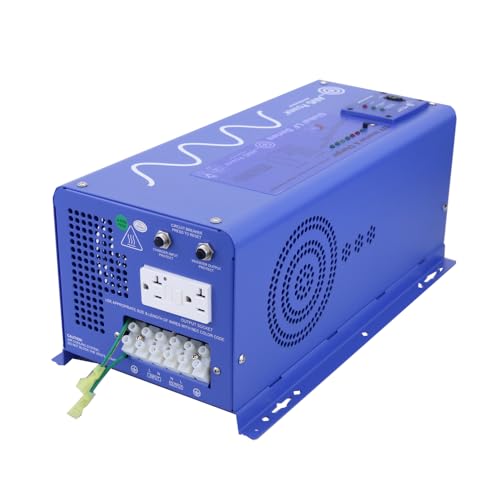
AIMS 2000W Inverter Charger — Surge muscle and a smart charger in the classic school
AIMS builds to an older, heavier philosophy, and this unit’s title shows it: a 2000W 12V pure sine inverter charger with transfer switch and 120V backup, rated 2000W continuous with a 6000W surge, 12V DC, a 65A smart charger and an auto transfer switch, for off-grid, RV and backup use. The number to stare at is 6000W: triple the continuous rating, the deepest surge reserve at this power class in the guide, aimed at the motors, pumps and compressors whose starting current humiliates lesser inverters.
The 65A smart charger is the modest figure in its row, and context matters before judging it. For the lead-acid and modest lithium banks that fill most vans of this class, 65A is a full overnight charge with room to spare; the Renogys’ higher currents only convert to saved hours when the bank is large and lithium and the stop is short. What the AIMS offers instead is a reputation pattern: units bought for backup and off-grid duty where the transfer switch and surge behaviour are the product, and charging is a strong supporting act rather than the headline.
Backup duty deserves emphasis because vans increasingly double as household insurance. A vehicle that can park beside a house in an outage and run its owner’s fridge, lights and communications through a transfer-equipped inverter charger is not merely a leisure asset; it is the household’s quiet generator that also goes on holiday. The AIMS title’s own positioning, off-grid, RV and backup, reads that dual role plainly, and for owners who value it, the surge depth that starts a home fridge’s compressor is the same surge depth that starts the van’s, one specification serving two emergencies.
Buyers should note what the title does not offer: no remote or Bluetooth is mentioned, so monitoring lives at the unit, and the design school here is function-first. Installation is the classic hardwired pattern with the same cabling discipline as every pick. Choose the AIMS 2000W when your load list includes something with a motor that starts hard and your battery bank is honestly medium; it is the specialist for that van, and generalists should look at the Renogy pair.
- Inverter: 2000W continuous pure sine wave, 6000W surge, 12V DC input
- Charger: 65A smart charger
- Transfer: auto transfer switch, with 120V backup positioning in the title
- Intended duty per title: off-grid, RV and backup
- Remote monitoring: no remote or Bluetooth is mentioned in the listing title, so plan to read status at the unit itself
- Charger adjustability: the title calls the charger smart without printing an adjustable range, so verify charge settings in the manufacturer documentation for sensitive banks
Strengths
- A 6000W surge rating is the strongest motor-starting margin at 2000W here.
- The 65A smart charger fully serves medium lead-acid and lithium banks overnight.
- Backup-duty positioning suits vans that double as home emergency power.
Trade-offs
- Charger current trails the Renogy pair for big lithium banks on short stops.
- No remote monitoring is stated, so the unit must be reachable to read.
- Feature set is utilitarian beside the high-frequency newcomers.
Best for: vans and RVs with hard-starting motor loads and medium battery banks.
Not suited for: big lithium banks needing the fastest possible hook-up recharge, or owners wanting app-based monitoring.
If a compressor or pump anchors your load list, start here; find the AIMS 2000W on Amazon and weigh its surge figure against your motor’s starting appetite.
AIMS 3000W Inverter Charger — Nine thousand watts of surge, eighty-five of charge
The AIMS 3000W scales its smaller sibling’s philosophy to the big class: a 3000W 12V pure sine inverter charger with transfer switch and 120V backup, 3000W continuous with a 9000W surge, an 85A smart charger and an auto transfer switch, for off-grid, RV and backup use. Nine thousand watts of surge is the largest peak figure in this guide, and it describes a unit built for the nastiest starting loads a van or small off-grid system can present, big compressors, well pumps in cabin service, workshop machinery with heavy inrush.
The charger also steps up, to 85A, second only to the Renogy flagship’s 100A and ahead of the smaller AIMS by a clear margin. That pairing, deepest surge plus strong charging, defines the unit’s buyer: a heavy electrical system in a large van, a toy hauler, or a van that moonlights as cabin and backup power, where the loads are muscular and the bank is big enough to deserve 85A. In that company the absence of stated app monitoring matters less than the electrical headroom, which is present in quantities none of the sleeker units match.
Consider who else specifies at this level: small off-grid cabins, site welfare units, mobile workshops. The AIMS 3000W’s buyer is building a power system that happens to have wheels, and the van is closer to a tiny building than to a tent with an engine. In that frame the unit’s priorities order themselves: surge for machinery, charging for a serious bank, transfer for the generator-and-shore rotation such properties live on. The title’s backup language is not decoration; it is the design brief, and heavy van builds inherit it intact.
Proportion is the caution. A 3000W inverter with this surge character wants the largest cabling, the largest fusing and the largest battery bank in this guide, and installing it behind a modest bank produces a system whose ceiling is set by everything except the inverter. Weight and space follow the same curve. This is the correct summit for a genuinely heavy build and an expensive ornament for a light one, and the honest buyer will know which van is theirs before the title’s big numbers do their persuading.
- Inverter: 3000W continuous pure sine wave, 9000W surge, the highest peak stated here
- Charger: 85A smart charger
- Transfer: auto transfer switch, 120V backup positioning
- Input: 12V DC
- Intended duty per title: off-grid, RV and backup
- Monitoring: the listing title names no remote or Bluetooth, so status reading happens at the unit unless the manufacturer documentation describes an accessory
Strengths
- The 9000W surge is unmatched here for hard-starting machinery.
- An 85A charger keeps pace with large banks on hook-up nights.
- Continuous 3000W plus backup positioning suits dual van-and-cabin roles.
Trade-offs
- Demands the heaviest installation in the guide, cabling, fusing and bank size.
- No stated remote monitoring for a unit that will live in a locker.
- Light vans gain nothing from surge reserve they cannot feed.
Best for: heavy builds, large vans and dual-purpose backup systems with big banks and motor loads.
Not suited for: compact campervans, small banks, or payload-sensitive conversions.
When the load list frightens other inverters, this is the answer; compare the AIMS 3000W on Amazon against your largest motor’s starting demand.

Tripp Lite APS2000 Inverter/Charger — The hardwired veteran from the fleet world
The Tripp Lite APS2000 arrives from a different tradition: its title describes a power inverter/charger with auto transfer switching, 2000W, 12V DC, 120V, hardwired, for RVs, trucks, fleet vehicles and emergency vehicles, model APS2012. That vehicle list is the biography of the APS line: equipment specified by people who outfit working vehicles, where the inverter charger is infrastructure rather than lifestyle gear. For van life, that heritage translates into a hardwired 2000W unit with automatic transfer, bought for dependability of function over novelty of features.
Two title details deserve the honesty this guide applies everywhere. First, the words pure sine do not appear in this listing’s title, unlike every other pick here. Many van loads, chargers, tools, resistive heating, do not care about waveform, but sensitive electronics are the reason pure sine became the category default, and a buyer whose van runs medical-adjacent equipment, audio gear or fussy electronics should verify the waveform specification in the manufacturer documentation rather than assuming it from the company the product keeps. We record the silence; we do not fill it.
There is a serviceability argument that fleet buyers understand and leisure buyers undervalue. A product line that outfits trucks and emergency vehicles accumulates documentation, parts channels and institutional knowledge that outlast any single model run. When a ten-year-old van needs help with its electrical heart, that ecosystem is the difference between a manual, a part and a person who answers, and a forum thread from 2019. None of that appears in a wattage table, and all of it belongs in a serious purchase decision for a component intended to serve a decade.
Second, the title prints no charger amp figure, where its rivals advertise theirs. The APS2000 certainly contains a charger, it is in the product’s name, but this guide will not invent its rating. Buyers for whom charger current is a deciding number should pull that figure from Tripp Lite’s documentation before comparing, and buyers who value the fleet-service ecosystem, documentation depth and a hardwired install will find those virtues legible in the title already. This is the pick for the van built like a work truck, by an owner who specs like a fleet manager.
- Inverter: 2000W, 12V DC to 120V, per the title
- Transfer: auto transfer switching
- Installation: hardwired, stated in the title
- Intended duty per title: RVs, trucks, fleet vehicles and emergency vehicles
- Model: APS2012
- Charger current and waveform: neither a charger amp figure nor the words pure sine appear in the listing title, so both must be confirmed in the manufacturer documentation before this unit is compared on those axes
Strengths
- Fleet and emergency-vehicle heritage suits vans built as working vehicles.
- Hardwired installation is the permanent, professional pattern.
- Auto transfer switching delivers the category’s core seamless hook-up behaviour.
Trade-offs
- Charger current is unstated in the title, complicating like-for-like comparison.
- Pure sine wording is absent from the title, so sensitive-load buyers must verify.
- No remote or app monitoring is mentioned in the title.
Best for: work-truck-style van builds and owners who value fleet-grade documentation and support.
Not suited for: buyers deciding primarily on published charger amps or app monitoring.
Spec-sheet shoppers should verify its two silent figures first; start with the Tripp Lite APS2000 on Amazon, then its manufacturer documentation for the charger rating.

ECO-WORTHY 3000W Inverter Charger — Adjustable charging for banks that change
ECO-WORTHY’s entry makes flexibility its headline: a 3000W 12V pure sine wave inverter charger, 12V DC to 120V AC, described as a 2-in-1 inverter and battery charger, with charging current adjustable from 25A to 100A, and a UPS mode with a 30ms transfer, aimed at off-grid, RV, home and cabin use. That adjustable range is unique in this line-up, and it solves a real van-life problem: banks are not static. They age, they get replaced by different sizes, they get charged from a small generator one month and a full hook-up the next, and a charger that can be told to sip at 25A or pour at 100A follows the system through all of it.
The 30ms UPS-mode transfer is the other stated figure worth dwelling on, because it is the only transfer time printed in any of these titles. Thirty milliseconds is fast enough that ordinary electronics, laptops, routers, entertainment gear, ride through the switch between shore and inverter without rebooting, which is the lived experience of seamless power that this category promises. Paired with 3000W of pure sine inverting, the unit covers the modern van’s expectations on both sides of the transfer.
The generator scenario makes the adjustability concrete. A small suitcase generator at a festival or a worksite can offer only so much current before it strains; a fixed 100A charger would either overload it or refuse the source, while this unit turned down toward its 25A floor sips politely and still banks real charge across a day. Then the same van reaches a full hook-up in the evening and the current goes back up. One charger, two electrical worlds, no hardware swapped: that is the lived value of the range printed in its title, and no rival here can imitate it.
What the title does not print is a peak or surge figure, and motor-heavy buyers should note the omission and verify it in the documentation before assuming compressor behaviour. Nor does the title mention a remote or Bluetooth, so monitoring expectations should be set at the unit. Judged on its stated evidence, though, this is the most adaptable charger here, and adaptability is a genuinely van-shaped virtue: the vehicle changes, the travel changes, and this unit’s charging can be re-told each time.
- Inverter: 3000W continuous pure sine wave, 12V DC to 120V AC
- Charger: adjustable charging current, 25A to 100A, stated in the title
- Transfer: UPS mode with 30ms transfer time, the only transfer figure printed among these titles
- Format: 2-in-1 inverter/battery charger
- Intended duty per title: off-grid, RV, home and cabin
- Peak/surge rating: no peak figure appears in the listing title, so motor-start capability must be confirmed in the manufacturer documentation rather than assumed from the 3000W class
Strengths
- Adjustable 25A to 100A charging adapts to banks, generators and seasons.
- The stated 30ms UPS transfer keeps electronics alive through source changes.
- Full 3000W pure sine inverting matches the flagship power class.
Trade-offs
- No surge figure in the title, a gap for compressor and pump planners.
- No remote or Bluetooth monitoring is mentioned.
- Adjustability is wasted on owners whose bank and habits never change.
Best for: evolving electrical systems, mixed generator and hook-up charging, and UPS-sensitive electronics.
Not suited for: compressor and pump builds that need a published surge rating settled before anything else.
If your van’s electrical system is a work in progress, this unit grows with it; look into the ECO-WORTHY 3000W on Amazon with your bank’s present and future sizes in mind.
What separates these six inverter chargers at a glance?
| Unit | Continuous / peak | Charger | Transfer | Signature |
|---|---|---|---|---|
| Renogy 3000W | 3000W / 6000W | 100A built-in | UPS switch | Bluetooth + LCD remote |
| Renogy 2000W | 2000W / 4000W | 80A built-in | UPS switch | Same monitoring, smaller class |
| AIMS 2000W | 2000W / 6000W surge | 65A smart | Auto switch | Surge at mid class |
| AIMS 3000W | 3000W / 9000W surge | 85A smart | Auto switch | Deepest surge here |
| Tripp Lite APS2000 | 2000W / not stated in title | Not stated in title | Auto switching | Hardwired fleet unit |
| ECO-WORTHY 3000W | 3000W / not stated in title | 25A–100A adjustable | UPS mode, 30ms | Adjustable charging |
What mistakes do van builders make with inverter chargers?
Buying a plain inverter and discovering the category error at the first campsite is the founding mistake: the sockets work beautifully off-grid, then the hook-up night arrives and nothing with any muscle is refilling the battery. The second mistake is cabling like the unit is a car accessory. A 3000W inverter at 12V draws current that embarrasses thin cable; voltage drop, heat and nuisance shutdowns follow, and the inverter gets blamed for an installation it never had a chance in. Cable gauge, run length and fusing are part of the product’s real specification, and they are bought separately, which is exactly why they get forgotten.
A fifth mistake is quieter: forgetting the standby draw. An inverter left on consumes power doing nothing, and across a parked week that appetite can eat the margin a careful owner thought the solar was banking. The transfer-equipped life encourages leaving everything live, which is the point, but the discipline is to know your unit’s idle behaviour from its documentation and to switch the inverter side off during long storage, letting a maintainer tend the bank instead. Seamlessness is for trips; storage is a different mode and deserves its own settings, its own checklist, and five honest minutes with the manual before the van is parked up for the season rather than after the spring discovery of a flat and sulphated bank.
Third, builders size the charger to the brochure instead of the bank. A 100A charger behind a small lead-acid bank is not a fast system, it is a mismatched one, because the bank’s acceptance sets the real pace; conversely a 65A charger behind a huge lithium bank turns every hook-up into an overnight vigil. Fourth, the transfer switch gets treated as magic and the AC wiring as an afterthought, when in fact the quality of the shore inlet, the breaker arrangement and the grounding is what makes the seamless experience safe rather than merely seamless. These are installation-phase decisions with ownership-phase consequences, and they reward the builder who reads the manual before the unit arrives, not after.
How should an inverter charger be installed in a van?
Site the unit close to the battery bank, because every metre of DC cable at these currents is voltage drop and money, and give it the ventilation its manual specifies; a unit that charges at 100A and inverts at 3000W makes heat as a by-product of doing its job well. Run the shortest, thickest sensible DC cables, fuse the positive run at the battery end, and keep the AC input and output wiring separated and clearly identified so that no future owner, including you at midnight, can confuse shore input with inverted output.
Document the installation as you finish it: cable sizes, fuse ratings, the unit’s settings, a photograph of the wiring before the panels close. Vans change hands and systems get serviced by strangers, and the difference between a documented electrical heart and a mysterious one is measured in diagnostic hours. Fleet practice, the Tripp Lite world, treats that documentation as part of the machine; a private builder who adopts the habit once will be repaid every time the system is touched for the rest of its life.
Commission the system deliberately. Set the charger for your battery’s chemistry and size where the unit allows it, the ECO-WORTHY’s adjustable current exists for this moment, then test the transfer with a real load running: plug into shore power, watch the sockets stay live and the charger wake, unplug, and watch the inverter take over without the load noticing. Test the biggest motor load’s start while on inverter alone. Only after those three tests pass is the installation finished, and a van that passes them has the electrical heart that makes every other system in the build, heating, refrigeration, work, leisure, quietly dependable.
Final Recommendation
Choose by the life your van actually leads. Hook-up-heavy tourers with big lithium banks take the Renogy 3000W and its 100A reset, or its 2000W sibling for the median build. Motor-heavy and backup-minded builders take the AIMS pair, surge first, and the APS2000 serves the fleet-spec hardwired van once its silent figures are verified. The ECO-WORTHY is the adapter’s choice, for systems still evolving and electronics that hate a transfer blink. A van’s electrical system is the build everything else stands on, and the right inverter charger is the one whose three jobs, inverting, charging and transferring, are each sized to your numbers rather than to a brochure’s adjectives. Buy it once, cable it properly, commission it deliberately, and it will repay the care every single day of the van’s life, in the only currency van life actually spends: mornings where everything simply works, wherever the night before happened to end, and evenings where plugging in is a single motion rather than a project with its own checklist and its own small anxieties, in rain, in darkness, in the tired last hour of a long driving day, with the kettle already on and tomorrow’s route already forming in the mind rather than in a spreadsheet of remaining amp-hours and recalculated compromises.
Frequently Asked Questions
Can an inverter charger replace both my inverter and my battery charger?
Yes, that is the definition of the category. Each unit here inverts 12V to 120V off-grid, charges the battery from shore power or a generator at the stated current, and transfers between sources automatically. Separate devices remain sensible only where one job vastly outgrows the other.
Why do charger amps matter more than inverter watts for van life?
Because watts decide what you can run, while charger amps decide how fast a hook-up restores you. A van that plugs in twice a week lives on its charger’s pace: the difference between 65A and 100A across a big lithium bank is hours of recovery, which is trip itinerary, not specification trivia.
What does the transfer switch actually do?
It senses incoming AC from shore power or a generator, passes it through to your sockets, and starts the charger, then reverses the arrangement the moment the AC disappears, putting the inverter online. The ECO-WORTHY states a 30ms UPS-mode transfer; the others state automatic or UPS switching without a printed time in their titles.
Is pure sine wave necessary in a van?
For the mix of electronics a modern van carries, it is the safe default, and five of these six titles state it outright. The Tripp Lite title does not use the term, so buyers with sensitive equipment should confirm its waveform in the manufacturer documentation before committing.
Do I need the 3000W class, or is 2000W honestly enough?
List your simultaneous loads, not your appliances. If the biggest realistic overlap is a hob or microwave plus lights, devices and a fridge, 2000W covers it and the Renogy 2000W’s 80A charger is arguably the guide’s sweet spot. Step to 3000W when loads genuinely overlap at the top end, a larger air conditioner, workshop tools, or two big kitchen loads at once, and only when your battery bank and cabling are sized to feed it.
Can I run one of these from a generator instead of shore power?
Yes, the charger side treats a generator as AC input like any other, which is where adjustable charging earns its keep: the ECO-WORTHY can be turned down toward 25A so a small generator is not overloaded, then turned back up on a full hook-up.
Related Guides
Complete the van’s charging picture with Best Hearing Aid Chargers for the smallest end of the charging world, Best Solar Trickle Chargers for maintaining batteries between trips, and Best DeWalt 20V Chargers for the tool batteries that ride along in so many vans.


