What's inside
- Key Takeaways
- Quick Picks
- How did we choose these six maintainers?
- What can a maintainer do, and what can it never do?
- Why does the controller matter as much as the panel?
- How does the resting fleet in your life actually lose its charge?
- What separates a kit from a bare panel, and why does it matter?
- The six solar trickle chargers, reviewed in detail
- Which solar maintainer matches which parked battery?
- What mistakes do owners make with solar maintainers?
- How should you set up a solar maintainer for a long rest?
- Final Recommendation
- Frequently Asked Questions
- Related Guides
As an Amazon Associate I earn from qualifying purchases. This post may contain affiliate links at no extra cost to you.
widgetverdict.com is reader-supported. When you buy through links on our site, we may earn an affiliate commission.
Where to buy: Amazon stocks all six solar maintainers below, along with the extension cables and battery-side leads that awkward parking spots demand. Before ordering, pace out where the vehicle actually sits and where the sun actually lands on it; the right wattage bought for the wrong patch of shade is the only genuinely wasted money in this category.
The best solar trickle chargers exist to defeat one specific enemy: the slow self-discharge and parasitic drain that flatten the battery of a vehicle that sits. Cars rest between weekends, boats rest between tides of enthusiasm, RVs rest between seasons, motorcycles and lawn tractors rest through entire winters, and every one of them loses charge a little each day to its own chemistry and its own electronics, clocks, alarms, control modules sipping in the dark. A solar trickle charger, more honestly called a solar maintainer, replaces that sip with sunlight, holding a full battery at full. It is not, and the honest titles here do not pretend otherwise, a machine for resurrecting a flat battery or charging one quickly.
The six picks span the maintainer range from a 2.5W panel barely larger than a paperback to a 20W kit, all for 12V batteries, all waterproof per their titles, and differing chiefly in three ways: panel wattage, the intelligence of the charge controller between panel and battery, and the connection hardware in the box. SUNER POWER’s Pro model stands out for naming a built-in MPPT controller; several others name smart controllers or controllers plainly; the smallest ECO-WORTHY names none, a silence its spec box preserves. Every figure we use, watts, controller type, connection options, comes from those titles.
Key Takeaways
- A trickle maintainer holds a charged battery at full against self-discharge and parasitic drain; it is not a recovery charger for a battery already flat.
- Wattage sets the maintenance budget: 2.5W suits small, low-drain batteries in good sun, while 10W to 20W panels cover cars, boats and RVs with real parasitic loads or imperfect light.
- The controller is the safety brain. Titles here name smart controllers, an MPPT controller on the SUNER POWER Pro, or in one case no controller claim at all, and that difference decides whether a panel can be left connected indefinitely.
- All six titles claim waterproof construction for 12V systems, suiting outdoor, marine and trailer duty.
- Connection hardware shapes the routine: alligator clips for occasional use, cigarette lighter plugs for convenience where the socket stays live, and tidy leads for permanent installations.
- Sun placement matters as much as panel size; a 20W panel in shade maintains less than a 7.5W panel in honest daylight.
Quick Picks
| Pick | Badge | Why it earns its place |
|---|---|---|
| POWOXI 7.5W Solar Trickle Charger | Mid-size all-rounder kit | A 7.5W 12V trickle maintainer kit with a smart charge controller and intelligent safety protections for cars, boats, RVs and motorcycles. |
| SUNER POWER 12W Solar Charger & Maintainer Pro | MPPT controller pick | A 12W maintainer with a built-in ultra-smart MPPT charge controller, the most advanced controller claim in this line-up. |
| SUNAPEX 12V Solar Trickle Charger Kit | Portable kit with smart controller | A 12V kit whose smart controller is stated to prevent overcharging, in a waterproof portable panel format. |
| Voltset 20W Solar Trickle Charger Kit | Largest panel here | A 20W kit with a smart charge controller and safety protections, for bigger batteries and greedier parasitic drains. |
| ECO-WORTHY 2.5W Solar Car Battery Charger | Smallest, simplest maintainer | A 2.5W waterproof panel for gentle maintenance of car, mower and utility batteries in good sun. |
| Topsolar 10W Solar Trickle Charger | Two connection options | A 10W maintainer supplied with both a cigarette lighter plug and alligator clips, for flexible hook-up. |
How did we choose these six maintainers?
We required the product to be honest about its job. Every pick’s title frames it as a trickle charger or maintainer for 12V batteries, not as a jump-start miracle or a rapid charger, and we excluded panels whose marketing promised recovery duties their wattage could never perform. Within the honest set we built a wattage ladder, 2.5W, 7.5W, 10W, 12W, 20W, with two kits at the portable middle, because the correct maintainer is a sizing decision and a guide should let a reader climb to their size rather than crown one panel for every vehicle.
We also tested every candidate against the calendar. A maintainer that holds beautifully in June and loses in January is a summer product wearing a year-round label, so we weighted low-light behaviour, controller intelligence and harvest margin more heavily than peak-sun wattage, which flatters every panel equally and predicts almost nothing. That weighting is why the MPPT pick ranks as a specialist rather than a curiosity, and why the largest panel earns respect beyond its number: both are, in different ways, winter arguments.
Controller evidence was the second filter, and it is reported with the same literal discipline as our other charger guides: a title that names an MPPT controller gets credited with MPPT, a title that says smart controller gets exactly that credit, and a title silent on controllers gets a spec box that says so. The discipline travels across this batch, from the bank matching in Best Marine Deep-Cycle Battery Chargers to the voltage classes in Best Scooter Battery Chargers: what is printed is what is claimed, and what is not printed is flagged, never filled in.
What can a maintainer do, and what can it never do?
Start with the arithmetic of rest. A resting 12V battery loses charge to self-discharge, and a modern vehicle adds parasitic drain on top, the small continuous appetite of its electronics. Together they are a slow leak measured in weeks: a healthy battery left alone in a garaged car can be too weak to start within a month or two, sooner in cold weather or with an older battery, and each deep flattening takes a permanent slice of the battery’s capacity with it. The maintainer’s whole purpose is to stand against that leak with a counter-flow of solar current roughly matched to it, arriving daily, costing nothing, asking nothing.
Insurance thinking helps calibrate the purchase. A maintainer costs a fraction of one replacement battery, and the battery it protects is also the thing standing between the owner and a ruined first day of a holiday, a missed launch window, a tractor idle in the first week of mowing. Judged as insurance the category is almost absurdly favourable, which is why experienced storage hands treat a maintainer as part of the vehicle’s standard equipment rather than an accessory to deliberate over. The deliberation belongs in the sizing, where this guide spends it, not in the whether.
Now the boundary, stated as plainly as this guide can state it: a maintainer is not a charger in the recovery sense. A 7.5W or even 20W panel delivers its rated watts only in strong sun at the right angle, and its daily energy harvest is sized for holding, not for refilling a battery that starts empty. Connect one to a flat battery and you will get, at best, an extremely slow partial recovery over many bright days, while the battery sits in the discharged state that damages it. The correct sequence is always the same: charge the battery properly first, with a mains charger or a drive, then let the solar maintainer keep it there. Products in this guide are the second half of that sentence.
The stored-vehicle shelf usually holds more than one kind of battery, and the maintainer’s owner is often the same person rotating tool packs through a bench charger inside. The pairing is natural: sunlight holds the vehicle’s battery outdoors while a unit from Best DeWalt 20V Chargers cycles the cordless fleet indoors, and the discipline in both places is identical, the right charger for the battery, connected before neglect begins rather than after it announces itself.
There is a middle case worth naming, the battery that is merely low, caught early, in summer, with a big panel and time. The 20W Voltset in strong sun can genuinely lift such a battery over days. But a guide that plans around best cases betrays its readers in winter, so we size and recommend for the holding job, and treat any recovery a maintainer achieves as a bonus the sun happened to provide.
Why does the controller matter as much as the panel?
A solar panel is a willing but unintelligent source: its output rises and falls with the sky, and connected carelessly to a full battery on a blazing afternoon it would keep pushing when pushing is no longer welcome. The charge controller is the component that turns that raw generosity into care, regulating what reaches the battery, preventing overcharge, and in proper designs blocking reverse flow at night. When a title says smart charge controller, as the POWOXI, SUNAPEX and Voltset titles do, or states that the controller prevents overcharging, that is the claim that the panel can be left connected as a permanent maintainer rather than babysat.
MPPT, named in the SUNER POWER Pro’s title as a built-in ultra-smart MPPT charge controller, is the advanced school of that regulation, continuously matching the panel’s operating point to squeeze the most usable power from varying light. On small maintainer panels the practical dividend is real but modest, better harvest in marginal light, mornings, winter angles, partial cloud, which happens to be exactly the light in which maintainers earn their living. A maintainer rarely enjoys perfect noon sun on a tilted rack; it gets a windscreen’s slant, a driveway’s shadow line, a northern winter. Controller intelligence is what converts that imperfect light into dependable holding.
Reverse-flow protection deserves its own sentence inside the controller story, because it operates at the hour owners never think about: night. A panel in darkness can become a small load rather than a source, and the controller or the panel’s design is what stands between the battery and that quiet back-drain. Titles rarely advertise the feature, which is one more reason the documentation check matters for any unit destined for permanent connection: the question to ask of the manual is not only how the product behaves at noon in June, but what it does at midnight in January, when the battery is alone with it.
The ECO-WORTHY 2.5W title names no controller, and we record that without rounding it up. At very low wattages some small panels rely on the battery’s own capacity to absorb the gentle input, a long-standing practice for tiny maintainers, but the absence of a printed controller claim means the buyer should read the product documentation for its overcharge behaviour before leaving it connected through a summer. Evidence discipline is not pedantry; on a battery you intend to forget about for months, the controller is the component you are trusting with the forgetting.
How does the resting fleet in your life actually lose its charge?
It helps to walk the driveway and count the ways. The daily car barely rests and needs nothing. The second car, the classic, the convertible waiting for weather, rests for weeks with a clock and an alarm sipping steadily. The boat rests on its trailer with a bilge pump’s float switch standing guard and a stereo remembering its stations. The RV rests longest of all, its detectors and control boards never fully asleep, through the months when its owners are planning rather than travelling. The mower and tractor rest through winter with no drain but their own chemistry, in the cold that makes every loss harder to win back.
Each of those rests has a different appetite, and the six picks map onto them almost one to one. That mapping, appetite first, product second, is the correct order of operations, and it inverts how these products are usually sold, panel first, questions later. An owner who has counted the drains in their own fleet will find the pick sections below read like answers rather than advertisements, because the sizing logic was settled here, in the arithmetic of their own driveway, before any brand was named.
One more rest deserves naming because it fools people: the vehicle in regular use whose battery still dies. Short trips, especially in winter, can return less charge than the start consumed and the accessories spent, so the battery of a daily driver on a two-mile commute lives in a slow decline that looks exactly like a storage problem. A maintainer on such a vehicle, connected on the driveway each evening, is legitimate medicine, though the deeper fix is an occasional long drive or a proper mains charge. Diagnosis before hardware, always: the maintainer treats resting loss, and it treats this commuting variant, but it does not treat a failing alternator or a dying battery, and no panel in this guide should be asked to.
What separates a kit from a bare panel, and why does it matter?
Five of these six titles call the product a kit, and the word carries the difference between a component and a solution. A kit bundles the panel with its controller and the leads and connectors the maker expects you to need, so the distance between the box arriving and the battery being maintained is an afternoon rather than a fortnight of adapter hunting. For the non-technical owner, who is most of this category’s market, that completeness is the product: the electrical decisions have been made by the maker, and the owner’s decisions are reduced to placement and connection, the two things only the owner can decide anyway.
The bare-panel end of the market, represented here in spirit by the simplest ECO-WORTHY unit, serves a different buyer: the one with existing leads, an existing routine, and a precise small job. Neither form is superior; they are answers to different levels of installation ambition. What a buyer should not do is confuse the forms, ordering a minimal panel for a from-scratch installation and discovering the missing pieces at the battery box, or paying for a full kit to replace one component of a working setup. The titles here are honest about which form each product takes, kit stated or panel plain, and the pick sections keep that distinction visible.
The six solar trickle chargers, reviewed in detail
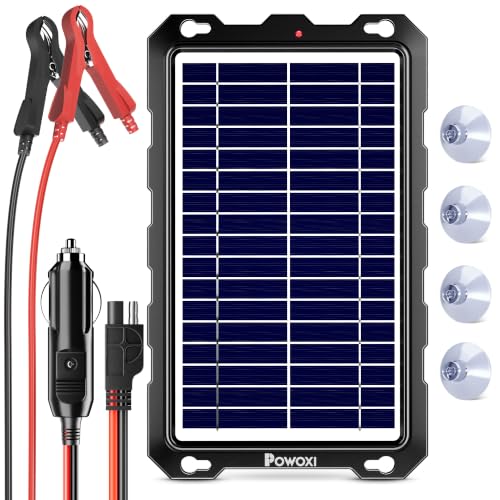
POWOXI 7.5W Solar Trickle Charger — The balanced middle of the wattage ladder
The POWOXI kit sits at the centre of this range and reads like the template for the category done properly. Its title describes a 7.5W 12V solar battery charger trickle maintainer kit for cars, with a smart charge controller, waterproof construction and intelligent safety protections, for boats, marine use, RVs, automotive, motorcycles and trailers. That breadth of named applications is credible at 7.5W: enough harvest for a resting car battery with ordinary parasitic drain, a boat battery on a trailer, a motorcycle through its off-season, provided the panel sees real daylight.
Seven and a half watts is the honest middle of maintainer sizing. It is meaningfully more than the token panels that struggle against a modern car’s electronics, and it stops short of the larger kits whose size becomes its own placement problem on a dashboard or a boat cover. The smart controller claim supports the leave-it-connected pattern that is the entire point of the product class, and the kit framing, panel plus controller plus connections, suits buyers who want one box that ends the project rather than the first item on a parts list.
Think of the vehicles this wattage quietly serves across a single street: the hatchback of a shift worker resting four days at a time, the motorcycle under its cover from October, the fishing boat that launches twice a month in season. None of them needs heroics; all of them were dying slowly before a maintainer arrived. The POWOXI’s proposition is that most battery grief is this undramatic kind, a slow leak in a parked machine, and that a mid-size panel with a smart controller is the appropriately undramatic cure, applied once and then forgotten.
Its limits are the class limits with a mid-size accent. A vehicle with heavy parasitic drain, an RV with detectors and modules awake, or a parking spot in structural shade will outrun 7.5W, and the honest answer there is the 12W or 20W pick, not optimism. Equally, this is a maintainer: a battery already flat needs a real charger first. For the broad middle of resting vehicles in decent sun, though, the POWOXI is the pick we would hand a first-time buyer, because its size, controller claim and application list all point the same way.
- Panel: 7.5W, for 12V batteries
- Controller: smart charge controller, stated in the title
- Protections: intelligent safety protections, per the title
- Construction: waterproof
- Applications named in title: car, boat, marine, RV, automotive, motorcycle, trailer
- Connection hardware included: the listing title calls the product a kit without itemising its leads, so confirm the connector set in the manufacturer documentation if you need a specific plug type
Strengths
- Mid-range wattage matches the common resting-car and motorcycle case.
- Smart controller claim supports permanent, unattended connection.
- The widest application list here, credible across land and marine storage.
Trade-offs
- Heavy parasitic drains and shaded parking can outrun 7.5W.
- Kit contents are not itemised at title level.
- Will not recover a battery that starts flat, as with every pick here.
Best for: cars, motorcycles, boats and trailers resting in decent sun between regular uses.
Not suited for: RVs with large always-on loads, or deep-shade storage where a bigger panel still starves.
The middle of the ladder is where most owners belong; check the POWOXI 7.5W kit on Amazon after checking where your vehicle actually catches the sun.
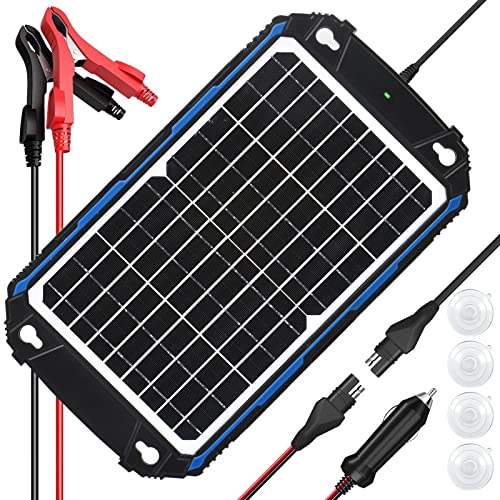
SUNER POWER 12W Solar Charger & Maintainer Pro — MPPT intelligence for marginal light
SUNER POWER’s Pro model makes the strongest controller claim in this guide and builds its case on it. The title describes a waterproof 12W 12V solar battery charger and maintainer Pro with a built-in ultra-smart MPPT charge controller, a 12 volt solar panel trickle charging kit for cars, automotive, boats, marine use, RVs and trailers. Twelve watts is already a healthy maintainer size; the MPPT controller is the argument that those watts will be harvested more completely across the imperfect light of real parking spots.
That argument deserves respect because of where maintainers actually work. They work on windscreens angled by a car’s rake, on driveways crossed by the shadow of a house at three in the afternoon, on boat decks under a boom tent’s edge, through the low sun of the months when batteries suffer most. In such light a basic controller leaves part of the panel’s potential unclaimed, while MPPT’s continuous matching is designed to claim it. For a northern owner maintaining a battery through winter, that margin can be the difference between holding and slowly losing, which is the only difference this category exists to make.
There is a subtle second dividend to MPPT in maintainer duty: forgiveness of placement sin. Owners rarely achieve the textbook angle; the panel ends up where the vehicle is, tilted by a windscreen or flattened by a roof rack’s convenience. A controller that continuously re-matches the panel’s operating point extracts the best available compromise from that imperfect geometry all day as the sun moves, rather than performing only at the one hour the angle happens to be right. For a product whose whole value is accumulated over months of unattended days, that all-day competence compounds into the margin that matters.
The Pro positioning also suits larger resting loads than the mid-size picks: an RV’s standby appetite, a boat with several batteries’ worth of self-discharge behind one connection point, a car that sits for months rather than weeks. What it cannot do is repeal the maintainer’s boundary; 12W, however intelligently harvested, will not refill a flat battery on any useful schedule. Buy it as the best holding instrument here for difficult light and longer rests, and it justifies its Pro name in the only currency that matters, a battery that is full when you finally turn the key.
- Panel: 12W, for 12V batteries
- Controller: built-in ultra-smart MPPT charge controller, the only MPPT claim among these titles
- Construction: waterproof
- Applications named in title: car, automotive, boat, marine, RV, trailer
- Kit contents beyond the panel and controller: not itemised in the listing title, so verify leads and mounts in the manufacturer documentation for your installation
- Overcharge behaviour: entrusted to the named MPPT controller; the title makes the controller itself the stated protection
Strengths
- MPPT harvesting suits the marginal, angled, winter light maintainers live in.
- Twelve watts covers larger resting loads than the mid-size kits.
- Waterproof build and broad application list match the Pro brief.
Trade-offs
- Controller sophistication is wasted on a small battery in perfect sun.
- Still a maintainer, with no recovery power over a flat battery.
- Kit contents need documentation checking before installation day.
Best for: RVs, boats and long-resting cars, especially in northern or partially shaded parking.
Not suited for: tiny batteries in ideal sun, where the 2.5W or 7.5W picks hold just as surely.
When light is the constraint rather than load, MPPT is the answer; review the SUNER POWER 12W Pro on Amazon with your parking spot’s winter sun in mind.

SUNAPEX 12V Solar Trickle Charger Kit — Portability with an explicit no-overcharge claim
The SUNAPEX kit’s title leads with the reassurance every maintainer buyer is really shopping for: a 12V solar battery charger trickle maintainer kit for cars that prevents overcharging with a smart controller, in a waterproof portable solar panel kit fitting 12V batteries for boats, RVs and more. Prevents overcharging is the plainest statement of the maintainer’s safety contract in this entire guide, and its presence in the title, rather than in fine print, is a credit to the listing. Portable is the second keyword: this is the kit for owners who move the maintainer between duties.
The overcharge sentence deserves one more moment of attention, because it addresses the fear that stops more maintainer purchases than any other: the worry that a panel left connected for months will cook the battery it was bought to protect. That fear is rational for a bare panel and obsolete for a controller-regulated kit, and the SUNAPEX title says so in the plainest available words. Buyers who have hesitated at exactly that worry should read this listing as the category answering them directly, and should demand the same plain sentence, in title or documentation, from any rival they consider.
Portability has a real use pattern behind it. The household with one maintainer and three resting batteries, the car this month, the mower through winter, the boat in spring, needs a panel that travels with its leads and sets up in minutes, and a waterproof portable kit is exactly that shape. The smart controller’s overcharge prevention is what makes such casual redeployment safe; a panel that will be connected and forgotten in four different places across a year must be trustworthy in all of them without adjustment.
The title does not print a wattage, and this guide will not invent one. That silence matters for sizing: a buyer choosing between this kit and a wattage-labelled rival cannot compare harvest from the title alone and should pull the panel’s rating from the product documentation before deciding, especially for larger batteries or shaded spots. What the title certifies is the safety behaviour and the format. For the rotating-duty owner whose batteries are modest and whose sun is decent, that certification may be the deciding evidence; for a big RV bank, buy on a printed wattage instead.
- System: 12V batteries
- Controller: smart controller, stated in the title to prevent overcharging
- Format: waterproof portable solar panel kit
- Applications named in title: cars, boats, RVs and more
- Panel wattage: the listing title does not print a wattage for this kit, so confirm the rating in the manufacturer documentation before sizing it against a large battery
- Connection types included: not itemised in the listing title
Strengths
- The clearest overcharge-prevention claim of any title here.
- Portable format suits one maintainer serving several resting batteries in rotation.
- Waterproof build fits the outdoor rotation, car to boat to mower.
Trade-offs
- No wattage in the title, so harvest sizing requires documentation homework.
- A rotating maintainer leaves the other batteries unheld while it travels.
- Kit contents are not itemised at title level.
Best for: households rotating one maintainer across a car, a boat and seasonal equipment.
Not suited for: a single large battery bank needing a permanently installed, wattage-verified panel.
If one kit must serve several batteries across the year, this is the traveller; find the SUNAPEX kit on Amazon and confirm its wattage in the documentation before ordering.
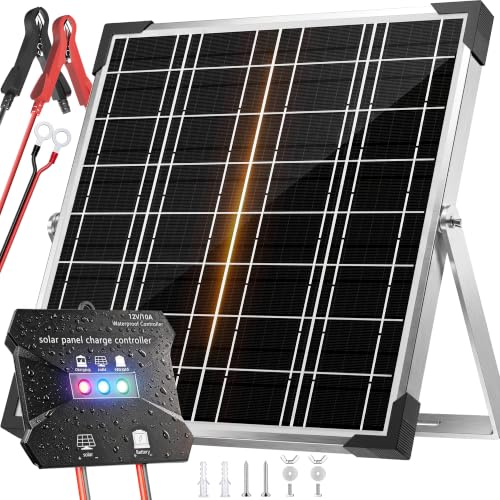
Voltset 20W Solar Trickle Charger Kit — The heavy lifter for big banks and greedy drains
At 20W, the Voltset kit is the largest panel in this guide and the correct answer to the situations the smaller maintainers honestly lose. Its title describes a 20W 12V solar panel battery charger trickle maintainer kit with a smart charge controller, waterproof construction and safety protections, for cars, boats, RVs, marine use, trailers, automotive, trailers again, trucks and motorcycles, a list as broad as its wattage. Twenty watts buys holding power against the serious parasitic appetite of a modern truck or RV, and harvest margin for the imperfect light of real storage.
Worked experience from the storage world supports the big panel’s case. Batteries in vehicles stored outdoors, on marina hardstanding, in farmyards, in the overflow car park of a small business, fail at rates that track their parasitic loads and their shade, and the installations that reliably end the failures are the ones that look oversized on paper. Twenty watts against a truck’s resting appetite in a bright yard is not oversized at all once winter’s short days halve the harvest; it is merely adequate with margin, and margin is what a maintainer is for. The Voltset is sized by people who learned that in February.
Size changes the placement conversation. A 20W panel is a considered object, happiest mounted or propped with intent on a roof, a tonneau, a boat’s hardtop or a shed wall facing the sky, rather than tossed on a dashboard. Owners who give it a proper aspect are rewarded with the strongest daily energy income here, enough that in bright seasons it can nudge a low battery upward over days, the middle case described earlier, while still performing its true office of holding a full one indefinitely through its smart controller.
The trade-offs are commitment and proportion. On a small mower battery in full sun, 20W behind a controller is surplus; on a vehicle that moves weekly, it is furniture without a job. And like every pick here, it remains a maintainer in identity: its extra watts widen the holding envelope, they do not convert it into the recovery charger a flat battery needs. For the big-bank, long-rest, heavy-drain end of the storage world, though, this is the pick that ends the monthly dead-battery ritual rather than merely postponing it.
- Panel: 20W, the largest rating in this guide, for 12V batteries
- Controller: smart charge controller, stated in the title
- Protections: safety protections, per the title
- Construction: waterproof
- Applications named in title: car, boat, RV, marine, trailer, automotive, truck, motorcycle
- Mounting hardware: the listing title calls the product a kit without itemising mounts, so plan placement from the manufacturer documentation and your vehicle’s sunniest surface
Strengths
- Twenty watts holds against heavy parasitic drains that defeat smaller panels.
- Harvest margin for shaded, angled and winter light.
- Smart controller keeps the larger input safe for permanent connection.
Trade-offs
- Panel size demands deliberate placement rather than dashboard casualness.
- Surplus capacity for small batteries in ideal conditions.
- Still not a recovery charger for a flat battery.
Best for: trucks, RVs, boats and big batteries resting for long stretches in imperfect light.
Not suited for: small equipment batteries, or vehicles used too often to need maintenance at all.
When the drain is real and the rest is long, size is the fix; size up the Voltset 20W kit on Amazon against your battery’s resting appetite.

ECO-WORTHY 2.5W Solar Car Battery Charger — The gentle minimum for small batteries in good sun
The smallest pick in the guide has the narrowest and most honourable brief. Its title describes a 2.5W solar car battery charger maintainer, a 12V waterproof portable solar trickle charger for cars, trucks, boats, lawn mowers, RVs, trailers, tractors and utility vehicles. Two and a half watts is a whisper of power, and for the right battery in the right place it is exactly enough: a lawn tractor’s modest battery through winter in a sunny lean-to, a utility vehicle’s battery on a bright yard, a classic car with almost no parasitic drain parked where daylight reaches it.
Agricultural and garden storage gives this little panel its natural habitat. Equipment sheds and lean-tos are unheated, often unpowered, and exactly where a mains maintainer cannot go; a waterproof 2.5W panel on the shed’s sunny wall, lead run to the tractor battery, is sometimes the only maintenance infrastructure available at any price. In that setting the absence of a named controller matters least, because the panel’s output is a trickle in the original sense of the word, and the battery it serves is sized to absorb it. Context acquits what a spec sheet questions.
Proportion is the whole judgement here. Small batteries with small losses need small replacement, and an oversized panel brings placement bulk without benefit. The ECO-WORTHY’s portability and waterproofing suit the seasonal shuffle of farm and garden equipment, where the maintainer moves from the mower in autumn to the tractor in spring, always in outdoor light, always against modest drains. Its title makes no controller claim, which this guide records plainly; at this wattage the traditional practice is gentle direct maintenance, but the buyer planning a permanent unattended summer connection should read the documentation’s overcharge guidance first, exactly as its spec box advises.
Where it cannot go is equally clear. A modern car with alarm, telematics and modules sipping all night will out-drink 2.5W, especially through a windscreen in winter, and an owner who asks it to hold such a battery will conclude wrongly that solar maintenance does not work. It works at its scale. Match the whisper to a whisper-sized loss and this is the simplest, most portable holding device in the guide.
- Panel: 2.5W, the smallest rating here, for 12V batteries
- Format: waterproof, portable
- Applications named in title: car, truck, boat, lawn mower, RV, trailer, tractor, utility vehicle
- Controller: no controller is named in the listing title, so check the manufacturer documentation for its overcharge behaviour before permanent unattended connection
- Connection hardware: not itemised in the listing title
- Harvest expectation: sized for small batteries and small drains in good sun, per the rating itself
Strengths
- Right-sized for mower, tractor and utility batteries with modest losses.
- Portable and waterproof for the seasonal equipment shuffle.
- The simplest possible holding routine for a sunny storage spot.
Trade-offs
- Modern cars’ parasitic drains can exceed its harvest.
- No controller claim appears in the title.
- Marginal in winter or shaded placement at any battery size.
Best for: lawn tractors, utility vehicles and low-drain batteries stored in honest daylight.
Not suited for: modern cars with heavy standby electronics, or any shaded long-term parking.
Small battery, bright corner, long rest: that is its whole brief; look at the ECO-WORTHY 2.5W panel on Amazon if your storage matches that description.

Topsolar 10W Solar Trickle Charger — Ten watts with the two connections owners actually use
The Topsolar pick’s distinction is printed at the end of its title, where the hardware lives: a 10 watt 12 volt solar trickle charger, a 10W 12V solar panel car battery charger and portable solar battery maintainer for cars, motorcycles, boats, marine and RV use, supplied with a cigarette lighter plug and alligator clips. Ten watts is a strong mid-size rating, and the dual connection set covers the two ways maintainers actually meet vehicles: clips straight onto the battery for certainty, and the lighter socket for a thirty-second, no-bonnet routine where the vehicle’s socket remains live at rest.
Motorcycles deserve a specific mention in this pick’s favour, because they combine a small battery, a long winter rest and, often, an owner who dreads removing bodywork to reach the terminals. A 10W panel with clips for the deep-winter setup and a lighter-style routine where the bike provides an accessory socket covers both the committed and the casual version of motorcycle storage. The panel’s size is generous for a bike battery, which in the marginal light of a garage doorway is a virtue rather than an excess, provided the documentation’s overcharge guidance is respected for the long connection.
That routine difference is not trivial. The best maintainer is the one that stays connected, and connection friction is the enemy of staying connected. A lighter-plug routine suits the car that rests in a driveway and is checked weekly; clips suit the boat, mower and project vehicle where the battery is the destination. One caution belongs with the lighter plug and this guide states it for all such products: the socket must be live when the vehicle is off, which is true of many vehicles and not all, and the owner’s manual or a simple test settles it before the first disappointed month.
The title names no controller type, describing the product as a charger and maintainer, so the same evidence discipline applies: its overcharge behaviour should be confirmed in the documentation for permanent connection, and we do not borrow the smarter rivals’ claims for it. What the title certifies, wattage, applications and both connection options, is a practical, flexible package at the size most resting cars actually need, and for owners who value hook-up convenience above controller sophistication, it is the natural final pick of the six.
- Panel: 10W, for 12V batteries
- Connections named in title: cigarette lighter plug and alligator clips
- Format: portable solar battery maintainer
- Applications named in title: car, motorcycle, boat, marine, RV
- Controller type: no controller type is named in the listing title, so verify overcharge protection in the manufacturer documentation before leaving it connected indefinitely
- Lighter-socket caveat: the socket must stay live with the vehicle off for that connection to work, which varies by vehicle
Strengths
- Both practical connections included, clips and lighter plug, per the title.
- Ten watts is a confident mid-size harvest for resting cars and boats.
- Portable format moves between vehicles and equipment easily.
Trade-offs
- No controller type is claimed at title level.
- The lighter-plug route fails on vehicles whose sockets sleep with the ignition.
- Ten watts still will not recover a flat battery on a useful schedule.
Best for: resting cars and boats whose owners want the easiest possible hook-up routine.
Not suited for: vehicles with ignition-switched lighter sockets using that route, or buyers requiring a named MPPT or smart controller.
Convenience is a feature when it keeps the panel connected; check the Topsolar 10W on Amazon and test your lighter socket’s resting state tonight.
Which solar maintainer matches which parked battery?
| Maintainer | Panel | Controller in title | Connections / format | Sized for |
|---|---|---|---|---|
| POWOXI | 7.5W | Smart controller | Kit | The resting-car middle |
| SUNER POWER Pro | 12W | MPPT, built-in | Kit | Marginal light, longer rests |
| SUNAPEX | Not printed in title | Smart, prevents overcharging | Portable kit | Rotating duty |
| Voltset | 20W | Smart controller | Kit | Big banks, heavy drains |
| ECO-WORTHY | 2.5W | None named | Portable panel | Small equipment batteries |
| Topsolar | 10W | None named | Lighter plug + clips | Easy hook-up routine |
What mistakes do owners make with solar maintainers?
Expecting resurrection is the first and commonest. A maintainer connected to a battery that is already flat becomes the scapegoat for a chemistry problem it never claimed to solve; charge first by proper means, then maintain. The second mistake is placement by convenience rather than by sun: the panel left on the shaded side of the boat, behind the windscreen’s tinted band, under the carport’s deepest roof, harvesting a fraction of its rating while the owner blames the wattage. Walk the spot at several hours of the day before blaming any number printed on a box.
A related error is disconnecting the maintainer for the vehicle’s occasional use and forgetting the reconnection, so the battery spends the season in alternating weeks of care and neglect that average out to neglect. The routine has to be part of the parking ritual itself, panel connected as the cover goes on, as automatic as the handbrake. Owners who build the connection into the shutdown sequence keep their batteries; owners who treat it as a separate chore discover, in spring, how many separate chores they skipped.
Third, owners size by battery alone and forget the drain. Two identical cars can need different maintainers because one sleeps with an alarm and telematics awake and the other is a analogue classic that draws almost nothing; the drain, not the battery’s label, sets the holding budget. Fourth, connections corrode quietly outdoors: clips and terminals on a boat or tractor deserve a seasonal glance and a clean, because a maintainer delivering its harvest into a green, resistive clip is a maintainer in name only. The sun is free and reliable; the last inch of copper is where these systems actually fail.
How should you set up a solar maintainer for a long rest?
Begin with a full battery, charged by a mains charger or a proper run, because the maintainer’s contract starts at full. Place the panel for the day’s honest sun, favouring the hours around midday and the season ahead rather than the season behind; a winter rest in northern latitudes wants a steeper tilt toward the low sun and a spot the building’s shadow reaches last. Connect with the tidiest run the hardware allows, clips firm on clean terminals or the lighter plug seated, cable slack protected from doors, bonnets and foot traffic.
Seasonal repositioning is the connoisseur’s touch, and it costs nothing. The panel angled for June’s high sun is wrong for November’s low arc, and a stored vehicle’s maintainer repays a twice-yearly adjustment of tilt and a check that new shadows, a grown hedge, a repositioned trailer, have not quietly annexed its light. Put the adjustment on the same calendar as the vehicle’s other seasonal rituals, antifreeze, tyre pressures, the cover’s inspection, and the panel’s harvest stays honest across the whole year rather than decaying unnoticed from its first installation.
Owners of several resting machines should resist the temptation to rotate one panel heroically among all of them on a mental schedule. Rotation works only when the schedule is written, realistic and weighted toward the greediest drain; otherwise the honest solution is a second maintainer for the second machine, sized by the same logic, because a battery left unheld for the three weeks between visits is not being maintained at all, merely visited.
Then verify once, properly, a week later: battery at rest, vehicle starting cleanly, panel still angled and unobstructed, connections bright. That single check converts hope into knowledge for the whole season. Repeat the glance whenever you pass the vehicle, and deep-clean the panel’s face when you clean anything else nearby, since a film of dust and pollen is a silent wattage cut no controller can recover. The routine is five minutes at the start and seconds thereafter, which is the entire promise of the category kept honestly.
Final Recommendation
Match the panel to the drain and the daylight, and let the controller carry the trust. Small equipment in bright storage takes the ECO-WORTHY 2.5W. The ordinary resting car takes the POWOXI 7.5W, or the Topsolar 10W where its lighter-plug routine keeps the connection effortless. Difficult light and longer rests argue for the SUNER POWER Pro and its MPPT harvest; rotating duty across several batteries suits the SUNAPEX kit; and the heavy-drain, big-bank end of the world belongs to the 20W Voltset. A stored battery dies of neglect measured in millivolts a day, and the right maintainer is simply the one whose quiet daily arithmetic beats that drain, in your light, on your vehicle, all season long. Buy it before the rest begins rather than after the first flat morning, connect it the day the vehicle parks, and the battery you already own will outlast the one your neighbour replaces, not because yours was better, but because yours was never left alone in the dark with its own slow leak and a calendar working patiently against it, week after quiet week, in all weathers, without complaint or ceremony, season after season, year after year.
Frequently Asked Questions
Can a solar trickle charger recharge a completely flat battery?
Not on any schedule worth planning around. These are maintainers sized to offset self-discharge and parasitic drain on a battery that starts full. A flat battery needs a proper mains charger first; the solar panel’s job begins the day after, holding the recovered charge indefinitely.
What size panel does my car need?
Judge by drain and daylight rather than by the car alone. A low-drain vehicle in strong sun holds on 7.5W; a modern car with heavy standby electronics, or any vehicle in partial shade, argues for 10W to 12W; trucks and RVs with serious resting loads are the 20W case. When torn between two sizes in poor light, take the larger.
Why does the controller matter if the panel is small?
Because the maintainer’s promise is unattended connection. A controller, smart or MPPT as the titles here variously claim, regulates the panel’s output and guards the full battery against overcharge across months of connection. Where no controller is named, as with the ECO-WORTHY and Topsolar titles, the documentation should be checked before permanent connection.
Can I use the cigarette lighter plug option on any car?
Only where the socket stays live with the ignition off. Many vehicles keep it powered; others switch it with the ignition, which disconnects the maintainer exactly when it is needed. Test yours, or use the alligator clips directly on the battery, which no ignition logic can interrupt.
Can one maintainer look after two batteries?
Not simultaneously in any way this guide endorses. A maintainer’s harvest is budgeted against one battery’s losses, and splitting it across two dilutes the holding current while complicating the controller’s view of both. The rotating pattern, one kit moved between batteries on a schedule, is the SUNAPEX pick’s pattern; permanent dual coverage means a second maintainer, or an installed multi-bank mains charger where power is available.
Will a maintainer work through winter?
Yes, with placement respect. Winter light is weaker and lower, batteries lose charge faster in the cold, and the margin narrows, which is why this guide steers winter storage toward the larger panels and the MPPT pick, a steep tilt toward the sun, and a battery that entered winter fully charged.
Related Guides
Storage power connects to the rest of the charging shelf. See Best DeWalt 20V Chargers for the tool batteries in the same garage, Best Marine Deep-Cycle Battery Chargers for the boat’s installed alternative, and Best Scooter Battery Chargers for the two-wheeled machines resting beside them.