What's inside
- Key Takeaways
- Quick Picks
- How Did We Rank Desks That Lift on Air?
- What Actually Happens Inside a Pneumatic Lift?
- How Much Weight Can a Gas-Spring Desk Honestly Carry?
- How Do You Set Up a Rolling Sit-Stand Desk So It Behaves?
- Which Rooms and Routines Suit a Desk With No Plug?
- How Do You Choose Between One Column, Two Columns and Four Legs?
- What Should You Measure Before Ordering One?
- How Do the Six Pneumatic Desks Stack Up Side by Side?
- How Does a Pneumatic Desk Age Over Years of Daily Use?
- What Mistakes Do People Make When Buying a Pneumatic Desk?
- Final Recommendation
- Frequently Asked Questions
- Related Guides
As an Amazon Associate I earn from qualifying purchases. This post may contain affiliate links at no extra cost to you.
widgetverdict.com is reader-supported. When you buy through links on our site, we may earn an affiliate commission.
Where to buy: Amazon carries all six desks in this roundup, and every one of them rises on a gas spring rather than a motor. That single fact sorts the category before anything else does: there is no power cord to trail across the floor, no control box under the top, and no hand crank to wind twenty turns at a time. You squeeze a lever, the counterbalanced column does the lifting, and the desk settles where you let go. Prices move around, so check the current figure on the listing rather than trusting any number printed elsewhere.
The best pneumatic sit stand desks answer a specific frustration: the standing desk that is technically adjustable but practically never adjusted, because plugging in, waiting for motors, or cranking by hand turns a ten-second posture change into a small project. A pneumatic desk removes the friction. It is the desk equivalent of an office chair’s height lever — pull, rise, release — and that immediacy changes how often people actually alternate between sitting and standing across a working day. The trade is real, though: gas springs lift modest loads, travel through narrower height ranges than tall electric frames, and most pneumatic models are compact mobile desks rather than full-width workstations.
So this guide is honest about scale from the start. Five of the six picks are small, rolling, laptop-first desks built for apartments, spare corners, classrooms and bedside work. One — the WALKINGDESK — is a fixed-frame 40-inch desk designed to stand over a walking pad. If your setup is a pair of large monitors on arms, a desktop tower and a printer, pneumatic lifting is probably not your mechanism, and the guide says so where it matters. If your setup is a laptop, a notebook and a coffee, and your room cannot spare a permanent workstation footprint, this is the corner of the desk market built for you.
Key Takeaways
- Pneumatic desks lift with a gas spring and a lever — no motor, no cord, no crank — so height changes take seconds and the desk can roll anywhere.
- Load capacity is the category’s hard ceiling: the VIVO cart is rated at 22 lbs, so these are laptop desks, not multi-monitor battlestations.
- The FLEXISPOT H7 Plus states the widest travel here, 27.6 to 45 inches, on a one-piece 40-inch top.
- Tilting tops on the Liftsync and the MUSSO D5 turn two of the picks toward drafting, reading and sketching rather than flat typing.
- The WALKINGDESK is the outlier: a four-leg fixed frame made to pair with a walking pad, not a rolling cart.
Quick Picks
| Pick | Badge | Why it earns its place |
|---|---|---|
| FLEXISPOT H7 Plus 40in Pneumatic | The full-width cordless desk | A one-piece 40-inch top on a dual-column pneumatic frame, travelling from 27.6 to 45 inches with nothing to plug in. |
| Liftsync 28in Pneumatic Rolling Desk | The tilting two-tier cart | A 28-inch tiltable top over two shelves, part laptop cart and part drafting table on wheels. |
| VIVO Mobile Pneumatic Laptop Cart | The podium that rolls | A 32 x 24 inch pneumatic cart rated for 22 lbs, with locking wheels, at home presenting as much as typing. |
| WALKINGDESK 4-Leg Pneumatic Desk | The walking-pad partner | A four-leg fixed frame with a fabric drawer, built to stand steady over a treadmill belt. |
| Gibbon Mounts 32in Glass Rolling Desk | The glass-top compact | A 32-inch glass surface with a drawer and hidden or lockable wheels for tight, tidy spaces. |
| MUSSO D5 Gas-Lift Mobile Desk | The sofa-side split top | A walnut gas-lift desk whose tilting split desktop is shaped for working beside a sofa, bed or chair. |
How Did We Rank Desks That Lift on Air?
By mechanism first, because in this category the mechanism is the product. A pneumatic desk’s gas spring is charged to counterbalance a particular load band: too little weight on top and the desk wants to float upward and feels skittish; too much and the lever strains, the rise slows, and the spring’s working life shortens. So the first question asked of every pick was whether its stated job — laptop cart, drafting table, walking-pad desk — matches the load a gas spring can honestly serve. Desks that pretend to be full workstations scored worse than desks that admit they are laptop furniture and do that job completely.
Second came the numbers the titles actually state: top dimensions, height range where given, and load rating where given. The FLEXISPOT’s 27.6-to-45-inch travel and the VIVO’s 22 lb ceiling are the kind of figures that decide a purchase, and where a title stays silent — several of these listings do not publish a load rating in the title at all — the review flags the silence rather than filling it with a guess. A buyer comparing a 28-inch cart against a 40-inch desk deserves to know which figures are confirmed and which are homework.
Third came the furniture around the lift: wheels that lock, tops that tilt, shelves and drawers that decide where the charger, notebook and mouse live while the desk moves. Pneumatic desks are bought to be mobile, and a mobile desk without storage turns every relocation into a juggling act. The picks that earned their places treat the whole object — surface, storage, casters, frame — as one design, and the detailed reviews below judge them that way. Readers who already know they want the walking version of this arrangement should also read our Best Small Treadmill Desks guide, where the belts that slide under desks like the WALKINGDESK are compared on their own terms.
What Actually Happens Inside a Pneumatic Lift?
A gas spring is a sealed cylinder of compressed nitrogen with a piston running through it. In a desk column, the spring is valved so that squeezing the lever opens the valve and lets the piston travel; the gas pressure, matched against the weight of the top and whatever sits on it, does the pushing in one direction and resists in the other. Release the lever and the valve closes, locking the column at that height. It is the same physics as an office chair’s lift and a car hatch’s struts, scaled up and — in the dual-column FLEXISPOT — doubled for stability.
Against an electric desk, the differences are practical rather than subtle. Electric frames lift more weight, travel further, and remember preset heights; they also need a wall socket, a control box, a cable chain of wiring under the top, and twenty to thirty seconds of motor whir per adjustment. A pneumatic desk adjusts in the time it takes to stand up, works during a power cut, works in a hallway, a balcony or a classroom with no free outlet, and can be rolled to the window for the afternoon without an extension lead. What it cannot do is hoist a heavy monitor stack or promise millimetre-repeatable heights — there are no memory presets on a gas spring, only the lever and your sense of where your elbows were happy yesterday.
Against a hand-crank desk, pneumatic wins on effort and loses on nothing much except load. Cranks are slow by design — dozens of turns for full travel — and that slowness is exactly why crank desks so often stay at one height for months. The gas spring’s whole argument is behavioural: an adjustment that costs two seconds happens daily, and an adjustment that costs a minute happens rarely. If you are choosing between the three mechanisms, choose by load and by honesty about your own habits, in that order.
How Much Weight Can a Gas-Spring Desk Honestly Carry?
Less than you hope, and the listings here are unusually frank about it. The VIVO cart states 22 lbs outright — a laptop, its charger, a notebook and a drink, with little margin beyond. The other titles mostly leave the rating unstated, which in this category should be read as a caution rather than an oversight to wave through: assume laptop-class loads until the manufacturer’s documentation confirms otherwise. A 40-inch top like the FLEXISPOT’s invites spreading out, but spreading out with paper, books and a laptop is a different load from bolting a monitor arm to the back edge, and only one of those belongs on a pneumatic column.
Height range deserves the same scrutiny. The FLEXISPOT’s stated 27.6 to 45 inches covers seated work for most adults and standing work for many, but taller users should check the top of any pneumatic range against their standing elbow height before ordering — gas-spring desks as a class run shorter at maximum extension than tall electric frames. Seated minimums matter too: a desk whose lowest setting is still high will leave shorter users shrugging their shoulders to the keyboard all day.
Finally, judge the top as a work surface, not a number. Twenty-eight inches (Liftsync) is a laptop and a notebook side by side. Thirty-two inches (VIVO, Gibbon Mounts) adds a mouse or a paperback’s worth of elbow room. Forty inches (FLEXISPOT, WALKINGDESK) is where a second device, a textbook or a drawing pad stops being an eviction notice for the laptop. Buyers who need genuinely wide, fixed, load-bearing surfaces are shopping in a different category — our Best Industrial Desks roundup covers the long wood-and-steel work tables that stay put and carry real weight.
How Do You Set Up a Rolling Sit-Stand Desk So It Behaves?
Start with the floor. Pneumatic carts assume hard floors or low-pile carpet; on deep carpet the casters drag, the desk resists rolling, and the whole point of a mobile desk leaks away. Lock the wheels before the first typing session and check the lock again whenever the desk moves rooms — a desk that creeps backwards mid-sentence will teach you this once, memorably. Then set the two heights that matter: seated, with feet flat and elbows near ninety degrees; standing, with the top at or just below elbow height so your shoulders stay down.
Cable discipline is simpler here than anywhere else in the desk market, because the honest pneumatic setup is nearly cable-free: a laptop on battery, a charger that visits rather than resides, a wireless mouse if you use one. Resist the urge to hang a power strip off the back edge — the trailing lead destroys the mobility you paid for and adds swinging weight the gas spring was not charged for. If the desk lives beside a sofa or bed, like the MUSSO D5 is designed to, park it in the same orientation every time so the split top’s tilting section lands over your lap rather than over the cushions.
In shared and teaching spaces the routine differs: these carts double as presentation podiums and overflow workstations, which is why the same models appear in training rooms — our Best Classroom Computer Desks guide covers the flip-top training tables built for that world full-time. For a rolling pneumatic cart in a classroom or meeting room, the setup habit that matters is the reset: wheels locked, top lowered, tilt flattened at the end of the session, so the next user meets a desk rather than a sculpture.
Build the rhythm deliberately in the first week, because the desk will not remind you. The pattern that survives is anchoring the change to events that already exist: stand for the first call of the day, sit for deep writing, stand again after lunch when the afternoon dip arrives, sit for the final hour. Owners who wait to feel like standing discover that the feeling rarely files a request; owners who tie the lever to the calendar’s existing landmarks find, a month in, that the alternation has become the day’s texture rather than an intervention in it. That is the entire health-adjacent promise this category can honestly make — not a posture miracle, just a change of position so cheap it actually happens.
Which Rooms and Routines Suit a Desk With No Plug?
The clearest case is the room that changes jobs. A spare bedroom that hosts guests monthly, a living room that becomes an office at nine and a cinema at seven, a studio flat where the desk shares square metres with the bed, the bike and the drying rack — in all of these, a desk that rolls away and needs no socket is not a compromise but the only category that fits the lease. Pneumatic desks are bought by people whose floor plans are negotiations, and their value is measured in rooms returned to their evening purpose, not in specifications.
The second case is the renter’s and the mover’s. Electric desks are furniture: heavy, wired, assembled with forty fasteners and a control box screwed underneath. A pneumatic cart arrives nearly whole, leaves through the same door it entered, and works in the next flat the same afternoon. Students, junior doctors on rotation, anyone in a furnished let with one socket already claimed by the lamp and the router — these are the natural owners of a desk that asks the room for nothing but floor.
The third case is the shared surface. In households where a desk is a timeshare — one partner’s morning calls, a child’s homework at four, a parent’s accounts at eight — the two-second adjustment stops being a convenience and becomes the peace treaty. Nobody negotiates with a crank for a forty-minute homework session; everybody will squeeze a lever. The same logic runs in classrooms and clinics, where a rolling pneumatic cart can be a teacher’s podium at ten and a student’s workstation at eleven, at two different heights, without a technician or a cable run.
And there is the case nobody puts in the brochure: the power cut, the tripped breaker, the old house whose study circuit already carries the heater. A gas spring does not care. Work that depends on standing — a presentation rehearsed, a call taken on your feet to keep your voice awake — continues through outages that freeze every motorised desk in the building at whatever height it died at.
How Do You Choose Between One Column, Two Columns and Four Legs?
Frame architecture decides how a pneumatic desk feels at the top of its travel, which is where gas-spring desks are most honestly tested. A single central column, the layout of the carts here, is the cheapest and lightest way to lift a top, and it behaves well at seated heights with a laptop centred over the column. Extend it fully, lean on a front corner, and the top will rock slightly around its single post — not dangerously, but noticeably, and more so the wider the top relative to the column’s bracing.
Two columns, as on the FLEXISPOT, spread the lift and the bracing across the top’s width. The seesaw disappears, the rise stays level even with the laptop parked at one end, and the desk can honestly wear a 40-inch surface. The cost is weight and price: a second gas spring, a synchronising mechanism and a sturdier frame make the desk a heavier object to roll and a dearer one to buy. For a desk that will live at standing height for hours with work spread wide, the second column is the specification that matters most in this entire roundup.
Four legs, as on the WALKINGDESK, step outside the column logic altogether. The lift still happens pneumatically, but stability comes from a planted stance at four corners — the same reason a table does not wobble. That architecture suits a desk that stays in one place and gets leaned on, bumped and vibrated, which is precisely the life of a desk over a walking pad. What it surrenders is the cart’s freedom: no casters, no rolling to the window, no vanishing into a corner at night.
The practical rule is to match the frame to the desk’s dominant hour. Mostly seated, mostly laptop, mostly moving rooms: a single column serves. Mostly standing, work spread wide, one home corner: two columns. Planted over a belt or against a wall, leaned on daily: four legs. Buyers who choose the frame by the brochure photo rather than by the dominant hour are the ones writing the disappointed reviews in this category.
What Should You Measure Before Ordering One?
Four measurements, taken with a tape rather than estimated from a chair. First, your seated elbow height: sit in your actual chair, feet flat, forearms level, and measure the floor-to-elbow distance — the desk’s minimum must reach it or below. Second, your standing elbow height, measured the same way in the shoes you work in; the desk’s maximum must reach it, and this is the figure pneumatic desks most often fail taller buyers on. Third, the doorway and the corner the desk will live in: a 40-inch top that cannot turn the hallway corner is a hallway desk now.
Fourth, the load itself. Put the laptop, its charger, the notebook, the phone and the drink you actually work with on a kitchen scale, all together. The total is usually a pleasant surprise — most laptop setups land well inside even the VIVO’s stated 22 lbs — but the exercise settles the question the listings leave open, and it exposes the one item that breaks the budget: the hardback reference book, the desktop speaker, the second screen someone was hoping to sneak aboard.
Measure the floor, too, while the tape is out. Rolling desks cross thresholds, rug edges and cable protectors badly; a route with a two-centimetre rug lip between the desk’s parking corner and its working spot will be negotiated twice a day, and casters that manage it in the showroom glide of a product video may not manage your particular lip. None of this takes ten minutes, and all of it is cheaper than a return.

FLEXISPOT H7 Plus 40in Pneumatic — The full-width cordless desk
Most pneumatic desks are carts that apologise for being small; the H7 Plus is a desk that happens to lift on air. The one-piece 40-inch top is the widest surface in this roundup alongside the WALKINGDESK, and the dual-column design matters more than the width: a single central column lets a wide top seesaw at the edges when you lean on a corner, while two columns brace the surface so typing at the far left does not announce itself at the far right. For a laptop, a notebook and a phone laid out in a working row, this is the only pick here that feels like a workstation rather than a perch.
The stated travel, 27.6 to 45 inches, is the other headline. That low end sits in genuine seated territory for most adults, and the high end reaches standing height for a broad band of users — the full sit-stand promise, delivered by a lever. Because there is no motor, there is also no control box dictating where the desk may live: it can work in the middle of a room, roll to a balcony door for the light, or serve as a spare surface in a guest room that has no free socket. Cordless is a lifestyle feature as much as a specification, and this desk is built around it.
The honest limits are the category’s own. The listing title does not publish a load rating, and a dual-column gas-spring desk should be loaded like a laptop desk — machine, charger, paper, a drink — not like an electric frame carrying monitor arms. Nor will the top suit a permanent multi-screen rig, because a pneumatic desk that gets rolled around is a desk whose contents get rearranged, and a three-monitor array does not enjoy being rearranged. Buy it as the best version of a mobile laptop workstation and it delivers; buy it as a cheap substitute for a full electric setup and it will correct you.
- Top: one-piece, 40 inches wide
- Lift: pneumatic, dual-column, cordless
- Height range: 27.6 to 45 inches, as stated in the listing title
- Load rating: absent from the title; verify it against the manufacturer’s documentation
- Finish: white
Strengths
- Widest one-piece top here, braced by two columns instead of one.
- The fullest stated height range in the roundup, from seated to standing.
- No cord, no motor, no presets to program — the lever is the whole interface.
Trade-offs
- Load capacity is unpublished in the title; heavy monitor setups are out of scope.
- No drawers or shelves — what is not on the top travels in your hands.
- White finish shows coffee rings and pen marks more readily than wood tones.
Best for: a laptop worker in a small home office who wants a real 40-inch surface that rises without a socket.
Not suited for: a fixed multi-monitor rig whose weight and cabling would ground a cordless desk permanently.
Check the FLEXISPOT H7 Plus on Amazon if the appeal is a full-width top that floats up on a lever and rolls wherever the light is better.

Liftsync 28in Pneumatic Rolling Desk — The tilting two-tier cart
The Liftsync makes a different bet from the FLEXISPOT: instead of width, it offers angle and storage. The 28-inch top tilts, which moves this desk out of pure typing territory and into reading, sketching, drafting and sheet-music territory — the listing itself names drafting-table and laptop-cart duties in the same breath. A tilting surface holds a page or a tablet at the angle your neck actually wants, and for anyone whose workday mixes a laptop with paper — teachers marking, students annotating, illustrators referencing — that hinge is worth more than extra inches of flat top.
Underneath, the two-tier shelving answers the rolling desk’s oldest problem: where the rest of the work lives while the desk moves. A lower shelf takes the textbook, the charger brick or the folder stack that would otherwise ride on the top and slide off at the first doorway. Combined with the pneumatic column, the whole object becomes a small mobile workstation that can present at standing height in one room and sit beside a chair in the next, carrying its own supplies with it.
The cautions are geometric. Twenty-eight inches is a laptop’s width with modest margins; a separate mouse will compete with the machine for the top, and tilting a surface that holds loose items demands the discipline of clearing it first — pencils and coffee obey the new angle immediately. The title also gives no height range or load figure, so standing-height fit and carrying limits are figures to confirm in the manufacturer’s documentation rather than assume. As a compact, angle-friendly cart for one person’s mixed paper-and-laptop work, though, nothing else in this roundup is shaped quite like it.
- Top: 28 inches, tiltable
- Storage: 2-tier shelves beneath the top
- Lift: pneumatic, on wheels
- Height range: not published in the title — the manufacturer’s documentation carries the confirmed figures
- Stated roles: computer workstation, drafting table, laptop cart
Strengths
- Tilting top serves reading, drawing and annotating, not just typing.
- Two shelves keep supplies travelling with the desk instead of on it.
- Compact footprint fits dorm rooms, spare corners and classroom edges.
Trade-offs
- 28 inches leaves little room for a mouse beside the laptop.
- Loose items must be cleared before tilting, every time.
- Height range and load rating are not published in the title.
Best for: a student or teacher whose work mixes a laptop with paper that needs an angled surface.
Not suited for: a mouse-and-laptop typist who needs flat width more than tilt or shelving.
Look at the Liftsync rolling desk on Amazon if a tilting top and two shelves sound like the small workstation your corner has been missing.
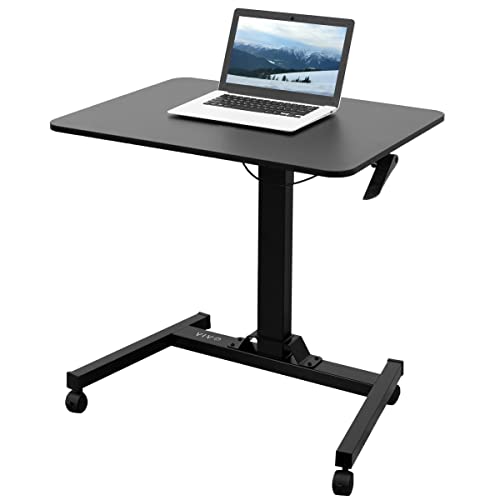
VIVO Mobile Pneumatic Laptop Cart — The podium that rolls
VIVO’s cart is the most plainly specified pick in this roundup, and that plainness is a virtue: a 32 x 24 inch top, a stated 22 lb load ceiling, pneumatic adjustment, locking wheels, black finish, model CART-V07B. There is no lifestyle photography fog to see through. It is a rolling podium that also holds a laptop at sitting height, and its natural habitats are the places podiums live — classrooms, meeting rooms, training sessions, church halls, trade-show booths — plus the home offices of people who present on video calls standing up.
The 22 lb rating deserves respect rather than disappointment. It tells you exactly what the gas spring was charged for: a laptop, notes, a clicker, a bottle of water. Within that envelope the cart does something electric desks cannot do at all — it follows the presenter. Roll it to the whiteboard, raise it, speak; roll it to the desk, lower it, type. The locking wheels matter here more than on any other pick, because a podium that drifts during a presentation is a prop in a comedy, and VIVO has at least named the lock in the title.
What it is not is a home workstation for long typing days. The top is a presenter’s rectangle, not an typist’s expanse; there is no storage, no tilt, no shelf for the charger, and the 22 lb ceiling rules out even a modest monitor. Buyers who mainly type should look at the FLEXISPOT or the WALKINGDESK. Buyers who stand and talk for a living — teachers, trainers, sales engineers, lecturers — will recognise this cart as the tool their job actually uses, with a sit-stand party trick the old wooden podium never offered.
- Top: 32 x 24 inches
- Load rating: 22 lbs, as stated in the listing title
- Lift: pneumatic height adjustment
- Wheels: locking casters
- Model: CART-V07B, black
Strengths
- The only stated load rating in the roundup — no guessing about the spring’s envelope.
- Locking wheels suit presentation work where a drifting podium is a real hazard.
- Generous 32-inch width for a cart, enough for laptop plus notes.
Trade-offs
- 22 lbs is a hard ceiling — laptop and papers only.
- No storage, tilt or shelving of any kind.
- Top shape favours standing presentation over long seated typing sessions.
Best for: a teacher or presenter who moves between speaking standing and noting seated.
Not suited for: a home worker wanting a permanent desk with room for peripherals and supplies.
See the VIVO CART-V07B on Amazon if your workday involves standing up in front of people with a laptop close at hand.

WALKINGDESK 4-Leg Pneumatic Desk — The walking-pad partner
Every other pick here rolls; this one plants. The WALKINGDESK is a four-leg, fixed-frame desk whose title makes two promises most standing desks only imply — pneumatic adjustment and no wobble — and names its intended partner outright: a walking pad treadmill underneath. That pairing explains the architecture. A desk standing over a moving belt gets bumped by knees, leaned on by tired walkers and vibrated by the motor below, so the frame trades casters for four planted legs and asks stability to come from geometry rather than from a motor’s gearbox.
The 40-inch top matches the FLEXISPOT’s width, and the fabric drawer underneath is a small but telling detail: walking-desk users accumulate the same desk clutter as everyone else — phone, remote for the pad, notebook — and a soft drawer swallows it without the rattle a hard drawer would add over a running belt. The title also lists gaming and home-office duty, which is fair: a fixed four-leg frame at 40 inches is a legitimate small desk even if no treadmill ever slides beneath it.
Two honest caveats. First, the desk is sold as a desk — the walking pad is a separate purchase, and the pairing only works if the pad’s width and your stride fit the frame’s stance, measurements to take before ordering either half. Second, pneumatic lifting over a treadmill has a practical rhythm: you adjust the height while standing still beside the desk, not mid-stride, because a gas spring under a shifting, leaning load is being asked to do physics it was not charged for. Set the height, start the belt, walk. Buyers building the full under-desk walking setup from scratch should compare the belts themselves in our treadmill desk guide linked earlier in this article.
- Top: 40 inches
- Frame: four-leg fixed frame, no casters
- Lift: pneumatic adjustment
- Storage: fabric drawer under the top
- Stated purpose: walking pad pairing, home office, gaming
Strengths
- Four planted legs answer the wobble that a moving belt underneath would expose.
- Fabric drawer holds the pad’s remote and phone without rattling.
- Works as a stable standalone 40-inch desk if the treadmill plan changes.
Trade-offs
- Fixed frame gives up the roll-anywhere freedom the other picks trade on.
- Walking pad is not included and must be sized to the frame separately.
- Height changes belong to stationary moments, not mid-walk adjustments.
Best for: a walking-pad owner who needs the desk above the belt to stay planted and quiet.
Not suited for: a renter who rearranges rooms weekly and needs the desk to roll with the furniture.
Check the WALKINGDESK frame on Amazon if your standing desk’s real job is hovering steadily over a moving belt.

Gibbon Mounts 32in Glass Rolling Desk — The glass-top compact
The Gibbon Mounts desk is the aesthete of the roundup: a 32-inch glass top on a pneumatic column, with a drawer and wheels that are hidden or lockable depending on how you set it up. Glass changes the room before it changes the work. In a small flat where a desk must live in the living room, a transparent top reads as a side table that happens to hold a laptop, not as office furniture that has annexed the sofa’s territory — and when the workday ends, the whole thing rolls into a corner and visually disappears in a way no wood-effect slab manages.
Functionally it is a compact laptop desk with one storage drawer, aimed by its own title at compact spaces. The hidden-wheel option is the thoughtful part: casters that disappear suit a desk that spends most of its life parked in view, while the lockable mode serves the days it parks on a slope or beside an active toddler. The drawer, shallow as drawers on glass desks must be, takes the charger, the notebook and the pen that would otherwise colonise the glass.
Glass also brings its own terms and conditions. It shows every fingerprint and coffee ring at full contrast, it is cold to the forearms in winter, and it asks for coasters as a way of life. The title publishes no load rating and no height range, and glass tops in particular should be loaded conservatively until the manufacturer’s documentation says otherwise — a laptop and its accessories, not a stack of hardback references. Buyers who can live with the wipe-down ritual get the most room-friendly object in this roundup; buyers who eat at their desk daily should choose a more forgiving surface.
- Top: 32 inches, glass
- Storage: one drawer
- Wheels: hidden or lockable configuration
- Lift: pneumatic sit-stand adjustment
- Load rating: the listing title does not give this figure — check the manufacturer’s documentation before ordering
Strengths
- Glass top keeps a small room feeling open instead of office-colonised.
- Wheels can hide away when the desk is parked in living space.
- A drawer at all is rare on glass desks and keeps the surface clear.
Trade-offs
- Glass shows marks instantly and demands coaster discipline.
- Cold surface under forearms in unheated rooms.
- Load and height figures are unpublished in the title; load it lightly.
Best for: a small-flat dweller whose desk must pass as living-room furniture between sessions.
Not suited for: a desk-diner whose meals and mugs would keep the glass in permanent need of a cloth.
View the Gibbon Mounts glass desk on Amazon if the winning desk is the one guests barely notice until you raise it.

MUSSO D5 Gas-Lift Mobile Desk — The sofa-side split top
The MUSSO D5 starts from a posture the other five picks ignore: working while seated in a sofa, a bed or a deep chair, with the desk pulled up to you rather than you pulled up to a desk. Its split desktop is the mechanism of that idea — one section stays flat for the laptop while the other tilts toward you as a reading and writing slope — and the gas-lift column raises the whole arrangement to sofa-arm height and beyond, into standing territory when the chair loses its appeal. The walnut finish is pitched at living rooms, not offices, and the design knows it.
The split top deserves a closer look, because it solves a real annoyance. On a single tilting top, everything tilts: the laptop slides, the mouse emigrates, the coffee contemplates leaving. Splitting the surface means the machine keeps its level while the notebook, tablet or paperback gets the angle — two postures on one desk, which is exactly the geometry of sofa work, where the laptop is the anchor and everything else is reference material. Locking casters keep the arrangement honest once it is pulled into place across your legs or beside the seat.
The limits follow from the specialisation. A split top is a smaller flat area than its headline dimensions suggest, so a separate keyboard and mouse crowd it quickly; the desk is a one-person, one-laptop instrument. The title gives neither dimensions nor a load rating, so buyers should confirm the flat section’s size against their laptop’s footprint in the manufacturer’s documentation before ordering. For the reader whose office is genuinely the end of the sofa — recovery, small flats, evening work that must not colonise a table — the D5 is the only pick here designed from that chair outward.
- Top: tilting split desktop, walnut finish
- Lift: gas-lift sit-stand adjustment
- Wheels: locking casters
- Stated positions: beside a sofa, bed or chair
- Dimensions: the listing title does not give this figure — check the manufacturer’s documentation before ordering
Strengths
- Split top keeps the laptop level while reference material tilts.
- Designed for sofa and bedside postures the other picks do not address.
- Walnut finish sits comfortably in living-room furniture company.
Trade-offs
- The flat section is modest — external keyboards will crowd it.
- Dimensions and load rating are absent from the title and need confirming.
- A specialist’s shape; as a main desk it would feel like a compromise.
Best for: a sofa-based worker who reads and annotates alongside the laptop all day.
Not suited for: a desktop-replacement setup with separate keyboard, mouse and monitor to house.
See the MUSSO D5 on Amazon if your real office chair has cushions and the desk needs to come to it.
How Do the Six Pneumatic Desks Stack Up Side by Side?
| Pick | Top | Lift and travel | Storage | Defining trait |
|---|---|---|---|---|
| FLEXISPOT H7 Plus | 40 in, one-piece | Pneumatic dual-column, 27.6–45 in | None | Full-width cordless workstation |
| Liftsync 28in | 28 in, tiltable | Pneumatic, rolling | 2-tier shelves | Drafting angle plus shelving |
| VIVO CART-V07B | 32 x 24 in | Pneumatic, locking wheels | None | 22 lb rated presenter podium |
| WALKINGDESK | 40 in | Pneumatic, fixed 4-leg frame | Fabric drawer | Built to stand over a walking pad |
| Gibbon Mounts 32in | 32 in, glass | Pneumatic, hidden or lockable wheels | One drawer | Disappears into a living room |
| MUSSO D5 | Split, tilting section | Gas-lift, locking casters | None | Sofa-side split surface |
Read the table by lifestyle rather than by numbers. The two 40-inch desks are the only ones that pretend to be primary workstations, and they split on mobility: FLEXISPOT rolls, WALKINGDESK plants. The three carts — Liftsync, VIVO, Gibbon Mounts — are furniture for rooms that change purpose during the day, and they split on what the top does: tilt, present, or vanish. The MUSSO stands outside the grid entirely, built for a seated posture the others treat as an afterthought.
How Does a Pneumatic Desk Age Over Years of Daily Use?
More gracefully than its price suggests, provided the load discipline holds. The gas spring is the only wearing component with a real lifespan, and its decline announces itself politely: the desk rises a touch slower, or settles a few millimetres after you release the lever with a heavy load aboard. Springs in chair duty survive years of exactly this work, and a desk spring lives an easier life than a chair’s — fewer cycles per day, no occupant’s full weight, no swivelling side-loads. The realistic enemies are not cycles but abuse: loads beyond the charged envelope, and the habit of sitting on the desk’s edge, which side-loads a column in the direction it was never braced for.
The rest of the object ages like ordinary furniture. Casters pick up hair and grit and want a minute’s cleaning each season; a caster that stops swivelling makes the desk crab sideways and gets blamed on the floor. Tilt hinges and drawer runners loosen by fractions and respond to a screwdriver. Glass tops accumulate micro-scratches that only show in low sunlight; wood-effect tops forgive more. None of this requires a service contract, which is the quiet ownership argument for the whole category: there is no motor to burn out, no control box to brick, no firmware to abandon. A pneumatic desk’s failure modes are mechanical, visible and slow — the three kindest adjectives a failure mode can have.
Resale and hand-me-down life follow from that simplicity. A used electric desk is a gamble on electronics a buyer cannot test in a driveway; a used pneumatic desk can be raised, lowered, loaded and locked in two minutes and judged completely. These carts pass down to children, across to spare rooms and out to siblings starting first flats with unusual success for office furniture, and a desk that will serve three households should be bought with slightly more care than one bought for a single season.
One more ownership note: keep the lever honest. A gas spring that has been propped, wedged or otherwise persuaded to hold a height outside its valve’s patience will repay the improvisation with a sudden descent, usually during a call. If a desk no longer holds its setting under a load it once carried, the remedy is a replacement spring or a lighter top — never a prop. The mechanism’s simplicity is its safety case, and it stays simple only while nobody improves on it with furniture wedges.
What Mistakes Do People Make When Buying a Pneumatic Desk?
The first is buying a gas-spring desk for an electric desk’s load. A monitor arm, a desktop tower or a stack of reference hardbacks will defeat a spring charged for laptop weight, and the failure mode — a desk that sinks slowly or refuses to rise — gets blamed on quality when it was arithmetic. Weigh what will live on the top, compare it with the stated rating where one exists, and where none exists, assume the laptop class.
The second is ignoring the top of the height range. Pneumatic desks publish attractive low numbers for sitting, but standing fit is decided at maximum extension, and a desk that tops out below your standing elbow height will hunch you as surely as a fixed desk does. The FLEXISPOT’s stated 45-inch ceiling is the benchmark in this roundup; for desks whose titles omit the range, the figure is worth finding before money moves.
The third is treating wheels as a detail. On a rolling desk the casters are the foundation, and unlocked or flimsy wheels turn typing into a slow drift across the room. Every pick here either locks its wheels or, in the WALKINGDESK’s case, abolishes them — that is not a coincidence, and a pneumatic desk without locking casters should be struck off a shortlist on that ground alone.
The fourth is expecting memory. There are no presets on a gas spring: your seated and standing heights live in your arm’s memory, not the desk’s. Most owners develop the knack in a week — a mark on the wall helps — but buyers who share a desk between two very different bodies should know the adjustment conversation happens at every handover.
Final Recommendation
For most readers, the FLEXISPOT H7 Plus is the pneumatic desk to buy: the widest one-piece top here, the fullest stated height range, two columns keeping the surface honest, and no cord dictating where it may work. If your work tilts — paper, drawing, reading — the Liftsync’s angled top and shelves serve it better, and if your work walks, the WALKINGDESK’s planted frame is the only architecture that respects a moving belt. Presenters should take the VIVO and its honest 22 lb rating; small flats should take the Gibbon Mounts and its disappearing glass; sofa workers should take the MUSSO D5 and its split top. A gas spring will never hoist a battlestation — but for the laptop life most of us actually live, a desk that rises in two seconds, anywhere in the home, with nothing plugged in, is the adjustment you will still be making in month six, and that habit, not the hardware, is what sit-stand working was always supposed to buy.
Frequently Asked Questions
How is a pneumatic desk different from an electric one?
The lift mechanism. A pneumatic desk rises on a gas spring released by a lever — instant, silent and cordless, but limited to lighter loads and offering no memory presets. An electric desk uses motors: slower, heavier-duty, preset-friendly, and tied to a wall socket. Choose by load first and by how often you truly adjust second.
Can a pneumatic desk hold a monitor?
A small, light monitor on a stand is within some models’ envelopes, but the category is charged for laptop-class weight — the one stated rating here is 22 lbs for the whole top’s contents. A monitor arm concentrates load at one clamp point and is a poor match for a gas-spring column. If a monitor is essential, confirm the rating in the manufacturer’s documentation for the specific model first.
Do gas springs wear out?
Slowly, yes — a gas spring loses pressure over years of cycles, and an overloaded desk accelerates that loss, which is another reason to respect the load class. In practice a spring treated within its envelope outlasts the furniture around it. A desk that begins to sink under a load it once held is telling you the spring is tired, not that the design failed.
Are pneumatic desks stable enough for typing?
At laptop loads, yes — especially dual-column and four-leg designs, which brace the top against the rocking a single central column can allow. Stability also depends on the floor and the wheels: lock the casters, and expect hard floors to feel firmer than deep carpet. vigorous typing on a fully extended single-column cart is the worst case, and even that is a wobble of millimetres, not a collapse.
Can two people of different heights share one?
Yes, and this is where the lever earns its keep — a full adjustment takes seconds, so the desk genuinely changes height at every handover instead of staying at a compromise neither user likes. What sharing does require is a landmark: a small mark on the wall at each user’s standing height, or a counted number of seconds of rise, replaces the memory presets a gas spring cannot offer.
What height range should I look for?
Your seated elbow height at the low end and your standing elbow height at the top end. The widest stated range here runs 27.6 to 45 inches. Taller users should scrutinise the maximum figure on any model, since pneumatic desks as a class extend less high than tall electric frames.
Related Guides
Keep reading: Best Small Treadmill Desks · Best Industrial Desks · Best Classroom Computer Desks
Related guides
- Best 17 Laptops: The Complete Tier-by-Tier Guide to Big-Screen Machines
- Best 4K Monitors for MacBook Pro: USB-C Panels With Real Power Delivery
- Best Routers for Remote Work: VPN Gateways, Travel Routers and Home Wi-Fi That Holds a Call
- Best Sim Racing Monitors: Ultrawide Cockpits From 34-Inch OLED Speed to the 49-Inch Wrap


