What's inside
- Key Takeaways
- Where to Buy
- Quick Picks
- Selection Logic for a Style-Led Shelf
- Retro Shelf, Compared Honestly
- Choosing a Retro Mirrorless Camera
- Shooting Film-Style With Digital Dials
- Caring for Silver Bodies and Classic Styling
- A Short History of Why Cameras Look Like This Again
- Building the Retro Kit: Primes, Straps and Restraint
- Learning Exposure the Dial Way: A Weekend Exercise
- Silver, Black and the Psychology of Being Seen
- The Second Photographer Effect
- Photowalks and Communities Around Retro Bodies
- Retro Buying Mistakes
- Frequently Asked Questions
- Final Recommendation
As an Amazon Associate I earn from qualifying purchases. This post may contain affiliate links at no extra cost to you.
[SITE_DOMAIN] is reader-supported. When you buy through links on our site, we may earn an affiliate commission at no extra cost to you. Prices and availability change; check the Amazon listing for the current details.
Some cameras are operated; others are handled, wound into the day like a good watch, and the best vintage looking mirrorless cameras exist for photographers who feel that difference in their fingertips. Dials that click to a shutter speed instead of scrolling through a menu, aperture rings, film simulations that finish a photograph in the camera — those tactile choices are the axis of this page, not a spec-sheet race.
One honesty note belongs at the front: the two Fujifilm X100 models below are fixed-lens cameras, included because no retro roundup is complete without the design that restarted the whole movement. Their lenses do not come off. The other four — Nikon’s Z fc, Fujifilm’s X-T5 and X-T50, and the OM System OM-5 Mark II — are true interchangeable-lens mirrorless bodies wearing their heritage on the outside.
Silver finishes dominate this shelf for a reason: the black-and-chrome language of mid-century rangefinders reads instantly as photographic rather than electronic. Beneath the styling, though, these are modern mirrorless cameras with modern sensors and video, so the choice becomes which flavour of deliberate, dial-led shooting suits the photographs you actually make.
There is a photograph before the photograph: the moment of picking the camera up. Retro bodies understand that the object itself is part of the ritual, that cold metal dials and a leatherette grip change the photographer’s mood before the first frame exists. Sceptics call that theatre; working photographers call it state of mind, and they have paid for far stranger creative tools than a shutter-speed dial that clicks like a combination lock.
Key Takeaways
- The X100V and X100VI are fixed-lens cameras, included for their defining role in retro design; the other four swap lenses.
- Dials, aperture control and film simulations are the buying criteria here, ahead of headline specifications.
- The Nikon Z fc pairs its retro brief with a 16-50mm zoom in this listing, the only kit lens on the page.
- Fujifilm’s X-T5 lists a 40 megapixel APS-C sensor and seven-stop stabilisation beneath its silver dials.
- The OM-5 Mark II brings IP53 weather sealing and a 20.4 megapixel Four Thirds sensor to the retro shelf.
- Every body here is the silver variant, so finish is part of the purchase, not an afterthought.
Where to Buy
Fujifilm X100V (Silver) — Check price on Amazon
FUJIFILM X100VI (Silver) — Check price on Amazon
Nikon Z fc with 16-50mm Lens — Check price on Amazon
FUJIFILM X-T5 (Silver) — Check price on Amazon
OM SYSTEM OM-5 Mark II (Silver) — Check price on Amazon
FUJIFILM X-T50 (Silver) — Check price on Amazon
Quick Picks
| Pick | Best for | Format / Sensor | Style Notes | Check |
|---|---|---|---|---|
| Fujifilm X100V (Silver) | The fixed-lens retro icon | Fixed-lens digital camera | Silver rangefinder styling | Check price on Amazon |
| FUJIFILM X100VI (Silver) | The current generation of the icon | Fixed-lens digital camera | Silver finish | Check price on Amazon |
| Nikon Z fc with 16-50mm Lens | Retro body with a working zoom kit | Mirrorless, interchangeable lens | Retro-inspired design, 16-50mm included | Check price on Amazon |
| FUJIFILM X-T5 (Silver) | Dial-led body with a 40MP sensor | APS-C, 40MP X-Trans CMOS 5 HR | Silver body only | Check price on Amazon |
| OM SYSTEM OM-5 Mark II (Silver) | Weather-sealed retro traveller | Four Thirds, 20.4MP | Silver body, IP53 sealing | Check price on Amazon |
| FUJIFILM X-T50 (Silver) | Compact dial-led Fujifilm body | Mirrorless digital camera body | Silver body only | Check price on Amazon |
Selection Logic for a Style-Led Shelf
Retro is easy to fake with a paint job, so the shortlist demanded cameras whose controls embody the styling: physical dials for the exposure decisions film photographers made by touch, and handling that rewards slowness. Every body here passes that test in its own dialect — Fujifilm’s dial triumvirate, Nikon’s homage to its FM-era SLRs, and OM System’s compact, dial-topped traveller.
The fixed-lens question was settled by honesty rather than purity. The X100 line defines what most photographers picture when they say vintage-looking, and pretending otherwise would have produced a technically tidier but genuinely less useful page. Both X100 models are labelled fixed-lens in every table and review, so no reader can mistake them for system cameras.
Specification restraint was deliberate. Titles on this shelf are often terse, and the reviews resist filling silences with borrowed numbers. Where a title does state a figure — the X-T5’s 40 megapixels and seven-stop stabilisation, the OM-5 Mark II’s sealing and sensor — the review builds on it; elsewhere the title-silence sentence stands in the spec box.
Retro bodies often become family cameras by accident, passed around at gatherings, and our guide to cameras parents actually enjoy using covers the handling traits that survive that handover.

Fujifilm X100V (Silver)
Best for: slow, deliberate street and travel photography with one fixed lens, finished in camera with film-style colour
Not suited for: changing focal lengths for different subjects, because the lens is fixed to the body for the life of the camera
- Format: fixed-lens digital camera — the lens does not detach
- Finish: silver
- Further specifications: Not stated in the listing title — verify with the manufacturer documentation
The X100V is the camera that made retro a modern category rather than a nostalgia act. Its silver rangefinder silhouette, its dials and its fixed lens distil photography to composition and timing, and a generation of street and travel photographers discovered that the constraint felt like freedom. The listing title is admirably blunt — Fujifilm X100V Digital Camera, Silver — leaving the legend to do the talking.
Living with one focal length rewires how a day is photographed. Instead of zooming from a bench, you walk; instead of cropping later, you frame now. Fujifilm’s film simulations complete the philosophy by finishing colour inside the camera, so photographs leave the body looking like photographs rather than raw material. For social sharing and personal archives alike, that immediacy is the product.
The fixed lens is also the whole risk. Portraits at a distance, tight interiors and wildlife all ask for focal lengths this camera will never offer, and no accessory changes that arithmetic. Buy the X100V as a commitment to a way of seeing, and it rewards the commitment daily; buy it as a system camera substitute, and the disappointment is scheduled in advance.
Ownership of an X100V tends to reorganise a photographer’s whole kit around it. The big system camera stays home more; the fixed-lens companion attends dinners, dog walks and city breaks, and quietly produces the year’s favourite frames because it was present for the unplanned ones. That is the deepest argument for the design: presence beats versatility in the statistics of a real archive. The silver finish assists socially, reading as a charming antique to strangers and disarming the suspicion that a modern black body can attract. A final practical note: the X100V’s fixed lens makes it the easiest camera here to insure, lend and pack, because there is nothing to detach, misalign or leave in a hotel room. Owners lend it to trusted friends and start photographers they would never meet; the camera returns with someone else’s eye-opening month inside it. Few objects in photography circulate goodwill like that.
Strengths
- The defining retro design, with dials that make exposure tactile
- Fixed lens enforces a focused, walk-and-frame shooting discipline
- Film simulations finish images in camera for immediate sharing
Trade-offs
- One focal length must serve every subject, forever
- Terse listing means details belong to the manufacturer documentation
- Demand for the model keeps availability and pricing unpredictable
Devotees of the one-lens life can review the silver X100V listing and check price on Amazon, keeping in mind that patience is part of this model’s ownership story.

FUJIFILM X100VI (Silver)
Best for: the current generation of the fixed-lens retro formula, getting the icon in its latest form straight away
Not suited for: building a lens system over time, since this camera’s lens is permanently fixed just like its predecessor’s
- Format: fixed-lens digital camera — the lens does not detach
- Finish: silver
- Further specifications: Not stated in the listing title — verify with the manufacturer documentation
Every generation of the X100 line inherits the same beautiful problem: the design is already right, so progress must happen quietly. The X100VI carries the silver rangefinder form into its newest iteration, aimed at photographers who watched the earlier models from the sidelines and want the current chapter rather than the back catalogue. The title, like its predecessor’s, keeps to name and finish, and the documentation carries the generational details.
What the newer model really sells is timing. Buying the current generation means firmware attention, parts availability and a longer supported life ahead, which matters for a camera people keep for a decade. The shooting experience remains the family recipe: dials under the fingers, a lens that never changes, colour finished in camera, and a body that draws compliments from strangers who then forget it is there — the street photographer’s favourite trick.
Choose between the two X100 generations on availability and intent rather than ideology. The older camera teaches the same discipline for less commitment when a good example appears; the newer one suits a keeper purchase. Either way, the lens question must be answered before checkout, not after the first missed telephoto moment.
The newest generation also inherits the line’s strangest market behaviour: demand that behaves more like a beloved watch than a consumer electronic. Buyers should therefore plan the purchase calmly — join the queue, buy through ordinary retail channels, and refuse the panic premiums that scarcity invites. The camera at the end of that patience is the same disciplined instrument as its predecessor, with the generational refinements documented by the maker, and it will be shot for a decade by the kind of owner who never reads resale threads. New-generation buyers should also plan the boring accessories early: a screen protector that respects the design, a strap that suits the lugs, and a case that will actually be used. The X100 line’s owners keep their cameras for years, and the small protections bought in week one are what a decade-old body’s condition is made of.
Strengths
- Current generation brings the longest support horizon in the line
- Same dial-led, fixed-lens discipline that defines the series
- Silver finish preserves the discreet rangefinder presence
Trade-offs
- Fixed lens repeats the family’s permanent focal-length limit
- Popularity can strain availability through ordinary retail channels
- Specification details require the manufacturer documentation, not the title
Photographers set on the newest chapter can examine the X100VI listing in silver and check price on Amazon, then weigh the wait against a well-kept earlier model.

Nikon Z fc with 16-50mm Lens
Best for: retro handling with a working zoom from day one, covering wide-angle travel scenes and everyday stills and video
Not suited for: judging it as pure jewellery, because the included 16-50mm zoom makes this a practical kit that expects to be used hard
- Format: retro-inspired compact mirrorless, interchangeable lenses
- Lens included: 16-50mm wide-angle zoom
- Use: stills and video camera
- Market: Nikon USA model
- Further specifications: Not stated in the listing title — verify with the manufacturer documentation
The Z fc answers the question the X100 cannot: what if the retro body could change lenses? Nikon styled the camera after its classic film SLRs, topped it with the dials that styling promises, and — in this listing — bundled a 16-50mm wide-angle zoom, making it the only camera on this page that arrives as a complete working kit. Retro on the outside, system camera underneath.
That combination changes the ownership arc completely. The kit zoom covers travel, family and street work immediately, while the Z mount leaves the door open to primes and longer zooms as tastes sharpen. Stills and video share the brief, per the title, so the same body that poses on a café table can film the afternoon as well. The USA model designation adds the provenance reassurance that matters at resale time.
Purists will note the dials serve a modern sensor and modern menus, which is precisely the point: the Z fc is a contemporary tool wearing its grandfather’s jacket, and it asks to be judged on photographs rather than authenticity. As the practical retro choice, it has this page to itself.
The Z fc’s party trick in daily life is how it recruits bystanders. A retro body at a family gathering starts conversations, invites grandparents to reminisce about film cameras, and makes portrait subjects relax in a way anonymous black slabs rarely achieve. Then the photographs arrive with modern sharpness and colour, and the joke resolves: the styling was the icebreaker, the system camera underneath did the work. Few cameras at any price manage to be both the entertainment and the instrument. The Z fc kit’s zoom deserves one more compliment: it keeps the retro promise honest in bad light indoors, where a prime-only kit might have stayed in the bag. Parties, kitchens and museums are this camera’s natural parish, and the bundled range covers all three without a lens swap in the doorway.
Strengths
- Only pick here bundled with a zoom lens in the listing
- Interchangeable lenses let the retro body grow into a system
- USA model status supports service and resale confidence
Trade-offs
- Kit zoom apertures lean on the sensor as light falls
- Retro controls slow down shooters who prefer full automation
- Styling draws attention that discreet black bodies avoid
Practical romantics can confirm the Z fc kit contents on the listing and check price on Amazon for the 16-50mm bundle in this USA model offer.
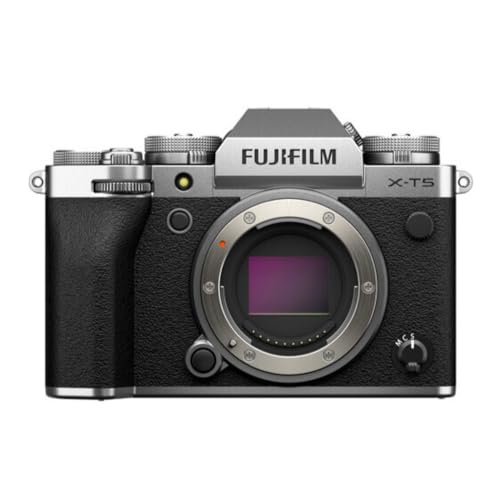
FUJIFILM X-T5 (Silver)
Best for: serious stills work under dial-led handling, with a 40 megapixel APS-C sensor and seven-stop stabilisation for handheld shooting
Not suited for: buying a complete kit in one box, because this silver body ships without a lens and the first Fujifilm glass is a second decision
- Sensor: 40 megapixel APS-C X-Trans CMOS 5 HR BSI
- Stabilisation: seven-stop in-body image stabilisation, per the listing title
- Configuration: body only, silver finish
- Further specifications: Not stated in the listing title — verify with the manufacturer documentation
The X-T5 is where this page’s styling meets its heaviest specifications. Beneath the silver dials sits a 40 megapixel APS-C X-Trans CMOS 5 HR sensor and seven stops of in-body stabilisation, both stated in the listing title, wrapped in the most classically Fujifilm body shape of the modern era. This is the retro camera for photographers who print large, crop honestly and still want shutter speed set by a knurled dial rather than a touchscreen.
Seven-stop stabilisation changes handheld habits. City evenings, museum interiors and woodland shade become working light instead of tripod appointments, and the high-resolution sensor forgives the reframing that handheld shooting invites. The title even gestures at high-speed action, a reminder that dial-led does not mean slow-witted; the X-T5 simply insists that the photographer, not the mode dial, stays in charge of the exposure triangle.
Body-only pricing is the toll. Fujifilm’s lens catalogue is a pleasure to shop and a budget to respect, so the true purchase is body plus at least one lens chosen with intent. Photographers who accept that toll get the most complete expression of the retro idea on this page: heritage handling, contemporary muscle.
Spend a landscape dawn with the X-T5 and the dial philosophy proves itself in gloves: shutter and ISO set by touch, aperture on the lens, eyes free for the light. The 40 megapixel files then reward the patience in the edit, holding shadow detail and print size that smaller sensors concede. It is the retro body for photographers whose nostalgia is methodological — they miss how film cameras were operated, not how film behaved — and who want that operation wrapped around the most capable APS-C sensor Fujifilm lists here. Silver X-T5 owners should expect the finish to map their habits: bright edges where the hands land, calm panels elsewhere. That wear pattern is the camera’s autobiography, and the retro market increasingly prices honest patina above mint anxiety. Buy it to be used, photograph the wear proudly, and let the dials’ clicks be the soundtrack.
Strengths
- 40 megapixel sensor supports large prints and confident cropping
- Seven-stop stabilisation opens handheld low-light work
- Classic dial layout keeps exposure decisions physical and visible
Trade-offs
- Body only, so lens spending starts immediately
- High resolution rewards good lenses and careful technique
- Silver finish shows wear more honestly than black
Stills photographers drawn to the dials can study the silver X-T5 body listing, then check price on Amazon while budgeting the first lens beside it.

OM SYSTEM OM-5 Mark II (Silver)
Best for: hiking and travel photography in unreliable weather, where IP53 sealing, a compact lightweight body and 5-axis stabilisation earn their keep
Not suited for: chasing maximum resolution for huge prints, since the 20.4 megapixel Four Thirds brief prioritises size and sealing over pixel count
- Sensor: 20.4 megapixel Four Thirds
- Video: 4K, per the listing title
- Stabilisation: 5-axis image stabilisation
- Sealing: IP53 weather-sealed
- Design: compact and lightweight, silver body
- Further specifications: Not stated in the listing title — verify with the manufacturer documentation
OM System inherited the prettiest silhouette in photography — the pentaprism hump of the classic OM film cameras — and the OM-5 Mark II wears it in silver over thoroughly modern internals. The title lists the working credentials plainly: 20.4 megapixel Four Thirds sensor, 4K video, 5-axis stabilisation and IP53 weather sealing in a compact, lightweight body. This is retro styling that expects rain.
Weather sealing reframes what a pretty camera is for. The OM-5 Mark II is the pick here for ridgelines, coastal paths and festival crowds in drizzle, where sealed bodies keep shooting and unsealed ones retreat into bags. Four Thirds lenses keep the whole kit small enough for a hip pack, and 5-axis stabilisation steadies the handheld frames that travel photography is mostly made of.
The trade is resolution headroom. Twenty megapixels serve prints and screens generously but crop less forgivingly than the X-T5’s forty, and the Four Thirds lens commitment is its own long decision. For photographers whose retro dream involves weather and walking rather than studio walls, the exchange is gladly made.
Silver over sealing is a statement of intent: this camera expects to be admired and rained on. Hikers who shoot film-era OM bodies will feel an almost physical recognition in the silhouette, now with stabilisation that turns a windy summit into a working location. The Four Thirds lens shelf keeps the pilgrimage affordable, with small weather-minded zooms and primes that suit the body’s scale. It is the retro choice for photographers whose scrapbooks smell of rain rather than studio dust. Pairing advice for this body: choose lenses that share the sealing philosophy wherever the budget allows, because a weather system is only as brave as its weakest joint. The Four Thirds catalogue makes that pairing affordable at several levels, which is a system virtue the specification table understates.
Strengths
- IP53 weather sealing suits outdoor travel in poor conditions
- Compact Four Thirds system keeps lenses small and light
- Classic OM silhouette with modern 4K video and stabilisation
Trade-offs
- 20.4 megapixels limit aggressive cropping
- Body-only listing leaves the first lens to budget separately
- Retro hump styling is a taste not everyone shares
Walkers and weather-watchers can read the OM-5 Mark II’s sealing details on its listing and check price on Amazon for the silver body offer.
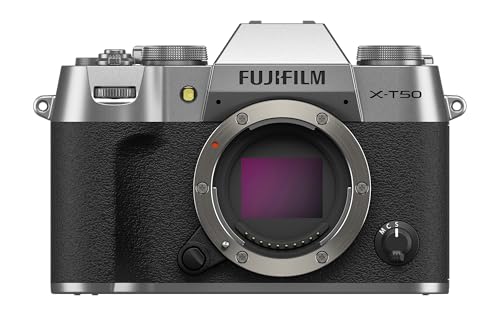
FUJIFILM X-T50 (Silver)
Best for: a lighter, simpler route into Fujifilm’s dial-led world, in silver, for everyday photography with film-style colour
Not suited for: expecting the flagship’s full specification, because this body plays the approachable role in the line rather than the maximum one
- Format: mirrorless digital camera body
- Finish: silver
- Configuration: body only in this listing
- Further specifications: Not stated in the listing title — verify with the manufacturer documentation
The X-T50 takes Fujifilm’s retro grammar and speaks it more casually. Where the X-T5 addresses committed stills photographers, the X-T50’s silver body aims at the everyday carrier: the photographer who wants dials and film simulations woven into ordinary life — school runs, market mornings, weekend trips — without flagship weight or flagship ceremony. The listing title keeps its counsel beyond name and finish, so the documentation holds the detail, but the positioning within the family is unmistakable.
That approachability is a genuine feature. Retro controls intimidate when every dial feels like an exam; a friendlier body invites experimentation, and Fujifilm’s colour science does the rest, finishing ordinary scenes with a filmic warmth that keeps casual photographers shooting instead of editing. Paired with a compact prime, the X-T50 becomes the camera on the hook by the door, which is the most important specification any camera can have.
Judge it as the welcoming door rather than the whole house. Demanding work will eventually point toward the X-T5’s stated resolution and stabilisation, and body-only pricing still applies here. As an entry into dial-led photography that does not feel like homework, the X-T50 makes the friendliest case on the page.
The X-T50’s friendliest quality is how it treats the second photographer in a household. Dials invite experimentation without the intimidation of a flagship’s control density, and Fujifilm’s colour makes early attempts look encouragingly finished. Many a family’s photography has doubled because a body like this converted a sceptical partner into a weekend shooter. That social multiplication never appears in a specification table, yet it changes an archive more than two megapixels ever will. The X-T50 in silver has one more social gift: it photographs beautifully itself, which matters in a visual culture. It appears in its owners’ travel feeds as an object of affection, recruiting the next photographer in the comments. Cameras that market themselves keep their makers’ ecosystems alive, and their owners’ enthusiasm is a feature with a measurable half-life of years.
Strengths
- Approachable take on Fujifilm’s dial-led handling
- Silver finish keeps the classic look at a friendlier tier
- Suits compact prime lenses for genuine daily carry
Trade-offs
- Title states few specifications, so documentation research is essential
- Body only, with lens costs following the purchase
- Committed stills shooters may graduate to the X-T5 quickly
Curious newcomers can look over the silver X-T50 body listing and check price on Amazon, remembering to hold back budget for the first lens.
Retro Shelf, Compared Honestly
Two fixed-lens icons, one kit-bundled Nikon, and three body-only system cameras: the table keeps the format column in view because format, not finish, decides how each camera is owned.
| Pick | Best for | Format / Sensor | Style Notes | Check |
|---|---|---|---|---|
| Fujifilm X100V (Silver) | The fixed-lens retro icon | Fixed-lens digital camera | Silver rangefinder styling | Check price on Amazon |
| FUJIFILM X100VI (Silver) | The current generation of the icon | Fixed-lens digital camera | Silver finish | Check price on Amazon |
| Nikon Z fc with 16-50mm Lens | Retro body with a working zoom kit | Mirrorless, interchangeable lens | Retro-inspired design, 16-50mm included | Check price on Amazon |
| FUJIFILM X-T5 (Silver) | Dial-led body with a 40MP sensor | APS-C, 40MP X-Trans CMOS 5 HR | Silver body only | Check price on Amazon |
| OM SYSTEM OM-5 Mark II (Silver) | Weather-sealed retro traveller | Four Thirds, 20.4MP | Silver body, IP53 sealing | Check price on Amazon |
| FUJIFILM X-T50 (Silver) | Compact dial-led Fujifilm body | Mirrorless digital camera body | Silver body only | Check price on Amazon |
Choosing a Retro Mirrorless Camera
Style opens the conversation; handling, format and lens plans finish it. These questions separate a camera that delights for a decade from one that photographs beautifully for a month and then sits.
Fixed lens or interchangeable: which constraint suits your habits?
A fixed lens is a creative vow. It simplifies every outing, sharpens composition instincts and removes lens spending entirely, at the cost of every focal length beyond the one fitted. Interchangeable bodies trade that purity for growth: one camera can become a portrait kit, a travel kit and a video rig across years. Look at your last hundred photographs and count the focal lengths honestly; the distribution, not the dream, should cast the deciding vote.
How much do the dials actually matter to you?
Physical dials slow the first week and speed up every week after, because exposure settings become visible at a glance and changeable by touch with the camera at your eye. Photographers who shoot in changing light — street, events, travel — feel the benefit constantly. Those who live in full automation may find dials decorative, which is fine, but then a plainer modern body may serve better for the same money. Handle the idea honestly before paying a retro premium.
Which lens ecosystem are you marrying?
Fujifilm’s X mount, Nikon’s Z mount and the Micro Four Thirds family behind OM System each offer distinct lens characters and used markets. Retro bodies encourage long ownership, so the lens catalogue is effectively part of the camera. Browse the primes especially: dial-led bodies pair beautifully with small, fast primes, and the availability of two or three lenses you genuinely want should outweigh a marginal body difference every time.
Dial-led bodies shine outdoors where screens wash out, and the finder discussion in our roundup of viewfinder-equipped mirrorless cameras explains the pairing in bright conditions.
Will the finish survive your real life?
Silver finishes photograph beautifully and record their history visibly — every scuff becomes patina or damage depending on temperament. Photographers who baby their gear will love the ageing process; those who throw cameras into tote bags may prefer to admire silver from a distance. Weather sealing, where a title states it, matters more than finish for outdoor lives, and only the OM-5 Mark II on this page makes that claim in its listing.
How do film simulations change the decision?
They move part of the creative work from the computer to the camera, permanently. Photographers who love editing raw files for hours will use simulations as a starting point and lose nothing; photographers who resent editing gain finished photographs at the moment of capture, which for many is the entire retro appeal. Decide which temperament is yours, because a simulation-led workflow is a genuine feature of the Fujifilm bodies here, not a filter pack afterthought.
What if you love the look but shoot mostly video?
Then let the titles arbitrate: the Z fc is listed as a stills and video camera and the OM-5 Mark II lists 4K video, so retro handling and moving pictures are not enemies on this page. What dial-led bodies will not give a serious videographer is the creator-first layout of screens, audio and controls found on video-led models elsewhere in this programme, so weigh the proportion of your working week honestly before the styling casts the deciding vote.
Shooting Film-Style With Digital Dials
The retro method begins before the photograph: set the shutter speed on its dial, the aperture on the lens or its control, and let ISO become the deliberate third decision rather than an invisible automation. Choose a film simulation as you once chose a film stock — for the whole walk, not per frame — and resist reviewing every shot. That discipline recreates the attentiveness film demanded, while the sensor keeps digital forgiveness in reserve.
Everyday scenes are the retro home turf, which connects naturally to our guide on lifestyle photography with pro-level mirrorless bodies and the lenses that flatter daily life.
Finish in camera wherever the mood allows. Fujifilm’s simulations and the colour recipes photographers build on them exist precisely so a photograph can be complete at the moment of capture. Sharing straight-from-camera files is not laziness; it is the aesthetic this entire camera category was rebuilt to serve.
Caring for Silver Bodies and Classic Styling
Silver finishes reward gentle routines: a soft cloth after handling, a dry storage spot, and a strap that keeps the body off table edges. Avoid abrasive cleaning, which dulls the finish unevenly, and treat early scuffs as the beginning of patina rather than damage — these cameras are designed to age in public.
Dials deserve the same respect. Work each dial through its range monthly so the clicks stay positive, keep grit out of the dial bases with a blower, and store the camera with controls at neutral settings. Mechanical-feeling controls stay mechanical-feeling only when they are exercised and kept clean.
A Short History of Why Cameras Look Like This Again
The retro revival began as rebellion. Early mirrorless cameras chased a gadget aesthetic — smooth, button-light, screen-led — and a generation of photographers raised on film SLRs felt their hands being retired. Fujifilm’s early X cameras answered with dials, and the market’s response taught every maker the same lesson: controls are not nostalgia, they are ergonomics with a memory. Nikon’s homage designs and OM System’s inherited silhouette followed from that proof.
The deeper driver is pace. Digital photography’s default tempo is frantic — thousands of frames, instant review, endless automation — and dial-led cameras impose a courtesy pause at every exposure. That pause is the actual product being sold on this page, wrapped in silver. Photographers are not buying the past; they are buying a slower present, with modern sensors forgiving the mistakes that slowness still makes.
Building the Retro Kit: Primes, Straps and Restraint
Retro bodies pair best with small prime lenses, for optical and philosophical reasons alike: the proportions stay classic, the aperture rings stay under the fingers, and the discipline of one or two focal lengths suits the deliberate method. A standard prime and a modest wide or short telephoto cover most lives; a drawer of zooms quietly rebuilds the gadget kit the retro purchase was escaping.
Accessories deserve the same restraint. A good strap, a soft release where the body accepts one, a leather half-case if the patina appeals — then stop. The retro aesthetic curdles into costume when every surface is accessorised, and the cameras on this page were styled by professionals who already made the tasteful decisions. Trust their restraint and spend the remainder on film-simulation experimentation and train tickets.
Learning Exposure the Dial Way: A Weekend Exercise
Set aside one walk with a single rule: nothing automatic. Choose the shutter speed on its dial for the subject’s motion, the aperture for the depth the scene deserves, and let sensitivity be the conscious compromise you make out loud. Miss exposures freely; the dials make every miss legible, because the settings are printed on the camera where the mistake happened, and the lesson attaches itself to the physical positions.
Finish the exercise by printing or enlarging the three best frames and writing, on the back, the settings the dials held. That small archive of cause and effect teaches faster than a month of automatic shooting, and it is the education these cameras were styled to deliver. Retro design is sometimes accused of being a costume; used this way, it is a curriculum.
Silver, Black and the Psychology of Being Seen
Finish is a social instrument, and this page’s all-silver shelf makes the point by omission: there is no black variant under discussion, so every photographer here has chosen visibility. Silver announces the camera as an object of craft. Strangers ask about it, subjects smile at it, and other photographers start the conversations that become collaborations. For portrait and street work, that announcement is frequently an asset disguised as vanity.
Visibility has a cost ledger too. A gleaming body is noticed by the wrong audiences in the wrong places, reflects in windows during interior work, and asks its owner to dress the rest of the kit down accordingly. The photographers who thrive with silver treat it as part of the method — dressing plainly, working openly, letting the camera’s charm do the diplomacy — rather than as jewellery that happens to expose film’s digital descendant.
There is also the matter of ageing in public. Silver shows its years, and the retro community has largely decided those years look good: bright metal at the edges reads as experience, the way a worn guitar reads as played rather than damaged. Readers who find that romance appealing should buy with confidence; readers wanting their tools anonymous and invisible should know that this particular shelf was not stocked for them, and that plainer modern bodies will serve their temperament better.
The Second Photographer Effect
Retro cameras recruit. A dial-led body on a family holiday produces a queue: a partner curious about the aperture ring, a teenager who has only ever tapped a phone, a grandparent whose hands remember the originals. Each recruit returns the camera with a frame or two inside it that the owner would never have made, and the archive quietly becomes a collaboration. No specification promises that, yet owners of these bodies report it so consistently that it belongs in any honest account of what the styling buys.
There is a teaching economy at work underneath the charm. Explicit controls make photography discussable — a shutter speed can be pointed at, an aperture shown — so retro bodies turn casual questions into five-minute lessons at the café table. A household with one dial-led camera often ends with two photographers, which is a return on investment no lens can match.
Photowalks and Communities Around Retro Bodies
Retro cameras have gathered a social world around themselves: photowalks where half the pleasure is comparing dials, online groups devoted to a single film simulation, repair cafés where film-era lenses meet mirrorless bodies through adapters. A buyer of any body on this page inherits invitations to that world, and accepting a few of them will teach more about the camera’s culture — and about seeing — than another month of solo practice.
The community also keeps these cameras alive longer. Shared knowledge about settings, simulations, straps that suit the lugs and repairers who love the models circulates freely among owners, which is a form of product support no manufacturer can sell. When the choice between two bodies on this page feels otherwise even, the livelier owner community is a legitimate tiebreaker, because a camera’s second decade is lived in its community’s memory.
Retro Buying Mistakes
Mistaking styling for handling
A camera can wear chrome and still bury its controls in menus. The retro premium only pays when dials genuinely run the exposure, so test the handling logic — in person or through the manufacturer documentation — before the finish seduces the budget.
Forgetting the X100 lens is fixed
It happens constantly: the icon is bought as a system camera and the discovery arrives with the first missed zoom. Both X100 models here are fixed-lens cameras for life. That is their charm and their limit, in equal measure, forever.
Buying body-only without a lens plan
Three of these six picks ship as bodies. A retro body without a lens is shelf decoration, so the first lens — ideally a compact prime that suits the styling — belongs in the same budget conversation as the camera itself.
Chasing resolution against the brief
The X-T5’s 40 megapixels are real, but retro shooting is about handling and colour, not pixel counts. Paying for resolution you never print while ignoring the dial layout you touch daily inverts the category’s whole value system.
Ignoring sealing for outdoor dreams
Vintage looks invite vintage adventures, and only the OM-5 Mark II states weather sealing in its title here. Photographers planning coastal and mountain work should weight that line heavily rather than discovering its absence in the rain.
Treating the retro body as a fragile ornament
These are working cameras with modern sealing, stabilisation and sensors, built to be carried daily. Owners who ration their retro body to special occasions invert the value: the design’s pleasure is precisely in ordinary use, where the dials turn a school run into a photographic walk.
Buying the costume and skipping the craft
A dial-led camera operated permanently in full automatic is an expensive point-and-shoot wearing a beautiful coat. The design only pays its dividend when the dials are used, so commit to the weekend exercise in this guide before committing the budget; if the exercise delights you, the purchase is already justified.
Hiding the camera to protect the finish
A retro body kept in a cabinet to preserve its silver is a sculpture with a battery. The design’s returns — handling pleasure, recruited photographers, photographs themselves — are all paid in daily use, and the patina that use creates is the community’s badge of honour rather than a defect to be insured against.
Frequently Asked Questions
Are the Fujifilm X100 cameras really mirrorless system cameras?
They are mirrorless in construction but not system cameras: their lenses are fixed and cannot be changed. They appear here because the retro category is incomplete without them, and every mention in this guide labels the fixed lens plainly so the distinction is never blurred.
Which pick includes a lens?
Only the Nikon Z fc, whose listing bundles a 16-50mm zoom. The X-T5, OM-5 Mark II and X-T50 are body-only listings, and the two X100 models carry their fixed lenses permanently. Budget accordingly before comparing figures across the six.
What are film simulations?
They are in-camera colour and tone profiles modelled on film stocks, letting a photograph leave the camera with a finished, filmic character. Fujifilm built its retro reputation on them, and they pair with dial-led shooting to keep editing optional rather than mandatory.
Is the OM-5 Mark II weather sealed?
Its listing title states IP53 weather sealing, the only explicit sealing claim among these six titles. Sealing reduces risk in rain and dust rather than making any camera waterproof, so sensible care still applies outdoors.
Silver or black: does finish affect anything practical?
Finish changes visibility and how wear shows, not image quality. Silver draws the eye and displays scuffs as patina; the listings gathered here are the silver variants, so the retro presentation is part of what each price buys.
Which retro body suits a complete beginner?
The Nikon Z fc kit removes the lens question entirely, while the X-T50 offers Fujifilm’s friendlier tier for those ready to choose a first lens. Beginners drawn to the X100 discipline should simply be certain the single focal length matches how they already photograph.
Do retro cameras take worse photographs than plain modern bodies?
No — the styling wraps contemporary sensors and processors, and two titles on this page state serious figures: 40 megapixels with seven-stop stabilisation on the X-T5, and a sealed 20.4 megapixel sensor on the OM-5 Mark II. What retro design changes is operation and pace, not image quality, and for many photographers the pace improves the pictures.
Can these cameras shoot video seriously?
Several titles say so directly: the Z fc is listed as a stills and video camera and the OM-5 Mark II lists 4K video. Dial-led bodies film perfectly well; their handling simply prioritises stills. Creators whose work is video-first should compare the creator-led bodies elsewhere in this programme, but a retro body will not embarrass a travel film.
Are retro cameras harder to learn?
They are more explicit, which beginners often experience as easier: the important settings sit on dials in plain sight instead of inside menus. The first week asks more attention than a fully automatic body, and every week after asks less, because the hands learn positions the way they learn a musical instrument’s frets.
Will a retro camera hold its value?
Design-led cameras historically depreciate more gently than gadget-styled rivals, because their appeal does not expire with a processor generation — the X100 line’s market behaviour is the standing example. Treat any resilience as a pleasant side effect rather than an investment thesis, though; cameras are bought with money and repaid in photographs, and the exchange rate favours the photographers.
Do retro bodies suit professional work?
Working photographers use them constantly for portraits, travel features and editorial colour work, where the handling and in-camera colour are assets and the clients enjoy the theatre. The professional questions are the ordinary ones — lens depth, support, deliverable formats — and they are answered per model in the manufacturer documentation rather than by the styling, which neither qualifies nor disqualifies a body for paid work.
Can retro bodies use vintage film-era lenses?
Through adapters, often yes, and the practice is half the subculture’s charm: manual focus, aperture set on the lens, and the finder’s aids doing the modern work. Compatibility, flange distances and which features survive adaptation belong to the adapter maker’s and manufacturer’s documentation for the specific pairing. Buyers should expect a slower, more deliberate method — which, on this page, counts as praise.
Final Recommendation
Choose the Z fc kit for retro handling with zero lens homework, the X-T5 for the serious stills version of the dream, and the OM-5 Mark II when the dream includes weather. The X-T50 is Fujifilm’s welcoming door, priced and pitched for everyday carrying. Each of those four grows with lenses and time.
The X100 pair stand apart as beautiful commitments: the V as the proven icon, the VI as its current chapter, both asking one focal length to be enough. Decide whether that vow sounds like freedom or like a cage, and the answer picks your camera — the dials, after all, were always about choosing deliberately.
Whichever body leaves with you, give the dials a month before judging them. The first week feels ceremonial; the fourth feels fluent, and fluency is when the photographs change. Retro cameras are long relationships disguised as purchases, and they repay the photographers who treat them that way.
And if the decision still stalls, borrow the oldest test in photography: imagine the camera on the table beside your keys, every morning for a year. The body you would reach for without thinking — while the light is still good and the day has not yet decided what it is — is the one this whole page has been describing.
One practical closing habit: photograph your new camera, with your phone, on the day it arrives — box, dials, serial side and all. That small portrait starts the ownership record, feeds the insurance file, and, years from now, will sit in the archive beside the first photograph the camera itself ever made, the pair of them bookending a working life.
One more habit separates satisfied retro owners from restless ones: they commit to a single film simulation or colour recipe for a whole season. Constraint is the aesthetic’s engine — the same discipline the fixed lens teaches, applied to colour — and a season of one palette produces a body of work with a recognisable signature, which is what clients, editors and posterity actually remember. Variety is available in the menus forever; identity is only available by choosing.


