What's inside
- Where to Buy
- Key Takeaways
- Quick Picks
- How the picks were chosen
- Comparison Table
- Should your next video camera be a DSLR or a mirrorless body?
- What the mirrorless transition actually changed for filmmakers
- Adapting legacy lenses: the bridge between traditions
- Audio, monitoring and the unglamorous half of video quality
- Common Mistakes
- Frequently Asked Questions
- Final Recommendation
As an Amazon Associate I earn from qualifying purchases. This post may contain affiliate links at no extra cost to you.
[SITE_DOMAIN] is reader-supported. When you buy through links on our site, we may earn an affiliate commission at no extra cost to you. Prices and availability change; check the Amazon listing for the current details.
Where to Buy
Canon EOS R6 Mark II Body — Check price on Amazon
Nikon D780 Body — Check price on Amazon
Canon EOS 5D Mark IV Body — Check price on Amazon
Nikon Z 5 — Check price on Amazon
Panasonic Lumix S5IIX — Check price on Amazon
Fujifilm X-T30 III 13-33 Kit — Check price on Amazon
Five listings are body-only; the Fujifilm is the exception, arriving with an XC13-33mm lens in the box. The reviews state each configuration plainly.
The best dslr mirrorless cameras for video sit on a fault line in camera history, and this guide stands directly on it: two DSLRs — Nikon’s D780 and Canon’s EOS 5D Mark IV — against four mirrorless bodies from Canon, Nikon, Panasonic and Fujifilm. The premise deserves honesty from the first paragraph. The DSLRs are older designs from the era when video was a feature a stills camera offered rather than the purpose it served, and their titles show it: the 5D Mark IV states 4K video beside a 30.4 megapixel stills sensor, while the D780’s title leads with its 24.5MP backside-illuminated sensor and EXPEED 6 processor and says nothing about video at all. The mirrorless bodies were designed in the era when the record button became a primary control.
Why include the DSLRs at all? Because the comparison is real shopping, not a history lesson. DSLRs carry enormous lens ecosystems bought and paid for, optical viewfinders some filmmakers still prefer for certain work, and used-market depth that mirrorless systems have not yet matched. A videographer with a cabinet of EF or F-mount glass faces a genuine decision between adapting, persisting and switching, and a guide that pretends the DSLR option does not exist fails that reader. What this guide will not do is pretend the two traditions are equal for video in 2026-era terms: the mirrorless bodies state the stronger video briefs, and the reviews say where and why.
Specifications are used only where listing titles state them, as throughout this site’s camera coverage. That rule produces some instructive silences — the Nikon Z 5’s title calls it the most compact full-frame mirrorless stills and video camera in its line and prints no recording figures, and the Lumix S5IIX title states 6K video without the recording detail its sibling listings sometimes carry — and those silences are recorded in the spec boxes rather than filled from memory. Readers building a stabilised kit on a strict budget may also want our guide to mirrorless Cameras With Image Stabilization for Less Than $500, which covers the older end of that market honestly.
Key Takeaways
- The two DSLRs are older video designs: the 5D Mark IV states 4K video from its era, and the D780 title states no video specification at all.
- The Panasonic Lumix S5IIX states the strongest headline video figure here: 6K video on a full-frame sensor with Active I.S. and phase hybrid AF.
- The Canon EOS R6 Mark II states a 24.2 megapixel full-frame sensor with photo and video capabilities, the balanced hybrid brief.
- The Nikon Z 5’s claim is compactness: the most compact full-frame mirrorless stills and video camera in Nikon’s line, per its title.
- The Fujifilm X-T30 III is the only kit here, with an XC13-33mm lens included — the only listing that films out of the box.
- Mount legacy is the hidden variable: EF and F-mount lens holdings argue for the DSLRs or for adaptation, while RF, Z, L and X mounts argue forward.
Quick Picks
| Pick | Badge | Why it made the cut |
|---|---|---|
| Canon EOS R6 Mark II Body | Balanced full-frame hybrid | 24.2 megapixel full-frame CMOS sensor with photo and video capabilities stated in the title. |
| Nikon D780 Body | The modern DSLR option | 24.5MP backside-illuminated FX sensor and EXPEED 6 processor in Nikon’s late DSLR body. |
| Canon EOS 5D Mark IV Body | The classic 5D line body | 30.4 megapixel full-frame sensor, stated 4K video and the EF mount’s deep lens ecosystem. |
| Nikon Z 5 | Compact full-frame mirrorless | Nikon’s most compact full-frame mirrorless stills and video body, per its title. |
| Panasonic Lumix S5IIX | 6K full-frame video body | 6K video and photo, Active I.S. and phase hybrid AF on a full-frame sensor. |
| Fujifilm X-T30 III 13-33 Kit | Kit that films out of the box | APS-C mirrorless body supplied with an XC13-33mm lens, the only complete kit in the set. |
How the picks were chosen
The selection was built to stage the tradition comparison fairly rather than to crown a winner by format. Two DSLRs represent the strongest late expressions of the DSLR idea from the two historic makers: Nikon’s D780, whose title emphasises a modern backside-illuminated sensor and a current-generation processor, and Canon’s 5D Mark IV, the body whose line effectively created the DSLR-video era and whose title still states 4K video. Four mirrorless bodies then answer from the present: a balanced Canon hybrid, Nikon’s compact full-frame entry, Panasonic’s video-led S5IIX with its stated 6K, and a Fujifilm kit that represents the accessible APS-C route.
Video claims were weighted by what the titles document. Where a title states a recording figure — 4K on the Canon DSLR, 6K on the Panasonic — the review builds on it. Where a title is silent, the review discusses the body’s documented role and directs the reader to manufacturer documentation for the figures, because a video purchase made on assumed recording specifications is the commonest expensive mistake in this category. The DSLRs were additionally judged on the honest terms of their era: they were not designed as video-first tools, and their reviews evaluate what that means in practice rather than scoring them against criteria their designers never targeted.
One more principle governed the ordering inside the guide: no body was ranked by tradition. The mirrorless bodies do not occupy the top of the page because they are mirrorless, nor the DSLRs the middle because they are old; the order follows the strength of each body’s documented case for the mixed audience this keyword serves — working hybrids first, legacy options argued on their honest merits, the video specialist given its full hearing, and the complete kit closing the set as the on-ramp. Readers whose priorities differ should feel free to read the set in their own order; the reviews were written to stand independently for exactly that reason.
Lens ecosystems were treated as part of each pick’s value, because in a cross-tradition comparison the mount is half the purchase. The DSLRs inherit the two deepest lens catalogues in photography; the mirrorless bodies inherit modern mounts with growing catalogues and, in Nikon’s and Canon’s cases, official adaptation paths for the legacy glass — verify adapter behaviour per lens in the manufacturer documentation. A reader whose shelves already hold EF or F-mount lenses will weigh every review here differently from a reader starting with empty shelves, and both readings are legitimate.

Canon EOS R6 Mark II Body — balanced full-frame hybrid
Badge: Balanced full-frame hybrid
Spec box
- Format: Full-frame CMOS sensor
- Sensor resolution: 24.2 megapixel
- Capabilities: Photo and video capabilities, per the listing title
- Body configuration: Body only
- Video specification detail: Not stated in the listing title – verify with the manufacturer documentation
- Stabilization: Not stated in the listing title – verify with the manufacturer documentation
Canon’s title for the EOS R6 Mark II is measured: a full-frame camera with a 24.2 megapixel CMOS sensor and photo and video capabilities, body only. That restraint suits the body’s actual role in this comparison. The R6 Mark II is the balanced hybrid of the set — not the resolution flagship, not a cinema specialist, but the full-frame mirrorless body whose brief is to do both jobs at a professional standard for the enormous middle of working practice. Its 24.2 megapixel figure sits in the all-rounder class: stills resolution enough for confident print and moderate cropping, file sizes that keep a heavy shoot day manageable, and a sensor size in the range video shooters favour for clean, gradeable footage.
The mirrorless advantages over the DSLRs below are structural, and this body exhibits them in their standard form. A mirrorless camera composes video through the same sensor feed it records, focuses with the full sensor rather than a separate stills-oriented system, and offers the electronic viewfinder and screen experience that video work — with its minutes-long takes and constant exposure judgement — actually uses. None of that requires a single invented figure; it is what the mirrorless architecture itself means, and it is why a body like this one, with a modest title, still represents the modern side of the comparison.
The title’s silence on recording detail is the review’s honest caveat. Frame rates, recording formats and any time limits live in Canon’s documentation, not in this listing, and a video-led buyer should read them there before purchase, particularly if the work involves long continuous takes or specific delivery formats. The same applies to stabilization, which the title does not mention. What the title does establish — full-frame format, all-rounder resolution, dual photo and video intent, RF system membership — frames the body correctly even though it cannot close the specification questions.
For the DSLR owner reading this guide as a switching decision, the R6 Mark II is the natural landing point on the Canon side: the body that keeps the full-frame character and the working resolution class of a 5D-style practice while moving the video side onto modern mirrorless footing, with Canon’s EF-to-RF adaptation path — verify per-lens behaviour in the documentation — softening the lens transition. For a newcomer building fresh, it is the Canon body here that asks the fewest questions about what the work will become, because balanced hybrids forgive a changing practice better than specialists do.
Strengths
- Stated 24.2 megapixel full-frame sensor sits in the versatile all-rounder class for stills and video.
- Photo and video capabilities are both stated, documenting genuine hybrid intent.
- Mirrorless architecture gives video the sensor-based focusing and monitoring DSLRs cannot match.
Trade-offs
- The title states no recording figures or stabilization detail, so video specifics require verification.
- Body only, so RF lenses — or adapted EF glass — are a separate cost.
- Resolution trails the 5D Mark IV’s stated figure for stills-led cropping work.
There is also a longevity argument for this class of body that spec comparisons miss. A balanced hybrid sits at the centre of its manufacturer’s attention — the lens catalogue grows around it, the accessory ecosystem assumes it, and the used market for its mount deepens every year. Buying the centre of a system is rarely the exciting choice, but it is consistently the choice that ages best, because every subsequent purchase, from lenses to a second body, compounds on the same foundation rather than stranding the first investment.
Best for: balanced photo and video work starts with a stated 24.2 megapixel full-frame mirrorless body.
Not suited for: documented recording figures are missing from the listing itself, since this title states capabilities without figures.
Canon shooters weighing the mirrorless move can Check price on Amazon for the R6 Mark II body and plan the RF or adapted-EF lens route beside it.

Nikon D780 Body — the modern DSLR option
Badge: The modern DSLR option
Spec box
- Format: FX full-frame, DSLR
- Sensor: 24.5MP backside-illuminated FX sensor
- Processor: EXPEED 6 image processor
- Body configuration: Body only
- Video specification: Not stated in the listing title – verify with the manufacturer documentation
- Mount: Not stated in the listing title – verify with the manufacturer documentation
The D780’s title tells a stills story in modern vocabulary: a 24.5MP backside-illuminated FX full-frame sensor and an EXPEED 6 image processor. Both details matter. Backside illumination is current sensor architecture, improving the light-gathering efficiency that low-light work depends on, and EXPEED 6 places the processing generation alongside Nikon’s mirrorless bodies of its era rather than with the DSLRs of a decade earlier. The D780 is therefore best understood as the DSLR tradition’s late, refined expression — a body that borrowed mirrorless-era components while keeping the optical viewfinder, the mirror box and the F-mount lens heritage that defined the format.
For video, honesty requires the framing this guide promised at the outset. The title states no video specification whatsoever, and the DSLR architecture carries inherent video compromises that no processor generation removes: focusing during video relies on the sensor in a body whose handling, monitoring and control layout were designed around stills through an optical finder. Filmmakers whose work is occasional — a stills practice that records interviews, behind-the-scenes material or simple locked-off footage — will find a modern DSLR serviceable. Filmmakers whose income is video should read the mirrorless reviews in this guide as the main event and the DSLR reviews as the legacy option, because that is the truthful ordering.
What, then, is the D780’s case? It rests on three honest pillars. First, the F-mount ecosystem: decades of lenses, owned outright by many photographers, working natively with no adapter behaviour to verify. Second, the optical viewfinder experience, which a real constituency of photographers still prefers and which costs no battery to use. Third, the stills-led practice itself: if the camera earns its living in photographs and video is a sideline, a refined DSLR with a modern sensor remains a coherent tool, and its video side only needs to be adequate rather than leading.
Buyers considering the D780 for any video purpose beyond the occasional should verify its documented video specification in Nikon’s documentation before purchase — the listing simply does not state it — and should weigh the Z 5 below, Nikon’s own compact mirrorless answer, in the same sitting. The D780 is a good camera being honest about what it is; the mistake would be buying it for what it is not.
Strengths
- Stated 24.5MP backside-illuminated sensor brings modern architecture to the DSLR format.
- EXPEED 6 processor matches the generation of Nikon’s mirrorless bodies of its era.
- Native access to the deep F-mount lens ecosystem with no adaptation questions.
Trade-offs
- The title states no video specification, and DSLR architecture is a stills-first design for filming.
- Body only, though many buyers will already own F-mount lenses.
- Mirrorless bodies in this guide state stronger video briefs at similar system scales.
One practical virtue of the late DSLRs deserves recording before the verdict: maturity. A design at the end of a long lineage has known behaviour, deep accessory support, an enormous base of user knowledge for every working problem, and a used market that prices it honestly. For a practice that values predictability over novelty — that would rather own a tool whose every quirk is documented by a decade of working photographers than a newer tool still revealing its own — that maturity is a feature money genuinely buys, and it partially offsets the video architecture gap for the stills-led work this body is actually for.
Best for: stills-led Nikon shooting keeps native F-mount lens access on a modern-sensor DSLR, with occasional video alongside.
Not suited for: video as a primary output stretches this listing too far, since it documents a stills-first body.
Nikon DSLR loyalists can Check price on Amazon on the D780 body and verify its documented video figures before deciding.

Canon EOS 5D Mark IV Body — the classic 5D line body
Badge: The classic 5D line body
Spec box
- Format: Full-frame DSLR
- Sensor resolution: 30.4 megapixel CMOS sensor
- Video: 4K video
- Positioning: Content creator camera, per the listing title
- Mount: EF mount
- Body configuration: Body only
The 5D Mark IV title reads like a summary of an era: 30.4 megapixel full-frame CMOS sensor, 4K video, content creator camera, EF mount, body only. The 5D line’s historical role is impossible to overstate — an earlier 5D generation effectively created the DSLR video movement, proving that a stills camera’s large sensor could produce cinematic footage and changing independent filmmaking permanently. The Mark IV is that line’s mature expression, and its title’s stated 4K video makes it the only DSLR in this guide whose listing documents a recording figure at all.
Judged on its own era’s terms, the proposition remains coherent. Thirty megapixels is the highest stated stills resolution among the full-frame bodies in this set, the EF mount opens the deepest lens catalogue Canon ever built — including decades of used glass at every price point — and 4K video from a full-frame sensor covers the delivery format most creators still publish in. A content creator whose practice is photography-led, whose shelves hold EF lenses, and whose video work consists of considered, tripod-friendly pieces will find this body entirely serviceable and its ecosystem economics genuinely attractive.
Judged on the present comparison’s terms, the limits are equally clear, and this guide’s premise requires stating them. The 5D Mark IV is an older design: its video implementation belongs to its generation, with the constraints that era’s DSLR video carried, and its title offers no further video detail beyond the 4K headline — recording formats, frame rates and any crop behaviour must be verified in Canon’s documentation before a video-led purchase. Filmmakers choosing fresh today, with no EF holdings, will generally extract more video capability from the mirrorless bodies here at comparable system cost, and the R6 Mark II above is Canon’s own statement of that fact.
The fairest summary is that the 5D Mark IV is a stills-heavy hybrid from the DSLR tradition’s peak, bought today for its sensor, its ecosystem and its price position rather than for video leadership. Buyers inside the EF world who understand exactly that bargain get a capable, proven body. Buyers outside it should let the mirrorless reviews lead.
Strengths
- Stated 30.4 megapixel sensor is the highest full-frame stills resolution in this set.
- 4K video is stated in the title, the only DSLR here with a documented recording figure.
- EF mount gives native access to Canon’s deepest lens catalogue, new and used.
Trade-offs
- An older design whose video implementation belongs to its DSLR generation.
- The title states no video detail beyond 4K, so formats and frame rates need verification.
- Body only, and fresh buyers without EF glass will usually do better starting mirrorless.
The used-market dimension strengthens the same case. Because the 5D line served a generation of professionals, bodies, lenses and accessories circulate in depth, and a careful buyer can assemble a complete EF working kit — body, standard zoom, fast prime, support — for a total that a new mirrorless equivalent cannot approach. For a creator whose budget is the binding constraint and whose video needs are modest and well understood, that arithmetic is not nostalgia; it is the rational core of the purchase, provided the documented video specification is checked against the work before the money moves.
Best for: an EF lens collection paired with stills-led work meets stated 30.4 megapixel resolution and documented 4K video.
Not suited for: current-generation video capability belongs to newer designs, since this body is an older DSLR design.
EF owners can Check price on Amazon for the 5D Mark IV body and weigh it against the cost of switching systems entirely.

Nikon Z 5 — compact full-frame mirrorless
Badge: Compact full-frame mirrorless
Spec box
- Format: Full-frame mirrorless
- Positioning: Most compact full-frame mirrorless stills/video camera in the line, per the listing title
- Body configuration: Nikon USA model
- Sensor resolution: Not stated in the listing title – verify with the manufacturer documentation
- Video specification: Not stated in the listing title – verify with the manufacturer documentation
- Stabilization: Not stated in the listing title – verify with the manufacturer documentation
Nikon’s title for the Z 5 makes a single, well-aimed claim: this is the most compact full-frame mirrorless stills and video camera in its line, sold as a Nikon USA model. Compactness is a real video feature, not a consolation prize. A full-frame body small enough to live in a modest bag gets carried to the locations where footage happens; it balances on smaller gimbals, travels in cabin luggage without negotiation, and draws less attention in public and documentary settings than a flagship rig. For creators whose video work is mobile — travel films, event coverage, everyday documentation with full-frame character — the smallest full-frame body in a system is often the most-used body in that system.
The stills and video wording in the title documents hybrid intent, and the mirrorless architecture delivers the structural video advantages described in the R6 Mark II review: sensor-based focusing during recording, electronic monitoring, and a control experience designed for the screen as much as for the finder. Set beside its own sibling in this guide, the D780, the Z 5 stages Nikon’s internal version of the tradition argument — the DSLR offers the optical finder and native legacy glass, the Z 5 offers the modern filming architecture in a smaller body — and Nikon buyers can weigh that argument inside one brand’s ecosystem, with Z-mount adaptation available for F-mount lenses, subject to per-lens verification in the documentation.
The title’s silences are extensive, and this review records them plainly: no sensor resolution, no video figures, no stabilization claim. A buyer for whom specific recording figures are decisive must read Nikon’s documentation before purchase, full stop. What the title establishes is the format, the hybrid intent, the USA model status and the compactness claim — enough to shortlist the body for the mobile full-frame role, not enough to sign off a production specification.
Within this set, the Z 5 is the accessibility point of full-frame mirrorless video on the Nikon side: the body a D780 owner adds for filming without leaving the brand, and the body a newcomer chooses when full-frame character matters but flagship size and cost do not fit the practice. Its compact claim should be verified against the lenses you intend to mount, since a small body behind large glass is a large kit — but paired with compact Z lenses, the Z 5’s stated proposition holds together completely.
Strengths
- Stated as the most compact full-frame mirrorless stills and video body in Nikon’s line.
- Full-frame mirrorless architecture gives modern sensor-based video focusing and monitoring.
- Nikon USA model status gives warranty clarity.
Trade-offs
- The title states no resolution, video or stabilization figures, so verification is essential.
- Compactness depends on pairing compact lenses; large glass erases the advantage.
- Video-led professionals will need documented figures this listing does not provide.
Compactness also changes who gets filmed and how. A small full-frame body on a small gimbal or a short tripod can work in spaces — cafés, workshops, family kitchens, mountain huts — where a flagship rig would dominate the room and alter the behaviour it came to record. Documentary and lifestyle filmmakers feel this difference immediately: subjects relax around modest equipment, locations tolerate it, and the footage keeps the unposed quality the project was commissioned for. That is a creative capability, not merely a convenience, and it is the strongest argument the Z 5’s single stated claim makes.
Best for: carrying less bulk points to the most compact full-frame mirrorless body in Nikon’s line for stills and video.
Not suited for: a listing that documents its recording specification would help more, since this title states positioning only.
Travelling Nikon shooters can Check price on Amazon on the Z 5 and shortlist compact Z-mount lenses in the same order.

Panasonic Lumix S5IIX — 6K full-frame video body
Badge: 6K full-frame video body
Spec box
- Format: Full-frame
- Video: 6K video plus photo
- Autofocus: Phase hybrid AF
- Stabilization: Active I.S.
- Body configuration: DC-S5M2XKK9, black
- Recording detail beyond 6K: Not stated in the listing title – verify with the manufacturer documentation
The Lumix S5IIX title leads with the strongest headline video figure in this guide: 6K video on a full-frame mirrorless body, with photo capability, Active I.S. and phase hybrid AF. Six-K recording deserves a plain explanation of its value, because few delivery pipelines publish in 6K. The value is in the edit: a 6K frame reframed, stabilised or cropped for a 4K delivery keeps full 4K detail where a native 4K frame loses it, and a 6K master gives a production future-proofing and punch-in options that editors genuinely use. A body whose title states 6K is stating oversampling headroom, and filmmakers who shoot interviews, performances and documentary scenes — work where the second angle or the tighter framing is discovered in the edit — will read that figure as working room.
Phase hybrid AF, stated in the title, is the second pillar. Panasonic’s video reputation was built on recording depth, and the phase hybrid designation documents the company’s combined autofocus approach for moving subjects — the feature that decides whether a solo operator can trust the camera with focus during an unrepeatable moment. Active I.S. completes the stated trio: stabilization named for active shooting, supporting the handheld and walking shots that location filmmaking runs on. Together the three stated features describe a coherent video philosophy — record more than you need, focus dependably, move freely — executed on a full-frame sensor.
The X variant’s positioning within the S5II family is oriented toward video production, and buyers should verify the exact recording formats, frame rates and any differences from the standard model in Panasonic’s documentation, because the title states the 6K headline without the recording detail beneath it. That verification step is the only caveat this review raises, and it is a routine one for production purchases. Readers comparing the wider stabilised-camera landscape can also consult our guide to mirrorless Cameras With Interchangeable Lenses for Hikers, where several of these same systems appear in their lightest configurations.
As the L-Mount body in this set, the S5IIX also carries the alliance advantage: lenses from multiple manufacturers on one mount, which widens the kit-building options beyond a single brand’s catalogue. For a filmmaker starting a system today around video first, that structural point, added to the stated 6K, phase hybrid AF and Active I.S., makes the S5IIX the most complete video proposition documented in any title in this guide.
Strengths
- Stated 6K video gives reframing, stabilising and cropping headroom for 4K delivery.
- Phase hybrid AF and Active I.S. are both stated, covering focus and movement for location filming.
- Full-frame format with L-Mount alliance lens choice across manufacturers.
Trade-offs
- The title states no recording detail beneath the 6K headline, so formats and rates need verification.
- Stills capability is present but the body’s design brief is plainly video-led.
- Body configuration means the first L-mount lens is a separate purchase.
Post-production is where the 6K decision pays or does not, so it deserves one more honest paragraph. A production that delivers one careful edit per shoot will use the reframing room constantly; a creator publishing same-day vertical clips will rarely open it, and for that workflow the S5IIX’s other stated virtues — autofocus and stabilization — carry the purchase instead. Neither reading diminishes the body, but they produce different rankings of it, which is precisely why this guide argues from your delivery specification rather than from a universal league table of cameras.
Best for: moving images lead here, with stated 6K recording, phase hybrid AF and Active I.S. on a full-frame body.
Not suited for: stills-first shooting reverses this body’s priorities, since every stated feature here serves moving images.
Filmmakers building an L-mount kit can Check price on Amazon for the Lumix S5IIX and verify its full recording specification in Panasonic’s documentation.
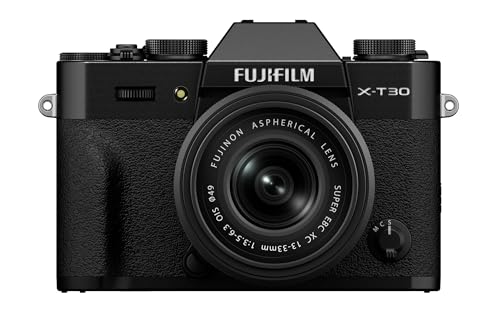
Fujifilm X-T30 III 13-33 Kit — kit that films out of the box
Badge: Kit that films out of the box
Spec box
- Format: Mirrorless, APS-C class body in Fujifilm’s X line
- Configuration: Body with XC13-33mm lens kit, black
- Sensor resolution: Not stated in the listing title – verify with the manufacturer documentation
- Video specification: Not stated in the listing title – verify with the manufacturer documentation
- Stabilization: Not stated in the listing title – verify with the manufacturer documentation
The Fujifilm X-T30 III listing breaks this guide’s pattern in the most practical way possible: it includes a lens. The XC13-33mm kit lens in the box makes this the only one of the six listings that can film on the day it arrives, with no second purchase standing between the buyer and the first footage. For the audience this kit addresses — a creator stepping up from a phone, a stills photographer adding video without a system commitment, a household documenting its own life at a quality phones cannot reach — that completeness is not a minor convenience. It is the product.
The 13-33mm zoom range deserves a word of interpretation. On Fujifilm’s APS-C format, that range covers wide to standard perspectives: the wide end for interiors, vlogging at arm’s length and establishing shots; the standard end for people, products and everyday scenes. It is a considered starter range for video, where wide coverage matters more than telephoto reach, and it keeps the kit compact enough to preserve the X-T30 line’s small-body appeal. Filmmakers who later need reach, speed or shallower depth of field can add X-mount lenses one at a time, which is exactly how a kit should grow.
The title’s silences must be recorded as plainly as elsewhere: no sensor resolution, no video figures, no stabilization claim appears in this listing, and this review will not supply them. Buyers with specific recording requirements should verify the documented specification in Fujifilm’s documentation before purchase. What the title does establish — a current-generation body in Fujifilm’s long-running X-T30 line, a matched kit lens, a complete filming package — defines the body’s role in this comparison as the accessible on-ramp, and on-ramps should be judged by how smoothly they merge traffic, not by the top speed of the motorway.
Set against the five body-only listings, the kit also reframes the price comparison honestly: its sticker is a working total, while every other total in this guide awaits a lens. Readers totalling systems should compare like with like — kit price against body-plus-first-lens price — before concluding anything about value. Our cross-tradition stabilisation survey, dSLR or Mirrorless Cameras With Image Stabilization, is a useful next read for buyers who find stabilization decisive and want it compared across both formats.
Strengths
- The only listing here that films out of the box, with the XC13-33mm lens included.
- Kit zoom range covers the wide-to-standard perspectives everyday video uses most.
- Compact APS-C system keeps the working kit light for travel and daily carrying.
Trade-offs
- The title states no sensor, video or stabilization figures, so specifications need verification.
- Kit lens is a starting point; faster or longer X-mount lenses are later purchases.
- APS-C format concedes low-light headroom to the full-frame bodies in this set.
The kit’s second virtue is educational. A first-time filmmaker learns framing, exposure and movement fastest on a simple, complete tool that removes purchasing decisions from the learning period, and a matched body-and-lens kit is exactly that: one system, understood deeply, rather than a shelf of half-mastered options. Months of shooting on the included zoom will teach its owner precisely which second lens the work actually needs — knowledge no amount of pre-purchase research substitutes for — and the X mount will be waiting with that lens when the lesson lands.
Best for: opening one box gives a complete mirrorless video kit with a wide-to-standard zoom included.
Not suited for: stated recording figures at the point of listing are unavailable, since this title prints none.
New filmmakers can Check price on Amazon on the X-T30 III kit and start filming the day it arrives.
The table below compresses the comparison into its documented facts, and its pattern of filled and empty cells tells the guide’s story at a glance: the mirrorless Panasonic fills its row with stated video features, the Canon DSLR fills the resolution and 4K cells, and several rows carry honest gaps where a listing chose positioning over figures. Read the gaps as instructions, not as absences — each one marks a specification to confirm in the manufacturer documentation before that body can be responsibly bought for video work.
Comparison Table
| Camera | Type | Format | Resolution stated | Video stated | Configuration |
|---|---|---|---|---|---|
| Canon EOS R6 Mark II Body | Mirrorless | Full-frame | 24.2 megapixel | Photo and video capabilities, figures not stated | Body only |
| Nikon D780 Body | DSLR | Full-frame FX | 24.5MP | Not stated in the listing title | Body only |
| Canon EOS 5D Mark IV Body | DSLR | Full-frame | 30.4 megapixel | 4K video | Body only |
| Nikon Z 5 | Mirrorless | Full-frame | Not stated in the listing title | Stills/video, figures not stated | Body, USA model |
| Panasonic Lumix S5IIX | Mirrorless | Full-frame | Not stated in the listing title | 6K video, phase hybrid AF, Active I.S. | Body |
| Fujifilm X-T30 III 13-33 Kit | Mirrorless | APS-C | Not stated in the listing title | Not stated in the listing title | Kit with XC13-33mm lens |
Should your next video camera be a DSLR or a mirrorless body?
Answer three questions in order and the tradition question usually answers itself. First: what do your shelves hold? A serious investment in EF or F-mount lenses is a genuine asset, and it argues either for the DSLRs in this guide or for a mirrorless body from the same maker with an adapter path you have verified lens by lens. An empty shelf argues for starting mirrorless, because every lens bought from today forward should serve the system you will still be using in five years.
Second: how much of the income, or the joy, is video? Occasional filming inside a stills practice tolerates DSLR compromises comfortably, and the D780 and 5D Mark IV remain coherent tools on exactly those terms. Video as a primary output reverses the logic: the mirrorless bodies’ sensor-based focusing, electronic monitoring and stated recording briefs stop being advantages and become the baseline the work assumes. The honest middle — a genuinely even split — belongs to the hybrids, the R6 Mark II and Z 5, which refuse to make either side the guest.
Third: what does your delivery actually require? Write the specification down — resolution, frame rates, recording lengths, colour workflow — and check each finalist’s documented figures against it in the manufacturer documentation. This step is where the titles in this guide deliberately stop and your homework starts, because several of these listings state positioning rather than figures. A body that matches a written delivery specification will serve for years; a body bought on a headline and a hope will be resold within one.
Notice what these three questions never ask: which tradition is better in the abstract. The DSLR-versus-mirrorless debate, conducted in the abstract, has been settled for years in mirrorless’s favour for video. Conducted against a specific shelf, a specific practice and a specific delivery specification, it still produces DSLR answers for a minority of real buyers — and serving that minority honestly, while steering the majority to the modern bodies, is the whole point of staging the comparison.
What the mirrorless transition actually changed for filmmakers
It is worth being precise about what mirrorless design changed, because the change is often described as fashion when it was really architecture. A DSLR focuses stills with a dedicated system that the mirror serves, and films with the mirror locked up, asking a stills-first body to improvise a second job. A mirrorless body has one imaging system — the sensor itself — and focusing, exposure judgement and monitoring all draw on the same live feed the recording uses. Focus that tracks a subject’s eye during a take, exposure judged on the exact image being recorded, silent operation with no mirror to slap: these are not features bolted onto mirrorless bodies but consequences of removing the mirror.
The second change was cultural. Once the record button became a primary control, manufacturers began designing bodies around filmmakers rather than accommodating them: cinema lines, video-first menus, recording specifications stated in titles the way the S5IIX states its 6K. The DSLRs in this guide predate that cultural shift in their design even where their components are modern, which is why the D780’s title talks about sensors and processors in stills language while the Panasonic’s talks about recording. Reading titles across this guide is reading that history in miniature.
None of this erases what DSLRs still do well. Optical finders, native legacy glass, mature used markets and stills handling refined over decades are real goods, and for photography-led practices they can outweigh video architecture. The transition changed who should buy what; it did not make the older tools useless, and a guide that says otherwise is selling something.
Adapting legacy lenses: the bridge between traditions
Adaptation is the practical bridge this comparison keeps crossing, so it deserves direct treatment. Both Canon and Nikon sell official adapters that mount their DSLR lenses on their mirrorless bodies, and for many lenses the arrangement works well enough that the lens collection stops being a reason to stay with a DSLR body. That is the strategic fact. The tactical facts vary by lens: autofocus behaviour, stabilization coordination and feature support differ across combinations, and the only reliable source is the manufacturer’s compatibility documentation for the specific lens and body pairing.
The sensible adaptation strategy is transitional, not permanent. Keep the legacy lenses that earn their place — the fast primes, the beloved telephoto — adapt them, and buy new lenses natively in the mirrorless mount as the kit renews itself. Within a few years the working kit is mostly native, the legacy favourites remain available, and no single purchase had to fund an entire system change. Filmmakers should additionally test adapted combinations for video-specific behaviour — focus smoothness and noise during recording — because stills satisfaction does not guarantee filming satisfaction.
Third-party and cross-brand adaptation exists beyond the official paths, but its variability rises sharply, and a working practice should treat it as experimentation rather than infrastructure. Build the paid work on documented combinations; experiment on personal time. The bridge metaphor holds to the end: adaptation exists to carry a practice across a transition at a humane pace, not to become the permanent road, and the photographers who use it best are the ones with a native destination already chosen.
Audio, monitoring and the unglamorous half of video quality
Cross-tradition comparisons obsess over sensors, but working filmmakers know that audiences judge footage by its sound and its stability at least as much as by its resolution. Audio deserves the first word. None of the listing titles in this guide states an audio specification, which is itself the lesson: audio capability must be verified body by body in the manufacturer documentation — microphone and headphone connectivity, level control, monitoring — because a body without a workable audio path imposes external recorders and sync work on every production. Budget the microphones with the body, whichever tradition you choose, and treat the audio plan as part of the camera purchase rather than an accessory decision deferred until the first noisy interview.
Monitoring runs a close second. Video is judged on a screen for minutes at a time, and the quality of that judging surface — its visibility in daylight, the information it overlays, the external monitors the body supports — shapes exposure and focus decisions on every take. Mirrorless bodies were designed around this screen-centric workflow; DSLRs arrived at it secondarily, which is one more architectural reason the modern bodies feel more natural on a video set even before a single recording figure is compared. When you handle finalists, film a test minute with each and judge the footage and the experience of capturing it together.
Finally, power and media form the third unglamorous pillar. Video consumes batteries and card capacity at rates stills habits underestimate, and long-form work — ceremonies, performances, interviews — exposes any weakness in a body’s power options or recording media immediately. These are documentation questions, not listing questions, and they belong on the same verification list as frame rates and recording formats. The filmmaker who checks them in advance looks professional on the day; the one who discovers them on the day does not.
Common Mistakes
The first mistake in this category is nostalgia pricing: paying mirrorless money for a DSLR because the badge feels professional, without writing down the video specification the work requires and checking the body against it. The second is its mirror image — dismissing a DSLR that would serve a stills-led practice perfectly well, and overspending on a video-led mirrorless body whose strengths the practice will never invoice. Both mistakes come from deciding by tradition instead of by task.
A third mistake is assuming a headline figure settles the video question. A title that states 4K or 6K says nothing by itself about frame rates, recording lengths, colour depth or crop behaviour, and several titles here state even less. The delivery specification must be checked against manufacturer documentation for the exact body, every time, before purchase. A fourth mistake is forgetting the lens arithmetic in cross-tradition comparisons: the body-only mirrorless price and the DSLR price are comparable only after the lens plan — new, adapted or already owned — is priced into both sides.
The final mistake is buying the transition twice: an interim body bought to postpone the system decision, replaced within a year by the body the work required all along. Decide the mount and the tradition once, with the shelf, the practice and the delivery specification on the table, and let that single decision compound. The photographers and filmmakers who navigate this transition well share one habit: they treat the body as the smallest part of the decision and the system — lenses, audio, support, workflow — as the real purchase, and they price and verify the whole system before any single component is ordered.
Frequently Asked Questions
Are DSLRs still worth buying for video? For stills-led practices with legacy lens holdings and occasional filming, yes — the D780 and 5D Mark IV in this guide are the honest examples. For video-led work, the mirrorless bodies state and deliver the stronger briefs, and fresh buyers should start there rather than buying into a tradition whose development has ended.
Which body states the strongest video specification? The Panasonic Lumix S5IIX, with 6K video, phase hybrid AF and Active I.S. stated in its title. Verify the recording detail beneath the 6K headline in Panasonic’s documentation before a production purchase.
Which DSLR states a video figure? Only the Canon EOS 5D Mark IV, whose title states 4K video. The Nikon D780’s title states no video specification, so its documented figures must be checked in Nikon’s documentation.
Can I use my EF or F-mount lenses on a mirrorless body? Generally yes, through the manufacturer’s official adapter, but behaviour varies by lens. Check the compatibility documentation for your specific lenses before relying on adaptation for paid work, and test video focus behaviour on your most-used lenses before a paid shoot depends on them.
Which listing can film straight out of the box? Only the Fujifilm X-T30 III kit, which includes the XC13-33mm lens. The other five listings are body-only.
Does the Fujifilm kit’s APS-C sensor hold it back for video? For most creator work, no. APS-C is a long-established motion format, the kit lens covers the perspectives everyday filming uses, and the complete-package advantage outweighs format differences until a specific delivery specification — low-light performance, say, or a particular depth-of-field look — says otherwise in the documentation.
What should I verify before buying any body in this guide? The recording figures your delivery requires — resolution at your frame rates, recording length behaviour, colour options — plus audio connectivity and media requirements, all in the manufacturer documentation for the exact model, because several listings here state positioning rather than figures.
Is 6K worth it if I deliver in 4K? For editors who reframe, stabilize or crop in post, yes — the S5IIX’s stated 6K is working headroom for a 4K finish. For creators who publish footage essentially as shot, the advantage shrinks, and handling, autofocus and colour workflow should weigh more heavily in the decision.
Which body suits a hybrid practice on a full-frame sensor? The Canon EOS R6 Mark II, whose title states photo and video capabilities on a 24.2 megapixel full-frame sensor, and the Nikon Z 5, whose title claims the most compact full-frame stills and video body in its line.
Final Recommendation
Let the shelf, the practice and the delivery specification vote in that order. Legacy EF holdings with a stills-led practice make the 5D Mark IV a defensible, economical answer, and F-mount holdings do the same for the D780, provided their documented video figures match the modest filming the practice actually does. Everyone else should buy mirrorless: the R6 Mark II for balanced full-frame hybrid work, the Z 5 for compact full-frame mobility, the Lumix S5IIX for the strongest stated video brief in this guide, and the Fujifilm kit for a complete, film-from-day-one start.
Whichever tradition you choose, write the delivery specification down and check the finalist against the manufacturer documentation before paying, because in this category the costliest errors are not bad cameras — they are good cameras bought for the wrong job, a mistake one honest page of homework always prevents.


