What's inside
- Key Takeaways
- Where to Buy
- Quick Picks
- How the Picks Were Chosen
- Side-by-Side Comparison
- How to Choose a Compact Camera for Steadier Shots
- Holding Technique: The Free Stabilizer
- Stabilization for Video: Walking, Panning and the Rolling Shutter
- When Stabilization Is Not Enough: Tripods, Monopods and Beanbags
- The Reciprocal Rule and What Stabilization Does to It
- Cold, Gloves and Other Enemies of the Steady Frame
- Testing a Stabilizer in the Shop and at Home
- Common Mistakes
- Frequently Asked Questions
- Final Recommendation
As an Amazon Associate I earn from qualifying purchases. This post may contain affiliate links at no extra cost to you.
[SITE_DOMAIN] is reader-supported. When you buy through links on our site, we may earn an affiliate commission at no extra cost to you. Prices and availability change; check the Amazon listing for the current details.
Sharpness is a promise made at the moment of exposure, and shaky hands break it a thousand times a day. The best compact cameras with image stabilization keep that promise mechanically — sensing the photographer’s tremor and counter-moving a lens element or the sensor itself — and the six cameras in this roundup span the full social range of the technology: a waterproof adventure body, a fast-lensed enthusiast compact whose title names its Power O.I.S. system outright, two Canon travel zooms, a Panasonic 30x traveller, and a budget Kodak bridge camera that prints Optical Image Stabilization in its title like a badge of honour.
Stabilization claims need literate reading, because the words conceal different machines. Optical stabilization moves glass or sensor to cancel shake while the shutter is open, genuinely extending the shutter speeds a steady photographer can use. Digital stabilization crops and warps the frame electronically, a video-era technique with different costs. Some titles in this set state their mechanism proudly; others say nothing about stabilization at all, and those silences are recorded faithfully in the spec boxes below, with the optical-versus-digital distinction taught as general knowledge rather than pinned on cameras whose sellers never claimed it.
Why does this matter enough for its own roundup? Because stabilization is the invisible specification — the one that decides keeper rates at dusk, at long zoom, on boats and bicycles and cold mountain paths where hands shake for honest reasons. Megapixels advertise; stabilization delivers.
Key Takeaways
- Only some titles name their system: the Panasonic LX10 states Power O.I.S., the Canon ELPH 360 states Image Stabilization, and the Kodak AZ255 states Optical Image Stabilization.
- Where a title is silent on the mechanism — the Tough TG-7, SX740 HS and ZS99 — the spec boxes record the silence rather than guessing.
- The OM SYSTEM Tough TG-7 is the rugged outlier: waterproof and freeze proof, a camera whose steadiness matters underwater and on trails.
- The Kodak PIXPRO AZ255 is the honest budget bridge pick, AA-powered with a 25x zoom — expectations should be set accordingly.
- Long zooms multiply shake along with reach, which is why the 30x and 40x travellers here live or die by their stabilization.
Where to Buy
- OM SYSTEM Tough TG-7 (Black) — Check price on Amazon
- Panasonic LUMIX LX10 — Check price on Amazon
- Canon PowerShot ELPH 360 (Black) — Check price on Amazon
- Canon PowerShot SX740 HS — Check price on Amazon
- Panasonic LUMIX ZS99 — Check price on Amazon
- KODAK PIXPRO AZ255 — Check price on Amazon
Quick Picks
| Pick | Best for | Sensor | Stabilization (as titled) | Check |
|---|---|---|---|---|
| OM SYSTEM Tough TG-7 (Black) | Underwater and trail shooting in any weather | Not stated in the listing title | Not stated in the listing title | Check price on Amazon |
| Panasonic LUMIX LX10 | Handheld dusk photography with a fast lens | 20.1MP 1-inch | Power O.I.S. | Check price on Amazon |
| Canon PowerShot ELPH 360 (Black) | Slim everyday carry with a 12x zoom | Not stated in the listing title | Image Stabilization | Check price on Amazon |
| Canon PowerShot SX740 HS | Travel and concert reach at 40x | 20.3MP | Not stated in the listing title | Check price on Amazon |
| Panasonic LUMIX ZS99 | 30x travel zoom for distant landmarks | Not stated in the listing title | Not stated in the listing title | Check price on Amazon |
| KODAK PIXPRO AZ255 | Budget bridge-camera reach for beginners | 16MP | Optical Image Stabilization (OIS) | Check price on Amazon |
How the Picks Were Chosen
The selection began with a demand for honesty about mechanism. Cameras whose titles state a stabilization system were admitted on that evidence; cameras whose titles stay silent were admitted only when their role in the category — rugged adventure body, long-zoom traveller — made stabilization the obvious question a buyer would ask, with the silence flagged rather than papered over. The result is a set that doubles as a lesson in reading camera listings: three explicit claims, three instructive silences.
Range was the second filter. Stabilization matters most at the extremes of handheld photography — very long zooms, very low light, very unstable platforms — so the set deliberately spans a 3x fast compact, a 12x slim zoom, 25x and 30x and 40x travellers, and a waterproof body that gets used hanging off kayaks and ski lifts. A buyer can therefore locate their own shooting pattern in the set and read the stabilization discussion at the relevant scale. The Canon models here also appear, from a different angle, in our guide to Canon compact cameras with Wi-Fi, since the ELPH and SX lines sell connectivity and steadiness as a combined travel promise.
Excluded: cameras whose only stabilization story is a software night mode, and interchangeable-lens bodies, whose stabilization belongs to a different buying conversation. What remains is compact, fixed-lens, and honest about what its titles do and do not say.

OM SYSTEM Tough TG-7 (Black)
Best for: snorkelling a reef in the morning and photographing a frosty summit cairn in the afternoon, with one camera that treats both as ordinary working conditions.
Not suited for: making the stabilization specification the first question — this title spends its words on waterproofing and toughness, and the stabilization mechanism must be confirmed in OM SYSTEM’s documentation.
- Build claims stated in the title: waterproof, freeze proof
- Video: 4K, as stated in the title
- Feature named in the title: macro shooting (44x macro, as titled)
- Colour stated in the title: Black
- Sensor resolution and stabilization mechanism: Not stated in the listing title — verify with the manufacturer documentation
The Tough TG-7 earns its seat in a stabilization roundup through environment rather than specification. Consider where this camera works: underwater, where the photographer’s whole body is the tripod and the water itself is moving; on winter trails, where gloved hands tremble with cold and effort; on boats, bikes and building sites. In those places, steadiness is not a refinement — it is the difference between a photograph and a smear — and a camera designed to survive those environments is designed, by necessity, around being used unstably. The title’s stated virtues, waterproof and freeze proof construction with 4K video and serious macro capability, describe a tool for exactly those unsteady worlds.
The macro mention deserves its own sentence, because macro is stabilization’s most demanding stills discipline: at close distances, a millimetre of sway becomes a ruined frame, and the TG line’s macro reputation rests on making those frames attainable handheld, in tide pools and on forest floors. Combined with 4K video — a medium that exposes shake mercilessly — the package coheres: this is the camera for motion-rich environments where a conventional compact would be either ruined or left in the dry bag.
The discipline of this guide requires the caveat to be printed as clearly as the praise: the title does not state a stabilization mechanism, a sensor resolution or a zoom range. A buyer for whom the specific stabilization system is decisive should confirm it in OM SYSTEM’s documentation. When the decisive factor is surviving the reef, the frost and the drop onto rocks, the title’s priorities already match the purchase.
Underwater is where the TG-7’s design logic becomes vivid. A snorkeller cannot brace against anything; the body drifts, the surge pushes, the subject — a turtle, a ray — moves on its own schedule. Photographs in that world are taken in bursts, at wide angles, close to the subject, with the camera’s toughness removing the anxiety that makes hands clumsy. Freeze-proofing extends the same logic to altitude and winter, where batteries sag and fingers stiffen. A camera that remains operable, with real buttons under gloves and a body indifferent to being dropped in snow, gathers photographs in conditions that send every rival in this set back to the lodge. Steadiness, in the TG-7’s world, is a property of the whole expedition system — grip, nerve, environment and camera — and the body is engineered as the reliable term in that equation.
Strengths
- Waterproof and freeze proof construction, stated in the title, opens environments no rival here can enter.
- Macro capability is a headline feature, serving the closest and shakiest handheld discipline.
- 4K video in a rugged body suits action environments where rigs and gimbals are impractical.
Trade-offs
- Stabilization type and sensor figures are unstated in the title and need documentation checks.
- Rugged design priorities mean bulk and control compromises a studio camera would not accept.
- Adventure buyers pay for survivability that a careful indoor photographer will never use.
Expedition-minded readers can inspect the TG-7’s current listing on its product page — Check price on Amazon.

Panasonic LUMIX LX10
Best for: photographing a jazz trio in a cellar bar at a thirtieth of a second, handheld, with the lens wide open and the frame holding together.
Not suited for: reach of any kind — a 3x zoom is a deliberate short range, and a distant subject will stay distant no matter how steady the camera is.
- Sensor: 20.1MP, 1-inch
- Lens: 3x Leica DC Vario-SUMMILUX, f/1.4-2.8 aperture
- Stabilization stated in the title: Power O.I.S.
- Video: 4K, as stated in the title
- Display: 3-inch LCD
- Model code in the title: DMC-LX10K (Black)
Here is the most complete handheld low-light formula in the set, and unusually, every ingredient is printed in the title. A 20.1MP 1-inch sensor gathers the light. A Leica zoom opening to f/1.4 — the fastest aperture anywhere in this roundup — admits it in floods at the wide end. And Power O.I.S., Panasonic’s named optical stabilization system, holds the frame steady while slow shutter speeds do their work. Fast glass and optical stabilization are multiplicative, not additive: each stop the lens gains and each stop the stabilizer saves compound into shutter speeds and ISO settings that neither technology reaches alone.
The 3x zoom is the honest price of that formula. Fast lenses are short lenses, because physics charges for aperture in glass and weight; Panasonic spent the budget on f/1.4 rather than on reach, and the LX10’s owner photographs the room they are in rather than the building across the street. For the camera’s intended world — interiors, evenings, streets, tables — that trade is not a compromise but a correct answer, and the 1-inch sensor’s files reward it with clean, gradeable results.
Power O.I.S. naming matters to a careful buyer. It identifies an optical system — lens elements moving against measured shake — rather than a digital crop, and optical systems preserve the full frame and the full resolution while they work. In video, where the LX10’s 4K capability invites walking shots, optical stabilization smooths the gait’s bob without the warping edges that electronic systems can produce at frame borders. This is the reference implementation against which the rest of the set’s claims, and silences, should be read.
The LX10 also rewards a word about its generation. It comes from the period when Panasonic’s LX line was the enthusiast’s default answer to Sony’s RX100 dominance, and its formula — big-for-a-compact sensor, very fast short zoom, named optical stabilization — was aimed at photographers rather than at spec-sheet browsers. That aim shows in the title’s completeness: nearly everything a handheld shooter needs to know is printed before the click. Owners who shoot JPEGs casually will find it pleasant; owners who shoot deliberately, bracing and breathing and choosing their shutter speeds, will find it formidable. Few compacts since have matched its particular concentration of speed and steadiness in so small a body, which is why a camera of its age still anchors a specialist roundup like this one without apology.
Strengths
- Power O.I.S. is named in the title — an optical system, stated rather than implied.
- f/1.4 at the wide end is the fastest aperture in this roundup, compounding the stabilizer’s gains.
- A 1-inch sensor and 4K video complete a coherent handheld-evening package.
Trade-offs
- 3x zoom is the shortest range here; telephoto subjects are simply out of reach.
- An earlier-generation model whose refinements trail the newest bodies in this set.
- The fast lens’s benefits concentrate at the wide end; at 3x the aperture has narrowed to f/2.8.
The LX10’s listing, in its black DMC-LX10K form, can be reviewed in full here — Check price on Amazon.
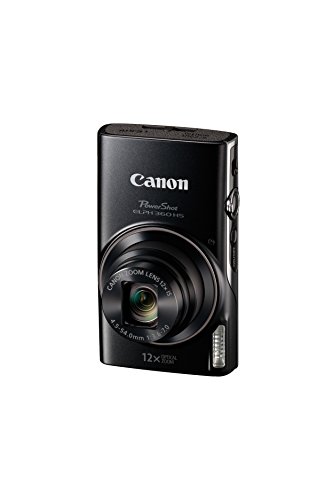
Canon PowerShot ELPH 360 (Black)
Best for: a slim camera that lives in a handbag or jacket, comes out at parties and school concerts, and steadies a 12x zoom that arms alone could not hold.
Not suited for: pixel-peeping at the long end — a slim body and a modest sensor class mean the 12x reach is for framing memories, not for cropping into distant detail.
- Lens: 12x optical zoom
- Stabilization stated in the title: Image Stabilization
- Connectivity stated in the title: Wi-Fi and NFC enabled
- Colour stated in the title: Black
- Sensor resolution: Not stated in the listing title — verify with the manufacturer documentation
The ELPH 360 is the everyperson entry in this set: a genuinely slim Canon whose title makes three promises — a 12x optical zoom, image stabilization, and Wi-Fi with NFC — and those three promises together describe the casual photographer’s actual life. The zoom reaches across a school hall. The stabilization keeps that reach usable in the hall’s dim light, where shutter speeds sag and small hands shake. The connectivity moves the result to a phone before the car ride home. It is a coherent little system, and its coherence is why the ELPH line has sold in such numbers.
Stabilization in a slim body deserves respect as engineering. There is no room for a large sensor to float or bulky lens groups to travel, yet the title states image stabilization as a headline feature alongside the zoom — an acknowledgement by Canon that a 12x lens without stabilization is a specification, while a 12x lens with it is a tool. At full reach, even a heartbeat’s tremor swings the frame through several degrees; the stabilizer is what converts that swing from a blur into a photograph.
The honest limits are size’s limits. The title states no sensor resolution, and cameras of this class carry smaller sensors than the 1-inch LX10, so low-light files will not match the Panasonic’s depth. The ELPH’s bargain is different: maximum convenience and reach per gram, with stabilization making the whole package honest. Understanding that bargain yields a camera that is always present; presence, in family photography, beats specifications that stayed home.
There is a demographic truth inside the ELPH 360’s design: it is the camera bought for someone else as often as for oneself — for a parent who will not learn menus, a teenager whose phone is full, a grandparent travelling once in a decade. For those owners, stabilization is not a feature to configure but a forgiveness built into every frame, quietly rescuing the school play and the birthday candles from hands that shake with age, cold or laughter. The Wi-Fi and NFC then close the generational loop, moving photographs to the family phones where they will actually be seen. Judged as a photographer’s instrument the ELPH is modest; judged as a family’s memory machine, its specification — stated plainly in its own title — is close to perfectly judged.
Strengths
- Image stabilization is title-stated and paired with a genuinely useful 12x optical zoom.
- Wi-Fi and NFC complete the shoot-and-share loop without cables or card readers.
- Slim ELPH proportions mean the camera is carried, which is the first virtue of any compact.
Trade-offs
- Sensor resolution is unstated in the title; low-light depth will trail the 1-inch cameras here.
- Full-zoom frames reward good light; dim halls will test the stabilizer and the sensor together.
- An older model generation, with the interface age that implies.
The black ELPH 360’s present listing terms are set out on its page — Check price on Amazon.

Canon PowerShot SX740 HS
Best for: filming a concert from the fortieth row and photographing a cathedral spire from the square below, on the same holiday, with the same pocket camera.
Not suited for: requiring the stabilization system to be named before purchase — the bundle’s title lists zoom, video and connectivity in detail but leaves the stabilization mechanism to Canon’s documentation.
- Sensor: 20.3MP
- Lens: 40x optical zoom
- Video: 4K UHD, as stated in the title
- Connectivity stated in the title: Wi-Fi and Bluetooth
- Bundle contents stated in the title: 64GB card and bag
- Stabilization mechanism: Not stated in the listing title — verify with the manufacturer documentation
Forty times zoom is a number that should provoke a stabilization question immediately, because magnification is indiscriminate: it enlarges the subject and the shake with perfect fairness. At the long end of the SX740 HS’s lens, the angular tremor of ordinary hands becomes a sweeping motion across the frame, and the camera’s usefulness at its headline specification depends entirely on how well that motion is countered. Canon’s travel-zoom line exists because that countering, in practice, works well enough to make pocketable superzooms a real category — but this guide’s rule stands: the title does not name the system, so the buyer who needs the mechanism in writing should find it in Canon’s materials.
What the title does state is a complete traveller’s kit: a 20.3MP sensor, 4K UHD video, Wi-Fi and Bluetooth for the evening’s transfers, and a bundle with a 64GB card and a bag. The bundle matters for a 4K superzoom, whose video files are heavy and whose lens deserves a case. As a package, the listing describes a camera bought for holidays and events and used hard at both, with the phone handoff built in rather than improvised.
The SX740 HS also illustrates the traveller’s central trade in its purest form. Reach this long, in a body this small, is paid for in light: the far end of a 40x zoom is a bright-day instrument, and dusk concerts will test it. Stabilization stretches the usable envelope — slower shutter speeds at long focal lengths are precisely its gift — but it cannot manufacture light. Grasping that boundary yields a remarkably capable holiday camera; expecting midnight miracles at 40x yields a lesson in physics. Concert shooters comparing screens for reviewing footage may also appreciate our guide to autofocus rangefinder cameras — a different category entirely, but one where deliberate, steady technique is likewise the price of admission.
Think about the concert use case in slow motion, because it explains this camera’s existence. The house lights fall; the stage is a bright island a hundred feet away; the phone cameras rise and produce glowing smears. The SX740 HS rises too, extends to a framing that actually contains the performer, and its 4K video records a watchable souvenir instead of an impressionist accident. That is the superzoom’s entire social function — converting distance, which defeats every phone, into a framed memory. Stabilization is the load-bearing wall of that conversion, which is why this guide insists on verifying its particulars in Canon’s documentation rather than waving at the category’s reputation. With that homework done, the bundle’s card and bag make the camera a complete holiday instrument out of the box.
Strengths
- 40x optical zoom is the longest reach in this set, in a pocketable travel body.
- 4K UHD video plus Wi-Fi and Bluetooth cover capture and sharing in one package.
- The bundle’s 64GB card and bag suit the camera’s video appetite and travel role.
Trade-offs
- The stabilization mechanism is not named in the title; verify it in Canon’s documentation.
- The telephoto end is light-hungry — a daylight and bright-venue tool first.
- Extreme zoom tempts distant, detached compositions; the best frames still come from walking closer.
Holiday shooters can review the SX740 HS bundle’s current contents on its listing — Check price on Amazon.

Panasonic LUMIX ZS99
Best for: a traveller photographing a distant lighthouse at the 720mm end of the zoom in the morning and a street market at 24mm by lunch, from one coat pocket.
Not suited for: paperwork-first shooting, reading stabilization documents before scenery — the ZS99’s title itemises its zoom and video but not its stabilization system, which Panasonic’s documentation must supply in full.
- Lens: 30x optical zoom, 24-720mm
- Video: 4K video and photo, as stated in the title
- Uses named in the title: travel and concerts
- Colour stated in the title: Black (DC-ZS99K9)
- Sensor resolution and stabilization mechanism: Not stated in the listing title — verify with the manufacturer documentation
The ZS99’s title is a study in what travel-zoom buyers are assumed to care about: the zoom, stated twice over as 30x and as 24-720mm; the 4K video; and the two venues named outright — travel and concerts. Both venues are stabilization examinations. A 720mm-equivalent frame from a viewpoint above a harbour magnifies every tremor into a sway, and a concert’s dim light forces the slow shutter speeds where sway becomes blur. Panasonic’s travel line has built its reputation on making those frames attainable from a pocket, and the ZS99 is its current expression in this set.
Thirty times is a considered ceiling, worth contrasting with the Canon’s 40x. Slightly less reach buys a slightly less extreme lens, and many travellers find 720mm-equivalent already beyond their steady-holding ambitions — the practical limit at such magnifications is often the atmosphere itself, with heat shimmer and haze softening distant subjects regardless of the camera’s steadiness. The ZS99’s proposition is balance: reach that covers landmarks, wildlife gardens and stage work, in a body that does not announce itself as equipment.
As with the SX740 HS, this review declines to invent the stabilization specification the title omits. The camera’s category and lineage make stabilization a certainty of design; its type and rated strength are documentation questions. Buyers comparing the two big travel zooms should therefore compare what is printed — zoom spans, video, bundle contents — and then verify stabilization particulars from the manufacturers before the final decision, a five-minute task that this guide will not shortcut on their behalf.
The ZS99’s 24mm wide end is easy to overlook beside the 720mm headline, yet travellers use the wide end more. Hotel rooms, market alleys, group photographs at arm’s length plus one step back — the daily currency of travel photography is wide, and a travel zoom that starts at a true 24mm covers it without the distortion gymnastics of phone ultra-wides. The zoom then functions as a reserve of reach, deployed for the lighthouse, the eagle, the distant dome, and rested otherwise. That pattern of use — wide by default, long by exception — is also the pattern stabilization serves best, because the long deployments are deliberate, braced and brief. Panasonic’s naming of concerts in the title acknowledges the exception case honestly: distant, dim and worth the effort of holding still.
Strengths
- A 24-720mm span covers nearly every travel subject from one pocket body.
- 4K video and photo modes suit the hybrid way travellers actually record trips.
- Travel and concert intent is stated in the title — the brief matches the hardware.
Trade-offs
- Sensor resolution and stabilization type are both absent from the title.
- At 720mm, atmosphere and technique limit sharpness as much as the camera does.
- No bundle is named, so card and case are separate purchases.
The ZS99’s current offer, in its black DC-ZS99K9 form, is detailed on the product page — Check price on Amazon.

KODAK PIXPRO AZ255
Best for: a beginner or a young photographer learning composition with a real 25x zoom and optical stabilization, on AA batteries that can be bought in any village shop on earth.
Not suited for: low-light or fast-moving work where a 16MP bridge sensor and 1080p video ceiling will show their limits within the first evening.
- Sensor: 16MP
- Lens: 25x optical zoom, 24mm wide angle
- Stabilization stated in the title: Optical Image Stabilization (OIS)
- Video: 1080p Full HD
- Power: AA batteries, as stated in the title
- Display: 3-inch LCD
- Form: bridge camera, as stated in the title
Every roundup needs its honesty anchor, and the AZ255 volunteers. Kodak’s bridge camera states its whole case in the title without blushing: 16MP, a 25x optical zoom starting at a genuinely wide 24mm, optical image stabilization named in full, 1080p video, a 3-inch screen, and AA batteries. Nothing here pretends to rival the LX10’s fast 1-inch formula. What the AZ255 offers instead is the complete grammar of photography — real optical reach, a viewfinder-style bridge body shape to hold properly, stabilization that teaches steady technique — at the entry end of the market, for learners and for households wanting a shared camera that is not a phone.
The optical stabilization claim is the surprise of the set: the budget camera names its mechanism more precisely than the premium travel zooms do. Optical stabilization at 25x is not a luxury; at the long end it is the difference between a recognisable bird and a brown smudge, and Kodak’s decision to print OIS in the title tells beginners exactly which feature will save their early photographs. Paired with the bridge body — a shape with a real grip, encouraging two-handed holds — the AZ255 is a teaching instrument as much as a camera.
AA power completes the honest-budget picture. No proprietary charger to lose, no battery that costs a meaningful fraction of the camera; cells from a petrol station revive it anywhere. The costs are equally plain: a 16MP sensor of modest class, video that stops at 1080p, and low-light performance that will not trouble the leaders of this set. Set expectations at daylight, learning and family reach, and the AZ255 meets them squarely — which is more than many pricier cameras manage against inflated hopes. For readers furnishing a desk where the day’s footage gets reviewed, our look at 5K and 8K monitors is a reminder that the viewing end of the chain deserves the same honest budgeting as the camera end.
The AZ255 also deserves credit as a household object. Bridge cameras of its class become the family camera — the one that lives in a drawer, attends birthdays and school sports days, and gets handed to a visiting cousin without a waiver. AA batteries suit that life perfectly: the drawer always holds spares, and a camera that wakes up after six idle months because its cells were stored separately is a camera that gets used. Optical stabilization, stated in the title, forgives the casual handling such a life involves. No camera in this set will produce finer family archives per unit of effort, because the others demand owners; the Kodak merely demands to be picked up, and its honest specification ensures nobody expects it to be a Leica.
Strengths
- Optical Image Stabilization is stated in full in the title — exemplary claim honesty at this price.
- A 25x zoom from 24mm teaches real framing across an enormous range.
- AA batteries make power a solved problem anywhere on the planet.
Trade-offs
- 16MP and 1080p video mark a clear ceiling beside the 4K cameras in this set.
- Low-light ability is modest; this is a daylight and learning camera.
- Bridge size gives up pocketability — it rides in a bag, not a jacket.
Beginners and gift-buyers can check the AZ255’s current listing on its page — Check price on Amazon.
Side-by-Side Comparison
| Pick | Zoom (as titled) | Stabilization (as titled) | Defining trait |
|---|---|---|---|
| OM SYSTEM Tough TG-7 (Black) | Not stated in the listing title | Not stated in the listing title | Waterproof, freeze proof, macro, 4K |
| Panasonic LUMIX LX10 | 3x Leica, f/1.4-2.8 | Power O.I.S. | 1-inch sensor, fastest lens here |
| Canon PowerShot ELPH 360 (Black) | 12x optical | Image Stabilization | Slim body, Wi-Fi and NFC |
| Canon PowerShot SX740 HS | 40x optical | Not stated in the listing title | 20.3MP, 4K UHD, card-and-bag bundle |
| Panasonic LUMIX ZS99 | 30x optical, 24-720mm | Not stated in the listing title | Travel and concert brief |
| KODAK PIXPRO AZ255 | 25x optical, 24mm wide | Optical Image Stabilization | AA power, bridge body, 1080p |
Read the table as a map of candour as much as of capability. Its middle column divides the set into cameras whose makers spent title space on the stabilization claim and cameras whose makers spent it elsewhere, and that division predicts the shopping experience: the first group can be compared from listings alone, while the second demands a documentation detour that this guide has flagged at every step. Neither group is automatically superior — the TG-7’s silence on mechanism accompanies the toughest body here — but the buyer who knows which group a camera belongs to knows exactly what homework remains before the order, and homework done in advance is the cheapest accessory in photography.
How to Choose a Compact Camera for Steadier Shots
Optical or digital — which kind is being offered?
Learn to ask this of every listing, because the two technologies are not interchangeable. Optical stabilization counteracts shake physically, during exposure, preserving the full frame for stills and video alike; the LX10’s Power O.I.S. and the Kodak’s OIS are claims of this kind. Digital stabilization works on the image after capture, typically cropping into the frame for video and warping edges to simulate steadiness — useful for clips, irrelevant to a still photograph’s sharpness. When a title names neither, as three in this set do not, the manufacturer’s documentation holds the answer, and handheld video work should not be signed for until it is read.
How much zoom is honestly usable handheld?
A working rule from the film era still disciplines expectations: without stabilization, shutter speed should roughly match the lens’s effective focal length — a 720mm frame wants a 1/750 second exposure, which bright noon provides and dusk denies. Stabilization buys back several stops of that rule, stretching a traveller’s usable day at long reach, but it buys nothing against subject motion: the distant footballer blurs at slow speeds no matter how still the camera floats. Match the zoom to the light and the subjects, not to the brochure’s maximum, and treat the far third of any long zoom as a fair-weather reserve.
Does the shooting happen on the move?
Platform changes everything. A photographer shooting from a boat, a bicycle’s rest stops, a kayak or a windy ridge needs stabilization as a primary system, and the TG-7’s rugged brief exists for exactly those platforms. A photographer shooting from cafe chairs needs it as insurance at dusk, which the LX10’s fast-lens-plus-O.I.S. formula supplies in depth. Name the platform honestly; the right camera follows from it more reliably than from any specification duel.
What does the claim’s wording reveal about the maker?
Precise claims signal confidence. Kodak printing Optical Image Stabilization in full, Panasonic naming Power O.I.S. as a branded system, Canon stating Image Stabilization plainly on the ELPH — each tells the buyer what was bought. Vague or absent claims are not proof of absence, but they transfer the verification work to the buyer, and a careful shopper accepts that transfer knowingly rather than discovering it after the first blurry evening.
Holding Technique: The Free Stabilizer
Technique multiplies whatever system a camera carries. The fundamentals cost nothing: both hands on the body, elbows drawn into the ribs, the camera pressed to the face when a finder allows it, breath exhaled slowly as the shutter is pressed rather than squeezed. At long zooms, lean the body’s weight against walls, trees, railings and doorframes — the world is full of tripods disguised as architecture. Burst discipline helps too: fire three frames at the critical moment, because the middle frame of a burst is statistically the steadiest, the photographer’s flinch bracketing it on both sides. And review honestly at full magnification after the first shots of a session; discovering a steadiness problem while the subject is still present is a rescue, while discovering it at home is an obituary.
Video technique differs in one respect: motion should be slow and deliberate rather than absent. Pans that begin and end on held frames, walks that roll through the heel to soften the gait’s bob, and zooms executed before recording rather than during — these habits let an optical system do its best work, because stabilizers correct tremor beautifully and choreography not at all.
Stabilization for Video: Walking, Panning and the Rolling Shutter
Video exposes shake differently from stills. A still frame hides a tremor as slight softness; a video frame sequence turns the same tremor into a nauseating swim, and stabilization systems earn their keep frame by frame. Optical systems excel at the high-frequency jitter of handheld walking, smoothing the gait’s rhythm into a glide when paired with a slow, heel-rolling step. They cannot fix a careless pan: whip the camera sideways and no stabilizer will make the result graceful, because the motion was intentional in the only language the sensors speak. Shoot video the way stabilizers prefer — moves begun and ended on held frames, zooms set before recording, turns made with the whole body rather than the wrists — and even the modest systems in this set produce footage that looks professionally calm. The 4K cameras here, the TG-7, LX10, SX740 HS and ZS99, all benefit doubly, since their resolution gives editors room to add a final electronic smoothing pass in post without visible quality loss.
When Stabilization Is Not Enough: Tripods, Monopods and Beanbags
Every stabilizer has an event horizon. Beyond a second or so of exposure, or at magnifications where the atmosphere itself shimmers, mechanical support takes over, and the wise compact owner carries the smallest support that does the job: a pocket tripod for tables and walls, a monopod that doubles as a walking pole for trail photographers, a beanbag that moulds to rocks and car roofs. The TG-7’s world adds a fourth option — the environment itself, with the camera rested on a reef-safe rock or a gloved hand pressed into snow. Choosing support is not an admission that stabilization failed; it is the recognition that steadiness is a system, and the camera’s internal system is one component among several. The photographers whose long-zoom and low-light work fills this category’s galleries are, without exception, relentless exploiters of every wall, railing and fence post the world provides.
The Reciprocal Rule and What Stabilization Does to It
Generations of photographers learned steadiness through the reciprocal rule: keep the shutter speed at least as fast as one over the focal length, and handheld frames stay sharp. Stabilization rewrites that rule’s arithmetic without repealing its spirit. A system rated for several stops of compensation lets a 200mm frame be attempted at a fifteenth of a second — once an absurdity, now a dusk routine — provided the subject cooperates by holding still. The rule’s deeper lesson survives intact: focal length is a shake multiplier, shutter speed is the budget, and stabilization is a raise in that budget rather than an exemption from it. Owners who internalise the arithmetic stop asking whether a camera has stabilization and start asking how much of it, in what light, at what reach — the questions this roundup’s title-by-title audit is designed to make askable.
Cold, Gloves and Other Enemies of the Steady Frame
Shake has causes that no specification sheet mentions. Cold hands tremble measurably more than warm ones, which is why winter photography — the TG-7’s stated freeze-proof territory — is stabilization’s sternest examination. Caffeine, fatigue, altitude and a held breath kept too long all add their tremors, and the working photographer’s countermeasures are embarrassingly unglamorous: warm the hands, rest the arms, shoot before the third coffee, exhale slowly. Gloves thick enough for real cold also blunt the small buttons of compact bodies, so winter shooters should rehearse their camera’s essential controls with gloves on, at home, before the mountain teaches the lesson at altitude. Steadiness, pursued seriously, becomes a whole-body discipline of which the camera’s internal system is merely the final, faithful assistant.
Testing a Stabilizer in the Shop and at Home
A stabilization system can be auditioned before it is trusted. In the shop or on the first evening at home, photograph a detailed, well-lit target — a bookshelf serves perfectly — at the lens’s longest setting, stepping the shutter speed down through the fractions while keeping everything else constant. Review each frame at full magnification and find the speed where sharpness collapses; that collapse point, compared across cameras and against the photographer’s unaided tremor, is the system’s real rating in the only units that matter, the owner’s own hands. Repeat the test after a month of practice and the improvement will be measurable, because technique and technology compound. Keep the test frames. They are the baseline against which every future claim — a new camera’s, a firmware update’s, a reviewer’s — can be checked without rhetoric, and they turn the vague promise of stabilization into a number the owner personally verified.
Common Mistakes
- Assuming every camera in a stabilization roundup states its system. Three titles here do not; the mechanism for the TG-7, SX740 HS and ZS99 lives in manufacturer documentation.
- Believing stabilization freezes subjects. It cancels camera motion only — a slow shutter under a stabilizer still blurs a moving child, dancer or dog.
- Shooting every scene at maximum zoom. The long end magnifies shake, drinks light and flattens scenes; it is a specialist tool, not a default position.
- Judging steadiness from the rear screen’s thumbnail. Small previews hide blur perfectly; only a magnified review tells whether the frame survived.
- Expecting a budget bridge camera to match a fast 1-inch compact at dusk. The AZ255’s stabilization is honest and its sensor is modest; daylight is its kingdom.
- Leaving stabilization engaged on a tripod. When the camera is fixed, a hunting stabilizer can introduce the very motion it exists to cancel; check the documentation for the recommended setting when the body is mounted.
Frequently Asked Questions
What is the difference between optical and digital stabilization?
Optical systems move a lens element or the sensor to cancel shake during exposure, helping stills and video without cropping the frame. Digital systems adjust the image electronically, mainly for video, at the cost of a cropped field of view and occasional edge warping. The titles in this set that name a system — Power O.I.S. on the LX10, Image Stabilization on the ELPH 360, Optical Image Stabilization on the Kodak AZ255 — are describing the optical family.
Which camera here is best for concerts?
Two titles volunteer for the duty: the Panasonic ZS99 names concerts in its title alongside travel, with a 30x zoom for distant stages, and the Canon SX740 HS pairs 40x reach with 4K video. Between them, the choice turns on verified stabilization details and low-light expectations — both are bright-venue instruments first, and their documentation should be compared before ordering.
Why is a waterproof camera in a stabilization guide?
Because the Tough TG-7 works where steadiness is hardest — underwater, on trails, in cold and motion — and its buyers need steadiness more than most. Its title, however, does not state a stabilization mechanism, so that specific must be confirmed in OM SYSTEM’s documentation; its inclusion rests on environment, not on an invented claim.
Can stabilization replace a tripod?
For handheld shutter speeds down to a fraction of a second in practised hands, it can postpone the tripod impressively. For multi-second exposures — night skies, silky waterfalls, architecture at blue hour — no stabilizer substitutes for a fixed camera. The technologies overlap in the middle ground and diverge at the extremes, and serious night photographers carry both.
Is the Kodak AZ255 a sensible first camera?
Yes, with expectations set as its review sets them: a 25x optical zoom with stated optical stabilization, a proper bridge grip for learning two-handed technique, AA batteries that never strand it, and daylight performance that teaches composition honestly. Its ceilings — 16MP, 1080p video, modest low-light ability — are the tuition structure, not a deception.
Does stabilization help with macro photography?
It helps and it is not sufficient, which is why the TG-7’s macro reputation rests on a whole design rather than one system. At macro distances, sway moves the subject out of the focal plane entirely, a problem stabilization cannot solve; the technique is to shoot bursts, brace on the ground itself, and let depth of field and luck divide the labour. Stabilization handles the rotational tremor while the photographer manages the rest.
Why do the travel zooms not name their stabilization in their titles?
Title space is spent on what sellers believe closes sales — zoom numbers, video resolution, connectivity — and stabilization, being expected in the category, is often left to the detail sections and documentation. That is precisely why this guide flags the omission instead of filling it: a buyer comparing the SX740 HS and ZS99 should pull both manufacturers’ stated stabilization particulars and compare those, not the titles’ emphases.
Which of these suits a grandparent photographing grandchildren?
The ELPH 360 is the natural answer: slim enough to be carried without thought, a 12x zoom that reaches across rooms and halls, image stabilization stated in its title to forgive unsteady hands, and Wi-Fi with NFC to move the results onto family phones the same day. Its limits — an unstated sensor resolution and modest low-light depth — matter less than its presence, because grandchildren do not repeat their moments for a better camera.
One sentence of perspective before the verdict, earned across every camera in this set: stabilization never made a photograph interesting, it only made interesting photographs possible at the hours and distances where they actually occur — and that quiet enabling, repeated over years of evenings and journeys, is worth more than any single specification a title can print.
How should the LX10 and the travel zooms be weighed against each other?
They answer different evenings. The LX10 assumes the subject is near and the light is poor, and it spends everything — aperture, sensor, stabilization — on that assumption. The SX740 HS and ZS99 assume the subject is far and the light is adequate, and they spend everything on reach, with stabilization as the enabler. A photographer whose diary is restaurants and streets should take the Panasonic’s short, fast lens every time; a photographer whose diary is coastlines, stadiums and safaris should take a travel zoom and accept its dusk curfew. The error is buying one for the other’s diary.
Final Recommendation
Buy the claim that is printed, for the platform where the camera will live. The LX10 is the connoisseur’s handheld instrument — Power O.I.S. named, an f/1.4 lens compounding its work, a 1-inch sensor banking the results. The ELPH 360 carries Canon’s stated stabilization into the slimmest body here, the natural party and school-hall camera. The two big travel zooms, Canon’s SX740 HS and Panasonic’s ZS99, promise reach that only stabilization makes usable; verify their mechanisms in writing, then choose on zoom span and bundle. The TG-7 stands apart for reefs, frost and drops, its steadiness a function of a body built for unsteady worlds. And the Kodak AZ255, printing Optical Image Stabilization in full at the budget end, may be the most instructive purchase in the set: proof that an honest claim, modestly powered, serves a beginner better than a grand claim nobody itemised. Whichever body is chosen, add the free stabilizer — braced elbows, a held breath, a wall leaned on — and the keeper rate will climb before the first accessory is bought.
Related guides
- Best Thermal Imaging Cameras Hunting: Six Handheld Thermal Monoculars for Night Observation
- Best Mirrorless Cameras for Bird Photography: Crop Reach, Fast Bursts and the Lens Question Answered First
- Best 4K Cameras Travel Shooters Actually Carry
- Best 1080 Webcams: Six Full HD Cameras Judged on Light, Focus and Voice


