What's inside
- Where to Buy
- Key Takeaways
- Quick Picks
- How the picks were chosen
- Comparison Table
- How do you choose among the best mirrorless cameras for advanced photography?
- Sensor size, working style and the resolution question
- Building a lens plan around a body-only purchase
- What deliberate technique demands from a camera body
- Common Mistakes
- Frequently Asked Questions
- Final Recommendation
As an Amazon Associate I earn from qualifying purchases. This post may contain affiliate links at no extra cost to you.
[SITE_DOMAIN] is reader-supported. When you buy through links on our site, we may earn an affiliate commission at no extra cost to you. Prices and availability change; check the Amazon listing for the current details.
Where to Buy
Sony a7R V Body — Check price on Amazon
Canon EOS R5 — Check price on Amazon
Nikon Z 8 Body — Check price on Amazon
Fujifilm X-T5 Body Black — Check price on Amazon
OM SYSTEM OM-5 Mark II (Black) — Check price on Amazon
Panasonic Lumix S5II — Check price on Amazon
Every listing above is a body or body-led listing, so the lens budget sits on top of the body budget; read each review for what the box actually contains before comparing totals.
Choosing the best mirrorless cameras for advanced photography is less about finding a body that can do everything and more about finding the one whose strengths line up with the photographs you actually make. Advanced work is deliberate work: exposures set by hand, focus placed where you decide it belongs, files pushed hard in the edit because the scene demanded it. A camera for that kind of practice has to reward attention rather than automate it away, and it has to hold up when a landscape session runs long, a portrait sitting turns demanding, or a travel day asks for stills in the morning and serious video after lunch.
The six bodies gathered here span three sensor formats and five lens mounts, and that spread is the point. Sony’s a7R V and Canon’s EOS R5 chase resolution at the full-frame top end. Nikon’s Z 8 pitches itself as a professional stills and video hybrid. Fujifilm’s X-T5 puts a 40 megapixel APS-C sensor behind traditional control dials. The OM System OM-5 Mark II trades sensor area for a genuinely compact Four Thirds body with an IP53 weather-sealed rating in its listing. Panasonic’s Lumix S5II closes the set with a 24.2 megapixel full-frame sensor, phase hybrid autofocus and a recording specification that video-leaning photographers will read twice.
One discipline governs every claim that follows. Specifications appear only where the listing title itself states them: sensor sizes and megapixel counts, the frame rates and stabilization figures the titles print, the mounts and recording formats named outright. Where a title stays silent about a specification, the spec box says so in plain words instead of dressing a guess up as a fact. Advanced photographers check spec sheets for a living; this guide respects that habit. If you are weighing these bodies against video-first alternatives, our companion coverage of sony Mirrorless Cameras for Video looks at the same decision from the moving-image side.
Key Takeaways
- Resolution splits the set: the Fujifilm X-T5 lists a 40MP APS-C sensor and the Canon EOS R5 a 45 megapixel full-frame sensor, while the OM-5 Mark II works with 20.4MP on Four Thirds.
- Only two titles state a stabilization figure: the X-T5 names 7-stop in-body stabilization and the OM-5 Mark II names 5-axis stabilization with an IP53 weather-sealed body.
- The Panasonic Lumix S5II is the video outlier, with unlimited 4:2:2 10-bit recording and phase hybrid AF stated in its title.
- Five of the six listings are body-only, so lens cost belongs in every total you calculate.
- Mount choice is the long-term decision: Sony E, Canon RF, Nikon Z, Fujifilm X, Micro Four Thirds and L-Mount glass do not interchange.
- The Nikon Z 8 and Canon EOS R5 both present themselves as stills and video hybrids, while the X-T5 leans hardest into stills-first handling.
Quick Picks
| Pick | Badge | Why it made the cut |
|---|---|---|
| Sony a7R V Body | Resolution-first full-frame body | A full-frame interchangeable lens body from Sony’s high-resolution R line, sold bare for photographers who already own or will choose E-mount glass. |
| Canon EOS R5 | Hybrid flagship with 8K video | 45 megapixel full-frame sensor, DIGIC X processor, up to 12 FPS and 8K video on the RF mount. |
| Nikon Z 8 Body | Professional stills and video hybrid | Nikon’s professional full-frame hybrid body, a USA model sold body-only for the Z mount. |
| Fujifilm X-T5 Body Black | Dials, 40MP and 7-stop stabilization | 40MP APS-C X-Trans CMOS 5 HR sensor with 7-stop in-body stabilization in a black body-only listing. |
| OM SYSTEM OM-5 Mark II (Black) | Compact sealed Four Thirds body | 20.4MP Four Thirds sensor, 5-axis stabilization, IP53 weather sealing and 4K video in a compact body. |
| Panasonic Lumix S5II | Full-frame video depth | 24.2MP full-frame sensor, phase hybrid AF, Active I.S. and unlimited 4:2:2 10-bit recording. |
How the picks were chosen
Advanced photography is not one genre, so a single winner would be a dishonest answer. Landscape work rewards resolution and dynamic patience. Portrait work rewards lens choice and a body that stays out of the way during a sitting. Documentary and travel work reward size discipline, because the camera that stays home takes no photographs at all. This selection was built to cover those poles honestly: two resolution-led full-frame bodies, one professional hybrid, one dial-driven APS-C stills camera, one compact weather-sealed Four Thirds body, and one full-frame body whose video specification is unusually complete for its tier.
Every body here is a current interchangeable lens model sold as a body or body-led listing, which keeps the comparison about sensors, mounts and handling rather than about which kit lens happened to be bundled. Titles were read closely and literally. When a title prints a number, the number is used. When it does not, the review discusses what the format and the mount imply in general photographic terms, and the spec box records the gap with the verification line rather than filling it from memory of a spec sheet.
Stabilization, sealing and video claims were treated with particular care, because those are the claims most often inflated in camera marketing. Only the Fujifilm and OM System titles state stabilization figures, so only those two reviews discuss stabilization quantitatively. Only the OM-5 Mark II title claims a weather-sealing rating, so it is the only body here described as sealed. That restraint narrows some reviews, but it keeps every sentence defensible.
Price was deliberately excluded from the selection logic. These bodies sit at different tiers, and a tier is a statement about build, support and intended working life as much as about features. A professional body that costs more than an enthusiast body is not automatically the better purchase for an enthusiast practice, and a compact body that costs less is not a compromise if its format matches the work. The reviews therefore argue from stated capability and working fit, and leave the arithmetic of value to the reader’s own budget and shooting volume, where it belongs.

Sony a7R V Body — resolution-first full-frame body
Badge: Resolution-first full-frame body
Spec box
- Format: Full-frame, per the listing title
- Body configuration: Body only, interchangeable lens camera
- Mount: Not stated in the listing title – verify with the manufacturer documentation
- Sensor resolution: Not stated in the listing title – verify with the manufacturer documentation
- Stabilization: Not stated in the listing title – verify with the manufacturer documentation
Sony’s listing title for the a7R V is strikingly plain: Alpha 7R V, full-frame, mirrorless, interchangeable lens, body. No megapixel count, no frame rate, no stabilization figure. That plainness is worth respecting rather than papering over, because the R badge in Sony’s line has always carried the resolution brief, and the honest way to read this listing is as the high-resolution seat in the Alpha full-frame range, sold bare so the lens decision stays entirely yours. Photographers stepping up from an earlier R body, or arriving from another mount with a resolution-led practice, are the audience this body-only configuration addresses.
What does a resolution-first body change in daily advanced work? It changes the crop conversation first. A high-pixel full-frame file lets a landscape photographer recompose modestly in the edit without surrendering print size, lets a studio photographer shoot a touch wider for safety and still deliver a tight final frame, and lets detail-heavy subjects — architecture, textiles, product surfaces — hold their texture at large output sizes. It also changes the discipline required: high-resolution sensors punish sloppy shutter technique, missed focus and cheap glass more visibly than forgiving sensors do, because the file records every small failure at the same fidelity as every success. Advanced photographers generally welcome that bargain, since the feedback loop makes technique better.
The body-only format deserves a paragraph of its own. Nothing in this listing puts a lens in front of the sensor, so the first lens purchase is part of the real cost of ownership, and for resolution-led work that lens should be chosen with the sensor in mind. Pairing a demanding sensor with an indifferent standard zoom wastes the very quality the body was bought for. The E-mount catalogue is broad, spanning native Sony glass and a deep bench of third-party options, which makes building a deliberate two- or three-lens set around this body a realistic project rather than a compromise.
Video is present in any modern Alpha body, but this listing makes no video claims at all, and the review follows that lead: treat the a7R V as a stills-led instrument whose moving-image side is a bonus to verify against the manufacturer documentation if video matters to you, not a headline reason to buy. Photographers whose work splits evenly between stills and serious video should read the Canon, Nikon and Panasonic reviews below before deciding, because those listings state their hybrid intent outright.
Strengths
- The R designation places this body at the resolution end of Sony’s full-frame line, suiting detail-led stills work.
- Full-frame format supports shallow depth of field control and strong performance in dim light compared with smaller sensors.
- Body-only sale keeps the first lens choice fully open across a deep E-mount catalogue.
Trade-offs
- The listing title states no sensor resolution figure, so the exact megapixel count needs verification before purchase.
- No lens is included, which raises the true starting cost beyond the body price.
- High-resolution files demand careful technique and capable lenses to show their advantage.
Best for: the a7R V delivers maximum full-frame stills detail from a body-only purchase with a serious lens budget behind it.
Not suited for: a complete kit in one box is out of reach here, since this listing contains no lens at all.
If the resolution brief matches your work, Check price on Amazon for the a7R V body before committing to a lens plan around it.
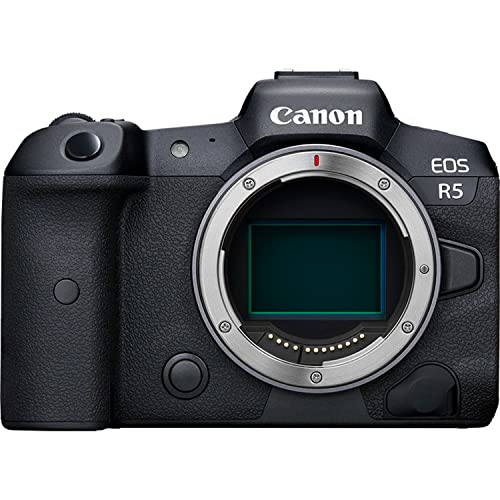
Canon EOS R5 — hybrid flagship with 8K video
Badge: Hybrid flagship with 8K video
Spec box
- Format: Full-frame CMOS sensor
- Sensor resolution: 45 megapixel
- Processor: DIGIC X image processor
- Continuous shooting: Up to 12 FPS
- Video: 8K video
- Mount: RF mount
- Body configuration: Body only
Canon’s title is the most forthcoming in this set, and it reads like a checklist for the advanced hybrid shooter: 45 megapixel full-frame CMOS sensor, DIGIC X processor, up to 12 frames per second, 8K video, RF mount, body only. Each of those figures does real work. The 45 megapixel sensor sits in the resolution class that supports large prints and meaningful crops while staying below the file sizes of the very highest-pixel bodies. Twelve frames per second is a working burst rate for events, wildlife opportunism and wedding candids rather than a spec-sheet ornament. And 8K video, whatever a given photographer’s delivery format, gives the editor oversampled 4K and reframing room that a native 4K capture cannot offer.
The R5’s proposition for advanced photography is the single-body practice: one camera that covers a portrait sitting in the morning, a landscape detour at golden hour and a short film project on the weekend, without the stills side feeling like an afterthought bolted to a video tool. That matters to working photographers who bill for both. The stills specification — resolution, burst rate, a current-generation processor — stands on its own merits, and the video specification is stated in the title rather than implied, which makes the hybrid claim here a documented one.
RF mount commitment is the decision underneath the decision. Buying the R5 body-only means building or extending an RF lens collection, and Canon’s RF line is where the company’s optical development now concentrates. Photographers arriving with EF glass should factor adaptation into their plan and verify adapter details against manufacturer documentation; photographers starting fresh can build directly in RF and skip the transition entirely. Either way, the body-only listing keeps the lens budget visible instead of hiding it inside a kit zoom that a serious shooter would replace within a year.
Heat and recording limits are the questions experienced video shooters ask about any high-resolution hybrid, and this listing title does not address them, so this review does not either. If long continuous 8K takes are central to your work, verify the recording behaviour in the manufacturer documentation and weigh the Panasonic below, whose title makes an explicit unlimited recording claim at a lower resolution tier. For mixed stills-led practices with serious video episodes, the R5’s stated figures remain a compelling combination.
Strengths
- A stated 45 megapixel sensor gives advanced stills work real resolution headroom for print and cropping.
- 8K video in the title makes the hybrid claim concrete rather than implied.
- Up to 12 FPS supports event and action episodes inside a stills-led practice.
Trade-offs
- Body only, so RF lenses are a separate and significant investment.
- The title states no stabilization figure, so stabilization performance needs verification elsewhere.
- 8K recording behaviour over long takes is not described in the title and must be checked before video-led use.
Best for: hybrid stills-and-video work fits this one full-frame body with stated 45 megapixel stills and 8K video credentials.
Not suited for: expecting a lens included in the purchase will disappoint, since the R5 listing is body only.
For a single-body hybrid kit, Check price on Amazon on the EOS R5 and price the RF lenses you would pair with it in the same sitting.

Nikon Z 8 Body — professional stills and video hybrid
Badge: Professional stills and video hybrid
Spec box
- Format: Full-frame
- Positioning: Professional stills/video hybrid camera, per the listing title
- Body configuration: Body only, Nikon USA model
- Sensor resolution: Not stated in the listing title – verify with the manufacturer documentation
- Video specification: Not stated in the listing title – verify with the manufacturer documentation
- Stabilization: Not stated in the listing title – verify with the manufacturer documentation
Nikon’s title for the Z 8 makes one claim and makes it plainly: this is a professional full-frame mirrorless stills and video hybrid, sold as a Nikon USA model, body only. No megapixel figure, no frame rate, no codec list. The professional positioning is itself the information. In Nikon’s line, that word signals a body built for paid work — the camera a wedding photographer, a photojournalist or a commercial shooter reaches for when the assignment cannot be reshot — and the hybrid wording states that video is a first-class citizen rather than a menu curiosity.
For advanced photographers already invested in Nikon, the Z 8 is the natural summit of the Z mount path: the body that removes excuses. Work that a lesser body makes difficult — fast-moving subjects, mixed stills and video coverage of the same event, long days where reliability matters more than novelty — is the work this class of body exists to absorb. The USA model designation in the title also matters practically, since region of sale affects warranty handling, and professional buyers rightly read that line before anything else.
Because the title withholds the numbers, this review will not supply them from memory. That restraint has a practical consequence for the reader: the Z 8 decision should be made in two steps. First, decide whether Nikon’s professional hybrid tier and the Z mount are where your practice belongs — a question of ergonomics, lens holdings and working style. Second, verify the exact sensor, burst and video figures against Nikon’s documentation and check that they match the demands of your assignments. A professional body is a multi-year commitment, and an hour with the official specification is cheap insurance.
The body-only configuration suits the intended audience. Professionals own lenses; what they buy in a body is capability and dependability. Newcomers to the Z mount should budget honestly for Z glass, because a professional body behind an entry-level zoom produces entry-level files with professional file sizes. Paired with lenses that match its tier, the Z 8 is the Nikon entry in this set that asks the fewest compromises of a working practice, and its review sits between the resolution-led Sony and Canon above and the format-diverse bodies below as the traditional professional’s option.
Strengths
- Professional positioning in the title signals a body built for paid, deadline-driven work.
- Stills and video hybrid intent is stated outright rather than implied.
- Nikon USA model designation gives warranty clarity for professional buyers.
Trade-offs
- The title states no sensor, burst or video figures, so specification homework is unavoidable.
- Body only, with professional-tier Z lenses representing a substantial additional spend.
- Its capabilities exceed what a casual practice will use, making it poor value for occasional shooting.
Best for: Nikon-committed professional work gets a full-frame hybrid body at the top of the Z line.
Not suited for: published headline figures are missing from the listing itself, since this title states positioning rather than numbers.
Nikon loyalists weighing the upgrade can Check price on Amazon for the Z 8 body and compare it against the cost of completing a Z lens set.

Fujifilm X-T5 Body Black — dials, 40MP and 7-stop stabilization
Badge: Dials, 40MP and 7-stop stabilization
Spec box
- Format: APS-C, X-Trans CMOS 5 HR BSI sensor
- Sensor resolution: 40MP
- Stabilization: 7-stop in-body image stabilization
- Body configuration: Body only, black
- Video specification: Not stated in the listing title – verify with the manufacturer documentation
The Fujifilm X-T5 title contains a small corruption — it breaks off mid-sentence about high-speed action — but the figures that survive are the two that define the camera: a 40MP APS-C X-Trans CMOS 5 HR BSI sensor and 7-stop in-body image stabilization. Forty megapixels on APS-C is a statement of intent. It puts this smaller-format body in the same resolution conversation as full-frame models, with the crop factor turning telephoto lenses effectively longer and the whole system — body and lenses — staying smaller and lighter than a full-frame equivalent built to the same ambition.
The 7-stop stabilization figure is the only hard stabilization number in this entire guide, and it changes what handheld photography can attempt. Seven stops of compensation, as stated in the title, supports slower shutter speeds for deliberate motion blur, steadier handheld work in dim interiors, and sharper results at the long end of a zoom where small movements magnify. Advanced photographers who shoot cathedrals, night streets, waterfalls with silk-smooth water or panned motorsport will read that figure as creative range, not as a safety net. It also reduces the tripod’s authority over the day’s plan: some sessions that once demanded support can be walked instead.
Fujifilm’s X-T line is known for direct mechanical-feeling control — dedicated dials for the exposure fundamentals — and while the title does not enumerate the dials, the line’s handling philosophy is the reason many advanced photographers choose it over technically comparable bodies. Working through physical controls keeps eyes on the subject and settings visible at a glance, an analogue rhythm that suits deliberate technique. The black body-only listing keeps the purchase focused: the body, then X-mount lenses chosen one by one. Fujifilm’s X lens catalogue is mature and APS-C-native, meaning the glass was designed for this sensor size rather than adapted down from full-frame, which keeps lens size in proportion to the body.
The honest cautions are format truths. APS-C gathers less light per frame than full-frame at the same settings, so the deepest low-light work and the shallowest depth of field remain full-frame territory, and 40 megapixels on a smaller sensor asks a lot of lens quality and technique. Photographers whose advanced work centres on available-darkness shooting should weigh the full-frame bodies above. Photographers whose work centres on travel, landscape, street and daylight craft will find the X-T5’s stated combination — resolution, stabilization, compact system — the most coherent in this set.
Strengths
- A stated 40MP APS-C sensor delivers full-frame-class resolution in a smaller system.
- 7-stop in-body stabilization is stated outright, the strongest stabilization claim in this guide.
- APS-C-native lens catalogue keeps the working kit compact for travel and street craft.
Trade-offs
- APS-C format concedes the deepest low-light and shallow-depth territory to the full-frame bodies here.
- Body only, so X-mount lenses are a separate purchase.
- The title states no video specification, so video-led buyers must verify elsewhere.
Best for: stills-led shooting gains stated 40MP resolution and 7-stop stabilization in a dial-driven APS-C system.
Not suited for: full-frame light gathering above all runs against this design, since this sensor is APS-C format.
If the dial-led way of working appeals, Check price on Amazon on the black X-T5 body and shortlist the X-mount primes you would mount first.

OM SYSTEM OM-5 Mark II (Black) — compact sealed Four Thirds body
Badge: Compact sealed Four Thirds body
Spec box
- Format: Four Thirds
- Sensor resolution: 20.4MP
- Video: 4K video
- Stabilization: 5-axis image stabilization
- Weather sealing: IP53 weather-sealed
- Design: Compact lightweight design, black body
Every figure in the OM-5 Mark II title points the same direction: 20.4MP Four Thirds sensor, 4K video, 5-axis image stabilization, IP53 weather-sealed, compact lightweight design. This is the outdoors body of the set, the camera designed around being carried far and used in weather that sends bigger systems back into the bag. Four Thirds is the smallest sensor format here, and the OM System proposition is that the size dividend — smaller body, smaller lenses, a kit that fits a daypack’s corner rather than dominating it — outweighs the resolution and light-gathering ground conceded to larger formats.
The IP53 rating deserves emphasis because it is the only formal weather-sealing claim in any of these six titles. An IP53 designation means the body is tested against dust ingress and water spray, which translates to shooting through drizzle, trail dust, sea spray and waterfall mist with a level of confidence the other listings simply do not document. Paired with a sealed lens — verify the lens rating separately, since body sealing alone does not seal the system — the OM-5 Mark II supports the advanced landscape and travel practice that treats weather as subject matter rather than as a reason to stop.
Five-axis stabilization, stated in the title, works with the format’s strengths. Micro Four Thirds lenses are small, the bodies are light, and stabilized handheld shooting at modest shutter speeds covers the dawn ridge, the forest interior and the evening old-town street without a tripod’s weight on the climb. The 20.4MP resolution is the honest trade: it supports strong prints at moderate sizes and web delivery at any size, but it will not match the 40-plus megapixel bodies for aggressive cropping or wall-scale output. Advanced photographers who know their output — books, moderate prints, screens — can judge whether that trade pays. Those who crop hard or print huge already know their answer, and it sits earlier in this guide.
There is also a creative argument for the smaller format that rarely gets made: depth of field. Four Thirds keeps more of the scene sharp at a given aperture, which landscape and macro photographers often want, and the compact lenses make a full multi-focal-length kit genuinely portable. The OM-5 Mark II is not a compromised full-frame camera; it is a complete expression of a different priority order, and for mountain, travel and weather-led advanced work that order may be the right one.
Strengths
- IP53 weather sealing is stated in the title, the only formal sealing rating in this set.
- Compact lightweight design plus small Four Thirds lenses make the most portable system here.
- 5-axis stabilization and 4K video are both stated, covering stills and motion in one small body.
Trade-offs
- 20.4MP is the lowest resolution here, limiting aggressive crops and very large prints.
- Four Thirds gathers less light than the full-frame bodies, narrowing the deepest low-light work.
- Body only in this listing, so lenses are an additional purchase.
Best for: outdoors, this body offers a stated IP53-sealed, stabilized build in the most compact system in this guide.
Not suited for: maximum megapixels for heavy cropping are not on offer, since 20.4MP is the ceiling stated here.
Walkers and weather-watchers can Check price on Amazon for the OM-5 Mark II and weigh it against the weight of the kit it would replace.

Panasonic Lumix S5II — full-frame video depth
Badge: Full-frame video depth
Spec box
- Format: Full frame
- Sensor resolution: 24.2MP
- Autofocus: Phase hybrid AF
- Stabilization: Active I.S. technology
- Recording: Unlimited 4:2:2 10-bit recording
- Body configuration: Body only, DC-S5M2BODY, black
Panasonic’s title for the Lumix S5II is written for the photographer who reads recording specifications before sensor ones: 24.2MP full frame, phase hybrid AF, new Active I.S. technology, unlimited 4:2:2 10-bit recording. The unlimited recording claim is the headline. Long-form video work — interviews, ceremonies, performances, documentary scenes that run until they finish — is constrained on many hybrid bodies by recording time limits, and a title that states unlimited recording removes that entire category of anxiety from the shoot. The 4:2:2 10-bit specification states the colour depth and sampling the files carry, which is the raw material colour grading works with; footage with more colour information survives stronger grades before breaking apart.
Phase hybrid AF in the title addresses the other historic question over this line: autofocus that combines phase detection with the system’s existing approach, aimed at keeping moving subjects locked during video and stills alike. For the advanced photographer who shoots hybrid assignments — stills for the client gallery, video for the client’s channels, same body, same day — dependable autofocus across both modes is not a luxury feature. It is the difference between covering the moment and apologising for it.
As a stills camera, the 24.2MP full-frame sensor occupies the classic all-rounder resolution: enough for confident prints and moderate crops, with file sizes that keep storage and processing sane across a heavy shooting day, and the full-frame light-gathering and depth-of-field character that smaller formats concede. Photographers whose advanced practice is resolution-led should look up the page to the Sony and Canon; photographers whose practice is balanced, with video carrying real weight, will find this body’s stated specification the most complete in the set for their shape of work. Our related coverage of dSLR and Mirrorless Cameras for Video places bodies like this one in the wider moving-image landscape for readers comparing across brands.
The S5II uses the L-Mount, shared across an alliance of manufacturers, which widens lens choice beyond a single brand’s catalogue — a structural advantage for building a kit over years. The body-only listing, model DC-S5M2BODY, keeps the purchase clean for photographers who will choose their first L-mount lens deliberately, very likely a fast standard zoom or a prime matched to their dominant subject. Taken as a whole, the S5II is the set’s clearest answer for the advanced shooter whose stills and video ambitions are genuinely equal.
Strengths
- Unlimited 4:2:2 10-bit recording is stated in the title, removing time-limit anxiety from long takes.
- Phase hybrid AF is stated, addressing moving-subject focus for stills and video.
- 24.2MP full-frame sensor balances print capability with manageable file sizes.
Trade-offs
- 24.2MP trails the resolution-led bodies here for heavy cropping and very large prints.
- Active I.S. is named without a stop figure in the title, so stabilization strength needs verification.
- Body only, so the first L-mount lens is an additional cost.
Best for: balanced full-frame work gets stated unlimited 10-bit recording and phase hybrid AF from this body.
Not suited for: the highest available stills resolution lies elsewhere, since 24.2MP is a deliberate all-rounder figure.
Hybrid shooters can Check price on Amazon on the Lumix S5II body and plan an L-mount first lens alongside it.
Read the six reviews together and a pattern emerges that no single review can show: the titles themselves reveal each manufacturer’s theory of the advanced buyer. Canon publishes numbers. Fujifilm publishes the two numbers its stills audience cares about most. OM System publishes the numbers an outdoor photographer checks first. Panasonic publishes recording specifications. Sony and Nikon publish positioning. None of these is the wrong approach, but they reward different reading habits, and the comparison table below therefore records only what the titles state, leaving the unstated cells honestly marked rather than filled from general knowledge.
Comparison Table
| Camera | Format | Resolution stated | Stabilization stated | Video stated | Configuration |
|---|---|---|---|---|---|
| Sony a7R V Body | Full-frame | Not stated in the listing title | Not stated in the listing title | Not stated in the listing title | Body only |
| Canon EOS R5 | Full-frame | 45 megapixel | Not stated in the listing title | 8K video | Body only |
| Nikon Z 8 Body | Full-frame | Not stated in the listing title | Not stated in the listing title | Stills/video hybrid, figures not stated | Body only, USA model |
| Fujifilm X-T5 Body Black | APS-C | 40MP | 7-stop in-body | Not stated in the listing title | Body only |
| OM SYSTEM OM-5 Mark II (Black) | Four Thirds | 20.4MP | 5-axis | 4K video | Body only |
| Panasonic Lumix S5II | Full-frame | 24.2MP | Active I.S., no stop figure stated | Unlimited 4:2:2 10-bit recording | Body only |
How do you choose among the best mirrorless cameras for advanced photography?
Start with output, because output decides how much sensor you actually need. Work that ends on screens and in books at moderate sizes is well served by every body here, including the 20.4MP OM-5 Mark II. Work that ends as large prints, or that relies on cropping a wide frame into a tight one, pushes toward the stated high-resolution bodies — the 45 megapixel Canon and the 40MP Fujifilm — and toward verifying the exact resolution of the Sony and Nikon before purchase. Photographers who routinely crop should treat resolution as a working tool, not a vanity figure.
Next, weigh the mount as a five-year decision. The body is the replaceable part; the lens collection is the commitment. Photographers with existing glass in one of these mounts hold a strong reason to stay, because lens holdings usually outweigh small body differences. Photographers starting clean should compare the lens catalogues themselves — the focal lengths and apertures their subjects demand, at sizes their bags can carry — and let the glass choose the body. A mount with the exact portrait prime or the exact compact travel zoom a practice needs beats a marginally better body behind the wrong lenses.
Then match the body’s stated strengths to your dominant failure mode. If your discarded frames die from camera shake at slow shutter speeds, the Fujifilm’s stated 7-stop stabilization speaks directly to your problem. If your shoots die from weather, the OM-5 Mark II’s stated IP53 sealing is the only documented answer here. If your assignments die from recording limits or thin colour information, the Panasonic’s stated unlimited 10-bit recording addresses the cause. Buying against your actual failure mode is the most reliable advanced-purchasing habit there is; buying against a spec-sheet ranking is the least reliable.
Ergonomics deserves a vote before the final decision, and it is the factor no specification table can settle for you. Advanced photographers hold a camera for hours, work its dials with gloves or in darkness, and carry it on a strap across whole days. A body whose grip, control layout and viewfinder suit your hands will produce more photographs than a marginally stronger body that fights you, simply because you will reach for it more and fumble with it less. Wherever possible, handle finalists in person, work the controls with your eyes on the finder, and pay attention to the small frictions — a dial that turns the wrong way for your habits, a menu logic that hides the setting you change most — because those frictions compound across thousands of frames.
Support and longevity form the quiet part of the choice. A body at the professional tier of a major mount sits inside a service and accessory ecosystem — rental availability, repair networks, a deep used market for lenses — that has practical value on the day something fails before an important shoot. Enthusiast-tier bodies in the same mounts share much of that ecosystem. This is one more reason the mount decision outranks the body decision: you are buying into the support structure and the lens shelf as much as into the camera itself, and that structure will still be there when the body is eventually replaced.
Finally, hold the body class to an honesty test about volume. Professional-tier bodies like the Z 8 earn their cost when the camera works weekly under deadline. A superb enthusiast practice that shoots monthly may extract more total value from the X-T5 or OM-5 Mark II and a better lens. The right question is not which body is best in the abstract but which body, plus the lenses the remaining budget buys, produces the strongest photographs across the next three years of your actual practice.
Sensor size, working style and the resolution question
Three sensor formats share this guide, and the differences between them are best understood as working-style differences rather than quality rankings. Full-frame gathers the most light and separates subjects from backgrounds most easily, which is why portrait and low-light practices gravitate to it; the cost is lens size, because glass that covers a full-frame sensor with quality is inherently larger. APS-C splits the difference, and Fujifilm’s 40MP sensor shows how far the format’s resolution has come. Four Thirds maximises portability and depth of field, and the OM-5 Mark II shows the format’s weather-sealed, go-anywhere expression.
Resolution interacts with format in ways that reward thought. Forty megapixels on APS-C and forty-five on full-frame produce similarly sized files, but the full-frame file spreads those pixels across more area, which generally flatters high-sensitivity work, while the APS-C file concentrates them, which flatters reach — a telephoto on the X-T5 frames tighter than the same lens on a full-frame body. Neither is a free lunch; each is a different allocation of the same physics. Advanced photographers choose the allocation that matches their subjects rather than chasing the largest number on the box.
It is also worth saying plainly that stabilization has quietly become a resolution technology. Sharpness at the pixel level — the thing a 40-plus megapixel sensor promises — is destroyed by movement long before it is limited by optics, and the stated stabilization figures in the Fujifilm and OM System titles are therefore part of their resolution story, not a separate convenience. Readers working to a strict budget who still need stabilization should know the entry end of that market exists too: our guide to mirrorless Cameras With Image Stabilization for Less Than $500 covers the older and smaller bodies that bring in-body stabilization within reach of a tight budget.
Building a lens plan around a body-only purchase
Five body-only listings out of six makes lens planning the real subject of this guide’s second half. A disciplined approach starts with the dominant subject. Portrait-led practices should fund one fast prime in the classic portrait range before anything else, because that single lens will make more signature images than a shelf of zooms. Landscape-led practices should fund a quality standard zoom and one wide option, since landscape framing lives at the wide end. Travel-led practices should consider whether one versatile zoom plus one fast prime for evenings covers the trip better than three zooms that duplicate each other.
Sequence the purchases. The first lens should cover the work you already do; the second should cover the work you keep failing to do — the reach you lacked at the school match, the width you lacked in the cathedral. Buying lenses against remembered failures produces a kit shaped by your photography rather than by catalogue anxiety. And keep the system’s total weight in view: the entire argument of the OM-5 Mark II and, to a degree, the X-T5 collapses if the lens plan rebuilds a heavy bag around a light body.
Budget the plan across years, not across the first month. A workable pattern for many advanced practices is one body, one standard zoom and one fast prime in year one; a second specialist lens in year two, bought against the failures the first year exposed; and accessories — support, lighting, storage — funded as the work demands rather than in anticipation. This sequencing keeps every purchase justified by evidence from your own shooting, and it prevents the common pattern of a complete-on-paper kit bought all at once, half of which turns out to duplicate what the other half already covered.
Adapters deserve one honest paragraph. Several of these mounts have official adapters for earlier lens generations, and adapting can stretch a budget or preserve a beloved lens. Adaptation usually works best for stills-led, deliberate shooting and should be verified lens by lens against manufacturer documentation before money moves. Photographers whose work depends on the fastest native autofocus performance should generally build natively from the start.
What deliberate technique demands from a camera body
Advanced photography is defined less by subject than by method: the photographer decides, the camera executes. That method places specific demands on a body that spec sheets only partly capture. Controls must be reachable without a menu dive, because a landscape photographer working a changing sky or a portrait photographer holding a sitter’s attention cannot spare the seconds a buried setting costs. Settings must be visible at a glance, so the state of the camera is known before the shutter fires rather than discovered in the playback afterwards. And the body must behave identically on the hundredth frame of a long day as on the first, because deliberate technique is a habit, and habits break when the tool’s behaviour drifts with heat, battery level or buffer pressure.
Files are the second demand. Advanced work is edited work, and editing exposes everything a file lacks: colour that breaks under a strong grade, shadows that dissolve into noise when lifted, highlights that clip without recovery. This is why the stated recording and sensor figures in these titles matter beyond their face value, and why the verification discipline used throughout this guide — check the exact figures for the exact body before purchase — is itself an advanced habit. The photographer who reads specifications sceptically, who distinguishes a stated figure from a marketing adjective, buys once and shoots for years. The photographer who buys the adjective buys again within eighteen months.
There is a fourth demand, easy to overlook until it bites: the body must integrate with the rest of a working kit without friction. Tethered shooting in a studio, reliable file transfer on location, flash systems that speak the body’s language, batteries shared across a two-body setup — these unglamorous compatibilities decide whether a camera feels like the centre of a practice or an island beside it. Photographers building a first advanced kit rarely weigh them; photographers replacing a body after five years weigh them heavily, because they have learned which frictions repeat daily. When two finalists otherwise tie, choose the one that fits the kit and the workflow you already own.
The third demand is the least discussed: a body for advanced work must tolerate being outgrown slowly. Skills compound. The camera bought for today’s landscape practice will be asked, in two years, to cover a friend’s wedding, a short documentary, a studio experiment. Bodies with genuine hybrid depth — the Canon and Nikon here state that intent, the Panasonic documents it in recording figures — forgive that growth. Bodies bought narrowly for one genre can become the ceiling on the next genre. None of this argues for buying the most expensive body; it argues for buying the body whose stated strengths overlap both the practice you have and the practice your recent work is drifting toward, which is a judgement only your own archive can inform.
Common Mistakes
The most common advanced-buyer mistake is purchasing resolution the practice cannot feed: a very high-pixel body behind mid-tier glass, handheld at careless shutter speeds, produces large files that are no sharper than a modest body’s. The second mistake is mirror-image reasoning — dismissing smaller formats on principle while carrying the full-frame kit less and less because of its weight, until the technically inferior camera that actually goes everywhere becomes the better photographic instrument by default.
A third mistake is reading marketing language as specification. This guide has been strict about using only title-stated figures for a reason: hybrid, professional and stabilization language all mean specific things only when numbers stand behind them. Before purchase, verify the exact figures that matter to your work in the manufacturer documentation for the specific body, especially where a listing title is silent. A fourth mistake is forgetting the system costs around the body — memory cards fast enough for the burst and video modes, spare batteries for long days, and the first lens — which together can rival a body upgrade’s price.
A related mistake is upgrading bodies on a rhythm set by product launches rather than by the limits of the current camera. A body should be replaced when it demonstrably blocks work — when its files cannot hold the print size, its recording stops the take, its sealing ends the session — not when a newer badge appears. Every body in this guide is capable of years of advanced work, and the photographers who extract the most from this tier are usually the ones who keep a body long enough to know its behaviour in every light they shoot, rather than restarting the learning curve each season.
The final mistake is buying for the photographer you intend to become rather than the one your calendar shows. Aspirational purchases are not always wrong, but they should be made knowingly. If the next year holds travel and family and landscape weekends, the sealed compact body serves that year better than the professional hybrid bought for assignments that have not yet arrived.
Frequently Asked Questions
Which of these bodies has the highest stated resolution? The Canon EOS R5, at 45 megapixel as stated in its title, followed by the Fujifilm X-T5 at 40MP. The Sony a7R V and Nikon Z 8 titles state no resolution figure, so their exact counts should be verified in manufacturer documentation before a resolution-led decision.
Which body states the strongest stabilization? The Fujifilm X-T5, whose title states 7-stop in-body image stabilization. The OM-5 Mark II states 5-axis stabilization without a stop figure, and the Panasonic names its Active I.S. technology without a figure.
Which body is weather sealed? Only the OM SYSTEM OM-5 Mark II carries a sealing claim in its title: IP53 weather-sealed. Other bodies may have sealing in their full specifications, but it is not stated in these listings and should be verified before weather-led use.
Which body suits long-form video? The Panasonic Lumix S5II, whose title states unlimited 4:2:2 10-bit recording. The Canon EOS R5 states 8K video; check its recording behaviour in the manufacturer documentation if long continuous takes matter.
Do any of these listings include a lens? No. All six are body or body-only listings, so a first lens is a separate purchase in every case.
Which mount should a newcomer choose? The mount whose lens catalogue best matches your subjects at sizes you will carry. Compare catalogues first and bodies second; the lens collection outlives any single body.
Is APS-C or Four Thirds a step down for advanced work? Not inherently. The Fujifilm X-T5 states 40MP and 7-stop stabilization, figures that exceed many full-frame bodies, and the OM-5 Mark II states sealing the full-frame listings here do not document. Format decides light gathering, depth of field character and system size; skill decides the rest.
Should video matter to a stills photographer? Increasingly, yes, because clients and audiences ask for motion from the same shoot. You do not need the deepest video specification, but a body whose title states its video intent — the Canon, Nikon and Panasonic here — leaves the option open without a second purchase.
Final Recommendation
Match the body to the failure mode and the output, and this set resolves cleanly. Resolution-led stills work points to the Canon EOS R5’s stated 45 megapixels or the Fujifilm X-T5’s stated 40MP with 7-stop stabilization in a smaller system, with the Sony a7R V as the resolution-line alternative whose exact figures deserve a documentation check. Professional Nikon hybrid work points to the Z 8. Weather-led travel points to the sealed, compact OM-5 Mark II. Genuinely equal stills and video ambitions point to the Panasonic Lumix S5II and its stated unlimited 10-bit recording.
Whichever body you choose, fund the first lens as part of the same decision, verify the silent specifications before money moves, and let the next three years of your actual shooting calendar — not a spec ranking — cast the deciding vote, because the camera that fits your real practice will quietly outperform the camera that merely wins on paper.


