What's inside
- Key Takeaways
- Where to Buy
- Quick Picks
- How the Picks Were Chosen
- Side-by-Side Comparison
- How to Choose a 1-Inch Compact
- Shooting With a 1-Inch Sensor: Getting the Most From the Format
- Files and Workflow After the Shutter
- What 4K Video Means Across This Set
- Carrying a Compact: Pockets, Straps and Habits
- Longevity: Buying a Compact That Stays in Service
- Common Mistakes
- Frequently Asked Questions
- Final Recommendation
As an Amazon Associate I earn from qualifying purchases. This post may contain affiliate links at no extra cost to you.
[SITE_DOMAIN] is reader-supported. When you buy through links on our site, we may earn an affiliate commission at no extra cost to you. Prices and availability change; check the Amazon listing for the current details.
A phone sensor is small, and no amount of software polish fully hides that once the light drops or a print gets large. That is the whole case for the best compact cameras with 1 inch sensor designs: a sensor roughly four times the area of a typical phone module, behind a real zoom lens, inside a body that still disappears into a jacket pocket. The six cameras below all build around that 1-inch class sensor, yet they split into distinct personalities — a long-zoom flagship, a creator favourite, a travel zoom with serious reach, two video-first Sonys that disagree about whether a lens should zoom, and a squat vlogging brick that treats the wide end as home.
Read the set as a decision about focal length first and electronics second. The RX100 VII stretches from 24mm to 200mm and aims at people who refuse to leave reach behind. The ZS300 stretches even further, to 360mm, and accepts a travel camera’s compromises to get there. At the other end, the ZV-1F never leaves 20mm at all, betting that a fixed ultra-wide frame is exactly what a solo presenter needs. Between those poles sit the G7 X Mark III, the ZV-1 II and the PowerShot V10, each carving out a slightly different everyday-carry niche.
One caution before the details: listing titles in this class are uneven witnesses. Sony’s RX100 VII bundle title spells out the stacked sensor and the included cards and case, while Canon’s G7 X Mark III title says almost nothing beyond the model name and colour. Where a title stays quiet, the spec boxes below record that quiet honestly rather than filling gaps from memory, because a premium compact is too expensive a purchase to rest on assumed specifications.
Key Takeaways
- Every camera here is built on a 1-inch class sensor, so the real separators are lens range, video intent and handling — not sensor size.
- The Panasonic LUMIX ZS300 owns reach in this set, with a 15x zoom covering 24-360mm in a travel body.
- Sony splits its video line by lens philosophy: the ZV-1 II zooms from 18-50mm, while the ZV-1F fixes a 20mm lens and simplifies everything else.
- The Canon PowerShot V10 is a fixed wide-angle vlogging brick with a flip screen and stereo microphone — a form factor choice, not a shrunken conventional camera.
- Bundle listings change what lands in the box: the RX100 VII listing here includes two 64GB cards and a case, which matters when comparing listings side by side.
Where to Buy
- Sony RX100 VII — Check price on Amazon
- Canon PowerShot G7 X Mark III — Check price on Amazon
- Panasonic LUMIX ZS300 — Check price on Amazon
- Sony ZV-1 II — Check price on Amazon
- Sony ZV-1F — Check price on Amazon
- Canon PowerShot V10 — Check price on Amazon
Quick Picks
| Pick | Best for | Sensor | Lens | Check |
|---|---|---|---|---|
| Sony RX100 VII | One-pocket camera with genuine telephoto reach | 20.1MP 1-inch stacked CMOS | 24-200mm | Check price on Amazon |
| Canon PowerShot G7 X Mark III | Everyday stills in a classic compact shape | 1-inch class (title-silent on resolution) | Not stated in the listing title | Check price on Amazon |
| Panasonic LUMIX ZS300 | Travel days that run from plaza to distant tower | 20.1MP 1-inch | 15x zoom, 24-360mm | Check price on Amazon |
| Sony ZV-1 II | Vlogging and travel clips with a flexible wide zoom | 20.1MP 1-inch | 18-50mm | Check price on Amazon |
| Sony ZV-1F | Solo presenters filming at arm’s length | 1-inch | Fixed 20mm | Check price on Amazon |
| Canon PowerShot V10 | Standing the camera on a table and talking to it | 1-inch CMOS | Built-in wide-angle zoom | Check price on Amazon |
How the Picks Were Chosen
The filter was strict about the sensor and loose about everything else. A camera qualified only if its listing placed it in the 1-inch class; models riding on smaller sensors were cut even when their zoom numbers looked heroic, because the entire premise of this category is that a bigger light-gathering surface changes what a pocket camera can do at dusk, indoors and at moderate ISO settings. Six survivors were then arranged to cover the realistic ways people actually use such a camera: stills-first carry, travel reach, creator video, and table-top presenting.
Titles were read literally throughout. When a listing states a stacked CMOS sensor, a focal range or a bundle’s contents, the review leans on it. When a listing offers only a model name — the G7 X Mark III is the clear case — the review discusses the model’s role in the set without dressing it in specifications the seller never printed. Readers comparing our guide to compact cameras for low light will notice the same discipline there: aperture and sensor claims appear only where a listing supports them.
Deliberately excluded: interchangeable-lens bodies, however small, because a compact with a fixed lens is a different ownership proposition; action cameras, whose tiny sensors break the premise; and the long tail of no-name pocket cameras whose titles promise enormous megapixel counts on sensors far smaller than an inch. What remains is a short list where every entry can plausibly be the only camera a person carries.

Sony RX100 VII
Best for: carrying one pocket camera that covers a school play from the back row and a street scene at 24mm without a lens swap.
Not suited for: filming long stage events where a 24-200mm zoom tempts constant reframing and the small body has nowhere to shed heat or grip to rest in the hand.
- Sensor: 20.1MP 1-inch stacked CMOS
- Lens: 24-200mm
- Bundle contents stated in the title: two 64GB memory cards and a case
- Model code in the title: DSC-RX100M7
- Autofocus system, battery rating and weight: Not stated in the listing title — verify with the manufacturer documentation
The stacked sensor is the technical heart of this camera. Stacked designs move processing circuitry behind the photodiodes, which is the hardware story behind the RX100 line’s reputation for speed, and the title puts that architecture front and centre rather than hiding it in fine print. Paired with a 24-200mm lens, the result is a camera that behaves like two cameras: a wide everyday compact at one end of the zoom and a genuine short telephoto at the other, useful for compressing a harbour skyline or isolating a goalkeeper from a muddy midfield.
That range is also the discipline problem. At 200mm, small hand movements become large frame movements, and the temptation to shoot everything from a distance produces flat, detached images. The RX100 VII rewards a photographer who walks closer by default and treats the long end as a specialist tool — a distant detail, a candid across a square, a climber on a far crag. Used that way, the lens range stops being a spec-sheet trophy and becomes a compositional vocabulary.
The bundle framing deserves attention because it changes the first month of ownership. Two 64GB cards and a case in the box mean the camera can be used hard from day one, cards rotating through a card wallet while one sits in a reader. It also means the listing should be compared against bare-body listings with the bundle contents priced in, not against a headline figure alone. Creator-bundle packaging is aimed at people producing both stills and video, and the RX100 VII’s brief in this set is exactly that hybrid role.
Handling is where the RX100 VII’s ambition shows its seams, and the seams are worth understanding rather than merely listing. A body small enough for a jacket pocket gives fingers little to hold when the lens is extended to 200mm, so experienced owners develop a two-handed discipline: left hand cradling the barrel, right hand working the controls, elbows tucked. That discipline is learnable in a weekend and pays off in keeper rate at the long end. The camera also asks its owner to think in bursts — short, deliberate sequences when a subject moves, rather than hopeful single frames — because the stacked sensor’s speed is an invitation to work that way. Owners who accept both invitations describe the camera as a small professional tool. Owners who expected a casual point-and-shoot sometimes describe the same body as fussy. Both are reporting the same design: capability concentrated into very little space, with the photographer supplying the steadiness and intent that a larger body would have provided mechanically.
Strengths
- The 24-200mm range is the widest span in this set that still starts at a true 24mm wide end.
- A stacked 1-inch sensor gives the speed-oriented architecture that fast-moving subjects demand.
- Cards and a case are included, so the camera arrives ready for a full shooting day.
Trade-offs
- Telephoto reach in a pocket body makes steady technique the photographer’s job, not the camera’s.
- The title leaves autofocus and battery details unstated, so those need checking before a purchase built around them.
- Bundle pricing only makes sense against listings that include equivalent cards and a case.
For the full bundle contents and the current terms, the RX100 VII’s own page is the place to confirm what ships — Check price on Amazon.

Canon PowerShot G7 X Mark III
Best for: a coat-pocket stills camera for city breaks, family dinners and the sort of photography that happens because the camera was simply there.
Not suited for: depending on specifications the listing never prints — the title gives a model name and a colour, so a purchase hinging on a stated video mode or lens range needs the manufacturer’s documentation first.
- Model: Canon PowerShot G7 X Mark III
- Colour stated in the title: Black
- Sensor resolution, lens range and video specification: Not stated in the listing title — verify with the manufacturer documentation
There is a particular honesty in reviewing this listing: the title is a name and a colour, nothing more. The G7 X Mark III sits in this roundup because the model belongs to Canon’s 1-inch compact line and has long been the default recommendation when somebody asks for a small Canon that is not a phone. Its role here is the straightforward stills compact — the camera bought for image quality in a familiar shape, carried daily, and judged over years rather than spec-sheet duels.
What can be said without inventing numbers is how such a camera earns its keep. A 1-inch sensor behind a compact zoom produces files with visibly more editing headroom than a phone’s computational output, especially in skin tones under mixed indoor light, where phone processing often smooths faces into wax. The G7 X formula — pocketable body, zoom lens, direct controls — suits a photographer who wants to set exposure deliberately and then put the camera away, not somebody chasing a video production tool.
The sparse title cuts both ways. It protects a reader from the inflated claims that crowd this category, but it also means the listing itself cannot settle questions about video modes, lens range or connectivity. Treat this entry as a pointer to a well-known model whose full specification lives in Canon’s documentation, and verify the exact points that matter — particularly video, if clips are part of the plan — before ordering. Readers whose priority is editing flexibility will also want our roundup of compact cameras with RAW support open alongside, since file format is a decision made at purchase time, not afterwards.
There is also a generational point to make about this model. The G7 X line became the default creator-era Canon compact because it balanced sensor size, lens brightness in spirit, and a body that vloggers and stills shooters could share. The Mark III sits in that lineage as the mature version, the one bought by people who watched the line develop and chose its most complete expression. That maturity matters for accessories and knowledge: cases fit, tutorials exist, and the second-hand market understands the model. None of that appears in a listing title, and none of it should be dressed up as a specification — but as ownership context it is real, and it partly explains why a title consisting of a name and a colour can still sell a camera. The name has a decade of accumulated meaning behind it, and Canon’s listing trades on exactly that.
Strengths
- A proven 1-inch Canon compact formula in a genuinely pocketable body.
- The listing is refreshingly free of inflated claims — the model name carries the pitch.
- Black finish and classic PowerShot handling suit discreet everyday carry.
Trade-offs
- The title states almost nothing, so nearly every specification needs outside verification.
- Video ambitions should be checked against documentation rather than assumed from the model line.
- No bundle contents are listed, so cards and a case are separate purchases.
Because the listing leans on the model name alone, confirm the current configuration on the product page itself — Check price on Amazon.
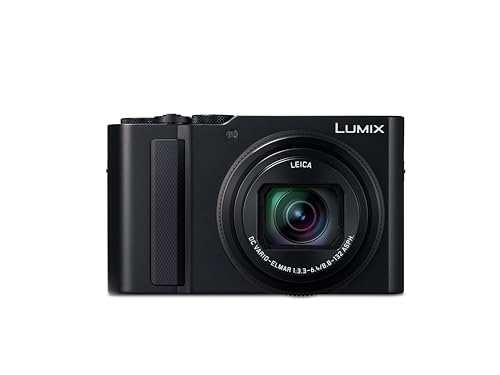
Panasonic LUMIX ZS300
Best for: a two-week trip where one camera must frame a cathedral facade at breakfast and a lighthouse across the bay by afternoon.
Not suited for: low-ceiling indoor work as the main event — the travel-zoom brief spends its design budget on reach, and dim interiors belong to the faster-lensed cameras in this category.
- Sensor: 20.1MP 1-inch
- Lens: 15x optical zoom, 24-360mm
- Video: 4K, as stated in the title
- Positioning stated in the title: compact travel zoom camera
- Aperture range and stabilisation type: Not stated in the listing title — verify with the manufacturer documentation
Reach changes travel photography more than any other single specification. A 24-360mm range lets a traveller crop with the lens instead of with footsteps that may not be possible — across a river, from a marked viewpoint, inside a stadium seat that cost real money. The ZS300 builds that range around a 1-inch sensor rather than the smaller sensors of older travel zooms, and that pairing is the entire product: telephoto framing with a sensor large enough to keep distant detail from dissolving into mush.
The honest cost of 360mm in a compact body is light. Long lenses on small bodies gather less of it, and the far end of this zoom is a daylight tool — bright plazas, coastal paths, safari vehicles at noon. Travellers who understand that bargain get enormous value: the ZS300 replaces the second camera, the borrowed binoculars shot, and the phone’s smeared digital zoom with one pocketable instrument. Travellers expecting the telephoto end to perform at midnight will blame the camera for physics.
Within this article the ZS300 is deliberately kept in its lane. It is the travel-zoom expression of the 1-inch idea — sensor quality traded carefully against focal range — and it is reviewed here on sensor and reach alone. A dedicated travel-zoom comparison would weigh it against rival long-zoom bodies on their own terms; here, the question is narrower: given a 1-inch sensor as the entry ticket, which lens philosophy serves which traveller? The ZS300 answers with distance.
Consider the arithmetic of a travel day to see why this camera exists. A mirrorless body with two lenses covering 24-360mm would fill a small backpack and weigh several times as much; the ZS300 covers the span in a body that rides in a coat pocket and comes out in seconds. That speed of access changes behaviour: the distant church tower actually gets photographed, the boat across the harbour actually gets framed, because the tool is present rather than packed. Travel photographers call this the availability advantage, and it compounds over a trip — hundreds of small decisions to shoot rather than skip. The 20.1MP resolution matters here too, since travel frames are often printed or displayed large later; a 1-inch sensor at this resolution holds together at sizes where smaller travel-zoom sensors begin to look tired. The ZS300 is, in short, a bet that presence and reach beat ultimate refinement for the travelling photographer, and it is a bet many travellers win.
Strengths
- 24-360mm is the longest reach in this set by a wide margin, on a 1-inch sensor.
- 4K video is stated in the title, so clips sit comfortably alongside stills.
- The travel brief is coherent: one body, no lens changes, no camera bag.
Trade-offs
- The telephoto end is a bright-light instrument; dusk shortens the usable zoom range.
- Aperture and stabilisation details are absent from the title and need verification.
- Reach invites lazy composition — distant subjects still need foreground thought.
Travellers weighing the reach-versus-light bargain can see the current listing terms on the ZS300’s page — Check price on Amazon.

Sony ZV-1 II
Best for: filming a market walk where the frame must swing from an 18mm establishing shot to a 50mm close-up of hands shelling peas, without stopping to swap anything.
Not suited for: distant subjects — a lens that ends at 50mm will not pull a far stage or a shy animal closer, and cropping 4K frames is a poor substitute.
- Sensor: 20.1MP 1-inch
- Lens: 18-50mm
- Video: 4K, as stated in the title
- Uses named in the title: vlogging, portraits and travel
- Stabilisation method and microphone specification: Not stated in the listing title — verify with the manufacturer documentation
The ZV-1 II’s lens tells its story in one line: 18-50mm starts wider than most compacts dare and ends exactly where a flattering portrait begins. That range is a vlogger’s map of the world — wide for rooms, markets and arm’s-length pieces to camera; mid-range for two-shots and product details; 50mm for a face without distortion. Sony aimed the model at video first, and the title’s own ordering — vlogging, portraits, travel — reads like a shooting script.
For stills photographers the same range feels like a deliberate narrowing. There is no telephoto to rescue a distant composition, so the ZV-1 II asks its owner to move, reframe and accept the frame the street provides. Many photographers find that constraint healthy: an 18-50mm lens covers the focal lengths where most memorable everyday photographs actually live, and the 1-inch sensor keeps those files clean enough for serious editing.
Placed beside its sibling below, the ZV-1 II is the flexible half of Sony’s experiment. It assumes the presenter sometimes steps back from the camera, sometimes hands it to a companion, sometimes turns it on the landscape. That assumption costs complexity — a zoom ring to manage, a wider range of framing decisions — and buys insurance against the shot that a fixed lens simply cannot make.
The 18mm wide end deserves a second look, because it quietly changes what indoor video looks like. At 18mm, a small apartment room reads as a place rather than a corridor; a kitchen demonstration can hold the presenter and the counter in the same frame; a hotel-room review can show the bed, the desk and the window without the camera retreating into the bathroom doorway. Presenters who film in real homes — not studios — feel this difference in every take. At the other end, 50mm on a 1-inch sensor gives a face gentle proportions and enough background softness to separate a speaker from a bookshelf. The range is short on paper and complete in practice for the rooms-and-people world the camera was designed for. What it refuses to do — reach across a field, isolate a bird — it refuses honestly, and the ZS300 and RX100 VII exist in this same set for precisely those refusals.
Strengths
- An 18mm wide end captures rooms and arm’s-length framing that 24mm lenses crop awkwardly.
- The 50mm long end gives portraits a natural perspective without a lens change.
- 4K video on a 20.1MP 1-inch sensor keeps stills and clips in one credible body.
Trade-offs
- No reach beyond 50mm, so wildlife and stage work are outside the brief.
- The title is silent on stabilisation and audio hardware; both matter for video and need checking.
- Zoom flexibility means more framing decisions mid-take than a fixed-lens model demands.
Video-first shooters can confirm the present bundle and terms on the ZV-1 II listing — Check price on Amazon.

Sony ZV-1F
Best for: a presenter who films alone at a desk or on a sofa, wants the room visible behind them, and never intends to zoom at all.
Not suited for: travel photography built on variety — a fixed 20mm lens frames the world one way, and a trip full of distant landmarks will expose that single perspective quickly.
- Sensor: 1-inch
- Lens: fixed 20mm
- Video: 4K, as stated in the title
- Colour stated in the title: White
- Uses named in the title: vlogging, streaming and social media
- Sensor resolution in megapixels: Not stated in the listing title — verify with the manufacturer documentation
A fixed 20mm lens sounds like a limitation until it is understood as a decision the camera makes so the presenter does not have to. At 20mm, a camera at arm’s length holds a face, shoulders and a meaningful slice of the room; the presenter can gesture, hold up a product, glance at notes — the framing survives all of it. The ZV-1F strips away the zoom ring, the focal-length second-guessing and much of the menu anxiety, leaving a camera that is ready the moment it is switched on.
The white finish is not a trivial detail. This model is designed to be seen — on desks, in streams, in the background of other people’s videos — and the pale body reads as studio equipment rather than photographic hardware. For creators building a recognisable setup, that visual identity is part of the product; for travellers wanting discretion, it is a mark against, and the black-bodied alternatives in this set exist for them.
The comparison with the ZV-1 II is the cleanest lens lesson in compact cameras. Same sensor class, same 4K video headline, opposite philosophies: one lens that does a single job predictably, against a zoom that adapts and occasionally distracts. Neither answer is wrong. The fixed lens wins when the shot is always the same shot; the zoom wins the first time the presenter films anywhere else.
Streaming sharpens the fixed-lens argument further. A streamer sits in one chair, in one room, at one distance, for hours; a zoom lens in that setting is not flexibility but a setting that can drift, get knocked, or tempt mid-session fiddling. The ZV-1F’s 20mm frame is the same on Tuesday as on Saturday, which makes lighting, background dressing and camera placement into one-time decisions. That repeatability is a production value. It also simplifies the mental load of going live: power on, check the frame that is always the frame, begin. For social clips the same logic holds at arm’s length, where 20mm keeps gestures and surroundings in view without the presenter performing the constant distance-checking dance that narrower lenses demand. The camera’s simplicity is therefore not the absence of features but the presence of a decision, made once at the factory, in favour of a single recurring shot done reliably.
Strengths
- Fixed 20mm framing removes setup decisions for solo filming and streaming.
- The 1-inch sensor gives social video a depth and cleanliness phones work hard to fake.
- A distinctive white body suits on-camera studio setups where the camera is part of the scene.
Trade-offs
- One focal length, permanently: no zooming to details, no compression, no reframing from the chair.
- The title omits the megapixel count, so stills resolution needs a documentation check.
- White shows travel scuffs and stands out where a black body would disappear.
Creators sold on the fixed-lens idea can review the current offer on the ZV-1F’s page — Check price on Amazon.

Canon PowerShot V10
Best for: propping the camera on a cafe table, flipping the screen up and recording a piece to camera with the built-in stereo microphone, no tripod or rig involved.
Not suited for: slipping into a trouser pocket as a conventional stills compact — the V10 is a squat vlogging brick, and its shape serves table-top video rather than walk-around photography.
- Sensor: 1-inch CMOS
- Lens: built-in wide-angle zoom
- Video: 4K, with streaming named in the title
- Screen: flip LCD
- Audio: built-in stereo microphone
- Stabilisation: image stabilisation stated in the title
- Colour stated in the title: Black
Most compacts are cameras that can record video; the V10 is closer to a video appliance that also takes photographs. The title reads like a presenter’s checklist — 4K streaming, a wide-angle lens, a flip screen for self-framing, a stereo microphone so speech does not depend on accessories, and image stabilisation for the walk between locations. Canon built the form around a single recurring scene: one person, one table or one pavement, talking to a lens.
That specialisation produces real conveniences. A flip screen that serves the person in front of the lens, rather than only the person behind it, changes how confidently a solo presenter can frame a shot. A built-in stereo microphone removes the cold-shoe juggling that turns other compacts into small rigs. And the brick shape stands and grips in ways a slim stills body does not, because it was never asked to slide into a shirt pocket.
The cost is versatility as a stills camera. A wide-angle zoom is the right tool for presenting and the wrong one for portraits at a distance or details across a plaza. Photographers whose day mixes landscapes, faces and far-off subjects will feel the V10’s narrow intent within an hour. Presenters will feel only relief. Knowing which of those two people is holding the camera settles this pick completely — and readers comparing stabilised shooting across the category may also find our guide to compact cameras with image stabilization useful context.
Think of the V10’s shape as furniture rather than luggage. A conventional compact is designed to travel; the V10 is designed to sit — on a kitchen counter while a recipe is explained, on a desk edge during a product talk, on a cafe table between two coffees. Its wide-angle lens assumes a conversational distance of about a metre, its stereo microphone assumes a single voice in a real room, and its flip screen assumes the speaker is also the operator. Within that scene the camera is remarkably complete: no rig, no external microphone cable, no separate monitor. Step outside the scene — a walking tour, a wildlife hide, a portrait session — and each assumption inverts into a limitation. That inversion is not a flaw to apologise for; it is the definition of a specialised tool, and it is why the V10 appears in a 1-inch roundup as the form-factor outlier rather than as a rival to the RX100 VII’s all-purpose brief.
Strengths
- Flip screen, stereo microphone and streaming-ready 4K form a complete solo-presenter kit in one body.
- Image stabilisation is stated outright in the title, not left to inference.
- The wide-angle lens matches the arm’s-length and table-top distances presenters actually use.
Trade-offs
- The brick form factor gives up the pocketability that defines the rest of this set.
- A wide-angle-only outlook frustrates stills work that needs reach or subject isolation.
- The title does not state the lens’s exact focal range, so framing limits need verification.
Presenters can look over the current V10 listing and its stated contents here — Check price on Amazon.
One thread runs through all six reviews and deserves naming before the comparison table flattens these cameras into rows: each body represents a different answer to the question of what a pocket camera is for in a decade when the phone already photographs everything adequately. Sony’s flagship answers with speed and reach, Panasonic with distance, Canon’s stills compact with familiarity, the ZV pair with video fluency, and the V10 with the presenter’s table. Adequacy is the enemy each design attacks from a different direction, and the table below should be read as six arguments, not six scores.
Side-by-Side Comparison
| Pick | Sensor (as titled) | Lens (as titled) | Defining trait |
|---|---|---|---|
| Sony RX100 VII | 20.1MP 1-inch stacked CMOS | 24-200mm | Bundle with two 64GB cards and a case |
| Canon PowerShot G7 X Mark III | Not stated in the listing title | Not stated in the listing title | Minimal listing — model name and black finish only |
| Panasonic LUMIX ZS300 | 20.1MP 1-inch | 15x zoom, 24-360mm | Travel zoom with 4K video |
| Sony ZV-1 II | 20.1MP 1-inch | 18-50mm | Wide zoom aimed at vlogging, portraits, travel |
| Sony ZV-1F | 1-inch | Fixed 20mm | White streaming-focused body |
| Canon PowerShot V10 | 1-inch CMOS | Built-in wide-angle zoom | Flip LCD, stereo mic, image stabilisation |
How to Choose a 1-Inch Compact
Which focal range matches the photographs actually taken?
Scroll through a year of phone photographs and measure the honest pattern. If most frames are rooms, groups and street scenes, a lens living between 18mm and 50mm covers that life, and the ZV-1 II’s range or even the ZV-1F’s fixed 20mm will feel natural. If the album is full of zoomed crops — distant signs, animals, architectural details — the sensor was never the bottleneck; reach was, and the RX100 VII or ZS300 answers the real problem. Buying a sensor size is abstract. Buying the focal lengths a person genuinely uses is concrete, and it predicts satisfaction far better.
Does the camera need to earn its place against a phone?
A 1-inch compact justifies its pocket when it does things a phone visibly cannot: hold detail in dim restaurants without computational smoothing, keep a zoom range that is optical rather than interpolated, and hand the photographer direct control over aperture and shutter. Test any candidate against the scenes where the phone currently disappoints. If those scenes are bright and static, the phone may already be enough; if they are candlelit, moving or far away, the compact’s case makes itself.
Stills first, video first, or presenting first?
The six bodies divide by intent more than by quality. The G7 X Mark III and RX100 VII read as photographers’ cameras that also film. The ZV-1 pair read as video cameras that also photograph. The V10 reads as a presenting appliance. Mismatches here cause most returns in this category: a stills photographer frustrated by a video-first menu layout, or a presenter defeated by a camera that expects a tripod and an external microphone. Name the primary job before comparing specifications, because the right camera is the one whose compromises fall on the secondary job.
What does the listing actually include?
Bundle listings complicate comparisons in this class. The RX100 VII listing here includes two 64GB cards and a case; other listings in the set name the camera alone. Price the accessories a kit genuinely needs — fast cards for 4K video, a case, a second battery for travel days — and add them to bare listings before declaring one offer cheaper than another. A bundle is not automatically a bargain, but a comparison that ignores box contents is not a comparison at all.
Shooting With a 1-Inch Sensor: Getting the Most From the Format
The format’s gift is balance. A 1-inch sensor gathers enough light to keep ISO settings moderate in interiors where smaller sensors smear detail, yet the bodies stay small enough to be carried without negotiation. Protect that advantage with technique: brace against doorframes at dusk, keep shutter speeds honest at the long end of zooms, and resist the urge to crop deeply — the sensor rewards photographers who fill the frame at capture time, because its files, while strong, are not an invitation to photograph everything from across the street and crop later.
Depth of field deserves a word, because it surprises phone graduates. At wide apertures, a 1-inch sensor behind a fast lens can separate a subject from its background in a way phone portrait modes imitate with software edges. That separation is optical and continuous — hair, glass rims and bicycle spokes render correctly — and it is one of the quiet reasons these cameras still sell. Use it deliberately: step closer, open the lens, and let backgrounds fall away naturally instead of relying on a mode.
How much menu complexity is acceptable?
Premium compacts hide deep menu systems inside small bodies, and tolerance for that depth varies more than tolerance for weight. A photographer arriving from a larger system will find the RX100 VII’s density familiar and even welcome; a phone graduate may experience the same menus as a toll booth between intention and photograph. The ZV-1F and the V10 sit at the forgiving end of this spectrum, their narrower briefs permitting simpler control layouts. There is no virtue in suffering a complicated camera in the name of seriousness. The camera whose controls become invisible through habit is the one that gets used at the decisive moment, and that invisibility is a personal match, not a specification. Where possible, handle a candidate or study its control layout photographs closely: dials where fingers expect them are worth more than a fractional sensor advantage.
What about sound — the forgotten specification?
Video buyers fixate on resolution and forget audio until the first unusable clip. Titles in this set treat sound unevenly: the V10 names a built-in stereo microphone outright, while the Sony listings leave audio hardware unstated, which is precisely the sort of gap the spec boxes flag for verification. Room echo, wind and handling noise ruin more amateur footage than soft focus ever will, so a presenter’s checklist should rank microphone provisions alongside the lens. A camera that records a clear voice in a kitchen beats a sharper camera that records the refrigerator’s hum in high fidelity. Test recordings made in real rooms — many owners publish them — teach more about a model’s audio character than any resolution chart.
Files and Workflow After the Shutter
A compact camera’s work continues at the desk. Files from a 1-inch sensor edit gracefully: white balance can be rescued from mixed restaurant lighting, shadows lift without the waxy collapse that phone files show, and prints hold detail at sizes that surprise people who assumed small cameras meant small output. Build the workflow to match — import into dated folders, keep the two-card rotation the RX100 VII bundle encourages so a card is never formatted in a panic, and back up travel photographs to a second location before the journey home. The cameras in this set produce files worth that modest discipline; treating them as disposable phone snapshots wastes the very headroom the sensor was purchased to provide.
What 4K Video Means Across This Set
Four of the six titles mention 4K video outright — the ZS300, both ZV-1 models and the V10 — and the phrase does not mean the same thing in each mouth. On the Panasonic it is a traveller’s bonus: the camera that frames a distant tower can also record it moving, and 4K footage tolerates gentle cropping in the edit, which rescues compositions that the moment did not allow. On the Sony pair, 4K is the main event, the reason the bodies exist, with stills as the supporting act. On the V10, 4K is paired with streaming in the title itself, signalling a camera whose video may never touch an editing timeline at all, flowing straight from lens to audience.
Practical consequences follow. Shooting 4K drains batteries and fills cards at rates that stills photographers find startling, which is why the RX100 VII’s bundled pair of 64GB cards is more than a marketing garnish — it is an acknowledgement of how video-first owners actually consume storage. Heat is the other quiet variable: small bodies recording long 4K takes in warm rooms are working at their thermal limits, and presenters planning hour-long recordings should test their specific camera in their specific room rather than trusting a headline resolution figure. Resolution is the beginning of a video specification, not its summary.
Carrying a Compact: Pockets, Straps and Habits
The best compact camera is a behavioural achievement before it is a technical one. A camera left in a hotel safe takes no photographs, so the carrying system matters: a wrist strap for street days, a small belt pouch for hikes, a padded pocket in the everyday bag. The slim bodies in this set — the G7 X Mark III, the ZV-1 pair, the ZS300 — accept that treatment gracefully. The V10, shaped like a small brick, prefers a bag’s side pocket or a desk drawer, which suits its stationary brief. Build a habit loop: the camera charges in the same place nightly, the spare card lives in the same pouch pocket, and the lens gets a cloth wipe whenever it returns home. Compact cameras die more often from neglect and lint than from electronic failure, and their small lenses, exposed every time the body wakes, collect pocket debris faithfully. A ten-second cleaning ritual preserves the sharpness the sensor was bought for.
Settings habits compound the effect. Owners who configure their compact once — file quality, focus behaviour, a custom button for exposure compensation — and then stop menu-diving take more photographs, because the camera stops being a device to operate and becomes a reflex. The six cameras here all reward that investment, and all punish the opposite habit of renting their defaults forever. Spend one quiet evening with the manual; the following year of photographs is the dividend.
Longevity: Buying a Compact That Stays in Service
A premium compact is a multi-year purchase, and its failure modes are mundane: worn zoom mechanisms, tired batteries, scratched lenses, software left behind by phone updates on the companion-app side. Protect the investment with boring habits. Keep the lens barrier clean, store the body dry, cycle two batteries rather than exhausting one, and update firmware when the manufacturer publishes it. Resale values in this class hold up unusually well for recognised models — another quiet argument for the named cameras in this set over anonymous alternatives — provided the body shows honest, cared-for wear rather than neglect. Buy the camera as a five-year companion and the price divides into a modest annual figure; buy it as a gadget for one holiday and even the cheapest listing here is expensive. The distinction is not the camera. It is the carrying habit built around it, and every camera in this set rewards the habit equally.
Common Mistakes
- Choosing by megapixels inside the same sensor class. Three cameras here state 20.1MP on a 1-inch sensor; the count is not the separator. Lens range and intent are.
- Assuming every title states the full specification. The G7 X Mark III listing proves otherwise — a famous model name can arrive with almost no printed detail, and verification is the buyer’s task.
- Treating a travel zoom’s far end as an all-light tool. A 360mm compact lens is a daylight instrument; expecting midnight performance from it misreads the design.
- Buying a fixed-lens presenter camera for varied travel. The ZV-1F’s 20mm lens is a feature for streaming and a wall for landscapes that need reach.
- Ignoring box contents when comparing listings. Cards and a case carry real value; a bare camera and a bundled camera are different offers wearing similar headlines.
Frequently Asked Questions
Is a 1-inch sensor really better than a phone camera?
For light gathering and optical zoom, yes, in ways that show up exactly where phones struggle: dim interiors, distant subjects framed optically rather than digitally, and files that tolerate editing. Phones counter with computational tricks that are genuinely impressive in bright, static scenes. The compact wins on physics; the phone wins on always being present. Many owners carry both and reach for the compact when the photograph matters.
Which of these cameras has the most zoom?
The Panasonic LUMIX ZS300, by a clear margin: its title states a 15x optical zoom spanning 24-360mm. The RX100 VII follows with 24-200mm. At the other extreme, the Sony ZV-1F has no zoom at all — its lens is fixed at 20mm — and the ZV-1 II covers 18-50mm.
Why does one listing include memory cards and a case?
The RX100 VII listing in this set is a creator bundle, and its title says so, naming two 64GB cards and a case. Bundles vary by seller and over time, which is why the review treats box contents as part of the offer to verify rather than a permanent property of the model.
Can these cameras replace a larger interchangeable-lens camera?
For travel, family and street work, frequently yes — that substitution is the category’s reason to exist. For specialised work — very fast lenses, extreme telephoto, studio lighting systems — the larger system’s depth still wins. The honest test is the photographs a person actually takes, not the ones imagined on the day of purchase.
What should be verified before ordering the G7 X Mark III?
Nearly everything beyond the model name, because the listing title states only the model and its black colour. Lens range, video specification and connectivity should be confirmed in Canon’s documentation and on the listing’s detail sections, particularly if video features are part of the reason for buying.
Do all six cameras really use 1-inch sensors?
That is the premise of the set, and the titles support it to different degrees: the RX100 VII, ZS300, ZV-1 II and V10 state the 1-inch class explicitly, the ZV-1F states a 1-inch sensor without a megapixel count, and the G7 X Mark III’s title states neither — its place rests on the model’s known position in Canon’s 1-inch line, which is exactly why its review insists on documentation checks. When a specification decides a purchase, the listing title alone is never the final authority.
Which model suits a complete beginner?
The ZV-1F makes the fewest demands: one lens, one framing, a body designed around a single recurring shot. For stills, the G7 X Mark III’s classic compact formula asks little beyond pointing with intent. The RX100 VII rewards experience most and forgives least, because its range and speed multiply both possibilities and mistakes.
How should the two Sony ZV models be decided between?
Picture the last ten videos filmed or imagined. If they share one setting — a desk, a kitchen, a workshop bench — the ZV-1F’s fixed 20mm lens will frame every one of them without a single adjustment, and its simplicity compounds across hundreds of sessions. If those ten videos wander — a street market, a friend’s garden, a hotel balcony, a child’s football match watched from the touchline — the ZV-1 II’s 18-50mm zoom earns its complexity within the first outing. The sensor and the 4K headline are shared; the decision is purely about whether the filming life is stationary or roaming, and it is better answered from a diary than from a showroom.
Final Recommendation
Start from the lens, not the logo. Distant subjects dominate the album? The ZS300’s 24-360mm range on a 1-inch sensor is the set’s travel answer, with the RX100 VII as the faster, bundle-equipped alternative that stops at 200mm. Video leads the brief? The ZV-1 II’s 18-50mm zoom adapts to rooms and faces alike, while the ZV-1F strips the decision away for presenters who always film the same way, and the PowerShot V10 commits fully to table-top talking-head work with its flip screen and stereo microphone. Stills in a classic Canon shape remain the G7 X Mark III’s quiet territory — just verify its details beyond the title before ordering. A 1-inch compact earns its pocket by being carried, so the best choice here is the body whose lens and shape match the photographs and clips that already fill a life; pick that one, carry it daily, and let the phone handle the rest.


