What's inside
- Key Takeaways
- Quick Picks
- How These Chargers and Kits Were Chosen
- The Six Picks in Detail
- Side-by-Side Comparison
- How Many Packs and Chargers Does a Cordless Yard Actually Need?
- Heat, Dust and Storage: Keeping Outdoor Packs Alive
- Reading a Charger Title Like a Buyer, Not a Fan
- Common Mistakes When Buying Tool Chargers and Kits
- Frequently Asked Questions
- Final Recommendation
- Related Guides
As an Amazon Associate I earn from qualifying purchases. This post may contain affiliate links at no extra cost to you.
widgetverdict.com is reader-supported. When you buy through links on our site, we may earn an affiliate commission.
Where to buy: every item below links to a checked Amazon listing, starting with the DEWALT DCB1104 4 Amp Charger, the current-standard DEWALT bench charger. Four picks are chargers alone and two are starter kits that pair a 5.0Ah battery with its charger, because both kinds of purchase bring a dead platform back to life.
The best outdoor power tool battery packs and chargers matter because outdoor work is where battery platforms go to be humbled. A mower, blower, chainsaw or string trimmer draws current the way indoor drills only dream of, and a yard session can empty a pack that lasted a week in the workshop. When the pack dies mid-hedge, the charger on the bench stops being an accessory and becomes the pacing item of the whole afternoon. Choosing that charger well — and choosing the starter kits that add fresh packs to a platform — is what decides whether a cordless yard feels like freedom or like a queue.
Six picks cover the three platforms that dominate cordless outdoor equipment. DEWALT’s 20V MAX appears twice: the DCB1104 charger that serves both 12V MAX and 20V MAX packs, and the DCB205C starter kit that pairs a 5Ah battery with a charger for owners starting or restarting the platform. Milwaukee’s M18 outdoor line is represented by the 48-59-1812 multi-voltage charger, which also speaks M12 for the compact tools sharing the bench. Makita’s 18V LXT platform — the deepest outdoor catalogue in the business — gets the DC18RC Rapid Optimum Charger and the BL1850BDC1 starter pack built around a 5.0Ah battery. RYOBI’s ONE+ platform, the value backbone of suburban yards, closes the list with the PCG002 charger. One rule governs everything below: chargers and batteries stay inside their platform. No pick here charges another brand’s packs, and no honest guide should pretend otherwise.
Key Takeaways
- Platform loyalty is absolute: a DEWALT charger will never charge a Makita pack, so every pick below belongs to exactly one battery family.
- The DEWALT DCB1104 covers two voltages in one unit — 12V MAX and 20V MAX — at a stated 4-amp charge rate.
- Milwaukee’s 48-59-1812 is the other dual-voltage pick, spanning M12 and M18 with an onboard fuel gauge mentioned in its title.
- Makita’s DC18RC carries the Rapid Optimum name, the platform’s fast-charging line for the big LXT outdoor packs.
- The two starter kits — DEWALT DCB205C and Makita BL1850BDC1 — each pair a 5.0Ah-class battery with a charger, the fastest way to revive or begin a platform.
- RYOBI’s PCG002 is the simple, cord-equipped charger for the enormous ONE+ installed base of yard tools.
Quick Picks
| Pick | Badge | Why it earns its place |
|---|---|---|
| DEWALT DCB1104 4 Amp Charger | The yellow bench standard | Charges 12V MAX and 20V MAX lithium-ion packs at a stated 4 amps — one charger for the whole DEWALT bench. |
| Milwaukee 48-59-1812 M12/M18 Multi-Voltage Charger | The red two-system bridge | One charger for M18 outdoor packs and M12 compact packs, with an onboard fuel gauge. |
| Makita DC18RC 18V LXT Rapid Optimum Charger | The teal rapid charger | Makita’s Rapid Optimum charging for the 18V LXT packs that run its deep outdoor catalogue. |
| RYOBI ONE+ 18V Charger PCG002 | The green everyday charger | A straightforward ONE+ charger with an indicator and a six-foot cord for flexible bench placement. |
| DEWALT 20V MAX Battery and Charger Starter Kit DCB205C | The yellow restart kit | A 5 Ah 20V MAX battery plus charger — the single box that starts or revives a DEWALT setup. |
| Makita 18V LXT Battery and Charger Starter Pack BL1850BDC1 | The teal starter pack | A 5.0Ah LXT battery with its charger, sized for the outdoor tools that eat capacity. |
How These Chargers and Kits Were Chosen
The selection began with platform reality. Outdoor cordless tools cluster on a handful of battery families, and a useful guide has to serve the families owners actually hold: DEWALT 20V MAX, Milwaukee M18, Makita 18V LXT and RYOBI ONE+ between them cover the overwhelming majority of cordless mowers, blowers, saws and trimmers in garages today. Each family therefore appears with its working charger, and the two largest outdoor families — DEWALT and Makita — additionally appear as starter kits, because the most common purchase in this category is not a charger at all. It is a fresh 5Ah-class battery with a charger in the box, bought when the original packs fade or when a bare tool joins the fleet.
Within each family, the pick had to be the charger a platform owner would actually be sent to buy: the current standard unit, not a discontinued oddity or a slow trickle charger sold on price. Dual-voltage coverage earned its place where titles stated it — the DEWALT and Milwaukee picks both bridge their brand’s two voltages, a genuine bench-space economy for households running compact indoor tools beside big outdoor ones. Where a title states a charge rate, as DEWALT’s 4-amp figure, the review uses it; where a title offers only a name like Rapid Optimum, the review says what the name signifies within its platform and invents no numbers around it.
Outdoor duty shaped the final judgement. Yard tools return their packs hot, dusty and deeply drained, often twice in one day during leaf season or a fencing project. A charger for this life needs to be the platform’s proper unit — the one designed around those packs’ electronics — rather than a generic substitute, and every pick below is its platform’s own equipment. That is also why no cross-platform or universal charger appears here: in lithium power-tool charging, “universal” is a claim this guide does not trust with a hot 5Ah pack.
The Six Picks in Detail

DEWALT DCB1104 4 Amp Charger
The DCB1104 is the charger DEWALT’s current ecosystem is built around, and its title carries the two facts that matter: it charges 12V MAX and 20V MAX lithium-ion batteries, and it does so at 4 amps. The dual-voltage coverage is the practical headline for most households. DEWALT’s outdoor line — mowers, blowers, chainsaws, trimmers — runs on 20V MAX packs, while the same household’s drills, drivers and inspection lights often run on the compact 12V MAX system. One DCB1104 on the bench serves both fleets, which means the charger that came with a combo kit years ago can be retired and the wall outlet count of the charging corner drops to one.
Four amps is the rate to think with. DEWALT does not hide it in a marketing name; the title states it, and the figure positions this unit as a genuine working charger rather than the slow pack-in unit bundled with entry kits. For outdoor work the rate matters in a specific rhythm: a 5Ah pack drained by a mower at midday needs to be a working pack again by the time the blower comes out, and a 4-amp charger turns that turnaround into a lunch break rather than an afternoon. Owners running two packs in rotation — one on the tool, one on the charger — will find the DCB1104 keeps the rotation honest through a full day of yard work, which is the real test of any charger in this category.
The other quality this pick trades on is ordinariness, in the best sense. It is the standard unit: widely stocked, instantly recognisable, and the charger every DEWALT battery from the last decade of 12V MAX and 20V MAX production was designed to meet. When a platform’s packs are the expensive part of the system — and outdoor-sized packs are genuinely expensive — feeding them with the maker’s own current-standard charger is the conservative, correct instinct. Buyers whose DEWALT bench is purely 20V MAX lose nothing here, since the 12V MAX capability simply sits unused, and buyers with both systems gain a bench with one plug.
Households standardising their charging corners often sort the small-device end at the same time; our Best Nintendo Switch Chargers guide handles the console corner of that same shelf.
Placement turns out to matter for a charger in this class, because outdoor packs come back to the bench in a particular state: warm, grass-dusted and heavier than indoor packs. A charger living at bench height, where a 5Ah pack can be set down and slid home with one hand, gets used correctly a hundred times a season; a charger dangling from a high outlet by its cord gets fumbled, and fumbled lithium packs eventually land on concrete. The DCB1104’s role as the bench standard assumes that sensible placement — near the door the yard tools come through, with the packs stored beside it rather than across the garage. Set the corner up once with that traffic pattern in mind and the charger quietly organises the whole platform’s habits around itself.
Strengths
- One charger covers both DEWALT voltages — 12V MAX compact tools and 20V MAX outdoor tools.
- The 4-amp rate is stated plainly in the title and suits a two-pack working rotation.
- It is the platform’s current standard unit, designed for the packs owners already hold.
Trade-offs
- DEWALT only: Milwaukee, Makita and RYOBI packs need their own chargers, full stop.
- A single charging bay means a three-pack rotation still queues during the heaviest yard days.
- The title states no charge-time figures, so turnaround expectations should be set from the 4-amp rate and pack size.
| Spec | From the listing title |
|---|---|
| Platform | DEWALT 12V MAX / 20V MAX lithium-ion |
| Charge rate | 4 amp |
| Model | DCB1104 |
| Bays | The listing title does not state a bay count; the product page shows the unit’s layout |
| Charge times | Not printed in the listing title — DEWALT’s own documentation pairs times with specific packs |
| Mounting | The listing title is silent on wall mounting; confirm on the product page if bench space is tight |
Best for: a DEWALT household running 20V MAX outdoor tools beside 12V MAX compact tools, wanting one charger for both.
Not suited for: a mixed-brand bench, because this charger speaks only DEWALT and no adapter changes that.
Yellow-platform owners can check the DCB1104 on Amazon and retire the drawer of ageing pack-in chargers.
Milwaukee 48-59-1812 M12/M18 Multi-Voltage Charger
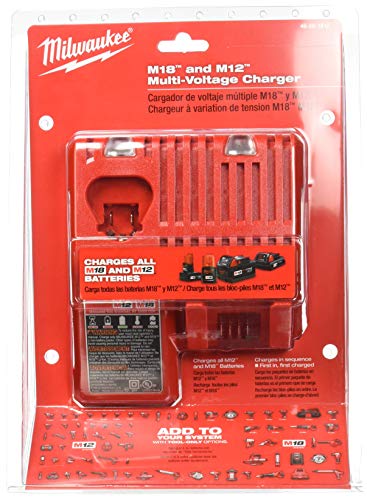
Milwaukee’s 48-59-1812 solves the same two-system problem as the DEWALT pick, in red. Its title describes a multi-voltage lithium-ion charger for M12 or M18 batteries — the M18 line that powers Milwaukee’s outdoor equipment, and the M12 line that powers its compact tools — with an onboard fuel gauge. That last detail distinguishes it in this guide: a fuel gauge on the charger speaks to the pack’s state where the pack sits, which matters for outdoor work because M18 packs come off a mower or blower hot and drained, and the first question is always how drained. Reading the answer at the charger, without mounting the pack on a tool and squeezing a trigger, is a small convenience repeated hundreds of times across a season.
The M18 outdoor context is the reason this charger anchors Milwaukee’s slot. Milwaukee built its outdoor range — blowers, trimmers, chainsaws, mowers — on the same M18 packs that run its jobsite tools, so a household or a landscaper invested in red tools charges everything from one family of packs. The 48-59-1812’s job is to be the home base for that family, and its dual-voltage design acknowledges that M18 households almost always accumulate M12 tools as well: the compact driver in the kitchen drawer, the inspection light, the heated jacket’s battery. One charger on the bench, both voltages served, no second wall wart to lose.
What the title does not state is a charge rate, and this review will not supply one from memory. Milwaukee sells faster chargers in its range, and owners for whom turnaround time is the dominant concern — crews rotating packs through saws all day — should compare within the M18 charger line on the product pages, using stated rates where listings provide them. For the homeowner pattern of outdoor work, where packs charge overnight and between weekend sessions, the standard multi-voltage unit’s appeal is its universality within the brand rather than its pace, and that is the honest basis on which it is recommended here.
The fuel gauge deserves a second thought, because it changes a small behaviour with outsized effects: pack triage. A bench with several M18 packs in different states — one full, one half, one forgotten since autumn — is a bench where the wrong pack gets grabbed for the mower. A gauge readable at the charger turns triage into a glance, and the habit of glancing builds the larger habit of knowing your fleet’s state at all times. Fleets fail at the margins: the pack that sat flat for a winter, the pair that got separated. Anything that makes state visible fights that entropy cheaply, and Milwaukee putting the gauge on the charger rather than only on tools is the kind of detail that reads as minor in a title and major in a season.
Strengths
- M12 and M18 coverage in one unit mirrors how Milwaukee households actually accumulate tools.
- The onboard fuel gauge named in the title reports pack state at the charger itself.
- It is the platform’s own equipment for the M18 packs that run Milwaukee’s outdoor line.
Trade-offs
- No charge rate appears in the title, so speed-focused buyers must dig into the product page.
- Milwaukee only — the multi-voltage generosity stops at the brand border.
- Crews needing rapid turnaround across many packs may outgrow a standard single unit.
| Spec | From the listing title |
|---|---|
| Platform | Milwaukee M12 or M18 lithium-ion |
| Model | 48-59-1812 |
| Gauge | Onboard fuel gauge |
| Charge rate | The listing title gives no amp figure; Milwaukee’s product documentation is the source for rates |
| Bays | Not specified in the listing title — check the product page for the port layout |
| Outdoor line fit | M18 packs, as used across Milwaukee’s cordless outdoor tools |
Best for: a Milwaukee household whose M18 outdoor tools and M12 compact tools share one bench and one outlet.
Not suited for: a timed crew rotation where charge rate is the buying criterion, until the product page’s figures confirm it meets the pace.
Red-platform owners can view the 48-59-1812 listing on Amazon for the port layout and pack compatibility list.

Makita DC18RC 18V LXT Rapid Optimum Charger
Makita’s claim on the outdoor market rests on depth: the 18V LXT platform runs an enormous range of yard and garden tools, including the 36V equipment powered by paired 18V packs, and the DC18RC is the charger that platform’s owners meet most often. Its title is the shortest in this guide — 18V LXT Lithium-Ion Rapid Optimum Charger — and the operative words are Rapid Optimum, Makita’s name for its fast-charging system. Within the Makita world, that name distinguishes the DC18RC from the brand’s slower standard chargers: this is the unit intended to turn big LXT packs around at working pace, which for outdoor tools is not a luxury. A paired-pack 36V mower consumes two batteries per session; a charger that dawdles leaves the second session of the day hostage to the first.
The LXT context rewards a word of explanation for owners new to the platform. Makita built LXT over many years, and its packs span small compact-tool sizes up to the 5.0Ah and larger units that outdoor tools demand. A Rapid Optimum charger serves that whole span within the 18V family, so the same unit that revives a mower pack in the morning can top up a trimmer pack in the afternoon. Owners running the paired-pack 36V tools should note the arithmetic: two packs per tool session means charging capacity, not just charging speed, governs the day, and a single-bay charger — however rapid — refills the pair in sequence. Many committed LXT households therefore end up owning two chargers, and the DC18RC is the unit they duplicate.
Because the title offers no numerical rate, this review makes no numerical claim; Makita’s own materials pair the DC18RC with charge times per pack, and that is where a comparison shopper should verify pace against a specific battery. What can be said from the title and the platform is the positioning: this is Makita’s rapid charger for its 18V system, sold for years as the working standard, and its presence in countless LXT kits means replacement and duplication are effortless. For an LXT owner whose current charger is the slow unit from a compact drill kit, the DC18RC is the single upgrade that changes how the outdoor fleet feels.
The same platform logic governs cart batteries, covered in our Best Golf Cart Battery Chargers guide — one family, one correct charger, no improvisation.
There is a generational point about the DC18RC worth stating for buyers cross-shopping used equipment. LXT is an old platform in the best sense — deep, stable, with packs and tools spanning many years — and its chargers have been in garages long enough that secondhand units circulate widely. A new DC18RC buys certainty: known history, current production, no mystery about the damp shed it may have lived in. Given that the charger guards the health of packs worth far more than itself, the new unit is the rational purchase even in a platform where used bargains abound. The same logic, incidentally, is why this guide lists the platform’s standard rapid charger rather than hunting for exotic alternatives — in charging, boring provenance is a feature.
Strengths
- Rapid Optimum is Makita’s fast-charging line, built for turning around the large packs outdoor tools consume.
- Serves the full 18V LXT span, from compact-tool packs to the big units in paired-pack 36V tools.
- The platform’s long-standing standard rapid unit — easy to replace or duplicate for a second bay’s worth of capacity.
Trade-offs
- The title states no amp rate or charge times, so pace must be verified per pack in Makita’s documentation.
- Paired-pack 36V tools drain two batteries per session, and one charger refills them one after another.
- Makita LXT only; the teal charger does nothing for other brands’ packs.
| Spec | From the listing title |
|---|---|
| Platform | Makita 18V LXT lithium-ion |
| Model | DC18RC |
| Charging system | Rapid Optimum |
| Charge rate | The listing title prints no amp figure; look to Makita’s own documentation for per-pack times |
| Pack sizes served | 18V LXT range, including packs used in pairs by 36V (18V X2) tools |
| Cooling features | Not described in the listing title — the product page carries the charger’s full feature set |
Best for: an LXT household running outdoor tools on large packs, especially paired-pack 36V equipment with daily turnaround needs.
Not suited for: a bench built on another brand’s packs, or a purchase decision that needs a stated amp figure in the listing before trusting a charger’s pace.
LXT owners ready to retire a slow pack-in charger can see the DC18RC on Amazon and confirm their pack models against its compatibility list.

RYOBI ONE+ 18V Charger PCG002
RYOBI’s ONE+ platform is the suburban standard: one 18V battery family stretched across an enormous catalogue of indoor and outdoor tools, sold on the promise that the pack bought for a drill a decade ago still runs today’s blower. The PCG002 is that platform’s straightforward charger, and its title lists the two practical details RYOBI chose to state — an indicator and a six-foot cord. The cord deserves more respect than it usually gets. Most tool chargers arrive with cords sized for a charger that lives directly above its outlet; six feet lets the PCG002 sit on the bench, the shelf or the garage floor where the packs actually accumulate, rather than dictating the geography of the charging corner around a wall socket.
The indicator covers the only question a simple charger must answer — what is the pack doing — and for the ONE+ pattern of use, simple is correct. RYOBI outdoor tools serve yards measured in fractions of an acre, where a blower session or a trimming round drains a pack across an afternoon rather than a morning, and overnight charging restores the rhythm. The PCG002 fits that rhythm without pretending to be a crew tool. It is also the charger of accumulation: ONE+ households gather packs steadily — a kit here, a bare tool with a bonus battery there — and the platform’s chargers multiply the same way, one per kit, until every corner of the garage can revive a pack. A sensibly priced standard charger is exactly what that ecosystem wants.
Compatibility is the point to verify, and it is a platform question rather than a model question: the PCG002 charges ONE+ 18V lithium-ion packs, the family described in its title. RYOBI’s older battery generations and chemistries have their own history within the ONE+ line, and owners reviving a very old pack should confirm its chemistry against the charger’s stated lithium-ion scope on the product page. Within the modern lithium ONE+ fleet — which is to say, the packs running today’s outdoor tools — the PCG002 is the home base.
Consider the PCG002 as the charger of the second location, because that is where ONE+ fleets often need one. The main bench has its charger; the shed at the bottom of the garden, the allotment hut, the in-laws’ garage where the hedge gets trimmed twice a year — those places strand packs. A sensibly priced standard charger with a long cord is the unit you station there without anxiety, and RYOBI’s ecosystem pricing has always understood that owners buy chargers in multiples. Judged as the one and only charger for a heavy fleet it is modest; judged as the unit that makes a platform available wherever the work is, it is exactly right, and most ONE+ households end up owning its like in twos and threes.
Strengths
- The six-foot cord stated in the title frees the charger from living directly at the outlet.
- A charge indicator answers the pack-state question without ceremony.
- It serves the vast ONE+ installed base — the most widely held yard-tool platform in suburbia.
Trade-offs
- No charge rate is stated in the title, so pace expectations rest on the product page.
- ONE+ only, and lithium-ion scope per the title — very old packs of other chemistries need a compatibility check.
- Heavy all-day outdoor work on many packs will want additional chargers alongside it.
| Spec | From the listing title |
|---|---|
| Platform | RYOBI ONE+ 18V lithium-ion |
| Model | PCG002 |
| Cord | 6 ft |
| Indicator | Charge indicator included |
| Charge rate | The listing title names no amp figure; RYOBI’s product page is the place to confirm pace |
| Legacy packs | The listing title describes lithium-ion charging; check older-chemistry packs against the full listing |
Best for: a ONE+ household whose yard tools work at suburban pace and whose packs charge overnight or between weekend sessions.
Not suited for: a landscaping crew cycling many packs per day, where charge rate and bay count become the whole purchase.
Green-platform owners can look at the PCG002 listing on Amazon to confirm it matches the packs in their garage.

DEWALT 20V MAX Battery and Charger Starter Kit DCB205C
A starter kit is a different purchase from a charger, and the DCB205C is in this guide because it answers the two most common DEWALT questions at once: my packs are tired, and where do I begin. The title states the contents plainly — a 20V MAX 5 Ah lithium-ion battery and a charger. Five amp-hours is the working size for outdoor tools: enough capacity to run a blower through a real cleanup or a trimmer around a real property line, in a pack whose weight a string trimmer’s operator can carry all afternoon. Pairing that pack with its charger in one box means the kit revives a platform whose original charger was lost, damaged or never adequate, and it equally serves the new owner who bought a bare outdoor tool and needs the entire power side of the system in a single purchase.
Think about who buys this kit and the value sharpens. The first buyer inherited or bought used DEWALT outdoor tools with ageing packs that now quit mid-job; the kit replaces the weakest link — the battery — while refreshing the charger as a by-product. The second buyer is expanding from DEWALT indoor tools and owns only compact 2Ah-class packs, which outdoor tools drain embarrassingly fast; the 5Ah pack is the upgrade that makes a cordless mower or saw feel like a tool rather than a demonstration. The third buyer runs a small crew or a large property and simply needs another full-size pack in rotation with a charger to feed it. All three are buying capacity first and charging second, and the kit format prices that combination as one decision.
What the title leaves unstated is the bundled charger’s model and rate, so this review does not assign it one. Buyers for whom the charger’s pace is the priority — rather than the pack — should either verify the included unit on the product page or buy the DCB1104 above as the known-quantity charger and add a bare 5Ah pack separately. That two-box route costs more deliberation; the kit’s appeal is precisely that it removes the deliberation for the common case. Either way, the pack at the kit’s heart is the standard 5Ah 20V MAX unit, compatible across the platform’s outdoor range.
Starter-kit logic applies to pocket devices too, in miniature — readers refreshing a whole travel shelf can pair this with our Best Slim Portable Chargers guide for the power banks that ride along.
One more buyer deserves naming, because retailers see this purchase constantly: the gift-adjacent rescue. A family member’s DEWALT mower sits dead, its pack deceased, its charger the slow unit from a drill kit bought years ago, and the conversation turns to replacing the whole machine. The DCB205C is the intervention that saves the mower — a fresh full-size pack and a proper charger for a fraction of a new tool’s cost — and it works because platforms, unlike machines, rarely need replacing. Only their consumables do. If a platform’s tools are mechanically sound, its electronics are almost always one kit away from feeling new again, and that is the economic heart of this entire category.
Strengths
- A 5 Ah pack plus charger in one box revives a tired platform or starts a bare-tool purchase completely.
- The 5Ah capacity class is the outdoor sweet spot — real runtime without trimmer-wrecking weight.
- The pack is the standard 20V MAX unit, compatible across DEWALT’s outdoor catalogue.
Trade-offs
- The bundled charger’s model and rate are not stated in the title; pace-focused buyers should verify on the product page.
- Owners who already own a good charger are paying for a second one to get the pack.
- One pack is a start, not a rotation — heavy outdoor days still reward a second 5Ah pack.
| Spec | From the listing title |
|---|---|
| Contents | 20V MAX 5 Ah lithium-ion battery and charger |
| Kit model | DCB205C |
| Platform | DEWALT 20V MAX |
| Bundled charger rate | The listing title does not name the included charger’s rate; the product page identifies the unit in the box |
| Pack gauge | Not described in the listing title — check the listing images and details for the pack’s features |
| Best paired tools | 20V MAX outdoor tools: blowers, trimmers, chainsaws, mowers in the platform |
Best for: a DEWALT owner whose packs have faded, or a bare-tool buyer who needs the complete power side in one box.
Not suited for: an owner with a healthy charger and healthy packs, for whom a bare additional battery is the cleaner purchase.
One box, platform revived — inspect the DCB205C starter kit on Amazon to confirm the charger included in the current box.
Makita 18V LXT Battery and Charger Starter Pack BL1850BDC1
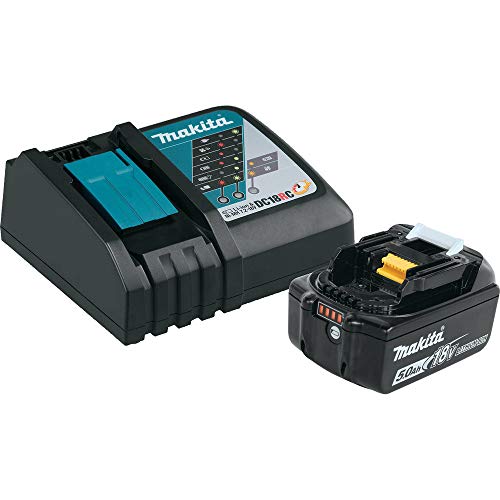
The BL1850BDC1 is Makita’s mirror of the DEWALT kit: an 18V LXT battery and charger starter pack built around a 5.0Ah pack, as its title states. Within the LXT world, the 5.0Ah battery is the outdoor workhorse size — the pack that goes into blowers, trimmers, chainsaws and, in pairs, the 36V (18V X2) equipment that anchors Makita’s cordless garden range. A starter pack around that battery serves the same three buyers as its DEWALT rival: the owner whose original LXT packs have faded after years of service, the bare-tool buyer who needs a complete power supply, and the established owner adding a full-size pack to a rotation that leaf season keeps exposing as one pack short.
The paired-pack arithmetic deserves emphasis for Makita owners specifically. A 36V LXT mower or blower consumes two 5.0Ah packs per session, so a single starter pack is genuinely a start — half a tool-load — and the honest recommendation for owners of paired equipment is to treat this kit as the foundation of a four-pack rotation: two on the tool, two resting or charging. The kit’s charger keeps that rotation fed between sessions, and owners who later add the DC18RC rapid charger above will find the two chargers divide the work naturally, the rapid unit handling midday turnarounds and the kit’s charger handling overnight duty.
As with the DEWALT kit, the title does not name the bundled charger’s model or rate, and the review respects that silence: the pack is the headline, the charger is the enabler, and buyers whose priority is charging pace should verify the included unit on the product page or pair a bare 5.0Ah pack with the DC18RC instead. What the kit guarantees is authenticity of combination — Makita’s own battery with Makita’s own charger, matched by the maker — which for lithium packs of this size is the combination that protects the investment in both.
Makita owners should also hear the case for buying this pack sooner rather than later, because LXT’s breadth creates a subtle trap: the platform’s small packs are so numerous and so cheap to add that a fleet can drift into being all compact packs, fine for drills and hopeless for the mower. The 5.0Ah unit in this kit is the corrective — the pack that rebalances a fleet toward outdoor work. Once one full-size pack is in rotation, its difference is obvious within a single mowing session, and owners typically standardise on the size for every subsequent purchase. The starter pack is thus less a single transaction than a fleet policy in a box: big packs for big tools, bought with the charger that keeps them honest.
Strengths
- A 5.0Ah LXT pack with its charger — the outdoor-sized battery at the heart of the platform.
- Feeds the paired-pack 36V LXT tools as part of a rotation, as well as single-pack 18V tools directly.
- Maker-matched battery and charger protect a substantial lithium investment.
Trade-offs
- Owners of paired-pack 36V tools need two packs per session, so one kit is a foundation, not the whole answer.
- The included charger’s model and rate are not stated in the title; verify on the product page if pace matters.
- LXT only — the pack and charger are strangers to every other platform in this guide.
| Spec | From the listing title |
|---|---|
| Contents | 18V LXT lithium-ion battery and charger starter pack |
| Pack capacity | 5.0Ah |
| Kit model | BL1850BDC1 |
| Platform | Makita 18V LXT, including paired use in 36V (18V X2) tools |
| Bundled charger rate | The listing title leaves the included charger unspecified; the product page names the unit supplied |
| Pack features | Not itemised in the listing title — confirm gauge and protection details on the full listing |
Best for: an LXT owner adding the platform’s outdoor-sized pack, or starting a bare 18V or 36V tool with a matched charger.
Not suited for: a paired-pack tool owner expecting one kit to complete the setup — the second pack is part of the real purchase.
Teal-platform owners building a rotation can check the BL1850BDC1 starter pack on Amazon for the current box contents.
Side-by-Side Comparison
| Pick | Platform | Type | Stated rate or capacity | Distinguishing title detail |
|---|---|---|---|---|
| DEWALT DCB1104 | 12V MAX / 20V MAX | Charger | 4 amp | Dual-voltage DEWALT coverage |
| Milwaukee 48-59-1812 | M12 / M18 | Charger | Rate not stated in title | Onboard fuel gauge |
| Makita DC18RC | 18V LXT | Charger | Rate not stated in title | Rapid Optimum charging system |
| RYOBI PCG002 | ONE+ 18V | Charger | Rate not stated in title | Indicator and 6 ft cord |
| DEWALT DCB205C | 20V MAX | Battery + charger kit | 5 Ah battery | Complete starter kit in one box |
| Makita BL1850BDC1 | 18V LXT | Battery + charger kit | 5.0Ah battery | Starter pack for single and paired-pack tools |
How Many Packs and Chargers Does a Cordless Yard Actually Need?
The honest answer scales with the tools, not the marketing. A single-pack household — one trimmer, one blower, a suburban lot — lives comfortably on two packs and one charger: one pack works while the other rests, and overnight charging resets the pair. The moment a mower joins, or the property grows, the arithmetic tightens, because mowing consumes a full-size pack the way trimming never does. Three to four 5Ah-class packs and two chargers is the configuration that stops governing the workday: enough capacity on tools, enough on chargers, and a spare for the pack that inevitably gets left in the rain or the truck.
Paired-pack platforms double everything, which LXT 36V and similar owners learn in their first season. Two packs per session means the rotation question is really about sessions: how many mower-loads or blower-loads must the yard absorb in one day? Buy packs in pairs for paired tools, keep the pairs together through their working lives so they age evenly, and mark them if necessary — a dab of paint or a numbered sticker is the professional habit that prevents a strong pack and a weak pack being married into a pair that performs like the weak one.
Chargers deserve the same realism. A second charger is the cheapest productivity purchase in the entire cordless ecosystem: it halves turnaround queues, provides a spare when one unit fails mid-season, and lets one charger live in the garage while another lives in the shed or the truck. Owners who balk at a second charger while owning six packs have the system’s economics backwards — packs hold the value, chargers protect the schedule, and schedules are what outdoor work runs on.
Heat, Dust and Storage: Keeping Outdoor Packs Alive
Outdoor packs live harder lives than indoor ones, and their care differs in three ways. First, heat: a pack that comes off a mower on a July afternoon is hot, and lithium packs prefer to cool before charging hard. Every platform’s genuine charger manages its packs’ electronics properly, which is another argument for the maker-matched picks above, but the owner’s part is simpler — let a hot pack rest in shade while the second pack works, rather than slamming it straight onto the charger in a sun-baked garage. Second, dust and moisture: yard packs inhale grass dust and morning dew. Store them indoors, off concrete floors, with their contacts clean, and never leave them on a charger in an open carport through a wet season.
Third, the winter question. Outdoor packs spend months idle, and lithium packs prefer storage at partial charge in cool, dry conditions over either extreme of full or empty. The practical routine is unglamorous: bring packs inside before the first hard freeze, charge them partway if they are flat, check them once mid-winter, and give them a full charge the week the grass wakes up. Followed yearly, that routine is the difference between packs that serve two seasons and packs that serve six — a larger economic difference than any choice between the six picks in this guide.
Reading a Charger Title Like a Buyer, Not a Fan
This guide’s six titles vary wildly in how much they tell you, and the variation itself is a buying lesson. DEWALT’s DCB1104 title states its voltages and its amp rate — everything a comparison needs. RYOBI’s PCG002 title states a cord length and an indicator. Makita’s DC18RC title states a system name and trusts the platform’s reputation. None of these approaches is dishonest, but they reward different reading habits: where a figure is stated, compare it; where a name is stated, understand what the name means inside its platform; where a title is silent, treat the product page and the maker’s documentation as part of the purchase process rather than an optional extra. The buyers who regret charger purchases are rarely the ones who chose the wrong brand — they are the ones who assumed a silent title was hiding the answer they wanted.
A final reading habit: note what a kit contains, exactly. The word “kit” and the word “pack” do different work in these titles — one promises a battery with a charger, the other a battery with its charger as a starter bundle — and the contents list in the title is the contract. Read it literally, the way this guide has, and the box that arrives will never surprise you.
That discipline matters most at the platform border. Every year, owners buy a charger for the platform they wish they owned, or the platform of the tool they borrowed, and discover the closed-system rule at the bench. The check takes ten seconds — the battery family’s name is printed on every pack you own — and it is the cheapest ten seconds in the category.
Common Mistakes When Buying Tool Chargers and Kits
The first mistake is cross-platform optimism: assuming a charger can be adapted, or that a bargain universal unit will treat a lithium pack properly. It cannot and it will not; platform chargers exist because each maker’s packs carry their own electronics and expectations. The second mistake is buying capacity by the indoor standard. Compact 2Ah-class packs that feel fine in a drill are a frustration in a mower; outdoor tools want the 5Ah class and upward, which is why both starter kits in this guide centre on it.
Third, owners under-buy chargers and over-buy packs, then wonder why the fleet is never ready — the queue at a single charger is the bottleneck, and a second charger fixes it for less than one pack costs. Fourth, kit blindness: buyers compare a starter kit’s price against a bare charger and conclude the kit is expensive, forgetting the kit contains the battery, which is the costly half of any platform. Compare kits against pack-plus-charger bought separately, and chargers against chargers, or the arithmetic misleads in both directions.
Frequently Asked Questions
Can I charge one brand’s battery on another brand’s charger?
No. Power-tool battery platforms are closed systems: the pack’s shape, contacts and electronics all belong to one maker, and each pick in this guide charges only its own family’s packs. Adapters that claim otherwise put an expensive lithium pack at risk to save the cost of the correct charger, which is poor arithmetic in every case.
Is a starter kit better value than buying a battery and charger separately?
Usually, when you genuinely need both. The DCB205C and BL1850BDC1 pair a 5Ah-class pack with a charger in one box, aimed at owners starting or reviving a platform. If you already own a good charger, a bare pack is the cleaner buy; if your charger is the platform’s slow pack-in unit and your packs are fading, the kit replaces both weak points at once.
Why do my outdoor tools kill batteries so much faster than my drill does?
Because outdoor tools draw sustained high current — a mower or blower works at full load for minutes at a time, where a drill works in seconds-long bursts. Sustained draw is what exposes a small pack’s limits, and it is why outdoor work standardises on 5Ah-class packs and why charge turnaround matters more in the yard than in the workshop.
Should I buy a second charger or a third battery first?
If your packs are healthy and your complaint is waiting, buy the charger — it is the cheaper fix and it makes every existing pack more available. If your complaint is runtime on the tool, buy the pack. Most growing fleets need both eventually, in the order their bottleneck dictates.
Can I leave packs on the charger between weekends?
Genuine platform chargers are designed to finish a charge and then behave safely with a pack seated, but the kinder habit for lithium packs is to charge them, remove them, and store them in a cool dry place — especially across long gaps and winter. The exception is the night before a workday, when a full pack waiting on the charger is simply readiness.
Do dual-voltage chargers charge both voltages at once?
That depends on the unit’s port layout, which the titles here do not specify — the DEWALT and Milwaukee picks each serve two voltages, and whether both can charge simultaneously is a product-page detail worth confirming if your routine depends on it. For most households the question is academic, since the two fleets rarely arrive at the bench empty in the same hour.
My platform sells 40V or 80V outdoor tools. Do these chargers apply?
Only through their smaller siblings. Several makers run a high-voltage outdoor line beside the 18V-class platforms in this guide, and those tools use their own packs and chargers entirely. The principles transfer perfectly — genuine chargers, full-size packs, one more charger than feels necessary — but the hardware does not. Check which voltage family your outdoor tools belong to before buying anything in this category, because the two families within one brand are as separate as two brands.
How long should a yard-tool battery pack last before it needs replacing?
Years, if it is charged on its genuine charger, kept out of weather, and stored sensibly through winter — the routines described above. The packs that die young almost always trace back to heat, deep neglect across a winter, or a charger that was never the platform’s own. When a pack’s runtime falls away gradually across a season, that is age speaking honestly; when it falls off a cliff, suspect storage or charging habits before blaming the brand.
Final Recommendation
Stay inside your platform and buy for the bottleneck you actually have. DEWALT owners should make the DCB1104 their bench standard and reach for the DCB205C kit when packs, not charging, are the weak point. Milwaukee households get the same dual-voltage economy from the 48-59-1812, with its fuel gauge as a daily convenience. Makita’s LXT owners should treat the DC18RC as the working charger their outdoor fleet deserves and the BL1850BDC1 as the rotation-building kit — bought in pairs when 36V tools are involved. RYOBI’s ONE+ majority is well served by the PCG002’s simple competence. Across all four platforms the pattern repeats: genuine chargers, 5Ah-class packs for outdoor work, and one more charger than feels necessary. Equip the bench that way, and the yard stops waiting on the wall outlet. One closing caution, because it is the mistake this category forgives least: when a pack finally fades, replace it inside the platform rather than using its death as an excuse to fragment the fleet across a second brand. Fragmented fleets mean two chargers, two pack families and half the rotation depth in each — the exact inefficiency every pick in this guide exists to prevent. Keep the fleet whole, keep the packs fed, and the platform will outlast several generations of the tools it powers.


