Our Top Picks



What's inside
- Best Quality Headlight Halo Sets: Angel Eyes That Actually Fit Your Build
- What Halo Rings and Angel Eyes Actually Are
- How to Measure and Choose the Right Ring Diameter
- COB vs SMD LED Rings: What the Construction Changes
- Single Color vs RGB: Remote, App, and Show Modes
- Vehicle-Specific Kits vs Universal Rings
- The Six Halo Sets, One by One
- Installation Overview for a Retrofit Halo Job
- A Cautious Word on Colored Light and Road Use
- Quick Buying Checklist
- Frequently Asked Questions
- Disclosure and How These Picks Were Chosen
- Check prices on Amazon
- Final Thoughts
As an Amazon Associate I earn from qualifying purchases. This post may contain affiliate links at no extra cost to you.
Best Quality Headlight Halo Sets: Angel Eyes That Actually Fit Your Build
A halo ring is one of the smallest changes you can make to a headlight, and one of the most visible. A thin circle of light around a projector or reflector bowl turns an ordinary housing into something people notice in a parking lot at dusk, in a rearview mirror on the highway, and in photos long after the drive is over. The idea is simple, a ring that glows, but choosing a good set is not simple at all. Diameter, LED type, color control, voltage range, vehicle fitment, and the way the ring mounts inside or around the housing all change whether the finished job looks clean or looks like an afterthought.
This guide covers six halo options that represent the main paths a buyer can take. There are compact universal COB rings in white and in red, a Bluetooth-controlled RGB ring for people who want color from a phone app, two vehicle-specific kits shaped around BMW platforms and the Dodge Challenger, and a flexible strip-based accent system for Challenger owners who want a different mounting approach. None of these products replace the main headlight beam. They are daytime running light and accent lighting components, and they should be chosen, wired, and used with that role clearly in mind.
Our research for this roundup is based on published specifications and product documentation from the manufacturers and sellers, cross-checked against general automotive lighting practice for 12-volt systems, retrofit work, and LED construction. The sections below explain how to measure for a ring, how COB and SMD designs differ, what RGB control actually adds, and where a vehicle-specific kit saves time compared with a universal ring. Each product then gets its own section limited to what its published listing states, followed by general installation guidance and a short set of frequently asked questions.
What Halo Rings and Angel Eyes Actually Are
The terms halo ring, angel eye, and halo set all describe the same basic component, a circular or near-circular light element fitted around the optical center of a headlight. The nickname angel eye became popular through factory BMW lighting, where corona rings served as daytime running lights and gave those cars a recognizable face. Aftermarket halo sets borrow that visual language for a wide range of cars, trucks, motorcycles, and off-road machines. Some rings copy the factory look as closely as possible in a steady white. Others treat the ring as a canvas for color, chasing, and flashing effects that no factory system would ship with.
A typical ring is a rigid or semi-rigid circuit board formed into a circle, populated with light-emitting diodes, and often covered by a diffuser or a clear or frosted plastic cover. When power is applied, the diodes illuminate the ring. With individual surface-mounted diodes you may see distinct points of light at close range unless a diffuser smooths them out. With chip-on-board construction the emitting surface tends to look more continuous. Either way, the ring itself is an accent. It outlines the lamp rather than lighting the road, and its brightness is judged by visibility and evenness in daylight and at night, not by how far it throws light down a lane.
Understanding that distinction matters for expectations and for safety. A halo set will not fix a weak headlight, a yellowed lens, or a misaimed beam. If night visibility is the problem, the headlight bulbs, projectors, lenses, and aim need attention first. A halo is the finishing layer, the part that gives a completed headlight build its signature. Buyers who keep that order straight, function first and styling second, almost always end up happier with the result, because the ring is then decorating a headlight that already works properly rather than distracting from one that does not.
Where Halo Rings Are Used
Most halo sets in this guide are described for headlight daytime running light or driving accent use. That phrasing appears again and again in the listings, and it reflects how owners actually use the rings, as a bright outline visible during the day and a styling element at night alongside the main lamps. Rings also appear as fog light accents, as decorative lighting on motorcycles and off-road vehicles, and as show lighting on cars that spend time at meets and exhibitions. The red Qasim ring in this lineup is explicitly positioned for decoration and warning-style daytime use on motorcycles, snowbikes, and off-road utility vehicles, which is a reminder that halo lighting has spread well beyond its sedan origins.
How to Measure and Choose the Right Ring Diameter
Diameter is the single most common reason a halo project goes sideways. Rings are sold by size in millimeters, and the listings in this guide include 70mm, 80mm, and 90mm rings alongside vehicle-specific kits and a 12-inch strip system. Those numbers refer to the size of the ring itself, and the correct size is the one that matches the feature it will surround, usually the outer edge of a projector shroud, a reflector bowl, or a decorative bezel inside the housing. A ring that is too small will not clear the component. A ring that is too large will crowd the housing, sit crooked, or interfere with the lens when the headlight is resealed.
Measure before you order, and measure the actual vehicle rather than relying on a forum post about a similar model. Headlight internals vary by year, trim, market, and whether the car has halogen or xenon lamps. The BMW kit in this guide, for example, is specified for cars with xenon headlamps, which is exactly the kind of detail that changes internal dimensions. Use calipers if you have them. Measure the outside diameter of the shroud or bowl the ring will sit on, measure the available depth so the ring and its wiring will clear the lens, and check for clips, adjusters, and trim pieces that intrude into the circle. Write the numbers down and compare them with the ring size in the listing before spending anything.
A Practical Sizing Workflow
- Identify the mounting surface. Decide whether the ring will sit on a projector shroud, around a reflector, or on a bezel, because each surface gives a different target diameter.
- Measure twice in millimeters. Record the outer diameter of that surface and the clearance to the lens, then convert carefully if your tools read in inches, since a small conversion slip becomes a visible gap or a forced fit.
- Account for the cover and wiring. A plastic cover adds presence around the ring, and the power leads need an exit path that does not pinch when the housing closes.
- Check both sides. Left and right housings are mirror images, and wiring routes and obstructions are not always symmetric, so confirm the plan works on the driver and passenger sides.
- Match the kit count to the car. Some listings describe a pair, some describe a kit for a full front end, and strip systems are measured by length rather than diameter, so confirm what arrives in the box against how many lamps you intend to treat.
Vehicle-specific kits reduce this burden because the maker has already matched ring sizes to a known housing. That is the core appeal of the BMW and Challenger kits below. Universal rings in standard sizes put the measuring work on the buyer but reward it with flexibility, the same 80mm or 90mm ring can serve many housings, fog lamp openings, and even non-automotive projects running on compatible DC power. Neither approach is automatically better. The specific kit is better when your car is exactly the car it names. The universal ring is better when your housing is unusual, already modified, or not covered by any named kit.
COB vs SMD LED Rings: What the Construction Changes
Two abbreviations run through halo listings, COB and SMD, and they describe how the diodes are built and mounted. SMD stands for surface-mounted device. An SMD ring carries many individual LED packages soldered onto a circular board. Listings in this guide cite counts such as 72-SMD, 264-SMD, and 60SMD, which tell you how many individual emitters the maker placed around the ring. At close range, an uncovered SMD ring can show a dotted appearance, brighter at each diode and dimmer between them. Diffusers and covers soften that effect considerably, and high diode counts crowd the points closer together so the ring reads as a continuous line from normal viewing distances.
COB stands for chip on board. In a COB ring, many LED chips are bonded directly onto the substrate and covered with a phosphor layer, producing a broader, more uniform emitting surface. The visual result is usually a smoother, more solid band of light with fewer visible points, which is why COB rings are popular for the clean factory-style angel eye look. Both Qasim rings in this guide use COB construction. COB does not automatically mean brighter or longer-lived than SMD in every case, because drive current, heat management, and component quality all matter, but the look is distinct enough that buyers with a strong preference for a seamless ring usually start with COB, while buyers who want dense multi-diode layouts or RGB color mixing often land on SMD designs.
Heat, Brightness, and Evenness in Plain Terms
Every LED converts some electrical energy into heat, and inside a sealed headlight that heat has nowhere generous to go. Well-designed rings spread their diodes or chips so no single spot runs dramatically hotter than the rest, and they are driven at levels the board can sustain in a warm housing on a summer day. Published listings rarely give full thermal data, so buyers should be conservative, avoid stacking additional light sources tightly against a ring, keep wiring and drivers positioned with airflow and distance from hot components in mind where the design allows, and treat any ring that flickers, dims unevenly, or discolors as a signal to cut power and inspect rather than as a quirk to live with.
Evenness is the quality most visible in photographs and in person. A ring with a dark gap, a hot spot, or a section that glows a slightly different shade will draw the eye for the wrong reasons. When comparing options, look at how the maker describes diode count, cover design, and color consistency, and treat published counts as comparisons within a size class rather than as absolute promises about how any single car will look.
Single Color vs RGB: Remote, App, and Show Modes
The simplest halo sets glow in one color whenever they receive power. White rings serve as daytime running lights and match factory styling. A red ring serves a decorative and warning-accent role on the vehicles its maker names. Single-color wiring is straightforward, the ring ties into a suitable power source, and there is no controller to mount, no remote to lose, and no app to pair. For a daily driver that needs to look right every single morning without any fiddling, that simplicity is a genuine feature and not a lack of ambition.
RGB rings add a controller that mixes red, green, and blue diodes to produce a wide range of colors, along with effects. The 70mm ring in this guide uses Bluetooth app control and lists music, timing, and flashing modes. The Challenger kits use remote control, with one describing multi-color rings and the OPT7 system describing multicolor halo rings with remote-controlled accent strips. App control puts settings on a phone you already carry and can offer timers and music-reactive effects. A dedicated remote keeps control independent of the phone, works without pairing, and is easy to hand to a passenger or use at a show. Both approaches add a controller box that needs a sensible mounting spot, clean power, and protection from moisture and heat.
Choose RGB for the right reasons. If the car attends shows or you will genuinely use the modes, RGB earns its extra wiring. If the car will live its whole life on white, a quality single-color ring will look sharper doing the one job it was bought for. Many RGB owners use a clean white setting on the road and reserve colors for parked display, a sensible pattern given the legal cautions covered later in this guide.
best car battery chargers and jump starters
Vehicle-Specific Kits vs Universal Rings
A vehicle-specific kit is engineered around one housing family. The BMW kit names the 3, 5, and 7 Series applications and the E36, E46, E39, and E38 chassis with xenon headlamps. The Challenger kits name the 2008 to 2014 model range in one case and 2008 to 2023 in the other. When your car matches the named application exactly, a specific kit usually means ring sizes, counts, and harness expectations have been thought through for that lamp, which shortens the measuring and improvising phase. When your car is close but not exact, a specific kit can be a trap, because close in model years does not guarantee identical internals.
Universal rings are sold by diameter and electrical specification alone. The Qasim 80mm white set and 90mm red set and the 70mm RGB ring can go wherever a ring of that size fits and the voltage matches. That freedom suits custom retrofits, fog lamp projects, motorcycles, and off-road vehicles, and it suits owners whose headlights have already been modified with aftermarket projectors whose shroud sizes no factory kit anticipates. The trade is responsibility, the buyer owns the measuring, the mounting method, and the wiring plan. Read the next sections with your path in mind, because the right product here depends less on which ring is most impressive in isolation and more on which one matches your housing, your vehicle, and your appetite for fabrication.
The Six Halo Sets, One by One
Each product below is described strictly from its published listing title and the general category knowledge explained above. Voltage figures, sizes, diode counts, control methods, and named vehicle applications are taken from those listings. Where a listing is silent on a detail, this guide says so by omission rather than filling the gap with an invented specification.
1. Qasim 80mm White COB Angel Eyes, Pair with Plastic Covers
The Qasim 80mm set, ASIN B078Y6MFNB, is the straightforward universal option in this lineup. The listing describes two pieces of 80mm white angel eye halo rings using COB light construction, presented as circle ring LED lights suitable for fog light and daytime running light roles, supplied with a plastic cover, and rated for 12V and 24V use. That combination of details tells a clear story. This is a mid-size universal ring for buyers who measured a housing or fog lamp opening in the 80mm neighborhood, want a steady white appearance, and prefer the smooth emitting surface associated with COB construction over a visibly dotted ring.
The plastic cover deserves attention because it shapes both the look and the installation. A cover diffuses the light, protects the emitting surface, and gives the ring a more finished edge inside the housing. It also means the buyer should confirm clearance with the cover fitted, not just the bare ring, when checking depth against the lens. The dual voltage description, 12V and 24V, widens the range of vehicles and projects the set can serve, since many cars run nominal 12-volt systems while some trucks and specialty applications run higher. As with any electrical accessory, the actual vehicle voltage and the wiring plan should be confirmed before connection, and the rings should be powered in a way that matches their intended daytime running light role rather than left glowing when the vehicle is parked and shut down.
Who should shortlist this set? Owners doing a clean, factory-inspired retrofit who want white light only, builders treating a pair of fog lamp openings, and anyone whose measurements land on 80mm. Who should look elsewhere? Buyers who want color changing, buyers whose housings need a different diameter, and BMW or Challenger owners who would rather start from a kit matched to their exact lamp. Within its lane, the appeal is focus, a pair of covered COB rings in a popular size with broad voltage compatibility and no controller to manage.
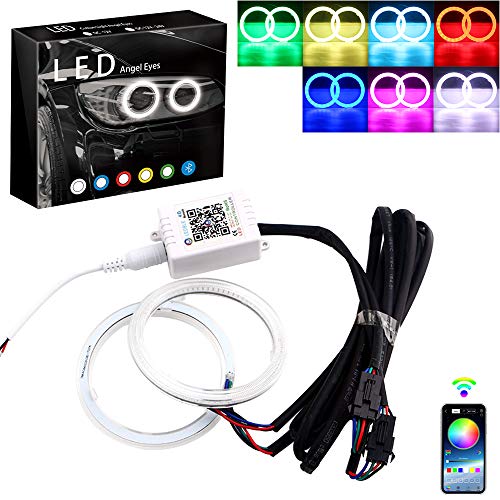
2. 70mm RGB Halo Ring with 72 SMD LEDs and Bluetooth App Control
The 70mm RGB ring, ASIN B072MRWB26, is the compact showpiece of the group. Its listing describes a 70mm RGB halo ring with 72-SMD LED angel eye construction, Bluetooth app control, 12V operation, and music, timing, and flashing modes. Seventy millimeters is the smallest diameter here, which makes this ring relevant for compact housings, smaller projector shrouds, motorcycle applications, and accent positions where an 80mm or 90mm ring simply will not fit. The diode count is notable for the size, seventy-two individual SMD emitters around a 70mm circle is a dense layout, and density is what helps an RGB ring mix colors smoothly instead of showing separated red, green, and blue points.
Bluetooth app control defines the ownership experience. Settings live on a phone, which makes exploring colors and effects convenient and gives access to the listed music mode, where the light responds to sound, the timing mode, where behavior can be scheduled, and flashing modes for display use. App control also means the buyer should think about the practical side before installation, keeping the controller within Bluetooth range of the driver position, positioning it where it will stay dry, and confirming the app and phone pairing while the housing is still open or accessible rather than after everything is sealed. A bench check on a suitable 12-volt supply before final assembly is a wise general practice for any controlled ring, because it confirms color, modes, and connections while changes are still easy.
This ring suits builders who know they want color and effects in a small format and who are comfortable managing a controller and an app as part of the lighting system. It is less suited to buyers who want a fit-and-forget white daytime running light, and its 12V description should be respected rather than assumed to cover other voltages. As a single-ring style listing, buyers should also confirm how many rings their project needs and order accordingly, since a symmetrical front end usually calls for matched rings on both sides with identical settings so the car does not look lopsided in color or brightness.
3. iJDMTOY LED Angel Eye Kit for BMW 3, 5, and 7 Series with Xenon Headlamps
The iJDMTOY BMW kit, ASIN B008BA97WS, is the traditionalist choice for a specific and well-loved set of cars. The listing describes an LED angel eye halo ring lighting kit for BMW 3, 5, and 7 Series models, fitting the E36, E46, E39, and E38 chassis equipped with xenon headlamps, producing 7000K xenon white light from a 264-SMD LED halo ring layout, intended for headlight daytime running light and driving accent lighting. Every element of that description is doing work. The chassis codes narrow the application to particular generations. The xenon headlamp condition narrows it further. The color temperature names a cool white intended to sit naturally alongside xenon lighting. The diode count signals a dense ring layout aimed at a full, even appearance.
For an owner of one of these cars in the correct configuration, this is the lowest-guesswork path in the guide. The angel eye look originated with this brand’s factory styling, so a kit shaped for these housings is chasing a well-defined target, rings that read as a natural evolution of the car rather than a generic addition. The 7000K xenon white description suggests a crisp, slightly cool tone. Buyers who prefer a warmer, more halogen-like white should note that distinction, because color temperature differences between the ring and the main lamps are visible, and a matched appearance is usually the goal on a car whose design is this lighting-led.
The cautions are equally specific. Confirm the chassis code and the xenon headlamp equipment on the actual car, not just the badge or the series number, because these generations were sold in many configurations across many markets. Confirm the kit contents against the number of rings the housing design uses, since BMW lamps of this era are known for multi-ring layouts and the listing describes a kit rather than a single universal ring. Owners of other BMW generations, or of these chassis with different headlamp equipment, should not assume fitment. For the cars it names, though, a dedicated 264-SMD kit in xenon white is exactly the kind of product the vehicle-specific category exists to provide.
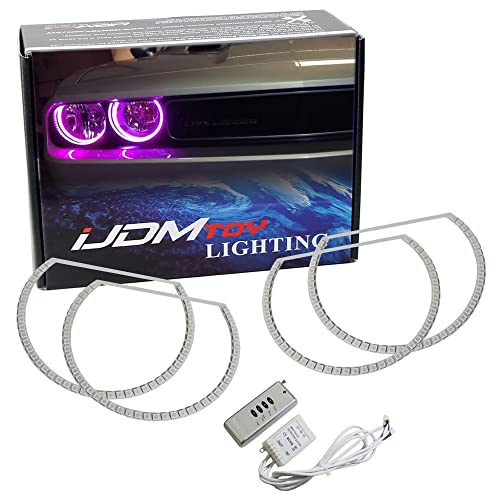
4. iJDMTOY RGB LED Angel Eye Kit for Dodge Challenger 2008 to 2014
The iJDMTOY Challenger kit, ASIN B00V5JMQ5M, brings color to a car whose styling invites it. The listing describes an RGB LED angel eye halo ring kit for the Dodge Challenger from 2008 to 2014, with multi-color LED rings and remote control, intended as a headlight daytime running light and driving lighting retrofit upgrade. The Challenger’s dual round lamp face is one of the most recognizable in modern muscle cars, and rings outline that face in a way that suits both a clean white daytime look and vivid color at shows. A kit built for the application takes the housing’s ring positions as a given rather than asking the owner to adapt universal circles to a distinctive lamp.
Remote control, rather than an app, shapes daily use. A remote is immediate, it works without unlocking a phone or repairing a Bluetooth connection, and it is easy to use in a show field or a driveway. It is also a small object that needs a home in the car, and the receiver and controller need the usual thoughtful placement for power, signal, and protection from the under-hood or in-housing environment described by the kit’s own instructions. Multi-color capability means the owner decides how the car presents in different settings, and the sensible pattern discussed earlier applies here too, restrained light on public roads and expressive color when parked and on display.
Model years are the critical check. This kit names 2008 to 2014. Challenger lighting and fascias evolved across the model’s long production run, so owners of later cars should not stretch this fitment to cover their year, especially with the OPT7 system below explicitly naming a wider 2008 to 2023 range. Owners inside the named range get the benefit of application-specific design plus RGB flexibility, a combination none of the universal rings can match for this car. As with the BMW kit, verify the car’s exact year and headlamp configuration against the listing before ordering, and plan the controller location and wiring route while the front end is apart rather than improvising afterward.
5. Qasim 90mm Red COB Angel Eyes for Motorcycles and Off-Road Use
The Qasim 90mm red set, ASIN B08139XJ52, is the outlier in this guide, and deliberately so. Its listing describes a 90mm red angel eye COB LED halo ring set of one pair, positioned as a car daytime running light and warning decor light, built with 60SMD driving day light construction, operating across 9 to 30 volts DC, and aimed at motorcycle, snowbike, off-road, and UTV accessory decoration. The largest diameter here, a red output, and the widest voltage range in the group make it a different tool for a different job, accent and decoration lighting for powersports and off-road machines as much as for cars.
Red light demands the most careful thinking in this entire guide. On the front of a road vehicle, light color is regulated and red facing forward is widely restricted because of its association with the rear of vehicles and with emergency signaling conventions. The listing’s own framing points toward decoration and off-road and powersports contexts, and buyers should follow that framing honestly. On a trail machine, a show bike, or an off-road UTV used away from public roads, a red halo can be a striking accent that matches a build’s theme. On a street-driven car, forward-facing red is the kind of modification that can draw enforcement attention and create confusion for other drivers, and the general legal section below returns to this point. Buy the red set for the uses it names, not as a front daytime running light for ordinary road driving.
Technically, the 9 to 30 volt DC range is genuinely useful for powersports, where electrical systems and accessories vary, and the 90mm size suits larger lamp openings and decorative positions that smaller rings cannot fill. The listing pairs COB in its product name with a 60SMD figure in its description, so buyers reading closely will notice both terms appear in the published text, and the safest interpretation is to treat the listing’s stated size, color, count, and voltage as the operative facts rather than building expectations on either construction label alone. For an off-road or motorcycle builder who wants a large red accent ring with flexible voltage compatibility, this set occupies a niche the white and RGB car-focused options do not attempt to serve.
6. OPT7 Aura RGB Halo Accent Lights for Dodge Challenger 2008 to 2023
The OPT7 Aura system, ASIN B08GC2CSM4, takes a different mechanical approach from every rigid ring above. Its listing describes OPT7 Aura RGB halo accent lights for the Dodge Challenger from 2008 to 2023, with remote control, multicolor halo rings formed by waterproof 12-inch LED strips, positioned as muscle car neon lighting and JDM-style headlight accessories. Instead of a fixed-diameter rigid circle, flexible strips of a stated length form the halo effect, which changes both the installation and the fitment logic. Length and routing replace diameter as the buyer’s main concern, and the waterproof description speaks directly to a strip that may live in a more exposed position than a ring sealed deep inside a housing.
The model year range is the headline for Challenger owners. Covering 2008 to 2023 in one listing spans far more of the modern Challenger’s production than the 2008 to 2014 range of the iJDMTOY kit, which makes this system the starting point for owners of later cars who want an application-directed option. Remote control and multicolor output put it in the same functional family as the other RGB products, with the same sensible division between road manners and parked display. The neon lighting framing in the listing is honest about intent, this is accent styling with a bold, modern glow, suited to owners who want their Challenger to stand out at night meets and in photos.
Strip-based systems reward careful surface preparation and routing. The path the strip follows must be clean, the bends must respect the strip’s flexibility without forcing it, and the wiring exit and controller placement need the same planning as any RGB system. Buyers should confirm from the listing and its documentation exactly what the kit includes, how the strips are intended to be positioned for the Challenger application, and whether their model year and trim match the stated range. For the right Challenger, the combination of wide year coverage, waterproof strips, and remote-controlled color is a practical alternative to opening housings for rigid rings, and for some owners that difference in labor and reversibility will decide the purchase on its own.
Installation Overview for a Retrofit Halo Job
Most rigid ring installations share the same broad sequence, and understanding it helps you judge whether to do the work yourself or hand it to a lighting shop. The headlight assemblies come off the vehicle. For rings that live inside the housing, the lens must be separated from the housing, a step commonly done with controlled heat to soften the sealant, followed by careful prying without cracking tabs or distorting the lens. The ring is positioned on the shroud or bezel, secured by the method the housing allows, and its leads are routed through a discreet exit point. Wiring then connects the rings to a suitable 12-volt source, often a daytime running light or parking light circuit, with attention to polarity, secure connections, and protection against chafing where wires pass near metal edges. Finally the housing is resealed, the assemblies go back on the car, and aim and function are confirmed before regular driving resumes.
A few general practices protect the result. Disconnect the battery before wiring work. Confirm each ring lights evenly on a bench supply before the housing is sealed, because fixing a dead section afterward means repeating the hardest step. Keep fingerprints and dust off internal reflectors and lenses while the housing is open, and allow sealant to set fully before washing the car. If opening a sealed housing or tapping into vehicle wiring feels beyond your experience, professional installation is a reasonable expense, since a damaged housing costs far more than labor.
A Cautious Word on Colored Light and Road Use
Lighting color on public roads is regulated in most places, and the details vary by jurisdiction. As a general principle, forward-facing lights on road vehicles are expected to be white or amber, while red is associated with the rear of a vehicle, and flashing or rapidly changing colored light can be confused with emergency vehicles. This guide does not state the rule for any particular state or country, because those rules differ and they change. The practical approach is simple. Use steady white for everyday road driving, save vivid RGB colors and flashing modes for parked display, shows, and private property, treat forward-facing red with particular caution, and check your local requirements before relying on any colored setting on the street. When in doubt, the conservative setting is the right setting.
Quick Buying Checklist
- Diameter or fitment confirmed against the actual housing, chassis, and model year on your vehicle.
- Construction chosen deliberately, COB for a smooth band of light or SMD for dense multi-diode and RGB layouts.
- Control method decided, simple powered white, a handheld remote, or a Bluetooth phone app with music and timing modes.
- Voltage matched to the vehicle system, whether that is the 12V, 12V and 24V, or 9 to 30 volt DC range stated in the listing.
- Controller and wiring planned, including mounting position, moisture protection, and a power source that suits daytime running light use.
Frequently Asked Questions
Do halo rings replace my headlight bulbs?
No. Halo rings are daytime running light and accent components. Your main low and high beam lights still do the work of illuminating the road, and they need their own bulbs, lenses, and correct aim.
Can one ring size fit every car?
No. Ring size must match the shroud or opening it surrounds, which is why this guide includes 70mm, 80mm, and 90mm options plus vehicle-specific kits and a strip system. Measure your housing or choose a kit that names your exact application.
Are RGB halos suitable for daily driving?
The hardware can be used daily, but color choice matters. A steady white setting is the sensible road choice in most places, with colors and effects reserved for parked display. Check local rules before using colored light on public roads.
Why does the BMW kit specify xenon headlamps?
Because headlight internals differ between equipment levels. The listing limits fitment to the named chassis with xenon headlamps, so owners should confirm that equipment on their own car before ordering.
Disclosure and How These Picks Were Chosen
This article contains affiliate links to Amazon. If you buy through those links, our editorial team may earn a commission, at no additional cost to you. The six products above were selected and described from manufacturer and seller documentation and published specifications, including stated sizes, diode counts, voltages, control methods, and named vehicle applications, rather than from direct personal use of each set. Readers should confirm fitment, contents, and current listing details on the product page before ordering, since sellers can revise kits and documentation over time.
Check prices on Amazon
Live listings for the shortlist in this guide are pulled from Amazon below, so prices and availability are always current at the moment you look.

Final Thoughts
The best quality halo set is the one that fits your housing, matches your vehicle electrical system, and glows in a way you will still enjoy a year from now. Choose the Qasim 80mm COB pair for a clean universal white build, the 70mm Bluetooth ring for compact color control, the iJDMTOY BMW kit for the named xenon-equipped chassis, the iJDMTOY Challenger kit for 2008 to 2014 cars that want remote-controlled color, the Qasim 90mm red pair for off-road and powersports decoration within its stated role, and the OPT7 Aura strips for the widest Challenger year coverage with a flexible, waterproof approach. Measure carefully, wire thoughtfully, and keep road use conservative, and a modest ring of light will do exactly the job it promises, giving your headlights a finished, deliberate face.