Our Top Picks


What's inside
- Why passive designs suit the home stereo receiver so well
- The T-shaped dipole, the classic flat wire antenna
- Rabbit ears adapted for FM listening
- Passive loop antennas for the shelf
- Passive models in the Terk style and other styled designs
- Seventy-five ohm, three hundred ohm, and the balun adapter
- Orientation, polarisation, and dipole geometry indoors
- Multipath, the indoor problem behind most FM frustration
- A practical placement and rotation method that actually converges
- HD Radio reception with a passive antenna
- When passive is enough, and where its boundary honestly lies
- Check prices on Amazon
- Choosing among the passive designs for your receiver and room
As an Amazon Associate I earn from qualifying purchases. This post may contain affiliate links at no extra cost to you.
Before the first station gets tuned in, a quick word about how this page is funded: some links in this article are affiliate links, meaning the site may receive a commission if you purchase through them, and that commission never adds anything to what you pay.
A home stereo receiver with a fine tuner section can still sound starved when its antenna is an afterthought. FM broadcasting occupies frequencies where a wavelength measures roughly three metres, so the antenna that serves a receiver is a physically meaningful object, not a token wire dangling behind the cabinet. Yet the solution for most homes is refreshingly simple. A passive indoor antenna, correctly connected and thoughtfully positioned, delivers clean stereo reception without power supplies, amplifiers, or anything mounted outside.
This guide covers only that category: unpowered indoor antennas intended for component home stereo receivers and tuners. Every design discussed here, from the flat T-shaped dipole to rabbit ears, passive loops, and the passive models associated with Terk, works without electricity. The antenna gathers the signal, the cable carries it, and the receiver does the rest. Understanding why that suffices in most living rooms, and where its limits honestly lie, is the purpose of the pages that follow.
Why passive designs suit the home stereo receiver so well
FM signals arriving from a metropolitan transmitter are, by radio standards, generous. Broadcasters run substantial power from tall towers, and a receiver in the same city or its suburbs often sits in a field strength that a simple dipole harvests easily. Manufacturer specifications for typical home tuners list sensitivity figures showing that only a tiny signal is required for quiet stereo, provided the antenna delivers it without interference. A passive antenna introduces no distortion, no additional noise, and no overload of its own, which makes it the cleanest possible source for that tuner.
Simplicity brings reliability that powered alternatives cannot match. There is no wall adapter to hum, no amplifier stage to fail, and no gain control to misadjust. A passive dipole installed carefully behind a bookcase can serve unchanged for decades, because nothing in it ages except the cable and its connectors. Owner reports from long term stereo owners frequently mention antennas older than the receivers they now feed, still performing exactly as installed.
The passive approach also preserves the dynamic behaviour of the tuner. Strong local stations stay clean because nothing ahead of the receiver can overload. Adjacent channel selectivity, capture effect, and stereo separation all remain properties of the receiver itself, exactly as its designer intended. When reception disappoints with a passive antenna, the cause is almost always geometry: position, orientation, or connection. Those are fixable with patience rather than purchases, which is why this guide spends so much of its length on placement.
There is an aesthetic argument too. A flat dipole can hide along a wall edge, rabbit ears fold away behind the cabinet, and a loop sits on a shelf like a piece of audio furniture. Living rooms are shared spaces, and an antenna solution that disappears into the room survives longer than one that demands visual compromise from everyone else in the household. Readers arranging a compact listening corner alongside equipment such as best 2 0 home theater speakers will appreciate how little space a well routed dipole actually claims.
The T-shaped dipole, the classic flat wire antenna
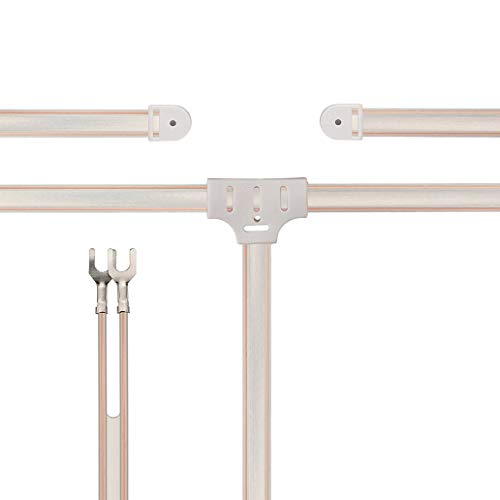
The T dipole, sometimes called a ribbon dipole, is the antenna packed in the box with generations of receivers. It consists of a horizontal top section of flat twin lead, roughly a metre and a half across, joined at its centre to a downward lead that ends in terminals or a connector for the receiver. Manufacturer specifications and textbook dimensions agree on the reason for that width: the top section approximates a half wavelength across the middle of the FM band, giving the antenna genuine resonance where it matters.
Resonance is what separates the T dipole from a random length of wire. At its design frequency the dipole presents a balanced impedance near 300 ohms and transfers signal efficiently to its feedline. Toward the band edges performance softens gradually rather than collapsing, so one fixed size serves the whole dial acceptably. Owner reports consistently rank a properly spread T dipole above the short vertical whips bundled with lesser equipment, particularly for stations in the lower half of the band.
Installation decides whether that promise materialises. The top section wants to be straight, horizontal, and as high in the room as domestic arrangements allow, ideally along the wall facing the transmitters you favour. Tacking it in a drooping curve behind furniture wastes its geometry. Stretching it along the top of a bookcase, the back of a tall cabinet, or the wall above a window preserves the shape. Small pins or removable adhesive hooks hold the ribbon without piercing its conductors, which piercing would risk.
The downward lead deserves equal care. It should drop from the centre of the top section at a right angle, avoiding long runs bundled against mains cables or draped across the warm back panel of an amplifier. Excess lead can be folded back on itself in a loose zigzag rather than coiled tightly, since a tight coil behaves like an inductor and upsets the match. These details sound fussy, yet each one appears repeatedly in owner accounts of a dipole that transformed after ten minutes of tidying.
Limitations are honest and predictable. A fixed horizontal dipole favours stations in the directions broadside to its top section and hears less from its ends. In a city with transmitters scattered around the compass, some stations will always be weaker than others on a fixed installation. Rotating the whole arrangement is impractical once tacked up, so the T dipole suits listeners whose favourite stations share a general direction, which in most cities they do, because transmitters cluster on the same tower sites.
Cost and availability complete its case. The T dipole sits in the lowest price band of any antenna category, often arriving free with the receiver, and replacements are everywhere. Starting here is not a compromise made from cheapness; it is the reference installation against which every fancier passive design must justify itself. Many listeners who experiment widely end by returning to a carefully placed ribbon dipole, having discovered that their room, not their budget, was the limiting factor all along.
Rabbit ears adapted for FM listening
Rabbit ears carry a television heritage, but their two telescopic rods form an adjustable dipole that serves FM reception remarkably well. Each rod extends to a useful fraction of an FM wavelength, and the hinged base lets the listener vary both the angle between the rods and the orientation of the whole antenna. Manufacturer specifications for dual purpose models list the rod length range and the FM band among their intended uses, while the television band markings on the base translate loosely to FM positions near full extension.
Adjustability is the entire argument for this design. Where the ribbon dipole fixes its geometry to a wall, rabbit ears invite experimentation: rods raised into a V, spread fully horizontal, or angled toward a stubborn station. Owner reports describe listeners developing an instinct for the shape each favourite station prefers, sometimes marking positions with small pieces of tape. For a household whose stations arrive from several directions, that freedom outweighs the ribbon dipole’s electrical tidiness.
The classic technique mirrors dipole practice. Start with both rods extended to roughly seventy centimetres each and arranged as a straight horizontal line, then rotate the base slowly while listening to a weak stereo station. Hiss that fades at one heading and returns at another reveals the directional pattern working. Lowering one rod or narrowing the V sometimes cleans a station plagued by reflections, because the altered pattern rejects a reflected path arriving from an unwanted angle.
Bases vary in quality more than rods do. A heavy base with firm hinges holds its setting when the cabinet vibrates with bass or a cat investigates. Flimsy bases drift, and drifting rabbit ears are a recurring complaint in owner reports about otherwise satisfactory models. The connection at the base matters equally: some models offer a coaxial output, others bare twin lead, and a few include a switch for combined television and FM use that adds one more contact to keep clean.
Appearance divides households. Rabbit ears announce themselves visually in a way a hidden ribbon never does, and their perch on top of the receiver cabinet competes with ornaments and ventilation space. Receivers run warm, and blocking top vents with an antenna base is poor practice regardless of reception. A nearby shelf at similar height usually serves as well and keeps both the amplifier’s airflow and the room’s appearance intact.
For renters and students, though, rabbit ears may be the most practical passive option of all. Nothing attaches to a wall, everything folds flat for a move, and the same unit follows the receiver from room to room during the search for the best listening spot. Listeners who enjoy radio while moving around the home sometimes pair this flexibility with ideas from best am fm radio headphones, keeping the main receiver installation simple while personal listening covers the rest of the house.
Passive loop antennas for the shelf
A passive FM loop folds the dipole concept into a circle or rounded rectangle of conductor, usually between twenty and forty centimetres across, mounted on a small stand or frame. Manufacturer specifications describe a balanced output suited to 300 ohm terminals, sometimes with a balun providing a coaxial alternative. The loop’s appeal is directional behaviour in a compact object: rotating the frame on its shelf steers a reception null that can suppress an interfering reflection or a co-channel station.
Loops hear best broadside to their plane and least through their edges, a pattern listeners exploit deliberately. Where a ribbon dipole’s nulls point along a wall and cannot move, the loop’s null travels with a simple twist of the wrist. Owner reports from apartment dwellers praise this steerability when a single reflection ruins one cherished station while leaving the rest of the dial clean. Turning the loop a few degrees trades a small amount of desired signal for a large reduction in the reflected component, and stereo hiss falls away.
Electrical efficiency is the honest trade. A loop of this size is small relative to an FM wavelength, so it captures less signal than a full ribbon dipole in the same location. In strong and moderate signal areas that difference rarely matters, because the receiver needs only a modest input for full quieting. In weak signal rooms the loop’s convenience can cost the last few decibels that separate stereo from mono fallback. Choosing between a loop and a ribbon is therefore a question about your signal environment first and your furniture second.
Build forms range from rigid circular frames to folding designs that pack flat. Some incorporate a simple tuning control that peaks the loop on the station of interest, adding a small interactive ritual to listening that many owners enjoy. A tuned loop demands readjustment when changing stations across the band, which suits deliberate listening sessions better than background radio that hops between presets all day.
Placement follows the same physics as every indoor antenna, with one loop specific caution. Large metal objects close behind the loop, such as a refrigerator side or a steel filing cabinet, distort its pattern and detune tuned models. A wooden shelf or the top of a loudspeaker cabinet, kept clear of the receiver’s own vents, gives the loop the neutral surroundings it prefers. Distance from mains powered lamps and chargers helps here as it does everywhere in indoor reception.
Passive models in the Terk style and other styled designs
Terk built its name on antennas that look like audio accessories rather than laboratory equipment, and its passive FM offerings follow that philosophy. Tower shaped and low profile designs house a dipole derived element inside a finished enclosure meant to sit visibly beside a receiver. Manufacturer specifications for these passive models emphasise the internal element arrangement, the fitted connector, and freedom from any power requirement. The enclosure buys placement convenience and domestic acceptance at some cost in raw element span.
What the styled enclosure genuinely offers is a stable, self supporting antenna for rooms where tacking a ribbon to the wall is unwelcome. The unit sits on the cabinet or a side table, connects with a short lead, and can be rotated in seconds when a different station needs favouring. Owner reports from design conscious households describe this as the difference between an antenna that gets installed and one that stays in its box. Reception that exists beats theoretical reception that a household vetoed.
Performance expectations should stay calibrated. An enclosed element cannot exceed the capture of an equivalent exposed dipole, and compact enclosures constrain element length further. In the strong signal districts these products target, that constraint is invisible in daily listening. At the fringe of a station’s coverage, the same constraint shows up as hiss that a full ribbon dipole on the wall might have avoided. The buying question is therefore local: styled convenience for adequate signals, or maximum element for marginal ones.
Connector arrangements on styled models vary by generation. Many provide a coaxial output suited to modern receivers, some include push terminal compatibility, and adapters are commonly bundled. Checking the exact termination against your receiver’s antenna input before ordering prevents the familiar disappointment of a new antenna waiting on a missing adapter. The section on impedance below explains how to make that check in a minute.
Other makers offer passive FM designs in similar spirit: flat panels meant to lean behind the receiver, wire frame shapes that hang like pictures, and low wedges for crowded cabinets. The comparison criteria remain constant across all of them. Element span, connector type, rotational freedom, and the honesty of the stated specifications separate a good styled antenna from a decorative one. Readers furnishing a combined listening and viewing space, perhaps around equipment like best 2 0 soundbars, often find these designs the easiest to integrate without visual clutter.
Seventy-five ohm, three hundred ohm, and the balun adapter
Two connector traditions meet at the back of a home stereo receiver, and confusing them is the most common cause of a new antenna seeming broken. Older and many current receivers provide screw or push terminals marked 300 ohm, expecting the balanced twin lead of a ribbon dipole. Others provide a coaxial socket marked 75 ohm, the unbalanced standard shared with cable television hardware. Some generous models provide both, which settles the matter entirely.
The numbers describe impedance, the electrical character the antenna and input must share for efficient transfer. A 300 ohm balanced dipole feeding a 300 ohm input connects directly, lead to terminals, with polarity irrelevant for reception. A coaxial 75 ohm antenna feeding a 75 ohm socket connects just as directly. Trouble begins only when the two traditions must cross, and that crossing is exactly what a balun adapter exists to perform.
A balun, named from balanced to unbalanced, is a small transformer that converts between the two worlds while translating impedance in the same step. One common form accepts a coaxial plug on one side and presents twin spade lugs on the other. The reverse form sits behind receivers with only coaxial sockets, letting a ribbon dipole feed them properly. Manufacturer specifications state the conversion direction and the frequency range, and FM sits comfortably inside every such adapter’s intended span.
Using the wrong arrangement rarely silences reception completely, which is why mismatches survive for years unnoticed. A dipole clipped straight onto a coaxial input through improvised wiring delivers some signal, accompanied by extra hiss on weaker stations and a pattern distorted by the unbalanced feed. Owner reports are full of listeners who discovered the balun only after complaining about a tuner, then watched stereo quieting improve across the dial within minutes of fitting the correct adapter.
Practical checks take moments. Look at the receiver’s rear panel and note whether the FM input is a round coaxial socket or a pair of terminals. Look at the antenna’s lead and note whether it ends in a round plug or flat twin conductors. If they match, connect them. If they differ, order the balun that converts in the direction you need, and prefer a single quality adapter over a chain of improvised fittings, each of which adds loss and a future corrosion point.
Coaxial cable quality for the short indoor run matters less than connector integrity. A clean, firmly seated plug outperforms an expensive cable hanging by one corroded thread. Push on coaxial fittings common on some receivers deserve a periodic reseat, because oxidation at that single contact quietly raises the noise floor over the years. A listener who reseats every antenna connection annually will never chase that particular ghost.
Orientation, polarisation, and dipole geometry indoors
A dipole receives most strongly broadside to its length and weakest off its ends, a pattern worth visualising before any antenna gets fixed in place. For a ribbon stretched along an east facing wall, stations to the east and west arrive favoured, while stations due north along the wall’s line arrive diminished. City transmitter maps make this concrete: most metropolitan FM stations share a handful of tower sites, so one wall often serves nearly the whole dial. Checking which direction your favourite stations broadcast from turns installation from guesswork into geometry.
Polarisation adds a second alignment. Broadcast FM in North America is predominantly circularly polarised, which forgives antenna orientation considerably and explains why both horizontal ribbons and angled rabbit ears can succeed in the same room. In regions where horizontal polarisation dominates, the flat horizontal dipole holds a clearer advantage, and tilting it vertically costs real signal. Local practice and broadcaster information settle which regime you live in, and the ribbon’s classic horizontal mounting remains the safe default in either case.
Height interacts with orientation because indoor reflections scramble the tidy textbook pattern. A dipole that theory says should favour one direction may, in a particular room, perform best along the opposite wall where a clean reflected path dominates. This is why experienced installers tack a ribbon temporarily, live with it through an evening of listening, and only then fix it permanently. The room gets a vote, and ignoring that vote in favour of theory is the classic beginner’s error.
Rabbit ears translate the same geometry into continuous adjustment. A straight horizontal pair reproduces the ribbon’s pattern with rotational freedom. A raised V tilts the pattern upward and mixes polarisation, sometimes rescuing a station whose path arrives over rooftops at an angle. Narrowing or widening the V while listening to stereo hiss gives immediate feedback, and the best shape is simply the one where the hiss recedes furthest on the stations you actually play.
Distance from walls and large objects forms the third geometric variable. An antenna pressed flat against a wall couples to whatever wiring and metal lurk inside that wall. Standing a loop or rabbit ears a modest distance into the room often cleans reception noticeably. Conversely, a ribbon dipole is designed to live on a wall and tolerates the arrangement, though even it prefers a wall without a bathroom’s worth of copper pipe directly behind the plaster.
Multipath, the indoor problem behind most FM frustration
Multipath occurs when a receiver hears the same station by several routes at once: directly from the transmitter and reflected off buildings, hills, or large objects. The copies arrive at slightly different times, and their combination at the antenna can reinforce or cancel parts of the signal. In analogue FM the audible results are familiar to every city listener: distortion on loud passages, a spitting harshness that comes and goes, stereo that collapses or swims, and reception that changes when a person walks across the room.
Severity varies by frequency, which is why one station suffers while its neighbour on the dial sounds immaculate. At a particular spot in a room, the reflected copies may cancel the direct signal at 98 megahertz and reinforce it at 101. Moving the antenna by even half a metre changes every path length and can move a station from unlistenable to clean. This sensitivity explains the otherwise puzzling owner reports of reception transformed by shifting a dipole from one end of a bookcase to the other.
Directional antennas fight multipath by discrimination. A dipole or loop oriented so its null faces a strong reflecting surface hears less of the delayed copy and proportionally more of the direct wave. The improvement often sounds larger than any signal strength meter suggests, because the meter measures total energy while the ear suffers from the mixture. Listeners pursuing one distorted favourite station should therefore experiment with orientation even when the signal strength reading already looks healthy.
Receiver behaviour can confirm a multipath diagnosis. Many tuners blend stereo toward mono as signal quality falls, so a station that keeps slipping into mono in one seat of the room is telling you about its paths. Some receivers expose a multipath indicator or a signal quality meter distinct from raw strength. Where such aids exist, they make antenna adjustment far more precise than judging by ear during music, and a steady test tone or a talk programme gives the clearest feedback of all.
Furniture and people are part of the path environment. Metal framed shelving, radiators, and large mirrors all reflect FM wavelengths efficiently. A reception arrangement perfected in an empty room may degrade when the room fills for the evening, which is a multipath reality rather than a fault. Positioning the antenna high, where fewer bodies and objects interrupt the paths, stabilises reception across the room’s daily life. Listeners who also use personal receivers elsewhere at home, as in best am fm radios headsets, often reserve the main tuner for the stations its fixed antenna serves best.
A practical placement and rotation method that actually converges
Random antenna wandering rarely converges on the best spot, so a short methodical routine pays for itself. Choose three test stations: your favourite, one known weak station, and one in the opposite part of the dial. Set the receiver to each in turn, note whether it plays in clean stereo, and use a talk or news programme for judgement because speech exposes distortion that music conceals. That baseline, recorded before anything moves, prevents the common trap of optimising one station while silently ruining two others.
Begin with position before orientation. Try the antenna at the highest practical point on the wall or shelf nearest the transmitter direction, then at the same height on the adjacent wall, then near a window if the room offers one. Windows often help, though modern coated glass can attenuate signals, so a window result should be measured rather than assumed. At each candidate position, rotate rotatable antennas slowly through a full half turn, pausing where the test stations sound cleanest, and score the position by its worst station rather than its best.
Small movements deserve the same respect as large ones. Once a good wall or shelf is chosen, shifts of twenty or thirty centimetres along it explore the multipath landscape efficiently. Mark the best few spots with removable tape before committing to fixings. Listeners who rush this stage and tack a ribbon permanently at the first acceptable spot routinely leave a cleaner position undiscovered a forearm’s length away, as the pattern of owner reports on repositioned dipoles shows again and again.
Cable routing comes after position, not before. A route chosen first silently constrains where the antenna can go, and the tail ends up wagging the installation. With the antenna spot proven, route the lead along skirting or behind furniture, keeping it away from mains cables where parallel runs are avoidable and never trapping it under a cabinet foot. Leave a gentle service loop of spare cable near the receiver so the antenna can be nudged later without rerouting everything.
People moving through the room form the final test. Ask someone to walk the usual paths and sit in the usual seats while a marginal station plays. If reception collapses when a particular chair is occupied, a modest height increase usually cures it. Confirming the installation under real living conditions, rather than in an empty room at midday, is what separates a setup that delights for years from one that mysteriously disappoints every evening.
Document the result in whatever form suits you: a phone photograph of the final arrangement, a note of the rabbit ear angles, a sketch of the ribbon’s wall. Antennas get moved for decorating, cleaning, and furniture changes, and the household member who moves one rarely knows the reasoning behind its exact spot. A photograph restores in a minute what took an evening to discover, and it also records the balun direction and terminal arrangement for the day a receiver gets replaced.
HD Radio reception with a passive antenna
HD Radio broadcasts travel as digital sidebands alongside the analogue FM signal from the same transmitter, so any antenna serving the analogue station is already pointed at its digital companion. No special HD antenna category exists for indoor use, and marketing that implies otherwise deserves a raised eyebrow. What the digital service does demand is a cleaner, more stable version of the same signal, because digital reception holds perfectly until it drops out entirely, with little of analogue’s graceful hiss in between.
That cliff edge changes how placement success feels. An analogue station may sound acceptable through mild multipath while its HD layer refuses to lock, or locks and then mutes during a favourite song when someone crosses the room. Listeners adopting HD should therefore optimise placement using the digital lock itself as the test instrument, waiting at each candidate position long enough for the receiver to acquire and hold the digital stream through a minute of ordinary room movement.
Signal margin is the concept to carry away. A position where HD locks instantly and survives doors opening, people sitting down, and the heating system starting is a position with margin. A position where lock takes many seconds and drops under the same disturbances sits at the edge, whatever the analogue sound suggests. Passive antennas provide that margin in most urban and suburban homes precisely because the underlying broadcast signals are strong; the work is in finding the stable spot, not in amplifying a weak one.
Multicast channels, the additional programmes carried on HD2 and HD3 streams, share the same carrier and therefore the same reception fortunes as the main digital channel. If the primary HD service holds reliably, the subchannels will too. A listener whose favourite subchannel keeps vanishing while the main channel plays should suspect momentary dropouts masked by the receiver’s analogue blending on the main channel, and return to placement with that suspicion in mind.
Antenna choice for HD follows the same hierarchy as analogue. The full ribbon dipole offers the most signal and the most placement stability once fixed. Rabbit ears offer the adjustments that can rescue a marginal lock. A loop offers null steering against the reflection that keeps breaking the stream. Styled passive units serve homes where the signal is comfortably strong. The digital layer rewards the careful installer and exposes the careless one, but it asks for nothing a good passive installation does not already provide.
When passive is enough, and where its boundary honestly lies
Passive reception is enough whenever the desired stations arrive at your building with reasonable strength, which describes most urban and suburban homes within comfortable range of their city’s transmitters. The symptoms of sufficiency are easy to recognise: favourite stations lock into quiet stereo, HD services hold through ordinary room activity, and only genuinely distant or low powered community stations show hiss. A household matching that description gains nothing audible from amplification, because the receiver already gets everything it can use.
Distance redraws the picture gradually. As the kilometres from the transmitter grow, the field strength falls, and the capture difference between antenna designs starts to matter. First the styled compact units fall behind, then the loop, while the full ribbon dipole keeps delivering quiet stereo longest. Owner reports from the outer suburbs show this ordering consistently, which is why this guide keeps returning to element span as the honest currency of passive performance.
Building construction can imitate distance. A basement listening room, a steel framed apartment block, or foil backed insulation in the walls can reduce indoor signal to fringe levels even a few kilometres from the tower. The diagnostic is comparative: if reception improves dramatically the moment any antenna moves near or outside a window, the building is the bottleneck. Placement creativity, including the window adjacent positions discussed earlier, should be exhausted before concluding that passive reception has failed you.
The boundary itself can be stated plainly. When a correctly connected, well placed full size dipole still leaves your main stations hissing in stereo or dropping their HD lock, and the same stations play cleanly on a car radio outside the building, your location sits beyond what indoor passive antennas can honestly serve. At that point the conversation legitimately turns to amplified indoor models or an outdoor antenna, options outside this guide’s scope. Naming that boundary protects buyers from the opposite error of purpursuing endless passive variants in a location where none can succeed.
Amplification deserves one clarification even here. An amplifier raises whatever the antenna delivers, including multipath corruption and interference, so it cannot repair a distorted signal, only a weak clean one. Many households that believe they need amplification actually need a better position, which is why the boundary test above specifies a well placed dipole rather than whatever antenna happened to come out of the box first. Exhaust the geometry before reaching for gain, and most homes will find the geometry sufficient.
Check prices on Amazon
Live listings for the shortlist in this guide are pulled from Amazon below, so prices and availability are always current at the moment you look.

FM Antenna for Stereo Receiver, Magnetic Base, 16ft Cable, 75 Ohm


Choosing among the passive designs for your receiver and room
Start with the ribbon dipole if your favourite stations share a transmitter direction and any wall or tall furniture can host its span. It offers the strongest passive performance, the simplest connection to 300 ohm terminals, and a cost so low that trying it first risks nothing. Its fixed nature is its only real demand, and the placement method in this guide exists to make that single decision a good one.
Choose rabbit ears when stations arrive from several directions, when walls cannot accept fixings, or when the receiver moves between rooms. Their continuous adjustability compensates for a less tidy pattern, and a heavy based model with clean connections will hold its settings faithfully. Accept the visual presence as the price of that freedom, and give the base a shelf position that respects the receiver’s ventilation.
Choose a passive loop when one or two stations suffer from a specific reflection that orientation can null, or when shelf space is the only space available. Its steerable null is a surgical tool no other passive design matches. Accept its smaller capture in exchange, after confirming with the boundary reasoning above that your signal area can afford the trade.
Choose a styled passive unit in the Terk tradition when domestic acceptance decides whether an antenna exists at all. A finished enclosure that a household welcomes onto the cabinet will outperform, in lived experience, the theoretically superior dipole that stayed in a drawer. Confirm its connector matches your receiver, rotate it patiently during setup, and judge it on your weakest favourite station rather than your strongest.
Whichever design you settle on, keep the losing candidates if storage allows. Rooms change, stations change their transmitter arrangements, and a spare ribbon dipole costs nothing to keep. The antenna that disappointed in one apartment may be exactly right in the next home, and a small collection of passive options, each fully understood, is the mark of a listener who has stopped buying hope and started practising placement.
Fit the dipole to the wall with care, give the ears or the loop a patient quarter hour of turning, and the quiet stereo waiting inside your receiver’s tuner will finally have the signal it was built to deliver.
Receiver features interact with passive antennas in a few ways worth knowing before you judge any installation. A signal strength meter calibrated in arbitrary units still serves as a comparison tool between positions, provided you compare the same station within the same session. A stereo threshold control, where fitted, should sit at its normal setting during antenna work, because forcing stereo on a marginal signal makes every position sound worse than it is. Likewise, high blend and noise reduction switches belong off while you evaluate, then back on afterwards if you prefer their effect on genuinely weak stations.
Tuner alignment in older receivers forms the one variable an antenna cannot influence. A vintage receiver whose front end has drifted will underperform on every antenna in this guide, and the giveaway is uniform disappointment across strong local stations that play perfectly on a second tuner in the same room. Owners of older equipment who borrow a modern receiver for one evening gain a decisive diagnostic. If the borrowed unit sings on your existing dipole, the antenna was never the problem, and servicing the tuner becomes the honest next step.
Interference from modern household electronics deserves a place in any indoor FM discussion. LED lamps, dimmers, phone chargers, and the power supplies of nearby equipment can raise a buzzing or hash laden floor on parts of the band. Because a passive antenna has no amplifier to exaggerate these intrusions, they usually enter through the receiver’s mains connection or radiate over a very short distance. Moving the antenna a metre from a suspect lamp, or switching that lamp off briefly as a diagnostic, identifies culprits quickly. Owner reports suggest that one faulty charger accounts for a surprising share of supposedly weak reception in otherwise strong signal districts.
Two receivers in one home, perhaps a main tuner and a kitchen unit, raise the question of sharing. A passive splitter can divide one good antenna’s output between two coaxial inputs at the cost of a few decibels each, a trade that strong signal homes absorb without noticing. Twin lead installations split less gracefully, and running a separate simple dipole for the second receiver often proves cleaner. The deciding factor, as always, is margin: homes with signal to spare can share generously, while fringe homes should give the main receiver the undivided antenna.
Seasonal and weather variation affects FM less dramatically than distant television folklore implies, yet listeners at the edge of coverage do notice summer evenings when distant stations crowd in over local weak ones. Tropospheric conditions can lift signals from a neighbouring city for a few hours, temporarily disturbing a marginal favourite. A passive installation cannot prevent the weather, but a directional loop or dipole null aimed at the intruder sometimes restores order. Recognising the phenomenon prevents needless antenna changes in response to a passing atmosphere.
Care of a passive antenna is nearly effortless, which suits its fit and forget role. Dust the elements occasionally, keep twin lead away from heat sources that embrittle its insulation, and inspect the receiver terminals yearly for the green tinge of oxidation. Rabbit ear hinges benefit from being exercised through their range once in a while so they do not seize in a single position. Styled enclosures want only a wipe and a check that their connecting lead has not been pinched by a cabinet door. Nothing here requires a service visit, and a decade of such minimal attention is entirely realistic.
Households with children or pets should route leads where small hands and teeth cannot reach them, not because the signals pose any danger, since a receiving antenna carries no meaningful energy, but because a pulled dipole and a toppled loop serve nobody. Securing the ribbon along its wall with proper clips rather than loose tape also keeps it from becoming a tempting hanging toy. A thoughtfully routed installation survives family life; a dangling one eventually becomes a repair.
Finally, allow a new installation a week of ordinary listening before passing judgement. First impressions formed during one programme, on one station, in one weather pattern mislead remarkably often. A week samples morning news, evening music, weekend sport, and the comings and goings of the household, and by its end the antenna’s true character in your room is beyond argument. Listeners who grant that week rarely return their passive antennas; listeners who judge in an hour sometimes return the very unit that would have served them for years.
Gift buyers and those equipping a first stereo system often ask which single passive antenna to choose blind, without a site survey. The ribbon dipole remains the safest blind recommendation for the reasons already given: genuine resonance, generous span, universal availability, and compatibility with the 300 ohm terminals fitted to so many receivers. Where the recipient’s receiver offers only a coaxial socket, adding the correct balun to the gift prevents a frustrating first evening. A few minutes spent confirming the connector turns a thoughtful present into an immediately usable one.
Second hand receivers complicate the picture pleasantly, because they frequently arrive with no antenna at all and their new owners assume the tuner is faulty when silence follows. Fitting any passive antenna from this guide, even temporarily draped over a door, reveals within seconds whether the tuner lives. Many a supposedly dead receiver has been rescued by a ribbon dipole and ten patient minutes, and many a bargain has been secured because a seller never made that simple check. The antenna is the cheapest diagnostic instrument in the entire audio hobby.
Recording from FM, whether to a computer interface or an older tape format, raises the stakes on reception stability. A dropout or burst of multipath distortion that a casual listener forgives becomes a permanent flaw in a recording. Listeners who record favourite programmes should complete the placement method with extra rigour, choose the position with the greatest margin rather than the first acceptable one, and avoid readjusting anything on recording days. The passive antenna’s freedom from power supplies and gain stages removes two sources of surprise from a recording session entirely.
Community and college stations deserve a special mention in any FM guide, because their modest transmitter power makes them the first casualties of a careless installation and the greatest beneficiaries of a careful one. A listener who values a low powered station broadcasting from across town should optimise the entire setup for that station specifically, accepting slightly weaker results on the powerful commercial outlets that will survive almost any arrangement. Direction, height, and the steerable null of a loop all earn their keep in this scenario, and the reward is programming available in no other form.
Apartment buildings introduce shared constraints that shape antenna decisions quietly. Lease terms may forbid fixings on walls, neighbours sit only metres away through thin partitions, and the transmitter direction may face across an interior courtyard rather than open sky. Removable adhesive mounting, shelf based loops, and rabbit ears all respect those constraints while still delivering the geometry that reception needs. Courtyard facing rooms often find that a reflected path off the opposite building is the strongest available, another case where the room’s evidence overrules the map’s prediction.
Comparing two candidate antennas fairly in your own room is entirely possible without instruments. Install the first, run the three test stations, and note the results in writing with the date and approximate weather. Repeat with the second antenna in the identical position on the same evening if possible. Memory alone will betray you between sessions, because the ear adapts and enthusiasm colours judgement. Written notes from a single evening settle most comparisons honestly, and they become the foundation of the installation record recommended earlier in this guide.
There is a quiet satisfaction in an antenna that asks for nothing: no socket, no battery, no subscription, no firmware. A passive dipole or loop installed with care simply gathers what the broadcasters send, season after season, asking only to be left in the position your patience discovered. In a home filling with devices that demand updates and charging, that self sufficiency has a value beyond its reception figures, and it is reason enough that the designs in this guide have outlived every fashion that was supposed to replace them.
One more scenario completes the picture: the receiver that lives in a workshop, studio, or home office rather than a lounge. Such rooms add fluorescent or LED lighting, computers, and metal tool storage to the reflection and interference environment, yet they also grant freedom, because nobody objects to a ribbon dipole stretched along a workshop wall or rabbit ears perched on a high shelf. Reception in these rooms often ends up better than in the main living space, simply because the antenna can occupy the position physics prefers without negotiating with the decor. Listeners who work long hours in such rooms consistently rate a dedicated passive antenna among their best value audio purchases.
Travel between homes, whether for students each term or anyone relocating for work, favours the designs that pack without damage. A ribbon folds into an envelope, rabbit ears collapse into a box, and a folding loop slips between books. Styled enclosures travel worst, their finished surfaces scuffing and their internal elements vulnerable to crushing. Knowing that a move is coming should tilt a choice made today, because the antenna that survives the van is the one still serving at the new address while its replacement is still being considered.
To close the comparison, weigh the four families by the single question each answers best. The ribbon answers how much clean signal a passive antenna can gather for almost no money. The ears answer how freely an antenna can adapt to stations arriving from everywhere. The loop answers how precisely a listener can reject one offending reflection. The styled enclosure answers how gracefully an antenna can live in a room that rejects visible equipment. Your room, your stations, and your household will point to one of those answers more clearly than any universal ranking could.
Keep the packaging and any bundled adapter from whichever antenna you buy, together with a note of the position that won your placement session. If the receiver is ever replaced, that small parcel shortens the new installation to minutes, because the connector question and the geometry question have both been answered once already. Households that keep such records describe every later equipment change as oddly painless, and the habit, like the antennas themselves, costs nothing and asks for nothing beyond a moment of foresight.
And if a visiting friend asks why such an unassuming strip of ribbon or pair of rods transformed the stereo, the honest answer is the one this guide has repeated in many forms: the receiver was always capable, the broadcasters were always sending, and the only missing ingredient was an antenna given the span, the connection, and the position it needed.