What's inside
- Key Takeaways
- Quick Picks
- How We Chose These Picks
- Comparison: The Astro Ladder Side by Side
- Which Astro connection type fits the machines on your desk?
- How should you set up an Astro headset for clear party chat?
- What does living with a charging dock actually change?
- How long should an Astro headset last, and what wears out first?
- What changes when a household shares one Astro between several players?
- Common Mistakes When Buying an Astro Headset
- Final Recommendation
- Frequently Asked Questions
- Related Guides
As an Amazon Associate I earn from qualifying purchases. This post may contain affiliate links at no extra cost to you.
widgetverdict.com is reader-supported. When you buy through links on our site, we may earn an affiliate commission.
Shopping for the best astros headsets means shopping inside a single brand’s ladder, and that changes the usual rules. There is no rival logo to hide behind here. Every pick below carries the same angular earcup language, the same family of flip-to-mute microphones, and the same design lineage that began in tournament halls long before streaming setups had ring lights. What separates one Astro from another is not styling. It is how you connect, how many machines the headset has to serve, and how much switching hardware you are willing to put on your desk.
Astro, now folded into Logitech G, built its reputation on a simple promise: a headset that works the same on a console controller, a PC, and a tournament station. That promise produced some odd artefacts over the years, including base stations with optical passthrough and mixers shaped like hockey pucks. The current range is cleaner. At the top sits a flagship that routes your television, console, and computer through one dock. At the bottom sits a wired headset that costs less than many replacement controllers and shrugs off being dropped on hardwood. Between those poles live two wireless mid-tier models that look similar on a shelf yet suit very different players.
This guide walks the whole ladder rung by rung. Four of the six headsets can be bought new with verified listings today, and those carry links. Two older designs — the wired tournament veteran and the previous flagship — are covered as prose-only entries because they still circulate through resale channels and because understanding them explains where the current models came from. If you already own one of those older sets, the comparisons here will tell you whether an upgrade changes your evenings or merely your desk clutter.
Where to buy: the four current models are sold through Amazon and major electronics retailers, and the linked picks below use verified listings so you can check price on Amazon against the configuration you actually need. Pay attention to platform labelling on the mid-tier wireless models especially, because Astro has historically sold near-identical headsets in PlayStation, Xbox, and PC flavours that differ in wireless compatibility rather than in sound.
Key Takeaways
- The Astro A50 X is the only headset here that switches between PlayStation, Xbox, and PC from one base station while also passing your console picture to the television.
- Buyers with one console and a modest budget should look at the A20 X first; it keeps wireless freedom and platform switching without the flagship dock.
- The A20 Gen 2 for Xbox is a narrower tool: excellent inside the Xbox ecosystem, deliberately limited outside it.
- The A10 remains the sensible wired starter — no charging, no pairing, and a frame that tolerates rough handling by younger players.
- Older A40 TR and previous-generation A50 units still appear second-hand; they can be bargains, but battery age and missing accessories decide whether a used set is truly cheap.
Quick Picks
| Pick | Badge | Why it is here |
|---|---|---|
| Astro A50 X | Flagship switchboard | One dock runs both consoles and a PC, passes high-refresh video to the TV, and charges the headset between sessions. |
| Astro A20 X | Wireless for most players | Platform switching, a clear detachable-style mic character, and no base station to find desk space for. |
| Astro A20 Gen 2 (Xbox) | Xbox household pick | Simple USB-transmitter wireless built specifically around Xbox consoles and Windows PCs. |
| Astro A10 | Wired survivor | A tough, light, cable-fed headset that works with anything offering a 3.5mm jack. |
| Astro A40 TR with MixAmp Pro TR | Tournament veteran | The wired broadcast-era favourite, still valued by streamers who mix game and voice on hardware knobs. |
| Astro A50 (previous generation) | Used-market flagship | Yesterday’s top model with a charging dock, now a second-hand consideration rather than a new purchase. |
How We Chose These Picks
Because every candidate shares a badge, the selection test had to be about roles rather than brands. We asked what jobs an Astro buyer actually hires a headset to do. One job is running a multi-platform living room where a PlayStation, an Xbox, and a PC all feed one screen. Another is equipping a teenager whose sessions happen entirely inside one console’s ecosystem. A third is surviving as the household spare, the headset grabbed when the main one is charging. Each pick below owns one of those jobs outright, and the two prose-only entries mark jobs that used to exist at retail and now live on the second-hand market.
Connection method carried more weight than driver marketing. Astro’s history includes optical cables, proprietary docks, USB transmitters, and plain analogue plugs, and the wrong choice strands a buyer with a headset that cannot hear their console’s chat mix. We favoured models whose connection story is honest and current: HDMI-based switching at the top, USB wireless in the middle, and a universal 3.5mm plug at the entry point. Anything that depended on an optical port — a socket modern consoles have abandoned — was pushed into the historical entries, however fondly it is remembered.
Microphone behaviour mattered because Astro buyers play in parties. The brand’s flip-to-mute gesture is one of its genuine ergonomic wins, and we checked that each current model preserves a fast, unambiguous way to silence yourself. We also weighed how each headset handles the balance between game audio and voice chat, since a shooter player and a co-op player need that dial in different places. Finally, we considered ownership friction: charging habits, replaceable ear cushions, firmware updates, and whether the headset still works when its battery is empty. A flagship that goes silent mid-session with no wired fallback asks more of its owner than its price suggests, and that trade-off is named plainly in its section.
One further filter deserves record because it eliminated several plausible inclusions: software dependence. A headset whose best features hide inside a companion app inherits that app’s update cadence and eventual abandonment. We scored the current Astro line well here because its essential behaviours — switching, muting, balancing chat — all live on physical controls, with software reserved for EQ refinement and firmware. The historical picks score even better by the same measure; a MixAmp dial will work in twenty years, and that kind of independence is part of what the second-hand market is pricing when complete kits hold their value.

Astro A50 X — Flagship switchboard
The A50 X is less a headset with accessories than a small switching station that happens to include a headset. Its base station accepts HDMI and USB from a PlayStation 5, an Xbox Series X|S, and a PC simultaneously, then passes the console video onward to your television at up to 4K and high refresh rates with variable refresh support. Pressing a button on the earcup cycles the whole chain — picture source, audio source, and chat path — from one machine to another. Anyone who has ever swapped cables behind a TV stand will understand immediately why this product exists and why it commands the top of the range.
Sound comes from 40mm graphene drivers, a material Logitech G adopted for stiffness at low weight, and the tuning leans toward clarity rather than theatre. Footsteps, reload clicks, and dialogue sit forward; explosions have weight without smearing the midrange where voices live. The headset connects to its dock over a 2.4GHz wireless link and can also hold a Bluetooth connection, so a phone call or a podcast from a tablet can run alongside a game session. Battery life stretches across long evenings, and the dock doubles as the charger, which quietly enforces the habit of parking the headset in the same place every night.
The microphone deserves specific mention because Astro historically stumbled here on earlier A50 generations. On the A50 X the boom carries a 48kHz-bandwidth mic that sounds noticeably fuller than the narrowband voice of older models, closer to a modest streaming microphone than to a bundled chat stick. Party members hear the difference as presence rather than volume. Detach the boom and the headset becomes a clean pair of wireless headphones for a train or a desk, which extends its working day beyond games in a way the older, permanently-boomed generations never managed comfortably.
Ownership caveats are real. The switching magic depends on routing your consoles through the dock, which means HDMI cable discipline and a spare power outlet behind the television. Firmware updates arrive through Logitech’s G Hub software, so a PC or Mac is effectively part of the package. And when the battery does run flat, there is no simple analogue cable rescue of the kind the wired A10 offers — the dock-and-charge routine is the lifestyle you are buying into. For a single-console household that entire apparatus is overkill, and the sections below exist precisely for those readers.
There is also a quieter, longer-term argument for the flagship: it is the Astro most likely to still feel current in four years. HDMI switching standards move slowly, the graphene drivers are not a bottleneck, and the wideband mic already speaks the language newer consoles prefer. Buyers who keep headsets for a long time, rather than cycling annually, recover the premium through sheer years of uncomplaining service — provided the battery ages gracefully, which is the one variable no reviewer can guarantee and the reason the dock routine, with its shallow nightly top-ups, is actually kind to the cells.
- Form: over-ear wireless headset with HDMI/USB base station
- Form: over-ear wireless with charging base station
- Form: over-ear wireless headset with HDMI/USB base station
- Drivers: 40mm graphene
- Platforms: PlayStation 5, Xbox Series X|S, PC, Mac, plus Bluetooth devices
- Microphone: detachable boom, wideband voice
- Charging: drop-in dock, USB-C on the headset
- Switches a whole three-machine setup from the earcup, picture included
- Wideband microphone ends the muffled-party-chat era for this line
- Dock charging builds a tidy nightly routine with no cable hunting
- Base station demands HDMI routing and desk or TV-stand space
- Most expensive route into the Astro range by a wide margin
- No plain wired fallback when the battery is empty
- Form: over-ear wireless, USB transmitter included
- Form: over-ear wireless, USB transmitter included
- Weight class: light, under 300 grams
- Platforms: PlayStation, Xbox, PC, Switch family, plus Bluetooth
- Microphone: fixed boom, flip to mute, wideband voice
- Charging: USB-C, usable while charging
- Platform hopping without a base station or TV rewiring
- Cloth cushions stay comfortable in warm rooms
- Microphone quality punches above its tier
- Less noise isolation than sealed leatherette designs
- No charging dock in the box
- Fixed boom is less elegant for music-only use away from home
- Form: over-ear wireless with USB transmitter
- Form: over-ear wireless with USB transmitter
- Tuning: warm, bass-forward 40mm drivers
- Platforms: Xbox Series X|S, Xbox One, Windows PC
- Microphone: flip-to-mute boom
- Charging: micro-USB cable
- Pairing could not be simpler inside the Xbox ecosystem
- Headband design handles long sessions and glasses comfortably
- Established model with a long track record of reliability
- Micro-USB charging feels dated beside current cables
- Xbox-specific wireless will not serve a PlayStation household
- Bass emphasis needs EQ help for competitive play
- Form: over-ear wired, 3.5mm connection
- Form: over-ear wired, 3.5mm connection
- Drivers: 32mm
- Platforms: anything with a headset jack, including controllers and handhelds
- Microphone: flip-to-mute boom, inline volume control
- Power: none required
- Frame tolerates drops, twists, and bag abuse
- Universal cable works with nearly every device in the house
- Zero charging or pairing overhead, ever
- Positional detail trails the flagship’s graphene drivers
- Cable tethers you to the controller or desk
- Fabric cushions admit more room noise than sealed pads
- Form: open-back wired headset with desktop mixer
- Form: open-back wired headset with desktop mixer
- Mixer: hardware game/voice balance, EQ presets, Dolby processing
- Microphone: detachable boom, mountable on either side
- Customisation: swappable speaker tags, mod-kit cushions and plates
- Connection: optical/USB era consoles and PC
- Open-back soundstage remains a class benchmark
- Physical mixer dials beat software menus for mid-game adjustment
- Deep customisation and replaceable wear parts
- Open back leaks sound both ways in shared spaces
- Complete kits are increasingly a second-hand hunt
- Optical-era connections need workarounds on current consoles
- Form: over-ear wireless with charging base station
- Audio: Dolby processing, optical/USB era connections
- Microphone: flip-to-mute boom, narrowband voice
- Variants: console-specific PlayStation and Xbox editions
- Charging: drop-in dock
- Docked wireless flagship experience at used-market cost
- Roomy, plush earcups suit long sessions
- Proven design with a huge owner community
- Battery age is the gamble in every used purchase
- Microphone was the weak point of its generation
- Optical connections sit awkwardly with current consoles
There is a generational story here that helps buyers decide between the two docked models. The older A50 belongs to the optical era, when console audio travelled by light pipe and a base station was mainly a wireless and charging accessory. The A50 X belongs to the HDMI era, when the station became the switchboard for the whole entertainment stack. If your setup still lives in the older world — a PC, an older console, a television with inputs to spare — the retired flagship speaks your language fluently. If your wall of devices has already moved to single-cable HDMI life, the newer model is the native speaker and the old one the talented immigrant.
Strengths
Trade-offs
Best for: living-room players running both consoles plus a PC through one screen.
Not suited for: single-console rooms where a dock would solve a problem nobody has.

Astro A20 X — Wireless for most players
The A20 X takes the flagship’s favourite trick — moving between platforms without re-pairing — and strips away the television plumbing. Its PLAYSYNC audio switching hops between two wireless sources, drawn from PlayStation, Xbox, PC, and Nintendo Switch systems, using a compact USB transmitter rather than a dock. There is nothing to wire into your TV and nothing to charge except the headset itself. For the large group of players who own one console and a computer, this is the version of the Astro idea that fits their furniture.
At roughly 290 grams it sits light on the head, with cloth-faced cushions that breathe better than the leatherette found on many rivals. Long sessions in warm rooms are where that choice pays off; the trade is a little less passive isolation, so a loud household leaks in more than it would through sealed pads. The sound signature is friendly rather than analytical — a gentle lift in the bass, clear mids for dialogue, and treble that stops short of harshness during long stretches of menu music and gunfire alike.
Its microphone broadcasts at the same generous bandwidth class as the flagship’s, which surprises people who assume the mid-tier model must sound thinner. In party chat the A20 X voice comes through full and easy to place among louder teammates. The boom is fixed rather than detachable, and muting follows the family flip-up gesture, fast enough to kill a cough or a doorbell interruption without hunting for a button. Bluetooth rides alongside the low-latency link, so a handheld console or phone can join the session without disturbing the main connection.
What you give up versus the A50 X is the integrated charging dock, the HDMI video switching, and some of the flagship’s premium materials. What you keep is the part most owners actually use daily: painless movement between a console and a PC, honest comfort, and a mic that flatters your voice. Charging is by USB-C cable, which means a flat battery mid-evening is an inconvenience you solve with a long cable rather than a finished session, since the headset can keep working while it tops up.
Travel behaviour separates this model from its docked sibling more than any specification does. The A20 X folds into a bag with just its transmitter, works in a hotel room or a spare bedroom without negotiation, and pairs to a handheld for a flight’s worth of films over Bluetooth. Households where the gaming seat migrates — kitchen table in the morning, sofa at night, desk on weekends — will feel that portability weekly. A dock optimises one shrine of a setup; this headset optimises a life, and for many buyers that is the more modern product, whatever the price ladder says.
Strengths
Trade-offs
Best for: two-device players who swap between console and PC most evenings.
Not suited for: noisy shared rooms where maximum isolation matters more than breathability.
Astro A20 Gen 2 (Xbox) — Xbox household pick
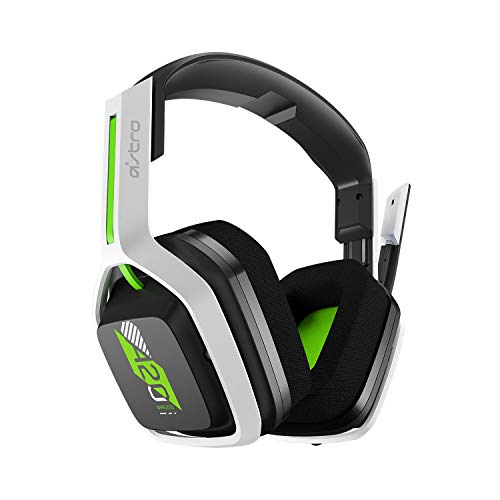
This earlier A20 generation survives in the range for one clear reason: it is the straightforward wireless answer for an Xbox-centred home. A USB transmitter plugs into the console, the headset pairs, and that is the entire setup ceremony. It also works with Windows PCs, which covers the common pattern of an Xbox in the living room and a laptop or desktop in the bedroom. The white and green finish of the listed version announces its allegiance openly, matching the console generation it was designed beside.
Audio comes from 40mm drivers tuned with a warmer, bass-forward hand than the newer model. Single-player adventures and sports titles sound big and forgiving; competitive players may find the low end slightly generous when several explosions stack at once, though Astro’s EQ presets in the companion software let you pull the balance toward footsteps. The headset uses the family’s familiar headband with a suspended cushion arrangement that spreads weight well across long sessions, and the ear cushions are plush enough for glasses wearers to avoid the temple pinch that thinner pads cause.
The microphone flips up to mute, the brand’s signature gesture, and delivers clear narrowband chat that your squad will have no trouble understanding. It will not be mistaken for a broadcast microphone, and it does not try to be. Battery endurance covers several evenings of play between charges over micro-USB — the one visibly dated detail on this model, since the household cable drawer has largely moved to USB-C by now. Keep the included cable somewhere findable and the issue stays minor.
Compatibility discipline is the thing to get right before ordering. This Xbox version is not the PlayStation version, and the two are not interchangeable despite their similar shells. Within its intended ecosystem, though, it remains a rational buy: proven hardware, simple pairing, and a price tier well below the current flagship line. It is also a sensible second headset for a household where the newer model lives on the main console and this one serves the bedroom Xbox or the family PC.
Durability reports from long-term owners are reassuring in the specific way that matters for a family purchase: the failure mode people describe is cosmetic — cushion wear, a scuffed band — rather than electronic death. Replacement cushions are easy to source, and the headset’s simplicity leaves little to go wrong beyond the battery’s slow ageing. In a market where headsets increasingly behave like small computers with update cycles, there is real comfort in a model whose entire manual could fit on an index card and whose behaviour on day three hundred matches day one.
Strengths
Trade-offs
Best for: Xbox-first homes adding wireless to a console and a Windows PC.
Not suited for: PlayStation owners, despite the near-identical appearance of its sibling model.

Astro A10 — Wired survivor
The A10 is the headset Astro sells to people who break headsets. Its frame is built from a damage-resistant polymer with a flexible headband that can be twisted, sat on, and stuffed into a school bag without the cracking sounds that end lesser designs. A single 3.5mm cable connects it to controllers, PCs, handhelds, phones with jacks, and anything else with the universal socket. There is no battery to manage, no firmware to update, and no wireless standard to become obsolete, which is precisely why schools, younger siblings, and spare-room setups keep choosing it.
Sound from its 32mm drivers is honest entry-level audio: dialogue is clear, game worlds have enough low-end presence to feel substantial, and music sounds pleasant if not especially detailed. Competitive players will notice that fine positional cues are less distinct than on the graphene flagship, but at this end of the range the honest competition is other wired headsets, and the A10’s tuning is more balanced than the bloated bass many budget rivals use to impress in the first thirty seconds of a demo.
The flip-to-mute microphone covers party chat and classroom calls without fuss, and an inline volume wheel on the cable handles quick adjustments when a cutscene suddenly shouts. The ear cushions are fabric-faced, which keeps ears cooler and washes better than vinyl, though they soak up a little more ambient noise from the room. Because the cable is the single point of failure on any wired headset, it is worth noting the A10’s lead is sturdy and the headset keeps working with standard replacement cables if the original eventually frays after years of chair-wheel incidents.
Think of the A10 as infrastructure rather than indulgence. It is the headset that lives in the drawer and always works, the one handed to a guest, the one packed for a trip where a lost flagship would sting. Many owners of the expensive models in this guide also own an A10, bought first and never quite retired. That longevity, more than any single specification, explains why a design this old still earns a full section in a current buying guide.
One more audience quietly swears by this model: players on older hardware. A previous-generation console, a handheld from two cycles ago, a PC with no Bluetooth at all — the A10 asks only for the jack that audio equipment has carried for decades. That universality also makes it the easiest headset to lend, gift, or donate onward, because the recipient’s setup is almost guaranteed to accept it. Products at this tier rarely get credit for generosity of compatibility, yet it is the trait owners mention most when explaining why the A10 never quite leaves the house.
Strengths
Trade-offs
Best for: younger players, guests, classrooms, and anyone needing a spare that always works.
Not suited for: players who pace, stream, or sit far from their screen.
Astro A40 TR with MixAmp Pro TR — Tournament veteran
For a decade, the A40 was the headset you saw on broadcast desks, and its silhouette — open-backed earcups, swappable speaker tags, a boom that could mount on either side — still defines what a tournament headset looks like in many players’ minds. It is a wired, open-back design, which gives it a wider, more natural soundstage than any closed model in this guide, at the cost of leaking sound to the room and admitting room noise to you. In a quiet streaming room that trade is glorious. In a shared flat it is antisocial, and the A40 never pretended otherwise.
The MixAmp Pro TR is the other half of the proposition: a desktop mixer with a large volume wheel, a game-to-voice balance dial, EQ presets, and Dolby processing, built for players who adjust audio by touch mid-match. Streamers valued its stream port, which could feed a mixed output to a capture setup without software wrestling. Modern headsets have absorbed some of these tricks into apps, but a physical dial under your fingers remains faster than any menu, and that tactile argument keeps used MixAmps changing hands at healthy prices.
We list the A40 TR as prose-only because new retail stock has largely given way to the wireless era, and the sets circulating now are mostly second-hand or remaining channel inventory of varying completeness. A used A40 without its MixAmp is a different, lesser product; a set with worn ear cushions and a tired headband cushion will need the mod-kit parts that made this line famously customisable. Buy the complete kit or do not buy it at all — that single rule separates the bargains from the disappointments in this corner of the market.
Owners who already have an A40 TR should feel no pressure from this guide. Its soundstage still embarrasses newer closed-back rivals, and its microphone remains perfectly serviceable for streaming. The reasons to move on are lifestyle reasons — wireless freedom, modern console connections, a detachable mic for commuting — rather than any failure of the original design. Few gaming products of its era can say the same, which is why it closes the historical half of this list with its reputation intact.
The A40’s open-back character still pulls enthusiasts toward a discontinued-era product, for reasons worth unpacking. Closed headsets create a sealed pressure world that can feel fatiguing and oddly interior, as if the game were happening inside your skull. The A40 lets sound breathe outward, so a battlefield feels located around you rather than within you, and long sessions carry less of that underwater pressure sensation. Players raised on it often try modern closed flagships, admire the features, and quietly return — a loyalty pattern that says more about acoustic taste than about nostalgia.
Strengths
Trade-offs
Best for: streamers and quiet-room players who value hardware mixing and soundstage.
Not suited for: shared rooms, commuters, or buyers wanting a warranty-backed new purchase.
Astro A50 (previous generation) — Used-market flagship
The fourth-generation A50 was the flagship before the X rewrote the formula, and thousands of them sit on desks today, still docked, still glowing. It offers wireless audio through its base station with optical and USB connections, Dolby processing, and the same drop-in charging routine the new model keeps. Owners remember two things about it fondly — the convenience of the dock and the plush, roomy earcups — and one thing less fondly: a microphone that sounded thinner than the headset’s price promised, a flaw the A50 X was explicitly engineered to answer.
As a used purchase it can make sense at the right discount, with three checks deciding everything. First, battery health: a set that only holds a few hours away from its dock has lost the product’s main convenience, and replacement is not a casual user job. Second, completeness: the base station is not optional, and the correct console-specific version matters, because PlayStation and Xbox variants of this generation were distinct products. Third, connection fit: modern consoles dropped the optical port this generation liked to use, so a PC or older-console home gets an easier life from it than a brand-new console setup.
Compared with its successor, the older A50 cannot switch your television picture between machines, cannot take a Bluetooth call alongside the game, and cannot match the new model’s microphone. What it can do is deliver the docked wireless flagship experience for a fraction of the new cost when bought carefully — as a prose-only entry we describe it rather than link it, because condition varies too much between individual used units for a single listing to represent the product honestly.
If you own one and it still holds charge, the rational upgrade trigger is not sound quality, which remains enjoyable, but friction: the day the optical workaround, the ageing battery, or the thin mic starts annoying you weekly is the day the A50 X earns its keep. Until then this generation remains a respectable flagship in retirement, and its presence in the guide is a reminder that Astro’s ladder has a history worth buying into second-hand when the checks above come back clean.
Strengths
Trade-offs
Best for: careful second-hand shoppers with PC or older-console setups.
Not suited for: shoppers unwilling to gamble on an ageing battery.
Comparison: The Astro Ladder Side by Side
Tables flatten products, so read this one as a map of intentions rather than a league table. Each row is the best answer to a different question, and the notes column names that question honestly.
| Pick | Connection | Platforms | Microphone | Notes |
|---|---|---|---|---|
| Astro A50 X | Wireless via HDMI base station | PS5, Xbox Series, PC, Mac, Bluetooth | Detachable wideband boom | The switchboard for a three-machine television setup |
| Astro A20 X | Wireless via USB transmitter | PlayStation, Xbox, PC, Switch, Bluetooth | Fixed flip-to-mute boom | Platform hopping with no furniture rewiring |
| Astro A20 Gen 2 (Xbox) | Wireless via USB transmitter | Xbox consoles, Windows PC | Flip-to-mute boom | The simple Xbox-household wireless answer |
| Astro A10 | Wired 3.5mm | Anything with a headset jack | Flip-to-mute boom | The indestructible spare and starter |
| Astro A40 TR with MixAmp Pro TR | Wired via desktop mixer | Optical-era consoles, PC | Detachable boom | Open-back soundstage and hardware mixing |
| Astro A50 (previous generation) | Wireless via charging dock | Console-specific editions, PC | Flip-to-mute boom | Retired flagship, bought used with care |
Two patterns stand out once the range is laid flat. First, microphone quality climbs steeply at the current top of the range and is merely adequate everywhere else — voice is where the generational money went. Second, platform freedom and infrastructure demand rise together: the more machines a headset serves, the more hardware it asks you to install. Your job as a buyer is simply to locate your household on those two slopes and stop at the rung that matches, because every rung above it charges rent for capacity you will not use.
Which Astro connection type fits the machines on your desk?
Choosing inside this brand is mostly choosing a connection philosophy. The wired path, represented by the A10 and the historical A40, asks nothing of you: plug in, play, put it away. It suits single-device players, children, and anyone whose gaming happens within cable reach of a controller. Its hidden cost is immobility — you will feel the tether the first time you stand up with the headset on, and everyone in this hobby has exactly one story about a controller pulled off a table.
USB-transmitter wireless, the A20 pattern, removes the tether for one or two machines without asking you to rewire entertainment furniture. It suits the console-plus-PC majority. Its discipline is charging: a cable at the desk and a habit of plugging in twice a week keeps it invisible as an issue. Base-station wireless, the A50 pattern, is for households where the television is a shared switching hub for several machines. It replaces cable swapping with dock living, and its discipline is placement — the dock needs a permanent home with power and HDMI access, not a temporary perch.
A practical test before spending: count how many devices you played on in the last fortnight, and how many times you moved between them mid-evening. One device points to the A10 or A20 Gen 2. Two devices with mid-evening swaps point to the A20 X. Three devices, or two consoles sharing one television input, is the only pattern that truly feeds the A50 X. Buying above your pattern buys features you will demonstrate to visitors once and then ignore, while buying below it creates a daily annoyance that no saving justifies.
How should you set up an Astro headset for clear party chat?
Start with fit, because microphone position follows earcup position. The boom should end a finger’s width from the corner of your mouth, not directly in front of your lips, where breath noise lives. On the flip-to-mute models, practise the flip until it is muscle memory; the gesture only protects you from broadcasting a private conversation if you actually use it in the half-second before you speak.
Next, set levels in the right order. Put the headset’s own volume at a comfortable maximum-safe level, then adjust the console or PC output so that game audio sits under your friends’ voices, using the game/voice balance control where your model offers one. Most “my headset sounds muddy” complaints are actually balance complaints: effects mixed too hot against chat. Finally, check what your friends hear with a short recorded clip or the console’s mic test, and speak at your normal volume rather than performing for the test. A mic that only sounds good when you lean in and project will fail you during a tired late-night session.
Wireless owners should also place transmitters and docks with a clear line to the play position, away from the tangle of power bricks behind the console where interference and heat gather. Wired owners should route the cable so chair wheels never cross it; more A10-class headsets die from wheel damage than from any electronic failure. These are small rituals, but party chat quality is built from small rituals repeated until they disappear.
What does living with a charging dock actually change?
Dock owners consistently report the same unexpected benefit: the headset is always in the same place. No drawer hunt, no cable excavation, no session delayed by a flat battery discovered at the worst moment — provided the headset goes back on the dock every night. The dock converts charging from a task into a parking habit. It also converts your TV stand into a small equipment bay, with power and HDMI runs that need to be planned rather than improvised, which is why the A50 X rewards a settled living room and frustrates a frequently rearranged student setup.
Cable-charged wireless models like the A20 pair ask slightly more discipline and give slightly more freedom in return. They can travel to a friend’s house without their infrastructure, work from a sofa far from the dock’s home, and top up from a laptop port. The honest summary is that docks optimise a fixed gaming station while transmitter models optimise a life that happens in several rooms. Neither is the premium choice in the abstract; each is premium for a different geography of play.
There is a broader comfort point worth making for shared and solo players alike: clamp force is the specification nobody prints and everybody feels. Astro’s suspended bands cheat the problem by floating the headset’s weight on a strap, so the earcups can seal gently instead of gripping. If you have ever finished a session with a tender jaw and blamed your headphones’ padding, the culprit was probably grip, not foam — and it is the single strongest reason this brand’s older designs remain comfortable benchmarks against which newer, heavier rivals are quietly measured.
How long should an Astro headset last, and what wears out first?
Ear cushions are the first casualty on every model here, typically softening or flaking after a couple of years of nightly use, and they are also the cheapest fix — every current Astro accepts replacement pads, and fitting them restores much of the original comfort and seal. Headband cushions follow the same curve. Treat pads as consumables, like controller thumbsticks, and the headsets themselves are built to outlast several sets of them.
Batteries are the second clock, ticking only on the wireless models. A docked A50 lives a gentle life of shallow cycles, which lithium cells prefer; a transmitter model left flat in a drawer for months ages faster than one used weekly. If you buy the A20 class, use it or charge it monthly. Cables are the third clock, and they govern the wired picks: the A10’s lead will eventually fray at a strain relief if it is yanked daily, which is a cheap failure compared with a dead wireless battery sealed inside an earcup.
Electronics, honestly, rarely die first on this brand’s hardware. Drivers and wireless boards from the previous decade still work in the wild, which is why the used market in the older picks is as active as it is. Your realistic planning horizon is five years of heavy use for a current model, with one cushion change midway — a lifespan that reframes the price differences in this guide considerably when spread across the evenings involved.
Gift buyers form one more quiet constituency for this range, and their calculus differs from self-purchasers. A gift headset must work on Christmas morning without a firmware saga, fit a head you have never measured, and survive being loved roughly. That brief points squarely at the wired A10 for younger recipients and the transmitter-based A20 X for older ones, reserving the docked flagship for the rare gift where you also know the recipient’s television cabinet personally. The platform-variant trap matters doubly here, because a gift in the wrong console flavour fails publicly and immediately — check the recipient’s machine, not their wishlist’s photograph of it.
What changes when a household shares one Astro between several players?
Shared headsets live harder lives than personal ones, and the Astro range quietly anticipates this. The A10’s replaceable-everything simplicity and crush-proof frame make it the natural communal set, while the wireless models reward a household rule — one dock or one charging cable, always in the same place — that prevents the archaeology of searching for a transmitter at midnight. If several heads of different sizes share a set, prioritise the suspended headband designs, which adapt without the ratchet-click ritual that smaller players often set wrong and then endure.
Hygiene deserves one honest paragraph. Fabric cushions can be removed and washed; leatherette wipes clean in seconds but cracks sooner under enthusiastic cleaning. A shared headset wiped down weekly and stored on a stand rather than a hook through its headband will outlast a pampered personal set stored badly. And set a household chat rule early: flip-to-mute exists so that the room’s private conversations stay private, a courtesy that visiting friends will appreciate more than any sound quality you could buy.
Finally, consider whose name is on the purchase when a household shares. The flagship’s app profiles and EQ presets live on one account and one PC, which suits a single enthusiast’s station. A family room is often better served by the models that behave identically for whoever picks them up. Bear in mind, too, that a headset is the one gaming purchase your household hears as well as sees: dock lights glowing in a dark room and a boom left live during a family film both register with people who never touch a controller, and choosing with them in mind is simply good household politics. The most sophisticated headset is not always the most democratic one, and shared living rooms run on democracy.
Common Mistakes When Buying an Astro Headset
More Astro returns trace to one slip than to any defect: buying the wrong platform variant of a mid-tier model. The A20 generations were sold in console-specific editions whose shells look interchangeable in product photos, and a PlayStation household that orders the Xbox version discovers the mistake only at pairing time. Read the platform line twice before checkout, and treat marketplace listings with vague platform descriptions as a risk rather than a bargain.
A second error is paying flagship money to solve a microphone problem with a headset change when the real culprit is mic position or a console chat setting. Astro’s current wideband models genuinely improve voice quality, but a boom placed at your chin and a chat mixer buried in a menu will sabotage any of them. Exhaust the free fixes first; then upgrade with a clear conscience.
Third, used-market shoppers routinely price an older A50 by the headset alone and forget the base station is half the product. A listing without the correct dock is not a cheap flagship, it is an incomplete one. Fourth, wired buyers underestimate cable length in reclined setups: measure from controller to your actual seated head position, including slouch, before assuming the included lead reaches. Finally, do not buy the open-back A40 for a shared room out of nostalgia for its soundstage; the leak is real, and your household will vote on it nightly.
Astros also carry an unusual amount of second-system value. Because the brand’s transmitters, docks, and cables stayed consistent across long product runs, a headset retired from the main television often begins a second career on a bedroom PC or a child’s console without new purchases. That cascade — flagship to hand-me-down to spare — is how many households quietly end up owning three Astros while remembering buying one. When you price any model in this guide, it is fair to count that cascade as part of the return, because a headset that stays useful somewhere in the house for a decade has earned differently from one that becomes e-waste at its first battery failure.
Final Recommendation
Most readers should start at the A20 X and argue themselves upward or downward from there. It carries the brand’s best idea — painless platform movement — in its least demanding form, with a microphone that flatters and cushions that breathe. Argue upward to the A50 X only if your television genuinely hosts both consoles and a PC, because that is the problem its dock was born to solve, and in that home it is transformative rather than indulgent. Argue downward to the A20 Gen 2 if your world is Xbox and Windows alone, or to the A10 if the headset must survive children, travel bags, and years of cheerful neglect.
The two prose-only veterans frame the decision rather than compete in it. A complete, healthy A40 TR kit or previous-generation A50 can still be the smartest money in this guide when bought with open eyes. But for a new purchase with a warranty, the ladder is clear, and every rung on it is defensible. Choose by your rooms and your machines, not by the size of the number after the letter A. That habit, repeated across a whole desk setup, is what separates a battlestation that serves you from a collection of trophies that you serve. An Astro bought for the life you actually live will still be on your head, earning its keep, long after a spec-sheet trophy would have been returned.
Frequently Asked Questions
Does the Astro A50 X really switch the television picture as well as the audio?
Yes — that is its defining feature. Consoles connect to the base station by HDMI and USB, the station passes video to the TV, and one button cycles the active machine. Your screen, game sound, and chat all move together, which no transmitter-only headset can do.
Can one Astro headset work on both PlayStation and Xbox?
The current A50 X and A20 X are built for exactly that, using platform switching. Older generations, including the A20 Gen 2 and the previous A50, were sold as console-specific editions, so a used purchase must match your console family.
Is the A10 good enough for online classes and calls, or is it only for games?
It handles calls perfectly well. The flip-to-mute boom is clear for speech, the 3.5mm plug fits school laptops and tablets, and there is no battery to die before a morning lesson. It is a game-styled design doing a thoroughly respectable second job.
What should I check first on a used Astro A50?
Battery endurance away from the dock, then completeness. Ask how long a full charge lasts in play, confirm the correct console version of the base station is included with its cables, and inspect ear cushions for flaking before agreeing a price.
Do Astro headsets work with Nintendo Switch?
The A20 X lists Switch systems among its wireless platforms, and any Astro with a 3.5mm plug, such as the A10, works with a Switch in handheld mode through the headphone jack. Docked play with voice chat follows Nintendo’s own app-based arrangement.
Why does my party say I sound quiet on my Astro?
Usually the boom sits too far from your mouth or the console’s microphone level is set low. Angle the boom toward the corner of your mouth, raise the input level in your platform’s audio settings, and re-test at normal speaking volume before blaming the hardware.
Should I replace my older Astro or keep it another year?
Keep it if three things still hold: the battery survives your longest typical session, the cushions can be refreshed cheaply, and its connections still suit the consoles you own. Replace it when any one of those fails structurally — a battery that strands you mid-evening, a console upgrade that orphaned its connection type, or a microphone your team mates comment on weekly. Cosmetic wear alone is not a reason; this brand’s hardware was built to look used and keep working.
Are Astro headsets comfortable with glasses?
Generally yes, and the suspended headband models are the kindest of the range because they spread pressure above the frames rather than clamping the temples. The plush cushions on the A20 generations and both A50 generations give spectacle arms room to sit without being pressed into the skin. If you wear thick frames, favour cloth cushions over stiff leatherette, and take the thirty seconds to seat the headset after putting your glasses on, not before.
Related Guides
Building out the rest of your desk? These guides continue the same verified-pick approach in neighbouring categories: best barebones keyboards for a keyboard you assemble around your own switches, best blutooth keyboards for designers if your work is visual and your desk is shared with a drawing tablet, and best 15-inch laptop backpacks for carrying the whole setup out of the house. A headset chosen this carefully deserves a keyboard and a bag chosen the same way.


