Our Top Picks


What's inside
- Best Purple Digital Cameras: Honest Picks for Kids, Teens, and First-Time Shooters
- What the Purple Camera Market Actually Looks Like
- Why Buy a Purple Camera at All?
- How to Choose a Purple Digital Camera
- The Six Purple Cameras, One by One
- Comparing the Six Side by Side
- Getting the Best From a Starter Purple Camera
- Frequently Asked Questions
- Check prices on Amazon
- Conclusion
As an Amazon Associate I earn from qualifying purchases. This post may contain affiliate links at no extra cost to you.
Best Purple Digital Cameras: Honest Picks for Kids, Teens, and First-Time Shooters
If you searched for a purple digital camera hoping to find a rainbow of options from every major camera maker, the current market will surprise you. The purple cameras actually available to buy new today, with a card in the box and a listing you can order from, are almost entirely compact point-and-shoot models aimed at children, teenagers, and complete beginners. That is not a flaw in your search. It is simply what this color category looks like right now, and understanding it upfront will save you money and disappointment.
This guide is built around six purple cameras that our research found listed with clear product details: a stated video resolution, a stated photo resolution where the maker provides one, a digital zoom figure, anti-shake on most models, and in every case a memory card included in the box. Every one of them is a small, simple, fixed-lens camera designed to be picked up, switched on, and used without a manual the size of a novel. None of them is a professional tool, none of them is an interchangeable-lens system, and none of them should be bought expecting the image quality of a flagship phone or a dedicated enthusiast camera. What they offer instead is something phones do not: a real camera shape in a favorite color, physical simplicity, a screen that belongs to photography alone, and a device a young person can call their own without handing over a family smartphone.
We will be straightforward throughout about what this class of camera can and cannot do. We compared listings, checked what each box actually includes, and paid close attention to the difference between headline numbers and everyday usefulness. Along the way we will explain why the big brands largely left this color behind, how to read megapixel and zoom claims on entry-level cameras, why the included memory card matters more than most buyers realize, and which of these six purple models fits which kind of first-time photographer.
What the Purple Camera Market Actually Looks Like
Color used to be a genuine battleground in compact cameras. In the late two thousands and early twenty tens, major manufacturers sold point-and-shoot cameras in purple, violet, pink, blue, and a dozen other finishes, and a purple body from a famous name was easy to find on a store shelf. Those color lines were discontinued long ago as phone cameras took over the casual market and the surviving compact ranges shrank to a handful of mostly black and silver models. The purple versions of big-brand cameras are therefore not part of this guide. They belong to the used market, where condition, battery health, and charger availability vary wildly from one listing to the next, and where a nostalgic color can carry a price that has little to do with photographic value.
What replaced them is a large, lively category of entry-level digital cameras sold under lesser-known names, aimed squarely at kids, teens, students, and gift buyers. Purple is one of the most popular colors in this category, alongside pink and blue, because the buyers choosing these cameras care about personality as much as specifications. The typical purple camera in this class records Full HD video, offers digital rather than optical zoom, includes a memory card so it works straight out of the box, and keeps its controls deliberately simple. Several models in this guide add features pitched at young users, such as filters, face detection, and smile capture, which are software touches rather than optical advances, but which genuinely add fun for the audience they are built for.
Setting expectations correctly is the single most valuable thing a buyer can do here. A purple starter camera is a first camera, a party camera, a holiday camera, a school-project camera, and a gift that encourages a child to look at the world through a viewfinder or screen of their own. Judged on those terms, the best of them are charming and worthwhile. Judged as rivals to a modern smartphone’s main camera, they will fall short, because smartphone computational photography is far ahead of what simple dedicated hardware at this level can do. Buy one for the experience, the independence, and the joy of the color, and you will be buying it for the right reasons.
Why Buy a Purple Camera at All?
The color itself is a legitimate reason, and it is worth saying so without embarrassment. Photography is a hobby people stick with when their equipment feels personal, and a camera in a favorite color gets picked up more often, carried more willingly, and treated with more affection than a generic black box borrowed from a drawer. For a child receiving a first camera as a birthday or Christmas gift, the purple finish is often the difference between a gadget that is used for a weekend and one that becomes a constant companion on walks, trips, and family gatherings.
There are practical advantages to a dedicated starter camera too. It has no notifications, no messages, no games competing for attention, and no access to apps or accounts, which makes it a comfortable choice for younger children whose parents are not ready to hand over a phone. It can be dropped, within reason, without risking the device the family relies on for communication. Its battery and card belong to it alone, so a day of photography never drains the phone a parent needs for the drive home. And because these cameras are compact and light, they fit in small hands, small bags, and jacket pockets, which means they actually get taken along.
Finally, there is real educational value in a simple camera. A child who frames a shot on a dedicated screen, waits for the moment, and reviews the result later is learning the core habits of photography in a way that tapping a phone screen does not always encourage. If that interest grows, broader guides such as best point and shoot cameras for kids can help you plan the next step, but the first step is simply a camera the young photographer loves looking at and loves using.
How to Choose a Purple Digital Camera
Resolution on the box versus resolution in real life
Entry-level cameras advertise two different resolution figures, and confusing them is the most common buying mistake in this category. The video figure, usually Full HD 1080P and in one case here 4K, describes the size of the moving footage the camera records. The photo figure, stated in megapixels on several of these models, describes the size of still images. Both numbers deserve a calm reading. On inexpensive cameras, high megapixel counts are frequently achieved with small sensors and processing that interpolates detail, so a camera claiming a very high stills figure does not automatically produce sharper real-world photos than one claiming a lower figure. Treat the headline number as a rough guide to the file sizes you will get, not as a promise of professional sharpness.
What matters more for everyday satisfaction is consistency: a camera that focuses reliably, exposes scenes sensibly, and produces pleasant color in daylight will make its owner happier than one with a bigger number and fussier behavior. All six cameras here are at their best outdoors or in bright indoor light. In dim rooms, every camera in this class struggles to some degree, because small sensors gather little light, and no headline figure changes that physics. Buy for bright, happy, everyday scenes and you will be pleased. Expect miracles after dark and you will not.
Digital zoom, explained plainly
Every camera in this guide offers 16X digital zoom, and it is important to understand what that term means. Optical zoom uses moving lens elements to magnify the scene before it reaches the sensor, preserving detail. Digital zoom crops into the image and enlarges the middle portion, which discards detail as you push further. On a starter camera, digital zoom is best thought of as a framing convenience: useful for getting a little closer to a subject at a school play or a pet across the garden, but not a substitute for walking nearer. The happiest results come from using modest amounts of zoom, or none, and moving your feet instead. Young photographers learn this quickly, and it is a genuinely useful lesson about how cameras see.
Anti-shake and why it helps beginners
Most of the cameras here list anti-shake, which in this class means electronic assistance that reduces the effect of small hand movements. Small cameras are light, small hands are not always steady, and beginners tend to jab the shutter button, so this feature earns its place. It will not freeze fast action and it will not rescue a photo taken while running, but for portraits of friends, pictures of pets sitting still, and scenes around the home, it noticeably improves the keeper rate. Combined with the face detection and smile capture offered on one model here, it reflects a design philosophy aimed at helping new photographers succeed early and often.
The memory card in the box
Every camera in this guide includes a memory card, and the capacity differs in a way that matters. Models with a 32GB card give a young photographer a healthy amount of room for photos and short Full HD clips, and for many children that is plenty for weeks of casual use. Models with a 64GB card double that breathing room, which suits teens who shoot more video, vlog-style clips, or long days out without a computer nearby to empty the card. The deeper point is that an included card makes the camera a complete gift: there is no disappointing moment on the birthday morning when the camera cannot save a single picture for want of a card nobody bought. Check the listing details for the exact card included with the model you choose, and consider a small card reader, which one model here helpfully includes, if your household computer lacks a card slot.
Batteries, charging, and spares
Battery arrangements are easy to overlook and hard to forgive on a day out. One camera in this guide stands out by including two batteries and a charger, which is a thoughtful touch for families, because a spare battery turns a flat camera back into a working one in seconds. For the other models, our research suggests checking the listing for exactly what power accessories are supplied, and planning around charging before trips and events. A camera that lives in a child’s bag should be charged the night before an outing as a matter of routine, and a spare, where the model supports one, is among the cheapest happiness insurance in photography.
Screen size and handling
One model here specifies a 3-inch screen, which is generous in this class and makes framing and reviewing photos easier for young eyes and for grandparents helping out. On models where the listing does not emphasize screen size, expect a compact rear screen suited to composing simple scenes and checking results. Handling matters just as much: a lanyard, included with one model here, is a small accessory that prevents a large number of drops, and compact bodies with simple layouts are easier for small hands to grip and operate than anything pretending to be a miniature professional camera.
Who the camera is really for
Listings in this category name their audience honestly: kids, teens, starters, students, and gift buyers. Take that guidance seriously. A purple starter camera is a poor purchase for an adult enthusiast who wants manual control and pristine files, and a wonderful purchase for a nine-year-old who wants to document a holiday, a teen who wants a retro-feeling digicam for fun with friends, or a student who needs simple documentation for projects. Matching the camera to the person is the whole art of choosing in this category, and the product sections below are written with specific people in mind.
The Six Purple Cameras, One by One
1. FHD 1080P Point and Shoot Camera for Kids, Teens and Starters, Purple, with 32GB Card
This first model is perhaps the purest expression of what this category is about. Its listing describes a Full HD 1080P point-and-shoot camera for kids, teens, and starters, finished in purple, supplied with a 32GB card, and equipped with filters, 16X zoom, and anti-shake in a compact, small body that is easy to use. The positioning is gift-first: the listing names Christmas and birthdays and boys and girls directly, which tells you exactly the moment this camera is designed for, the unwrapping, the first switch-on, and the first photograph taken within minutes because everything needed is already in the box.
The feature set is sensibly chosen for that moment. Filters give a young photographer creative variety without any editing knowledge, turning an ordinary garden photo into something playful to share with family. Anti-shake supports unsteady small hands. The 16X digital zoom, used gently, helps frame subjects that cannot be approached, such as birds at a feeder or performers on a stage. The 32GB card removes the last barrier between opening the box and making pictures. Nothing here pretends to be more than it is, and that honesty in positioning is a point in its favor.
Who should choose this one? It is the natural pick for a younger child’s first camera, particularly as a planned gift where the giver wants a complete, cheerful package with no extra purchases required. Its emphasis on ease of use suits children who would be frustrated by menus and modes. Teens with more ambitious video plans may prefer one of the 64GB models below, and anyone prioritizing a spare battery should look at the second camera in this guide, but as a straightforward, friendly introduction to photography in a joyful color, this model understands its job completely.
2. Digital Camera 1080P with 32G Card, 16X Zoom and 3-Inch Screen, Purple, with Two Batteries
The second camera in this guide distinguishes itself with the most practical accessory bundle of the six: alongside a 32G card, 16X zoom, and a notably large 3-inch screen, its listing includes two batteries and a charger. That single detail changes the ownership experience more than any headline resolution figure could. Families who have watched a child’s camera die halfway through a zoo trip will understand immediately why a spare battery matters, and why we checked this listing twice to be sure the second battery was really part of the offer.
The 3-inch screen is the other headline here. In a class where screens are often merely adequate, a larger display makes composition easier, reviewing photos with friends more sociable, and menu navigation less squinty for younger users and the adults helping them. Anti-shake is included as well, rounding out a package that feels designed by someone who has actually watched children use cameras: big screen, steady help, plenty of power, card included, done.
This model is described as easy for kids, and its bundle supports that claim in practical rather than marketing terms. Ease of use is not only about buttons. It is about the camera being ready when the moment arrives, and readiness is exactly what two batteries and a charger deliver. For a family buying one purple camera to be shared between siblings, or for a child who shoots a lot on trips and camps where charging opportunities are scarce, this is arguably the most sensible purchase in the entire guide.
Choose this camera if reliability across a long day matters more to you than maximum card capacity or the highest stated photo resolution. Its 1080P video matches most of the field, its zoom matches the field, and its screen and power arrangements beat the field. It is the workhorse of this purple lineup, dressed in a color that makes the work feel like play.
3. 2026 New Digital Camera, 56MP, FHD 1080P, Purple, with Face Detect and Smile Capture
The third model presents itself as a 2026 design and leads with the highest stated stills figure in this guide, 56MP, alongside FHD 1080P video, 16x digital zoom, anti-shake, a 32GB TF card, a battery, and a lanyard, all in purple. It also adds two features aimed directly at photographing people: face detection and smile capture. Those additions make it the most portrait-minded camera here, and they shape who should buy it.
Face detection helps a beginner by having the camera recognize where the faces are and prioritize them for focus and exposure, which is precisely the assistance a child photographing friends and family needs. Smile capture goes a step further in spirit, firing at the happy moment and increasing the chance of a natural expression rather than a blink. In practice, features like these are about keeper rate, the proportion of shots that come out well enough to keep, and for young photographers, a high keeper rate is what turns early enthusiasm into a lasting hobby.
The megapixel figure deserves the calm reading we recommended earlier. A 56MP claim on an entry-level camera should be understood as a statement about file size rather than a guarantee of fine detail rivaling far more expensive hardware. Buyers who understand that will enjoy this camera for what it genuinely offers: modern presentation, people-friendly automation, a handy lanyard that guards against drops, and a complete in-box kit built around a 32GB card. Buyers chasing the number itself, expecting it to transform image quality, are shopping with the wrong compass, here and everywhere in this class.
This is the purple camera for the socially minded young photographer: the one whose camera roll will be full of friends, cousins, teammates, and family gatherings. If your intended photographer’s favorite subject is people and laughter, the combination of face detection and smile capture makes this model the most tailored choice in the guide.
4. Digital Camera, 44MP, Full HD 1080P, Purple, with 64GB Card
The fourth camera pairs a stated 44MP stills figure and Full HD 1080P video with the larger of the two card capacities in this guide, 64GB, plus anti-shake and 16X zoom in a compact body pitched as a vlog camera and a portable small digicam gift for kids and teens. The 64GB card is its quiet superpower. Storage is the constraint that ends shooting days, and doubling it relative to the 32GB models gives a teen creator real freedom to film clips, retake them, and keep filming without the nagging arithmetic of what to delete.
The vlog positioning is worth taking seriously within the limits of the class. A young creator who wants to record pieces to camera, document a hobby, or film a day out with friends needs three things from a starter device: adequate Full HD video, enough storage to be carefree, and a body small enough to carry everywhere. This model addresses all three directly. Its anti-shake support helps handheld clips, and its compact digicam format suits the informal, personal style that makes beginner vlogging fun rather than intimidating.
The 44MP stills claim sits in the middle of this guide’s range and should be read the same way as every figure here: as file size guidance, not a sharpness promise. The honest strengths of this camera are its capacity, its portability, and its clear sense of audience. The listing names teen girls and boys and kids as gift recipients, and the specification supports slightly older children better than the very youngest, because the value of 64GB only reveals itself to someone who shoots enough to fill 32GB.
Choose this model for the teen who has already shown they will use a camera heavily, the young vlogger experimenting with video, or any photographer planning long trips away from a computer. Among the six, it is the capacity pick, and capacity, unglamorous as it sounds, is what creative freedom is made of at this level.
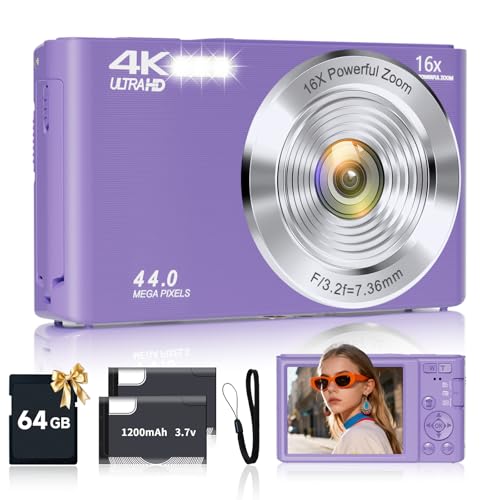
5. FHD 4K Digital Camera for Kids, Purple, with 64GB SD Card and Autofocus
The fifth camera is the video headline of the guide: it is listed as an FHD 4K digital camera for kids in purple, with a 64GB SD card, 16X digital zoom, a compact point-and-shoot body aimed at teen boys, girls, and kids, and autofocus. The combination of the highest stated video resolution here with the larger card capacity makes it the natural choice for the most video-curious young photographer in the family.
A word of proportion about 4K in this class is important. A 4K label on an entry-level camera describes the dimensions of the recorded file, and it does not by itself guarantee the fluidity, stabilization sophistication, or low-light grace of premium video gear. What it does offer a young creator is footage with more resolution to play with, a sense of shooting in a modern format, and files that look at home on today’s screens for family viewing. Paired with 64GB of storage, which higher-resolution video consumes quickly, the specification is at least internally sensible: the bigger appetite comes with the bigger plate.
Autofocus is the other detail worth highlighting, because focusing is where beginners lose the most shots. A camera that handles focus automatically and competently lets a child concentrate on the genuinely creative decisions, where to stand, when to press, what to include, rather than fighting the machinery. For kids moving from stills into video, reliable autofocus is arguably more valuable than any resolution figure, because a sharp, well-focused Full HD or 4K clip of a family moment will be treasured long after format specifications are forgotten.
Choose this camera for the video-first child or teen: the one filming skateboard attempts, dance routines, pet documentaries, and holiday tours. If stills are the priority and video an afterthought, other models here may suit better and simpler needs, but for moving pictures in purple, this is the guide’s clearest recommendation. Families comparing formats more broadly may also enjoy browsing best fuji instant cameras to see how different a film-based route feels, though that is a different hobby entirely.
6. Kids Camera 1080P, Vlog Camera, Purple, with 64GB Card and Card Reader, 44MP
The sixth camera closes the guide with the most complete transfer story of the six: a kids’ camera recording 1080P video, positioned also as a vlog camera, finished in purple, with a 64GB card, 16X zoom, anti-shake, a card reader included, and a stated 44MP stills figure in a compact, portable, small point-and-shoot body. The card reader is a small inclusion with outsized everyday value, because the best photograph in the world does a child no good if it stays trapped on a card nobody can read.
Households vary enormously in their computers. Many modern laptops have no card slot at all, and a young photographer who cannot move photos to a family computer, a school machine, or a tablet for sharing will lose momentum fast. By including a reader, this model completes the whole loop of photography, shoot, transfer, view, share, in a single box. Combined with 64GB of capacity, it supports the full habit rather than just the first half of it, and that completeness suits students in particular, which the listing acknowledges by naming students and children and teens among its audience.
Its stills and video figures, 44MP and 1080P, match the middle of this guide’s field, and its anti-shake and zoom match the field as well. The differentiation here is workflow, and workflow is a mature thing to shop for. A slightly lower video ceiling than the 4K model is a fair trade for families who value easy transfer and generous storage, and who know their young photographer’s audience is family screens and school projects rather than large displays.
Choose this camera for the student, the organized young creator, and any household where photos are meant to be shared, printed for projects, or archived on the family computer. It is the most end-to-end thoughtful package in the guide, and a fitting final entry in a lineup where the differences are about real life rather than spec-sheet drama.
Comparing the Six Side by Side
Stepping back, the six cameras divide along a few clear axes. On video, five record at 1080P Full HD while the fifth model in this guide adds a 4K claim for the video-first buyer. On stills, three models state megapixel figures in the mid-forties, one states the highest figure at 56MP, and two lead with their video specification and bundle instead, a reminder that in this class the bundle often matters more than the number. On storage, the field splits evenly between 32GB cards, which suit younger and lighter users, and 64GB cards, which suit teens, vloggers, and travelers.
On distinctive extras, each camera has a claim to a particular buyer. The first model’s filters and gift-ready simplicity suit the youngest first-time owners. The second model’s twin batteries, charger, and 3-inch screen suit families and heavy day-long use. The third model’s face detection and smile capture suit the people photographer. The fourth model’s 64GB capacity and vlog pitch suit the prolific teen creator. The fifth model’s 4K video and autofocus suit the aspiring videographer. The sixth model’s card reader and generous card suit the student who needs to move and share work. There is no single winner, and any guide that crowned one without asking who it is for would be misleading you.
What all six share is the honest core of the category: compact purple bodies, digital zoom rather than optical, simple controls, included storage, and a purpose built around fun, learning, and gifts rather than professional output. If your needs extend beyond that core, toward interchangeable lenses, large sensors, or serious low-light work, this entire category is the wrong shelf, and it is better to know that now. If your needs match the core, any of these six will deliver what it promises, and the choice becomes a pleasant one about which extras fit your photographer best. Readers curious about a different kind of colorful, giftable photography might enjoy best instant cameras for kids, where the picture appears in your hand instead of on a card.
Getting the Best From a Starter Purple Camera
A few habits multiply the value of any camera in this guide. Shoot in daylight whenever possible, because every small-sensor camera rewards bright scenes with its best color and clarity. Get closer instead of zooming to the maximum, because digital zoom spends detail you do not have to spare. Hold the camera with both hands and tuck elbows in, letting anti-shake help rather than asking it to perform miracles. Review photos together at the end of the day, deleting obvious misses and celebrating keepers, because that ritual is where young photographers actually improve.
Finally, set the creative tone early. A purple camera invites playful projects: photograph everything purple for a week, document a pet’s day, shoot a family event from a child’s eye height, or make a photo alphabet around the neighborhood. Projects give a new camera purpose beyond the first weekend, and purpose is what turns a gift into a hobby. For families whose young photographer outgrows this class and starts asking about image quality above all, best 5 compact cameras by image quality is a sensible direction to explore next.
Frequently Asked Questions
Are purple digital cameras professional cameras?
No, not the ones available new today. The current purple market consists of entry-level point-and-shoot cameras for kids, teens, students, and beginners. They are designed for fun, gifts, and learning, with simple controls and included memory cards. Professional cameras are almost universally black, are sold body-only at far higher cost, and are a completely different category of product.
Why are there no purple cameras from the big brands in this guide?
Major manufacturers sold colorful compact cameras years ago, including purple finishes, but those lines were discontinued long ago as the casual camera market shrank. Remaining examples are used items with variable condition and aging batteries, so we focused this guide on new cameras with clear listings, stated specifications, and complete in-box kits that a gift buyer can rely on.
What does 16X digital zoom actually do?
Digital zoom crops into the center of the image and enlarges it, which makes subjects appear closer while reducing detail. It is handy for modest framing adjustments at a distance, but the best results come from using a little zoom or none and moving closer to your subject whenever you can. None of the cameras in this guide offers optical zoom, which is normal for this class.
Is a 56MP camera much better than a 44MP camera here?
Not necessarily in real-world photos. On entry-level cameras, high megapixel figures describe file size and are often achieved through processing on small sensors, so they do not translate directly into sharper pictures. Focus reliability, good light, steady hands, and sensible exposure matter far more to the photos a young photographer brings home. Choose between these models on bundle, storage, screen, and features rather than the megapixel headline alone.
Which card size should I choose, 32GB or 64GB?
Choose 32GB for younger children and lighter, photo-focused use, where it provides ample room for casual shooting. Choose 64GB for teens, video, vlogging, and long trips away from a computer, where footage fills space quickly. Every camera in this guide includes its card, so either way the camera works straight out of the box.
Can these cameras replace a smartphone camera?
They are better understood as companions to a phone than replacements for one. A modern phone will usually produce more polished images, especially in low light. The purple camera’s value is different: it is a dedicated, distraction-free device a child can own, carry, and learn on, with no apps, accounts, or messages attached. Many families find that difference is exactly the point.
Which of the six is best for video?
The 4K-listed model with 64GB storage and autofocus is the natural video pick, with the two other 64GB models close behind for Full HD vlogging and clips. Storage matters as much as resolution for video, because footage fills cards quickly, so any of the 64GB cameras will serve a young videographer better than a 32GB model over a long day.
Which is best for a young child’s very first camera?
The first model in this guide, with its filters, anti-shake, included 32GB card, and gift-focused simplicity, is the gentlest introduction. The second model is a strong alternative if the child will shoot on long family days out, thanks to its spare battery and larger screen. For either, the lanyard habit and a simple carry pouch will prevent most accidents.
Check prices on Amazon
Live listings for the shortlist in this guide are pulled from Amazon below, so prices and availability are always current at the moment you look.


Conclusion
The best purple digital camera is the one matched honestly to its photographer. This category is not about professional hardware in a playful color. It is about first cameras, gift cameras, and fun cameras that happen to come in a color their owners adore, and judged on those terms, all six models here have a genuine case. The gift-ready simplicity of the first, the twin batteries and big screen of the second, the people-friendly automation of the third, the generous storage of the fourth, the video ambition of the fifth, and the complete shoot-to-share workflow of the sixth each answer a different family’s needs.
Our research kept returning to the same conclusion: in this class, the bundle is the specification. An included card, a spare battery, a card reader, a lanyard, a bigger screen, these are the details that decide whether a purple camera is used daily or drawer-bound by February. Read the megapixel and zoom figures calmly, buy the extras that fit your photographer’s real life, and set expectations at bright, joyful, everyday photography. Do that, and a little purple camera can be the start of a lifelong habit of noticing the world, which is worth far more than any number printed on a box.
Affiliate disclosure: This guide was prepared independently from manufacturer materials and retail listings, and it may contain affiliate links. If you buy one of these cameras through a link on this page, the site may earn a commission from the retailer at no additional cost to you. That possibility never decides which cameras appear here or how they are described: the six models above were selected because their listings clearly state their format, storage, and intended audience, and we have been candid throughout about the limits of this entry-level class, including where a smartphone will outperform them. Prices and availability change frequently, so please confirm the current details, the exact card and accessories included, and the color on the product page before ordering, and thank you for supporting independent buying guidance written for real families rather than for spec sheets.


