Our Top Picks


What's inside
- Portable PA speakers solve a different problem than party speakers
- Match the system to audience, venue, and voice first
- Power ratings, sensitivity, and the numbers game
- Microphones: the half of the system buyers underestimate
- Inputs, mixing, and connecting everything else
- Battery life claims and power strategy for long days
- Carrying, mounting, and surviving real venues
- Feedback, placement, and getting clear sound on the day
- Choosing by scenario: a practical tour of typical buyers
- Durability, warranties, and the cost of ownership
- Accessories that genuinely earn their place in the bag
- Setup routine for event day, step by step in prose
- Troubleshooting the faults that actually happen
- Comparing all in one systems with modular setups
- How to read owner feedback for PA equipment
- Budget thinking without quoting a single price
- Questions buyers ask most often
- Safety, etiquette, and being a good neighbour with amplified sound
- Recording, streaming, and hybrid audiences
- Making the final decision: a calm shortlisting method
- Worked examples for three common buyers
- Storing, transporting, and handing the system between people
- When to upgrade, expand, or replace
- Pre purchase checklist
- Understanding tone shaping for different voices
- Check prices on Amazon
- Closing thoughts for clearer events
As an Amazon Associate I earn from qualifying purchases. This post may contain affiliate links at no extra cost to you.
Portable PA speakers solve a different problem than party speakers
A portable public address speaker exists to make one voice, or a small handful of voices, intelligible to a room or a field full of listeners who did not come to admire bass. That single purpose reshapes every buying decision, because clarity at conversational volume matters more than thunder at maximum output, and a microphone input matters more than a light show. Teachers, celebrants, tour guides, coaches, market traders, fitness instructors, and community organisers all lean on these compact systems for the same reason: nobody enjoys repeating an announcement three times to a restless crowd.
Unlike a home speaker that lives on a shelf, a portable PA unit travels in car boots, gets carried across playing fields, and sets up on whatever table, tripod, or patch of grass the venue provides. Battery endurance, handle comfort, weather tolerance, and setup speed therefore rank alongside sound quality in any sensible comparison. A system that sounds glorious but takes twenty minutes of cable wrestling before a ten minute talk will quietly stop being invited to events.
This guide approaches the category through use cases first, then works through drivers, amplification, microphones, inputs, batteries, and durability, drawing on published specifications and recurring themes in buyer feedback. Output figures in this market are notoriously optimistic, so the emphasis stays on matching system size to audience size, reading specifications sceptically, and choosing features that survive contact with real venues, real weather, and real schedules.
A quick note on how this page is funded: links here point to retailer listings, and a purchase through one of them may pay us a small commission that helps keep the guides free to read. That arrangement never guarantees any brand a place in our coverage, and the shortlists below rest on documented capability and owner reports, not on direct trials of the hardware. Always confirm the current bundle, warranty terms, and delivery details on the product pages themselves, since packages change without warning.
Match the system to audience, venue, and voice first
Start by picturing your largest realistic audience rather than your average one, because a system that copes on the biggest day of your calendar will cruise through ordinary weeks. A classroom of thirty children, a wedding ceremony of eighty guests seated outdoors, and a sports day crowd spread along a touchline each demand very different projection, even when the headcount sounds similar on paper. Spacing matters as much as numbers: listeners packed into rows sit close to the speaker, while a dispersed outdoor crowd swallows sound into open air.
Indoor venues add reflections that can help or hurt. Hard walls in a village hall bounce speech around the room, sometimes carrying a modest system surprisingly far, sometimes smearing consonants into mush when volume climbs too high. Soft furnishings, carpets, and curtains absorb that energy, demanding a little more output but rewarding listeners with cleaner diction. Outdoor settings offer no reflections at all, so every doubling of distance from the speaker costs far more than newcomers expect.
Voice only work is far less demanding than mixed programmes of speech and music. A guided tour, a classroom, or an auction needs intelligibility in the midrange above all else, while a fitness class or a street performance asks the same box to reproduce bass heavy tracks at sustained volume without distortion or thermal shutdown. Be honest about your programme mix, because systems tuned for speech often disappoint when judged as party machines, and music focused systems can bury a quiet spoken voice under exaggerated low end.
Consider who operates the system on the day. A confident presenter may happily ride a gain dial and swap microphone channels, whereas a rotating cast of volunteers needs a box that forgives guesswork: clearly labelled controls, sensible default levels, and a microphone that simply works when switched on. The best choice for a school or community group is frequently the one a nervous first time user can run without a phone call to whoever bought it.
Readers planning a broader event kit may also enjoy best bluetooth party speakers for celebrations where music leads the programme, while best bluetooth outdoor speakers for pool covers relaxed listening near water rather than formal announcements. Keeping those categories distinct prevents the classic mistake of buying one speaker that tries to do everything and excels at none of it.
Power ratings, sensitivity, and the numbers game
Wattage figures dominate PA marketing, yet the industry quotes them in several incompatible ways, from continuous ratings measured under strict conditions to peak figures describing a millisecond the amplifier survived once. Two systems with wildly different headline numbers can produce similar real world volume, while a modestly rated but efficient design can outrun a louder sounding rival in an actual hall. Treat wattage as a rough size indicator within one brand family, not as a universal currency for comparing across manufacturers.
Sensitivity and maximum sound pressure level, when published honestly, tell a more useful story. Sensitivity describes how much output a speaker produces from a given input, and higher figures mean a system reaches working volume with less strain on its amplifier and battery. Maximum level figures indicate the ceiling before distortion becomes objectionable, although brands measure that ceiling at different distances and distortion thresholds, so even these numbers deserve a sceptical eye.
Driver size shapes expectations in a more tangible way. Compact units built around small full range drivers project speech beautifully and weigh almost nothing, but they cannot move enough air for authoritative music playback to a large group. Mid sized enclosures with dedicated woofers and tweeters balance portability against fuller sound, while the largest portable systems trade easy carrying for genuine low frequency presence and coverage across bigger spaces.
Coverage pattern is the quiet specification nobody prints in large type. A speaker that beams sound in a narrow cone serves a seated audience facing one direction, but leaves listeners at the sides straining during a fete or market where people stand in an arc. Wider dispersion suits informal gatherings, while narrower, longer throw designs suit talks and ceremonies with orderly seating. Positioning and elevation influence coverage as much as engineering, a theme this guide returns to when setup is discussed below.
Microphones: the half of the system buyers underestimate
More presentations fail because of microphone problems than because of speaker limitations, yet buyers routinely spend ninety percent of their research time on the box and whatever time remains on the device the audience actually hears. Decide first between handheld, headset, and lapel styles. Handheld microphones suit panels, auctions, and karaoke because they pass easily between speakers and let confident presenters control distance naturally. Headsets free both hands for demonstrations, fitness instruction, and signing, while keeping a constant distance from the mouth that evens out volume beautifully. Lapel microphones look discreet on camera and clothing but pick up rustle and demand careful placement.
Wired microphones remain the reliability champions: no batteries, no interference, no pairing rituals, just a cable that either works or obviously does not. Wireless freedom transforms movement on stage and removes trip hazards from walkways, at the cost of batteries, radio planning, and occasional dropouts in crowded spectrum. Many working presenters carry a wired microphone as insurance even when wireless is the daily choice, because a flat transmitter battery five minutes before a ceremony is a very lonely problem.
Wireless systems operate in different bands with different legal and practical implications by country, and some frequencies require licences for professional use in certain regions. Check that any system you consider is legal and appropriate where you will actually use it, especially if you travel across borders for work. Digital systems in licence free bands suit most community and educational users, while analogue UHF setups remain common in larger venues with coordinated frequency planning.
Microphone technique deserves a paragraph in any honest buying guide. Holding a handheld microphone too far away forces the operator to raise gain until feedback squeals, while eating the microphone muffles consonants and exaggerates breath noise. A brief rehearsal, a sound check from the back row, and a presenter who understands that the system amplifies technique as faithfully as voice will improve results more than any accessory purchase.
Inputs, mixing, and connecting everything else
Count your sources before choosing, then add one spare input for the guest you did not expect. A typical small event might combine a wireless microphone, a wired backup, a laptop playing walk in music, and a phone handling a video call from a relative abroad. Systems with two microphone channels, a stereo line input, and Bluetooth streaming cover that scenario gracefully, while single input boxes force awkward splitter cables and constant replugging.
Combo sockets that accept both XLR and quarter inch plugs offer welcome flexibility for microphones and instruments, and individual gain controls per channel matter more than a forest of effects. Echo and reverb can flatter a singer in a hall, but they erode speech clarity when applied carelessly, so an effects section you can bypass entirely is the responsible design. Basic tone controls, typically bass and treble or a simple voice and music shaping switch, help tame boomy rooms and thin outdoor sound without a mixing desk.
Bluetooth streaming has become standard for backing tracks and interval music, and recent versions hold connections across a hall more reliably than early implementations did. Keep the streaming device near the speaker during critical playback anyway, because bodies, walls, and competing networks in a crowded venue all nibble at wireless range. For ceremonies where a specific song must start at a specific moment, a cable connection remains the choice of cautious organisers.
Some systems add USB or card playback for prerecorded material, useful for instructors who repeat the same tracks daily and prefer not to tether a phone. Others offer an output socket for linking a second speaker, spreading coverage across a long room or delaying the upgrade decision until audiences grow. Presenters recording events for absent members should look for a line output that feeds a recorder or camera cleanly, independent of the main volume dial.
Anyone building a presentation setup around projection might pair these audio ideas with best android projectors with bluetooth, since a bright picture deserves speech that the back row can follow without leaning forward. Similarly, remote participants sound far more present when the local host wears one of the options covered in best gaming headsets with microphone, a reminder that event audio is a chain and every link in it counts.
Battery life claims and power strategy for long days
Manufacturers usually quote battery endurance at modest volume with a gentle programme, conditions that flatter any system compared with a windy sports field at high output. Expect real endurance to fall as volume rises, bass content grows, wireless receivers multiply, and batteries age through hundreds of charge cycles. A prudent buyer plans around a conservative fraction of the headline figure and treats anything beyond that as a pleasant surprise on the day.
Removable batteries change the logistics of long events entirely. A spare pack swapped during a break keeps a system running through a tournament or a full day conference, while a sealed internal battery commits you to mains power once it fades. If your shortlisted model seals its battery inside, check the replacement policy and cost before purchase, because a worn pack three years from now should not retire an otherwise healthy speaker.
Charging behaviour matters on tour and in schools where kit returns to a cupboard each night. Systems that charge while operating let you top up opportunistically during lunch, and clear battery indicators prevent the slow walk toward silence during a keynote. Fast charging claims deserve the same scepticism as runtime claims, but even ordinary overnight charging suits most routines if someone owns the habit of plugging in after every event.
Mains operation remains the professional default whenever a socket sits within safe cable reach. Running on mains removes endurance anxiety, often unlocks full output, and preserves battery cycles for the venues that genuinely need them. Manage the cable like a professional: tape it down, route it away from feet and chair legs, and never let convenience tempt you into daisy chaining adapters across a damp field.
Carrying, mounting, and surviving real venues
Weight figures look abstract on a specification sheet and painfully concrete on a staircase. Weigh the complete travelling kit in your mind: speaker, microphones, cables, stand, charger, and the bag itself. Retractable trolley handles and wheels transform a heavy system on flat ground and become dead weight on gravel or stairs, while a well padded shoulder strap suits compact units carried across a campus several times a day. Handles moulded into the enclosure beat clip on accessories that rattle and detach.
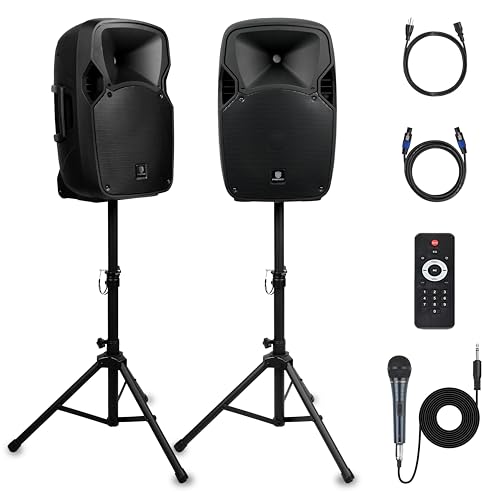
Speaker stands unlock a disproportionate share of any system potential. Raising the enclosure so its tweeter sits above head height lets sound travel over the front rows to the back, instead of being absorbed by the bodies and coats of the nearest listeners. Most portable PA enclosures include a standard pole socket underneath, but confirm stand compatibility and weight limits before assuming your existing stand will serve. A wobbling stand on uneven grass is a safety problem, not a cosmetic one, so spread legs wide and keep the centre of gravity low on blustery days.
Weather resistance ratings help outdoor users judge what a system tolerates, from light drizzle during a prize giving to dust at a building site induction. Splash resistant covers for control panels, tethered socket caps, and common sense placement under a canopy all extend working life. No consumer rating invites you to leave equipment in a downpour, and microphones, especially wireless transmitters worn on clothing, usually carry lower tolerance than the speaker itself.
Cabinet construction predicts survival in school cupboards and van boots. Tough moulded enclosures shrug off knocks that would dent thin wooden boxes, while metal grilles protect drivers from curious fingers and stray equipment. Corner protectors, recessed controls, and latches that close positively all signal a designer who imagined the product being transported weekly rather than photographed once for a catalogue.
Feedback, placement, and getting clear sound on the day
Feedback, that rising howl every audience dreads, happens when a microphone hears its own amplified output and the loop builds on itself. Prevention is mostly geometry: keep the speaker in front of the presenter, facing the audience, never behind an open microphone. Raise volume gradually during setup, walk the room while speaking at event level, and note where the system begins to ring so you can set a sensible ceiling before guests arrive.
Equalisation can notch out a troublesome frequency in skilled hands, but most portable systems offer only broad tone controls, making placement and microphone discipline your primary tools. Presenters who wander should carry the microphone consistently, avoid cupping its head with a hand, and pause amplification during applause breaks if the system sits close to its feedback threshold. A headset microphone, sitting close to the mouth, allows lower overall gain and therefore calmer behaviour in reverberant halls.
Room acoustics reward a short experiment before doors open. Clap once in the empty venue and listen for flutter echoes between hard parallel walls, then moderate your volume expectations accordingly, because empty rooms sound harsher than full ones and audiences absorb a surprising amount of energy. Position the speaker to cover the seating without aiming directly at a bare back wall, and angle it slightly downward from its stand when the audience sits close.
Outdoor setups trade reflections for wind, traffic, and distance. Face the audience away from competing noise where you can, keep the speaker downwind of the microphone, and accept that a gentle breeze across a microphone grille can sound like a storm through the system. Foam windscreens cost little, weigh nothing, and rescue outdoor speech more reliably than any electronic wind reduction feature advertised on a box.
Choosing by scenario: a practical tour of typical buyers
Teachers, tutors, and training rooms
Voice preservation drives this group as much as audibility, because speaking over thirty students for six hours a day strains even healthy vocal cords across a school year. A compact system with a comfortable headset microphone, simple controls a supply teacher can master in minutes, and enough battery for a full timetable removes daily friction. Clarity at low volume matters more than maximum output, and a carry weight that respects a walk between buildings will decide whether the system actually gets used.
Ceremonies, weddings, and garden gatherings
Ceremony audio lives or dies on discretion and reliability. The system should disappear visually, run silently without fan noise during vows, and handle a celebrant plus a reader or two without drama. Battery operation avoids cables across lawns and photographs, while a spare wired microphone in the bag insures against the one failure nobody can improvise around. Music before and after the formal words asks for decent full range playback, but speech remains the guest of honour.
Fitness, dance, and sports coaching
These instructors need the opposite balance: sustained music output, a headset that survives energetic movement, and controls reachable mid routine. Sweat resistance on the transmitter, a secure headset fit, and the ability to play tracks while talking over them define the shortlist. Outdoor coaching adds wind handling and enough projection to reach the far side of a pitch without shouting over your own system.
Guides, markets, and public speaking outdoors
Portability rules here, sometimes down to waist worn amplifiers for walking tours where even a small box on a stand cannot follow the group. Sellers and announcers at outdoor markets need quick setup, a microphone that rejects handling noise, and a battery routine that survives a trading day. For static pitches, a mid sized system on a stand covers a respectful radius without encroaching on neighbouring stalls.
Durability, warranties, and the cost of ownership
A PA speaker earns its keep in environments that punish electronics: sports halls, building sites, school playgrounds, festival fields, and the boots of cars shared by entire committees. Before buying, examine how the manufacturer supports that reality. Spare parts availability for microphone cables, headset bands, batteries, and chargers tells you whether a small failure in year two means a modest repair or a complete replacement. Brands that sell these accessories openly, with clear compatibility lists, respect the working life of their products.
Warranty terms vary in ways that matter for portable gear. Some policies exclude batteries from the main coverage period, treating them as consumables with a shorter guarantee, while others cover the whole system evenly. Accidental damage is rarely included anywhere, which strengthens the case for a padded bag or flight case in the original budget rather than as an afterthought purchased after the first cracked corner.
Cleaning and storage habits quietly determine lifespan. Wipe sweat and dust from headsets after events, store microphones dry rather than sealed in a damp bag, and keep batteries partially charged during long holidays instead of leaving them flat for months. A labelled storage routine, written on a card inside the case lid, helps groups where equipment passes between many hands and nobody remembers what the last user did.
Accessories that genuinely earn their place in the bag
A tripod stand, a spare microphone cable, and a roll of gaffer tape will rescue more events than any exotic add on. Add a short mains extension with a protected socket for outdoor work, spare batteries for every wireless device in the kit, and a phone charging cable, because the device playing your music will inevitably arrive at the venue nearly empty. A printed running order and a laminated setup checklist complete a kit that a substitute operator can run confidently.
Cases deserve thought proportional to travel frequency. A soft padded bag suits a teacher moving between classrooms, while a hard case with foam cutouts protects a system flying to conferences or riding in a shared van. Weigh the case as part of the system, since protection that makes the load miserable to carry will eventually be left behind, defeating its own purpose.
Backup playback is the accessory nobody lists. Keep ceremony music or class tracks stored locally on a second device, or on a USB stick the speaker can read directly, so a streaming outage or a forgotten password cannot silence a key moment. Test that backup path during a calm rehearsal, not while eighty guests watch you troubleshoot.
Setup routine for event day, step by step in prose
Arrive early enough to work without an audience, because every task below becomes slower and more public once guests start filling seats. Position the stand first, on the firmest and flattest ground available, then mount the speaker at a height that clears the front row heads. Connect mains power if you are using it, route cables along walls or tape them across walkways, and only then switch anything on, with volume controls turned down before power flows.
Pair or connect microphones next, checking each one from the places presenters will actually stand, including the lectern, the top table, or the centre of the pitch. Set microphone gain so a normal speaking voice registers strongly without clipping, then raise the master volume to event level and walk to the furthest seat while a helper speaks. Adjust tone only after levels behave, and resist chasing perfection in an empty room that will sound different once bodies and coats absorb the reflections.
Prepare playback devices last: download tracks for offline use, silence notifications, enable do not disturb, and set screen locks to manual so a phone does not sleep mid song. Brief every presenter on microphone distance and on passing handheld units under the chin rather than across the speaker line. Finally, agree who owns the volume control during the event, because three helpful volunteers adjusting by instinct will undo your careful setup within minutes.
Troubleshooting the faults that actually happen
Silence at switch on is usually mundane: a volume dial left at zero, a microphone channel muted, a Bluetooth source connected to the wrong device, or a battery that charged on a switched off socket overnight. Work through power, source selection, channel gain, and master volume in that order before suspecting expensive failures. Keeping a wired microphone and a cable in the bag converts most wireless mysteries into a thirty second workaround.
Distortion at moderate volume often traces back to an input driven too hard rather than a speaker at its limit. If a phone or laptop outputs at maximum into a sensitive microphone channel, the result crackles long before the amplifier reaches its ceiling. Use the correct line input for playback devices, lower the source volume slightly, and let the speaker do the amplifying it was designed for.
Wireless dropouts cluster around predictable causes: distance beyond the comfortable range, a body blocking the path between transmitter and receiver, competing networks in a crowded venue, or batteries fading mid event. Fresh batteries before important events, line of sight placement for receivers, and a brief scan of the environment during setup prevent most of these interruptions. When a dropout does occur, moving two steps closer usually restores the link faster than any menu diving.
Buzz and hum through a system typically signal a grounding or cable issue, especially when laptops join the chain while charging. Trying battery power on the laptop, swapping a suspect cable, or repositioning power supplies away from audio leads resolves the majority of cases. Note what fixed it in your setup checklist, because the same venue will present the same fault next season.
Comparing all in one systems with modular setups
All in one portable PA units bundle amplification, speakers, mixing, and often a wireless receiver into a single enclosure that one person can deploy. That integration is their great virtue for schools, celebrants, and community groups: fewer cables, fewer compatibility puzzles, and a setup routine a volunteer can learn in one demonstration. The compromise arrives when one element fails or outgrows you, because upgrading the mixer or adding a second wireless channel may be impossible within a sealed design.
Modular setups separate the speaker, mixer, and microphones into components chosen individually, rewarding knowledgeable buyers with tailored performance and a growth path. A small mixer adds channels for a panel discussion, a second powered speaker covers a longer room, and professional microphones lift vocal quality beyond bundled accessories. The cost is complexity, setup time, and a tangle of leads that demands an owner who enjoys, or at least tolerates, audio plumbing.
Most readers of this guide will be happiest starting with a capable all in one system whose limits they understand, then adding a wired microphone, a stand, or a second unit for linked coverage as their events evolve. Buyers running weekly multi performer programmes, recording their events, or covering audiences in the several hundreds should step toward modular thinking earlier, guided by the channel count and coverage their programme genuinely requires.
How to read owner feedback for PA equipment
Reviews of PA gear carry a particular bias: people write them after weddings, funerals, school plays, and product launches, occasions where emotions run high and a single fault can colour an entire account. Extract the operational details and set the drama aside. A complaint that a system struggled outdoors for two hundred guests tells you about sizing, not necessarily about quality, while repeated remarks about a fragile headset connector across many owners reveal a pattern worth respecting.
Praise needs the same scrutiny. A five line celebration of booming bass from a buyer who used the unit for garden parties says little about speech clarity in a hall, which may be your entire purpose. Look for reviewers describing your scenario, your audience size, and your programme type, and weight their experience far above generic enthusiasm. Manufacturer responses to criticism, when present and specific, also signal how support behaves after the sale.
Video demonstrations flatter almost every system, because a close microphone in a quiet room cannot reproduce the physics of a windy field. Use recordings to judge controls, build, and feature layout rather than absolute sound quality. The specification sheet, the manual, and the returns policy remain your most honest documents throughout the decision.
Budget thinking without quoting a single price
Value in this category hides in bundles and in avoided purchases. A system sold with a competent wireless microphone, a stand socket, and a protective cover may cost less in total than a cheaper bare unit that needs each accessory added separately. Conversely, bundles sometimes include novelty items, extra effects, or a second microphone of poor quality that you will replace within a year, inflating the apparent bargain.
Plan the purchase as a kit from the start: speaker, microphones, stand, cables, bag, spare batteries, and tape. That discipline prevents the common pattern where the entire budget lands on the speaker and the stand turns out to be a wobbling afterthought borrowed from a camera. It also clarifies tier choices, because stepping down one speaker tier to fund proper accessories usually produces better events than the reverse.
Groups and institutions should consider who approves replacement parts and how quickly, because a system that sits silent for a term awaiting a committee decision on a microphone cable delivers no value at all. Keeping small spares in the bag, bought alongside the main unit, is inexpensive insurance for continuity. For individual professionals whose income depends on being heard, a backup compact system, even a modest one, can be the difference between a recovered event and a refunded booking.
Questions buyers ask most often
How loud is loud enough for a hundred people outdoors?
Think in terms of coverage and clarity rather than a single magic figure. A mid sized system, elevated on a stand and aimed at seated guests, generally handles a ceremony of that scale for speech, provided wind and traffic stay moderate and presenters use microphones properly. Spread out standing crowds, background music between announcements, or a noisy roadside location all push you toward a larger system or a linked pair.
Can one system handle both speech and singing?
Yes, provided the microphone suits the singer, the mixer offers per channel control, and expectations about low end stay realistic for a portable enclosure. Singers benefit from a touch of echo in reflective venues and from a microphone with good handling of loud passages. For regular musical performance, prioritise models whose owners praise vocal reproduction, and consider a dedicated vocal microphone as the first upgrade.
Is Bluetooth reliable enough for ceremony music?
Modern Bluetooth holds up well across a room when the source stays close and the path stays clear, but ceremonies punish any avoidable risk. Download the tracks, keep the device near the speaker, and hold a cabled connection ready as the plan you hope not to need. That belt and braces approach costs nothing and removes a whole category of worry from the day.
What maintenance does a busy system need?
Charge batteries after events rather than before the next one, clean microphone grilles and headset parts that contact skin, inspect cables for kinks near their plugs, and store everything dry. Once a season, run the full system at home, update any companion app or firmware the manufacturer provides, and replace consumables before they fail in public.
Safety, etiquette, and being a good neighbour with amplified sound
Amplification carries responsibilities that product pages rarely mention. Volume that feels reasonable beside the speaker can overwhelm front row listeners, especially children and older guests with hearing aids that react unpredictably to loud, close sound. Walk the seating during setup, sit briefly where your most vulnerable listener will sit, and set levels for their comfort rather than for the enthusiast standing at the back asking for more.
Outdoor events share sound with everyone within earshot, willing or not. Check local rules about amplified audio in parks, beaches, and residential streets, finish at agreed times, and angle systems toward your audience and away from neighbouring homes where the layout allows. A courteous announcement schedule, with quiet intervals between segments, keeps goodwill intact for groups that return to the same venue week after week.
Electrical safety deserves the same calm attention. Keep mains cables out of puddles and doorways, use outdoor rated extension equipment where weather threatens, and never defeat a plug or connector that refuses to fit. Batteries should charge on hard surfaces away from soft furnishings, and swollen or damaged packs leave service immediately rather than being coaxed through one final event.
Hearing health applies to operators as well as audiences. Instructors who stand close to a loud system for hours daily should position themselves out of its main beam, use the lowest level that achieves clarity, and treat ringing ears after an event as a warning sign rather than a badge of effort. Good system design helps here, because a speaker on a stand projecting over the presenter protects the person doing the talking.
Recording, streaming, and hybrid audiences
Many talks now serve two audiences at once: the people in the room and the people watching from home. A PA system chosen with a clean line output makes that dual duty far easier, feeding the room through its speaker while sending a tidy signal to a camera, recorder, or streaming laptop. Without such an output, recordings capture room echo, coughs, and the hiss of a microphone held near a loudspeaker by a well meaning volunteer.
Levels for the room and levels for the stream rarely match perfectly, so whoever runs the event should monitor the recorded feed on headphones at least briefly during setup. A voice that sounds full in the hall can arrive thin and distant on the recording if the feed was taken from the wrong point in the chain. Note the working settings in your checklist once you find them, because hybrid events repeat and nobody wants to rediscover the recipe under time pressure.
Latency and echo complicate hybrid question sessions, where a remote guest speaks through the PA and hears the room return through a microphone. Keep the room microphone as close to presenters as practical, mute remote audio paths when nobody remote is speaking, and rehearse the handover between in room and online voices. These habits matter more than any particular hardware badge, and a modest system run thoughtfully will outperform a premium one improvised on the day.
Making the final decision: a calm shortlisting method
Write your scenario in three lines before opening any listings: audience size and layout, programme split between speech and music, and who carries and operates the kit. Score every candidate against those lines and delete anything that fails a hard requirement, such as a missing headset option for a fitness instructor or a sealed battery for an all day outdoor announcer. This sounds obvious, yet most regret in this category comes from buying for an imagined event rather than the recurring one.
Next, examine the unglamorous documents. Read the manual section on battery care, check the weight including accessories, confirm stand socket compatibility, and verify which microphones the bundle actually contains, because listing photographs sometimes show optional extras. Look at the returns policy with fresh eyes, since fit, weight, and control layout are personal qualities that no specification sheet can settle for you.
Finally, imagine the second year of ownership. The novelty will have faded, the bag will carry the scuffs of real work, and what remains is whether the system still sets up quickly, sounds clear, and has spare parts available when a cable fails. Choose the candidate whose ownership story you trust, not merely the one whose launch page shouted loudest.
Worked examples for three common buyers
Consider a primary school whose hall hosts assemblies, parents evenings, and a summer sports day. Their ideal system lives on a trolley, runs from battery on the field and mains in the hall, and accepts a headset for the teacher leading games plus a handheld unit for pupil readings. Speech clarity and volunteer proof controls dominate their decision, and a linked second speaker can wait until sports day crowds actually outgrow the first unit.
Now picture a wedding celebrant working gardens and barns across three counties. Portability in a single car load, elegant appearance, silent operation during vows, and a flawless battery routine matter most, with music playback as a supporting act before and after the ceremony. This buyer invests in microphone quality and a beautiful setup routine, accepting a mid sized enclosure because their audiences sit close and listen attentively.
Finally, meet a fitness instructor teaching dawn classes in a park and evening sessions in a leisure centre. Their system must survive weather, sweat, and being carried daily, project music with conviction, and keep a headset locked comfortably in place through jumping and turning. Battery swaps, rugged construction, and simple controls reachable mid track define their shortlist, and they will forgive a heavier box that a trolley can manage between car and venue door.
Each example rewards a different balance of the same criteria, which is precisely why universal rankings mislead in this category. Your scenario, written honestly, is the ranking that matters.
Storing, transporting, and handing the system between people
Shared equipment fails socially before it fails electronically. A system owned by a committee, a department, or a family needs a booking habit, a single storage home, and a rule that it returns complete, charged, and clean, ready for the next user to lift without detective work. A contents list taped inside the case, photographed by every borrower at handover, prevents the slow disappearance of cables and transmitters that quietly cripples shared kit.
Transport in private cars sounds trivial until a speaker slides across a boot and lands grille first on a stand leg. Secure the load, keep the enclosure upright where its design expects it, and separate sharp accessories from soft microphone parts. In vans and shared vehicles, a hard case earns its cost quickly, while a school trolley that never leaves the building can rely on lighter protection.
Label everything with the organisation name and a contact number, using tags that survive handling. Microphones and transmitters wander at events in a way speakers never do, especially when several similar systems gather at festivals, conferences, or inter school competitions. Distinctive coloured tape on your cables also speeds the end of event pack down, when tired helpers coil every black lead in the room into one anonymous pile.
When to upgrade, expand, or replace
Audiences grow, programmes change, and a system bought for a book club may find itself addressing a village fete. Expansion usually begins sensibly with accessories: a better microphone, a second input source, a stand upgrade, or a linked speaker for wider coverage. Pursue those steps before replacing the core unit, because they often reveal that the original box had headroom its bundled accessories never unlocked.
Replacement becomes the honest answer when batteries no longer hold a working charge and spares have vanished from sale, when wireless frequencies fall out of legal use, or when repeated repairs approach the cost of a modern equivalent. Note how your usage changed since the first purchase and let that record, rather than habit, shape the specification of the successor. Many second time buyers choose simpler controls and lighter weight over more power, having learned what their events truly demand.
Sell, donate, or recycle the outgoing system responsibly. A retired unit with honest faults described can serve a smaller group happily for years, and keeping one working system in circulation beats storing it until its battery swells unnoticed in a cupboard. Remove any paired personal devices, reset streaming accounts, and pass along the manual and charger so the next owner starts with a complete story.
Pre purchase checklist
- Write down your largest audience, its layout, and whether listeners sit, stand, or move with you.
- Decide the microphone styles you need now, and confirm the bundle includes them or prices them clearly.
- Count simultaneous sources, then require at least one spare input beyond that total.
- Plan battery use around a conservative share of the quoted endurance, with a mains fallback for long days.
- Weigh the full travelling kit, including stand, bag, cables, and charger, not the speaker alone.
- Confirm stand socket fit, weather tolerance for your venues, and legal wireless operation in your country.
- Check spare parts, battery replacement, and warranty treatment for portable wear before ordering.
- Read the returns policy in case weight, controls, or sound character disappoint in your own room.
Run this list against your top two candidates and notice where each one forces a compromise. A compromise you choose knowingly, documented in your notes, rarely festers into regret, while the compromise discovered mid ceremony tends to be remembered by everyone present. That distinction, more than any specification, separates a purchase that settles into your routine from one you keep apologising for.
Understanding tone shaping for different voices
No two presenters arrive with the same voice, and a system that flatters a deep, resonant speaker can make a lighter voice sound thin or harsh without any change of equipment. Tone controls exist to rebalance that relationship gently. Adding a touch of low end warmth helps a nervous speaker sound settled, while trimming bass in a boomy hall restores the consonants that carry meaning to the back rows. Adjust in small steps, and judge from the audience position rather than from beside the speaker, where every setting sounds deceptively rich.
Voices also change across a long day. A teacher in the final period or a celebrant at an evening ceremony may speak more quietly as fatigue sets in, tempting an operator to chase volume and invite feedback. A better response is to raise the microphone gain slightly, bring the microphone a little closer, and lower competing playback sources, preserving clarity without pushing the whole system toward its unstable edge.
Children deserve particular care during school events. Young speakers hold microphones at unpredictable distances, turn away mid sentence, and speak in bursts of confidence followed by whispers. A patient operator riding the channel level, plus a rehearsal that teaches them to speak across the microphone rather than into the floor, will rescue more of those moments than any automatic levelling feature. Positioning a second adult near the children to cue them gently completes a setup built around encouragement rather than volume.
For panel discussions, balance between speakers matters more than absolute loudness. Set each microphone channel individually while its owner speaks at their natural level, mark the dial positions with small pieces of tape, and resist adjusting during applause, when adrenaline tempts every hand toward the controls. A panel that sounds even allows the audience to follow ideas instead of straining through the quietest contributor.
Weather planning for outdoor announcements deserves a final word of its own, because forecasts shape everything from clothing to cable runs. Check conditions the evening before, pack a canopy or cover for the control panel, and decide in advance who calls a pause if rain turns serious, so the decision never falls to whoever happens to be holding a microphone. Dry bags for transmitters, a towel for grilles, and spare batteries kept warm in an inside pocket all belong in the kit of anyone who announces through a British spring or an autumn tournament season. Events remembered fondly are often simply the ones where somebody thought about the weather before the weather thought about them.
Keep a small notebook with the system, recording which settings suited which venue, which microphone each regular presenter prefers, and any fault that appeared, however minor it seemed on the day. Those humble notes become the institutional memory that survives staff changes, and they turn every event into quiet preparation for the next one, long after the applause and the packing away are done.
Photograph your favourite venue setups with a phone, stand position and dial settings included, so returning to the same hall months later starts from a proven arrangement instead of a fresh round of guesswork under time pressure.
Check prices on Amazon
Live listings for the shortlist in this guide are pulled from Amazon below, so prices and availability are always current at the moment you look.



Closing thoughts for clearer events
The portable PA market rewards buyers who think like event organisers rather than spec sheet collectors. Begin with the audience and the room, respect microphones as half the system, budget for the stand and spares that make the headline product usable, and keep a setup routine simple enough for a substitute to follow. Output figures will keep inflating on boxes, but intelligibility, reliability, and calm operation remain the qualities your listeners actually remember.
Choose well, label your cables, charge everything the night before, and your voice will reach the very last row of folding chairs with the same easy clarity it had at the front.


