What's inside
As an Amazon Associate I earn from qualifying purchases. This post may contain affiliate links at no extra cost to you.
A small active stage monitor is a speaker that sits close to the performer and lets them hear themselves, and the word stage monitor here means an audio monitor speaker, not a computer display, because on a stage the monitor is the speaker that points back at the singer or the keyboard player so they can hear what they are playing. The best small active stage monitors are compact, powered speakers with a built-in amplifier, which means they need no separate amplifier, and many of them have a small mixer built in, with microphone and instrument inputs, so a singer can plug a microphone straight in and hear their own voice without a separate mixing desk. They are small enough to carry in one hand, mount on a microphone stand, or sit on a tabletop, and they are loud enough for a small room, a rehearsal space, a classroom, or a coffee-house gig.
The features that matter for a small active stage monitor are different from the features that matter for a large PA speaker, because the monitor is used at close range, and clarity matters more than volume. A full-range driver, usually around five inches, gives a clear vocal sound without a separate tweeter, and a built-in mixer with microphone inputs and phantom power lets a singer connect a microphone directly. A three-band equaliser lets the user cut the frequencies that cause feedback, which is the high-pitched squeal that happens when a microphone hears itself through the speaker, and a compact, lightweight cabinet makes the monitor easy to carry and position. This guide covers six small active stage monitors, from a personal PA that has become a standard for solo performers to a compact cube monitor designed for keyboards and electronic drums.
Quick picks: best small active stage monitors
| # | Product | Where to buy |
|---|---|---|
| 1 | Mackie SRM150 | Check on Amazon |
| 2 | Behringer Eurolive B205D | Check on Amazon |
| 3 | Behringer Eurolive B105D | Check on Amazon |
| 4 | Galaxy Audio Nano Spot NSPA | Check on Amazon |
| 5 | Samson RSXM10A | Check on Amazon |
Quick Comparison
| Speaker | Key Specs | Best For |
|---|---|---|
| Mackie SRM150 | 150W, 5.25-inch driver, 3-channel mixer | Solo vocals and presentations |
| Behringer Eurolive B205D | 150W, 5.25-inch driver, 3-channel mixer | Vocals, keyboards and speech |
| Behringer Eurolive B105D | 50W, 5-inch driver, 3-channel mixer | Ultra-compact personal monitoring |
| Roland CM-30 Cube Monitor | 30W, 6.5-inch driver, 3-channel mixer | Keyboards and electronic drums |
| Galaxy Audio Nano Spot NSPA | 100W, 5-inch driver, compact wedge | Personal monitoring on a mic stand |
| Samson RSXM10A | 200W, 10-inch driver, wedge | Small stages and rehearsals |

Mackie SRM150
The Mackie SRM150 is the small active stage monitor that solo performers reach for first, and it has become a standard for a simple reason: it is a compact, powered speaker with a built-in three-channel mixer, a 150-watt Class-D amplifier, and a 5.25-inch full-range driver, all in a cabinet that weighs about seven and a half pounds and can be carried in one hand. The mixer has two combo XLR and line inputs with true 48-volt phantom power, which means a condenser microphone can be connected directly, and a stereo channel for a phone, tablet, or music player, with a three-band active equaliser that lets the user shape the sound and cut the frequencies that cause feedback. The speaker can be placed on a tabletop, mounted on a microphone stand with the included adapter, or used as a floor wedge, which makes it versatile for different performance situations.
For a singer or a presenter, the SRM150 has a practical advantage that comes from its design as a personal monitor, which is that it is meant to be used close to the performer, and at close range the 5.25-inch driver gives a clear, intelligible vocal sound, with enough volume for a small room, a classroom, a meeting room, or a coffee-house gig, without the bulk of a full PA system. The built-in limiter protects the amplifier and the driver from damage if the input is too loud, which is a useful safety net for a performer who is also operating the sound, and the speaker puts out a high sound pressure level for its size, which means it can be heard clearly even in a noisy room. The top handle makes it easy to carry, and the cabinet is rugged enough to survive being transported to gigs regularly.
The trade-offs are the ones that come with any small full-range speaker, and they are worth stating plainly. The 5.25-inch driver gives a clear vocal sound, but it does not produce deep bass, so the SRM150 is not suitable for bass guitar, electronic drums, or music with a heavy low end, and it is best used for vocals, speech, acoustic guitar, and keyboards. The sound is thin compared to a larger speaker with a separate tweeter and woofer, which is a characteristic of the full-range design, although the three-band equaliser helps, and the speaker can sound harsh if the treble is boosted too much. The SRM150 is also a single speaker, so it is a mono system, and a stereo setup needs two of them, which doubles the cost and the setup time.
The SRM150 fits a solo performer, a presenter, a teacher, or a busker who needs a compact, powered monitor for vocals and speech, someone who wants a built-in mixer and phantom power without a separate mixing desk, and anyone who values portability over deep bass. It is less suited to a full band, a bass-heavy performance, or a large venue where a bigger PA system is needed. Plug a microphone in, set the equaliser to cut feedback, and the SRM150 will let the performer hear themselves clearly in a small room.
Check price on Amazon: Mackie SRM150
Behringer Eurolive B205D
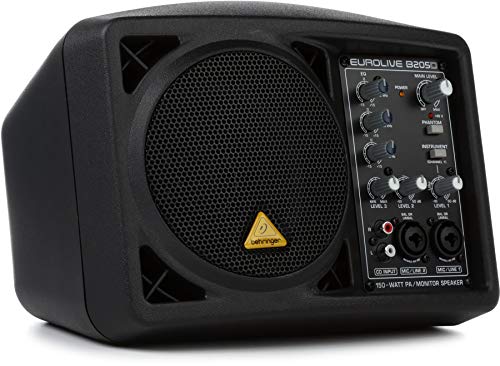
The Behringer Eurolive B205D is the small active stage monitor that competes directly with the Mackie SRM150, and it is popular for the same reasons: it is a compact, powered speaker with a built-in three-channel mixer, a 150-watt Class-D amplifier, and a 5.25-inch full-range neodymium driver, all in a cabinet that weighs about seven pounds and can be carried in one hand. The mixer has two microphone preamplifiers with phantom power, an instrument-ready input, and a stereo channel for a music player, with a three-band equaliser that lets the user shape the sound. The speaker can be placed on a tabletop, mounted on a microphone stand, or used as a floor wedge, and it has a pole mount socket, which means it can also be used as a small PA speaker on a stand.
For a vocalist or a keyboard player, the B205D has a practical advantage that comes from its input flexibility, which is that it can take a microphone, an instrument, and a music player at the same time, and mix them together, which means a solo performer can sing, play a keyboard, and play backing tracks through a single speaker, without a separate mixer. The neodymium driver is light, which keeps the cabinet portable, and the Class-D amplifier is efficient, which means the speaker runs cool and can be used for long sessions without overheating. The built-in limiter protects the speaker from damage, and the three-band equaliser is effective at cutting the frequencies that cause feedback, which is the most common problem with a small monitor used close to a microphone.
The trade-offs are similar to the Mackie SRM150, because the two speakers are designed for the same job. The 5.25-inch full-range driver gives a clear vocal sound but not deep bass, so the B205D is not suitable for bass-heavy music, and the sound is thin compared to a larger two-way speaker, although the equaliser helps. The build quality is good for the price, but the cabinet is plastic, and it can feel less rugged than a wooden cabinet, although it is light and easy to carry. The B205D is also a mono speaker, so a stereo setup needs two of them, and the speaker is best used at close range, because at a distance the small driver cannot fill a large room.
The B205D fits a vocalist, a keyboard player, a presenter, or a solo performer who needs a compact, powered monitor with a built-in mixer, someone who wants to connect a microphone, an instrument, and a music player to a single speaker, and anyone who values input flexibility and portability. It is less suited to a full band, bass-heavy music, or a large venue. Set the mixer levels carefully, cut the feedback frequencies with the equaliser, and the B205D will give a clear, portable monitor sound for small performances.
Check price on Amazon: Behringer Eurolive B205D

Behringer Eurolive B105D
The Behringer Eurolive B105D is the smallest active stage monitor in this guide, and it is included because it does the job of a personal monitor in a cabinet that is even more compact than the B205D, which makes it the right choice for a very small room, a desktop setup, or a performer who needs the lightest possible speaker. The B105D is a 50-watt active speaker with a 5-inch full-range driver, a built-in three-channel mixer, and a three-band equaliser, in a cabinet that is small enough to sit on a desk or a tabletop, and light enough to carry in a bag. The mixer has microphone and line inputs, with phantom power, and a stereo channel for a music player, which means a singer can plug a microphone straight in and hear themselves without a separate mixing desk.
For a personal monitor, the B105D has a practical advantage that comes from its size, which is that it can be placed very close to the performer, on a desk, on a keyboard stand, or on a microphone stand, and at that distance the 50-watt amplifier is loud enough for a small room, a practice space, or a home studio, without overwhelming the space. The speaker is also useful as a monitor for electronic drums or keyboards in a home studio, where a large speaker would be too loud, and the three-band equaliser lets the user shape the sound to suit the room. The cabinet is compact and the controls are simple, which makes the B105D easy to set up and use, even for someone who has never used a PA speaker before.
The trade-offs are that the B105D is a small speaker with a small amplifier, and it cannot fill a large room or compete with a loud band, so it is best used as a personal monitor rather than as a main PA speaker. The 5-inch driver gives a clear vocal sound but very little bass, so it is not suitable for bass guitar or music with a heavy low end, and the 50-watt amplifier means the speaker will distort if it is pushed too hard, although the built-in limiter helps. The B105D is also a mono speaker, so a stereo setup needs two of them, and the speaker is best used at close range, because the sound does not carry far.
The B105D fits a buyer who needs the smallest possible active monitor, someone practising at home, a teacher in a small classroom, or a performer in a very small venue, and anyone who values portability and simplicity over volume. It is less suited to a loud band, a large room, or bass-heavy music. Place it close, keep the volume moderate, and the B105D will give a clear personal monitor sound in a compact package that fits easily on any desk.
Check price on Amazon: Behringer Eurolive B105D
Roland CM-30 Cube Monitor
The Roland CM-30 Cube Monitor is the monitor for keyboards, electronic drums, and electronic instruments, and it earns its place in this guide because it is designed specifically for that job, with a 6.5-inch woofer and a tweeter, a 30-watt amplifier, and a three-channel mixer, in a compact cube cabinet that is easy to carry and position. The CM-30 has three input channels, with microphone and line inputs, and a stereo link function that lets two CM-30 monitors be connected for a stereo setup, which is useful for keyboards, which are often stereo instruments. The speaker can be placed on a tabletop, on the floor as a wedge, or mounted on a stand, and the cabinet is rugged, with corner protectors that help it survive being transported to gigs and rehearsals.
For a keyboard player or an electronic drummer, the CM-30 has a practical advantage that comes from its two-way design, which is that the separate woofer and tweeter give a fuller sound than a single full-range driver, with clearer highs and more defined lows, which matters for keyboards, which span a wide frequency range, and for electronic drums, which need a tight, punchy low end. The 30-watt amplifier is modest, but the CM-30 is designed for close-range monitoring, and at that distance it is loud enough for a rehearsal room, a small stage, or a home studio, without the bulk of a full PA system. The stereo link function is a useful feature, because a keyboard in stereo sounds wider and more natural than a keyboard in mono, and two CM-30 monitors can be linked with a single cable to create a stereo pair.
The trade-offs are that the CM-30 is a 30-watt monitor, and it cannot fill a large room or compete with a loud band, so it is best used as a personal monitor rather than as a main PA speaker. The 6.5-inch woofer gives more bass than a 5-inch full-range driver, but it still does not produce deep bass, so it is not suitable for bass guitar or music with a heavy low end. The CM-30 is also an older design, and it does not have the Bluetooth connectivity or the digital features of newer monitors, although that simplicity is part of its appeal, because there is nothing to go wrong. The price is higher than the Behringer monitors in this guide, and that premium is for the Roland build quality and the two-way design.
The CM-30 fits a keyboard player, an electronic drummer, or a home studio user who needs a compact, two-way monitor for electronic instruments, someone who values a full sound over sheer volume, and anyone who wants a stereo pair for keyboards. It is less suited to vocals alone, a large venue, or bass-heavy music. Connect the keyboard, link a second CM-30 for stereo if needed, and the monitor will give a clear, full sound for electronic instruments.

Galaxy Audio Nano Spot NSPA
The Galaxy Audio Nano Spot NSPA is the ultra-compact personal monitor in this guide, and it is included because it is one of the smallest powered monitors available, with a 100-watt amplifier and a 5-inch driver in a cabinet that is small enough to mount on a microphone stand and light enough to carry in a bag. The Nano Spot is designed to be a personal monitor that sits close to the performer, on a mic stand, on a tabletop, or on the floor, and it gives a clear vocal sound at close range, which is exactly what a singer in a loud band needs, because the main stage monitors are often too far away or too loud to hear clearly. The speaker has a microphone and line input, with a volume control, and it can be daisy-chained with other Nano Spot monitors, so each performer can have their own monitor.
For a performer in a loud band, the Nano Spot has a practical advantage that comes from its size and its mounting, which is that it can be placed on a microphone stand, right next to the singer, so the sound is close to the ears and does not need to be loud to be heard, which reduces feedback and makes the monitor more effective than a large floor wedge that is several feet away. The 100-watt amplifier is powerful for such a small speaker, and the 5-inch driver gives a clear vocal sound, although the bass is limited, which is fine for a vocal monitor, because vocals do not need deep bass. The Nano Spot is also useful for presenters, teachers, and speakers, who need a small monitor that can be placed on a tabletop and heard clearly in a small room.
The trade-offs are that the Nano Spot is a very small speaker, and it cannot fill a room on its own, so it is best used as a personal monitor rather than as a main PA speaker. The 5-inch driver gives a clear vocal sound but very little bass, and the speaker has no built-in mixer or equaliser, so the sound needs to be shaped at the mixing desk, which means it is less self-contained than the Mackie or Behringer monitors in this guide. The Nano Spot is also a mono speaker, so a stereo setup needs two of them, and the speaker is best used at close range, because the sound does not carry far, which is the point of a personal monitor, but it limits the speaker’s versatility.
The Nano Spot fits a singer in a loud band who needs a personal monitor on a mic stand, a presenter who needs a small tabletop monitor, and anyone who values an ultra-compact size over features. It is less suited to a solo performer who needs a built-in mixer, a large room, or bass-heavy music. Mount it on a mic stand, keep it close, and the Nano Spot will let the performer hear themselves clearly without adding volume to the stage.
Check price on Amazon: Galaxy Audio Nano Spot NSPA

Samson RSXM10A
The Samson RSXM10A is the wedge monitor in this guide, and it earns its place because it is a small, powered floor monitor with a 10-inch woofer and a 1-inch tweeter, a 200-watt amplifier, and a cabinet that is designed to sit on the floor at an angle, pointing up at the performer, which is the classic stage monitor position. The RSXM10A is larger than the personal monitors in this guide, but it is still compact for a wedge, and it is light enough to carry with one hand, which makes it a good choice for small stages, rehearsal spaces, churches, and bars, where a full-size wedge would be too big and a personal monitor would be too small. The speaker has microphone and line inputs, with a volume control and a three-band equaliser, which lets the user shape the sound and cut feedback.
For a small stage, the RSXM10A has a practical advantage that comes from its two-way design, which is that the separate woofer and tweeter give a fuller sound than a single full-range driver, with clearer highs and more defined lows, which matters for a monitor that needs to reproduce vocals, guitars, and keyboards at the same time. The 200-watt amplifier is powerful enough for a small stage, and the 10-inch woofer gives more bass than the 5-inch drivers in the personal monitors, which makes the RSXM10A suitable for a wider range of instruments, including bass guitar at moderate volumes. The wedge shape is also an advantage, because it points the sound up at the performer, which is the most effective position for a stage monitor, and the cabinet can also be used as a main PA speaker on a pole, which makes it versatile for different setups.
The trade-offs are that the RSXM10A is larger and heavier than the personal monitors in this guide, and it needs floor space, which is not always available on a small stage, and it is not as portable as a mic-stand monitor, although it is still easy to carry. The 200-watt amplifier is powerful, but the speaker can still be overwhelmed by a very loud band, and the three-band equaliser is useful but not as flexible as a separate mixing desk. The RSXM10A is also a mono speaker, so a stereo setup needs two of them, and the wedge position means the sound is directional, which is good for the performer but not for the audience, so it should not be used as a main speaker for the audience unless it is pole-mounted.
The RSXM10A fits a small band, a church, a rehearsal space, or a bar that needs a compact wedge monitor, someone who wants a fuller sound than a personal monitor can give, and anyone who values a two-way design and a floor wedge position. It is less suited to a solo performer who needs a mic-stand monitor, a very small room, or a large venue where a bigger wedge is needed. Place it on the floor, angle it toward the performer, and the RSXM10A will give a clear, full monitor sound for a small stage.
Check price on Amazon: Samson RSXM10A
Buying Guide
What is a small active stage monitor?
A small active stage monitor is a compact, powered speaker that sits close to a performer on a stage and lets them hear themselves, and the word active means the amplifier is built into the speaker, so no separate amplifier is needed. The word stage monitor here means an audio monitor speaker, not a computer display, because on a stage the monitor is the speaker that points back at the singer or the musician. A small active stage monitor usually has a full-range driver of around five inches, a built-in mixer with microphone inputs, and a cabinet that can be placed on a tabletop, mounted on a microphone stand, or used as a floor wedge, and it is loud enough for a small room, a rehearsal space, or a coffee-house gig, but not for a large venue.
Do I need a mixer with a small active stage monitor?
Many small active stage monitors have a mixer built in, with microphone and line inputs, phantom power, and a three-band equaliser, which means a singer can plug a microphone straight in and hear themselves without a separate mixing desk. A monitor without a built-in mixer, such as the Galaxy Audio Nano Spot, needs the sound to be mixed at a separate desk, which is fine for a band with a sound engineer, but less convenient for a solo performer. A solo performer should choose a monitor with a built-in mixer, while a band with a mixing desk can use a simpler monitor and shape the sound at the desk.
How do I stop feedback from a stage monitor?
Feedback is the high-pitched squeal that happens when a microphone hears itself through the speaker, and it is the most common problem with a stage monitor, because the monitor is close to the microphone. The fixes are to place the monitor behind the microphone, so the microphone does not point at the speaker, to cut the feedback frequencies with the three-band equaliser on the monitor, to keep the volume as low as possible while still hearing clearly, and to use a directional microphone that rejects sound from behind. A monitor on a microphone stand, close to the performer, is less likely to feed back than a floor wedge, because the sound is close to the ears and does not need to be loud. If feedback persists, turn the monitor down slightly and move it a few inches farther from the microphone, because a small change in position often removes the ringing frequency entirely, and check that the microphone is not pointing directly at the speaker, which is the most common cause of feedback in a small room.
Can a small active stage monitor be used as a PA speaker?
A small active stage monitor can be used as a PA speaker for a small room, because it is a powered speaker with a mixer, and it can amplify a microphone and a music player, which is all a small PA system needs. The Mackie SRM150 and the Behringer B205D are both designed to be used as personal PA systems as well as monitors, and they can fill a small room with sound. A wedge monitor such as the Samson RSXM10A can also be used as a main speaker on a pole, which makes it versatile. A small monitor cannot fill a large room, so it should not be used as the main PA for a large venue, but for a classroom, a meeting room, or a coffee-house gig, it is enough.
What is the difference between an active and a passive stage monitor?
An active stage monitor has the amplifier built into the speaker, so it only needs a power cable and an audio input, while a passive stage monitor needs a separate amplifier, which adds cost, weight, and complexity. Active monitors are more convenient, because they are self-contained, and they are the standard for small monitors, because the built-in amplifier is matched to the driver, which gives a better sound and protects the speaker from damage. Passive monitors are still used for large systems, where a single amplifier can drive multiple speakers, but for a small active stage monitor, the active design is the right choice, because it is simpler, lighter, and easier to set up.
Frequently Asked Questions
Can I use a small active stage monitor for vocals?
Yes, a small active stage monitor is designed for vocals, because the full-range driver gives a clear, intelligible vocal sound, and the built-in mixer lets a microphone be connected directly. The Mackie SRM150 and the Behringer B205D are both popular for vocals, because they have phantom power for condenser microphones, a three-band equaliser to cut feedback, and a compact cabinet that can be placed close to the singer. A small monitor is best for vocals in a small room, a rehearsal space, or a coffee-house gig, and it should not be used for a large venue where a bigger PA system is needed.
Is a 5-inch driver enough for a stage monitor?
A 5-inch driver is enough for a vocal monitor, because vocals do not need deep bass, and a 5-inch full-range driver gives a clear, intelligible sound at close range. A 5-inch driver is not enough for bass guitar, electronic drums, or music with a heavy low end, which need a larger woofer, such as the 10-inch driver in the Samson RSXM10A, or a separate subwoofer. The size of the driver should match the instrument: vocals and speech need a small driver, keyboards need a medium driver, and bass needs a large driver.
Can I mount a small stage monitor on a microphone stand?
Yes, many small active stage monitors, including the Mackie SRM150, the Behringer B205D, and the Galaxy Audio Nano Spot, can be mounted on a microphone stand, either with an included adapter or with a separate mount, which puts the speaker close to the performer and makes it easy to hear. A mic-stand monitor is less likely to feed back than a floor wedge, because the sound is close to the ears and does not need to be loud, and it takes up no floor space, which is useful on a small stage. Check that the monitor has a mic-stand adapter or a pole socket before buying, because not all small monitors can be mounted this way.
Do small active stage monitors need a subwoofer?
Small active stage monitors do not need a subwoofer for vocals, speech, or acoustic instruments, because those sounds do not have deep bass, and the full-range driver is enough. A subwoofer is needed for bass guitar, electronic drums, or music with a heavy low end, where the small driver cannot reproduce the lowest frequencies, and in that case a larger monitor, such as the Samson RSXM10A, or a separate subwoofer, is a better choice. A subwoofer adds cost, weight, and complexity, so it should only be added if the music actually needs it.
What is the best small active stage monitor for a solo performer?
The Mackie SRM150 is the best small active stage monitor for a solo performer, because it has a built-in three-channel mixer with phantom power, a 150-watt amplifier, and a compact cabinet that can be carried in one hand, which means a singer can plug a microphone straight in and hear themselves without a separate mixing desk. The Behringer Eurolive B205D is a close alternative, with similar features and a lower price, and the Roland CM-30 is the best choice for a keyboard player, because it has a two-way design and a stereo link function.
Conclusion
For a solo performer or a presenter, the Mackie SRM150 is the small active stage monitor that does everything well, with a built-in mixer, phantom power, and a compact cabinet that can be carried in one hand, while the Behringer Eurolive B205D is the close alternative with similar features. The Behringer Eurolive B105D is the ultra-compact choice for a very small room, the Roland CM-30 is the choice for keyboards and electronic drums, the Galaxy Audio Nano Spot is the ultra-compact personal monitor for a singer in a loud band, and the Samson RSXM10A is the wedge monitor for a small stage. Whichever monitor is chosen, the rules are the same: place it close to the performer, keep the volume as low as possible while still hearing clearly, cut the feedback frequencies with the equaliser, and the small active stage monitor will let the performer hear themselves clearly, in small rooms and on small stages, night after night.