Our Top Picks
 KALOUR 72 Watercolor Pencils Set1 Count (Pack of 72)8.27 x 7.87 x 1.3 inches1.5 poundsCheck on Amazon
 Prismacolor Premier Watercolor Colored Pencils36 Count (Pack of 1)8 x 2 x 0.6 inches0.87 poundsCheck on Amazon
 Kird Barken 36‑Count Watercolor Pencils for Adults1 Count (Pack of 38)6.65 x 0.67 x 7.48 inches0.5 poundsCheck on Amazon
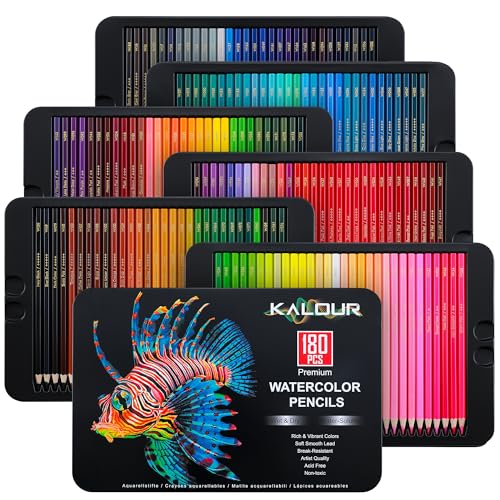 KALOUR Professional Watercolor Pencils180 Count (Pack of 1)8.8 x 2.56 x 12.8 inches3.9 poundsCheck on Amazon


What's inside
- Best Watercolor Pencil Sets for Beginners: A Calm, Honest Starting Guide
- How Watercolor Pencils Actually Work
- What Beginners Should Look For, and What They Can Ignore
- KALOUR 72 Watercolor Pencils Set: The Generous All-Rounder
- Castle Art Supplies 72 Watercolor Pencils With Tin Case: Orderly, Vibrant, Desk-Friendly
- Faber-Castell Watercolor Pencils, 24 Color: The Focused Starter Set
- Prismacolor Premier Watercolor Colored Pencils, 36 Count: Rich Color With a Lightfast Promise
- Kird Barken 36-Count Watercolor Pencils: The Water Brush Pen Advantage
- KALOUR Professional Watercolor Pencils, 180 Colors Set: The Deep Bench, Honestly Framed
- Castle Art Supplies 72 Watercolor Pencils With Zip Case: The Same Set, Ready to Travel
- Core Techniques Every Beginner Should Practice in the First Month
- Common Beginner Mistakes, and the Simple Fix for Each
- Check prices on Amazon
- Which Set Should You Actually Buy?
As an Amazon Associate I earn from qualifying purchases. This post may contain affiliate links at no extra cost to you.
Best Watercolor Pencil Sets for Beginners: A Calm, Honest Starting Guide
Watercolor pencils occupy a friendly middle ground between drawing and painting, and that is exactly why so many beginners reach for them first. You hold them like an ordinary colored pencil, you can work slowly and precisely, and then, with nothing more exotic than a damp brush, the marks you have already made melt into soft washes of color. There is no palette to set up before you begin, no cup of muddy water demanding attention from the first minute, and no pressure to finish a passage before it dries. If a line lands in the wrong place while the page is still dry, you can often lift it, lighten it, or simply draw over it. For someone who is curious about watercolor but a little intimidated by tubes, pans, and puddles, that slower, more forgiving rhythm matters more than almost any specification on a box.
This guide compares seven sets that a beginner is realistically likely to shortlist: the KALOUR 72 Watercolor Pencils Set, the Castle Art Supplies 72 set in a tin case, the Faber-Castell Watercolor Pencils in 24 colors, the Prismacolor Premier Watercolor Colored Pencils in 36 colors, the Kird Barken 36-count set, the KALOUR Professional 180 Colors Set, and the Castle Art Supplies 72 set in a zip case. Two honest notes belong right at the front, because they shape everything that follows. First, the two KALOUR sets are two sizes of the same brand line, not two unrelated ranges, so the real question between them is how many colors you want, not which brand to trust. Second, the two Castle Art 72 sets contain the same 72-color assortment; they differ in the case they arrive in, tin versus zip, so they are best understood as two packaging choices for one set. Treating them honestly that way will save you money and confusion.
Our research for this guide was deliberately simple and repeatable. We compared listings side by side, checked what each product title actually promises, noted the color count, the case or storage format, and any included extras such as brushes, and then weighed those facts against what a first-time buyer genuinely needs in the first months of learning. We did not treat a bigger box as automatically better, and we did not assume that a famous name removes the need to think about paper, water, and practice. A watercolor pencil is a modest tool, and the differences that matter at beginner level are mostly practical ones: how smoothly the core lays color down, how the pigment behaves when a brush touches it, how easy the set is to keep organized, and whether the range of colors encourages you to keep going rather than overwhelming you on day one.
How Watercolor Pencils Actually Work
A watercolor pencil looks like a regular colored pencil, but its core is made with water-soluble pigment and binder. Used dry, it behaves much like a standard colored pencil: you can hatch, cross-hatch, shade edges, letter a title, or draw the fine lines of a leaf or a roofline. The difference appears when water arrives. Drag a damp brush across a dry patch of color and the pigment dissolves, spreads, and settles into the paper more like paint. Edges soften, separate strokes merge, and a flat area of scribbled color can turn into an even wash. That two-stage process, draw first and paint second, is the whole appeal. You get the control of drawing with the atmosphere of painting, and you can decide, area by area, how much of each you want.
There are three basic ways beginners use that behavior, and every set in this guide supports all three. The most common is dry-then-wet: color the shape dry, then brush water over it once, gently, and leave it alone to dry. The second is wet-on-dry detail work afterward: once a wash is fully dry, draw back into it with a dry pencil to restore a crisp edge, add texture such as fur, bark, or roof tiles, or deepen a shadow. The third is picking pigment directly from the pencil tip with a wet brush and painting with it, which works well for tiny areas where drawing first would be fiddly. None of these requires talent or special equipment. They require only patience about one rule: let a layer dry before you judge it, because watercolor pencil color almost always dries a little lighter and calmer than it looks while wet.
Paper deserves a mention this early because it quietly decides how enjoyable any of these sets will feel. Ordinary thin sketch paper wrinkles and pills when it gets wet, which can make a perfectly decent pencil look disappointing. A heavier watercolor paper, or at least a mixed-media paper that tolerates a damp brush, gives the pigment somewhere to settle and lets you brush over an area without tearing the surface. Beginners do not need the most expensive cotton paper to start. They need paper that stays reasonably flat, does not disintegrate under one pass of water, and is cheap enough that a failed page feels like information rather than a loss. Pair any set below with sensible paper and the gap between a modest set and a premium one shrinks noticeably.
What Beginners Should Look For, and What They Can Ignore
The first thing to look for is a core that lays down color smoothly without scratching or crumbling. Several listings in this roundup describe soft cores and smooth, blendable pigments, and that language points at something real: a softer core usually deposits more pigment with less pressure, which makes the later water stage richer and reduces the strain on your hand during long coloring sessions. A very hard, faint core forces you to press, and pressing leaves grooves in the paper that water cannot erase. If you color adult coloring books, illustrate, or sketch for pleasure, comfortable laydown is not a luxury feature. It is the difference between a relaxing hour and a sore wrist.
The second thing is how the pigment behaves with water: whether it dissolves cleanly, blends into neighboring colors without turning muddy at the first touch, and keeps enough of its identity that a red area still reads as red after it dries. Listings here use words such as vibrant, vivid, richly saturated, and blendable, and while wording alone cannot prove performance, it does tell you what each maker is aiming at. Beginners benefit from colors that stay lively after a wash, because early work tends to be timid. Strong, clear pigment forgives a light hand. It also teaches faster, since you can actually see what changed when you added water, added a second layer, or blended two colors at their border.
The third consideration is color count, and it is the one beginners most often get backwards. More colors feel like more capability, yet a first set mainly needs a sensible spread: warm and cool versions of the main hues, a few earth tones, useful grays, a deep color for shadows, and enough light colors for skies, skin, and highlights. A 24-color set can cover that ground surprisingly well and forces you to learn mixing, which is a genuine skill that transfers to every medium. A 36-color set adds convenience, especially for coloring books where matching a mood quickly matters. A 72-color set removes most mixing friction and gives you subtle steps between hues. A 180-color set is a deep bench for people who already know they love the medium. None of those choices is wrong, but they serve different stages, and paying for colors you will not touch for a year is rarely the best first move.
Storage and extras are the fourth practical factor. A tin case keeps pencils in ordered trays, protects them on a desk, and makes it easy to see the whole range at once. A zip case travels better, slips into a bag, and usually keeps pencils in individual slots or a more portable wrap, at the cost of flipping or unzipping to survey everything. Included brushes matter too: the KALOUR 72 set lists two brushes, and the Kird Barken 36 set includes a water brush pen, which is a small reservoir brush that carries its own water. A water brush pen is genuinely handy for beginners because it removes the open water cup from the desk, controls moisture more gently, and makes working in a sketchbook on a sofa or train far more plausible. If a set includes one, your first session can start the moment the box opens.
Finally, here is what you can safely ignore at the start: giant color counts as a status symbol, elaborate claims about professional status, and the idea that you must settle on one brand for life. Pencils are consumable, mixable, and replaceable one at a time in your habits even when a set is sold as a box. Many artists keep a favorite everyday set and borrow single colors from another. If you are also setting up a small creative desk, our research notes often sit alongside guides to neighboring tools, such as best affordable drawing tablets for artists for digital sketching, because plenty of beginners move between paper and screen while they figure out what they enjoy most. The pencil decision should stay small, reversible, and focused on starting.
KALOUR 72 Watercolor Pencils Set: The Generous All-Rounder
The KALOUR 72 Watercolor Pencils Set is, for many beginners, the easiest recommendation in this group to understand. Its listing describes a water-soluble set with two brushes included, a soft core, and smooth blendable pigments intended for wet and dry painting, with adult coloring books, sketching, and illustration named as typical uses. That combination maps neatly onto how a beginner actually works: color a page dry in the evening, brush water over selected areas to soften them, and leave the detailed lines untouched where you want them crisp. Having brushes in the box removes the small but real friction of a separate first purchase, and 72 colors is the point at which most people stop feeling that the box is missing an obvious shade.
The soft core description deserves unpacking, because it affects both stages of the technique. On dry paper, a softer core tends to fill the tooth of the paper faster, so flat areas for skies, walls, or clothing need fewer passes and show fewer white flecks. When water follows, a heavier deposit of pigment gives the wash more depth, so a single brushed pass can look finished rather than apologetic. The trade-off with any soft core, from any brand, is care: drop a soft pencil repeatedly or sharpen it aggressively and the tip is more likely to snap than a firmer core would. That is not a defect to fear, just a habit to learn. Sharpen with a light touch, store the set flat or in its case, and the pencils will reward ordinary care with easy, generous color.
Seventy-two colors also change how you learn blending. With more steps between hues available, you can lay a light color, brush it wet, let it dry, and then glaze a related darker color only where the shadow belongs, instead of pressing harder with the same pencil and hoping. For coloring books, the range means fur, foliage, fabric, and food all get plausible colors without constant mixing on a scrap page. For sketching and illustration, it means you can keep a consistent family of colors across a scene: the same family of blues for a sky and a distant hill, the same warm browns for wood, hair, and earth. Beginners often underestimate how much calmer a picture looks when its colors belong to one coherent set, and a mid-to-large set like this quietly provides that coherence.
Who should choose this set? The beginner who wants one box that covers coloring, sketching, and early illustration without an immediate second purchase, and who likes the idea of brushes being included from the start. Who should pause? The absolute beginner on a tight budget who is not yet sure the medium suits them might learn just as happily from a 24- or 36-color set and spend the difference on better paper. And anyone tempted by the larger KALOUR box below should read that section carefully, because the honest comparison is about appetite for color, not about a leap in kind. This 72 set is the balanced middle of the KALOUR line for most people, and balanced middles are usually where beginners thrive.
Castle Art Supplies 72 Watercolor Pencils With Tin Case: Orderly, Vibrant, Desk-Friendly
The Castle Art Supplies 72 set in its tin case presentation is aimed squarely at adults who want a complete, tidy, ready-to-open range. The listing emphasizes vibrant pigments for blending, coloring, and drawing, describes the quality as professional-grade, and highlights the tin case presentation. Strip away the presentation language and the practical offer is clear: 72 watercolor pencils, chosen for lively color, kept in a rigid tin that opens flat and shows the range at a glance. For a desk-based beginner, that last detail is more valuable than it sounds. A set you can survey in two seconds is a set you will use more thoughtfully than one you have to excavate.
A tin case encourages a particular, healthy working habit: returning each pencil to its place. That sounds fussy until you have spent ten minutes hunting for the one green you used yesterday while a wash dries without you. Ordered trays also make it easier to plan a palette before you start, lining up the six or eight colors for a picture and ignoring the other sixty-odd until they are needed. Beginners benefit from that kind of pre-selection because the most common early mistake is not poor drawing but too many colors competing in one small picture. The tin will not stop you, but its structure nudges you toward choosing deliberately, and deliberate choices are what practice is supposed to build.
Consider this tin version if your work will mostly happen at home, at a desk or table, and if you value a set that feels organized and presentable enough to leave out, ready for use. Consider the zip version of this same set, covered later in this guide, if the same pencils need to travel. That is the whole decision between them, and it is a decision about your routine, not about pigment. One more practical note: a rigid tin protects pencils well against knocks in a drawer, but it is not the thing to throw loose into a backpack for a day of sketching outdoors. Match the case to the life the set will actually live, and either version of the Castle Art 72 can be the right buy.
Faber-Castell Watercolor Pencils, 24 Color: The Focused Starter Set
The Faber-Castell Watercolor Pencils in 24 colors represent the opposite philosophy from the big boxes, and for a true beginner that philosophy has real strength. The listing is brief: premium quality, art supplies, originals, in a 24-color assortment. A smaller range like this asks you to learn the medium itself rather than shop inside your own pencil box. With 24 colors you will mix, layer, and dilute to reach the shade you imagined, and every one of those small decisions teaches you how pigment and water behave together. People who start small often develop a surer sense of color than people who start huge, simply because the set makes them practice the underlying skill from the first page.
Working within 24 colors does require a few techniques worth learning early. First, control value with water and pressure before reaching for another color: the same pencil can give you a pale wash, a mid tone, and a strong dry line, which is three tools in one. Second, layer complementary colors lightly to make interesting shadows and neutrals instead of relying on a ready-made gray for everything; a shadow built from layered color looks alive next to the lit areas. Third, keep a scrap of the same paper beside your work as a swatch strip, and brush a little of each mixture there first. That humble habit, which costs nothing, prevents more ruined pages than any upgrade in pencil quality. A small set plus a swatch habit is a genuinely strong education.
Choose the Faber-Castell 24 if you are brand new, if you prefer a recognized art-supply name with a restrained assortment, if you will carry your set between rooms or to a class, or if you suspect that limits will help you focus. Pause if your main plan is large adult coloring books with elaborate, pre-printed scenes where you expect to match many specific shades quickly; in that case a 36- or 72-color set will simply feel less frustrating. Also pause if you already draw confidently in dry colored pencil and know you want watercolor effects across a wide palette from week one. For everyone else at the starting line, 24 well-chosen colors is not a compromise. It is a curriculum.
Prismacolor Premier Watercolor Colored Pencils, 36 Count: Rich Color With a Lightfast Promise
The Prismacolor Premier Watercolor Colored Pencils, in a 36 count with assorted colors, make the most specific pigment promises in this roundup. The listing describes water-soluble cores for shimmering effects, richly saturated lightfast colors, and wet or dry use, aimed at art supplies and adult coloring. Each of those phrases points at a different beginner concern. Water-soluble cores are the basic mechanism, of course. Rich saturation speaks to how much color you get from a normal stroke. Lightfastness speaks to how well finished work resists fading over time. And the explicit wet or dry framing is a reminder that these are drawing tools first, which only sometimes become paint.
Lightfastness deserves a plain explanation, because beginners often either ignore it or overvalue it. All pigments fade eventually under strong light, but lightfast colors are formulated to resist that change for much longer, so a picture framed on a wall or a coloring page kept in an album holds its relationships: the sky stays related to the sea, the shadow stays deeper than the light. For practice sketches, this hardly matters. For the first piece you are proud enough to frame, gift, or sell as a small print reproduction study, it matters a great deal. If your ambitions already lean that way, a set that names lightfastness in its listing is speaking your language, and 36 colors is enough range to compose serious work while still learning to mix.
If you print your finished artwork or scan it for a portfolio, you may also find yourself comparing output tools while you learn, which is why some readers keep a reference like best 12 x 12 photo printers nearby for square-format prints of finished pages. That is a later step, though. The Prismacolor Premier 36 earns its place earlier in the journey: choose it if you care about saturated color, if you hope some of your early work will last, and if a mid-size range feels like the right discipline. Pause if you know you want the sheer convenience of 72 ready-made shades for coloring books, or if your budget stretches further by choosing a larger value set and spending the remainder on paper. There is no contradiction in admiring this set and still choosing another; it is the connoisseur-leaning option in a beginner list, and it knows it.
Kird Barken 36-Count Watercolor Pencils: The Water Brush Pen Advantage
The Kird Barken 36-count set is the most explicitly beginner-addressed listing in this group. It describes blendable wet or dry watercolor pencils for adults, includes a water brush pen, promises smooth laydown, and names coloring, sketching, artists, and beginners among its uses. That combination tells a coherent story: a mid-size color range, an emphasis on easy application, and the single most convenient accessory a newcomer can own already in the box. If the KALOUR 72 tempts you with range and the Faber-Castell 24 tempts you with focus, the Kird Barken 36 tempts you with immediacy. Open it, fill the brush pen, and the first session needs nothing else except paper.
A water brush pen changes beginner behavior in subtle, positive ways. Because the water lives in the barrel and arrives through the brush tip when you squeeze gently, you tend to use less water overall, and less water means less buckling paper, fewer runaway puddles, and more control on the smaller pages of sketchbooks and coloring books. It also means you can work in places where an open cup is awkward: a lap desk, a cafe table, a train tray, a hospital waiting room during a long afternoon. Portability is not a trivial feature for a hobby. The hobbies that survive are the ones that fit into real days, and a set built around a reservoir brush fits into more real days than a set that demands a studio ritual.
Smooth laydown, the other headline promise, pairs well with that portability. In a coloring book, smooth application means large areas fill without a fight and without the scratchy streaks that water later exaggerates. In a sketchbook, it means you can block in the big shapes of a scene quickly, brush them into washes, and still have energy left for the dry detail pass that makes a sketch feel finished. Thirty-six colors is a sensible size for that workflow: enough to separate foliage from sky from stone from skin, few enough that you will actually remember where each pencil lives in the box. Beginners who feel overwhelmed by 72 or 180 colors often relax immediately with a range they can hold in their head.
Choose the Kird Barken 36 if you want the gentlest possible first month: moderate range, included water brush pen, and a listing that names beginners without embarrassment. It is also a thoughtful gift choice for the same reasons, since the recipient does not need a shopping list of extras before starting. Pause if you already own brushes you love and would rather put every bit of value into a larger color range, or if you plan very large work where a traditional brush and a proper water supply will serve you better than a pen reservoir. But do not underestimate this set for being approachable. In practice, the best beginner set is often the one that gets opened five days a week, and everything about this box is designed to be opened.
KALOUR Professional Watercolor Pencils, 180 Colors Set: The Deep Bench, Honestly Framed
Now for the largest box in the guide, and the one that needs the most honest framing. The KALOUR Professional Watercolor Pencils set offers 180 colors and is water-soluble, and it belongs to the same KALOUR line as the 72 set covered earlier. That relationship matters. Buying the 180 is not switching to a different philosophy of pencil; it is buying a much wider spread of shades from the same family, including the subtle in-between colors that a 72 set asks you to mix or layer your way toward. If you liked the description of the 72, soft and blendable color for wet and dry work, the 180 simply extends that idea to its practical limit for a home artist.
Who genuinely benefits from 180 colors? Colorists who work through detailed adult coloring books and love matching a specific mood without stopping to layer. Illustrators building a consistent world across many pages, where the same character, costume, or landscape returns and small color differences carry meaning. And beginners who are not really beginners at hobbies in general: people who know themselves, know they commit, and would rather buy the deep set once than buy a mid set now and a bigger one in four months. For those readers, the large range removes friction every single session, and removing friction is a legitimate reason to spend more on a tool you use daily.
For a tentative first-timer, though, the same box can quietly work against learning. With 180 choices, the temptation is to hunt for the perfect pencil instead of learning what water, layering, and pressure can do with an imperfect one. Sessions can shrink into swatching and organizing. Pages can end up using twelve barely different greens when three would have made a stronger picture. None of that makes the set bad; it makes it mismatched to a shaky first month. A useful rule from our research is this: if you cannot yet name the colors you wish your current set had, you do not yet need 180 of them. When you can name them, a big set stops being a maze and becomes a library, and at that point this KALOUR box makes complete sense.
Castle Art Supplies 72 Watercolor Pencils With Zip Case: The Same Set, Ready to Travel
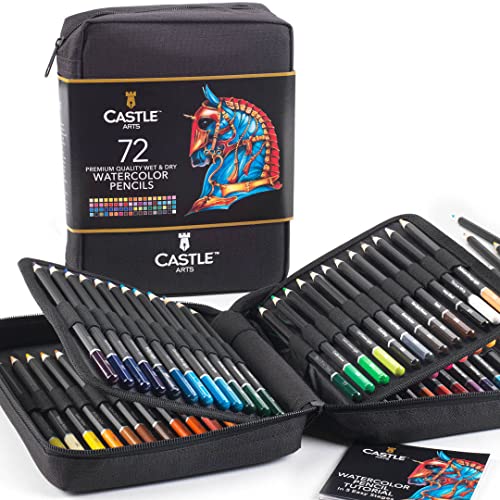
The Castle Art Supplies 72 set in a zip case contains the same 72 watercolor pencils as the tin case version, presented instead in a travel case. Its listing describes vivid, blendable colors that create beautiful effects with water, addresses professional and adult artists, and highlights the included travel case. Read that alongside the tin version and the honest summary is short: same colors, same job on the page, different home. The zip case is softer, lighter to carry, and better suited to a bag, a drawer in a small flat, or a set that moves between home, class, and holiday. The tin is sturdier on a desk and quicker to survey at a glance.
That packaging difference changes small daily things. A zip case usually keeps pencils in loops or slots, so they rattle less, arrive in the order you left them, and survive a commute without the lid popping open in your bag. It also makes the set feel more like a sketching kit and less like a piece of desk furniture, which nudges some people to actually take it outside: to a park bench, a botanical garden, a train window seat. Watercolor pencils are unusually good travel companions because the painting stage can wait. Sketch and color dry on location, add water later at home, or carry a water brush pen and finish on the spot. A case designed for travel supports exactly that rhythm.
So the decision procedure is refreshingly unglamorous. If you are choosing between the two Castle Art 72 presentations, ignore the pencils, since they are the same assortment, and interrogate your routine instead. Where will the set live? How often will it move? Do you prefer opening a flat tin and seeing everything, or unzipping a compact case and flipping through an ordered kit? Answer those questions and you have answered the Castle question completely. Anyone who tells you one case version draws better than the other is selling you a story, and a beginner guide should not. Readers planning a larger creative corner sometimes compare these portable kits with bulkier equipment in guides such as best 3d multi color printers, but for most people the charm here is the opposite: everything you need fits under one arm.
Core Techniques Every Beginner Should Practice in the First Month
Whatever set you choose, four simple exercises will teach you more in a month than any upgrade. First, make a swatch chart: for every pencil, draw a patch, brush half of it with water, and label it. You will learn your real palette, including how much each color lightens as it dries, and the chart becomes your most-used reference. Second, practice the graded wash: color a rectangle dark at the top and lighter toward the bottom, then brush downward once with a damp brush so the value melts from deep to pale. Skies, water, and backgrounds all grow out of that one motion. Third, practice dry detail over dry wash: let a shape dry completely overnight if needed, then draw edges, veins, lettering, or texture back in. That contrast between soft wash and crisp line is the signature look of the medium. Fourth, practice lifting: while an area is still damp, touch it with a clean, dry brush or the corner of a tissue to pull a little color away and create a highlight or a cloud.
Paper and format choices support that practice more than beginners expect. Work smaller than your ambition at first: postcard and sketchbook sizes dry faster, use less pigment, and let you finish, which teaches more than one large abandoned page. If you eventually want to work at poster or portfolio sizes, planning that step is easier once your habits are set, and some readers pair that planning with references like best 11×17 inkjet printers for proofing larger layouts at home. Keep the order right, though: habits first, size second, gear third. Every set in this guide is capable of beautiful small work today, with the paper already in your cupboard, as long as that paper can tolerate a damp brush.
Common Beginner Mistakes, and the Simple Fix for Each
The most common mistake is pressing too hard during the dry stage. Heavy pressure burnishes the paper, carves grooves, and leaves lines that refuse to dissolve, so the finished piece shows scratchy bones under the wash. The fix is to build color in two or three light layers instead of one forceful one, letting the pencil do the work its soft or smooth core was made for. The second mistake is using gritty, thin paper and blaming the pencils when it pills. The fix is unglamorous: switch to paper made for wet media, even an inexpensive pad, and watch the same set improve overnight. The third mistake is buying range before routine, owning 180 colors and finishing nothing. The fix is a tiny commitment device: one finished small page per session, in any colors, before any new swatching or organizing is allowed.
Check prices on Amazon
Live listings for the shortlist in this guide are pulled from Amazon below, so prices and availability are always current at the moment you look.
Which Set Should You Actually Buy?
Let the decision follow your honest answers, not the biggest number on a box. If you want the smallest, most focused start and a set that teaches mixing from day one, choose the Faber-Castell 24. If you want mid-size range with an eye on work that lasts, or saturated color for adult coloring and art projects, the Prismacolor Premier 36 is the thoughtful pick. If you want the gentlest on-ramp of all, with a water brush pen included and smooth, beginner-addressed handling, choose the Kird Barken 36. If you want one generous box for coloring, sketching, and illustration with brushes included, the KALOUR 72 is the balanced buy, and if you already know you are committed to the medium and crave the deepest range in that same line, step up to the KALOUR 180 with your eyes open about organizing it.
The Castle Art 72 decision sits slightly apart, because it is really two decisions wearing one coat. First decide whether a vibrant, blendable 72 range in a presentation case suits your desk and your coloring or drawing plans; if it does, then choose the tin case for a home base where the set stays open, ordered, and visible, or the zip case for the same pencils in a form that travels without complaint. Do not buy both, and do not let anyone persuade you that the case changes the colors. Spend the money you save on paper, which will improve your results more than a duplicate set ever could. Whichever route you take, start this week, swatch before you judge, use less water than you think, and let pages dry before you decide what they are. That is the whole beginner method, and every set above can carry it.
Affiliate disclosure: This article may contain affiliate links to the watercolor pencil sets discussed. If you buy through one of those links, we may earn a commission from the retailer, and that commission does not increase the price you pay. We compared listings and product details from public retailer pages for our research, and the sets you choose should reflect your own budget, paper, and working habits.