Our Top Picks


What's inside
- What a childrens snorkel set actually has to do
- Dry-top snorkels: keeping the tube clear without effort
- Mask lenses: tempered glass versus polycarbonate
- Mask fit: the seal decides everything
- Fogging: why new masks mist and how families prevent it
- Short fins: propulsion sized for small legs
- Beginners who are still learning to swim versus confident swimmers
- Supervision: the non-negotiable layer no product replaces
- First sessions: a progression that builds calm
- Materials, construction and what durability really looks like
- Comfort details children notice and adults overlook
- Pool sets, travel sets and reef sets: buying for the venue
- Sizing across growth spurts and siblings
- Common buying mistakes and how to sidestep them
- Understanding water entry, waves and the limits of a dry top
- Teaching breathing rhythm and buoyancy awareness
- Health, hygiene and sharing equipment sensibly
- What good value means across three summers
- Reading product descriptions like an inspector
- Check prices on Amazon
- A calm checklist for the day you buy
As an Amazon Associate I earn from qualifying purchases. This post may contain affiliate links at no extra cost to you.
If you choose to buy through a link on this page, we may receive a small commission from the retailer, and that support helps us keep publishing independent guides.
What a childrens snorkel set actually has to do
A snorkel set for a child is not a shrunken version of adult equipment. It is a confidence tool first and a viewing tool second, and every component, mask, snorkel, and fins, has to work for a smaller face, a smaller mouth, weaker legs, and a shorter attention span than any adult design assumes. When one part fights the child, a strap that slips, a mouthpiece that tires the jaw, fins that cramp the calves, the whole experience collapses, because children rarely diagnose equipment problems. They simply decide that snorkelling is unpleasant and want to get out.
The three pieces also depend on each other in ways that buying them separately can obscure. A mask that seals beautifully is useless if the snorkel attached to its strap floods at every small wave and frightens the wearer. Short fins that propel a child gently are a safety feature as much as a convenience, because a tired child far from shore is a problem that good supervision should never have to solve. A matched set, designed so the snorkel keeper fits the mask strap and the fins suit the same age range, removes several of those mismatches before the first swim.
Age labels on packaging are a starting point, not a verdict. Children of the same age vary enormously in face width, swimming strength, and comfort with water on the face, and manufacturers size their junior ranges differently from one another. A set described for younger children generally means a smaller mask skirt, a shorter snorkel tube, and shorter fin blades, while older junior sets approach small adult dimensions. The sections that follow break the choice into the parts that actually decide success: how the snorkel handles water at the surface, how the mask seals and what its lens is made of, and how the fins match a child’s legs.
Parents should also decide honestly where the set will be used. A calm hotel pool, a sheltered cove with a sandy entry, and open sea from a boat are three different environments wearing the same holiday clothes. Pool practice rewards any reasonable set and forgives almost any weakness. Open water exposes every weakness at once: chop floods snorkels, currents tire legs, and bright sun punishes a mask with a narrow field of view. Buying for the hardest environment the child will realistically face, rather than the easiest, is the central judgement in this guide.
Dry-top snorkels: keeping the tube clear without effort
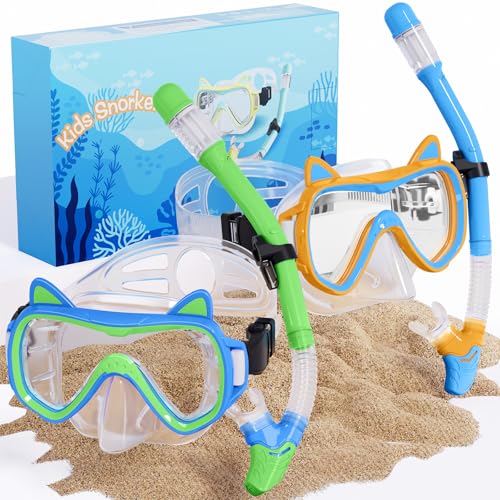
The snorkel is where children’s sets differ most from basic tubes, and the dry-top design is the headline feature for good reason. A dry-top snorkel carries a mechanism at its upper end, usually a float valve inside a splash housing, that seals the tube when a wave washes over it or when the child dips below the surface. When the top rises back into air, the float drops and breathing resumes. For a child, that automatic behaviour replaces a skill, forceful exhaling to blast water from a flooded tube, that many adults still perform badly under surprise.
Below the dry top, most children’s snorkels add a purge valve near the mouthpiece, a one-way flap that lets water collecting in the lower tube drain with a gentle exhale or even gravity when the child lifts their head. The combination matters: the top valve reduces how much water enters, and the purge valve reduces the effort needed to clear what does enter. Sets that offer only a splash guard, an open cap that deflects spray but cannot seal, sit in a middle category. They help in ripples, they do nothing during a duck-dive, and product descriptions sometimes blur that distinction, so look for the words float valve or dry top rather than splash protection alone.
Tube dimensions for children are a safety specification, not a comfort detail. A snorkel that is too long or too wide increases the volume of exhaled air the child rebreathes, which can cause carbon dioxide to build up and produce headaches or worse. Junior snorkels are deliberately shorter and narrower than adult tubes for exactly this reason, and parents should never hand a child an adult snorkel as a stopgap, however convenient it seems at the beach bag stage. Equally, a child who has outgrown a junior tube should move up promptly, because breathing resistance through an undersized tube exhausts small lungs quickly.
Mouthpiece fit completes the snorkel picture. Junior mouthpieces are moulded smaller, with bite tabs positioned for a child’s jaw, and they should be made of soft silicone rather than rigid plastic, because a child will bite down hard when concentrating. A snorkel keeper, the clip or loop attaching the tube to the mask strap, should hold the snorkel upright without tools and release without a struggle. Keepers that require threading the strap through a rigid ring annoy everyone on a windy beach, and a snorkel that detaches and sinks ends the session as surely as a flooded mask.
Mask lenses: tempered glass versus polycarbonate
The lens material is the specification parents most often skip, and it affects both safety and clarity. Tempered glass, the standard in quality diving masks, is heat-treated so that if it ever breaks it crumbles into small, relatively blunt granules rather than sharp shards. It resists scratching from sand remarkably well, stays clear for years, and gives the crisp, undistorted view that makes a reef look magical rather than murky. Its costs are weight and a higher price, and on a small child’s face a heavy mask can drag downward and break its own seal.
Polycarbonate lenses take the opposite trade. The plastic is extremely impact-resistant, light enough that a small mask stays put, and common in sets aimed at younger children and pool use. Its weakness is surface softness: dragged across sand, stored loose with fins, or wiped with a gritty towel, polycarbonate scratches, and each scratch fogs the view a little more until the mask feels permanently hazy. Families choosing polycarbonate should treat the mask like eyewear, rinsed, stored in its case or wrapped in a soft cloth, and never left lens-down on a sun lounger.
Single-lens and two-lens designs divide the junior market as well. A single panoramic lens gives an uninterrupted field of view and usually sits closer to the eyes, which widens what a child can see without turning their head, valuable when the interesting fish refuse to stay centred. Two-lens masks can sit lower in volume, meaning less air inside to manage, and in adult ranges they accept corrective lenses, a consideration for older children who wear glasses, though junior corrective options remain limited and specialist advice is worth seeking for a child who cannot see the reef clearly.
Whatever the material, check how the lens is described for impact standards and whether the mask is a snorkelling mask at all, rather than swim goggles with a nose cover added. Goggles leave the nose exposed and cannot be equalised, which is fine at the surface but wrong for any duck-diving, and their straps and skirts are not designed for a snorkel’s weight hanging from one side. A proper mask covers the nose inside the skirt, has a substantial strap, and is sold for snorkelling explicitly. That distinction is the single most common buying mistake in this category.
Mask fit: the seal decides everything
No feature compensates for a mask that leaks, and fit on a child’s narrower, less defined face is harder to achieve than on an adult’s. The skirt, the soft flange that meets the skin, should be silicone rather than cheaper rigid plastic or PVC, because silicone conforms to small facial contours, tolerates being folded in a beach bag, and does not harden after a season of sun. A good skirt has a double edge in better designs, a thin inner lip that presses gently as water pressure increases, turning the sea itself into part of the sealing mechanism.
The classic fit check works for children exactly as for adults, with patience added. Place the mask on the child’s face without the strap, ask them to inhale gently through the nose, and see whether the mask stays in place unaided for a few seconds. If it falls immediately, the skirt is the wrong width or shape for that face, and no strap tension will fix it; overtightening a strap on a leaking mask distorts the skirt and usually makes leaks worse, a counterintuitive fact that frustrates many parents on the first morning of a holiday. If the mask holds briefly, the shape is promising and the strap only needs to keep it positioned.
Hair is the silent saboteur of children’s seals. A single strand trapped under the skirt creates a channel that admits a slow, maddening trickle, and long hair should be tied back and smoothed away from the forehead before the mask goes on. Sunscreen creates a similar problem by making skin slippery, so applying sun protection well before swimming, and wiping the mask contact zone, improves both sealing and the child’s temper. Teaching a child to clear a small leak, pressing the top of the mask and exhaling through the nose, converts an emergency into a routine, but a well-fitted mask should make that skill a backup rather than a rhythm.
Strap design matters for independence. Wide silicone straps with easy buckles let a child adjust their own mask without removing it entirely, and split straps that cup the back of the head distribute pressure and resist sliding down wet hair. Some junior masks replace the silicone strap with a fabric-covered elastic band, which eliminates hair pulling entirely, a genuine quality-of-life improvement for children with long or curly hair who dread the strap’s grip. Whatever the style, practise adjustment at home in a bath or shower, where a child can learn the buckles with warm water and no audience.
Fogging: why new masks mist and how families prevent it
Almost every new mask fogs on its first outings, and the cause is manufacturing residue: a thin film left on the inside of the lens during production that gives condensation a surface to cling to. Removing that film before first use, using the preparation method the mask’s maker recommends, transforms early sessions. Thereafter, fogging is managed session by session with a defogging treatment or the time-honoured substitute of saliva worked across the dry inner lens and rinsed lightly, because both leave a surfactant layer that makes moisture form a clear sheet instead of droplets.
Children fog masks faster than adults for behavioural reasons. They lift the mask onto the forehead between swims, letting warm moist air and water mix inside; they breathe through the mouth and nose alternately while excited; and they handle the inner lens with sunscreened fingers. A simple family routine helps more than any product: mask on at the water’s edge, mask left on until the swim ends, and a designated adult carrying the defog for a mid-session reset when a long morning genuinely requires one. Most fogging complaints trace back to routine, not equipment.
Storage between holidays decides whether a mask fogs next year. Rinsing in fresh water after salt use, drying in shade rather than fierce sun, and storing the mask away from the fins and snorkel that scratch it keeps the skirt supple and the lens clear. A skirt stored squashed under heavy beach gear can take a set, a permanent warp that ruins the seal as effectively as the wrong size. Better sets include a hard or semi-rigid case, and using it is the cheapest insurance in the whole purchase.
Short fins: propulsion sized for small legs
Fin length is where children’s sets most visibly depart from adult gear, and the short blade is deliberate engineering, not cost cutting. A long blade moves more water per kick but demands strength and a slow, wide kicking motion from the hip that children’s legs cannot sustain. A short blade lets a child kick quickly and naturally, almost like running underwater, producing modest but steady propulsion that matches the short distances and frequent stops of junior snorkelling. The child who can move without exhausting themselves stays calm, and calm is the foundation of every other safety habit.
Foot pocket design divides junior fins into two families. Full-foot fins slip on like a shoe, work barefoot in warm water, and suit pool practice and tropical holidays; they must fit snugly, because a loose full-foot fin blisters heels and eventually swims off entirely, usually at the least convenient moment. Adjustable open-heel fins use a strap behind the heel, accommodate growth spurts and neoprene socks in cooler water, and forgive sizing errors that would end a full-foot fin’s career. For fast-growing children, adjustable heels often deliver two or three seasons where a fixed pocket delivers one.
Sizing fins by shoe size alone misleads, because foot length and width vary within every size and manufacturers’ pockets differ. A fin should hold the foot without curling the toes, allow a finger’s width of decision at the heel strap rather than a gap, and stay on during a gentle shake of the leg out of water. Trying fins at the end of the day, when feet are slightly swollen as they will be on holiday, gives a truer fit than a morning fitting. Any fin that leaves red pressure marks within minutes in a shop will be unbearable after half an hour of kicking.
Fin stiffness deserves a sentence of its own. Soft, flexible blades forgive weak technique and spare young ankles, while stiff blades reward strong swimmers and punish everyone else with cramp. Junior sets overwhelmingly and correctly choose softness. Parents tempted by a stiffer, more serious-looking fin for a sporty child should remember that snorkelling is sightseeing, not racing: the goal is an unhurried child drifting over coral with energy in reserve, not a personal best back to the beach. Readers who plan to film those drifts will find the cameras compared in best 10 underwater cameras a natural next purchase once the basic set is sorted.
Beginners who are still learning to swim versus confident swimmers
The most important segmentation in this category is not age but water competence, and honest assessment here is a safety duty rather than a judgement. A child who is still learning to swim, who cannot yet float calmly on their back, tread water, and stand up confidently in chest-deep water, should snorkel only in water where they can stand, with an adult within arm’s reach, and ideally with a flotation aid chosen on professional advice for the activity. In that setting the snorkel set is a window for looking down while standing or floating supported, not a licence to venture into depth.
For those beginners, equipment priorities shift. The dry-top snorkel matters even more, because a learner has no spare composure for clearing a flooded tube. The mask should be the easiest-sealing model available rather than the widest-view one, and fins may be optional at first: many instructors introduce mask and snorkel in standing depth before adding fins at all, because fins change how a child’s body sits in the water and can tip a nervous beginner forward. Building the skills in layers, face in water, then breathing through the tube, then kicking with fins, respects how children actually gain confidence.
Confident young swimmers, children who swim lengths, dive for sinkers, and recover calmly when splashed, can use the full set in open water under supervision and begin learning real snorkelling craft: reading entries and exits, finning without stirring sand, and keeping orientation by glancing at the shore. For them, a slightly larger mask volume, a snorkel with an effective purge valve for duck-dives, and fins with enough blade to handle a gentle current become relevant. The step up should still be gradual, from sheltered bays toward more exposed sites across many sessions, never in a single ambitious leap.
Full-face snorkel masks require a specific, careful word in this section, because families encounter them everywhere. These masks integrate mask and snorkel into one unit covering the whole face, and they are marketed heavily for beginners. Safety authorities and water safety organisations have urged caution with them, particularly around carbon dioxide build-up in poorly designed models and the difficulty of removing a full-face unit quickly in a panic. Many organised snorkel tours and some beaches restrict them. A traditional two-piece mask and separate snorkel remains the configuration that instructors teach, that a child can clear, remove, and manage piece by piece, and this guide recommends that traditional layout for children without reservation.
Supervision: the non-negotiable layer no product replaces
Every reputable water safety body repeats the same core message in different words: children in water require active, undistracted supervision, and snorkelling raises rather than lowers that requirement because a snorkeller’s face is down, their calls for help are muffled by a mouthpiece, and distress in a snorkeller can be quiet. An adult supervising from a lounger with a phone is not supervising in any sense that matters. The supervising adult should be in the water or at its immediate edge, watching continuously, close enough to reach a struggling child in seconds.
Buddy habits should be taught from the first session. A child snorkels beside their adult, never ahead around a headland or behind a moored boat, and agrees signals in advance: a raised hand and waving means help, a thumbs-up can be confused underwater so surface signals should be big and simple, and tapping on the adult’s arm is the underwater way to get attention. Regular head-up checks, counting heads every few minutes on group outings, sound tedious on land and become second nature in water. Children accept these rituals happily when adults model them without embarrassment.
Environmental judgement belongs to the adults entirely. Rips and currents that an adult swimmer would shrug off can carry a finned child surprising distances, because fins tempt children to range further than their unaided swimming ever would. Check local flags, lifeguard advice, and tide times; enter and exit at the same sandy point; and set a visible boundary, a buoy, a rock, a boat, that the child may not pass. Sessions should end while the child is still warm and keen, because cold and fatigue arrive together in small bodies and degrade every skill the child has practised. A short, happy session builds a snorkeller; a long, chilling one can retire one.
Skin and sun protection form the unglamorous tail of supervision. Snorkelling exposes the back of the neck, shoulders, and the backs of legs to reflected and direct sun for long, unnoticed stretches, and water washes protection away. Rash vests with ultraviolet protection solve several problems at once: sun coverage, light warmth in the water, and a bright, visible colour that helps a supervising adult track a small swimmer at a glance. Brightly coloured fins and snorkel tops serve that same visibility purpose, which is a practical reason to let a child choose the loudest colour in the range. Families who record sessions for grandparents will appreciate the action cameras in best 4k 60fps action cameras, though no footage justifies a distracted supervisor.
First sessions: a progression that builds calm
Practice before the holiday
The highest-value snorkelling lesson happens in a bath, a shower, or a local pool weeks before any reef appears. A child who has already learned how their mask seals, how the snorkel sounds, and how breathing through a tube feels can spend their first sea session looking at fish instead of fighting equipment. Bathtub practice sounds undignified and works brilliantly for younger children: mask on, face in, breathing through the tube while a parent sits beside the tub. Pool practice adds movement, floating face-down with a noodle under the arms for support, then short fin swims along the wall.
Teach three recovery skills explicitly and rehearse them until they bore the child, because boredom in practice becomes automatic calm in the sea. First, lifting the head and removing the snorkel mouthpiece to speak or breathe freely. Second, clearing a partly flooded mask by pressing its top edge and exhaling through the nose. Third, rolling onto the back to rest, breathe, and signal, which converts any moment of panic into a floating pause. A child who owns those three moves has a way out of every common discomfort, and knowing the way out is what confidence actually consists of.
Choosing the first sea site
The ideal first site has a sandy, gently shelving entry, water clear enough to reward looking down within a few metres of shore, and shelter from wind and swell on the day itself rather than in general reputation. Rocky entries, boat traffic, and surf each add a demand that a first session does not need. Arrive at slack, calm times where tides apply, keep the first sea session short, and let the child decide when curiosity is satisfied. Ending early with enthusiasm intact guarantees a second session; pushing for value from the day pass teaches a child that the sea is an endurance event.
Wildlife etiquette begins at this first site too, because habits form immediately. Look without touching, because corals are living animals damaged by a fin kick or a steadying hand, and because some beautiful creatures sting. Keep fins up and bodies horizontal to avoid stirring sand that clouds everyone’s view. Give resting turtles, rays, and any large animal a wide, quiet berth. Children absorb these rules readily when adults explain that the underwater world is someone else’s home being visited, and that framing tends to produce gentler, more observant snorkellers than a list of prohibitions.
Materials, construction and what durability really looks like
Beyond the headline features, the materials list of a set predicts its lifespan with unusual accuracy. Silicone skirts and straps stay flexible across seasons, resist ultraviolet degradation better than cheaper alternatives, and clean easily. Rubber fin blades on budget sets can crack at the flex point after a summer of heat and chlorine, while modern thermoplastic blades flex millions of times without splitting. Buckles deserve a glance too: chunky, rounded buckle teeth survive being stepped on in a beach bag, while thin ratchet mechanisms jam with a single dose of sand.
Seams and bonds reveal manufacturing care. The joint where a snorkel’s mouthpiece meets its tube, the bond between a fin blade and its foot pocket, and the frame holding a mask lens all concentrate stress, and tidy, even finishing at those points correlates with a set that survives a childhood rather than a holiday. Parents cannot laboratory-test any of this in a shop, but squeezing, flexing gently, and inspecting for rough edges, loose keeper clips, or a mouthpiece that twists too freely filters out the worst construction quickly.
Replacement availability extends a set’s life disproportionately. Straps snap, keepers vanish into sand, and fin straps perish long before masks and blades do. Brands that sell spare straps and keepers turn those small losses into minor orders instead of a whole new set, and a spare strap packed in the holiday bag has saved more snorkelling mornings than any premium feature. When comparing two otherwise similar sets, the one with obtainable spares is the more economical object over three summers, whatever the tickets say on the day.
Cleaning chemistry matters at the margins. Chlorine in pools gradually stiffens some materials and fades colours, salt crystals abrade lens coatings if left to dry on them, and the inside of a snorkel tube can develop a musty film if stored wet in a sealed bag. The universal antidote is boring: rinse everything in fresh water, shake the tube clear, air-dry in shade, and store loosely assembled rather than compressed. A set treated that way after every swim will look and seal like new for seasons; a set abandoned wet in a car boot may not survive August.
Comfort details children notice and adults overlook
Children judge equipment by sensations adults barely register. A mask strap that catches hair at one specific point will be mentioned twenty times a session. A snorkel mouthpiece slightly too wide produces jaw ache that a child reports as tiredness or boredom. Fin pockets that rub the ankle bone create a sore spot that dominates the whole memory of the day. Because children report these problems as global dislike rather than precise diagnosis, adults should interrogate comfort specifically after early sessions: where exactly did it rub, pinch, or ache, and did it start immediately or after a while?
Weight out of water shapes willingness too. A set a child can carry themselves, in a mesh bag that drains and lets sand fall out, becomes their equipment rather than another parental burden, and that ownership changes how carefully they treat it. Mesh bags included with many sets are not packaging filler; they are the transport system, letting wet gear ride home without soaking everything else. Labelling each child’s set, with a coloured band on the snorkel or a marker on the fin strap, prevents the sibling disputes and accidental swaps that plague families with two similar sets.
Visibility from the child’s side includes the frame colour and lens tint. Clear or lightly framed masks feel less enclosing to nervous beginners because peripheral light reaches their eyes. Tinted or mirrored lenses, fashionable and useful against glare for adults, dim the underwater world and can make a hesitant child feel more cut off, so plain clear lenses are the sensible default for juniors in all but the brightest tropical shallows. Anti-fog performance, strap kindness, and a light frame will do more for a child’s verdict on snorkelling than any specification aimed at grown-ups.
Ears deserve a mention that most buying guides skip. Snorkelling at the surface rarely troubles ears, but children who duck-dive even a metre or two can feel pressure, and they must learn never to force a descent against ear discomfort. Parents should teach surfacing at the first squeeze and should treat repeated ear complaints as a reason to stay at the surface or consult a clinician, not as a technique problem to push through. Sets cannot solve ear physiology, and any product implying otherwise should be distrusted on the spot.
Pool sets, travel sets and reef sets: buying for the venue
Venue shapes the sensible budget more than brand does. A set bought purely for a villa pool and paddling-depth rock pools needs a sealing mask and a dry-top snorkel, but its fins will barely work and its lens material matters less, because chlorinated water and short sessions are forgiving. Spending moderately and replacing as the child grows is rational here, especially since pool-only children often migrate to other holiday enthusiasms entirely by the following summer.
Travel imposes its own geometry. Short fins pack flat along a suitcase edge where long blades will not, masks travel safest in their case inside hand luggage or nested in shoes, and a snorkel’s dry-top housing is the most crushable part of the whole kit, so it should ride protected rather than at the bottom of a holdall. Families who fly to snorkel every year sometimes keep a dedicated travel set, accepting polycarbonate’s lightness as a fair trade for luggage survival, while a home-waters set in tempered glass covers local beaches. Readers planning to document trips from every angle might enjoy the wider perspectives in best 360 degree cameras, though a child’s first reef needs eyes, not footage, as the priority.
Reef and open-water sets justify the strongest specifications in this guide: tempered glass for scratch survival on boats and rocky entries, a genuinely sealing dry-top with purge valve, adjustable fins that can take a neoprene sock against chill and chafe, and bright colours for visibility. This is also the venue where buying mask and snorkel as a matched pair from a dive-oriented maker, rather than a toy-oriented one, pays for itself in seal quality. The price gap between a toy set and a proper junior set is real but modest compared with the cost of the holiday built around the reef, and the reef is the worst place to discover that a mask leaks at the left temple.
Cold-water families face an additional layer of decisions, literally. In temperate seas, a child in a wetsuit stays comfortable far longer, but buoyancy from neoprene changes how they float with a snorkel, and supervision should account for a child who pops up higher and tires differently. Fin pockets must accommodate suit socks, and mask straps sit over or under a hood depending on thickness. None of this is exotic, but it does mean northern families should shop where staff understand their local water, rather than importing assumptions from tropical product photographs. The surface-swimming cameras in best 1080 sports cameras suit those family beach days as well, once the in-water basics are settled.
Sizing across growth spurts and siblings
Children’s faces and feet grow in spurts that laugh at annual planning, so a set bought perfectly in spring can pinch by the following summer. Adjustable elements stretch a purchase: mask straps with generous range, snorkel keepers that reposition, and open-heel fins with strap travel all accommodate growth at the margins. What cannot adjust is mask skirt width and fin pocket volume, and those two dimensions decide retirement dates. When a child sits between sizes, choose based on the mask first, because a mask can sometimes be the larger size worn with strap adjustment, while fins a size large simply depart mid-kick.
Handing a set down between siblings works when hygiene and fit are handled honestly. Mouthpieces should be replaced for a new wearer, a small and inexpensive part on better sets, and skirts should be inspected for the warping and nicks that accumulate invisibly. A younger sibling also deserves their own fit check rather than inheriting assumptions, because face shapes differ within families as much as shoe sizes do. A set that passes down successfully is genuinely satisfying, turning one careful purchase into years of use, but a set forced onto the wrong face teaches the second child the same dislike the first one escaped.
Borrowing and hiring deserve a balanced word. Dive shops at resorts hire junior equipment that is cleaned and maintained professionally, and hiring suits a single-trip family unsure whether snorkelling will take. The drawbacks are fit lottery and unfamiliar gear on the exact day it matters. A hybrid approach works well for many families: buy the mask, the most personal and fit-critical item, and hire fins locally where sizing can be swapped on the spot. A child in their own well-fitted mask approaches hired fins with a confidence that borrowed-everything rarely produces.
Common buying mistakes and how to sidestep them
The first mistake is buying by age printed on a box without a fit check, already covered here because it causes more returns and tears than every other error combined. The second is choosing a set by its photograph, where wide lenses and dramatic colours hide a rigid skirt and a toy-grade snorkel. Specifications to seek in text, silicone skirt, dry-top float valve, purge valve, tempered glass or polycarbonate named explicitly, tell the truth that photography conceals. If a listing refuses to name its lens material or skirt material, assume the cheaper option in both cases.
The third mistake is oversizing deliberately to allow growing room, a logic that works for coats and fails underwater. An oversized mask leaks from the first minute, oversized fins fall off or blister, and an oversized snorkel mouthpiece exhausts a small jaw. Snorkel equipment must fit now, on this holiday, for this face. The fourth mistake is the opposite economy: buying the cheapest complete set for a reef holiday, where its failures will be charged against the most expensive days of the year. Match spending to venue, fit precisely to the present child, and both errors dissolve.
A fifth, quieter mistake is neglecting the adult’s own equipment and fitness while optimising the child’s. A supervising adult with a leaking mask, no fins, and rusty swimming cannot stay beside a mobile child comfortably, and supervision quality quietly collapses. Families should budget for the adult to be properly equipped too, rehearse together in a pool, and be honest about adult swimming confidence before choosing sites. The child’s safety system is the adult, and the adult deserves the same careful fitting this guide recommends for juniors.
Understanding water entry, waves and the limits of a dry top
A dry-top valve is a clever device with honest limits, and families should understand them before trusting the name. The float seals when water rises around the top of the snorkel, which handles splashes, chop, and brief submersion gracefully. It does not make the snorkel a submarine breathing tube, and it was never meant to: breathing through any snorkel below the surface is impossible because water pressure on a child’s chest prevents inhalation long before tube length becomes the issue. Children should be told plainly that the snorkel works at the surface, that duck-diving means holding a breath, and that the valve simply keeps the tube clear for the return to air.
Waves change technique as well as equipment demands. In small chop, a child breathes in the troughs and expects the valve to click shut at the crests, a rhythm that feels alarming the first time and ordinary by the third outing. Turning the back to incoming waves while clearing a mask or speaking protects the snorkel top and the child’s face at once. In surf zones, none of this finesse applies, and breaking waves are a reason to choose a different beach for junior snorkelling rather than a test of any valve. Equipment extends the range of comfortable conditions modestly; it does not repeal the sea’s terms.
Entries and exits cause a surprising share of minor accidents, usually when a child wearing fins tries to walk on wet rock or shuffles backwards into deeper water while looking at the shore. Teach a simple sequence: mask on and adjusted at the water’s edge, fins carried in hand until knee depth, then sit or crouch to pull fins on while floating support is available, and reverse the whole sequence on exit without rushing. On boat trips, follow the crew’s ladder routine exactly, fins off and handed up before climbing, mask pushed up only once seated. Practised sequences turn the clumsy edges of a session into calm ritual.
Teaching breathing rhythm and buoyancy awareness
Breathing through a snorkel feels unnatural for the first minutes of a child’s life with one, because the sound of their own breath is suddenly loud and the air arrives through the mouth alone. Slow, deep, unhurried breathing is the skill, and it can be coached with a game: count a long inhale, pause, count a longer exhale, and notice how the body settles lower and calmer with each cycle. Rapid shallow breathing, the instinctive response to excitement at a first turtle sighting, is what produces the panicky sense of not getting enough air. An adult who recognises that pattern can signal for a head-up pause before it escalates.
Buoyancy awareness grows alongside breathing. A child with full lungs floats high and bobs; the same child after a long exhale sits lower and steadier for looking through the surface ripple. Wetsuits, rash vests with foam panels, and any flotation support change that balance again, sometimes making it hard for a child to get their face down comfortably or, conversely, making duck-diving nearly impossible. None of these states is wrong, but a child should experience each one first in standing depth, noticing how their body behaves, rather than discovering it above a reef in moving water.
Equalising and depth discipline complete the junior skill set for confident swimmers who begin shallow duck-dives. Descent should be slow, ears cleared gently and early by pinching the nose through the mask’s nose pocket and blowing softly, and aborted at any pain. Depth limits for children should be conservative and set by the supervising adult based on the child’s swimming maturity, with the understanding that the surface already offers most of what a young snorkeller wants to see. The reef’s best theatre, turtles grazing, rays resting, schools turning in unison, plays out in the first few metres of water in any case.
Health, hygiene and sharing equipment sensibly
Shared snorkel equipment in a family needs basic hygiene habits that resorts apply professionally and households often skip. Mouthpieces go in mouths, so each child should have their own, rinsed after use and washed periodically with mild soap and thorough rinsing. A child with a cold, a mouth ulcer, or a stomach bug should sit out shared sessions entirely, both for their own comfort and because a blocked nose and ears make even surface snorkelling miserable. Lending a set to visiting cousins is kind; handing over an unwashed mouthpiece is not, and spare mouthpieces cost little enough to keep as guest supplies.
Ear and skin health after swimming complete the picture. Water trapped in ears after long sessions can be encouraged out by tilting and gentle movement, and children prone to ear infections deserve a clinician’s advice about plugs or drops before a snorkelling holiday rather than improvisation during it. Skin under mask skirts and fin straps should be checked after early sessions for friction marks, because a small area of chafing on day one becomes a wound that ends swimming by day three if the strap position never changes. A thin layer of suitable barrier product on a known rub point, kept away from the mask seal area itself, often solves the problem cleanly.
Finally, recognise the difference between tiredness and the early signs of a child who has swallowed water, chilled, or frightened themselves quietly. A child who goes suddenly silent, clings, or wants to hold the adult’s hand after ranging freely is communicating clearly in the only register available to them. The correct response is an unhurried exit, warmth, a drink, and no analysis on the spot. Snorkelling confidence is rebuilt on land, with hot chocolate and a retelling in which the child is the hero of the outing. Protecting that narrative is part of the equipment’s job too, even though no manufacturer can sell it to you.
What good value means across three summers
Judging value in this category requires thinking in seasons rather than receipts. A set that fits this summer, survives being handed down, and keeps its seal into a third year has delivered more snorkelling per unit of spending than two successive bargain sets that leaked, fogged, and split at the fin pocket. The expensive failure mode is not buying quality; it is buying quality in the wrong size, for the wrong venue, or for a child whose interest was a passing phase fuelled by a single film about turtles. Practice sessions before a big trip test that interest cheaply and honestly.
Resale and donation extend the story further. Outgrown junior sets in sound condition are welcomed by swim clubs, school trip programmes, and other families at the beach hut stage of the hobby, provided mouthpieces are replaced and any cracked buckle is declared rather than discovered. Passing equipment along with its care habits attached, rinse it, shade-dry it, store the mask flat, multiplies the original purchase’s usefulness. A set that teaches three children to look under the surface has earned a kind of value no specification sheet can express.
Reading product descriptions like an inspector
Product pages in this category reward slow reading, because the difference between a durable junior set and a toy in a printed box lives in adjectives that are easy to skim past. Silicone should be stated, not implied by the word soft. A dry top should be described as a float valve or sealing mechanism, not merely as a cover or guard. Lens material should be named outright, and fin sizing should be given as a range with guidance about adjustable straps rather than a single age. When a description leans entirely on adventure language and says nothing about materials, it is telling you where the money went: into the packaging.
Photographs can be interrogated too. Look for the purge valve bulge low on the snorkel, the width and texture of the mask strap, the buckle size relative to the frame, and whether the fin foot pocket shows an adjustable heel or a closed shoe shape. Images of a child wearing the set reveal scale that studio shots hide, particularly whether the snorkel towers absurdly above a small head or sits at a sensible height. A set photographed only at dramatic angles, never in profile and never worn, deserves the same suspicion as a description that will not name its plastics.
Finally, weigh the maker’s own care and sizing guidance as evidence of seriousness. Brands that publish face-fit instructions, lens preparation steps, spare part lists, and honest statements about supervision understand the product they are selling. That documentation will also serve you later, on the first morning a strap needs adjusting on wet sand, when a remembered instruction is worth more than any feature list. Choose the set whose maker writes like an instructor, and you will usually find the equipment behaves like it too.
Check prices on Amazon
Live listings for the shortlist in this guide are pulled from Amazon below, so prices and availability are always current at the moment you look.




A calm checklist for the day you buy
Bring the child, or at minimum their shoe size and a recent photograph that shows face width honestly, because remote guessing wastes everyone’s afternoon. In the shop or on delivery day, run the mask suction check without the strap, flex the fin blades and confirm they spring back evenly, work the snorkel keeper on and off the strap, and confirm the mouthpiece size against the child’s bite rather than your thumb. Read the maker’s care instructions before the first swim, prepare a new lens against fogging as directed, and schedule a pool or bath practice before any open-water plan depends on the gear.
Then keep the receipt and the packaging until after that practice session, because fit problems declare themselves in water, not on land, and a set that fails its first pool outing should go back while exchange is simple. Note what the child says about comfort in their own words, adjust straps and keepers once, and practise the three recovery moves until they are dull. Do that, choose a sheltered first site, stay within arm’s reach while confidence is young, and a modest set of mask, tube and fins becomes something far larger than its parts: the first clear look your child ever gets at the world under the surface, on a morning they will describe for years.