Our Top Picks
 Pointworks 19 Inch Premium Backgammon Sets for Adults19 inches x 25 inches19 x 12.5 x 0 inches4 poundsCheck on Amazon
 Pointworks 20 Inch Large Backgammon Sets for Adults20 inches x 10.5 inches20 x 11 x 0.1 inches11 poundsCheck on Amazon


What's inside
- Tournament size and what the twenty one inch figure really means
- Playing surfaces: felt, leather, suede, and modern alternatives
- Checkers: materials, diameter, thickness, and weight
- Dice and dice cups: where fairness is manufactured
- The doubling cube and scorekeeping
- The case: hinges, locks, frame, and joinery
- Travel sets versus tournament sets
- Rules, etiquette, and the equipment they assume
- Vintage sets and the second hand market
- How to inspect a set in person, in a sensible order
- Materials in the frame and field, compared honestly
- Understanding sizes across the whole range
- Care, cleaning, and storage that preserve play quality
- What separates a premium set from a merely expensive one
- The starting position as a diagnostic tool
- Sound, touch, and the sensory side of quality
- Matching a set to the games you actually play
- A closing word on buying once
- Check prices on Amazon
- Gift purchases and presentation, handled without regret
As an Amazon Associate I earn from qualifying purchases. This post may contain affiliate links at no extra cost to you.
This guide may earn a modest commission from purchases made through its links, at no additional cost to you, and that reader support is what funds the research behind comparisons like this one.
A quality backgammon set is a piece of precision equipment disguised as a beautiful object. Beneath the leather, wood, and polished checkers sits a geometry problem that has been refined for centuries: twenty four narrow triangles, thirty checkers in two colors, a bar down the middle, doubling cube, dice, and a playing field whose proportions decide whether checker play feels crisp or sloppy. When the dimensions are right, checkers slide with a soft, controlled glide, dice tumble and settle honestly, and the board folds into a case that protects everything without rattling. When dimensions drift, the whole game quietly degrades, even if the materials photograph beautifully.
Backgammon rewards this attention because it is a game of both chance and calculation. Players race, hit, prime, and bear off while the doubling cube raises the stakes and turns equity judgment into the central skill. Serious players study checker play the way chess players study endgames, and tournament play follows published rules on equipment, dice handling, and clock use. A set bought for a lifetime of games therefore deserves the same specification mindset as any other precision purchase: field size, surface material, checker diameter and thickness, dice quality, cube readability, hinge construction, and the fit of every part inside the closed case.
This guide works at the category level, drawing on tournament equipment conventions, federation rule documents, and maker specifications rather than naming individual products. That approach suits backgammon especially well, because the best makers are often small workshops whose models change, while the underlying standards, a tournament field near twenty one inches, checkers sized to the point width, precision dice with balanced pips, remain stable. Learn the standards once and any set, new or vintage, modern or traditional, can be judged in minutes with a tape measure and a critical eye.
Tournament size and what the twenty one inch figure really means
When players describe a tournament set, the headline number usually refers to the closed case length or the open playing field, and sellers do not always say which. A large tournament board typically opens to a field in the region of twenty one inches long, with a width that keeps the classic proportions of the game, and it folds into a briefcase style case that travels between clubs and events. That size exists for practical reasons. It gives fifteen checkers per side enough room to stack, blot, and move without crowding, it lets dice roll with genuine randomness across a meaningful distance, and it keeps the board readable from across a table during a long match.
Checker diameter follows from field size, and this relationship is the first specification worth checking on any set. The playing field divides into twelve points along each long side, and a checker should sit on a point with a small, deliberate clearance on each side. On a tournament field, checkers commonly measure around one and three quarter inches across, a size that fills the point width confidently without binding against neighbors. If checkers are too small for the field, they wander, stack unevenly, and make priming formations look untidy; too large, and they jam, chip at the edges, and force players to nudge pieces into place with fingertips.
Smaller boards scale the same geometry down. A medium set for home play might run several inches shorter, with checkers near one and a half inches, while travel sets shrink further still. The game remains fully playable at those sizes, and for casual family use the difference may never matter. Where size begins to bite is in dice behavior and in stacking: five checkers on one point, a common formation, need vertical and lateral room, and a cramped field turns that stack into a leaning pile. Players who learned on a full size board also develop muscle memory for checker travel distances, which is one reason club players gravitate to the standard even at home.
Board proportions hide another detail, the bar. The raised divider down the center separates the home and outer boards, holds hit checkers waiting to re-enter, and gives the doubling cube its traditional resting place during play. Its width should match the checker diameter logic, wide enough to hold a checker flat without overhang, narrow enough not to steal field space. On well made sets the bar sits perfectly flush in height logic with the frame, its surface finished to the same standard as the field, because a checker spends real game time resting there and a rough bar wears checker edges.
Playing surfaces: felt, leather, suede, and modern alternatives
The playing surface decides how a checker moves, and movement is the tactile heart of backgammon. Traditional wool felt offers a soft, quiet glide with moderate friction, forgiving to checker bases and gentle on the ears during fast play. Felt varies enormously in quality, though. A dense, tightly woven felt bonded flat to the field stays smooth for years, while a loose, fuzzy felt pills, sheds fibers into checker edges, and develops shiny worn lanes where checkers travel most. Pressing a fingernail across a sample and watching whether the nap recovers tells more than a product photograph ever will.
Leather fields sit at the premium end of the category and change the game feel in a distinctive way. A smooth leather surface lets checkers slide with a longer, silkier travel and produces the muted, expensive sound that club players associate with fine sets. Leather also ages visibly, developing a patina in the high traffic zones, which many owners prize and some dislike. It demands more care than felt: protection from spills, from prolonged direct sun, and from the solvents in some cleaning products. Makers who do leather well bond it drum tight over a rigid substrate, because any bubble or lift under a leather field will telegraph through checker movement within a season.
Suede and microsuede surfaces split the difference, offering a nap with more grip than leather and more refinement than basic felt. Checkers on suede stop a fraction sooner, which some players prefer for precise placement on crowded points, and the material resists the glare that smooth fields can throw under bright room lighting. Cork appears on some traditional and contemporary sets as a quiet, warm, naturally grippy alternative with a distinctive speckled look, and it shares with suede a forgiving attitude toward minor checker base imperfections. Each material is legitimate; the quality question is always execution, flatness, bonding, edge finishing where field meets frame, and consistency across all twenty four points.
Printed and inlaid fields raise a separate issue, point definition. On inlaid wood sets, the points themselves are veneers set into the field, beautiful and durable when the work is flush, distracting when a fingernail can catch each seam. On printed surfaces, point tips should be sharp, colors should contrast clearly under evening light, and the finish coat should be even enough that checkers do not accelerate across glossy patches. Color contrast is a playability feature, not decoration: a blot must be visible at a glance, and low contrast designer colorways that merge point, field, and checker tones make real games harder to read. Readers who enjoy tabletop pursuits alongside the dice and checkers may enjoy the miniature painting equipment surveyed in best resin printers for miniatures d d for a neighboring hobby bench.
Checkers: materials, diameter, thickness, and weight
Checkers are the components a player touches most, and their specification repays close reading. Diameter was covered with field size, but thickness is its own variable. Substantial checkers, often around half an inch thick on tournament sets, stack stably, present a confident edge to the fingers, and resist the tipping that plagues thin discs when a point holds four or five pieces. Thin checkers feel insubstantial, clack sharply, and skate unpredictably on smooth fields. Thickness also interacts with case design, because fifteen checkers per color must store somewhere, in racks, wells, or flat compartments, and a case designed for thin checkers cannot swallow thick ones.
Material decides weight, sound, and longevity. Bakelite, the early phenolic resin found on vintage sets, remains beloved for its dense, warm feel, its soft click, and its resistance to chipping, and surviving vintage checkers in good condition are traded among collectors for those qualities. Modern acrylic checkers dominate current production, ranging from light, hollow feeling discs to dense, polished pieces with a satisfying heft and glassy depth, sometimes with a swirled or pearlescent interior. Urea and other modern resins appear in mid range sets, generally harder and more brittle than the best acrylic. Fingerprint polished edges, a slightly rounded rim, and a flat, true base distinguish a checker that glides from one that rocks.
Weight deserves a number minded check even without a scale. A full set of thirty tournament checkers should feel collectively substantial in the hand; a set that feels like a bag of bottle caps will play like one. Heavier checkers carry momentum across the field, settle where they are placed, and stay put when the table is bumped, which matters during the animated final turns of a bear off race. Weight distribution matters too: a checker with a weighted, flat base behaves differently from a hollow shell with thick walls, and tapping a checker on the field and listening for a solid, low note rather than a hollow rattle is a fair field test.
Color and finish complete the checker specification. The two sets of fifteen must contrast with each other and with both point colors under the lighting where games actually happen, which is usually warmer and dimmer than a showroom. Translucent checkers look dramatic against light but can confuse the eye when stacked over dark points. A subtle detail on premium sets is a gently dished or textured top face that catches light and helps the eye count a stack quickly. Counting stacks at speed is a genuine skill input in backgammon, since prime structures and pip counts are read from those stacks throughout the match.
Dice and dice cups: where fairness is manufactured
Dice decide games, so their honesty matters more than any other component. Casual sets include ordinary molded dice with drilled and painted pips, and those dice carry a quiet flaw: drilled pips remove different amounts of material from each face, skewing the roll by tiny margins that accumulate over thousands of throws. Precision dice solve this by being machined or carefully cast to tight tolerances, with pips filled flush using material of the same density as the body, sharp or carefully rounded edges held consistent, and faces measured to thousandths. Tournament play expects precision dice, typically around nine sixteenths of an inch or slightly larger for big boards, and expects them to be translucent so any internal tampering or loading would show.
Size matching between dice, field, and cups is a system question. Dice too small for the field get lost visually and feel trivial in a serious match; dice too large cannot tumble freely in the cups or across a crowded board late in a game, when open landing space shrinks. Rules in organized play require dice to land flat on the playing surface, on top of checkers counting as valid in many rule sets, and to be rerolled when they land cocked against a checker, the bar, or the frame. A field with sensible dimensions and dice sized to it keeps cocked dice rare rather than routine, which speeds play and prevents arguments.
Dice cups are fairness equipment, not accessories. A proper cup has a trip lip or ridged interior that forces the dice to tumble rather than slide, so a practiced hand cannot set a roll by controlling the throw. Cups should be rigid, lined or shaped to deaden rattling without softening the tumble, and sized to the dice with room to shake. Tournament etiquette and many rule sets require a cup for rolling, prohibit shaking dice in a closed hand as a substitute, and define when a roll is complete. Sets that include flimsy, undersized cups undermine the precision dice they ship with, so the two components should be judged together, as a matched rolling system.
Spare dice and color coordination sound trivial until a die rolls off a table into a dark floor corner mid match. Thoughtful sets include dice in colors that read against the field, and experienced players carry a spare pair matched to the set. Storage for dice and the doubling cube inside the case, in fitted recesses rather than a loose pouch, prevents the small pieces from migrating, chipping checkers, or being forgotten in a coat pocket. When evaluating a set, open and close it, tilt it, and listen: a well planned interior is silent, because everything has a place that holds it.
The doubling cube and scorekeeping
The doubling cube is backgammon’s signature object, a large die marked two, four, eight, sixteen, thirty two, and sixty four, and it transforms a race with dice into a game of judgment under pressure. A quality cube is oversized relative to the rolling dice, commonly around an inch or more on tournament sets, with deeply engraved or crisply printed numerals that read instantly from either side of the table. Its edges are usually rounded more generously than dice edges, since it is handled and placed rather than rolled, and it often rests on the bar or in a designated spot where both players can see the current stake without asking.
Material and legibility decide whether a cube does its job during the tense moments it exists for. A cube whose numerals wear, whose faces are finished so glossily that numbers vanish under a lamp, or whose size makes it tip from the bar will generate disputes in exactly the games where the stakes have grown. Better cubes use contrasting inlay or paint in recessed numerals, a matte or satin face, and enough mass to sit still when the table moves. Some premium sets turn the cube from wood or cast it to match the checkers, a coherence that looks deliberate rather than assembled from spares.
Scorekeeping rarely appears in product photographs, yet matches are won by points accumulated across games, and a complete quality set supports that record. Traditional sets sometimes include score markers or a small abacus style counter built into the frame; most modern players use a score sheet or a phone, which is legitimate and common in clubs. What matters for the buyer is simpler: if a set advertises itself as complete for match play, confirm that cube, dice, and cups are all present and matched, because replacing a missing cube with a mismatched one afterward costs more than expected and never looks right.
The case: hinges, locks, frame, and joinery
Most quality sets fold into a briefcase form, and the case is half the product. Frame construction divides the field into price tiers more honestly than surface decoration does. Solid wood frames, joined at the corners with miters reinforced by splines, keys, or finger joints, resist the racking that years of carrying by one handle impose. Veneered frames over a stable core can be excellent and more resistant to humidity movement, provided the veneer is thick enough to survive edge knocks and the corners are genuinely joined rather than butted and glued. A frame that flexes when the open board is lifted by one corner will eventually disturb the field bonded inside it.
Hinges carry the entire folding life of the set, and they are a classic place for hidden economy. A piano hinge running the full length of the spine distributes load evenly and keeps the two halves aligned so the bar and points meet without a step. Two small butt hinges concentrate stress, loosen in their screws, and allow the halves to drift until checkers catch on the center seam. Hinge screws should thread into solid material, sit flush so they cannot scratch a table or the field opposite, and operate without grinding. The open board must lie perfectly flat, because a board that rocks or crowns at the center changes dice behavior and checker glide on every single roll.
Locks and latches protect the contents in transit and reveal the maker’s standards in miniature. Quality clasps close with a positive, even action, align the case halves precisely, and can be operated thousands of times without bending. Some premium cases use combination or keyed locks, which are more about ritual and presentation than security, since a determined thief takes the whole case regardless. More important is that the closed case seals evenly, with no corner gap that invites dust onto a felt or suede field, and that the handle is anchored through the frame rather than into a thin wall, because a tournament set with checkers, dice, and cube inside carries real weight. Players who carry a set to clubs alongside other gaming gear, the kind surveyed in best gaming keyboard coverage of competitive setups, learn quickly that handle strength is not a decorative detail.
Exterior finish and interior layout finish the assessment. Outside, leather covered, wood veneered, and lacquered cases each age differently; leather scuffs and heals visually with conditioning, lacquer chips at corners, veneer can lift if stored damp. Inside, look for checker storage that separates the two colors, protects polished faces from rubbing, and does not force checkers to be stacked so tightly that edges chip during removal. A maker who thought about the interior as carefully as the field usually thought about everything else too, and the reverse is equally reliable as a buying signal.
Travel sets versus tournament sets
Travel sets compress the game into bags, rolls, and miniature folding boards, and they should be judged by travel standards rather than condemned by tournament ones. A roll up set with a fabric or leather field, flat checkers, and a pouch for dice weighs almost nothing, survives a backpack, and plays a perfectly enjoyable game on a train table or a picnic blanket. Its compromises are known and accepted: dice have little room to tumble, checkers slide on a surface that may not lie perfectly flat, and wind is a genuine opponent outdoors. Within those limits, quality still shows in stitching, in checkers that stay put on the surface texture, and in dice sized sensibly to the shrunken field.
Magnetic travel sets solve the movement problem by holding checkers to a metal field, which keeps a game intact through jolts and lets a position be packed away mid game and resumed later. The trade off is feel: magnetic checkers click into place with a slight pull that changes the glide players expect, and weak magnets give the worst of both worlds. Folding miniature wood sets with inlaid fields sit between the extremes, charming and genuinely playable for short games, though their small checkers test eyesight and fingertip precision during a long session. Choosing among them is a matter of trip style, not hierarchy, and honest makers describe their small sets accordingly.
Tournament sets make the opposite trade: full geometry, honest dice behavior, and presence on the table, at the cost of size and weight that demand a deliberate trip. For a player entering club or federation events, that trade is mandatory, because events specify equipment expectations and opponents are entitled to a board and dice that meet them. For home play, a tournament set earns its shelf space every time a match runs long and the equipment disappears from attention, which is the deepest compliment gaming equipment can receive. Between the poles sits the mid size home set, and the right question for it is whether its checker to field proportions stayed honest as it shrank, since that ratio, more than raw inches, preserves the character of the game.
Rules, etiquette, and the equipment they assume
Modern tournament rules, published by national federations and the worldwide bodies that coordinate them, describe equipment in surprising detail because disputes taught them to. They address precision dice, cups with trip features, the legality of rolling into a cupped hand in place of a cup in some formats, clocks for match play, and the handling of the doubling cube. A buyer does not need to memorize a rulebook to shop well, but knowing that these documents exist explains why certain features, lipped cups, translucent dice, a generously sized cube, recur on serious sets. They are not styling cues copied between brands; they are answers to adjudicated arguments.
Etiquette around equipment also shapes what quality means in practice. Players shake dice visibly, roll onto the field on their own side, handle only their own checkers where local custom requires it, and keep the cube placement unambiguous. A board whose field colors make a blot hard to spot, or whose checkers are so glossy that stacks reflect into a blur, creates friction that etiquette cannot fix. Likewise a case that takes five minutes of puzzle solving to pack discourages the simple courtesy of clearing the table promptly for the next match at a club night.
Clock play, now standard in serious matches, adds one more equipment consideration: space and stability. A chess style clock sits beside the board, players press it after each turn, and a crowded or wobbly table turns that rhythm into a hazard. A full size set on a stable frame leaves the clock its territory and keeps dice rolls clear of it. Home players who never expect to use a clock can ignore this entirely, yet it illustrates the general principle that a backgammon set is a small system whose parts, and whose setting, interact. Judging the system whole, rather than falling for a single luxurious material, is the habit this guide is really recommending. The competitive gaming world explored in best projectors for sports games runs on the same principle of matched, regulation aware equipment.
Vintage sets and the second hand market
Backgammon’s long history means the second hand market is unusually rich, and vintage sets reward the same specification checks as new ones. Mid century Bakelite checker sets, leather club boards from European makers, and wooden inlaid sets from resort eras all circulate, often with the patina that only decades of play produce. The checks are concrete: count the checkers, fifteen per color, matched in diameter and thickness; inspect for chips at checker rims, which spread; confirm the dice are a matched pair and consider replacing them with modern precision dice for serious play, keeping the originals for authenticity; work the hinges and clasps through several cycles.
Field condition decides vintage value more than frame beauty. Felt can be cleaned gently and sometimes replaced by a skilled restorer, but a warped substrate under any surface is a structural fault that shows in every roll. Hold the open board at eye level and sight across it for crown or twist, then close it and check that the faces meet evenly. Smell matters too, undiplomatically: decades of smoke or damp storage live in felt and leather, and removing those odors fully is difficult. A vintage set that passes geometry, count, and field checks can outplay most new production, because older workshop standards for materials were often generous.
Replacement parts for vintage sets are a mixed picture. Checkers in standard diameters are obtainable from specialist dealers, and a single missing checker can sometimes be matched closely enough that only its owner knows. Cubes and cups are easy to substitute. Hinges and clasps can be repaired by luggage and case restorers whose skills transfer directly. What cannot be fixed cheaply is a field that has shrunk, cracked, or delaminated across its points, so the field inspection deserves the longest pause in any vintage purchase, however charming the case exterior may be.
How to inspect a set in person, in a sensible order
Begin with the board open and empty. Sight across the field for flatness, run a palm slowly over both halves and the bar, and feel for lifted edges, bubbles under the surface, seams that catch skin, and any step where the halves meet at the center. Lay a straight checker on several points and watch for rocking that betrays a crowned field. Close the board and reopen it a few times, listening to the hinges and watching whether the halves return to the same alignment each time, because repeatability at the hinge is what keeps the center seam invisible during play for years rather than months.
Next, set up the checkers in the starting position, all thirty of them. This simple act tests more than any measurement taken in isolation. Checkers should fill their points with the small clearance described earlier, stacks of five should stand straight without coaxing, and the two colors should read clearly against the points under the room light as it actually is, not as the shop wishes it were. Slide several checkers the length of the board with one finger, slowly and then briskly. The glide should be even, without sticky patches, sudden acceleration, or a gritty undertone that suggests debris or a failing surface bond.
Then roll the dice, many times, from the cups as the rules intend. Watch whether they tumble freely, whether cocked dice against checkers or the bar happen rarely, and whether the pips read at a glance from a seated position across the table. Shake the cups and listen: a controlled rattle is right, a harsh clatter suggests thin walls, a muffled thud suggests the dice cannot move enough to randomize. Place the cube on the bar and in its storage recess, close the case with everything inside, carry it a few steps by its handle, and tilt it gently. Silence from within is the passing grade.
Finish with the unglamorous paperwork and provenance questions. Ask what the field material actually is, not what it resembles; what the checkers are made from; whether replacement checkers in the same diameter and color can be obtained; and what the maker recommends for cleaning. A seller who answers those questions precisely is describing a product they understand. A seller who retreats to adjectives is describing a photograph. Backgammon sets are unusually long lived purchases, often kept for decades and handed on, so the answers matter more than the small ceremony of the sale itself.
Materials in the frame and field, compared honestly
Walnut, oak, mahogany, and beech dominate wooden frames, each with a different grain character and hardness, and each perfectly capable when the joinery and substrate are sound. Exotic veneers add visual drama and should be judged on thickness and edge treatment rather than species romance, because a paper thin veneer over a soft core will dent and lift at the corners where a case actually takes its knocks. Leather covered frames trade that risk for scuffing, which many owners accept as character, and fabric covered cases sit at the lighter, more casual end, appropriate for travel formats rather than heirloom ambitions.
The substrate under the field deserves a question most buyers never ask. A rigid, stable board, quality plywood or a well prepared composite, keeps the field flat through humidity seasons that would cup a solid panel. Traditional construction sometimes used solid wood fields, and surviving examples prove it can work, but modern stable substrates are an advance rather than a shortcut when the surface above them is genuine. What should raise suspicion is not a material name but a refusal to name materials at all, combined with a field that already shows waviness under raking light in the shop.
Point construction splits into inlaid, printed, stitched, and applied methods, and each carries a maintenance story. Inlaid points in wood or leather can last generations and can be refinished. Printed points under a durable clear coat are consistent and affordable, and their lifespan is the lifespan of that coat. Stitched points on leather and suede fields, where each triangle is a separate piece sewn or bonded down, create the luxurious segmented fields of premium club sets, with seams that must be tight enough never to catch a checker edge. Applied felt points on a felt field are the economy method, prone to lifting corners after heavy use. None of these is automatically right; the match between method, material, and intended years of play is the judgment.
Understanding sizes across the whole range
Manufacturers describe size inconsistently, some by closed case length, some by open field, some by checker diameter, so converting between descriptions is a core buying skill. As a working map, the largest category pairs a field around twenty one inches with checkers near one and three quarter inches; a mid size home category steps down to a field in the high teens with checkers around one and a half inches; compact sets continue downward from there; and miniature novelty boards abandon playable proportions almost entirely. These are conventions rather than laws, which is exactly why the checker to point relationship should be verified on the individual set rather than inferred from a category label.
Hand size and playing style interact with these numbers in ways that rarely appear in listings. Players with large hands find small checkers fiddly during fast bear off sequences, while smaller hands may prefer the control of a mid size checker. Players who compete study positions for hours, and the reduced eye strain of a full size field with strong contrast accumulates value across a long match. A household set that will teach children the game benefits from checkers big enough for small fingers to move deliberately, and from a surface forgiving of the enthusiastic checker slamming that young players bring to a hitting play.
Storage footprint is the final size variable, and it eliminates more dream purchases than any other. A tournament case needs a shelf or cupboard slot of real dimensions, and it will be carried, so its weight with full contents belongs in the decision. Measure the intended storage place before ordering, and be honest about whether a large set that must be fetched from a distant closet will actually be used on a weeknight. The best set for a given household is the one whose size fits its rooms, its players, and its habits, with proportions intact, rather than the largest set that fits a budget. Enthusiasts who outfit a games corner piece by piece, much like the trail camera hobbyists reading best affordable game cameras for their own field setups, tend to arrive at the same conclusion: fit to routine beats maximum specification.
Care, cleaning, and storage that preserve play quality
Each field material has a short list of friends and enemies. Felt likes a soft brush, a lint roller, and prompt blotting of spills; it dislikes soaking, harsh solvents, and being stored damp, which invites mildew that no brushing fully forgives. Leather likes a barely damp cloth, occasional conditioning with products the maker approves, and distance from radiators and sunny windowsills. Suede likes a dry brush and protection from oils, including the oils on hands during marathon sessions, which is why some owners rotate two sets or accept a gradual darkening at the bar and home board as the honest record of games played.
Checkers and dice need gentler handling than their hardness suggests. Acrylic checkers can be washed in lukewarm water with a drop of mild soap, dried fully, and polished with a soft cloth; solvents and abrasive pads cloud them permanently. Precision dice should never be stored loose against checkers, because their edges are their accuracy, and a chipped edge is a changed die. The doubling cube, handled constantly, benefits from the same mild cleaning as checkers, with attention to keeping numerals legible rather than polishing them away.
Storage conditions decide whether a set ages gracefully. A case stored flat, in a room with ordinary humidity, away from attics and damp basements, will hold its field flat and its hinges aligned for decades. Storing a case on edge for years can encourage a slow warp in marginal substrates, and storing it under heavy objects invites hinge and clasp distortion that shows up as a center seam step. A silica packet inside the case is cheap insurance in humid climates. None of this care is burdensome; it is the small rent a fine object charges for outliving its owner in playable condition.
What separates a premium set from a merely expensive one
Price in this category buys four things when it is honest: materials with substance, dimensional accuracy, hand finishing time, and small production runs. A premium set shows those purchases in specific places: checkers with polished, even edges and consistent diameter across all thirty pieces; a field bonded without a single detectable bubble; hinge alignment that survives a hundred openings unchanged; a cube with numerals that will outlast the finish around them; cups that genuinely randomize. Expensive decoration, by contrast, concentrates spending where a camera looks, in exotic exterior veneer, plated fittings, and presentation boxes, while the field geometry quietly remains ordinary.
Consistency across a production run is the least visible premium of all. Small workshops check each board against templates, match checker colors within a set by eye under daylight, and reject fields that a larger operation would ship. That rejection rate is a cost the buyer ultimately funds, and it is worth funding, because backgammon equipment punishes inconsistency during play rather than on the shelf. A single undersized checker in a stack, a single point slightly narrower than its brothers, will be noticed by the fingers hundreds of times a year.
The value question resolves differently for different players. A competitor needs the tournament specification and should buy it once, from a maker whose sets appear at events. A social player hosting a monthly game needs honest proportions, pleasant materials, and durability through years of evenings, which a strong mid range set delivers fully. A gift buyer should weight presentation more heavily, since the ritual of opening a beautiful case is part of the gift, while still checking checker count, proportions, and hinge quality so the object plays as well as it presents. In each case the specification list, not the story around it, predicts satisfaction.
The starting position as a diagnostic tool
There is a reason experienced players set up the opening position when judging an unfamiliar board. The standard arrangement places two checkers on the twenty four point, five on the thirteen point, three on the eight point, and five on the six point, mirrored for the opponent, and it instantly populates the field with stacks of different heights in both colors. Crowding problems, contrast problems, and stacking problems all declare themselves in that one arrangement. A point that cannot hold its five checkers in a tidy column during setup will not improve during the chaos of a real game, when a prime of six points must be read at a glance and a blot hiding behind a stack can change a cube decision.
The setup also exposes checker diameter honesty. On a well proportioned board the five checker stacks sit with visible daylight discipline: each checker rests mostly on its own point, neighbors touch lightly if at all, and the bar holds its temporary residents without overhang. On a board whose checkers were sized by guesswork, the setup looks drunk, stacks lean into adjoining points, and the eye cannot tell where one point ends and the next begins. Since nearly every tactical idea in backgammon is expressed through point occupancy, that visual confusion is not a cosmetic flaw. It is a tax on every decision the game will ever ask its players to make.
Sound, touch, and the sensory side of quality
Players describe favorite sets in sensory language for good reason. The sound of a move, checker meeting field, dice leaving the cup, the soft percussion of a bear off, forms the rhythm of an evening, and materials conduct that sound differently. Bakelite and dense acrylic on felt produce a low, brief note. Thin hollow checkers on a hard printed field produce a sharp clatter that grows wearing across a long match and carries into neighboring rooms. Leather fields mute the exchange further, which apartment dwellers and late night players may count as a genuine feature rather than a luxury.
Touch operates below conscious attention until it fails. A checker edge with a molding seam or a sharp rim registers on the fingertips hundreds of times per session, and the small irritation accumulates into a feeling that a set is somehow unpleasant without the player naming why. Premium finishing removes those seams, rounds the rim consistently, and keeps the base flat so a checker pushed with one finger travels straight instead of veering. Dice deserve the same fingertip audit: edges should be uniform, faces smooth, pips flush enough that a thumb cannot read the number by touch, a detail that matters for both fairness and the simple pleasure of handling honest equipment.
Matching a set to the games you actually play
A household that plays short, social games with rotating guests needs forgiveness above all: checkers that survive being dropped, a field that shrugs off a spilled drink wiped up quickly, dice large enough not to vanish under furniture weekly. A student of the game who studies with software, plays long matches, and records positions needs the opposite emphasis: exact proportions, strong contrast for photographing positions, and a cube whose numbers read in a snapshot. Neither household is wrong, and a set optimized for one will merely satisfy the other, which is why the honest first step in this purchase is describing your own table truthfully.
Frequency reshapes the durability calculation as well. A set used twice a year at holidays can carry delicate finishes and intricate inlay without consequence, because its lifetime total of games stays small. A set used nightly accumulates thousands of checker slides across the same lanes, thousands of hinge cycles, thousands of clasp operations, and its wear points arrive on schedule. For that set, replaceable felt, serviceable hinges, obtainable spare checkers, and a maker who answers correspondence are worth more than a rarer veneer. Judging a purchase against a realistic calendar, rather than an imagined one, is the least glamorous and most reliable advice in this entire guide.
A closing word on buying once
Backgammon sets occupy a rare corner of consumer life where the object, bought well, simply stops being a topic. It comes out of the cupboard, opens flat, plays true, packs away silently, and returns to the shelf, year after year, while the games themselves supply all the drama anyone needs. Reaching that quiet state requires no secret knowledge, only the willingness to measure a field, count and weigh a set of checkers, roll proper dice from a proper cup, work a hinge, and read a maker’s answers as carefully as their adjectives.
Choose the size your rooms and routines support, insist on proportions that keep points, checkers, and dice in honest relation to one another, favor surfaces and frames built from named materials with visible care at the seams, and let decoration spend what remains after those standards are met. A set selected in that order will not merely look like quality across a table; it will keep proving it, one unremarkable, perfectly behaved roll at a time, long after the evening of its first game has been forgotten.
Check prices on Amazon
Live listings for the shortlist in this guide are pulled from Amazon below, so prices and availability are always current at the moment you look.

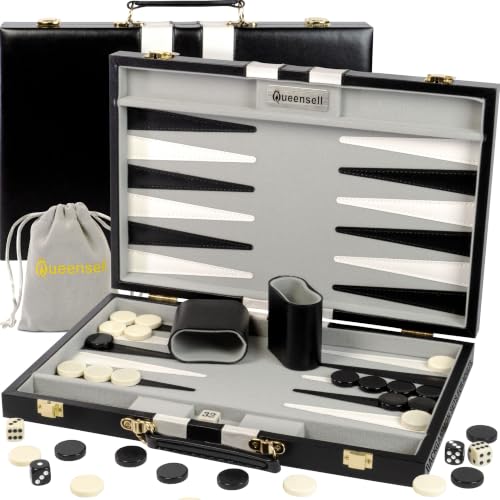


Gift purchases and presentation, handled without regret
Backgammon is a classic gift precisely because a fine set is both playable and displayable, yet gift buying introduces a trap: the purchaser often cannot judge the recipient’s playing habits, space, or existing equipment. The safe path through that uncertainty runs through the middle of the specification range. A mid to large home set with honest proportions, a classic color scheme with strong contrast, checkers of comfortable size, and a case that looks at home on a shelf will suit a beginner, a returning player, and a club player alike, whereas an extreme choice, a novelty miniature or a stark designer colorway, gambles on tastes the giver cannot verify.
Presentation details that genuinely add value are easy to separate from padding. A protective outer sleeve or a sturdy storage box matters because sets live in cupboards between games. A printed rule summary tucked inside helps a household that is learning, and a small note of the materials and care instructions signals that the object expects to be kept. Engraving a case plate can be lovely on a milestone occasion, though it should be done by the maker or a skilled hand, since a crooked aftermarket plate on a fine case is the kind of flaw the eye finds every time the case is opened.
Finally, a gift set should be checked before it is wrapped with the same setup test described earlier in this guide: thirty checkers counted, dice and cube present, cups matched, hinges worked, case closed and carried. Discovering a missing checker on the morning of a celebration converts a generous gesture into an errand, and the check takes ten minutes at a quiet table. That small diligence, invisible to the recipient, is what allows the visible part of the gift, the first opening of the case and the first roll across a new field, to feel exactly as effortless as it should.
One more habit separates satisfied owners from disappointed ones, and it costs nothing. Play a full game on a candidate set whenever the seller allows it, rather than judging from setup and a few rolls alone. A complete game exercises every corner of the equipment: the bear off trays or the habit of stacking borne off checkers beside the board, the cube decisions that test numeral legibility under mild pressure, the moment a hit checker waits on the bar while dice are rolled around it, and the final packing away that reveals whether the interior layout was designed or merely improvised. Faults that hide during a demonstration tend to introduce themselves during that single honest game, and virtues do the same. A set that emerges from a full game with its players talking about the game rather than the equipment has passed the only examination that ultimately counts.
Keep the score sheet from that first full game, too, tucked inside the case lid or folded into a notebook that lives with the set. It becomes the first page of the set’s own history, the record against which later evenings are measured, and a reminder that the value of all this specification care was never the objects themselves. It was the uninterrupted attention the equipment allows, game after game, on the oldest contest in the room.