What's inside
- Key Takeaways
- Quick Picks
- How We Chose These Picks
- Why Do So Many Devices Still Want Exactly 32GB?
- What Do the Speed Markings on a 32GB Card Actually Promise?
- Which 32GB SD Cards Earned a Detailed Look?
- How Much Actually Fits on a 32GB Card?
- How Do These Six 32GB Cards Stack Up Against Each Other?
- How Do You Spot a Fake 32GB Card Before It Eats Your Photographs?
- How Should You Set Up a 32GB Card in an Older Device?
- Should You Buy One Premium Card or Several Ordinary Ones?
- What About Trail Cameras, Dashcams and Audio Recorders?
- What Mistakes Do 32GB Card Buyers Keep Making?
- Final Recommendation
- Frequently Asked Questions
- Related Guides
As an Amazon Associate I earn from qualifying purchases. This post may contain affiliate links at no extra cost to you.
widgetverdict.com is reader-supported. When you buy through links on our site, we may earn an affiliate commission.
Where to buy: three of the cards below carry verified Amazon links — all SanDisk full-size SDHC models spanning the honest range of this class — while three further cards from rival brands are covered in prose because our pool holds no verified listing for them.
There is a particular kind of camera that still runs the world quietly: the compact in the glovebox, the trail camera on the fence post, the older DSLR that refuses to die, the dashcam recording its endless loop. They share one appetite — a full-size 32GB SDHC card, cheap, dependable and formatted the way hardware from another decade expects. The best 32gb memory sd cards are not exciting, and that is exactly the point. This is the most mature, most commoditised corner of flash memory, where the buying skill is not finding performance but avoiding the two failure modes that still lurk here: counterfeit cards wearing famous labels, and modern speed assumptions applied to hosts that cannot use them.
Honesty about the class matters, too. Thirty-two gigabytes in full-size SD form is a legacy tier now; brands refresh it rarely, some famous lines have quietly thinned out, and a few names shoppers expect to find no longer field a serious entry. This guide works with what genuinely exists: three verified SanDisk cards that cover the class’s real jobs — everyday shooting, a faster everyday option, and a proper V30 card for video — plus three prose-only alternatives from Lexar, Kingston and Samsung for buyers who want a different badge in the slot. Small capacity, full-size card, no nonsense.
Key Takeaways
- 32GB full-size SDHC is a legacy tier: buy for reliability and compatibility, not headline speed.
- Three verified SanDisk cards cover the class — two Ultra tiers for stills and everyday use, one Extreme PRO with V30 for video.
- Older cameras and devices often cap at SDHC and FAT32; a 32GB card is frequently the largest card they will ever accept.
- Counterfeits thrive at this price point because nobody expects fraud on a small cheap card — test capacity anyway.
- UHS-II and other exotic speed in a 32GB card only pays off if the camera and your reader both support it.
- For dashcams and always-on recording, endurance-rated media is a different product class; standard cards wear faster.
Quick Picks
| Card | Badge | What it is for |
|---|---|---|
| SanDisk 32GB Ultra SDHC (120MB/s) | Best everyday 32GB SD card | The faster of the two verified Ultra cards and the sensible default for compacts, camcorders and family DSLRs. |
| SanDisk 32GB Ultra SDHC | Best value staple | The long-running Ultra in its 100MB/s form: the card to buy in pairs for spares drawers and second cameras. |
| SanDisk 32GB Extreme PRO SDHC | Best for video and bursts | A genuine V30, U3 full-size card for 4K-capable cameras and burst shooters whose 32GB limit is set by the host, not the hobby. |
| Lexar Professional 633x 32GB SDHC | Prose-only — photographer’s alternative | Lexar’s long-standing professional-line SDHC card for shooters who standardised on Lexar years ago. |
| Kingston Canvas React Plus 32GB SDHC | Prose-only — UHS-II speed niche | A UHS-II card for the small set of cameras and readers that can actually exploit the second row of contacts. |
| Samsung PRO Plus 32GB SD | Prose-only — the Samsung option | Samsung’s full-size PRO Plus line reaches down to this tier for brand loyalists with SD-slot devices. |
How We Chose These Picks
We began by limiting the field to cards that genuinely exist in full-size SDHC form at 32GB from established memory brands — a filter that removes more famous names than shoppers expect, because several lines now start at 64GB or have moved entirely to microSD with adapters. Every linked card was then confirmed against our verified pool, full title matched, so the speed figure and class markings attached to each pick below are the ones the manufacturer actually prints for that exact card. Cards outside the pool appear in prose only, with positioning described fairly and no invented numbers.
Ranking within the class followed the jobs these cards actually do. For stills cameras and everyday recording, read speed governs how painless offloading feels, while write behaviour in short bursts is comfortably within any modern card’s ability. For the minority of 32GB hosts that record serious video, the V30 minimum sustained write guarantee is the whole ballgame, which is why one slot is reserved for a properly classed card rather than a third everyday option. Compatibility breadth — working in the widest range of ageing hosts without formatting drama — acted as the tiebreaker throughout, because a 32GB SDHC card that fusses with a fifteen-year-old camera has failed its only real test.
We also made a deliberate omission worth explaining: no endurance-rated card appears among the six, although dashcam owners land on this category constantly. Endurance media is a distinct product family — different NAND priorities, different warranty language, usually microSD rather than full-size — and folding it into a general 32GB guide would muddy both recommendations. Readers equipping a dashcam or a security recorder should shop that family directly; readers equipping cameras, which is this guide’s brief, are better served by the six honest generalists above.
Why Do So Many Devices Still Want Exactly 32GB?
The answer is a standards boundary. SDHC — the generation of the SD standard that 32GB caps — tops out at precisely this capacity, and it is the ceiling for an enormous installed base of hardware designed before SDXC arrived: cameras, camcorders, dashcams, trail cameras, audio recorders, older game hardware and industrial kit by the warehouse. Those devices were built and firmware-locked in the SDHC era, and many will never see a firmware update, because their makers have moved on or vanished. For all of them, 32GB is not a small card. It is the biggest card that will ever work.
The file system rides along with the standard: SDHC cards ship formatted FAT32, which these hosts expect, and the 4GB single-file limit that comes with FAT32 is the reason long video recordings on older gear arrive as a chain of segments rather than one file. None of this is a defect to engineer around; it is the environment the card lives in. Buying for this tier means accepting the environment — choosing dependable cards inside it — rather than importing expectations from the SDXC world of terabytes and exFAT.
The boundary also explains a small mystery of the second-hand market: why elderly cameras so often arrive with their original tiny cards still inside. The bundled 1GB or 2GB card was never the point; owners simply never needed more, because the photography those cameras did was measured in dozens of frames per outing. The 32GB upgrade is therefore less about hunger than about time — modern shooting habits, grandchildren, video clips and burst modes have all grown into a ceiling that was generous when it was drawn. The card in this guide is the largest answer the standard allows, which is why it remains, quietly, a best-seller.
There is also a quiet economic logic. At this capacity the card costs little enough to treat as semi-consumable: one in the camera, one in the bag, one in the drawer, rotated without anxiety. Professionals working with constrained hosts buy them by the handful before trips. That disposability is a genuine feature of the tier, and it shapes the recommendations below — reliability per card matters, but so does the sanity of buying two ordinary cards instead of one exotic one.
What Do the Speed Markings on a 32GB Card Actually Promise?
Three marking systems share the label, and they promise different things. The headline read figure — up to 100MB/s or 120MB/s on the verified cards here — describes best-case sequential reading under test conditions with a capable reader; it predicts how fast a card full of photographs empties into your computer, and roughly nothing else. Class 10, the marking every card in this guide carries, guarantees a minimum sequential write of 10MB/s, which is the floor that made the class the default for HD-era devices. UHS Speed Class refines the write promise: U1 matches that same floor, while U3 raises it to 30MB/s and pairs with the V30 video class marking that certifies it for 4K recording.
The trap is treating the read figure as a write figure, or as a guarantee of anything inside a camera. A card advertising a big read number with only Class 10 behind it writes like a Class 10 card — fine for stills, adequate for HD video, and not certified for the sustained demands of 4K. That is why the Extreme PRO below is a distinct pick rather than a pricier duplicate of the Ultras: its V30 and U3 markings are promises of a different kind, enforced by the standard rather than by marketing. Match the promise to the job and this entire category becomes simple.
UHS-II deserves its own sentence because it appears in one prose pick. UHS-II adds a second row of contacts and much higher theoretical throughput, but only hosts and readers wired for it benefit; everywhere else the card runs as a UHS-I card. In a 32GB card it is a niche within a niche — real for the few compatible cameras, pointless elsewhere — and we flag it as such rather than letting a bigger number imply a better card for your fifteen-year-old compact.
A final marking causes quiet confusion: the bus itself. UHS-I on every mainstream pick here describes the interface generation, and its real-world ceiling in cameras is set as much by the host’s controller as by the card. Two UHS-I cards with different headline figures will often perform identically inside an older camera and differently only in a modern reader. This is why the guide keeps returning transfers to the reader conversation: the card’s read figure is a promise about your desk, not about your camera, and buying for the desk is legitimate only when the desk is where your bottleneck actually lives.
Which 32GB SD Cards Earned a Detailed Look?
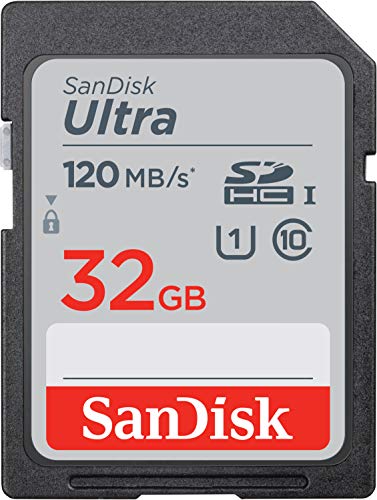
SanDisk 32GB Ultra SDHC (120MB/s) — Best everyday 32GB SD card
If one card in this guide deserves the word default, it is this one. The 120MB/s generation of SanDisk’s Ultra SDHC is the card the class revolves around: UHS-I, Class 10 and U1, aimed squarely at the compact and mid-range cameras and camcorders its verified listing names, with read speed that makes a full card of family photographs a short coffee-break transfer rather than an overnight chore. In the camera it asks for nothing — no special formatting, no host features, no ceremony — and that invisibility is the highest praise a 32GB card can earn.
Its honest boundary is video ambition. With U1 rather than U3 behind it, this is an HD card, entirely comfortable with the Full HD recording its class was built for and not the card to ask for certified 4K sustained writes. Most 32GB hosts cannot record 4K anyway, which is why the boundary so rarely bites in practice. Buy it singly for the camera in the drawer or in pairs for the camera and the bag; of the two verified Ultras, this faster generation is the one to choose when the price gap is the small one it usually is.
Think of this card in terms of the cameras it will outlive. The compact it feeds today will eventually be replaced by a phone for everyday snaps, yet the card will migrate — into the camcorder that films school plays, the spare body kept for holidays, the relative’s camera rescued at a family gathering. A mainstream card from the deepest distribution network is the one that fits every chapter of that wandering life without an adapter, a format argument or a specification surprise. Longevity in this tier is not about the card surviving; it is about the card remaining ordinary everywhere it goes, and no card in the class is more practised at being ordinary in the best sense.
- Format: 32GB SDHC, full-size SD, UHS-I
- Verified listing figure: up to 120MB/s read
- Classes: Class 10, U1
- Build notes from listing: temperature, water and shock proofing claims
- Positioning: everyday stills and Full HD video
Strengths
- The fastest read figure among the verified everyday cards here.
- Universally compatible manners across old and new SDHC hosts.
- From the deepest retail distribution of any card in the class.
Trade-offs
- U1 write class is not a 4K certification; video shooters should look below.
- Read speed needs a decent reader to show itself in transfers.
- At 32GB, heavy shooters will fill it faster than they expect.
Best for: compact and mid-range camera owners who want the sensible card and no further decisions. Not suited for: certified 4K recording or anyone whose host accepts larger SDXC media.

SanDisk 32GB Ultra SDHC — Best value staple
This is the Ultra in its long-running 100MB/s form, and its role in the guide is the staple: the card you buy without research when a device needs feeding today. Its verified listing pairs that read figure with water-resistant and impact-resistant build language, and in every functional respect that matters to an SDHC-era host — Class 10 write floor, FAT32 formatting, full-size shell — it is interchangeable with its faster sibling above. The difference is twenty megabytes per second of best-case read and whatever small price gap the day offers.
Why keep both Ultras in a six-card guide? Because this tier is bought in multiples and in moments. The staple card is the spare in the glovebox, the second card in the trail camera rotation, the one handed to a relative whose camera “stopped working” because its card died in 2019. In those moments, availability and price beat spec-sheet refinement, and this is the most available card in the class — the one every camera shop, supermarket electronics shelf and marketplace seller of genuine stock seems to carry. Buy two; the second one is the cheapest reliability upgrade in photography.
There is a small ritual worth attaching to this card: write the purchase date on its label with a fine marker. Flash memory in light duty lasts for many years, but it does not last forever, and a dated fleet of staple cards lets you retire the oldest first instead of discovering age through a corrupted card at a birthday party. Rotated this way — newest in the main camera, veterans in the trail cameras and spares drawer — a handful of these inexpensive cards becomes a managed system rather than a pile of identical black rectangles, and the whole system costs less than one exotic card.
- Format: full-size SDHC card, 32GB, UHS-I bus
- Verified listing figure: up to 100MB/s read
- Classes: Class 10, U1-era everyday specification
- Build notes from listing: water-resistant, impact-resistant design
- Positioning: the ubiquitous spare and second card
Strengths
- Available everywhere genuine cards are sold; easy to replace like-for-like.
- Entirely sufficient for stills and HD-era hosts of every age.
- The natural multi-buy card for spares and rotations.
Trade-offs
- Slower best-case reads than the 120MB/s generation.
- Same U1-class write ceiling as its sibling; not a video specialist.
- Its ubiquity makes it the most counterfeited card in the class.
Best for: spares drawers, second cameras, trail-cam rotations and rescuing relatives’ cameras. Not suited for: buyers who offload huge stills batches daily and feel every transfer minute.

SanDisk 32GB Extreme PRO SDHC — Best for video and bursts
The Extreme PRO is the card in this guide playing a different sport. Its verified listing quotes up to 100MB/s read and up to 90MB/s write, and — far more important than either — carries V30 and U3 markings, certifying a sustained write floor three times the everyday cards’ guarantee. In a host that records 4K or fires long RAW bursts yet caps at SDHC media, those markings are the difference between a card that is certified for the job and a card that merely attempts it. Buffer clearing after a burst is where you will feel the write speed most: the camera returns to ready while lesser cards are still chewing.
It is also the pick that tests whether the buyer knows their host. If your camera is a stills compact or an HD camcorder, the Extreme PRO’s talents are invisible and the Ultra above is the same experience for less money — we would rather tell you that than sell you up a tier. But if the 32GB ceiling comes from a genuinely capable camera — and a generation of excellent machines sits exactly there — this is the card that lets the hardware be what it is. It is the enthusiast’s 32GB card, in a tier that mostly forgot enthusiasts exist.
One more duty flatters it: time-lapse and interval work on capable bodies, where the camera writes steadily for hours and buffer behaviour shapes the result. The same sustained-write discipline that serves 4K serves the intervalometer, and a card certified for the harder job takes the easier one in stride. Pair that with its burst manners and the picture completes itself — this is the card for the SDHC-era body that is still, unmistakably, a serious photographic instrument, owned by someone who knows exactly what its ceiling is and shoots brilliantly beneath it.
- Format: 32GB SDHC, full-size SD, UHS-I
- Verified listing figures: up to 100MB/s read, up to 90MB/s write
- Classes: Class 10, U3, V30
- Certification: 4K UHD recording per its listing
- Positioning: video and burst specialist within the SDHC ceiling
Strengths
- Genuine V30 sustained-write certification, unique among the linked picks.
- Fast writes clear burst buffers noticeably quicker.
- Lets capable SDHC-capped cameras perform at their real level.
Trade-offs
- Its premium buys nothing a stills-only or HD-only host can use.
- 32GB fills quickly at 4K bitrates; carry the Ultra as its spare.
- Read figure matches the staple card despite the higher tier.
Best for: 4K-capable and burst-shooting cameras whose media ceiling is SDHC. Not suited for: everyday compacts, where its certification is money spent on invisible headroom.
Lexar Professional 633x 32GB SDHC — Prose-only: photographer’s alternative
Lexar’s Professional line has served working photographers for as long as SD cards have existed, and its 633x-series SDHC card at 32GB is the line’s representative in this tier: a UHS-I card from a brand whose name on a card still means something in a camera bag. For shooters who standardised on Lexar across their larger cards, keeping the same badge in the older body is a small comfort with real logic — one brand’s warranty route, one familiar behaviour across the kit.
Our pool holds no verified listing for it, so it appears in prose with no link and no figures quoted from memory. The honest framing is parity: at this tier and class, a genuine Lexar Professional and the verified SanDisk Ultras do the same jobs, and the choice between them is ecosystem and price on the day rather than capability. Buy from a reputable channel, as Lexar’s professional branding is counterfeited nearly as enthusiastically as SanDisk’s, and the 633x name has been in circulation long enough for fakes to be very practised.
Lexar’s history adds a wrinkle buyers should know: the brand passed through ownership changes in the late 2010s, and cards from different eras of the company circulate side by side in the market. Both eras produced genuine media, but packaging and labelling vary, which makes the channel you buy through more important than the vintage you receive. A reputable retailer’s stock is the constant. Chosen that way, a Lexar Professional in the bag is a known quantity with a professional support route behind it — the two things this entire tier is really selling, whatever badge the card wears.
- Format: full-size SDHC, 32GB, UHS-I bus
- Speed figures: not quoted — outside our verified pool
- Classes: professional-line everyday specification
- Positioning: the Lexar-loyalist equivalent of the Ultra tier
Strengths
- A genuine professional-line card from a heritage flash brand.
- Keeps a Lexar-standardised kit under one warranty route.
- Capability parity with the everyday linked picks.
Trade-offs
- No verified listing in our pool, hence no link here.
- Long market life means practised counterfeits circulate.
- No capability argument over the verified cards; it is a preference pick.
Best for: photographers whose bags already run on Lexar and want the older body to match. Not suited for: bargain hunters, since its case is loyalty rather than price.
Kingston Canvas React Plus 32GB SDHC — Prose-only: UHS-II speed niche
Kingston’s Canvas React Plus is the exotic of this guide: a UHS-II card, built around a second row of contacts and throughput figures that dwarf everything else here — on paper, and on the small set of hosts wired to use them. A handful of high-end cameras offer UHS-II slots, and for an owner of one such body whose workflow involves a UHS-II reader and a deadline, a fast 32GB card is a rational specialist tool: offloads become near-instant, and burst buffers drain at the interface’s pace rather than the card’s.
Everywhere else, honesty requires deflation. In a UHS-I host — which is to say, in essentially every device that wants a 32GB card — a UHS-II card runs at UHS-I behaviour while costing UHS-II money. We include it because the niche is real and Kingston is a serious manufacturer, but we label it plainly so that no owner of a trail camera or a 2012 compact mistakes a bigger interface for a better card for them. It is prose-only here, outside our verified pool, so check the exact listing’s interface and your camera’s slot specification twice before spending.
To be fair to the niche, it is not imaginary: a wedding photographer running a UHS-II body as a second camera, capped at 32GB by a client’s delivery specification or a personal workflow, genuinely benefits from offloads that finish before the next card is needed. Rental houses and specialist shops serve exactly these buyers, and for them the React Plus is not a curiosity but a tool. The guide’s caution is aimed at the far larger audience whose hosts cannot spell UHS-II — for whom this card’s premium buys a logo’s worth of speed and a UHS-I card’s worth of reality.
- Format: 32GB SDHC, full-size SD, UHS-II
- Speed figures: not quoted — outside our verified pool
- Classes: UHS-II interface; falls back to UHS-I elsewhere
- Positioning: specialist card for UHS-II hosts and readers
Strengths
- The only route to UHS-II throughput in this capacity class.
- From Kingston, a manufacturer-grade memory brand.
- Backwards compatible with every UHS-I slot.
Trade-offs
- Its speed is unreachable in the overwhelming majority of 32GB hosts.
- Premium pricing for headroom most buyers will never touch.
- Unverified in our pool; confirm the exact listing carefully.
Best for: owners of UHS-II camera bodies who also run a UHS-II reader. Not suited for: literally every other 32GB use case, where the verified UHS-I cards do the same work for less.
Samsung PRO Plus 32GB SD — Prose-only: the Samsung option
Samsung’s full-size PRO Plus line — distinct from its microSD cards of the same name — extends Samsung’s memory range into the SD slot, and it reaches this 32GB tier for buyers who want the Samsung badge in a camera rather than a phone. The PRO Plus name carries Samsung’s top-tier positioning for the format, and for households already running Samsung storage everywhere else, there is a coherent one-brand logic to choosing it for the family camera.
It sits in prose because our verified pool does not include Samsung’s full-size card at this capacity, so no link and no quoted figures appear here. Treat it as the loyalist alternative to the verified SanDisk everyday cards: same class of job, same FAT32 world, different badge and warranty route. As ever in this tier, the seller matters more than the sliver of difference between genuine cards — Samsung’s popularity makes its packaging a counterfeiter’s favourite costume, so buy through channels with real returns.
Samsung’s full-size line also illustrates a market truth worth naming: the biggest memory maker on earth treats 32GB full-size SD as a legacy courtesy, stocked and supported but not marketed, because its volume lives in microSD and larger capacities. That is not a criticism of the card — legacy courtesies from giant makers are often the safest buys in a tier — but it explains the thinner shelf presence compared with SanDisk’s ever-present Ultras. If you find genuine stock at a fair price, the card itself will not know it was a courtesy, and neither will your camera.
- Format: 32GB, full-size SD card (SDHC generation)
- Speed figures: not quoted — outside our verified pool
- Classes: PRO Plus is Samsung’s top full-size SD line
- Positioning: brand-loyalist alternative to the Ultra tier
Strengths
- Samsung’s flagship full-size line, from a top-tier NAND maker.
- Keeps a Samsung-standardised household on one brand.
- Everyday capability in line with the class.
Trade-offs
- Outside our verified pool, so it carries no link in this guide.
- Full-size Samsung cards are less widely stocked than the SanDisks.
- Popular branding invites counterfeits; seller choice is critical.
Best for: Samsung loyalists equipping an SD-slot camera or camcorder. Not suited for: buyers who want the verified, linked, no-research purchase — that is the Ultra pair above.
How Much Actually Fits on a 32GB Card?
Capacity questions in this tier are really device questions, because 32GB means wildly different things in different hosts. In a compact camera shooting JPEGs, it is a small town’s worth of photographs — thousands of frames, more than most owners shoot in a year. In an enthusiast body shooting RAW, it is a few hundred frames: a serious day, not a holiday. In an HD camcorder it is hours of footage; in the Extreme PRO’s 4K host it is a tight session. The card does not change; the appetite of the device defines whether 32GB reads as abundance or discipline.
That spread explains the tier’s buying patterns. JPEG shooters and HD-era hosts can treat the card as effectively unlimited and buy on reliability alone. RAW shooters and 4K hosts treat it as a magazine — loaded, emptied nightly, rotated — and for them the two-card habit matters more than any single card’s virtues. Trail cameras sit at the far end of patience: at a few photographs a day, 32GB is geological time, and the card will be limited by the camera’s batteries and the seasons long before its capacity becomes a conversation.
Usable space trims every figure slightly: a 32GB card formats to a little under thirty gigabytes in the device, the familiar decimal-versus-binary difference. Plan against the formatted number, keep the card below roughly ninety percent full in cameras that write bursts — controllers behave better with breathing room — and the capacity you bought is the capacity you will experience, with no surprises scheduled for the worst possible afternoon.
RAW shooters should also plan the evening, not just the day: a 32GB card of RAW files is a meaningful offload, and the rotation only works if yesterday’s card is emptied, verified and returned to the bag before tomorrow. The read figures on the verified picks exist for exactly this hour of the workflow. A card that empties briskly into the laptop is a card that gets emptied; a slow one tempts its owner to postpone, and postponed offloads are how full cards meet full days.
How Do These Six 32GB Cards Stack Up Against Each Other?
| Card | Link status | Defining trait | Choose it when |
|---|---|---|---|
| SanDisk Ultra SDHC (120MB/s) | Linked | Fastest verified everyday card | You want one default card for a normal camera |
| SanDisk Ultra SDHC (100MB/s) | Linked | The ubiquitous staple | You are buying spares and second cards |
| SanDisk Extreme PRO SDHC | Linked | V30 and U3 certification | Your SDHC host records 4K or fires long bursts |
| Lexar Professional 633x | Prose-only | Heritage pro line | Your kit already runs on Lexar |
| Kingston Canvas React Plus | Prose-only | UHS-II interface | Your camera and reader are both UHS-II |
| Samsung PRO Plus SD | Prose-only | Samsung’s full-size flagship line | You standardise on Samsung storage |
Read as a map, the six split into three verified working cards and three allegiance-or-interface alternatives. Nothing in the prose trio does a job the linked trio cannot, except the Kingston’s UHS-II trick in its tiny niche — which is exactly why the linked cards are linked: they are the ones we could confirm, and in a commoditised tier, confirmed and sufficient beats exotic and assumed every time.
There is also a generational comfort in the linked trio: all three come from the same maker’s current full-size range, so a household can standardise on one brand’s behaviour across its main camera, its spare and its one demanding body, and learn a single card’s habits deeply. Standardisation is an underrated virtue in storage — it turns troubleshooting into pattern-matching, because any card that behaves differently from its identical siblings has announced itself as the problem.
How Do You Spot a Fake 32GB Card Before It Eats Your Photographs?
Counterfeiting at this tier follows a simple economy: the genuine card is cheap, so the fake must be cheaper, and the entire fraud lives in the gap. The product is usually a much smaller card — sometimes only a few gigabytes — whose controller has been taught to report 32GB to any device that asks. In a camera it behaves beautifully until real data crosses its true capacity, at which point new photographs overwrite old ones in a silent rotation of loss. The failure is discovered at the computer, weeks later, when the files at the start of the card have dissolved into noise.
The defences are procedural and they work. Buy from the maker’s own storefront, a major retailer or a camera shop — channels with supply chains — rather than the cheapest marketplace listing. On arrival, run a full write-and-verify test with a utility such as H2testw or F3 before the card’s first real outing; the test takes under an hour at this size and settles the question permanently. Inspect the packaging with a sceptic’s eye: blurred printing, misspelled words and missing holograms are confessions. And keep perspective on price — a genuine card in this tier costs little enough that a listing at half the going rate is not a bargain but a biography of the fraud.
One more subtlety: fakes cluster around the most famous names, because fame is what is being sold. The two SanDisk Ultras in this guide are, by that logic, the most imitated cards in the class — which is an argument not against the cards but for the channel. A genuine Ultra bought properly will serve a decade; the same name bought carelessly may not survive the month. In a tier this cheap, the seller is the specification.
The test deserves one practical footnote: run it on the card as it arrives, before formatting it into a device, and keep the result in mind when the second card of a pair arrives from the same order — batches share fates, and a failed test on one card is evidence about its siblings. Sellers of genuine stock replace tested-bad cards without drama, because their supply chain gives them somewhere to send the problem. A seller who argues with a capacity test has identified themselves more clearly than the test identified the card.
How Should You Set Up a 32GB Card in an Older Device?
Format the card in the device that will use it, not on a computer. Ageing hosts can be particular about partition layout and file-system details, and their own format command produces exactly the card they expect; a computer-formatted card that a 2010 camera rejects is a rite of passage best skipped. If the device offers a low-level format option, use it for a card with a past life. Then shoot a short test — a burst of stills and a minute of video at the device’s highest setting — and play everything back in the device before the card goes on real duty.
Mind the FAT32 file-size ceiling in your expectations: long recordings will be saved as consecutive segments of just under 4GB each, which is normal behaviour, not corruption. When offloading, copy the whole card’s folder structure rather than cherry-picking files, so spanned clips and sidecar files stay together. Finally, retire cards gracefully: a 32GB card that starts producing errors, slow formats or vanished files is telling you its remaining life is short, and at this tier the correct response is replacement, not repair attempts.
Keep a small fleet discipline if several devices share the tier: one card per device, labelled, rather than a single card passed from slot to slot. Card swapping between hosts invites formatting prompts — and a tired user who accepts a format prompt on the wrong card has performed the oldest data-loss ritual in digital photography. Dedicated cards cost little at this size, keep each device’s file system exactly as its host prefers, and turn “which card has the wedding on it?” from a panic into a label-reading exercise.
Should You Buy One Premium Card or Several Ordinary Ones?
This tier’s pricing poses a pleasant dilemma: the flagship-certified card costs roughly what two or three everyday cards cost, and both strategies are defensible — for different photographers. The premium card concentrates its value in one slot: certified sustained writes, faster buffer clearing, the ceiling of what the standard allows. The fleet strategy spreads its value across risk and place: a card in every camera, a spare in every bag, no single failure able to strand a day’s shooting, and natural rotation that spreads wear across several devices.
The deciding question is what your camera does with a card. If it records 4K or lives in burst mode, the premium card is not a luxury but the tool’s other half, and the fleet logic applies to its spares — a V30 card deserves a V30 understudy. If your hosts shoot JPEGs and HD, the premium buys invisible headroom while the fleet buys visible resilience, and resilience wins birthdays, holidays and school plays more often than headroom does. Most households, honestly assessed, land in the second camp — which is why this guide’s centre of gravity sits with the two Ultras and treats the Extreme PRO as the specialist it is.
There is a hybrid worth naming: one premium card for the capable body, everyday cards for everything else, all of them dated and rotated. It costs little more than the pure fleet, covers the one workload that genuinely needs certification, and keeps the spares drawer honest. Whichever strategy you choose, choose it on purpose — the only wrong answer in this tier is the accidental one, bought in a hurry at a markup from a seller you would not trust with a sandwich.
What About Trail Cameras, Dashcams and Audio Recorders?
Three device families land on this category with needs the camera-first picks only partly serve, and each deserves a direct answer. Trail cameras are the easiest: they sip capacity, tolerate any healthy card, and live outdoors, where the card’s build and the owner’s rotation habit matter more than speed. Either verified Ultra is a sound trail card; buy two, swap them on visits, and review the footage at home rather than standing in a field scrolling a tiny screen.
Dashcams are the exception that must not be waved through. A dashcam overwrites continuously, and that duty consumes a standard card’s write endurance in months rather than years — often failing silently, discovered only when footage of an incident is needed and absent. If the recording matters, endurance-rated media is the correct product family, full stop; the cards in this guide are for cameras that record when their owners ask them to. Audio recorders, by contrast, are the gentlest hosts in the building: tiny files, trivial write demands, and a premium on absolute reliability, since a lost recording of an interview or a lecture cannot be restaged. For them, the staple Ultra’s ubiquity and manners are exactly the specification.
The pattern across all three is the guide’s recurring lesson in miniature: the device’s duty cycle, not the card’s headline, writes the requirements. Match a gentle card to a gentle host and a certified card to a hungry one, and this modest tier of flash memory will serve for years without ever becoming a story you tell.
What Mistakes Do 32GB Card Buyers Keep Making?
The classic is buying a microSD card plus adapter for a device with a full-size slot and then blaming the device for flakiness — adapters add a contact interface and a failure point, and in ageing slots with tired springs they are a common source of intermittent misery; a native full-size card like the ones here is the boring correct answer. The second classic is assuming a bigger, newer card will work: sliding a 128GB SDXC card into an SDHC-era host produces either refusal or, worse, partial behaviour that corrupts quietly.
Then come the counterfeit traps, which at this price point catch people precisely because the sums feel too small to fake — they are not; the margin on a fake card is the whole price. Buy from real channels, run a capacity check on arrival, and treat packaging errors as the confession they usually are. And the final mistake is endurance blindness: looping a standard card in a dashcam or security recorder until it dies mid-incident, when endurance-rated media exists for exactly that duty cycle.
A last mistake is sentimental: nursing a beloved old card long past its reliability because it has “always worked.” Flash does not send warning letters; it works until the outing where it does not, and the outing is never a rehearsal. Cards in this tier cost less than the fuel to reach most photo locations. Replace on schedule, retire the veterans to the audio recorder and the spares drawer, and let sentiment live in the photographs rather than in the plastic that carried them.
And a word for the drawer of mystery cards every household accumulates — unlabelled, inherited, found in old devices. Test each one before trusting it, label the survivors with their capacity and the year, and recycle the failures without nostalgia. A 32GB card of unknown provenance holding a family’s only copy of anything is a risk with no upside: the genuine replacement costs less than the recovery attempt, and infinitely less than the loss. The drawer, audited once, becomes a fleet; unaudited, it remains a lottery.
That small audit, done once a year alongside the camera bag’s spring clean, is the whole maintenance programme this tier asks of anyone. No firmware, no software, no ceremony — just known cards, dated labels and a spare that has been tested before it is needed. Storage at its best is invisible, and at 32GB invisibility is genuinely achievable: the right card, in the right host, forgotten until the day it is full of photographs worth keeping.
Final Recommendation
Keep it simple, because this tier rewards simple. The 120MB/s SanDisk Ultra is the card to buy for a normal camera; its 100MB/s sibling is the card to buy two of for spares; and the Extreme PRO is the card to buy when your SDHC-capped host genuinely records 4K or lives on burst mode. The prose trio serves loyalty and one narrow interface niche, honestly labelled. In a category built for devices that have outlived three generations of marketing, the best 32GB card is the genuine one, formatted in its host, doing its unglamorous job for another decade.
Buy the card before you need it, is the final practical word. These are the purchases made in haste at petrol stations and airport shops when a camera dies on day one of a holiday — the worst channels, at the worst prices, with the worst authenticity odds in the category. A genuine card ordered calmly this week, tested on arrival and waiting in the camera bag, converts that future emergency into a non-event. Few upgrades in photography offer so much peace for so little money, and none of them come in a smaller packet.
Frequently Asked Questions
Why won’t my camera accept a card larger than 32GB?
Because it was built to the SDHC standard, which ends at 32GB, and its firmware cannot address SDXC media. This is a hard standards ceiling, not a fault — a 32GB card is the largest that will ever work in that host, which is why this category continues to exist.
Can I use a microSD card with an adapter instead?
You can, and it often works, but a native full-size card removes an extra set of contacts that ageing slots handle poorly. For a card that will live in one older device for years, the native card is the more reliable choice; adapters are best kept as a convenience, not a foundation.
Is a 32GB card big enough for video?
For HD-era hosts, comfortably — hours of footage at their bitrates. For 4K on a V30 card, think in tens of minutes per outing rather than whole days, and carry a spare. Capacity adequacy is a bitrate question, and your camera’s recording settings decide it.
What does V30 add over a normal Class 10 card?
A certified minimum sustained write speed three times higher — 30MB/s against 10MB/s — maintained for the whole recording rather than achieved in a burst. That guarantee is what 4K recording actually consumes, and it is why the Extreme PRO in this guide is a distinct pick rather than a trim level.
How can I tell if my cheap 32GB card is fake?
Run a full write-and-verify capacity test with a utility such as H2testw or F3 before trusting it. Fakes report 32GB while holding far less, and the test exposes the lie in one pass. Misspelled packaging and prices far below every reputable seller are the earlier warnings.
Should a dashcam use one of these standard cards?
It will work, but it is the wrong tool for years of loop recording: constant overwriting wears standard NAND quickly. Endurance-rated cards are built and warrantied for that duty. For a camera that records occasionally, the standard cards here are entirely appropriate.
Can I use a 32GB card in a camera that came with a smaller one?
Almost always, yes — SDHC hosts accept any SDHC capacity up to the 32GB ceiling, and the bundled card’s size was a cost decision, not a compatibility limit. Format the new card in the camera before first use and it will behave as if it had always belonged there.
Why does my 32GB card show less than 32GB in the camera?
Manufacturers count gigabytes in decimal and devices report in binary, so the same card honestly shows a little under thirty. Every brand plays by the same convention; the difference is units, not missing memory, and it affects all capacities equally.
How long should a 32GB SD card last?
In camera duty, years — typically longer than the device it serves, because stills and occasional video are gentle work for flash. Cards die early mainly in overwrite-heavy service or through physical abuse. Date your cards, rotate the oldest into the lightest duty, and replace any card at its first unexplained error rather than its third.
Is it worth paying more for the Extreme PRO if I only shoot photos?
Only if those photos arrive in long RAW bursts. For single frames and casual sequences, the camera clears its buffer comfortably on the Ultra cards, and the premium buys headroom you will never see. Burst shooters and 4K hosts are the buyers the PRO’s certification was printed for.
Related Guides
Storage needs rarely stop at one slot, so continue with best SD cards for cameras that shoot 4K, best micro SD cards for dashcams and security cameras and best high endurance memory cards for always-on recording.


