What's inside
- Key Takeaways
- Quick Picks
- How We Chose These Picks
- Comparison
- How do Lenovo’s ranges actually differ beneath the badges?
- How do you choose between LOQ and Legion, or IdeaPad and ThinkPad?
- What does each range feel like to live with for a year?
- How should a family with several users divide the Lenovo ladder?
- Common Mistakes
- Final Recommendation
- Frequently Asked Questions
- Related Guides
As an Amazon Associate I earn from qualifying purchases. This post may contain affiliate links at no extra cost to you.
widgetverdict.com is reader-supported. When you buy through links on our site, we may earn an affiliate commission.
Links first, briefly: five of the six Lenovos below carry Amazon links, where you can check price on Amazon and read the exact configuration in the listing title, and one — the Yoga — is covered in prose because its specification is assembled from a configuration menu. With a single maker, the model name is only the beginning of the truth; the listing title is the rest of it, every time.
Choosing among the best 15 lenovo laptops is really choosing among four companies that happen to share a logo. Lenovo sells the sensible IdeaPad your family needs, the LOQ your teenager is negotiating for, the Legion your evenings deserve, and the ThinkPad your employer issues — four product philosophies, four price logics, four ideas about what a laptop is for, all wearing the same badge and all, at 15 inches, genuinely good at their jobs. The beginner’s mistake is to shop “a Lenovo” as if it were one thing, one price logic, one promise. The informed purchase starts by deciding which Lenovo you are actually shopping for, and this guide is organised to make that decision in the first ten minutes.
The ladder, in one breath: IdeaPad is the mainstream — honest machines for home, school and office, priced by reason. LOQ is Lenovo’s gaming doorway, built to put real graphics within reach of first-time gaming budgets. Legion is the gaming flagship line, where the cooling, panels and power all grow up. ThinkPad is the business institution, engineered around keyboards, durability standards and corporate service, priced by a logic that includes all three. Yoga floats across the ladder as the convertible idea — the hinge — applied at several altitudes. Five linked picks below carry one representative of each major rung at or near 15 inches, plus the IdeaPad family’s entry point, and the prose pick carries the hinge idea itself, proudly.
One size note, in the open where this guide keeps them: the ThinkPad representative is a 14 inch machine, because Lenovo’s current ThinkPad line concentrates its best-selling professional models at that size, and a Lenovo guide without a ThinkPad would be a map missing its capital. Its size is flagged wherever it appears. Everything else here sits in the 15 inch class the title promises.
Key Takeaways
- Lenovo is four ranges wearing one badge: IdeaPad for the mainstream, LOQ for entry gaming, Legion for flagship gaming, ThinkPad for business — choose the range before the model.
- The IdeaPad Slim 3 is the range’s sweet spot: Ryzen 7 5825U, 16GB of memory, 512GB SSD and a Full HD touchscreen in one verified listing.
- The LOQ and the Legion 5a share RTX 5060 graphics and a Ryzen 7 250 in their listings — the Legion’s OLED 165Hz panel and 32GB of memory are what the step up buys.
- The ThinkPad T14 Gen 6 represents the business line at 14 inches (flagged): 32GB of DDR5, a 1TB SSD, dual Thunderbolt 4 and Windows 11 Pro in its listing.
- The IdeaPad 1 is the family’s honest floor — Ryzen 5 7520U, 8GB of memory, 256GB SSD — and this guide says plainly who should and should not buy it.
Quick Picks
| Pick | Badge | Why it is here |
|---|---|---|
| Lenovo IdeaPad Slim 3 15.6 | Range Sweet Spot | The mainstream perfected: Ryzen 7, 16GB, a touchscreen and balanced everything. |
| Lenovo IdeaPad 1 15.6 | Honest Floor | The family’s entry machine — Ryzen 5, 8GB, 256GB — for light duties done properly. |
| Lenovo LOQ 15.3 | Gaming Doorway | RTX 5060 graphics and a 165Hz WUXGA IPS panel at the gaming range’s entrance. |
| Lenovo Legion 5a 15.3 | Gaming Flagship | The same graphics tier, elevated: OLED WQXGA at 165Hz and 32GB of memory. |
| Lenovo ThinkPad T14 Gen 6 | Business Institution | A 14 inch professional benchmark with 32GB DDR5, 1TB SSD and dual Thunderbolt 4. |
| Lenovo Yoga 7i 2-in-1 | Prose Pick | The hinge, applied at a premium altitude; specification comes from its configuration menu. |
How We Chose These Picks
Representation came before ranking. A Lenovo guide that listed six IdeaPads would be accurate and useless, so the shortlist was built to carry each of the maker’s ranges at the size class in question, with a linked listing whose title proves the specification. The IdeaPad family earns two seats because it is two products in practice — the Slim 3’s balanced mainstream and the IdeaPad 1’s entry floor — and because most Lenovo buyers are, whether they know it yet or not, IdeaPad buyers. LOQ and Legion take one seat each, as the two ends of the gaming ladder, and their listings happen to share a processor and graphics tier, which turns the comparison between them into the cleanest illustration in this guide of what a range step actually buys.
The ThinkPad’s seat required the size exception described above, and it was granted for a structural reason: ThinkPad is not a trim level of Lenovo, it is a third of the company’s identity, and its current professional heartland is the 14 inch T series. The T14 Gen 6’s listing — 32GB of DDR5 memory, a terabyte of storage, Thunderbolt 4 twice, Windows 11 Pro — is the business argument in its strongest current form. The Yoga closes the six in prose because convertible configurations resist single-listing proof, and because the hinge idea deserves a hearing in a Lenovo guide even when it cannot carry a link.
Within each range, the judging standard was fitness for that range’s promise. IdeaPads were scored on balance and value, gaming machines on cooling, panels and sustained performance, the ThinkPad on keyboard, ports, service logic and security furniture. Cross-range comparisons were deliberately resisted: asking whether the Legion is “better” than the ThinkPad is asking whether a sports car outranks a pickup truck, and the honest answer is a question about your life, which the rest of this guide exists to ask properly.
Lenovo IdeaPad Slim 3 15.6 — Range Sweet Spot
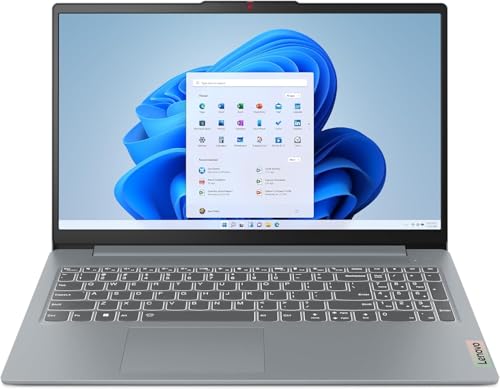
Meet the Lenovo most people should buy, wearing the range’s most balanced specification. The Slim 3’s verified listing pairs a Ryzen 7 5825U — eight cores from AMD’s efficient, proven family — with Radeon integrated graphics, 16GB of DDR4 memory and a 512GB SSD, behind a 15.6 inch Full HD touchscreen. Inside the IdeaPad range, this is the configuration the line exists to sell: powerful enough that no everyday task can embarrass it, priced by the logic of the mainstream rather than the flagship, and finished to a standard that survives family life. If the whole IdeaPad idea had to be defended by one machine, this is the machine Lenovo would send.
The touchscreen is the Slim 3’s signature inside its own family, and it is worth understanding why Lenovo bothers. IdeaPads live in kitchens, classrooms and shared living rooms, where a screen gets pointed at, tapped and pinched by people who did not read the manual because there effectively isn’t one. Touch collapses the distance between intention and action for those users — the grandparent enlarging a photograph, the child navigating homework, the cook scrolling with a floury knuckle. The panel underneath is a proper 1920 by 1080 IPS-class display, so the convenience costs nothing in clarity, and the 5825U’s efficiency means the machine stays cool and quiet while it serves.
Radeon graphics widen the Slim 3’s remit beyond the office. Light gaming, photo editing, and the GPU-accelerated grind of modern browsers and video calls all run with headroom that integrated graphics of a few generations ago could not offer. Wi-Fi 6 and Bluetooth 5.2 from the listing keep the machine current on crowded home networks, and the 720p camera handles the call schedule of a normal household without complaint. Nothing in the specification reaches for drama; everything in it reaches for sufficiency with margin, which is the harder engineering target.
The Slim 3’s compromises live where IdeaPad money is always saved. The chassis is a tidy polymer construction that will not be mistaken for the ThinkPad’s armour or a Legion’s intent, the camera is a 720p unit in a world drifting to sharper sensors, and the battery is a working day rather than a expedition. Owners forgive all three because the machine’s centre — screen, speed, memory, silence — never asks for forgiveness. In the Lenovo ladder, this is the rung where value peaks: below it, specifications start to bite; above it, you are buying specialisation.
Service and community complete the mainstream argument. IdeaPads sell in numbers that guarantee an ecosystem: replacement parts, repair videos, and a decade of accumulated forum wisdom for nearly every behaviour the machine might exhibit. For a family buying one computer to serve everyone, that support shadow is worth as much as a specification line — it is the difference between a problem and a search result.
There is a generational comfort to the Slim 3 as well: it is the machine a family can hand to any member without a briefing. The interface is Windows without surprises, the touch layer forgives imprecise users, and the performance margin means nobody’s session collapses because someone else left twenty tabs open. Mainstream design is often mistaken for the absence of design; the Slim 3 is what it looks like when the design goal is the absence of friction, pursued competently across every line of the specification.
- Panel: 15.6 inch Full HD touchscreen, 1920 x 1080, per the listing
- Chip: AMD Ryzen 7 5825U, eight cores, Radeon integrated graphics
- Memory and storage: 16GB DDR4 beside a 512GB SSD
- Connections: Wi-Fi 6, Bluetooth 5.2
- Camera and system: 720p HD camera, Windows 11 Home
Strengths
- The IdeaPad range’s most coherent specification
- Touchscreen suits the shared, informal rooms IdeaPads live in
- Efficient and quiet under everyday loads
Trade-offs
- Polymer build beside the family’s pricier materials
- 720p camera is the range’s standard compromise
- Integrated graphics cap gaming ambitions
Best for: families, students and home offices buying the mainstream on purpose.
Not suited for: gamers and creators whose software needs a discrete GPU.

Lenovo IdeaPad 1 15.6 — Honest Floor
Every range needs a floor, and the IdeaPad 1 is Lenovo’s — the machine that answers the question “what is the least laptop a person can buy and still call it a laptop?” Its verified listing is admirably plain about the answer: a 15.6 inch Full HD display, an AMD Ryzen 5 7520U processor, 8GB of LPDDR5 memory, a 256GB SSD, a numeric keypad, and a lightweight design pitched at students and home office use. Nothing in that sentence is pretending. The IdeaPad 1 is not a failed Slim 3; it is a successful minimum, engineered for the duties that genuinely fill most home laptops’ days — documents, browsing, email, video, school platforms — and priced to leave money in the household for everything else.
The Ryzen 5 7520U deserves a fair hearing, because it is the component that keeps the floor honest. It is a modern, efficient quad-core-class chip that handles the everyday stack — browser, office suite, streaming, calls — without the stutter that gave entry laptops their reputation a decade ago. Paired with an SSD rather than a spinning drive, the IdeaPad 1 wakes fast, loads fast, and feels responsive in the interactions that dominate its working life. The 15.6 inch Full HD panel matters here too: at this end of the market, lesser resolutions still circulate, and Lenovo’s floor keeps the full 1920 by 1080 that text and video deserve.
The limits are structural and should be bought with eyes open. Eight gigabytes of memory is the ceiling of comfort for today’s multitasking and the floor of tomorrow’s; the machine will serve a disciplined user well and a forty-tab user poorly. The 256GB drive fills with a large photo library or a couple of big games. LPDDR5 memory in designs of this class is typically not upgradeable, so the specification you buy is the specification you retire. None of this is a defect — it is the definition of an entry machine — but it converts the IdeaPad 1 into a purchase for a known, bounded job: the child’s first laptop, the spare for guests and grandparents, the dedicated machine for a single purpose like writing, accounts or online courses.
Judged against that job description, the IdeaPad 1 is rather admirable. It is light to carry, undemanding to run, and backed by the same service ecosystem as its pricier siblings. The numeric keypad — a detail many entry machines delete — survives here, quietly serving the home accounts and spreadsheet homework that entry laptops actually do. Lenovo’s restraint is the story: the floor of the range is a real computer, specified by people who understood the assignment of “enough”.
Buy it for the bounded job and it will be remembered fondly. Buy it as a five-year main machine for a growing workload and it will be remembered as a lesson. The guide’s job is to make sure you know which purchase you are making, and the IdeaPad 1, to its credit, hides nothing that would confuse the two.
Schools and course providers are the IdeaPad 1’s natural habitat, and worth picturing: a classroom set of identical machines, each running the same learning platform, each cheap enough to deploy by the dozen and sturdy enough to survive the deployment. The model’s virtues — price logic, a full-size screen, a proper keyboard with a keypad — are institutional virtues as much as domestic ones, and the home buyer inherits the benefit of engineering done for the toughest audience in computing: other people’s children.
- Panel: 15.6 inch Full HD display, per the listing
- Chip: AMD Ryzen 5 7520U
- Memory and storage: 8GB LPDDR5 with a 256GB SSD
- Layout: numeric keypad retained — rare at the floor of a range
- Pitch: lightweight design for students and home office duties
Strengths
- A genuine Full HD screen where rivals still cut resolution
- Modern efficient chip keeps everyday work responsive
- Numeric keypad serves real home-office life
Trade-offs
- 8GB of memory bounds multitasking today and tomorrow
- 256GB fills quickly with media and games
- Not a machine to grow into heavier workloads
Best for: first laptops, spare machines and single-purpose home duties.
Not suited for: a household’s only computer across a five-year span.

Lenovo LOQ 15.3 — Gaming Doorway
LOQ is the smartest idea in Lenovo’s catalogue: a gaming range built for the buyer who cannot, or will not, pay flagship prices, engineered by people who understood that the doorway matters as much as the destination. The verified listing for this LOQ describes a 2026 machine with NVIDIA GeForce RTX 5060 graphics, an AMD Ryzen 7 250 processor, 16GB of memory and 1TB of storage, behind a 15.3 inch WUXGA IPS display running at 165Hz, in Luna Grey. Linger on the graphics line. A current-generation RTX card in the doorway range — with its upscaling and frame-generation features intact — means the LOQ is not a toy version of a gaming laptop. It is a gaming laptop, full stop, with the savings taken in the places a first-time buyer will feel least.
The panel choice shows the same intelligence. WUXGA IPS at 165Hz is the pragmatic gamer’s specification: resolution high enough to look sharp at 15.3 inches, refresh fast enough for competitive play, and an IPS panel whose brightness and viewing angles survive ordinary rooms better than a bargain OLED would at this level. Crucially, the resolution is matched to the graphics card’s honest abilities — the RTX 5060 drives WUXGA at high frame rates in modern titles, where a costlier 4K panel would spend its life being fed half-resolution compromises. LOQ’s engineers chose the screen the GPU can honour, and the machine is better for their restraint.
Where the doorway range saves is in the materials and the margins. The chassis is a purposeful polymer construction rather than the Legion’s armoured statement; the keyboard is a good gaming deck rather than a per-key-lit theatre; the cooling is competent and audible rather than overbuilt. Sixteen gigabytes of memory is the correct gaming figure today and the figure a growing library of creative software will eventually test. None of these savings touches the experience of playing a game tonight, which is precisely the LOQ thesis: spend on the session, save on the ceremony.
The ownership path is the final part of the pitch. LOQ buyers are often first-time gaming-laptop owners, and Lenovo supports the range like a first step rather than a dead end — the machines are serviceable, the community is large, and the upgrade from a LOQ to a Legion in a few years is a path the company visibly maintains. A teenager’s first gaming machine, a student’s one big purchase, a returning player’s re-entry: the LOQ is built for beginnings, and beginnings deserve engineering this honest.
Set it beside the Legion below and the ladder’s logic snaps into focus. Same graphics tier, same processor family in their listings — the step up buys panel technology, memory and cooling headroom, not a different sport. Buyers who understand that can choose their rung with confidence instead of anxiety, which is all a range structure is ever for.
Parents buying a first gaming laptop will find the LOQ’s restraint reassuring in a second way: it is a machine whose pleasures are the games themselves rather than the theatre around them — no light show, no aggressive styling shouting from a school desk. Luna Grey reads as a laptop first and a gaming machine second, which in shared houses and shared rooms is a diplomatic feature. The doorway range turns out to be designed for households as carefully as for players.
- Panel: 15.3 inch WUXGA IPS, 165Hz, per the listing
- Graphics: NVIDIA GeForce RTX 5060
- Chip: AMD Ryzen 7 250
- Memory and storage: 16GB memory with 1TB storage
- Identity: 2026 LOQ line in Luna Grey — gaming’s doorway range
Strengths
- Current-generation RTX graphics at the doorway price logic
- Panel resolution honestly matched to the GPU’s abilities
- A terabyte of storage swallows a real game library
Trade-offs
- Polymer build beside the Legion’s armour
- 16GB is today’s right answer, not tomorrow’s headroom
- Cooling is audible when the games get serious
Best for: first-time gaming buyers and students entering PC play.
Not suited for: players set on OLED contrast and flagship cooling today.
Lenovo Legion 5a 15.3 — Gaming Flagship
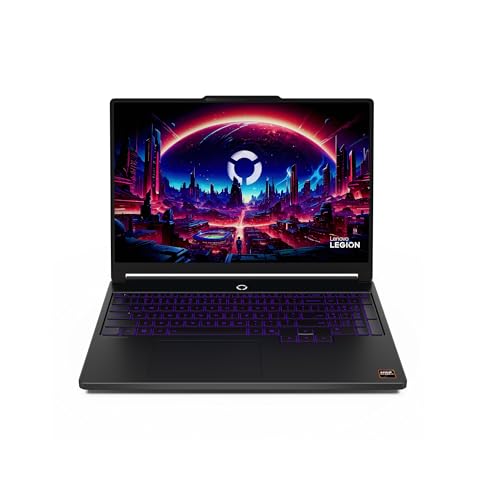
Legion is where Lenovo stops economising, and the 5a’s listing reads like the range’s manifesto: a 15.3 inch OLED WQXGA display at 165Hz, GeForce RTX 5060 graphics, a Ryzen 7 250, 32GB of memory and 1TB of storage in Eclipse Black. Compare it line by line with the LOQ above — same graphics badge, same processor family — and the flagship’s thesis reveals itself. Legion does not sell a different sport; it sells the same sport at a higher level of execution: a panel with OLED blacks and higher resolution, double the memory, and a cooling system built to hold performance through the fourth hour rather than the fourth minute. Buyers cross-shopping the two are not choosing between gaming and not-gaming; they are choosing how much of the experience they want at full strength.
The OLED panel is the flagship’s centrepiece and the single largest experiential jump on this page, full stop. Games gain contrast that IPS cannot counterfeit — caves become caves, night maps acquire weather — and the 165Hz refresh rate keeps competitive motion liquid on top of it. WQXGA resolution at 15.3 inches is dense enough that individual pixels vanish at playing distance, while the RTX 5060, with the current generation’s upscaling, drives it at the frame rates the panel was built to show. It is the screen the LOQ’s sensible IPS points towards, the one you upgrade to when the doorway has done its work.
Thirty-two gigabytes of memory changes the machine’s second identity. As a gaming laptop the figure is luxurious headroom; as a creator’s machine — and the 5a, with this panel and this memory, is a genuine creator’s machine — it is the difference between timelines that flow and timelines that swap. Streaming, recording, editing and rendering all move from “also possible” to “properly supported”. Legion’s cooling and keyboard complete the flagship pattern: sustained performance as a design goal, and a deck built for long sessions rather than short impressions.
The flagship’s costs are the flagship’s costs. This is a substantial machine that lives on desks and travels with intent; its battery serves the gaps between sockets rather than the day; its fans, working as designed, are part of the soundscape of a hard session. Eclipse Black styling keeps the theatre tasteful, but nobody mistakes a Legion for an IdeaPad in a meeting, and its owner should not want them to. It is a machine with a centre of gravity, bought by people who share it.
Within Lenovo’s own ladder, the 5a is also the answer to a timing question. Buy the LOQ and you buy a beginning, with an upgrade implied. Buy the Legion and you buy the destination — the configuration that will not ask to be replaced when your library, your channel or your ambitions grow. Priced across years rather than months, the flagship’s arithmetic is sterner and better than it first appears.
Esports players will read the 5a’s panel line with particular attention, because the combination it names — OLED response with a 165Hz ceiling — is the one competitive players describe as feeling connected: motion that resolves instantly, targets that separate from backgrounds at a glance. Casual players get the atmosphere; competitive players get information. A panel that serves both is rare at any price, and its presence in Lenovo’s own flagship, beside 32GB of memory, is the clearest statement in this guide of what the top rung of a ladder is for.
- Panel: 15.3 inch OLED WQXGA, 165Hz — the guide’s best gaming screen
- Graphics: NVIDIA GeForce RTX 5060
- Chip: AMD Ryzen 7 250
- Memory and storage: 32GB memory, 1TB storage
- Identity: 2026 Legion line in Eclipse Black
Strengths
- OLED contrast transforms games the IPS picks can only describe
- 32GB of memory opens genuine creator duty
- Cooling engineered for sustained, hour-four performance
Trade-offs
- Desk-first weight and battery behaviour
- Flagship pricing inside Lenovo’s own ladder
- Fans are audible partners in hard sessions
Best for: committed players who also edit, stream or render.
Not suited for: commuters and meeting-room minimalists.

Lenovo ThinkPad T14 Gen 6 — Business Institution
The size flag flies first, as promised: the ThinkPad T14 Gen 6 is a 14 inch laptop in a 15 inch guide, included because a Lenovo map without a ThinkPad is a fiction, and because this is the professional machine Lenovo’s business buyers actually choose at scale. Its verified listing specifies a 14 inch FHD+ touchscreen, an Intel Core Ultra 5 225U processor, 32GB of DDR5 memory, a 1TB SSD, a fingerprint reader, an IR webcam, two Thunderbolt 4 ports, fast charging and Windows 11 Pro. Read that as a business manifesto: memory and storage in professional quantities, security hardware as standard, ports that run a desk from a single cable, and an operating system edition built for managed fleets.
ThinkPad’s legend rests on things benchmarks ignore. The keyboard is the industry’s reference — sculpted keys, a proper layout, the red pointing stick in the middle for the faithful — and the T series chassis is engineered and tested to durability standards that consumer lines do not attempt. The IR webcam and fingerprint reader make signing in a glance and a touch, the way professionals who unlock their machines forty times a day require. Two Thunderbolt 4 ports mean one dock, one cable, and a desk that assembles itself each morning. These are not luxuries; across a three-year corporate deployment, they are the product.
The processor choice teaches the ThinkPad philosophy in miniature. The Core Ultra 5 225U — which the listing notes outperforms the previous Ultra 7 155U — is an efficiency-first chip chosen for battery, thermals and fleet consistency rather than benchmark theatre. Professionals do not render films between meetings; they run offices, terminals, browsers and calls for ten hours, and the T14 is tuned for exactly that endurance profile. Thirty-two gigabytes of DDR5 ensure the tuning is never wasted by a memory ceiling, and the terabyte gives a consultant’s whole practice a local home.
What the ThinkPad does not do is entertain. Its FHD+ panel is a working display — accurate, anti-glare, entirely sufficient — rather than a cinema; its speakers serve calls, not scores; its graphics are integrated and proud of it. Buyers who want one machine for the boardroom and the blockbuster should look at the Legion or the Yoga. Buyers whose laptop is a professional instrument — consultants, engineers in the field, anyone whose employer or clients judge the work and never the machine — will find the T14 the most serious object in this guide.
Time is the other matter. ThinkPads are bought by organisations that model cost across years, supported by Lenovo’s business service apparatus, and resold into a second-hand market that prizes them. An individual buyer who adopts the same logic — buy the T14, maintain it, keep it — joins the most rational ownership pattern in the industry. The premium over an IdeaPad is not for speed. It is for the absence of surprises, invoiced in advance.
Freelancers and remote employees have quietly adopted the T series as their own institution, and the Gen 6’s listing shows why the habit persists: the security pair of fingerprint and IR camera for client confidentiality, the Thunderbolt pair for a one-cable home office, the storage for an entire practice’s documents held locally. An individual professional buying a ThinkPad is buying the same risk management a corporation buys, at retail — and the machine’s resale strength means the risk management retains value when the practice outgrows it.
- Panel: 14 inch FHD+ touchscreen — below 15 inches, flagged openly
- Chip: Intel Core Ultra 5 225U, efficiency-tuned for fleet endurance
- Memory and storage: 32GB DDR5 with a 1TB SSD
- Security and ports: fingerprint reader, IR webcam, two Thunderbolt 4
- System: Windows 11 Pro with fast charging
Strengths
- The industry’s reference keyboard and durability culture
- Professional memory, storage and security as standard
- Business service logic and long support horizon
Trade-offs
- 14 inch screen in a guide named for 15
- Working display and speakers, not entertainment hardware
- Business pricing buys assurance, not spectacle
Best for: professionals and consultants whose laptop is an instrument.
Not suited for: entertainment-first buyers and gamers.
Lenovo Yoga 7i 2-in-1 — Prose Pick
Yoga is Lenovo’s argument that the laptop’s shape is a variable, not a constant. The Yoga 7i applies the 360-degree hinge at a premium altitude: aluminium bodywork, strong panels, pen-friendly touchscreens and the full rotation through laptop, tent, stand and tablet postures. In a Lenovo guide organised by ranges, the Yoga is the cross-cutting idea — the machine for the buyer whose work involves presenting, sketching, annotating and sharing a screen across a table. It is covered in prose because Yoga configurations are assembled from menus of chips, memory and panels, and a single linked listing would pretend to a precision the family does not offer.
The postures earn their keep in specific, picturable moments. Tent mode turns the machine into its own stand for a video call on a crowded desk or a film on a tray table. Stand mode puts the screen forward and the keyboard away for presentations to the person sitting opposite. Tablet mode, at the sizes Yoga offers, makes a large, luxurious slate for reading, marking up documents and reviewing photographs. None of these is a gimmick; each is a small daily problem that clamshells solve badly, solved by a hinge. Buyers whose days contain those moments will use the hinge weekly and miss it forever if they give it up.
Yoga ownership asks for the usual convertible taxes — weight from the hinge and touch layer, a specification that must be chosen carefully from the menu, and pricing that reflects the premium rung it occupies between IdeaPad and ThinkPad. The configuration discipline from the rest of this guide applies with full force: 16GB of memory as the sensible floor, a panel whose technology and resolution are stated in the listing, storage at 512GB or beyond. Chosen that way, the Yoga 7i is the Lenovo for people whose work faces other people — teachers, presenters, designers in review meetings, and anyone whose screen is regularly watched by someone else.
Set against its own family, the Yoga’s role is clarifying. The IdeaPad is the better pure value, the ThinkPad the better pure instrument, the Legion the better pure performance. The Yoga is the better shape-shifter, and in households and studios where the shape of the work keeps changing, that can be the specification that matters most. Lenovo’s ladder has a rung for it because Lenovo’s customers kept asking for one.
Artists and note-takers should weigh one Yoga trait the specification tables flatten: the pen experience. A Yoga screen lying flat or folded back becomes a drawing and annotation surface of genuine size, and for marking up plans, sketching ideas in meetings, or teaching over a shared document, that surface changes the kind of work a laptop can join. Buyers whose work is made of other people’s documents — reviewers, editors, teachers, consultants — often find the Yoga’s hinge is not a convenience but the tool itself.
- Form: 360-degree convertible — laptop, tent, stand and tablet
- Position: premium rung between IdeaPad and ThinkPad
- Panels: touchscreen, pen-friendly — technology per configuration
- Memory guidance: 16GB as the sensible configuration floor
- Buying check: chip, panel and storage must be read off the listing
Strengths
- Postures that solve real presenting and sharing problems
- Premium build above the IdeaPad line
- Pen-friendly screens suit annotation and sketching
Trade-offs
- Hinge and touch hardware add weight
- Configuration menu demands careful reading
- Premium pricing for the flexibility
Best for: presenters, teachers and annotators whose screen faces others.
Not suited for: owners whose hinge would never fold past ordinary laptop mode.
Comparison
| Pick | Range | Proven core | One-line verdict |
|---|---|---|---|
| IdeaPad Slim 3 15.6 | IdeaPad | Ryzen 7 5825U, 16GB, 512GB SSD, FHD touchscreen | The mainstream at its most coherent |
| IdeaPad 1 15.6 | IdeaPad | Ryzen 5 7520U, 8GB, 256GB SSD, FHD panel | An honest floor for bounded duties |
| LOQ 15.3 | LOQ | Ryzen 7 250, RTX 5060, 16GB, 1TB, WUXGA IPS 165Hz | Real gaming through the doorway range |
| Legion 5a 15.3 | Legion | Ryzen 7 250, RTX 5060, 32GB, 1TB, OLED WQXGA 165Hz | The flagship execution of the same sport |
| ThinkPad T14 Gen 6 | ThinkPad | Ultra 5 225U, 32GB DDR5, 1TB SSD, dual Thunderbolt 4 | The professional instrument, at 14 inches |
| Yoga 7i 2-in-1 | Yoga | Configuration family; premium convertible hardware | The shape-shifter for presenters |
How do Lenovo’s ranges actually differ beneath the badges?
Start with engineering intent, because the badges are just its shorthand. IdeaPad is engineered to a price the mainstream can reach, with the savings taken in materials and margins. LOQ is engineered to a session — the gaming experience protected, the ceremony trimmed. Legion is engineered to a load: sustained watts, sustained frames, hour after hour. ThinkPad is engineered to a standard — durability testing, serviceability targets, keyboard specifications — and then priced to include the apparatus that keeps the standard true across a fleet’s life. Yoga is engineered to a hinge and everything the hinge implies. Five intents, five different machines that happen to share a parent and a logo.
Support tells the same story in a second language. Consumer ranges are served by consumer channels; ThinkPad ownership plugs into a business support culture built for organisations that measure downtime in money. Parts availability follows sales volume, which is why IdeaPad and ThinkPad owners swim in spares and guides while owners of rarer lines wait. Even the second-hand market respects the ranges: a used ThinkPad is an institution with its own pricing logic, a used Legion a known quantity among players, a used IdeaPad a commodity. When you choose a range, you are choosing all of this — the intent, the support, the afterlife — and the laptop is merely where the choice becomes visible.
The practical translation for a shopper is simple. Do not compare across ranges by specification alone, because the specifications are answers to different questions. Compare within the range that matches your life, then let the ranges compete for your life itself. That two-step — life first, ladder second — is the whole method of this guide.
How do you choose between LOQ and Legion, or IdeaPad and ThinkPad?
LOQ versus Legion is a question about ceilings. The two listings in this guide share a graphics tier and a processor family, so the decision reduces to three honest inquiries. Will you feel the panel difference? OLED contrast and WQXGA density are visible in every session, not just benchmarks — if your games are atmospheric and your evenings long, the Legion’s screen is a daily dividend. Will you use the memory? Streaming, editing and heavy multitasking turn 32GB from luxury into infrastructure. Will you keep it long enough? The Legion’s cooling headroom is a longevity feature disguised as a performance one. Three yeses buy the flagship; a budget that says no buys the LOQ with a clear conscience and an upgrade path.
IdeaPad versus ThinkPad is a question about what a laptop is. If it is a household appliance — shared, various, forgiving — the IdeaPad’s value and balance are the answer, and the Slim 3 is its best expression. If it is a professional instrument — carried to clients, docked daily, depended upon for income — the ThinkPad’s keyboard, ports, security and service logic repay their premium in the currency of days that go right. The overlap buyer, the home professional, should weigh the keyboard and the support most heavily, because those are the ThinkPad traits that survive contact with a home office.
And the Yoga question answers itself with a diary: if the last month contained three occasions where you turned a screen towards another person, propped one on a tray, or wished a laptop would get out of its own way, the hinge is a specification for you. If it contained none, save the weight and the money for the ranges above.
What does each range feel like to live with for a year?
A year of IdeaPad ownership is a year of not thinking about your laptop. The Slim 3 becomes household infrastructure — the machine on the counter, the one borrowed for a form, a call, a film — and its virtues compound quietly: it is quick enough that nobody waits, capacious enough that nobody purges, and ordinary enough that nobody is precious about it. The IdeaPad 1’s year is similar but narrower, a year of a tool doing its one job in the corner of a room, and owners of both tend to replace them out of changed needs rather than failures, which is the mainstream’s definition of success.
A year of LOQ or Legion ownership is a year of sessions. The machines develop rituals — the desk they live on, the headset that hangs beside them, the library that grows on the terabyte — and their owners develop opinions about cooling pads and driver versions. The Legion’s year is the richer one materially: the OLED never stops being a pleasure, and the memory headroom quietly absorbs every new habit, from streaming to editing, that the year invents. The LOQ’s year is the prouder one financially: the same sport, played nightly, at a doorway price, with the upgrade conversation postponed by how well the doorway was built.
A year of ThinkPad ownership is a year of professional calm. The T14 docks, undocks, travels in bags without ceremony, signs its owner in with a glance, and treats airports, site visits and home desks as one continuous office. Owners stop describing it, the way one stops describing a good pair of boots. And a year of Yoga ownership is a year of small conversions — colleagues who see the tent mode in a meeting and quietly rethink their next purchase — because the hinge, unlike a benchmark, is visible from across a room.
How should a family with several users divide the Lenovo ladder?
Households with more than one user often buy better by buying the ladder deliberately than by buying one heroic machine. A Slim 3 as the shared family computer covers the centre of household life — homework, accounts, calls, films — with the touchscreen earning its keep daily. An IdeaPad 1 serves as the child’s or the spare-room machine, bounded duties on an honest floor, at a price that makes a schoolbag accident survivable. When a teenager’s gaming becomes a serious hobby rather than a phase, the LOQ is the rung designed to receive them, and the parents’ old Slim 3 inherits downward gracefully.
The ThinkPad enters family planning through work: the parent whose employer allows a personal purchase, or whose home business needs a professional instrument, buys the machine that will dock at the home office desk for years. The Legion enters through the household’s player, whose sessions justify a flagship that doubles as the family’s editing and streaming engine. None of this requires buying at once — the ladder’s virtue is that it can be climbed one rung per year, each machine handing down to the next user, each purchase informed by the last. Lenovo’s range structure, understood this way, is less a catalogue than a family’s technology plan waiting to be noticed.
One discipline keeps the plan honest: buy each rung for the user it will serve longest, not the user it impresses first. The hand-me-down chain only works when each machine’s specification was chosen for years rather than for a birthday. The ranges make that easy — every rung in this guide was specified by its maker for a long service in a defined role — and the families who buy that way end up, a few years in, with a house full of Lenovos that all still work, which is the best advertisement the ladder could ask for.
Common Mistakes
Shopping the badge instead of the range is the founding error this guide was written to prevent. A buyer who orders “a Lenovo” by price alone can land anywhere on a ladder that runs from the IdeaPad 1’s honest floor to the Legion’s flagship — machines with almost nothing in common but the logo — and then blame the maker for the mismatch. The range is the product; the model is its local expression. Decide the range in daylight, from your life, and the model nearly chooses itself.
Comparing a LOQ and a Legion by their shared graphics badge, and concluding the Legion is a rip-off, is the subtler version of the same mistake. The graphics card is one line of the machine; the panel, the memory, the cooling and the build are the rest of it, and in the flagship they are the point. Specification blindness — reading the loudest line and ignoring the other twelve — is how buyers talk themselves out of machines they would have loved.
The third error is buying a ThinkPad for entertainment or an IdeaPad for a profession, then judging the range by the mismatch. ThinkPads make poor cinemas and IdeaPads make fragile instruments, not because either is badly built, but because each was built, deliberately, for the other’s opposite. Lenovo’s catalogue is a set of honest specialisations. The buyer’s only real job is to be as honest about their life as Lenovo is about its ranges.
Final Recommendation
Most households should land on the IdeaPad Slim 3: it is the range’s sweet spot, the specification with no weak line, and the Lenovo that serves the widest life with the fewest instructions. Buy the IdeaPad 1 instead only for a bounded job, and buy it proudly — a correctly chosen floor beats a wistful stretch. Gamers should take the LOQ as the doorway and the Legion 5a as the destination, choosing by the three questions above rather than by badge envy; either way, the graphics tier in these listings is genuinely current.
One last word on method, because Lenovo rewards it more than most makers: whatever rung you choose, read its listing title as the final authority and let the range names do only the work they are good at — telling you the machine’s intent. Intent from the badge, facts from the title, and the purchase will match the life it was bought for.
Professionals should go straight to the ThinkPad T14 Gen 6, accepting its 14 inch flag as the price of admission to the business line’s keyboard, ports and service culture. Presenters and annotators should shop the Yoga 7i’s configurations with the checklist discipline this guide teaches. Lenovo’s gift to the buyer is a ladder with no dishonest rungs — every range here keeps its promise, in its own dialect, for its own audience. Your job is only to stand on the rung that matches your life, and this guide has tried to make that a ten-minute decision rather than a ten-tab one.
Frequently Asked Questions
What is the difference between LOQ and Legion?
Intent and execution. LOQ is Lenovo’s gaming doorway — real current-generation graphics and honest panels, with savings in materials and margins. Legion is the flagship execution: OLED-class panels, double the memory in these listings, cooling built for sustained loads, and premium build. In this guide the two share a graphics tier and processor family, which makes the step between them unusually legible: you are buying panel, memory and thermal headroom.
Is the IdeaPad 1 too weak for a student?
For coursework, documents, research and streaming, no — its Ryzen 5 7520U and Full HD screen handle the student stack properly. For a student whose course involves heavy software, large datasets, gaming or media production, yes — the 8GB of memory and 256GB drive will bind within a year or two. Match the machine to the syllabus rather than to the student’s first semester, and consider the Slim 3 the default student Lenovo when the budget allows the step.
Why is the ThinkPad in this guide only 14 inches?
Because Lenovo’s current ThinkPad heartland is the 14 inch T series, and the guide chose the line’s real, best-selling representative over a token 15 inch model chosen only to fit a headline. The size is flagged in the pick, the table and this answer. Buyers who need ThinkPad virtues at a larger size should look at Lenovo’s bigger professional lines with the same checklist — keyboard, ports, security, service — applied line by line.
Are Lenovo laptops reliable?
The ranges carry different reliability stories, which is the honest answer. ThinkPads are engineered and supported to business durability standards and hold a decades-long reputation in fleets. IdeaPads are mainstream machines whose huge sales volume guarantees parts and knowledge. Legion and LOQ carry gaming thermals, which reward owners who keep vents clear and treat cooling as maintenance. Across all four ranges, and the Yoga besides, Lenovo’s service reach is among the industry’s broadest and most documented.
Which Lenovo is best for gaming on a budget?
The LOQ in this guide — its listing pairs RTX 5060 graphics with a 165Hz WUXGA panel and a terabyte of storage, a combination aimed squarely at real play rather than gaming-flavoured marketing. The Legion 5a is the better gaming machine in absolute terms, and the guide’s comparison exists so you can see exactly what its premium buys. A first gaming laptop is usually the LOQ; a settled player’s long-term machine is usually the Legion.
Can I upgrade a Lenovo later?
It depends on the range and model, which is why upgradeability belongs on your buying checklist. Gaming machines like the LOQ and Legion traditionally offer the friendliest access to memory and storage; slim IdeaPads vary, and memory in designs using LPDDR chips is typically fixed at purchase; ThinkPads are built with serviceability as a design goal. Whatever the range, confirm the specific model’s arrangement in its listing or its service manual before counting on an upgrade that the design may never have intended.
Related Guides
Lenovo is one maker among many, so place these picks in the wider field: the household shortlist in the best 15 standard laptops for home use shows how the IdeaPads compare with rival family machines, the extreme budget experiment in the best 150 dollar laptops marks the opposite end of the price universe, and the premium survey in the best 1500 dollar laptops shows what Lenovo’s ranges are aiming at from below.