What's inside
- Key Takeaways
- Quick Picks
- How Did We Judge the Crystal Field?
- What Makes Panoramic Glass Different From a Glass Side Panel?
- How Do You Keep a Crystal Build Looking Like the Photographs?
- The Crystal Cases, Pick by Pick
- What Does the Panoramic Line-Up Look Like Head to Head?
- How Do You Plan Cooling When the Front Is Glass?
- How Does Light Actually Behave Inside a Glass Volume?
- What Does a Year of Panoramic Ownership Actually Involve?
- How Do You Choose Between Curved, Tiered and Chambered Panoramas?
- Which Crystal Buying Mistakes Show Up Again and Again?
- Final Recommendation
- Frequently Asked Questions
- Related Guides
As an Amazon Associate I earn from qualifying purchases. This post may contain affiliate links at no extra cost to you.
widgetverdict.com is reader-supported. When you buy through links on our site, we may earn an affiliate commission.
Where to buy: All six picks below link to their verified Amazon listings, with one bundle to read carefully before anything else: the Iceberg Crystal Wave M at the top of this guide is sold with a 650W power supply included, so its listing is a case-and-PSU purchase, not a bare chassis. Every other pick here is a case alone. Check which kind of purchase you are making before comparing anything else about them.
Looking for the best crystal pc cases means looking for glass used as architecture rather than as a window. The crystal category — the fish-tank or panoramic school of case design — wraps the build in tempered glass across the front and side, usually with the corner pillar removed or curved away, so the components appear to float in a lit volume instead of sitting behind a panel. All six picks here work that idea at different scales of ambition: a curved-glass case bundled with a power supply, two 270-degree panoramas, an infinity-fan showcase, a tiered display tower with the guide’s largest printed clearances, a case with a screen built into its three-sided glass, and a dual-chamber airflow design that supports eleven fans.
The category’s bargain is always the same: the view is total, and so is the accountability. Every cable, every mismatched fan, every dusty corner is part of the exhibit. This guide therefore judges the six not just on their glass but on the machinery each provides for deserving it — back-connect support, hidden cable layouts, included fans, filtration — because a crystal case is only as good as the discipline it helps its owner keep.
Key Takeaways
- Crystal means panoramic tempered glass: front and side panels arranged as one continuous view, not a single glass side panel.
- The Iceberg Crystal Wave M is a bundle — the case comes with a 650W 80 Plus power supply, which changes both the purchase and the build plan.
- The MONTECH TG3 prints the guide’s strongest figures: 430mm graphics card clearance, 180mm cooler clearance and nine cooling positions.
- The STRUXVEX S8 and the TG3 both support back-connect motherboards, the cleanest route to a cable-free crystal interior.
- The darkFlash design adds a built-in screen to its three-sided glass, the category’s most theatrical extra.
- The Vetroo CT3 supports eleven fans and a 360mm radiator, the airflow maximalist of the panoramic field.
Quick Picks
| Case | Badge | Why it is here |
|---|---|---|
| Iceberg Crystal Wave M White (with PSU) | The bundled curve | White curved tempered glass case sold with a 650W 80 Plus power supply included. |
| STRUXVEX S8 Panoramic | The clean panorama | ATX case with 270-degree panoramic glass, three pre-installed fans and back-connect support in a dual-chamber layout. |
| Okinos Aqua 6 Infinity | The infinity showcase | ATX panoramic case with three 120mm infinity ARGB PWM fans pre-installed and a 10Gbps Type-C port. |
| MONTECH TG3 Panoramic | The tiered showcase | Back-connect ready ATX case with four ARGB fans, 430mm GPU clearance and a tiered showcase layout. |
| darkFlash ATX Case with Screen (Three-Side Glass) | The screened spectacle | Mid-tower with a built-in screen, three-side curved glass and four PWM ARGB fans pre-installed. |
| Vetroo CT3 Panoramic | The airflow panorama | Dual-chamber ATX case with panoramic glass, support for eleven fans and up to 410mm graphics cards. |
How Did We Judge the Crystal Field?
First, the glass had to be the architecture: panoramic or curved or multi-sided arrangements that change how the build is seen, not a conventional tower with one glass side. Every pick passes that test in its title’s own words — panoramic view, curved tempered glass, three-side glass, 270-degree view. Second, we looked for the supporting systems that make panoramic ownership survivable: dual-chamber layouts that exile the cables, back-connect support that removes them at the source, included fans that establish the lighting scheme, and filtration that slows the dust the glass will inevitably display.
We also read the six as a set, checking that the category’s spread was honestly represented rather than duplicated. A guide in which every pick were a black dual-chamber mid-tower would be a catalogue page, not a judgement; the curve, the screen, the tiers, the infinity fans and the bundle each had to defend a distinct reason to exist, and the two that could not have been cut regardless of their glass. What survived is a field in which choosing wrongly is still possible — but choosing identically is not, because no two of these cases are the same answer wearing different badges.
Third, we kept the evidence standard this site applies everywhere: figures come from the listing titles or they are flagged as unstated. The TG3’s printed clearances are used because MONTECH printed them; the Crystal Wave’s radiator support is flagged because Iceberg’s title does not state it. And one pick required a special note that runs through its whole section: the Crystal Wave M includes a power supply, a 650W 80 Plus unit, which makes it a different kind of purchase from everything else here and a genuinely convenient one for the right builder — provided the included unit suits the planned components, a check its section walks through.
Finally, we weighted variety of interpretation. The crystal idea can be curved or flat, tiered or chambered, screened or serene, and a guide with six identical aquariums would teach nothing. Read across these six and the category’s real range appears: the bundle, the minimalist panorama, the lighting showcase, the engineered display, the spectacle and the airflow build, each wearing the same material to a different end.
What Makes Panoramic Glass Different From a Glass Side Panel?
Geometry and honesty. A conventional glass side panel is a window in an otherwise ordinary box: the front stays metal or mesh, the corner post stays put, and the view is a framed rectangle. Panoramic design removes the frame — the front panel becomes glass too, the corner between front and side is curved, pillarless or angled away, and the build is visible across a continuous sweep that the eye reads as a volume rather than a picture. The STRUXVEX S8’s 270-degree claim and the Crystal Wave’s curved glass are two engineering dialects of the same sentence: there is no longer a front of the case in the old sense, only more of the exhibit.
The consequences run deeper than looks. With the front given over to glass, intake air must arrive from the side, bottom or rear, which is why panoramic cases lean on dual-chamber layouts, bottom fans and rear exhausts — the Vetroo CT3’s eleven fan positions and the Aqua 6’s floating design are answers to an airflow question the glass itself created. Cable management stops being a rear-panel private matter and becomes part of the visible design, which is why back-connect support appears in this category so often: the S8 and the TG3 both offer it, and the guide to the Best PC Cases to Hide Wires explores that pairing across a wider field. Crystal is not glass added to a case; it is a case reorganised around glass, and the reorganising is what you are paying for.
There is a lighting corollary. In a panoramic case, light does not decorate the build; it defines the visible space, bouncing between glass faces and components. Infinity-mirror fans, like the Aqua 6’s, exist precisely for this environment — their effect needs glass on more than one side to complete itself. Builders who dislike lighting should think carefully before buying any case in this guide, because an unlit panorama is a dark aquarium: the architecture assumes illumination the way a gallery assumes spotlights.
How Do You Keep a Crystal Build Looking Like the Photographs?
Plan the interior as an exhibit before a single part is ordered. Choose the colour scheme of the components — white builds in white glass, like the Crystal Wave’s own finish, read as sculpture; black builds in black glass read as depth with lights floating in it. Assign every fan a role in the lighting scheme and buy them as a set, which is the practical genius of the picks that include their fans: the Aqua 6’s three infinity fans, the TG3’s four ARGB units and the darkFlash’s four PWM ARGB fans all arrive speaking the same visual language, sparing the owner a mixed-accent interior.
Cable discipline is the second exhibit rule, and it is stricter here than anywhere else in case buying. In a panoramic interior there is no behind: the dual chambers of the S8, TG3 and CT3 hide the power supply and the cable mass, but every lead that crosses the visible chamber is on stage. Back-connect motherboards are the connoisseur’s answer, supported by the S8 and TG3; careful conventional routing, with leads dressed along edges and behind the tray line, is the honest alternative. The build that skips this planning does not look broken — it looks unfinished, permanently, in the most visible object on the desk.
Sound is the exhibit rule nobody expects. A panoramic case places its fans behind glass rather than behind a damped panel, and glass is a honest transmitter: fan noise in a crystal build is the noise the fans actually make, unflattered. That argues for larger fans turning slowly, for curves set conservatively, and for treating the fitted fans’ character as part of the purchase — one more reason the complete kits in this guide, whose fans were chosen by the case’s own designer, start with an advantage a bare canvas must buy its way toward.
Cleaning is the third rule, and it is a rhythm rather than an event. Glass this extensive shows dust in days and fingerprints at a glance, so the case wants a microfibre pass on the same schedule as the desk itself, and filtration — which the TG3 names in its title — earns real gratitude by slowing the interior’s dusting. Position matters too: a crystal case against a dark wall reads as a lit stage; the same case in front of a bright window spends the day as a mirror. The category rewards owners who treat placement, lighting and cleaning as part of the product, because in truth they are.
The Crystal Cases, Pick by Pick

Iceberg Crystal Wave M White (with PSU) — The bundled curve
Read this listing the way its title asks to be read: an Iceberg gaming case, Crystal Wave M, in white, with curved tempered glass — and with a power supply. The included unit is a 650W 80 Plus PSU, stated plainly in the title, and that single fact reorganises the purchase. This is a bundle for a builder who wants the panoramic white showcase and a competent mainstream power supply in one decision, skipping the separate PSU selection entirely. For a mid-range gaming build — the class a 650W unit serves — the Crystal Wave is the fastest route in this guide from an empty desk to a curved-glass machine.
The curved glass is the design’s signature and the reason the case leads the guide. Where flat panoramas join panels at an angle, the Wave bends its tempered glass into a continuous curve, so the view wraps the build without a corner seam. In white, the effect is gallery-like: a bright volume in which components appear suspended. Curved glass is also the least forgiving surface in the category — it shows reflections from more angles and asks to be cleaned with the care a lens gets — but as a piece of case architecture it is the purest crystal statement here.
The bundle demands one honest check and the title invites it: is 650W, at 80 Plus efficiency, the right power supply for your components, now and at the next upgrade? For a mainstream card and CPU, comfortably; for a flagship card with transient-hungry habits, plan accordingly or choose a bare case and a larger unit. The title states no radiator support, fan count or card clearance, so those belong to Iceberg’s documentation. Buy the Wave as what it is — a curved-glass showcase with its power already decided — and it is a coherent, elegant shortcut. Buy it carelessly and the PSU becomes the ceiling on a build that deserved a taller one.
- Form factor: gaming case, white
- Glass: curved tempered glass
- Included power supply: 650W, 80 Plus — this listing is a case-and-PSU bundle
- Radiator support: not stated in the listing title — verify with the manufacturer documentation
- Fans included: not stated in the listing title — confirm it in the maker’s own documentation
- Graphics card clearance: not stated in the listing title — the figure lives in the manufacturer documentation
Strengths
- Curved glass gives the most seamless panoramic view in the guide.
- Included 650W PSU makes it a one-decision showcase for mainstream builds.
- White finish turns the curved volume into a gallery piece.
Trade-offs
- The bundled PSU fixes the build’s power ceiling at 650W.
- Cooling and clearance figures are absent from the title.
- Curved glass shows reflections and fingerprints from every angle.
One more buyer should recognise this pick: the builder assembling a machine for someone else, where the recipient’s delight is part of the specification. A curved white showcase that arrives with its power supply decided removes the two most intimidating choices from the project and replaces them with the one the recipient will actually see. Gift builds fail on intimidation more often than on performance, and the Wave is engineered — bundle, colour, curve — to be unintimidating at exactly the points where a first build usually stalls.
Best for: a mainstream white build wanting curved panoramic glass without a separate power supply decision. Not suited for: a flagship graphics card build, where the bundled 650W unit becomes the limiting component.

STRUXVEX S8 Panoramic — The clean panorama
The S8 states the crystal formula in its cleanest form: an ATX mid-tower with 270-degree panoramic tempered glass, three pre-installed fans, a dual-chamber layout and back-connect support. Nothing in that title is decoration; each element answers the category’s standing problem. The 270-degree glass creates the view. The dual chamber gives the cables somewhere to be invisible. The back-connect support lets a suitable motherboard remove most cables from the visible chamber entirely. And the three fitted fans establish airflow and a lighting baseline on day one, so the panorama does not open onto an empty, dark box.
That completeness makes the S8 the guide’s easiest crystal recommendation for a first panoramic build. Its design intelligence is subtractive — the case’s job is to disappear around the components, and every stated feature serves the disappearance. Builders moving from a conventional glass-side tower will find the S8 the smallest step that still counts as a different category: same ATX board, same building habits, radically different presence on the desk.
The title’s silences are the usual ones for the class: no radiator size, no card clearance, no cooler height is printed, so a liquid plan or a very long card goes through the documentation first. The three fans are a start rather than a finished array for a hot build. Within those ordinary cautions, the S8 is the panorama reduced to its essentials and executed without a wasted feature — the pick for buyers who want the crystal effect itself, not a spectacle built on top of it.
- Form factor: ATX mid-tower
- Glass: 270-degree panoramic tempered glass
- Fans included: 3 pre-installed
- Layout: dual-chamber
- Motherboard support note: back-connect support, per the title
- Radiator support: the title does not say — check the manufacturer documentation for this figure
- Graphics card clearance: the title does not say — check the manufacturer documentation for this figure
Strengths
- 270-degree glass delivers the full panoramic effect in a mid-tower.
- Back-connect support enables a genuinely cable-free view.
- Dual-chamber layout hides the power supply and cable mass.
Trade-offs
- Three fans are a baseline for hotter builds, not a finish.
- Radiator and clearance figures live in the documentation.
- The clean aesthetic shows any component colour mismatch.
The S8 also suits the tidy-minded upgrader, the builder whose current machine is a good conventional tower that has slowly become a cable museum. Moving that build into a dual-chamber panorama with back-connect support is less a case swap than an editing process: the same components, re-presented with the clutter removed. Few upgrades change how a machine feels as completely for as little component spending, and the S8’s completeness — fans fitted, chambers arranged — keeps the project to a single afternoon.
Best for: a first panoramic build wanting the crystal effect with back-connect cleanliness. Not suited for: a radiator plan drawn from listing figures alone, since the title prints none.

Okinos Aqua 6 Infinity — The infinity showcase
The Aqua 6 Infinity is built around a lighting idea: three 120mm infinity ARGB PWM fans, pre-installed behind panoramic tempered glass, in an ATX case with 360mm radiator support, a floating design and a 10Gbps Type-C port. Infinity fans carry a mirrored lighting effect that appears to recede into depth, and in a panoramic case that effect is not a garnish — it is architecture, giving the glass volume a visual depth that flat lighting cannot. Okinos has essentially designed the case as the frame for its own fans’ illusion, and the coherence shows: this is the pick for builders whose crystal build is, at heart, a lighting composition.
The supporting specification is reassuringly concrete. The 360mm radiator support is stated, covering the mainstream AIO class; the fans are PWM, so their speed can be governed rather than merely endured; the Type-C port runs at a stated 10Gbps, a front-I/O figure most listings leave vague; and the floating design language gives the case a lifted, weightless stance that suits the aquarium idea. Where the title is silent — card clearance, cooler height — the documentation check applies as usual, but the Aqua 6 tells the buyer more about itself than most of its rivals do.
Its bet is that the owner loves the infinity effect as much in year three as on day one, because the fans are the case’s identity and replacing them with plain units would leave a handsome but ordinary panorama. Lighting-led builds also live or die by software discipline: one control ecosystem, one colour story, scenes saved rather than improvised nightly. For the builder who thinks in light, the Aqua 6 is the most single-minded case in this guide, and single-mindedness is what showcases are for.
- Form factor: ATX
- Glass: panoramic view tempered glass
- Fans included: 3 x 120mm infinity ARGB PWM, pre-installed
- Radiator support: 360mm
- Front I/O: 10Gbps Type-C port
- Design note: floating design, per the title
- Graphics card clearance: absent from the listing title — the manufacturer’s documentation is the place to confirm it
Strengths
- Infinity fans turn the panoramic volume into a lighting composition.
- Stated 360mm radiator support covers mainstream AIO builds.
- A specified 10Gbps Type-C port is unusually honest front I/O.
Trade-offs
- The infinity look is the identity; tiring of it means replacing the fans.
- Card clearance is not printed in the title.
- Lighting coherence depends on the owner’s software discipline.
Desk placement flatters the Aqua 6 in a way worth planning: the infinity effect reads best at eye level and at a slight angle, where the mirrored depth has somewhere to develop, so a desk-end position beats a floor placement by a wide margin. Owners who site it there get the full return on the fans’ illusion; owners who tuck it under the desk have bought a lighting composition and hung it in a cupboard. The floating design lifts the case visually even in a photograph — in the room, at the right height, it earns the name.
Best for: a lighting-led panoramic build composed around infinity fan effects. Not suited for: a lights-off, understated machine, where the case’s whole idea would be switched off.

MONTECH TG3 Panoramic — The tiered showcase
The TG3 is the engineer’s panorama: a black ATX case that is back-connect ready, fitted with four ARGB fans, and specified like a datasheet — a tiered showcase layout, 430mm of graphics card clearance, 180mm of cooler clearance, 360mm radiator support, Type-C, nine cooling positions and dust filtration. That is the most complete title in this guide, and it changes the buying experience: where rivals ask for documentation trips, the TG3 answers on the page. The 430mm card figure covers the longest current cards; the nine cooling positions let the owner grow the fan array across the build’s life; the filtration acknowledges the panoramic owner’s real enemy by name.
The tiered showcase is the design idea under the numbers. Rather than a flat aquarium floor, the interior is arranged in levels, so components sit at staged heights and the view through the panoramic glass gains the depth that flat layouts lack. Combined with back-connect readiness — the cables leave through the board’s rear, the tiers stay clean — the TG3 is the crystal case for builders who want the display engineered, not just glazed. Four fitted ARGB fans complete the opening state, lighting included, no second order required to make the tiers read as intended.
Black is the only finish the title offers, and the tiered interior imposes its own layout logic that builders with unusual hardware should check against the documentation. Those are mild caveats against the guide’s most complete specification. If the crystal category’s anxiety is that beauty is bought with vagueness, the TG3 is the rebuttal: a panoramic showcase that publishes its numbers like a workstation case and still turns every head the category promises.
- Form factor: ATX, black
- Glass: panoramic
- Fans included: 4 ARGB
- Graphics card clearance: 430mm
- Cooler clearance: 180mm
- Radiator support: 360mm
- Cooling positions: nine
- Motherboard support note: back-connect ready
- Extras named in the title: tiered showcase layout, Type-C, dust filtration
Strengths
- Printed 430mm card and 180mm cooler clearances remove guesswork.
- Tiered layout gives the panoramic view genuine depth.
- Nine cooling positions and dust filtration plan for year two, not day one.
Trade-offs
- Black is the stated finish; white-builders must look elsewhere here.
- The tiered interior suits staged components better than eccentric layouts.
- Four fans fill less than half its nine positions, leaving room that invites spending.
There is a workstation reading of the TG3 that deserves a sentence, because its specification supports it: a creator machine with a long card, a tall air cooler as a liquid alternative, filtered intakes for a dusty studio and a tiered interior that presents the tools of the trade like a display. Not every panoramic case has to be a gaming trophy. In black, with the lighting kept to a working white, the TG3 could sit in a studio as the most professional-looking machine in this guide — proof that the crystal idea has a grown-up register when the numbers underneath it are serious.
Best for: a high-end panoramic build wanting printed clearances and a back-connect clean interior. Not suited for: a white colour scheme, which this listing’s black finish cannot serve.
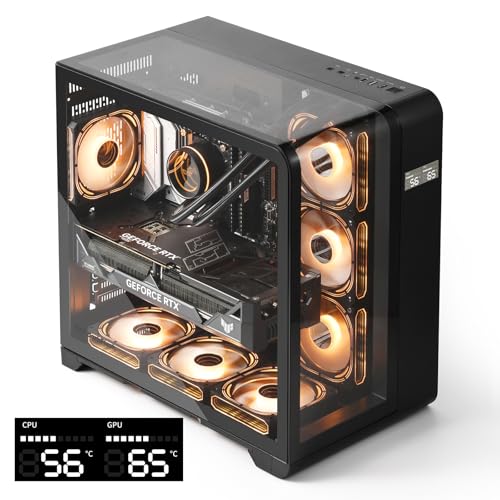
darkFlash ATX Case with Screen (Three-Side Glass) — The screened spectacle
Every category has one pick that refuses to be sensible, and here it is a mid-tower wearing glass on three sides, curved into a full-view design, with a screen built into the case itself. The darkFlash L280 adds a display to the crystal formula: system information, artwork, animation — a living element inside the glass volume that no fan or light strip can imitate. Four PWM ARGB fans come pre-installed, the front I/O includes Type-C, and the title states compatibility with RTX 40 Series cards, so the spectacle is not empty: the cooling set is fitted, the card class is named, the connections are current.
Judge the screen as the case’s thesis. A crystal build is already a display object; darkFlash simply asks why the display should be passive. For streamers, for desk-showpiece builders, for anyone whose machine is content as much as tool, a case that can show a face is a genuinely different product from a case that can only be looked through. The three-side curved glass wraps the idea completely — there is no angle from which this machine is merely a box — and the four fitted fans mean the light show around the screen is running from the first evening.
The honest cautions are about appetite and evidence. A screen is one more thing to configure, feed with software and keep interesting; owners who tire of it own a case with a dark rectangle where its party trick was. The title states no radiator size or millimetre clearance — the RTX 40 line is a class claim, not a measurement — so liquid plans and specific cards go through the documentation. Chosen by a builder who will actually use the screen, this is the most entertaining case in the guide. Chosen on impulse, it is a panorama with an unused television inside.
- Form factor: ATX mid-tower, black (L280)
- Glass: three-side glass, curved full view
- Signature feature: built-in screen
- Fans included: 4 PWM ARGB, pre-installed
- Front I/O: Type-C
- Graphics card note: RTX 40 compatible, per the title
- Radiator support: not given in the listing title — verify against the manufacturer’s documentation
Strengths
- The built-in screen makes the case an active display, not a passive one.
- Three-side curved glass wraps the build from every viewing angle.
- Four fitted PWM ARGB fans complete the spectacle on day one.
Trade-offs
- The screen needs feeding with content and software to earn its place.
- No radiator or clearance figures are printed in the title.
- It is the least understated object in this guide by a wide margin.
Consider the screen’s second career before dismissing it as theatre: a case display that shows system temperatures, a stream overlay, a chat feed or a simple clock is information design, and in a glass case it sits exactly where the eye already goes. The builders who get the most from this darkFlash are the ones who assign the screen a job on day one rather than a wallpaper in week three. A working screen ages into utility; an ornamental one ages into a reminder, and the difference is entirely in the owner’s intentions at purchase.
Best for: a streamer or showpiece builder who will genuinely use a case-mounted screen. Not suited for: a minimalist desk, where a glowing three-sided spectacle cannot blend in.

Vetroo CT3 Panoramic — The airflow panorama
The CT3 answers the crystal category’s oldest accusation — that glass cases cannot breathe — with arithmetic: a black dual-chamber ATX case with panoramic tempered glass, support for a 360mm radiator and eleven fans, room for graphics cards up to 410mm, Type-C readiness, and a stated high-airflow design for 50 Series graphics cards. Eleven fan positions in a panoramic case is a deliberate rebuttal in specification form. The dual chamber keeps the power supply and cables out of the intake story, the glass keeps the view, and the fan army keeps the temperatures honest.
The 410mm card figure and the 50 Series positioning place the CT3 squarely in the current high-end gaming moment: long, hot cards in a glass room, fed by as much moving air as the owner cares to install. That last phrase is the case’s character — support is not provision. The title does not state how many fans are included, so the eleven positions are a canvas the owner fills, and a full array is a real second budget line. Vetroo is selling capacity and trusting the builder to spec the array, which suits experienced hands and should be priced honestly by everyone else.
For the right builder, that trade is the point. A panoramic case whose cooling can grow from an AIO and a few fans to a full eleven-fan array never becomes the build’s bottleneck, and the dual-chamber layout keeps the growth tidy behind glass. If your crystal ambitions are thermal as much as visual — a flagship card, a hot room, a long upgrade path — the CT3 is the guide’s answer, the panorama that takes airflow as seriously as the mesh cases it competes with for your desk.
- Form factor: ATX, black
- Glass: panoramic tempered glass
- Layout: dual chamber
- Fan support: up to 11 fans
- Radiator support: 360mm
- Graphics card clearance: up to 410mm
- Front I/O: Type-C ready
- Fans included: not given in the listing title — verify against the manufacturer’s documentation
Strengths
- Eleven fan positions give a glass case a genuine airflow ceiling.
- Printed 410mm card clearance covers long current cards.
- Dual chamber keeps the panoramic view free of power and cable mass.
Trade-offs
- Included fan count is unstated, so the array is a second purchase.
- Filling eleven positions is a real cost in fans and wiring time.
- Black finish only, per the title.
Budget honesty completes the CT3’s picture. Eleven fan positions filled with quality fans, plus a 360mm radiator, is a cooling budget that can rival the case’s own price class, and the wise owner stages it: the radiator and the card’s intake path first, the decorative positions later, as the build’s heat and the owner’s enthusiasm dictate. The case’s gift is that the ceiling is there when wanted. Bought with that staging in mind, the CT3 is the panorama that never has to be replaced for thermal reasons — the longest-lived kind of showcase there is.
Best for: a high-end gaming build wanting panoramic glass without surrendering airflow headroom. Not suited for: a buyer expecting a complete fan set in the box, since the included count is not stated.
What Does the Panoramic Line-Up Look Like Head to Head?
| Case | Glass arrangement | Fans fitted | Card clearance (per title) | Defining extra |
|---|---|---|---|---|
| Iceberg Crystal Wave M | Curved tempered glass | Not in title | Not in title | 650W 80 Plus PSU included |
| STRUXVEX S8 | 270-degree panoramic | 3 | Not in title | Back-connect support, dual chamber |
| Okinos Aqua 6 Infinity | Panoramic | 3 x 120mm infinity ARGB | Not in title | Floating design, 10Gbps Type-C |
| MONTECH TG3 | Panoramic, tiered | 4 ARGB | 430mm | Nine cooling positions, filtration |
| darkFlash (L280) | Three-side curved glass | 4 PWM ARGB | RTX 40 class | Built-in screen |
| Vetroo CT3 | Panoramic, dual chamber | Not in title | 410mm | Support for 11 fans |
Two columns tell the category’s story: the fitted-fans column, where the complete kits separate from the canvases, and the extras column, where every case spends its personality. If scale rather than glass is your real appetite, the full-tower field in Best Biggest PC Cases includes panoramic giants of its own; if the ATX mainstream is calling, the standard format’s shortlist waits in Best ATX PC Cases.
How Do You Plan Cooling When the Front Is Glass?
Think in the paths the glass leaves open. Intake usually arrives from the bottom and the side chamber, exhaust leaves through the top and rear, and the graphics card — the hottest object in the room — sits in the middle of that river. Bottom intake fans aimed at the card are the panoramic layout’s signature move, and the cases here provide for it in their position counts: nine in the TG3, eleven in the CT3. A 360mm radiator, supported by the Aqua 6, TG3 and CT3 alike, most often rides the top as exhaust in this architecture, which keeps its heat out of the card’s air supply.
Work the plan on paper before the build. Count the positions you will actually fill, assign each an intake or exhaust role, and keep filtered intake slightly ahead of exhaust so dust is discouraged at the seams. Then set fan curves for the reality of glass: panoramic cases show their fans, so a curve that hunts up and down audibly will also flicker visually through changing light. Smooth curves, steady speeds and a lighting scheme that does not chase the tachometer make a crystal build feel calm rather than busy — the difference between an aquarium and an arcade.
How Does Light Actually Behave Inside a Glass Volume?
A panoramic case is a small optics problem wearing a computer as its excuse. Light from the fans and strips reflects between the glass faces, so a scheme that looks balanced in a conventional case can double itself in a panorama — brighter at the corners, doubled in the reflections, occasionally chaotic where two lit surfaces face each other. The designers here know it: infinity fans exploit the reflections to fake depth, the tiered TG3 staggers its surfaces so light lands at different distances, and the Crystal Wave’s curve bends reflections into a gradient instead of a mirror duel. The owner’s job is restraint — fewer, larger light sources read as design; many small ones read as noise.
Colour temperature is the second optical fact. White light in a white case, like the Crystal Wave’s interior scheme, reads clinical and bright; the same build behind the black-framed panoramas reads warmer and deeper because the dark frame absorbs the spill. Builders chasing a specific mood should choose the case colour as a lighting decision, not merely a finish decision. And brightness discipline matters more than colour choice: a panorama at full fan brightness in a dark room is a lamp with a computer inside it, so scenes should be tuned for the room’s evening, not for the product photograph’s noon.
The resting state completes the optics lesson. Powered down, a crystal case is a dark glass object whose contents show as silhouettes; against a light wall it reads as sculpture, against a dark one it nearly vanishes. Owners who love the running spectacle and ignore the resting object sometimes find the desk’s daytime face a disappointment. Walk past the empty case position in your mind at both hours before ordering — the category sells both views, and charges for them together.
What Does a Year of Panoramic Ownership Actually Involve?
Mostly, a cloth and a schedule. The exterior glass wants a weekly microfibre pass in a lived-in room; the interior wants a deeper clean on the rhythm of your home’s dust, eased considerably where filtration is fitted, as the TG3 states. Fans behind glass show their dust load honestly, which is either a prompt or an accusation depending on the owner’s temperament. None of this is heavy labour — it is the light, regular kind, and owners who build the habit in the first month rarely notice it by the sixth.
Upgrades inside a panorama carry one extra step: the audience test. Every new component is also a new visual element, and a card whose shroud quarrels with the established scheme will quarrel in public, across three glass faces. Experienced crystal owners start checking the photographs of a prospective component as seriously as its benchmarks — not from vanity, but because the case has made the interior a designed space and the design is part of what they own. Builders who find that idea exhausting have learned something valuable about themselves, and the mesh-front mainstream will welcome them back without judgement.
The reward, owners consistently report, is that the machine stays interesting. A conventional case disappears into the desk’s background within a month; a well-kept panorama keeps presenting the build as an object of attention, and that sustained visibility quietly encourages the maintenance that keeps it fast and clean. The category’s premium buys a machine that remains present in its owner’s life — which is either the whole point or an irrelevance, and the buyer usually knows which before the box arrives.
How Do You Choose Between Curved, Tiered and Chambered Panoramas?
The six divide by interior philosophy, and the choice says something about the builder. Curved glass, the Crystal Wave’s way, treats the case as a single sculptural volume: the build floats, the eye travels, and the interior scheme must be simple enough to survive being seen from everywhere at once. The tiered TG3 treats the interior as a stage set, arranging components at heights so the view has foreground and background; it rewards builders who compose. The dual-chamber designs — S8, CT3, and the darkFlash in its own theatrical dialect — treat the visible chamber as a gallery and everything else as the store room behind it, which is the most forgiving philosophy for real cable sets and the one most first-time panoramic builders should start from.
There is no hierarchy among the three, only fit. Sculptural cases punish clutter most and reward minimal builds; tiered cases reward deliberate component choice; chambered cases forgive the ordinary untidiness of a working machine while still presenting its best face. A builder honest about their own habits can choose correctly in one reading of this section, which is more than the spec tables can do — because the difference between these philosophies is not measured in millimetres but in how the owner will feel looking at the machine on an ordinary Tuesday.
Which Crystal Buying Mistakes Show Up Again and Again?
The first is forgetting the bundle. The Crystal Wave M includes a power supply; a buyer who orders a second one out of habit, or who plans a flagship card against 650W out of inattention, has misread the listing’s most important line. The second is the dark aquarium: buying panoramic glass and then filling it with unlit, mismatched components and factory cables, producing a case that displays its own neglect in 270 degrees. The category does not forgive an unplanned interior, because the interior is the product.
The third mistake is assuming figures. Three of these six titles print no card clearance; two print no radiator size. The TG3 and CT3 show that makers print numbers when they choose to — so where they do not, the documentation check is not optional diligence, it is the purchase process. The fourth is placement amnesia: a crystal case under a desk or against a bright window wastes the architecture it cost extra to buy. These cases are furniture with a power cable; site them like furniture, light them like exhibits, and they repay the category’s premium every day.
Final Recommendation
The TG3 is the guide’s most complete crystal case — printed clearances, back-connect readiness, fitted fans, filtration and a tiered interior that gives the glass something worth showing. The S8 is the purest panorama for a first step into the category, and the CT3 is its airflow-obsessed counterpart for flagship cards. The Aqua 6 belongs to lighting composers, the darkFlash to showpeople, and the Crystal Wave to the builder who values a curved white showcase with its power supply already chosen. What all six share is a demand disguised as a feature: they will show exactly the build you made, no better and no worse. Make a good one, and a crystal case is the most honest furniture a PC can live in. Make it carelessly, and the same glass becomes a daily report on the carelessness — which is why this guide spent as many words on chambers, cables, filtration and fitted fans as on the glass itself. The view is the invitation; the systems behind it are the substance, and the six picks above are ranked, in the end, by how completely they supply both halves of that bargain to the person who will live with the result. Choose the one whose discipline matches your own, keep its glass the way you would keep a lens, and the machine will repay the attention every single day it sits glowing quietly at the edge of your desk, long after the components inside it have been swapped for faster ones that nobody will remember by name.
Frequently Asked Questions
Is tempered glass in these cases acrylic or real glass?
Tempered glass, as every title in this guide states — the crystal category is defined by real glass panels in panoramic or curved arrangements. Acrylic belongs to an older, cheaper school of clear panels and scratches far more readily. When a listing says tempered glass across front and side, as these do, the material question is settled; the design question — curved, 270-degree, three-sided, tiered — is where the picks divide.
Does the Iceberg Crystal Wave’s included power supply limit my build?
It sets a ceiling rather than a limit: 650W at 80 Plus efficiency serves mainstream gaming builds comfortably, including most single-card systems. A flagship graphics card with high transient loads, or a planned upgrade in that direction, argues for a bare case and a larger separate unit. The bundle’s value is real precisely when the build’s appetite is known to fit under that ceiling.
Are panoramic cases worse for temperatures than mesh cases?
They cool differently rather than simply worse. With the front closed by glass, intake moves to the bottom and side, and the designs here compensate with fan counts — nine positions in the TG3, eleven in the CT3 — and 360mm radiator support across half the guide. A mesh front still wins on effortless intake, but a well-fanned panorama keeps flagship hardware honest, which is why the CT3 exists.
What is back-connect support, and why does it matter so much here?
A back-connect motherboard places its power and data connectors on the rear face, so cables exit behind the tray instead of crossing the interior. In a panoramic case, where the interior is visible across multiple glass faces, that removes most of the visual clutter at its source. The S8 states back-connect support and the TG3 states back-connect readiness; both need a matching motherboard to deliver the effect.
How fragile is a curved or three-sided glass case in daily life?
Tempered glass is tougher than its reputation — it is the panel material of the entire modern case industry — but more glass means more surface to respect: no leaning the case on a panel edge, no sliding it across grit, and two hands for moves. The Crystal Wave’s curve and the darkFlash’s three sides ask for the handling you would give a monitor, which is the right mental model for the whole category.
Do panoramic cases need more fans than ordinary towers?
They need their fans placed more deliberately rather than simply more numerous. A mesh tower forgives a rough fan plan because its front breathes anywhere; a panorama must move air along designed paths — bottom and side in, top and rear out — so each fan’s position and direction matters. The position counts here, nine in the TG3 and eleven in the CT3, are headroom for that design work. A thoughtful five-fan plan in a panorama will beat a careless nine-fan one, which is why the fitted sets in the S8, Aqua 6, TG3 and darkFlash are worth more than their counts suggest.
Which of these cases suits a white build?
Only one title here states white: the Iceberg Crystal Wave M, whose curved glass and white finish make it the white build’s natural home — with its bundled PSU to plan around. The TG3, darkFlash and CT3 state black, the S8 and Aqua 6 leave colour unstated in their titles, and this guide does not guess finishes. White-builders should also verify interior component colours, because in a white panorama every black cable shows.
Related Guides
Three adjacent fields continue the story: cable-free interiors in Best PC Cases to Hide Wires, the mainstream format in Best ATX PC Cases, and full-tower scale in Best Biggest PC Cases.


