Our Top Picks
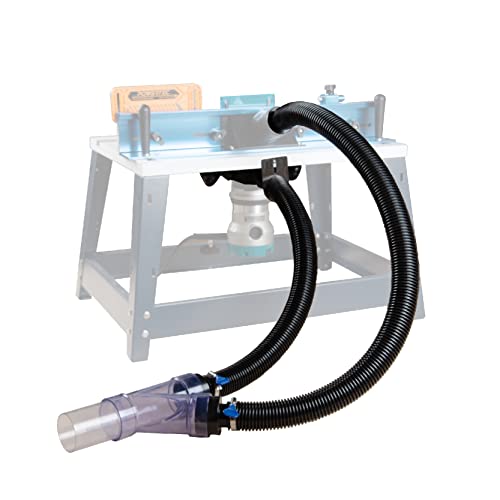 POWERTEC Dust Collector FittingsDust collection for router table13.98 x 13.98 x 5.24 inchesCheck on Amazon


What's inside
- Why router dust behaves differently from saw dust
- Collection points and how each one works
- Fixed base, plunge base, and extraction
- Hose sizes, adapters, and airflow losses
- Seeing the cut line
- Hardwood dust, MDF, and breathing protection
- Matching collection to the job
- Accessories that complete a system
- Maintenance for ports, brushes, and bearings
- Judging a router by its collection system
- Check prices on Amazon
- A practical setup sequence
As an Amazon Associate I earn from qualifying purchases. This post may contain affiliate links at no extra cost to you.
This guide is reader-supported. When you buy through links in this guide, a commission may be earned at no additional cost to you.
Why router dust behaves differently from saw dust
A router removes material with a spinning cutter that contacts the work along a narrow arc, and that geometry shapes everything about the debris it creates. Saw teeth enter and leave the kerf in a comparatively orderly line, carrying chips away in gullets designed for that purpose. A router bit has no gullet large enough to store the waste from a deep pass. Flutes clear material for a fraction of a rotation, then the cutter meets fresh wood again and throws the next fragment outward. The result is a fast, directional spray mixed with a cloud of much finer particles that stay airborne long after the coarse chips have landed.
Particle size separates into two problems that need different solutions. Coarse chips and curled shavings have mass, follow a trajectory, and can be intercepted by a shroud placed in their path. Fine dust has very little mass relative to its surface area, so air currents in the shop dominate its movement. Room air, the cooling fan inside the motor, and the rotation of the bit itself all push fine particles sideways, upward, and behind the base. A collection system that catches the visible chips can still miss most of the airborne fraction if airflow at the cutter is too weak or arrives from the wrong direction.
Ejection speed adds another complication. Bit diameter and spindle speed combine to produce high surface speed at the cutting edge, even on compact routers turning smaller cutters. Fragments leave tangentially, which means their direction depends on where the cutter contacts the work and whether the feed is along an edge, inside a mortise, or across an open field. Dust ports positioned for one cut may sit outside the spray pattern of another. Effective designs therefore surround the bit as completely as the work allows, rather than relying on a single opening placed behind the cutter.
The point of generation sits hidden under the base for much of the time. On a saw, the blade and guard give a clear indication of where extraction should happen. On a router, the base plate, sub-base, and workpiece enclose the cutting zone, and dust must escape through limited gaps before suction can capture it. If those gaps are blocked by a fence, a template guide, or the edge of the board, pressure inside the cavity rises and fine dust leaks out through the motor vents, the collet opening, and the seam between base and workpiece. Collection quality is therefore as much about controlled escape routes as it is about suction strength.
Heat plays a supporting role. Friction at the cutter and motor cooling air both warm the airstream around the bit, and warm air rises through the tool body. Fine particles ride that rising current toward the operator, especially during plunge cuts where the bit stays in one place and the cavity fills quickly. A port that draws air downward or sideways across the cutter counters that natural rise. Ports that merely sit on top of the base without shaping flow around the bit often leave the rising plume largely untouched.
Wood species changes the mixture. Softwoods tend to produce longer, stringier shavings that can bridge across a narrow port and form a plug. Hardwoods such as oak break into shorter, denser fragments plus a significant fine fraction. Manufactured boards behave differently again: MDF yields a powder with almost no coarse component, and that powder packs into filters, coats the inside of hoses, and resuspends easily when the workpiece is moved. A setup judged only on pine edging may perform poorly the first time it meets sheet goods.
Collection points and how each one works
The port on the base
Most handheld routers collect through a port moulded into or bolted onto the base, connected to a short internal channel that opens near the bit. Its strength is proximity. Suction applied a few centimetres from the cutter can capture fine dust before shop air disperses it, provided the channel is wide enough and the opening faces the spray. Its weakness is congestion: the same channel must pass coarse chips, and a single knot fragment or a wad of softwood shavings can narrow it dramatically in the middle of a pass.
Port orientation matters during edge work. When the router runs along the edge of a board, roughly half the cutter may be outside the material, and the spray fans outward beyond the board edge. A base port that opens toward the interior of the board misses that outward fan. Some bases use a wrap-around collector that extends past the edge, effectively forming a small fence of its own. Others rely on a chip deflector to redirect the stream back toward the port. Deflectors help with chips but do little for airborne dust, which follows airflow rather than bouncing predictably.
Clear base inserts change the balance between visibility and containment. A large opening in the sub-base lets the operator see the bit and the layout line, yet it also gives dust a direct exit away from the port. Smaller openings, or inserts matched to the bit diameter in use, keep the cavity more enclosed and let suction maintain negative pressure around the cutter. Swapping inserts when changing from a small straight bit to a large profiling bit is tedious, but the difference in capture is real and consistent across tool brands.
Shrouds that surround the cutter
A shroud extends the collection zone beyond the base itself. Typical designs are flexible skirts, rigid hoods, or brush-edged enclosures that ride on the workpiece surface and surround the bit on three or four sides. Brush edges conform to slightly uneven timber and seal gaps that a rigid hood would leave open. Rigid hoods hold their shape under strong suction and resist collapsing into the cutter path. Both approaches aim to enlarge the capture zone so that dust thrown sideways still lands inside a controlled space.
Surface-following shrouds excel at sign work, inlay, and freehand trimming, where the cutter moves in several directions and no fence defines the spray pattern. Their limitation appears at board edges. Half the shroud can hang over the edge with nothing to seal against, and suction then draws room air through the open side instead of pulling dust from the cutter. Edge-specific collectors with an extended lip address that geometry, while general-purpose shrouds often need a sacrificial board clamped alongside the work to give the skirt a surface to ride on.
Depth adjustment interacts with shroud performance in ways that are easy to overlook. Raising or lowering the bit changes the volume of the enclosed cavity and the distance between the cutter and the extraction opening. A shroud that seals beautifully at a shallow setting may lift, tilt, or bind at full plunge depth. Checking the full travel range before starting a cut, with the hose attached and the extractor running, reveals interference that a static inspection misses. Hose weight also pulls sideways on tall shrouds, gradually opening a gap on the opposite side during long passes.
Collection below a router table
Mounting the router under a table inverts the problem. Gravity now assists instead of opposing, because a large share of the waste falls or is thrown downward into the cabinet or box surrounding the router body. A well-sealed box beneath the table with a large port at the back or bottom captures that fraction efficiently, and it does so without any hose near the operator’s hands. The box also reduces noise, contains the spray when a bit exits the end of a board, and keeps the motor cleaner.
Below-table collection alone leaves the top surface exposed. Profiling an edge with a bearing-guided bit throws a stream outward at table height, and much of it never falls into the box. For that reason, serious table setups split extraction between two points: a large port on the enclosure below and a smaller port built into the fence above. The fence port sits directly behind the cutter opening, exactly where the spray from edge work concentrates. A splitter or Y-fitting divides airflow between the branches, and blast gates or sliding dampers let the operator favour whichever branch a particular cut needs.
Fence design determines how well the upper branch works. Fences with two faces that adjust independently can close tightly around bits of different diameters, leaving only a small notch for the cutter. The smaller that notch, the higher the air velocity through it and the better the capture at the point of generation. A wide, fixed opening wastes suction on room air. Some fences add a small hood above the bit for raised-panel and vertical work, where the spray pattern rises instead of travelling horizontally into the fence cavity.
Dust inside the enclosure deserves attention beyond capture rates. A box that collects efficiently also concentrates fine dust around the motor, its cooling intake, and the switch. Periodic emptying matters, and so does keeping the motor’s air intake unobstructed by settled powder. Enclosures with a sloped floor toward the port reduce dead corners where material accumulates. Access doors should seal reasonably well; a door that leaks on the operator side quietly undermines the negative pressure the whole box depends on.
Fixed base, plunge base, and extraction
A fixed base holds the motor at a set depth, and its collection hardware can be optimised for that stable geometry. Ports are usually compact, close to the bit, and shaped for edge and groove work where the base stays flat on the surface. Because the motor does not travel, the hose connection does not move relative to the base during a cut, which keeps hose routing predictable. Many fixed-base machines intended for table mounting omit elaborate above-table collection entirely, expecting the fence and enclosure to do the work.
Plunge bases introduce movement. The motor slides on two posts, the bit enters the work from above, and the collection channel must function at every depth from first contact to full plunge. Manufacturers answer with telescoping ducts, flexible sections, or ports mounted on the moving motor housing rather than the base. Each approach involves a compromise. Moving ports keep a constant relationship to the bit but travel with the hose, tugging as the operator plunges. Base-mounted ports keep hose behaviour steady but sit farther from the cutter at shallow depths, precisely when a mortise cavity is beginning to fill with waste.
Mortising exposes the difference most clearly. A plunge cut into the middle of a board creates a blind cavity with almost no natural escape route. Chips pack around the bit, heat builds, and the cutter begins recutting its own waste, which degrades both the cut surface and the motor load. Extraction that reaches into or directly over the cavity clears it continuously. Peck-style plunging, where the operator raises the bit briefly between depths, gives the airflow a chance to empty the pocket. Without any extraction, that manual clearing becomes far more frequent.
Interchangeable-base kits complicate purchasing decisions in a useful way. The same motor may offer mediocre collection in its plunge base and excellent collection in its fixed base, or the reverse. Judging a kit by a single published figure hides that variation. Buyers who mostly profile edges should weight the fixed base behaviour heavily. Buyers who cut mortises, inlays, and stopped grooves should weight plunge behaviour, hose clearance around the posts, and whether the port obstructs the lock lever or depth stop turret during normal hand positions.
Compact palm routers form a separate category. Their small bases leave little room for internal channels, so collection often depends on an accessory shroud that clips around the base. Those accessories vary enormously in fit: a shroud that seals against the base casting works well, while one with visible gaps leaks at every joint. Compact tools also get used one-handed, and a stiff hose can overpower the operator’s grip on a small body. Lightweight, flexible hose sections near the tool matter more here than on a full-size machine.
Hose sizes, adapters, and airflow losses
Four hose diameters dominate router extraction, and each belongs to a different class of machine. The smallest, 1-1/4 inch, appears on compact shop vacuum hoses and many tool ports. Next, 1-1/2 inch shows up on larger vacuum hoses and some European-style tool connections. The 2-1/2 inch size serves as the standard branch line in small-shop dust collection and as the fence or enclosure port on many router tables. Finally, 4 inch is the main-line size for stationary collectors and the typical port on a full-size table enclosure. Confusing these sizes is common because nominal dimensions, outside diameters, and cuff measurements rarely match exactly.
Adapters bridge the gaps, and every adapter costs airflow. Stepping a 2-1/2 inch hose down to a 1-1/4 inch tool port concentrates the entire system through the smallest opening. Air velocity through the narrow section rises, which helps carry chips, but total volume falls sharply because friction in the restricted section consumes pressure that would otherwise move air at the cutter. Long, gradual tapers lose less than abrupt steps. Multiple stacked adapters, a common sight when a new tool meets an old hose, compound the loss at every joint and add leak points along the way.
Hose length and corrugation add their own penalties. Flexible hose has a ridged interior, and each ridge generates turbulence. A short, smooth-walled connection between tool and main hose preserves far more suction than a long coil of fully extended flex hose. Sharp bends behave like additional restrictions, particularly the tight elbow that often forms where a hose leaves a handheld router and drapes toward the floor. Supporting the hose from above with a boom or a simple overhead hook keeps the bend radius gentle and removes weight from the tool at the same time.
- 1-1/4 inch: common on compact vacuum hoses; suits palm routers and small base ports where hose weight must stay low.
- 1-1/2 inch: a middle size found on some tool ports and larger vacuum wands; adapters to either neighbour are widely available.
- 2-1/2 inch: the usual branch size for router table fences, enclosures, and small-shop duct runs.
- 4 inch: main-line and enclosure size for stationary collectors; far too heavy and stiff to attach directly to a handheld router.
Static pressure and airflow volume describe two different strengths, and matching the extractor type to the router depends on understanding both. Static pressure is the suction force available to pull air through restrictions. Airflow volume, measured in cubic feet per minute, is how much air moves when the path is open. Shop vacuums generate high static pressure with modest volume. Stationary dust collectors generate high volume with modest static pressure. Neither figure alone predicts performance at a router; the port size decides which strength matters.
A handheld router, with its small port and narrow internal channel, is a high-resistance load. Connected to a large collector through a long reducing adapter, the collector’s volume advantage evaporates at the restriction, and its low static pressure cannot force much air through the remaining opening. A shop vacuum, built to pull hard through small hoses and nozzles, suits that load far better. This is why a modest vacuum often visibly outperforms a powerful collector at a handheld router, a result that surprises owners who bought the collector expecting it to improve every tool in the shop.
Router tables reverse the verdict. The 4 inch enclosure port and 2-1/2 inch fence port present wide, low-resistance paths where volume is exactly what capture requires. A collector moves a broad, gentle stream through the enclosure, sweeping fine dust out of the box and away from the motor. A shop vacuum connected to the same enclosure pulls fiercely at the port but moves comparatively little total air, leaving slow-moving pockets in the corners of the box where powder settles. Split systems, with a vacuum on the fence and a collector on the enclosure, exploit both strengths, at the cost of running two machines.
Filters and separators sit between the tool and the extractor and alter the equation over time. A cyclone separator ahead of a vacuum drops most chips and coarse dust into a bin before the airstream reaches the filter, so suction stays consistent through a long session. Without separation, fine MDF powder coats vacuum filters quickly, and performance degrades gradually enough that the operator may blame the router port for what is actually a clogged filter upstream. Bags rated for fine dust, cleaned or replaced on schedule, keep the system near its starting performance.
Automatic switches and remote starts influence whether extraction actually gets used. A vacuum that starts with the router and runs a few seconds after it stops captures the dust released as the bit spins down, which is a surprisingly dirty moment: airflow from the tool’s own fan stops, the cavity pressure equalises, and settled dust puffs out from under the base. Run-on timers handle that moment without any discipline from the operator. Systems that require a separate trip across the shop to start the collector get skipped for quick cuts, and quick cuts are numerous in routing work.
Seeing the cut line
Dust control and visibility are not separate concerns, because the same powder that extraction misses settles precisely where the operator needs to look. A layout line in pencil or chalk disappears under a film of pale dust within the first moments of a cut, particularly on light-coloured timber where contrast is already low. Operators compensate by blowing across the surface, which disperses the fine fraction into the air they are breathing, or by stopping the cut to wipe the line clear, which risks shifting the tool. Capture at the source preserves the line continuously and removes the need for either workaround.
Lighting built into the router helps under specific conditions. LEDs mounted around the collet or in the base illuminate the cutter area evenly and reveal the line through a thin dust film. Their benefit collapses when the airborne cloud itself is thick, because the light scatters in the cloud and creates glare rather than clarity. Lighting is therefore a complement to extraction, never a substitute. Models that keep the light on briefly after the motor stops also help with bit changes and inspection of the finished cut, though that convenience has nothing to do with dust performance during the pass.
Transparent sub-bases and clear shroud panels serve a similar supporting role. Polycarbonate components let the operator watch the bit engage a template, follow a scribed curve, or approach a stop mark. Scratches and dust film degrade transparency over time; static charge attracts powder to plastic surfaces especially strongly. Anti-static treatments and a habit of wiping panels with a damp cloth rather than a dry one slow the build-up. When a clear panel is part of the collection shroud, its condition directly affects both functions at once: a fogged panel hides the line and tempts the operator to remove the shroud entirely.
Chip deflectors deserve a mention in any discussion of visibility because they are often confused with extraction. A deflector is a small shield that redirects the chip stream away from the operator’s face and the line of cut. It improves comfort and sightlines for coarse debris while doing nothing about airborne dust. Tools supplied with only a deflector are sometimes described as having dust management, which stretches the term. A deflector plus a genuine port is a sensible combination; a deflector alone leaves the health and cleanup problems untouched.
Feed direction influences what the operator can see as much as any accessory. Routing so that the spray travels away from the layout line and away from the operator keeps the working area clearer than routing into the spray. Climb cutting reverses the natural throw and raises other safety concerns, so it is not a visibility strategy. Planning the sequence of cuts around a workpiece, starting with the edges whose spray falls on areas not yet marked or already finished, costs nothing and reduces the film that accumulates on critical lines later in the job.
Hardwood dust, MDF, and breathing protection
Wood dust is a respiratory hazard, and hardwood dusts have long been treated with particular caution in occupational guidance. Oak and similar dense species produce a fine fraction that remains airborne for extended periods, penetrates deep into breathing passages, and accumulates in a shop over a working day rather than clearing between cuts. MDF adds a further consideration: the board is made from refined fibres bonded with resin, and routing it releases that fibre in a very fine, uniform powder together with traces of the bonding agents used in manufacture. Neither material should be routed for hours in still air without extraction and respiratory protection working together.
The sensible hierarchy starts at the source. Capture at the bit removes the largest share before it becomes shop air. Room-level filtration, whether a ceiling-mounted air cleaner or a simple fan-and-filter arrangement, then reduces the background concentration that escapes capture and lingers. Personal protection sits last in the hierarchy not because it matters least, but because it protects only the wearer and only when the fit is correct. Relying on a mask while letting the shop fill with dust leaves the problem in place for the next task, the next person, and the surfaces where dust will resuspend from later.
Mask selection should follow fit and filtration class rather than comfort claims. Disposable respirators with a shaped nose seal and two straps generally seal better than single-strap nuisance masks, which are intended for coarse, non-hazardous particles. Reusable half masks with replaceable filters offer a more reliable seal for regular routing work and cost less over a season of use. Facial hair breaks the seal of any tight-fitting respirator; that is a physical fact, not a matter of adjustment. Operators with beards need to account for it honestly, either with powered respirators that supply filtered air under positive pressure or by accepting that a loose mask provides partial protection only.
Eye protection interacts with dust work in practical ways. Fine dust coats spectacle lenses and safety glasses, and the instinct to lift eyewear and wipe it mid-task exposes eyes at the dirtiest moment. Sealed goggles resist fogging from dust better than open spectacles in heavy routing, though they bring their own fogging from humidity. Anti-fog coatings, indirect vents, and the habit of cleaning eyewear away from the work area with the extractor still running all help. Contact lens wearers often find dusty routing especially uncomfortable, since particles that reach the eye are harder to clear.
Shop habits determine much of the real exposure. Dry sweeping a floor after routing resuspends the settled fine fraction and can produce a worse airborne concentration than the cutting did. Vacuuming with a fine-dust-rated machine, or damp wiping hard surfaces, avoids that second exposure. Clothing carries dust out of the shop and into vehicles and homes; a shop apron or dedicated work clothes left at the door reduce that transfer. These habits sound mundane beside tool specifications, yet they govern the dose received across a week far more than small differences between router ports.
Children, visitors, and anyone not wearing protection should not share air with active routing. A small shop concentrates dust quickly, and bystanders rarely have masks that fit. Scheduling heavy MDF work when others are absent, closing the shop door, and letting the air cleaner run after the last cut are simple courtesies with real effect. Extraction at the tool remains the foundation: every improvement there reduces the burden on every other measure downstream.
Matching collection to the job
Edge profiling
Profiling an edge with a roundover, ogee, or chamfer bit produces a continuous ribbon of waste along the full length of the board. The cut is open on one side, the bearing rides the edge, and the spray exits partly beyond the board. Collection that works here combines a base port with some form of edge enclosure: a wrap-around collector, a shroud with an extended lip, or a fence-like guide clamped to the work that carries its own port. On a table, the fence port does nearly all the work, with the enclosure catching what falls through the insert opening.
Long boards introduce hose management problems that short test pieces never reveal. The hose trails behind the router, catches on the board end, drags across clamps, and can pull the tool off line at the worst moment. Overhead suspension solves most of it. A simple arm, a bungee from a ceiling hook, or a hose routed along the bench and up keeps the weight off the cut. Wireless remote switches for the extractor also earn their place here, because the operator’s hands stay on the tool from start to finish of a long pass.
End grain at the corners deserves separate planning. The spray direction swings as the router rounds a corner, and fixed ports lose alignment with it. Slowing the feed slightly at corners, keeping the shroud pressed to the surface, and accepting a second cleanup pass on the end grain are pragmatic responses. Dust that escapes at corners lands close to the work and is easily vacuumed; the goal is preventing the continuous airborne release along the straight runs, where most of the material is removed.
Mortising
Mortise work concentrates every difficulty: a blind cavity, a plunging cutter, waste with nowhere to go, and a layout that must stay visible for the fence or guide to track. Extraction positioned above the cavity, drawing across the opening as the bit rises and falls, clears chips before they pack. Some plunge bases route the port so it looks directly into the cut zone; others accept an accessory hood that hovers over the work on the base. Either arrangement outperforms a distant side port by a wide margin in this application.
Cutting strategy and extraction reinforce each other. Shallow increments, brief retractions to clear the pocket, and a final light pass for the walls keep the cavity open for airflow. Deep single plunges pack waste faster than any small port can evacuate it, and the resulting heat discolours the mortise walls and dulls the cutter. A loose tenon or a mortise for a lock also demands accurate depth, and packed chips under the base can lift the tool slightly, changing depth without any visible sign until the joint is tried.
Guides and jigs change the airflow picture again. A mortising jig that clamps over the work may enclose the router base almost completely, which can either trap dust around the bit or, if the jig includes a port, turn the whole fixture into an efficient collector. Commercial and shop-made jigs increasingly include a hose connection for exactly this reason. When adapting a jig without one, leaving a deliberate vent gap on the side opposite the improvised port gives the air a path across the cutter rather than a dead cavity.
Sign making and freehand work
Lettering and pictorial carving use small bits, shallow depths, and constant changes of direction. Total material removal is modest, yet the work happens close to the operator’s face, often bent over the panel, so even a light dust release is intrusive. A close-fitting shroud with good transparency is the natural answer, paired with gentle suction: excessive pull through a small shroud can make a light router feel glued to the surface and disturb the smooth gliding that freehand lettering depends on. Balancing valves or a partially opened bleed on the hose let the operator tune that pull.
Visibility dominates every other concern in this category. The cutter must follow printed, transferred, or drawn lines exactly, and any dust film blurs the distinction between line and shadow. Clear shrouds, bright local lighting, and extraction that draws dust away from the front of the base combine to keep the line readable. Some carvers prefer to route with the panel tilted slightly toward the light and the extraction drawing from the lower side, using gravity to help clear the grooves. Grooves themselves fill with dust as fast as they are cut; a soft brush kept in the free hand, used during natural pauses, clears them without blowing.
Workshops that produce signs regularly often move the work to a dedicated bench position with fixed extraction: a downdraft surface, a capture hood on an articulated arm, or a small CNC enclosure for machine-cut lettering. The principles remain the same as handheld work, only the geometry is fixed. Readers planning a broader workshop refit sometimes compare furniture for shared spaces as well, and a guide such as best 2 person desks can be relevant when a sign bench doubles as a packing or design desk. Whatever the bench, extraction placed before the work begins gets used; extraction improvised afterward usually does not.
Work on a router table
Table routing rewards a systematic approach because the machine stays in one place and the extraction can be permanent. Ducting can be rigid, smooth-walled, and short, preserving airflow that flexible hose would waste. The fence port and enclosure port can each have a dedicated gate. The switch for the collector can live beside the router switch, encouraging combined use. Owners willing to invest an afternoon in permanent ducting gain performance every session afterward, with no setup time and no hoses crossing the floor.
Freehand table work, such as profiling curved pieces on a starting pin, removes the fence and with it the fence port. The enclosure below becomes the only collection point, and its effectiveness depends on the insert opening around the bit. Inserts with openings matched to the bit, including zero-clearance inserts made for a specific cutter, maximise the downward draw at the surface. A simple overhead guard with a small port, positioned above the bit on an arm, restores some top-side capture for curved work and adds a measure of guarding at the same time.
Raised-panel and large-diameter bits move serious volumes of material and test any system. The spray is wide, the chips are heavy, and the enclosure fills quickly. Large ports, short duct runs, and an extractor with genuine volume capacity are the appropriate response. Reducing speed for large bits, as safety guidance requires, also reduces ejection velocity, which slightly improves capture. Featherboards and guards crowd the area around the cutter on such work, so port placement must be planned with the full accessory stack in place, not on a bare table.
Accessories that complete a system
Dust boots are the aftermarket answer for routers whose factory collection is weak, and for CNC spindles where the same principles apply at machine scale. A boot surrounds the bit with a skirt, usually brush-edged, and a port on top. Sizing is critical: a boot made for a different base diameter either wobbles or will not fit, and a skirt too long tangles in the work while one too short leaks. Brush strips are replaceable on better designs, which matters because brushes wear, splay, and accumulate impacted dust that stiffens them.
Hose cuffs and connectors decide whether a system stays assembled or quietly falls apart in use. Rubber cuffs that thread onto hose ends grip tool ports of slightly varying diameter and tolerate the twisting a handheld router imposes. Hard plastic adapters are cheaper and more brittle; a dropped router or a stepped-on adapter cracks them at the narrow section. Swivel cuffs at the tool end reduce hose torque noticeably during edge work. Quick-release fittings suit shops where one vacuum serves several tools, provided the fitting seals well; a loose quick-release whistles, leaks, and costs more capture than its convenience returns.
Conversion ports and stepped adapters should be bought with measurements in hand. Tool ports are specified inconsistently: some makers quote inside diameter, others outside, and nominal inch sizes may describe the hose the port was designed around rather than the port itself. A digital caliper removes the guesswork. Measuring both the port and the hose cuff before ordering prevents the familiar drawer of almost-fitting adapters. Flexible rubber step adapters tolerate small mismatches better than rigid ones and double as vibration isolation between hose and tool.
Workshop layout accessories matter more than their modest appearance suggests. Floor sweeps and bench-top capture hoods handle the waste that escapes despite good tool collection. Hose reels and ceiling drops keep extraction within reach of the router table and the assembly bench alike. Shops that also house office furniture for design work, of the kind surveyed in best solid wood desks, benefit from keeping the dusty zone physically separated from desks and paperwork, since settled router dust migrates onto every horizontal surface in an open room. A door, a curtain, or even the orientation of the air cleaner can maintain that separation.
Storage for the router itself intersects with dust care. A router stored in the open shop accumulates dust in its vents and switch. Cases and cabinets keep the tool clean between sessions, and a quick vacuum of the case interior prevents yesterday’s dust from becoming today’s contamination. Foam inserts that shed particles are a poor choice around precision collets. Hard cases with smooth interiors wipe clean easily and protect the base plate from the knocks that would later break its seal against the work.
Maintenance for ports, brushes, and bearings
Collection ports clog gradually and then suddenly. Resinous softwood deposits build on the inside of channels, narrowing them session by session, until a single large chip bridges the narrowed passage and capture collapses mid-cut. Inspecting ports against a light source reveals the build-up. A bottle brush, a strip of wood shaped to the channel, or a blast of air from outside the shop clears most deposits. Waxy build-up from manufactured boards may need gentle scraping. Making this inspection part of bit-changing routine keeps it from becoming a project.
Motor brushes and bearings suffer when fine dust circulates through the tool. Carbon brushes wear normally with use, but abrasive dust accelerates that wear and can score the commutator. Brush caps that seal poorly admit dust directly to the brush holders. Checking brush length at the intervals the maker specifies, blowing out the motor housing with dry air in a ventilated area, and replacing brushes in pairs preserve both performance and the armature surface. Sparking that increases noticeably, a burning smell, or intermittent power under load are signs to stop and inspect rather than finish the job.
Bearings announce dust damage through sound and feel. A bearing contaminated with fine grit turns roughly when the shaft is rotated by hand with the tool unplugged, and it may whine at speed before it rumbles. Collet and bearing areas should be kept clean with a brush after dusty work, and solvents should be kept away from sealed bearings, whose internal grease they can dissolve. Storing bits clean matters too: resin and dust baked onto a cutter raise cutting forces, generate more heat and finer dust, and strain the bearings that extraction is meant to protect.
Hoses and filters complete the maintenance list. Flexible hose develops pinholes at the high points of its corrugations where it rubs on bench edges; a short section of split larger hose or a fabric sleeve at rub points extends its life. Vacuum filters for fine work should be cleaned outdoors, tapped gently rather than beaten, and replaced when cleaning no longer restores suction. Separator bins need emptying before they fill to the inlet, beyond which material carries over to the filter and the whole system degrades within minutes. A simple full-line marked inside the bin prevents most overfills.
Sub-bases, inserts, and shroud panels also wear. A sub-base scratched deeply or warped by heat no longer seals against the work, and capture falls even though the extractor is unchanged. Replacement sub-bases are inexpensive relative to the tool and restore both accuracy and sealing. Brush skirts on shrouds should be combed out or replaced when they mat. Gaskets on table enclosures compress over time; a door that once sealed may develop a visible dust streak on the floor beneath it, which is a reliable diagnostic that the seal, not the collector, needs attention.
Judging a router by its collection system
Published specifications rarely describe dust performance in comparable terms, so buyers must read a router’s physical design instead. Look first at the path dust must travel: the shortest, widest, least obstructed route from bit to port usually wins. Channels with right-angle turns, narrow slots, or screens that catch chips will underperform their port diameter. A port that accepts a standard hose size directly, without a proprietary adapter that must be ordered separately, signals that the maker expected the feature to be used rather than merely listed.
Weight and balance with the hose attached decide whether good collection survives contact with real work. A router that is beautifully balanced bare can become awkward once a stiff hose pulls from a high port. Shops that also run height-adjustable benches, like those compared in best adjustable standing desks, often find that matching bench height to the operator reduces hose drag as a side benefit, since the hose drapes at a gentler angle. Where possible, handle display tools with a hose fitted, or at least simulate the pull direction with one hand while holding the tool in working position with the other.
Accessory ecosystems extend a router’s useful life. Makers that offer several sub-bases, edge collectors, table plates, and shrouds for the same motor give the owner options as work changes. A router bought for edge profiling may later cut mortises weekly, and the difference between a supported accessory and an improvised one is the difference between extraction that exists and extraction that frustrates. Availability of replacement brushes, collets, and base hardware matters on the same horizon, since dust work accelerates wear on exactly those parts.
Noise is an underappreciated part of the system. A router plus a vacuum is loud enough that hearing protection is standard practice, and the combined pitch influences fatigue over long sessions. Some vacuums allow speed adjustment, which can drop noise substantially when full suction is unnecessary, as in shallow sign work. Collectors located in an adjoining space or a insulated enclosure reduce shop noise further, provided the duct run stays short enough to preserve airflow. Comfort features like these determine whether the full system gets switched on for a two-minute cut, which is where much real-world exposure happens.
Mobile and small workshops face constraints that permanent shops do not. A single vacuum may serve the router, the sander, and cleanup duty, moved between stations on a cart. Quick connections, a hose long enough to reach every station without stretching, and a separator compact enough to ride on the same cart turn that constraint into a workable system. Makers working across hobbies sometimes share that vacuum with entirely different benches; enthusiasts comparing best 3d printers kits for a corner of the same room will care about router dust for the opposite reason, since airborne powder settles on printer rails and build plates. Zoning dusty and clean processes apart protects both crafts.
Finally, judge the whole chain by its weakest link, because that is how the system itself behaves. A premium router on a clogged vacuum disappoints. A modest router with a short, well-sealed hose and a clean filter satisfies. Spending should follow the bottleneck: first a sound extractor with fine filtration, then a hose and cuff set that actually fits, then tool-side shrouds for the jobs performed most, and only then refinements such as remotes and booms. Sequenced that way, each purchase improves capture measurably instead of decorating a system whose basic path still leaks.
Check prices on Amazon
Live listings for the shortlist in this guide are pulled from Amazon below, so prices and availability are always current at the moment you look.


A practical setup sequence
Order matters when assembling a system from parts bought at different times. Begin with the extractor and its filter, since nothing downstream can compensate for weak or dirty suction at the source. Add the separator next if the work involves MDF or long sessions, because protecting the filter preserves every later improvement. Fit the hose and cuffs to the router actually owned, measuring ports rather than trusting nominal sizes. Then add the tool-side shroud or edge collector for the dominant job type, and only afterward invest in convenience hardware such as overhead supports and automatic switching.
Verification can stay simple and still be honest. Route a familiar edge in a dusty material with the system running, then inspect three places: the floor beneath the work, the surface film on the board, and the inside of the hose near the tool for early clogging. Repeat after any change of adapter, hose, or shroud, because small changes in the path produce visible differences in those three places. Keeping a short written note of which combination served which job prevents re-solving the same fitting puzzle each season.
Seasonal changes affect performance more than most owners expect. Cold shops stiffen hoses, making them pull harder on the tool and seal worse at cuffs. Summer humidity swells MDF dust deposits inside channels and makes them harder to brush out. Filters load faster in humid weather. A brief system check at the start of each season, covering ports, cuffs, filter condition, and brush skirt condition, keeps the capture rate near the level the owner originally set up, instead of drifting downward until a visibly dusty job forces a full overhaul.
One further variable deserves attention because it quietly changes results between otherwise identical setups: the condition of the cutter itself. A sharp bit shears fibres cleanly and produces a coarser, more predictable waste stream that shrouds and ports capture readily. A dull bit tears and burnishes instead of shearing, generating a higher proportion of fine powder, more heat, and a spray that disperses more widely as the operator applies extra feed pressure. Extraction that seemed adequate with a fresh cutter can appear to fail weeks later, when the real change is edge condition rather than any part of the collection chain. Cleaning resin from bits, honing or replacing dull cutters, and matching feed rate to the cutter diameter therefore belong in any honest assessment of dust performance. The same logic applies to bit selection: spiral cutters eject waste along their flutes in a directed stream that a well-placed port can intercept, while straight-fluted bits release material less predictably. Choosing cutter geometry with the spray direction in mind, and positioning the port to meet that stream, costs nothing at purchase time and pays off on every subsequent pass, in cleaner air and in less time spent sweeping the bench and floor afterward.
Good router dust collection is ultimately a chain of unglamorous details — a sealed cavity at the bit, a hose that fits, an extractor matched to the resistance of the path, and maintenance that keeps each link clear — and when those details align, the cut line stays visible, the shop air stays clearer, and routing becomes the precise, repeatable work it is supposed to be.