What's inside
- Key Takeaways
- Where to Buy
- Quick Picks
- How the Picks Were Chosen
- Detailed Reviews
- Comparison Table
- How to Choose a Jewellery CAD Printer
- Castable Resin: The Consumable That Decides the Casting
- From Print to Flask: The Bench Workflow
- Reading a Master Under the Loupe
- Common Mistakes
- Frequently Asked Questions
- Final Recommendation
As an Amazon Associate I earn from qualifying purchases. This post may contain affiliate links at no extra cost to you.
[SITE_DOMAIN] is reader-supported. When you buy through links on our site, we may earn an affiliate commission at no extra cost to you. Prices and availability change; check the Amazon listing for the current details.
Jewellery forgives nothing. A ring shank a fraction of a millimetre proud, a prong slightly fused to its neighbour, a surface texture the CAD file never drew — each flaw survives casting, polishing, and the customer’s first look under a loupe. The best jewelry cad 3d printers are therefore judged on a narrower, harder standard than other resin machines: not how large they print, nor how fast, but how faithfully a layer of cured resin can hold the edge of a design that will be burned away and replaced by metal. The six machines below — five linked, one covered as guidance — were chosen for detail work at the bench: small plates, fine screens, and the layer consistency that filigree, pavé, and engraved lettering demand.
The workflow these machines serve deserves stating, because it shapes every requirement. A design is modelled in CAD, printed in a castable resin, invested in plaster-like material, and burned out in a kiln, leaving a cavity that molten metal fills — the ancient lost-wax process with a printer standing where the wax carver stood. The printer’s contribution is the master: if the master’s detail is soft, no caster’s skill restores it; if the master carries uncured residue or ash-forming flaws, the casting inherits them. Detail quality — XY resolution, light uniformity, layer-to-layer consistency — is therefore not one axis among many in this guide. It is the axis, and plate size enters only as the question of how many masters share a run.
One pick is treated differently, and the reason is stated once, plainly: the Formlabs Form 4 is covered as prose guidance because no clean Amazon listing for the printer itself was found at research time. It receives a full review — its role in professional jewellery workflows is too significant to omit — but no link and no image, and readers who pursue it should verify any listing they find with the care its review describes.
Key Takeaways
- Detail is the axis: the sharpest stated figure here is a 22µm XY resolution on the phrozen pick, and every other machine is judged by how its screen class serves fine features.
- The Mars-class plates suit single pieces and small runs at the bench; the Saturn-class plates batch a day’s masters in one print.
- Castable resin is a consumable with its own discipline — burnout schedule, ash behaviour, complete curing — and it gets a full section below rather than a pick slot.
- Light source design matters at jewellery scale, where a COB source’s uniformity protects the corners of the plate where small pieces often sit.
- The Formlabs Form 4 is reviewed as guidance only, because no clean Amazon listing for the printer itself was found at research time.
Where to Buy
- ELEGOO Mars 5 — Check price on Amazon
- Anycubic Photon Mono 4 Ultra — Check price on Amazon
- ELEGOO Saturn 4 — Check price on Amazon
- ELEGOO Saturn 3 Ultra — Check price on Amazon
- phrozen Sonic Mini 8K S — Check price on Amazon
Quick Picks
| Pick | Best for | Platform | Screen / Build size | Check |
|---|---|---|---|---|
| ELEGOO Mars 5 | A small-detail desktop starter for the bench | Resin, mono LCD | 4K screen; 5.65 × 3.53 × 5.91 in | Check price on Amazon |
| Anycubic Photon Mono 4 Ultra | Fine masters with COB light and detection | Resin, mono LCD | 7-inch 10K screen; 6.04 × 3.42 × 6.49 in | Check price on Amazon |
| ELEGOO Saturn 4 | Batching masters on a 12K large plate | Resin, mono LCD | 10-inch 12K screen; 8.62 × 4.84 × 8.66 in | Check price on Amazon |
| ELEGOO Saturn 3 Ultra | Tall masters and sprued trees on a deep plate | Resin MSLA | 10-inch 12K screen; 8.62 × 4.84 × 10.24 in | Check price on Amazon |
| phrozen Sonic Mini 8K S | The finest stated XY figure for micro detail | Resin, mono LCD | 7.1-inch screen, 22µm XY; 6.5 × 2.8 × 6.7 in | Check price on Amazon |
| Formlabs Form 4 | Professional bench workflows, covered as guidance | Resin, professional class | See review — no listing title available | Prose-only coverage |
How the Picks Were Chosen
The first filter was detail evidence. Titles that stated a screen class earned a hearing; the phrozen pick, which states an XY resolution in micrometres — the unit jewellers actually think in — earned its place on that precision alone. The second filter was plate logic: a jewellery bench needs one small, nimble machine class for single pieces and quick iterations, and one larger class for batching masters and printing sprued trees, so the selection holds two Mars-class machines, two Saturn-class machines, and the phrozen’s narrow specialist plate between them. The third filter was workflow honesty — leveling and monitoring systems were weighed as casting-risk reducers, because a failed master costs a day of the casting calendar, not merely a reprint.
The Form 4’s inclusion as guidance follows a different logic: professional benches vote with their purchasing, and a guide that omitted the professional class entirely would mislead by silence. It is therefore reviewed at full depth with its evidence status stated openly — no listing title to quote, no specifications asserted beyond what its role requires, and a verification path described for readers who pursue it. Jewellers photographing finished work for clients and listings will find the camera side of the bench served by the best compact lumix mirrorless cameras, since a cast piece ultimately has to survive a lens as unforgiving as a loupe.
Detailed Reviews
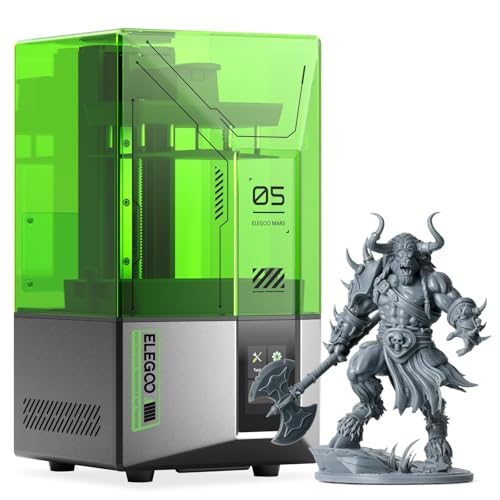
ELEGOO Mars 5
Best for: a bench’s first casting printer — single rings, pendants, and charms printed one or a few at a time beside the CAD workstation.
Not suited for: batching a full day’s masters in one run; at 5.65 × 3.53 inches the plate is the small-detail desktop option by design.
- Screen: 4K mono LCD
- Leveling: automatic leveling
- Form: desktop 3D printer
- Build size: 5.65 × 3.53 × 5.91 inches
- Not stated in the listing title — verify with the manufacturer documentation
The Mars 5 is the small-detail desktop option in this lineup, and its proportions suit the jewellery bench’s most common rhythm: one design, iterated. A ring modelled in the morning, printed by lunch, examined under magnification, adjusted in CAD, and printed again by evening — that cycle is how jewellery actually gets designed, and it runs on a small plate that turns over quickly, wastes little resin on tests, and sits beside the workstation rather than across the room. The 4K screen is the lowest class in this guide, and the honest framing is that it serves the iteration cycle and straightforward designs well, while the finest filigree ambitions should look further down this list.
Automatic leveling is worth more at the bench than its modest billing suggests. Jewellery prints are thin, delicate, and adhesion-critical; a first layer set slightly wrong does not merely fail — it fails asymmetrically, warping a shank that only reveals its flaw after casting. A machine that levels itself removes that variable from a workflow where every other variable is already being tuned by hand. The desktop form completes the picture: this is a printer that lives at the bench, in the workflow’s line of sight, rather than in a separate production corner.
Who outgrows it? The bench that starts batching — a dozen pendants for a market run, a set of masters for a small collection — will feel the plate’s edges, and the Saturn-class picks exist for that day. The bench that prototypes, customises, and casts one-offs may never feel them at all. As an entry into castable printing, the Mars 5’s combination of small plate, self-leveling, and modest screen class is a coherent apprenticeship: the skills it teaches — orientation for drainage, support placement that avoids faces, exposure discipline — are exactly the skills the sharper machines will later reward.
There is a teaching virtue in the modest screen, too. A bench learning castable printing makes its early mistakes — exposure, orientation, support placement — at a scale where each lesson costs a few grams of resin and an hour, and the 4K screen is honest enough to show those mistakes clearly without masking them behind resolution the process has not earned yet. Studios that train assistants often start them on exactly this class of machine for exactly this reason: the fundamentals announce themselves. Its 5.91-inch height, often overlooked beside the detail discussion, covers the bench’s taller needs: a bangle printed upright, a sprue tree of modest height, a pendant with its bail in one piece. Small does not mean shallow, and the Mars 5’s envelope is better balanced than its desktop label implies.
Strengths
- The small plate suits the design-iterate-cast cycle that dominates bench work.
- Automatic leveling protects thin, adhesion-critical first layers.
- Desktop size keeps the printer inside the bench workflow rather than exiled from it.
Trade-offs
- 4K is the lowest screen class here, limiting the finest filigree and micro-text.
- The plate batches only a few masters per run.
- No monitoring or detection system is stated in the title.
The Mars 5’s listing states its compact specification plainly — the configuration for a bench corner is at Check price on Amazon.

Anycubic Photon Mono 4 Ultra
Best for: fine masters on a compact plate where even light matters — the COB source and 10K screen serve prongs, milgrain, and lettering.
Not suited for: wide batch runs; the 6.04 × 3.42 inch plate is a precision instrument, not a production tray.
- Screen: 7-inch HD mono screen, 10K class
- Light source: COB light source
- Print speed: 120mm/h fast printing
- Monitoring: intelligent detection
- Build size: 6.04 × 3.42 × 6.49 inches
- Not stated in the listing title — verify with the manufacturer documentation
The Mono 4 Ultra is the compact plate’s detail specialist. A 10K screen over seven inches concentrates its pixels where jewellery lives, and the COB light source addresses the variable that pixel counts ignore: uniformity. A COB design spreads its light evenly across the plate, which matters disproportionately for jewellery because small pieces get placed wherever they fit — including the corners, where a dim or uneven source would cure one ring slightly softer than its neighbour at the centre. In casting, slightly softer means slightly rounder, and slightly rounder prongs are the difference between a setting that grips and one that sheds stones.
Intelligent detection watches the print, and at the bench that means a master’s failure is discovered during the working day rather than at its end — a small mercy with calendar consequences when a casting session is booked. The stated 120mm/h pace is brisk for the class, which serves the iteration rhythm: a revised master can be printed, washed, and inspected inside an afternoon, keeping the design conversation moving while the client’s requirements are still warm.
Set against the Mars 5, the Ultra’s proposition is refinement at the same scale: sharper screen, engineered light, detection, and speed, aimed at benches whose designs have begun to punish a 4K screen — engraved lettering that must stay legible at three millimetres, milgrain edges that must read as beads rather than bumps, pavé seats that must hold their geometry. Set against the Saturn pair, it concedes area and keeps agility. A bench doing both iteration and small-batch casting could justify this machine as the detail instrument and a Saturn as the tray, and many professional setups are built on exactly that division.
Speed deserves one jewellery-specific footnote. A master’s print time is governed by its height, and jewellery masters are short — which means the Ultra’s stated pace compresses the iteration cycle more than it would for tall general-purpose work. A designer testing three variants of a setting can print all three in the time a slower compact machine prints one, and that multiplication of attempts is, in practice, a quality feature: more variants examined under the loupe means the variant finally cast is the best of three rather than the only one tried. The title’s restraint should be noted: no leveling system is named, so plate setup remains the owner’s ritual. At this scale and for this audience — jewellers are, by trade, people who set things precisely by hand — that is a smaller concession than it would be in a general-purpose guide.
Strengths
- 10K resolution on a 7-inch screen concentrates detail at jewellery scale.
- The COB light source targets exposure uniformity across the whole plate.
- Intelligent detection plus a 120mm/h pace suit the iterate-and-inspect bench rhythm.
Trade-offs
- The compact plate limits batch casting preparation to small runs.
- No leveling system is named in the title.
- No heating is claimed for benches in cold studios.
Anycubic’s listing describes the COB arrangement and detection in its own words — worth a close read at Check price on Amazon before deciding the compact plate suffices.

ELEGOO Saturn 4
Best for: batching a day’s masters — a tray of rings, pendants, and components in one 12K run, monitored while the bench does other work.
Not suited for: a cramped single-desk studio; the 8.62 × 4.84 inch plate implies a machine with a production corner of its own.
- Screen: 10-inch HD mono LCD, 12K class
- Leveling: smart automatic leveling
- Monitoring: AI print monitoring
- Build volume: 8.62 × 4.84 × 8.66 inches
- Not stated in the listing title — verify with the manufacturer documentation
The Saturn 4 is where this guide’s axis turns from iteration to production. A 12K screen across ten inches keeps the pixel size fine while the plate grows to 8.62 × 4.84 inches — room for a full tray of masters: the week’s rings in a row, a pendant collection at once, components for several pieces sharing one exposure. For a bench that casts on a schedule, that tray is the unit of work, and printing it in one monitored run rather than four small ones changes the week’s shape entirely.
Smart automatic leveling and AI print monitoring are the systems that make the tray trustworthy. A large plate multiplies the cost of a setup error — a slight tilt that a small plate forgives can under-cure a corner of masters — so leveling that sets itself is production insurance, and monitoring that watches the run lets the jeweller return to the bench’s other work: stone setting, finishing, client pieces, while the masters print. The division of labour is the point. A Saturn-class machine earns its bench space by working unattended at exactly the tasks that do not need a jeweller’s hands.
Detail at this scale deserves a precise claim. Twelve thousand pixels across a ten-inch screen resolves less finely per inch than the compact Ultra’s concentration, and for the very finest single master the compact machines retain an edge. But production jewellery is rarely one master at the edge of possibility; it is many masters at a high, consistent standard, and consistency across a wide plate — every ring as true as its neighbour — is the Saturn 4’s actual product. Benches should choose it for the tray, not for a single heroic piece.
Batch printing changes the bench’s quality discipline in a way worth anticipating. With one master, inspection is total; with a tray of thirty, inspection becomes sampling unless the jeweller builds a rhythm for it — tray out, loupe across each row, calipers on a rotating few. The Saturn 4’s monitoring reduces the risk that a whole tray fails silently, but the consistency it cannot guarantee is per-piece, and production benches learn to inspect in patterns the way they learned to polish in patterns. The machine’s gift is time; the bench’s obligation is to spend some of that gift on looking. The 8.66-inch height adds the tree dimension: masters can be printed already arranged for spruing, or taller pieces — a cuff, a sculptural pendant — can stand whole. In a casting workflow, height is not vanity; it is how much of the foundry’s preparation the printer absorbs before the investment stage begins.
Strengths
- A 12K plate at production size batches a full tray of masters per run.
- Smart automatic leveling protects large-plate consistency where errors cost most.
- AI print monitoring frees the jeweller’s hands during long master runs.
Trade-offs
- Per-inch pixel density sits below the compact detail specialists.
- The footprint demands a production corner rather than a desk edge.
- Full trays consume resin and washing capacity at production rates.
The Saturn 4’s listing details its monitoring and leveling systems together — inspect that combination on the manufacturer’s page at Check price on Amazon.

ELEGOO Saturn 3 Ultra
Best for: tall masters and deep sprue trees — the 10.24-inch height is the deepest here — with Wi-Fi transfer feeding a 12K plate.
Not suited for: the absolute finest single-master detail; its 12K across ten inches serves production consistency first.
- Screen: 10-inch 12K monochrome LCD
- Technology: MSLA 3D printer
- Connectivity: Wi-Fi transfer
- Film: ACF release liner film
- Build size: 8.62 × 4.84 × 10.24 inches
- Not stated in the listing title — verify with the manufacturer documentation
The Saturn 3 Ultra is the previous generation’s flagship still arguing its case, and its argument is depth. The plate matches its successor’s footprint — 8.62 × 4.84 inches under a 10-inch 12K screen — but the height stretches to 10.24 inches, the deepest envelope in this guide. In casting terms, height is tree: masters arranged along a tall sprue, printed as one structure, invested as one flask. A bench that casts in trees will feel that extra depth on every flask; a bench that casts singles will not, which is why this machine’s audience is specific and its value to them is large.
The ACF release liner film is the specification jewellers should pause on. Release film governs how each cured layer peels from the tank floor, and a film engineered for easier release reduces the peel forces that tug at delicate features — thin prongs, fine wires, the fragile extremities that jewellery designs are made of. Lower peel force means fewer distorted extremities and fewer supports needed to hold them, and fewer supports means fewer marks to clean from surfaces that will be polished and photographed. It is an unglamorous line in a title and one of the most jewellery-relevant in this guide.
Wi-Fi transfer suits the production rhythm the machine implies: files move from the CAD station to the printer without a stick-mediated walk, and a bench running a casting calendar feels that convenience daily. Against its own successor, the Saturn 4, the Ultra trades the newer machine’s smart leveling and AI monitoring for its depth and its release film — a genuinely arguable exchange that depends on whether the bench’s pain is setup risk or tree height. This guide keeps both because benches differ on exactly that question.
Tree casting rewards one more discipline the Ultra’s height makes practical: spacing. Masters crowded on a tree compete for metal flow and heat; masters spaced generously cast cleaner and finish faster, because each piece’s sprue path is its own. A taller tree lets the bench space pieces vertically instead of packing them shoulder to shoulder, and the resulting castings show it in fewer misruns and less corrective filing. It is an unglamorous advantage that never appears in a screen specification, and production jewellers feel it in every flask. As a value pattern, a previous flagship with a distinctive physical advantage — depth — is a familiar and honourable category. The Ultra is not the older, lesser Saturn; it is the taller one, and for tree-casting benches the distinction is the whole decision.
Strengths
- The 10.24-inch build height is the deepest here, serving tall sprue trees.
- ACF release liner film reduces peel forces on delicate jewellery features.
- Wi-Fi transfer fits a production bench’s file workflow.
Trade-offs
- No smart leveling or AI monitoring is claimed, unlike its successor.
- Per-inch detail matches the production class rather than the compact specialists.
- The tall envelope needs vertical clearance in the studio.
ELEGOO’s listing for the Saturn 3 Ultra describes the ACF film and the tall envelope directly — confirm both at Check price on Amazon.

phrozen Sonic Mini 8K S
Best for: micro-detail masters — filigree, fine engraving, miniature-scale jewellery components — where the stated 22µm XY resolution is the specification that matters.
Not suited for: batching wide trays of masters; the 6.5 × 2.8 inch plate is the narrowest here, built for precision over area.
- Screen: 7.1-inch monochrome LCD
- XY resolution: 22µm, stated in the title
- Form: tabletop resin printer
- Applications stated in title: models, miniatures and action figures
- Build volume: 6.5 × 2.8 × 6.7 inches
- Not stated in the listing title — verify with the manufacturer documentation
The Sonic Mini 8K S earns its place with a single number no other title in this guide provides: 22µm XY resolution. K-classes describe a screen’s pixel count; micrometres describe the size of the smallest feature step the machine can draw, and for jewellery that is the honest unit. Twenty-two micrometres is fine enough to hold the edge of an engraved line, the separation between milgrain beads, the wall of a pavé seat — the features that separate a master that casts cleanly from one that casts approximately. Phrozen built its name in exactly this miniature-detail territory, and the title’s stated applications — models, miniatures, action figures — describe the same small, fine world the jewellery bench inhabits.
The plate tells the complementary truth: 6.5 × 2.8 inches is the narrowest here, a specialist’s tray for a handful of precious pieces rather than a production run. That narrowness is not a flaw in context — it is the physical form of the machine’s priorities, since a small screen is how a fine XY figure is achieved at this class. The 6.7-inch height still accommodates upright pieces and modest trees, so the constraint is width, not dimension in general: a row of rings fits; a wide tray of pendants does not.
Consider what 22µm buys in the specific geometry of a ring. A prong’s tip, a claw’s inner face, the knife-edge where a gallery meets a shank — these features live at scales where a coarser pixel grid rounds what the designer squared, and rounding at a stone seat is not an aesthetic issue but a setting failure scheduled for later. The Sonic Mini’s figure speaks to that geometry directly, which is why detail-led benches forgive its narrow plate so readily: the pieces it exists for are small by definition, and there are only so many of them a single master run needs to hold. For the bench, the Sonic Mini’s role writes itself. It is the detail instrument — the machine for the master that must be perfect: the signet’s engraved face, the filigree pendant, the component whose tolerances decide whether the finished piece assembles. Production volume belongs to the Saturns; iteration belongs to the Mars and the Mono 4 Ultra; the final, finest master belongs here. Benches that sell detail — and in jewellery, detail is frequently the entire product — will understand why a narrow printer with the guide’s only micrometre figure closes the linked picks.
Its title withholds the automation vocabulary of its rivals — no leveling system, no detection, no Wi-Fi is named — so the ownership picture is a craftsman’s tool: set up carefully, run attentively, judged on output. At jewellery scale, where the operator is already a precision worker by trade, that is a coherent offer.
Strengths
- The stated 22µm XY resolution is the finest detail figure in this guide.
- A compact tabletop form suits a dedicated detail station at the bench.
- Height of 6.7 inches still serves upright pieces and small trees.
Trade-offs
- The 2.8-inch plate depth is the narrowest here and caps batch width.
- No leveling, detection, or connectivity system is named in the title.
- The stated applications emphasise miniatures, so jewellery buyers should verify resin compatibility for casting work in the documentation.
Phrozen’s listing states the 22µm figure in its own title — the detail claim to verify first is at Check price on Amazon.
Formlabs Form 4
Best for: professional benches standardising on an industrial resin workflow — the machine jewellery studios most often name as their production reference.
Not suited for: ordering from this page; no clean Amazon listing for the printer itself was found at research time, so this review is guidance, not a purchase path.
- Not stated in the listing title — verify with the manufacturer documentation
The Form 4 appears in this guide under a discipline the other reviews did not need: there is no listing title to quote, so this review asserts no specifications at all — no screen, no volume, no speed figure appears above, deliberately. What can be said without a title is the machine’s role. Formlabs built its reputation on professional resin printing as a complete system — machine, materials, and software developed together — and the Form 4 is the current expression of that system, the printer that design studios and jewellery production benches most commonly standardise on when printing becomes infrastructure rather than experiment. In jewellery specifically, that system reputation rests on castable materials developed for the platform and a workflow tuned for repeatability across many masters.
Why include a machine that cannot be linked? Because benches comparison-shop across classes, and a guide that pretended the professional standard did not exist would fail its readers at exactly the moment their ambitions outgrow the desktop class. The Form 4’s presence here marks the ceiling of the category’s consumer tier: the point where a bench stops buying printers and starts buying a platform, with the service, materials pipeline, and process consistency that platform purchasing implies. For a one-person bench printing custom pieces, the five linked machines cover the work. For a studio casting daily at volume, the platform question is real, and this review is the signpost toward it.
The verification guidance matters more than any specification could. Because no clean Amazon listing for the printer itself was found at research time, readers pursuing a Form 4 should buy through channels where the machine’s identity, configuration, and support are unambiguous — the manufacturer’s own store and authorised resellers — and should treat any marketplace listing that does surface with suspicion: confirm the exact model, what is included, and who honours the warranty before money moves. Accessories and materials listings for a platform are not the printer, and confusing them is the classic error this prose-only treatment exists to prevent.
Judge the Form 4, then, as the professional reference the other five are measured against at the ambitious end — and judge this guide’s treatment of it as the honest one: full respect, full review depth, and not a single invented figure.
One practical consequence follows for benches planning a growth path. A studio that expects to standardise on a professional platform eventually should keep its process records — resin behaviour, exposure habits, burnout results — in forms that transfer, because the diary of what worked on a desktop machine is the fastest teacher when the platform machine arrives. The machines change; the casting physics does not, and the bench that documented its physics owns its knowledge outright, whichever printer it is currently feeding.
Strengths
- A complete professional platform — machine, materials, and software developed as one system.
- The standardising choice of production benches that cast at daily volume.
- Castable materials developed for the platform anchor its jewellery reputation.
Trade-offs
- No Amazon purchase path is offered in this guide, by evidence rather than by oversight.
- Platform purchasing commits the bench to one maker’s materials and service ecosystem.
- Its professional class overshoots the needs and budgets of one-off custom benches.
This model is covered as guidance in this guide, with no purchase link: readers who decide the Form 4 is their machine should verify a listing themselves by searching the manufacturer’s own store and authorised reseller channels for the exact model name, confirming the configuration and warranty terms on that seller’s page before ordering.
Comparison Table
| Pick | Screen | Build size (in) | Detail evidence | Leveling |
|---|---|---|---|---|
| ELEGOO Mars 5 | 4K mono LCD | 5.65 × 3.53 × 5.91 | Small-plate concentration | Automatic |
| Anycubic Photon Mono 4 Ultra | 7-inch 10K | 6.04 × 3.42 × 6.49 | 10K with COB light | — |
| ELEGOO Saturn 4 | 10-inch 12K | 8.62 × 4.84 × 8.66 | 12K production plate | Smart automatic |
| ELEGOO Saturn 3 Ultra | 10-inch 12K | 8.62 × 4.84 × 10.24 | 12K with ACF film | — |
| phrozen Sonic Mini 8K S | 7.1-inch mono LCD | 6.5 × 2.8 × 6.7 | 22µm XY stated | — |
| Formlabs Form 4 | No listing title available | — | Professional platform class | — |
The table’s shape is the guide’s argument in miniature: detail evidence strengthens toward the compact end, plate capacity toward the production end, and the professional platform stands outside the table’s terms altogether because no title exists to tabulate. A bench that knows which column it lives in — detail evidence or build size — already knows its shortlist.
How to Choose a Jewellery CAD Printer
What is the finest feature your designs actually draw?
Measure your own CAD files before reading any screen specification. If your finest recurring feature is a half-millimetre wall or a bold engraved initial, every machine here resolves it, and the choice should be made on plate and workflow. If your work lives below that — milgrain, pavé seats, filigree wires, micro-lettering on a charm’s reverse — the detail evidence column becomes the whole decision, and the phrozen’s stated micrometres and the Mono 4 Ultra’s concentrated 10K are the claims to weigh. Jewellery is unusual in that the product’s value often sits precisely in its finest features, so this question deserves measurement rather than optimism.
How many masters share a casting day?
The casting calendar decides the plate. A bench casting one-off commissions iterates on a compact machine and never misses the area. A bench casting a collection, or running market inventory, thinks in trays and trees, and the Saturn pair’s plates convert directly into flasks per week. Count the masters in your last three casting sessions — not your ambitions, your history — and buy the plate that history describes, with one size of headroom if the order book is genuinely growing.
Does your studio photograph what it casts?
Finished jewellery is sold by images as much as by metal, and the same eye for detail that chooses a printer eventually chooses a camera. Benches building a serious product-photography habit often end up weighing the value in the best used full-frame mirrorless cameras against new compact bodies, because a cast piece’s surface — the very quality this guide obsesses over — is what a good product photograph either honours or betrays. The printer makes the surface; the camera testifies to it.
Iteration or production — which rhythm runs your bench?
Most benches do both, but rarely in equal measure, and the ratio decides more than any specification. A commission-led bench lives in iteration: designs are conversations, masters are drafts, and the printer’s job is to shorten the distance between a client’s reaction and the next version. A collection-led bench lives in production: designs are settled, masters are inventory, and the printer’s job is to fill flasks reliably. Name your ratio honestly — last quarter’s casting diary will tell you — and weight the compact detail machines or the Saturn-class trays accordingly. Benches that refuse to name it tend to buy a compromise that serves neither rhythm well.
Castable Resin: The Consumable That Decides the Casting
Castable resin is not a pick in this guide — it is a consumable, and it deserves a full section because it, more than any machine above, decides whether a beautiful master becomes a beautiful casting. A castable formulation is engineered to do two contradictory things: cure hard and detailed on the printer, then disappear completely in the kiln. The disappearance is the craft. During burnout, the invested master heats through a scheduled ramp; the resin softens, drains, and combusts, and a well-formulated castable leaves minimal ash behind. Ash is the enemy in residence — residue in the cavity becomes inclusions and surface defects in the metal, flaws that no polishing fully forgives on a fine piece.
The bench’s side of the bargain is process discipline. Masters must be fully washed and thoroughly cured before investing, because uncured resin behaves badly in the burnout and can crack the investment as it expands. The burnout schedule itself — ramp rates, hold temperatures, total time — belongs to the resin and investment manufacturers’ documentation, and it should be followed as written rather than adapted from a forum’s folklore; castable resins differ, and the schedule that empties one cleanly can leave another’s ash in the mould. Ventilation during printing and curing is the standing rule for all resins, castable included, and gloves remain non-negotiable until the final cure is complete.
A word about shrinkage belongs here as well, because it lives at the junction of resin and design. Resins contract slightly as they cure, and castings contract again as metal cools, so experienced benches scale their CAD masters by a compensation factor earned from their own test castings rather than from anyone else’s table. The factor is small, consistent, and absolutely decisive for a ring that must arrive at a finger size. This is another place the casting diary earns its keep: the bench that records its compensation per resin owns a number that no printer purchase can supply, and every machine in this guide becomes more accurate in that bench’s hands than in a careless one’s.
Storage and handling complete the picture. Castable resins are premium consumables bought for specific work; keep them sealed, dated, and shaken before use, and print a small test master — a ring with a fine feature whose quality you can judge — whenever a new bottle opens. The test costs little and verifies the whole chain: resin, exposure, wash, cure. In a workflow where the printer’s output is destroyed to make the product, that verification habit is the difference between a casting practice and a casting gamble. Vintage-styled product photography, incidentally, has become a quiet trend among independent jewellers presenting cast work — the aesthetic territory of the best vintage-looking mirrorless cameras — because handmade metal and a classic rendering flatter each other.
From Print to Flask: The Bench Workflow
The working sequence, stated once in full, is the spine every pick in this guide serves. The design is modelled in CAD with casting in mind — walls thick enough to fill, sprues planned rather than improvised. The master prints, is washed, and is cured completely; supports are removed and their marks dressed while the resin is still the cheapest material in the chain to correct. Masters are attached to a sprue tree — the Saturn 3 Ultra’s height exists for this — and the tree is invested, vacuumed or vibrated to clear bubbles, and left to set. Burnout follows the resin maker’s schedule. Metal is cast into the hot flask, the investment is quenched and cleaned away, and the tree returns as metal: cut, filed, polished, set, and finished by the bench’s oldest tools.
Two habits keep the sequence honest across all six machines. The first is the test master: a small, known design — a band with a fine engraved line and one delicate feature — printed whenever a resin, a film, or a setting changes, and judged against the last good one. It converts drift into evidence before a client’s piece is at stake. The second is the casting diary: resin, exposure, burnout schedule, result, kept in a notebook or a file, because a workflow with six stages forgets faster than any jeweller admits, and the diary is how a bench’s tenth casting benefits from its first nine. Neither habit costs more than minutes; together they are the difference between a digital workflow and a digital hope.
Notice where the printer’s quality lands in that sequence: everywhere, permanently, and invisibly. A soft detail is soft in metal. A support scar is a filing job in metal. A warped shank is a straightening job in metal, if it is salvageable at all. This is why the guide’s axis is detail and consistency rather than speed — in a lost-wax workflow, the print is not a draft of the product. It is the product’s ancestor, and its flaws are hereditary.
Reading a Master Under the Loupe
The inspection habit separates benches that cast confidently from benches that cast hopefully, and it deserves its own short discipline. Every master, before investing, gets a minute under magnification with a checklist that becomes reflex: Are the prongs separated along their whole length, or fused at the tips where resin bridged a gap too fine for the exposure? Are engraved lines open and even, or swollen where over-exposure fattened them? Do the walls measure as the CAD file drew them — a caliper on the shank takes seconds and settles arguments that eyes start. Are support marks confined to the surfaces chosen for them, and has every island of the design printed with the support it needed?
Failures caught here cost a reprint. The same failures caught after casting cost metal, time, and occasionally a client’s confidence, which is the bench’s real currency. The printers in this guide differ in how often they hand the jeweller a master that passes inspection on the first attempt — detection systems, leveling automation, release films, and fine XY figures all push that rate upward in their different ways — but no machine abolishes the inspection itself. The loupe is the final quality gate of the digital half of the workflow, and it is the cheapest one the bench owns.
Common Mistakes
Investing a master that is not fully cured. Uncured resin expands and outgasses in the burnout, cracking investment and ruining flasks. Wash thoroughly, cure completely, and let the master rest as the resin’s documentation directs before it meets investment.
Supporting the face that will be photographed. Support marks belong on shanks’ undersides, pendant backs, and sprue junctions — never on the surfaces a customer examines. Orient every master with its display face protected, even when the slicer’s default suggests otherwise.
Judging a master by eye alone. The naked eye forgives what a loupe and a casting will not. Inspect masters under magnification before investing; the time to discover a fused prong is while it is still resin.
Adapting burnout schedules from folklore. Castable resins differ in ash behaviour and expansion, and their makers publish schedules for a reason. Follow the documentation for the resin in the flask, and change one variable at a time when results disappoint.
Buying plate area for detail work. A wide plate does not print finer; it prints more. Benches that buy area when their work needed resolution end up with neither the detail they wanted nor the batches they imagined.
Frequently Asked Questions
Can these printers print a finished ring directly?
They print the master, not the jewellery. The castable resin print is burned away during casting and replaced by metal — that is the lost-wax process these machines serve. Resin prints can be worn as prototypes and fitting models, which is genuinely useful for client approvals, but the durable, sellable piece is the casting that the master makes possible. That prototype role should not be undersold: a client who has held the exact form of a commission in resin approves with a confidence no rendering produces, and benches routinely credit the printed fitting model with saving the difficult conversations for after the piece is already loved.
How fine a detail can a castable master hold?
Finer than casting can always use — the practical limit is set jointly by the printer’s XY resolution, the resin’s behaviour, and the investment’s ability to reproduce the surface. The phrozen pick states 22µm XY, which addresses the printer’s share of that chain at the finest level in this guide. Beyond the printer, crisp detail demands the process discipline covered above: complete curing, correct burnout, and an investment mixed and handled to its own specification.
Why do two picks share a 12K class but feel like different machines?
Because the Saturn 4 and Saturn 3 Ultra divide on systems and shape rather than screen: the newer machine adds smart automatic leveling and AI monitoring, while the Ultra offers the deeper 10.24-inch height and the ACF release film. For a bench, that is a choice between supervision and depth — between a machine that watches itself and a machine that holds a taller tree.
Is the Form 4 worth pursuing if the linked machines cover my work?
Only when the work changes character — daily casting volume, a studio standardising across benches, or a platform’s materials pipeline becoming the point. For custom and small-batch benches, the linked machines in this guide cover the casting workflow completely, and the Form 4’s role is to mark where the professional platform tier begins. Readers who do pursue it should follow the verification guidance in its review, since no purchase link is offered here.
What else does a casting bench need beyond the printer?
The consumable perimeter: castable resin, investment, a kiln with a controllable schedule, casting equipment appropriate to the metal and scale, and the washing and curing setup every resin printer requires. None of those are picks in this guide. Budget and plan for them as a system, because the printer is the chain’s most visible link rather than its only one. Benches that cost the whole chain honestly at the start rarely regret the printer they chose; benches that cost the printer alone sometimes discover the chain’s other links dictating the decision afterwards.
How do I choose between the two Saturn generations?
By your bench’s bottleneck. If masters fail or drift because setup varies and nobody can watch a long print, the Saturn 4’s smart leveling and AI monitoring attack the actual problem. If the bottleneck is flask capacity — trees that must be split, tall pieces that must be sectioned — the Saturn 3 Ultra’s extra height and its release film attack that one instead. The screens are a wash for most work; the systems and the shape are the decision, and your last month of casting frustrations will identify which is yours.
Final Recommendation
A bench choosing among these machines is really choosing where its quality is manufactured. In the compact machines, quality is manufactured by concentration — pixels and light packed onto small plates where a single master’s fidelity is the whole product. In the Saturn class, quality is manufactured by consistency — many masters, one standard, monitored and levelled into uniformity. In the phrozen, quality is manufactured by resolution stated in the unit that matters. And in the professional platform, quality is manufactured by system — materials and machine developed together, at a tier this guide can only point toward honestly. None of those is the luxury option; each is the correct factory for a different bench’s work.
Choose by the master you print most. For the iterating bench — one design, refined until it is right — the Mars 5’s small, self-leveling plate is the honest starting point, and the Photon Mono 4 Ultra is its refinement, adding concentrated 10K detail, COB light, and detection at the same intimate scale. For the casting calendar that runs in trays and trees, the Saturn 4 brings monitored 12K production, while the Saturn 3 Ultra answers with depth and a gentler release for delicate features. For the single master that must be perfect, the phrozen Sonic Mini 8K S and its stated 22µm are this guide’s precision instrument. And the Form 4 stands at the platform tier as guidance, for the bench whose volume has become a business. Whatever you choose, hold it to the jewellery standard: judge every master under magnification, as your customers eventually will.


