What's inside
- Key Takeaways
- Quick Picks
- How We Chose These Picks
- Comparison Table
- Why does the lens decide whether a camera is really lightweight?
- How should you pack a light mirrorless kit for a trip?
- When is a phone still the lighter honest answer?
- How do you carry a camera all day without feeling it?
- What does lightweight cost you, honestly?
- Common Mistakes When Buying a Lightweight Mirrorless Camera
- Final Recommendation
- Frequently Asked Questions
- Related Guides
As an Amazon Associate I earn from qualifying purchases. This post may contain affiliate links at no extra cost to you.
widgetverdict.com is reader-supported. When you buy through links on our site, we may earn an affiliate commission.
Every photographer has met the camera that stayed home. It was excellent, it was expensive, and it was heavy enough that the walk, the trip and the ordinary Tuesday all happened without it — which is why the best lightweight mirrorless cameras are not a compromise category but a philosophy: the camera that travels is the camera that photographs. The six picks below approach lightness from different directions, and this guide judges them by bag logic — what the whole outfit weighs around your neck at hour three, not what a specification sheet claims at minute one.
Bag logic changes the rankings in ways spec sheets miss. A small body wearing a large lens is not a light camera; a full-frame body designed from the first sketch to be compact, like Sony’s a7C II, may travel lighter than a crop body burdened with fast glass. Lenses dominate the arithmetic, straps distribute it, and your own tolerance — shoulder, wrist, temperament — sets the budget that actually matters. Each review therefore discusses the system the body belongs to, because you carry systems, not bodies.
Honesty about numbers applies here with special force. Only one listing in this set prints a stabilisation figure and none prints a gram weight, so this guide argues from format, design language and the words the listings themselves use — Compact in Nikon’s title, Compact & Lightweight in Canon’s RP listing — and marks every unprinted figure as a question for the manufacturer’s documentation rather than inventing one.
Key Takeaways
- Lightness is a system property: sensor format decides lens size, and lens size decides what your shoulder reports at the end of a travel day.
- Sony’s a7C II is the compact-full-frame thesis — a full-frame interchangeable-lens body in the smallest shell Sony’s line offers, for travellers who refuse to give up the format.
- Canon’s EOS RP listing says its own argument out loud: a full-frame camera described as compact and lightweight for travelling and vlogging, sold with a versatile 24-105mm lens.
- Fujifilm’s X-T5 pairs a 40MP APS-C sensor with 7-stop in-body stabilization per its listing — the resolution heavyweight among the crop picks, in a retro-styled body.
- The Canon EOS M10 is the low-cost, genuinely tiny option, with the honest caveat that its EF-M lens system is discontinued, so it is a finished kit rather than a growing one.
- Sony’s a6400 and Nikon’s Z50 II represent the living crop systems: compact bodies whose mounts keep adding small lenses worth carrying.
Quick Picks
| Pick | Badge | Why it made the cut |
|---|---|---|
| Canon EOS M10 Mirrorless Camera Kit with 15-45mm Lens | Smallest, simplest, finished kit | The M10 with EF-M 15-45mm IS STM lens — a pocketable older Canon kit for buyers who want tiny and done. |
| Sony a6400 | Compact E-mount all-rounder | A compact APS-C body with real-time Eye Auto Focus, 4K video, flip screen and 16-50mm lens, on Sony’s E mount. |
| Sony Alpha 7C II Mirrorless Camera (Silver) | Full frame in a traveller’s shell | The a7C II full-frame interchangeable-lens camera in silver — the compact line’s answer to carrying full frame daily. |
| Canon EOS RP Mirrorless Camera RF24-105mm Lens Kit | Canon’s light full-frame kit | The EOS RP with RF 24-105mm f/4-7.1 IS STM lens, described by its listing as compact and lightweight for travel and vlogging. |
| Fujifilm X-T5 Mirrorless Camera Body (Silver) | High-resolution dial-driven traveller | An X-T5 body in silver with a 40MP APS-C X-Trans CMOS 5 HR sensor and 7-stop in-body stabilization per the listing. |
| Nikon Z50 II with Two Lenses | Two-lens compact Nikon outfit | A compact mirrorless stills and video camera with two lenses, easy colour presets and wireless photo sharing, USA model. |
How We Chose These Picks
Lightweight means different things to a hiker, a parent and a street photographer, so this selection deliberately spans the interpretations: two full-frame bodies engineered small, three living crop systems at different altitudes, and one discontinued-system bargain whose tininess remains unmatched at its price level. Each pick had to answer the same question — will its owner actually carry it on the days that are not photographic occasions? — and each had to belong to a lens conversation, whether that conversation is thriving, mature or honestly closed.
Weight figures are treated with suspicion throughout. Listings here print almost none, bodies are weighed by manufacturers without batteries or cards, and the lens you mount can double the total. Where a number is absent the spec box says so, and the reviews argue from the physical realities that do not need a scale: sensor format, lens diameter, grip depth and the design intent the listing itself declares.

Canon EOS M10 Mirrorless Camera Kit with 15-45mm Lens — Smallest, simplest, finished kit
The M10 is the elder of this guide by a wide margin, and its listing is correspondingly plain: the camera with an EF-M 15-45mm Image Stabilization STM lens kit. What that plainness buys is a camera small enough to disappear into a jacket pocket or the corner of a handbag, with a proper interchangeable-lens sensor behind a collapsing kit zoom — the formula that made Canon’s M line a travel favourite for years. For the photographer whose alternative is a phone, the M10 remains a revelation: real optics, real depth of field, real files, in a package that asks almost nothing of the carrier.
Now the caveat, stated as plainly as the brief for this guide demands: Canon’s EF-M system has been discontinued, and its lens catalogue is a closed book. No new EF-M lenses are coming. Read generously, that is a limitation; read honestly, it can be a liberation — the kit you buy is the kit, complete, with no upgrade path quietly taxing your attention and wallet for a decade. Buyers who want a small camera for travel, family and the occasional deliberate photograph, and who are content with the lenses that exist, get genuine lightness at a gentle entry cost.
What the M10 should not be bought as is a foundation. A young photographer planning to grow into a system — telephotos for sport, fast primes for portraits, a second body later — will hit the ceiling of a discontinued mount and have to start again elsewhere in this guide. The distinction is not quality but trajectory, and it is the single most important sentence in this review: finished kit, yes; first step of a growing system, no.
Within its finished-kit role, the stabilized kit lens deserves its credit. Image stabilization in the lens steadies the low-light interiors and dusk streets where travel photography actually happens, and the 15-45mm range covers the wide establishing shot and the modest portrait without a lens change. Paired with the body’s simplicity, it makes the M10 the pick most likely to be carried by someone who does not think of themselves as a photographer at all — which, by this guide’s philosophy, is the highest compliment available.
Age shows in expectations rather than capability. This is an older generation of Canon design, and buyers cross-shopping it against the a6400 or Z50 II should compare the full listings and Canon’s documentation for the details of its focusing and video rather than assuming parity. What does not age is the physics of its size: small sensor-era body, small collapsing lens, small total. For the right buyer that equation still wins.
- Body: Canon EOS M10 mirrorless camera
- Lens included: EF-M 15-45mm Image Stabilization STM lens kit, as listed
- Format: APS-C class interchangeable-lens system (EF-M mount)
- System status: EF-M lens line discontinued — a closed catalogue, stated as general framing
- Sensor resolution: Not stated in the listing title — verify with the manufacturer documentation
- Body weight: Not stated in the listing title — verify with the manufacturer documentation
- Genuinely pocketable outfit — the lightest carrying proposition in this guide.
- Stabilized kit lens included, covering travel’s wide-to-modest range.
- A finished, self-contained kit with no upgrade treadmill attached.
- The discontinued EF-M mount offers no growing lens future.
- An older design generation than every other pick here.
- The listing prints neither resolution nor weight, so both need the manufacturer’s documentation.
- Body: Sony a6400 mirrorless camera, black (ILCE-6400L/B)
- Format: Compact APS-C interchangeable-lens camera, as listed
- Lens included: 16-50mm lens, per the listing
- Autofocus named: Real-time Eye Auto Focus
- Video and screen: 4K video, flip screen, as listed
- Body weight: Not stated in the listing title — verify with the manufacturer documentation
- Compact body on the E mount, whose small APS-C lenses keep the system light as it grows.
- Real-time Eye AF serves the quick portrait style of travel photography.
- Collapsing 16-50mm kit lens shrinks the outfit for carrying.
- The listing prints no weight or stabilization figure to compare directly.
- Kit zoom apertures are modest for night streets; a small prime is the natural second purchase.
- Its design generation predates the newest rivals here, so compare full listings carefully.
- Body: Sony Alpha 7C II mirrorless camera, silver
- Format: Full-frame interchangeable-lens camera, as listed
- Mount: Sony E mount (line standard)
- Lens included: None stated in the listing title
- Sensor resolution: Not stated in the listing title — verify with the manufacturer documentation
- Body weight: Not stated in the listing title — verify with the manufacturer documentation
- Full-frame imaging in the compact body class — the format without the usual bulk.
- E-mount’s compact primes let the whole outfit stay genuinely light.
- Design-led silver body that travels discreetly in social settings.
- Heavy full-frame zooms defeat the concept; lens discipline is mandatory.
- The listing names no lens, so the working outfit’s cost starts above the box.
- Specification details must come from Sony’s documentation, not the title.
- Body: Canon EOS RP mirrorless camera
- Format: Full-frame interchangeable-lens camera, as listed
- Lens included: RF 24-105mm f/4-7.1 IS STM lens kit
- Positioning per listing: Compact and lightweight for travelling and vlogging
- Sensor resolution: Not stated in the listing title — verify with the manufacturer documentation
- Body weight: Not stated in the listing title — verify with the manufacturer documentation
- Complete full-frame travel kit in one box — body plus a 24-105mm stabilized zoom.
- The listing itself certifies the compact, lightweight intent for travel.
- RF mount gives a long upgrade runway beyond the kit lens.
- The kit zoom’s aperture narrows to f/7.1 at the long end, taxing low light.
- Pitched at travel and vlogging rather than action or specialist work.
- Resolution and weight figures are absent from the title and need Canon’s documentation.
- Body: Fujifilm X-T5 mirrorless camera body, silver — body only
- Sensor: 40MP APS-C X-Trans CMOS 5 HR BSI sensor, as listed
- Stabilization: 7-stop in-body image stabilization, as listed
- Lens included: None — body-only listing
- Body weight: Not stated in the listing title — verify with the manufacturer documentation
- Video specification: Not stated in the listing title — verify with the manufacturer documentation
- 40MP crop sensor gives travellers cropping freedom and large-print headroom.
- 7-stop in-body stabilization is printed in the listing — rare candour in this set.
- Dial-driven handling and X-mount’s small primes keep the outfit’s burden low.
- Body only: the first lens is a further purchase before any photograph exists.
- 40MP files are heavy on cards and storage across a long trip.
- No weight figure in the title, so comparisons rest on format and design rather than grams.
- Body: Nikon Z50 II mirrorless camera
- Lenses included: Two lenses (focal lengths not stated in the listing title)
- Format: Compact mirrorless stills/video camera, per the listing
- Features named: Easy colour presets, wireless photo sharing
- Market: USA model, as listed
- Body weight: Not stated in the listing title — verify with the manufacturer documentation
- Complete two-lens outfit whose crop-format lenses keep total weight down.
- Compact body and wireless sharing suit travel’s shoot-and-share rhythm.
- Living Z mount with a DX bench designed for this size class.
- Lens focal lengths are not printed in the title, so the outfit’s span needs verification.
- No stated weight figure for gram-level comparison with rivals.
- Two lenses still mean changes in the field, with dust and weather as guests.
One audience deserves a direct address: grandparents, parents and partners buying for someone else. The M10 kit is the gift-shaped camera in this guide — small, complete, undemanding, and finished, so the recipient is never handed a hobby that keeps invoicing them. A keen beginner will outgrow it and should be steered to the a6400 or Z50 II instead; but for the person who simply wants better-than-phone photographs from a camera that fits a coat pocket, this older Canon remains a considered, honest present.
Strengths
Trade-offs
Best for: travellers and casual photographers who want one tiny, complete camera and no system to manage. Not suited for: building a multi-year lens collection — the EF-M catalogue is closed, and that closure is permanent.
If tiny and finished is exactly the brief, look over the M10 kit’s listing on Amazon and confirm the lens included before ordering.

Sony a6400 — Compact E-mount all-rounder
Sony’s listing for the a6400 leads with a word this guide cares about — Compact — and then spends its remaining space on capability: real-time Eye Auto Focus, 4K video, a flip screen and the 16-50mm kit lens, all on the E mount. That combination explains the camera’s long life as a traveller’s default. The body is small in the way that matters, flat-topped and pocket-adjacent in a jacket, while the mount behind it is anything but small: E-mount APS-C lenses include some of the tiniest zooms and primes in mirrorless, so the system can stay light as it grows.
Eye autofocus is the feature travellers underestimate until they use it. Travel portraits — your companion against the old town, a street musician, your own child mid-laugh — are taken quickly, often one-handed, and a camera that finds the eye and holds it converts those grabs into keepers. The flip screen serves the same immediacy from the other side of the lens, for the vlogger and the solo traveller who is their own subject half the time. This is a camera designed around photographs taken in motion, in company, in real itineraries.
The 16-50mm kit lens is the system’s own essay in lightness: a collapsing power zoom that shrinks the outfit to its minimum for the bag, the pocket, the day you almost left the camera behind. Its range covers the travel grammar of wide street, standard scene and short portrait. Photographers who outgrow it step into E-mount’s deep bench of small primes without changing bodies, which is the growth story the M10 cannot tell — same starting size, entirely different ceiling.
Longevity is the quiet argument. The a6400 has been the recommendation that survives every model year because its formula — compact body, serious autofocus, real video, living mount — ages slowly. Buyers should still compare its full listing against newer rivals for the details that matter to them, but the shape of the proposition has not dated: this is the light camera for people who intend to keep photographing, and to keep carrying, for years.
Carrying it well is easy to get right. A wrist strap suits its size better than a neck strap; a single small prime turns it into an evening camera that fits a coat; the kit zoom keeps it a daylight all-rounder. Few cameras in this guide shapeshift as readily between those roles, and that adaptability is itself a form of lightness — one body doing the work that would otherwise justify two.
Second-hand thinking flatters this pick as well. Because the a6400 sold in large numbers for years, its accessories, cases and spare batteries circulate widely, and E-mount APS-C lenses appear on the used market constantly — a light system that is also a cheap system to feed. Travellers building on a budget can assemble around this body a kit that undercuts newer rivals while matching their photographs, provided each used lens is checked for smooth focus and clean glass before money moves.
Strengths
Trade-offs
Best for: travellers who want a compact body inside a living, growing lens system. Not suited for: confirming in-body stabilization figures from the listing itself — this title prints none, so that check belongs to Sony’s documentation.
For a light kit with a long future, examine the a6400’s current listing on Amazon and the E-mount lenses you would pair with it.

Sony Alpha 7C II Mirrorless Camera (Silver) — Full frame in a traveller’s shell
The a7C II’s listing is the shortest in this guide — a full-frame interchangeable-lens camera, silver — and the brevity is almost a flex, because the concept it names needs no adjectives. The C line is Sony’s answer to a specific refusal: photographers who love what full frame does to light and depth but decline to carry a full-frame body through an airport, a mountain pass or a long city day. The II generation refines that answer, and the silver finish underlines the intent — this is a camera meant to be seen on a strap, worn rather than lugged.
Judge it by the system it unlocks at a carryable size. E-mount full-frame glass includes compact primes designed for exactly this body class, and a 7C II wearing one of those is an outfit that disappears into a small sling while delivering the format’s full low-light and shallow-depth character. That is the honest comparison against the crop picks: not body against body, but the complete full-frame travel kit against the complete crop travel kit, where the Sony’s discipline in lens choice keeps the totals closer than format snobbery expects.
The discipline is real, though, and it is this pick’s central condition. Mount a large fast zoom — the lenses full-frame buyers reflexively covet — and the compact body becomes a small handle on a big lens, the outfit’s weight and balance both surrendered. The a7C II rewards the photographer who builds around small primes and moderate zooms, and it quietly penalises the collector of heavy glass. Know which photographer you are before the silver finish seduces you.
No lens is named in this listing, and no resolution or weight figure is printed, so the review refuses to supply them; Sony’s documentation carries the specification. What the listing does establish is the format and the line — full frame, compact series, current generation — and for the traveller who has already decided that full frame is non-negotiable, this is the lightest honest door into it among these six picks.
There is a psychological dividend worth naming. A camera that looks like an object of design rather than a piece of broadcast equipment changes how strangers react to it — street subjects relax, café owners wave you on, family members stop performing. Photographers who travel to make pictures of real life, rather than of landscapes alone, feel that dividend daily, and it compounds with the simple fact that the camera was present at all.
Compare it honestly with its own stablemate before buying. A traveller choosing between the a6400 and the a7C II is choosing between two philosophies wearing similar footprints: crop’s cheaper, smaller lenses and forgiving depth of field, against full frame’s low-light grace and subject separation at a higher system cost. The bodies are near enough in size that the decision is really about the decade of lenses behind each — which is exactly the decision this guide keeps returning to, because it is the one that cannot be revised cheaply later.
Strengths
Trade-offs
Best for: full-frame devotees who travel light and build around compact primes. Not suited for: large fast zooms as favourite lenses — on this body they erase the size advantage that justifies it.
If compact full frame is your non-negotiable, read the a7C II’s full listing on Amazon and price the small primes that complete it.

Canon EOS RP Mirrorless Camera RF24-105mm Lens Kit — Canon’s light full-frame kit
Canon’s RP listing makes its lightweight argument in its own words: a full-frame interchangeable-lens camera, compact and lightweight for travelling and vlogging, sold with the RF 24-105mm f/4-7.1 IS STM lens. That pairing is the most complete full-frame travel proposition in this guide — body and a genuinely versatile zoom in one box, the zoom spanning wide establishing shots to short-telephoto portraits, stabilized, and modest in aperture in exchange for modest size. The kit understands its traveller: one lens, no changes, no decisions, from the dawn market to the evening viewpoint.
The 24-105mm range deserves respect as a travel instrument. Twenty-four millimetres swallows interiors and squares; one hundred five compresses a skyline and isolates a face; the middle covers the documentary distance where most travel photographs actually happen. A traveller carrying only this lens gives up the extremes — ultra-wide architecture, distant wildlife — and gains the certainty of never missing a shot while swapping glass on a windy overlook. For many itineraries that trade is precisely what makes the whole kit worth carrying.
Full frame at this size changes what travel photographs look like in the day’s difficult hours. The blue minutes after sunset in a port town, the candlelit interior where flash would be vandalism — the larger sensor’s gathering power keeps those files graceful where a smaller format starts to strain, and the shallow depth available at the long end of the zoom gives travel portraits a separation that phone photography imitates and this delivers honestly. The RP is Canon’s gentlest-priced route into that RF full-frame world, and the mount’s lens bench — from compact primes to professional zooms — stretches far beyond the kit.
Set expectations by the listing’s own framing: travelling and vlogging. This is a camera pitched at the moving, publishing traveller, not at the sports sideline or the studio. Its kit zoom’s variable aperture, narrowing toward the long end, is the price of its size, and night owls will eventually add a fast RF prime for the evenings — an addition the mount makes easy and the body makes worthwhile. As a one-box answer to “full frame, but make it travel”, the RP kit remains the most literal fulfilment of this guide’s title on Canon’s side.
Carrying advice writes itself: the outfit is light enough for a cross-body strap all day, small enough for a personal-item bag rather than a dedicated camera backpack, and complete enough that the second lens stays home. Travellers who have suffered the camera-bag-as-second-suitcase regime will recognise the liberation immediately.
The vlogging half of the listing’s pitch should not be skimmed by stills photographers. A body positioned for travellers who publish video is a body whose screen, microphone provisions and handling were designed for one-person production — and the modern travel photographer is exactly that, shooting the still for the album and the clip for the family chat off the same viewpoint. Verify the specifics in Canon’s documentation, but the positioning itself signals an ease of one-person use that pure stills bodies sometimes neglect.
Strengths
Trade-offs
Best for: travellers who want full-frame quality with one lens and no lens-changing. Not suited for: fast apertures from the included glass in low light — f/7.1 at 105mm is this kit’s stated ceiling.
For the one-box Canon route to light full frame, check the RP kit’s contents and lens details on Amazon.
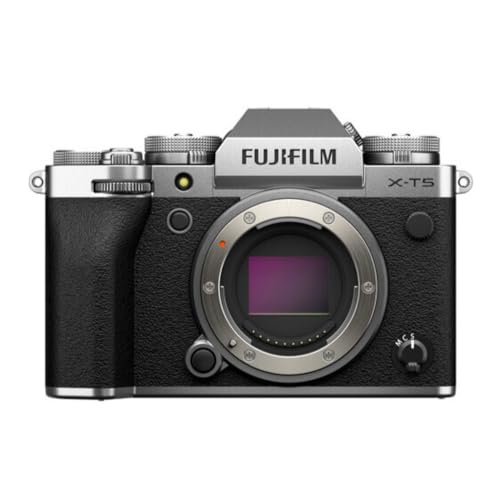
Fujifilm X-T5 Mirrorless Camera Body (Silver) — High-resolution dial-driven traveller
Fujifilm’s X-T5 listing packs two numbers that rarely share a lightweight guide: a 40MP APS-C X-Trans CMOS 5 HR sensor and 7-stop in-body image stabilization. Forty megapixels on a crop sensor is a traveller’s kind of resolution — it permits cropping a cityscape into three separate compositions, or printing a landscape at sizes that mock the body’s modest footprint — while the stabilization figure, printed rather than implied, is the specification that keeps handheld dusk photography viable without a tripod. This silver body-only listing is aimed at photographers who already speak Fujifilm, or intend to learn.
The X-T line’s identity is its dials: physical controls for shutter speed, sensitivity and exposure compensation that let a traveller set the camera by touch, eyes on the scene. That tactility has a weight consequence nobody lists — a camera you operate without menus is a camera you finish with faster, and the felt burden of equipment is partly the attention it demands. Fujifilm’s film simulations extend the same philosophy to colour, producing finished-looking files in the field, which lightens the other end of the trip: the evenings not spent editing.
APS-C keeps the lens side of the outfit honest. Fujifilm’s X-mount primes are small, its travel zooms moderate, and the 40MP sensor rewards the better ones with detail that justifies carrying them. Body-only means the first lens is your choice and your additional cost; pair this body with a small prime and the outfit rivals the a6400’s footprint while out-resolving everything in this guide, pair it with a large zoom and you have built a different, heavier camera that happens to share the name.
The listing’s own text gestures at versatility — its trailing phrase name-checks high-speed action among the body’s ambitions — but this review will judge it on the lightweight brief: a high-resolution, stabilized, dial-driven body for photographers who walk far and print big. Against the a7C II it trades the full-frame format for resolution, stabilization printed in the title, and a lens bench of genuinely small primes. That is not a lesser proposition; it is a different answer to the same aching shoulder.
Silver, again, is a considered choice rather than a colour. The retro finish pairs with the dials to make an object photographers enjoy carrying visibly, and enjoyment is a legitimate specification in a guide about equipment that must be present to be useful. The camera you like holding is the camera at the viewpoint when the light breaks.
Tripod-free landscape work is where this body’s printed numbers collaborate most visibly. Forty megapixels resolve the texture of a hillside; stabilization at the figure the listing claims keeps that resolution honest at the slow shutter speeds of dawn, when the light is best and the wind has not yet risen. A traveller who hikes to a viewpoint before sunrise with this body and one small zoom carries a landscape outfit that photographers a generation ago would have needed a vehicle to move — the lightweight idea fulfilled at the serious end.
Strengths
Trade-offs
Best for: walking photographers who print large, crop freely and shoot handheld at dusk. Not suited for: shooting straight from the box — this listing is a body, and its first photograph waits on a separate lens purchase.
If resolution without the full-frame burden is the goal, review the X-T5 body’s listing on Amazon alongside Fujifilm’s smaller primes.

Nikon Z50 II with Two Lenses — Two-lens compact Nikon outfit
Nikon’s Z50 II returns in this guide under its other virtue. The listing calls it a compact mirrorless stills and video camera, sold with two lenses, easy colour presets and wireless photo sharing as a USA model. Where the bird-photography reading emphasised its crop reach, the lightweight reading emphasises the outfit’s totality: two crop-format lenses are inherently smaller than their full-frame counterparts, so a complete two-lens Nikon kit can weigh less than a single full-frame body wearing one fast zoom. Completeness at low weight is a rarer achievement than a light body alone.
The two-lens span suits the traveller who refuses to choose between the wide scene and the distant detail. Crop-format standard zooms collapse small, crop telephotos stay jacket-pocket plausible, and the body’s own compactness keeps the whole arrangement inside a daypack’s camera cube rather than demanding a dedicated bag. Wireless sharing fits the same travel logic — photographs move to the phone for the evening post, the family group, the booking-site review that needs evidence of the view.
As in the bird guide, this review notes the title’s silence where it matters: neither lens’s focal length is printed, and no weight is stated. A traveller comparing outfits gram by gram must open the full listing and Nikon’s documentation. What the box demonstrably offers is the shape of a light system — compact body, two lenses, modern sharing — inside the Z mount, whose DX lens bench is built specifically for this format and whose full-frame bodies remain an upgrade destination that keeps some lenses useful.
The colour presets deserve a traveller’s footnote. Presets and picture controls that produce pleasing files in-camera reduce the editing backlog that quietly accumulates on trips, and a lighter workflow is a form of lightness too — the camera that asks less of your evenings gets carried more willingly on your mornings. For the photographer whose trips are holidays first and expeditions second, that ease is not a compromise of seriousness; it is the design brief.
Set against the a6400, the Z50 II offers the newer body inside the smaller catalogue; against the M10, a living system inside a slightly larger footprint. Its seat in this guide is the balanced one: genuinely compact, genuinely complete, genuinely growing — provided the unprinted details, checked in the full listing, match your itinerary.
Families splitting one camera among several travellers will feel this kit’s shape keenly. Two lenses mean the standard zoom can live on the body for whoever grabs it, while the telephoto waits for the safari park, the school match, the coastal walk — a division of labour that keeps the everyday outfit at its lightest and reserves the extra glass for the days that justify it. Systems that ask families to lens-swap for ordinary life get left behind; this one defaults to ready, which is the whole lightweight argument in miniature.
Strengths
Trade-offs
Best for: travellers who want a complete, compact two-lens system in a current mount. Not suited for: comparing outfits by printed focal lengths and gram weights — this title publishes neither, so the full listing must be consulted first.
Travellers leaning Nikon should open the Z50 II listing on Amazon to confirm the two lenses’ ranges before packing plans are made.
Comparison Table
| Pick | Format | Included glass | Lightweight logic |
|---|---|---|---|
| Canon EOS M10 Kit | APS-C (EF-M) | 15-45mm IS STM | Tiniest complete kit; closed lens catalogue |
| Sony a6400 | APS-C | 16-50mm | Compact body, collapsing zoom, deep small-lens bench |
| Sony Alpha 7C II | Full frame | None stated | Full frame in the compact line’s shell |
| Canon EOS RP Kit | Full frame | RF 24-105mm f/4-7.1 IS STM | One-lens full-frame travel kit, listing-certified light |
| Fujifilm X-T5 Body | APS-C, 40MP | None — body only | Resolution and 7-stop stabilization in a dial body |
| Nikon Z50 II Two Lenses | APS-C (DX) | Two lenses, ranges not stated in title | Complete two-lens outfit in crop-format sizes |
Why does the lens decide whether a camera is really lightweight?
Because lenses scale with the sensor they must cover. A full-frame lens projects a larger image circle, which demands larger glass elements, which arrive with larger barrels, filters and cases — the body is merely where that physics becomes visible. This is why the two full-frame picks here survive the lightweight brief only under discipline: the a7C II with compact primes, the RP with its deliberately moderate 24-105mm zoom. Break the discipline with a fast, heavy zoom and the outfit’s centre of gravity — literal and financial — moves into the lens, and the body’s grams stop mattering.
Crop systems invert the physics in your favour. APS-C and smaller formats let designers build zooms that collapse, primes the size of jar lids, and telephotos that fit jacket pockets, which is why three of these six picks are crop bodies and why their kits feel unreasonably light beside full-frame equivalents of similar reach. When you shop, weigh outfits, not bodies: body plus the two lenses you will actually carry, in the bag you will actually carry them in. That total, compared honestly, is the only lightweight ranking that survives contact with a holiday.
How should you pack a light mirrorless kit for a trip?
Start by deleting. One body, at most two lenses, chosen by the trip’s actual subjects — a city break wants a wide standard zoom and a fast prime for evenings; a landscape road trip wants the zoom and the discipline to leave the telephoto home. Carry the camera on a cross-body strap or wrist strap rather than in the bag, because a camera in the bag is a camera negotiating for its own use, and most negotiations on holiday end with the phone winning.
Protect without embalming. A padded wrap or a small cube inside a normal daypack beats a dedicated camera bag for most travellers: less weight, less signalling, faster access. Keep one battery in the camera and one in a pocket, cards in a hard case, and a microfibre cloth where your hand finds it without looking. Then run the only test that matters — carry the full outfit on a two-hour walk at home before departure. Shoulders vote early and honestly, and a kit that fails the home test will fail louder at the destination.
When is a phone still the lighter honest answer?
When the photographs are souvenirs rather than the purpose. A phone wins on hikes where every gram is argued over, on work trips where photography is incidental, and in rain, dust and crowds where a dedicated camera would spend the day protected instead of used. Naming those trips honestly is part of lightweight thinking: the mirrorless kit should travel when its advantages — real lenses, real low-light files, deliberate control — will actually be exercised.
The interesting territory is the border, and it moves with the picks in this guide. A camera as small as the M10 kit or an a6400 with its collapsing zoom asks so little carrying effort that the border shifts: trips that were phone-only by default become camera trips by preference. That shift, more than any specification, is what the lightweight category sells — not smaller cameras, but more photographs taken with a real one.
How do you carry a camera all day without feeling it?
Distribution beats reduction once the outfit is sensibly small. A cross-body strap moves the load to the opposite shoulder and keeps the camera at your hip, out of the chest-bounce that makes neck straps miserable by midday; a wrist strap suits the smallest kits, the M10 and a6400 class, for in-and-out-of-pocket shooting; and a simple belt or backpack-hipbelt pouch removes the weight from your shoulders entirely on hikes. Rotate positions during the day — shoulder, hand, bag — because fatigue is local, and moving the load postpones it more effectively than shaving fifty grams.
Clothing is part of the system. A jacket with a genuinely large pocket is a camera bag for the M10 class; a vest distributes small accessories across pockets instead of concentrating them in one swinging pouch. Travellers who dress around the camera slightly — nothing theatrical, just pockets and a strap chosen on purpose — report the paradox this whole guide is built on: the outfit feels lighter than a nominally lighter kit carried badly. Technique, as in bird photography and sport, quietly outranks equipment.
What does lightweight cost you, honestly?
Three things, and a buyer should sign for each knowingly. First, grip and control: smaller bodies carry fewer direct dials and shallower grips, so gloved hands and large hands both pay a tax — the X-T5’s dial-led layout is the partial exception here, trading menu depth for physical controls. Second, lens extremes: the longest and fastest glass in every mount is large, so a strict lightweight discipline caps your reach and your low-light apertures below what the mount technically offers. Third, battery and thermal headroom shrink with body volume, a tax paid mostly by heavy video users.
Against those costs, weigh what lightness buys: presence. The camera at the birthday, on the ridge, in the foreign street at dawn — present because carrying it never became a decision. Most photographers’ archives are limited far more by absence than by aperture, which is why this guide treats the three costs as a fair price rather than a warning. Sign for them knowingly, choose the pick whose costs fall where you feel them least, and go out more often than the heavy-kit photographer you might otherwise have been.
Common Mistakes When Buying a Lightweight Mirrorless Camera
Comparing body weights and ignoring the outfit. Manufacturers weigh bodies without lenses, batteries or cards; you carry all of it, all day. A “heavy” crop body with a collapsing zoom routinely out-travels a “light” full-frame body wearing fast glass. Weigh the system you will actually pack.
Buying a discontinued system as a foundation. The M10 kit is a fine finished purchase and a poor first step, because the EF-M lens catalogue is closed. Confusing those two roles is the most expensive lightweight mistake available in this guide.
Assuming an unprinted weight. Most listings here state no gram figure at all. Guessing from photographs — where lenses and hands distort scale — misleads; the manufacturer’s documentation carries the number, and your own two-hour walk test carries the verdict.
Letting the second lens creep in. Lightweight kits die by accumulation: the just-in-case telephoto, the spare prime, the tripod for one sunset. Each addition is defensible; the total is a betrayal. Pack for the trip you are taking, not the portfolio you are imagining.
Choosing full frame and then feeding it like a crop kit. The a7C II and RP stay light only under lens discipline. A buyer unwilling to practise it should buy the crop system honestly rather than carry a full-frame outfit that quietly weighs what a large body would.
Final Recommendation
Decide what “light” protects in your photography — spontaneity, distance covered, or the simple willingness to bring the camera at all — and the six sort themselves. For the smallest complete answer with no system to manage, the M10 kit remains unmatched, bought with open eyes about its closed mount. For a compact body inside a living system, the a6400 is the seasoned choice and the Z50 II the newer two-lens alternative, once its lens ranges are confirmed in the full listing. Full-frame travellers divide by lens philosophy: the RP kit for the one-zoom completeness its listing promises, the a7C II for compact-prime discipline in the format’s smallest shell. And the photographer who walks far and prints big should give the X-T5’s 40 megapixels and printed 7-stop stabilization a long look, budgeting its first lens alongside the body. In every case, run the two-hour walk test before the trip does it for you — the lightest camera in this guide is the one still on your shoulder at the viewpoint.
Frequently Asked Questions
Is full frame too heavy for travel photography?
Not inherently — it is too heavy only when paired carelessly. The a7C II exists precisely to carry the format in a compact shell, and the EOS RP kit pairs its full-frame body with a moderate zoom its listing calls compact and lightweight. Feed either body large fast zooms, though, and the outfit outweighs disciplined crop kits. The format is not the weight; the lens discipline is.
Why is a discontinued camera like the EOS M10 in a best-of guide?
Because for one defined buyer — the traveller who wants a tiny, complete, finished kit and no system to grow — it remains the lightest honest answer at its level. The guide states its closed EF-M catalogue openly and steers system-builders to the living mounts. A recommendation with its limitation printed on it serves readers better than an omission.
None of these listings print a weight — how do I compare?
Use the manufacturers’ documentation for gram figures, then distrust the comparison anyway: body weights exclude lenses, and the lens dominates the carried total. Compare complete outfits — body, your intended lenses, bag — and finish with a real walk. Format remains the reliable proxy in the meantime: smaller sensors permit smaller lenses, and smaller lenses are where the kilograms live.
Does in-body stabilization matter for a lightweight kit?
Yes, because it replaces the tripod you were not going to carry. The X-T5’s listing prints a 7-stop figure; the M10 and RP kits carry stabilization in their lenses instead. Either route steadies handheld dusk and interior shots, which is where travel photography’s best light lives. Where a listing is silent on the subject, the manufacturer’s documentation is the place to check.
APS-C or full frame for a one-camera travel life?
APS-C if your travel is long, walked and varied — the systems here stay light under every lens choice. Full frame if your travel centres on low light, shallow depth and deliberate photography, and you accept lens discipline as the entry fee. The a6400 and the a7C II are the two poles of that decision inside a single mount, which is why Sony appears at both ends of this guide.
Can a lightweight camera be a photographer’s only camera?
For most photographers, yes — and the picks here were chosen with that possibility in view. The a6400, Z50 II and X-T5 sit inside living systems that cover everything from weddings to wildlife with the right lenses, and the full-frame pair needs no apology anywhere. The exception is the specialist: the sports professional and the studio commercial shooter will outgrow any lightweight-first body. Everyone else is usually limited by opportunity and practice long before the camera objects.
How do I keep a light kit light as it grows?
Impose a bag rule and let the bag enforce it: the outfit must fit the small bag you chose at the start, and any new lens displaces an old one or stays home. Photographers who adopt the rule discover their purchases become more deliberate — a lens must now defeat an incumbent, not merely impress a reviewer. It is the same discipline the a7C II demands of its owners, applied as policy rather than discovered as regret.
What should my second purchase be after a lightweight kit?
A small fast prime in your most-used focal length. It transforms any of these bodies for evenings — brighter apertures for dark streets and restaurants — while adding almost nothing to the bag, which keeps the purchase loyal to the lightweight idea that started the system. Resist the telephoto until your travel actually demands it; primes first is the order that keeps kits light and used.
One final test before any of these is ordered, and it costs an afternoon rather than a fortune: borrow or rent the class of camera you favour, or at minimum handle it in a shop with the lens you intend to live with mounted. Hands report truths that shoulders only confirm later — grip depth against your fingers, dial stiffness, the viewfinder’s comfort against your glasses. Lightweight is a relationship measured in hours of contact, and ten minutes of handling has ended more mistaken purchases than any review, including the ones in this guide. Choose the body your hands vote for among the picks your head has shortlisted, and the two will rarely disagree for long.
Related Guides
Whichever pick leaves with you, protect the idea that chose it. Put the camera where your hand falls at the door, keep its battery charged as a household habit rather than a pre-trip project, and let it accumulate the unglamorous photographs — the Tuesday market, the dog in good light, the friend laughing mid-sentence — that heavy cameras are never present for. A year of those frames is worth more, to most lives, than a shelf of masterpieces from the three trips the big camera attended. That is the whole case for this category, and every pick above can make it. The differences among them — format, mount, dials, discipline — are real, and the preceding pages have weighed them as carefully as listings allow; but they are differences inside a shared conviction, that photography rewards the present. A traveller who internalises that conviction will choose well from this list almost regardless of which badge the box carries, because the choosing itself will have been done in the right units: days carried, evenings used, photographs that exist, and shoulders that still feel fresh when the light finally turns kind at the end of the long road back home, ready for whatever the evening still offers in the last of the day’s soft fading light.
Lightweight bodies rarely stay in one genre for long. If your travel camera will double as your video camera, the stills-video balance is examined in the best hybrid mirrorless cameras; when the budget and ambition grow, the best mid-range mirrorless cameras maps the tier above these kits; and landscape specialists who can base themselves near the car should compare these travellers against the best full-frame mirrorless cameras for landscape photography, where weight yields to resolution as the ruling value.



[…] whose birds share the weekend with matches and races should compare these bodies against the best lightweight mirrorless cameras when the bag itself becomes the burden, and those splitting their outings between stills and […]