What's inside
- Key Takeaways
- Quick Picks
- How We Chose These Picks
- How Does a Folding Desk Actually Live Day to Day?
- What Can a Folding Desk Honestly Hold?
- Where Does a Folded Desk Go?
- How Do You Make a Folding Desk Feel Permanent While It Stays Open?
- What Should Travel With a Folding Desk?
- Folding Desk or Small Fixed Desk: How Do You Decide?
- The Six No-Assembly Desks, Reviewed One by One
- Folded, Stored, Compared: The No-Assembly Field at a Glance
- How Do You Choose Between Two Folding Desks of the Same Size?
- What Mistakes Do No-Assembly Desk Buyers Keep Making?
- Final Recommendation
- Frequently Asked Questions
- Related Guides
As an Amazon Associate I earn from qualifying purchases. This post may contain affiliate links at no extra cost to you.
**[widgetverdict.com] is reader-supported. When you buy through links on our site, we may earn an affiliate commission.**
Where to buy: every desk in this guide is sold on Amazon, and each pick’s name links to its listing from the Quick Picks table and from its detailed review. No-assembly desks are bought on two measurements most buyers forget — the folded thickness and the weight you will actually carry — so check both on the listing page against the cupboard, car boot or under-bed space where the folded desk will live.
The best no assembly computer desks answer a question the rest of the desk market refuses to hear: what if the desk is not forever? Most desks assume a room, a commitment and an afternoon with an Allen key. Folding desks assume a life in motion — the dorm room that empties in May, the rental where the office corner must vanish when the landlord visits, the spare room that hosts guests more often than work, the RV, the market stall, the second desk that exists only during the busy season. For those lives, a desk that arrives ready, folds flat and stores in a gap is not a compromise product. It is the only product that fits the brief.
The six picks below are all folding desks in the 27- to 39-inch class, and they divide by what they optimise once the no-assembly promise is kept. The Elephance is the all-rounder at 39.4 inches. The TEMI and HMFOR are twin-sized 35.8-inch designs aimed at dorms, bedrooms and, in the HMFOR’s case, RVs and portable use. The JOYMOOP and the alawooder both state a 150 lb capacity, the alawooder adding a fold so flat it measures 2.3 inches stored. The GreenForest is the smallest and the only two-tier design, trading width for a shelf level. None of them will be assembled, because none of them need to be, and that sentence is the entire category’s charm.
Honesty about the trade is owed at the start. A folding desk exchanges the rigid, planted permanence of a framed desk for its freedom, and the exchange shows at the extremes: heavy multi-screen battlestations, leaning-while-thinking loads and decade-long daily service belong to framed furniture. What folding desks offer instead — immediacy, mobility, storage in a sliver of space — is worth more than rigidity to the lives they serve, and this guide judges them on their own terms: how fast, how flat, how steady, how honestly sized.
Key Takeaways
- No-assembly folding desks serve temporary, small and mobile lives: dorms, rentals, spare rooms, RVs and seasonal second desks.
- The Elephance at 39.4 inches is the widest and the natural all-rounder for a laptop-based home office.
- The TEMI and HMFOR share a 35.8-inch class size; the HMFOR leans portable, pitched at dorms and RVs in dark oak.
- The JOYMOOP and alawooder both state a 150 lb capacity — the alawooder folds flat to 2.3 inches, the slimmest storage here.
- The GreenForest is the compact outlier at 27.3 by 22 inches, with a second tier that lifts storage off the working surface.
- All six trade the permanence of framed desks for immediacy: open the box, unfold, work.
Quick Picks
| Pick | Badge | Why it earns its place |
|---|---|---|
| Elephance Folding Desk | Best all-round folding desk | The widest top here at 39.4 inches, in black oak, for a home office that starts the day the box arrives. |
| TEMI Folding Computer Desk | Best for dorms and bedrooms | A 35.8-inch foldable desk in brown, sized for the small rooms it names: bedroom, dorm, apartment. |
| HMFOR Folding Computer Desk | Best for portable use | A 35.8-inch dark oak folding desk pitched at compact storage and portable duty, dorm and RV included. |
| JOYMOOP Folding Desk | Best stated capacity | A lightweight, portable black folding desk rated to hold 150 lbs, for work, study and craft. |
| alawooder 31.5 Inch Folding Desk | Best fold-flat storage | A wood-topped 31.5-inch desk that folds to 2.3 inches flat, holds 150 lbs and shrugs off splashes. |
| GreenForest Folding Desk | Best with a storage tier | A two-tier 27.3 by 22 inch oak desk whose shelf level keeps the laptop’s surface clear in tiny spaces. |
How We Chose These Picks
The fold itself came first in the judging, because the fold is the product. We favoured designs whose listings make the folded state a specification — the alawooder’s 2.3-inch flat profile is the standard the category should be held to — and desks light enough, like the JOYMOOP, that folding them away is a one-person, one-minute act rather than a furniture event. A no-assembly desk that is miserable to store has kept only half its promise.
Stability came second, judged within the category’s honest limits. Folding frames concentrate their engineering in hinges and locks, and the stated capacities — 150 lbs on the JOYMOOP and alawooder — were read as the makers’ own confidence made public. We also weighed top size against realistic loads: a laptop, a lamp and a notebook is the class’s home load, a laptop plus a modest monitor is its stretch goal, and the reviews are plain about which desks suit which. Buyers planning a monitor should read the width and the capacity together, not separately.
Third, we scored the lives each desk names for itself, because this category is unusually honest in its listings about its audiences — dorm, apartment, RV, small bedroom, craft table — and a desk designed for a dorm’s year differs in its compromises from one designed for a spare room’s decade. Finish played its part here too: black oak, brown, dark oak and oak across the field means the temporary desk need not look temporary, which matters in rooms that are living rooms whenever the desk is folded away.
What we did not ask of these desks: drawers, cable systems, monitor stands, power. The category’s answer to storage is the room’s own furniture and the desk’s disappearance, and judging a folding desk for lacking a file drawer would be like judging a bicycle for lacking a boot. The GreenForest’s second tier is the one storage gesture in the field, and it is scored as the bonus it is.
A final consideration ran through the judging and rarely appears in listings: the second owner. Folding desks are the most resold, lent and handed-down desks in the furniture world, because their owners’ lives change fastest — the graduate leaves the dorm, the renter buys a house, the RV gets sold. A folding desk with a sound frame and a finish that survives handling keeps its value through those transitions, while a flimsy one becomes landfill with handles. We weighted build honesty partly as an environmental judgement: the greenest desk is the one still in use, in someone’s room, in ten years.
How Does a Folding Desk Actually Live Day to Day?
The rhythm is the revelation for first-time owners. The desk comes out when the work starts and goes away when it ends, and that rhythm redraws a small room twice a day: office by morning, bedroom by night, dining room on Sunday. Owners who expected to fold the desk away only occasionally find themselves doing it constantly, because a room that can change its mind is addictive — and owners who bought the desk for a fixed corner find the folding mechanism quietly unused, which is fine too, because an unfolded folding desk is simply a desk.
The mechanics reward a small discipline. Open the legs fully until the locks engage, every time, even for a five-minute task; a half-locked fold is the one genuinely unsafe state these desks have. Keep the folded desk stored vertically in its gap rather than flat under a pile, because the top’s finish is the part you will look at daily. And when the desk travels — to another room, another flat, the car boot — carry it folded by its frame, not by one leg, because hinges forgive weight but not leverage.
Work habits adapt to the format in ways worth knowing. The setup must be portable by design: laptop, lamp, notebook, done. Anything that needs bolting, clamping or a twenty-minute cable ceremony defeats the desk’s purpose, so folding-desk owners evolve the most disciplined setups in computing — a laptop, a wireless keyboard perhaps, a charger that lives in the laptop bag. If your working life is already that lean, or wants to be, these desks will feel less like furniture and more like a permission slip.
What Can a Folding Desk Honestly Hold?
Start with the stated numbers where they exist. The JOYMOOP and alawooder both publish a 150 lb hold, which in practical terms is far beyond a laptop setup’s weight and comfortably into a monitor-plus-laptop arrangement, provided the load is spread across the top rather than parked at one corner. Static weight, though, is only half the physics: folding desks are at their best under loads that sit still, and at their least certain under loads that push sideways — a heavy monitor arm clamped at the edge, a user who leans their full reading weight on the front corners, a tower that makes one end top-heavy.
The realistic load map, desk by desk, runs like this. A laptop alone: every desk here, trivially, including the GreenForest with its second tier for the extras. A laptop and a portable monitor, or a modest desktop monitor on its own stand: the wider desks — Elephance, TEMI, HMFOR, JOYMOOP — with the monitor centred over the frame. A full desktop battlestation with a tower on top: none of them, honestly, and buyers with that load should be reading framed-desk guides instead, a point this guide will repeat in the mistakes section because it is the category’s one real safety line.
There is also the floor to consider, because folding legs concentrate weight on small feet. On carpet, a folding desk settles and stays; on hard floors, its lightness means it can skate under a sideways nudge, which a rug or furniture pads answer in a minute. None of this is fragility — it is the physics of a desk designed to move, priced into the category, and managed by the same common sense that manages a folding chair.
Where Does a Folded Desk Go?
The gap inventory of a small home is shorter than people think, and this is where the alawooder’s 2.3-inch folded profile stops being a specification and becomes a superpower. Two and a bit inches fits behind a door, between a wardrobe and a wall, under a bed with low clearance, inside the cupboard that holds the ironing board — the slivers of a home that no other furniture can use. Desks that fold less flat still store respectably: against a wall behind a curtain, in the hall cupboard, in the boot of a car kept there for market days and site visits.
Think about the stored desk’s neighbours. It will lean against things and things will lean against it; a top stored face-out keeps its finish, and a blanket or the desk’s own packaging between it and a bicycle’s pedal saves the surface you will type at. RV and van users, whom the HMFOR names directly, should measure the storage slot rather than the living space: in a vehicle, the folded desk’s home is a specific locker, and the desk that fits the locker wins regardless of its open dimensions.
Finally, plan the fold’s choreography once and it becomes invisible: which way the legs tuck, which hand carries it, where it leans while the chair moves. Thirty seconds of choreography, done the same way every day, is the difference between a desk that feels like a clever system and one that feels like a recurring minor event. The category’s fans are made in that thirty seconds.
How Do You Make a Folding Desk Feel Permanent While It Stays Open?
Many folding desks spend their lives open, and a few deliberate touches close most of the gap between them and framed furniture. The first is the floor: a rug under the desk, or pads under the feet on hard floors, ends the skating that reminds you the desk can move, and quiets the small sounds of a light frame at work. The second is the load’s placement — the heaviest object centred over the frame, the daily objects arranged so nothing lives at the front corners where leverage lives. A folding desk loaded with respect feels, from the chair, remarkably like any other desk.
The third touch is a cable truce. A permanent setup on a folding desk should still be unpluggable in one motion — a single strip whose cable is the desk’s only tether to the wall — so the fold remains possible on the day the room suddenly needs it. Coil the setup’s cables to the desk itself rather than the wall, keep the charger in the laptop’s bag, and the desk can be folded by one person in minutes without a cable ceremony. Owners who wire a folding desk as if it were built-in discover the mistake exactly once, usually while a guest waits in the doorway.
The fourth is cosmetic and underrated: dress the desk like furniture. A mat under the laptop, a lamp with some weight and presence, the notebook stack squared — these small signals tell the room, and the worker, that this is a workplace rather than a temporary apology for one. The finishes in this guide, oak and black oak and brown among them, were chosen by their makers with that dignity in mind; meet them halfway and guests will not guess the desk folds until you show them, which owners reliably report is the most satisfying reveal in small-space living.
What Should Travel With a Folding Desk?
The portable setup is an ecosystem, and the desk is only its largest member. The kit that makes a folding desk work anywhere has a consistent anatomy: the laptop and its charger, a mouse that does not care what surface it meets, headphones for the rooms that are not yours alone, and a small bag that holds the cables, the adapter and the notebook as one grab-and-go unit. Assembled once and kept together, that kit turns any of these desks into an office in under five minutes, in a dorm, a rental, a relative’s spare room or a vehicle’s awning-side table.
Power deserves its own planning in the travelling kit. Strange rooms hide their sockets, so a compact strip or a charger with reach is the difference between working at the desk and working wherever the cable ends. Battery discipline matters the same way: the folding-desk life often happens at a distance from plugs — gardens, sites, vehicles — and a setup that can run a session on the laptop’s own power treats the desk as pure surface, which is the format at its most liberated. The HMFOR’s RV pitch implies exactly this life; its desk is the furniture half of a kit whose other half is power independence.
Finally, the kit should include the desk’s own small kindnesses: a microfibre cloth for the top, spare pads for the feet, and the habit of a thirty-second inspection when the desk is unfolded somewhere new — locks engaged, feet level, nothing trapped in the fold. Travel is where folding desks earn their keep and where they are most casually mistreated; the inspection habit is what separates the desk that tours for a decade from the one that comes home from its third trip with a limp.
Folding Desk or Small Fixed Desk: How Do You Decide?
The honest contest in this category is not among the six picks but between the category and its neighbour: the small fixed desk, assembled once and standing forever at the same size. The fixed desk wins on rigidity, on storage options and on the dignity of permanence; the folding desk wins on everything temporal — arrival speed, room flexibility, storage, moving day, the guest weekend. Deciding between them is therefore a question about your next two years, not about the desks: how likely is the room to change its mind?
Count the probabilities plainly. A tenancy with an end date, a course with a graduation, a spare room with guests in its future, a job that may relocate — each is a vote for the fold. A bought home, a settled room, a setup growing toward permanence — votes for the frame. Renters in particular should weigh the deposit’s testimony: a folding desk leaves no assembly scars, no wall of discarded packaging, and no furniture too built to leave, which in a rented life is a financial feature disguised as a convenience.
There is also the hybrid life, and it may be the most common: the fixed desk in the main room, the folding desk as the household’s flexible reserve — deployed for the busy season, the visiting relative who works, the child’s exam month, the market stall. Households that own one of each rarely regret either, because the two categories are not rivals but seasons. If this guide’s six are your household’s first folding desk, buy for the reserve role honestly and it will be borrowed by every future version of your life.
The reserve role also explains why so many households end up owning a second folding desk deliberately. The first proves the concept — a surface that appears when life needs one — and the second extends it to the household’s other pressure points: the partner’s busy season, the child’s exam term, the project that takes the kitchen table hostage. Two folding desks store in roughly the footprint of one armchair and between them cover contingencies that would otherwise each demand a furniture decision. When a category’s owners keep buying the category, the category is telling the truth about itself.
The Six No-Assembly Desks, Reviewed One by One
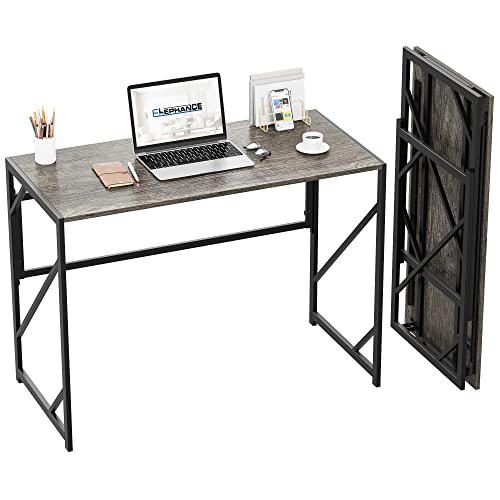
Elephance Folding Desk — Best all-round folding desk
The Elephance is the folding desk for people who did not know they wanted one: a 39.4-inch writing and computer desk in black oak, sold plainly for the home office, that happens to require no assembly and to fold for small spaces. At the top of this guide’s size range, its width is its argument — a laptop and a notebook side by side, a laptop and a modest monitor, a writing spread with elbow room — the everyday loads of a real working day, on a desk that was standing ready within minutes of the delivery driver’s knock.
Black oak is a diplomatic finish, dark enough to read as office furniture and warm enough not to glare in a living room, and diplomacy matters for a desk whose party trick is appearing and disappearing in shared spaces. The Elephance’s studied normality is its strategy: it looks like the desk a home office would buy on purpose, and only its owner knows it can be in the cupboard by Friday when the guests arrive.
No capacity figure is stated in its title, so the honest guidance is the category’s standard one: laptops and light monitor setups, spread across the top, will live here happily for years, while towers and clamped arms belong on framed furniture. Buyers who need the number in writing should take the JOYMOOP or alawooder below. For everyone whose load is a laptop life, the Elephance is the widest, calmest version of the folding idea — the default recommendation of this guide.
- Overall size: 39.4 inches
- Assembly: none — folding design
- Capacity: not stated in the listing title
- Aimed at: home office in small spaces
- Finish: black oak
Strengths
- Widest working top in the guide, for real daily loads.
- Reads as ordinary office furniture, not as a temporary measure.
- Ready to work within minutes of arrival, and gone as fast.
Trade-offs
- No stated capacity figure for buyers who need the number.
- Widest here also means the largest folded object to store.
- Black oak shows dust in bright rooms between uses.
Best for: a laptop-based home office that must sometimes not exist. Not suited for: a heavy desktop tower setup that needs a framed desk’s certainty.

TEMI Folding Computer Desk — Best for dorms and bedrooms
The TEMI names its rooms in its own listing — bedroom, dorm, apartment — and its 35.8-inch brown folding top is sized by those rooms’ arithmetic: wide enough for a laptop, a lamp and the open textbook, narrow enough for the wall a dorm actually allocates, and gone entirely during the holidays when the room must empty. Brown is the right finish for that life, warmer and more forgiving of a student room’s existing furniture lottery than black, and the desk’s whole proposition is that a temporary room deserves a real desk rather than the bed-and-lap compromise.
Student work has a specific shape the TEMI fits: the laptop at the centre, paper to one side, the phone and the mug negotiating the remainder, and long evening sessions where a proper surface at a proper height is the difference between studying and enduring. A folding desk at a student’s budget of space also solves the social problem — folded away, the room is a room again, with floor for the people who live in it.
Its limits are the student year’s own: one screen, light loads, no storage of its own. The desk is a surface, and the room’s shelves must do the rest. But judged as the answer to the dorm question — a real desk, no assembly, no trace by move-out day — the TEMI is the most precisely aimed product in this guide, and graduates who keep it as a spare-room desk afterwards will find it ages into its second life without complaint.
- Overall size: 35.8 inches
- Assembly: none — foldable design
- Capacity: not stated in the listing title
- Aimed at: bedroom, dorm, apartment study
- Finish: brown
Strengths
- Sized and finished precisely for student and small-bedroom life.
- Folds away for holidays, guests and room reshuffles.
- A real surface at a real height, replacing the bed-desk compromise.
Trade-offs
- One-screen, light-load territory by design.
- No storage tier or shelf for the student’s clutter.
- No stated capacity in the title for heavier monitor plans.
Best for: a student or small-bedroom worker whose room must change back. Not suited for: a permanent dual-screen office that happens to dislike assembly.
HMFOR Folding Computer Desk — Best for portable use
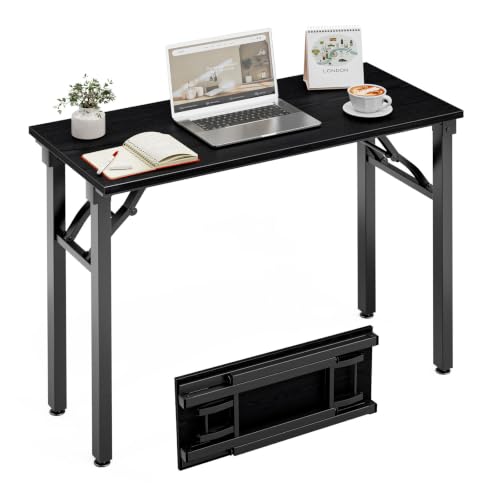
The HMFOR shares the TEMI’s 35.8-inch class and then walks it out the door: its listing pitches compact storage and portable use across dorm and RV small spaces, in dark oak. That RV mention is the desk’s whole character. A folding desk in a vehicle or a touring life is not furniture that occasionally moves; it is equipment, deployed at each stop and stowed for each journey, and the HMFOR is the one pick here designed with that rhythm as the main case rather than an edge case.
Portability reorders the virtues. The fold must be quick because it happens constantly; the stored size must suit a locker or a gap beside a seat rather than a spare-room wall; the finish — dark oak — must survive being seen in living spaces that are also driving spaces, where everything is on display all the time. The HMFOR’s pitch assembles exactly those virtues, and its home-office framing keeps it equally valid for the static version of the same life: the flat whose desk deploys for workdays and stows for weekends.
The cautions travel with it. Vehicle storage should be measured, not assumed, because a desk that fits the room but not the locker fits neither. And portable duty means the hinges live a harder life than a spare-room desk’s ever will, so the fold’s locks deserve a periodic check as part of the stowing ritual. For the touring worker, the market trader, the site-based professional and the RV dweller, this is the guide’s natural pick; for a desk that will stand in one corner for years, its talents are simply more than the job requires.
- Overall size: 35.8 inches
- Assembly: none — folding, foldable design
- Capacity: not stated in the listing title
- Aimed at: compact storage, portable use, dorm and RV spaces
- Finish: dark oak
Strengths
- Designed for deployment-and-stow rhythms, not occasional folding.
- Compact storage suits vehicle lockers and small flats alike.
- Dark oak finish holds up visually in full-display living spaces.
Trade-offs
- RV buyers must measure the storage locker before the living space.
- Constant folding asks for periodic checks of the locks.
- Same light-load ceiling as its size class.
Best for: an RV, touring or market-day worker who deploys a desk daily. Not suited for: a fixed corner office that will never fold anything.

JOYMOOP Folding Desk — Best stated capacity
The JOYMOOP puts its number in writing: holds 150 lbs. In a category where several listings leave capacity unstated, that figure is a statement of intent, and it arrives on a lightweight, portable black folding desk pitched at work, study and craft. The combination matters — capacity usually costs weight, and a folding desk that is both strong on paper and light in the hand has resolved the category’s central tension in the user’s favour. The craft pitch widens it further: sewing machines, cutting mats and project sprawl are loads with opinions, and a desk that invites them is confident in its frame.
For computer use, the 150 lb figure translates into headroom: a laptop and a monitor together, a small desktop setup with the tower beside rather than on the desk, a printer for the afternoon’s label run — loads the unstated-capacity desks might carry but cannot promise. Spread the load, centre the heavy items over the frame, and the JOYMOOP will serve as the most capable folding surface here. Its black finish and simple lines keep it room-neutral, the way a desk that visits many rooms should be.
The honest notes: 150 lbs is a static, distributed figure, not an invitation to sit on the desk or clamp a monitor arm at its edge, and portable lightness still means the desk can be nudged on hard floors in a way a framed desk cannot. Buyers whose primary need is a monitor on a stand plus a laptop, in a room that reclaims its floor nightly, have found their pick — the strongest promise in the guide, at a carry weight that keeps the promise usable.
- Size: small computer desk class (width not stated in title)
- Assembly: none — foldable, lightweight and portable
- Capacity: holds 150 lbs, per the listing title
- Aimed at: work, study, craft
- Finish: black
Strengths
- Stated 150 lb capacity gives monitor setups a written promise.
- Lightweight despite the capacity, so the fold stays a one-person act.
- Craft and work pitch suits project loads beyond computing.
Trade-offs
- Capacity is static and distributed; edge clamps remain a bad idea.
- Light desks can skate on hard floors without pads or a rug.
- Width is unstated in the title — confirm it on the listing page.
Best for: a monitor-plus-laptop setup in a room that reclaims its floor. Not suited for: a clamped monitor arm or a user who leans their full weight on the desk’s edge.

alawooder 31.5 Inch Folding Desk — Best fold-flat storage
The alawooder’s specification reads like a love letter to small homes: a 31.5-inch wood top that holds 150 lbs, folds flat to 2.3 inches, shrugs off splashes, and stands on a sturdy metal frame. The 2.3 inches is the number to savour. It is the difference between a desk that needs a storage plan and a desk that fits the gaps a home already has — behind the door, beside the wardrobe, under the bed — and for the studio flat and the one-room life, that difference is the whole purchase.
The splash-proof wood top is the second thoughtful detail, because temporary desks live dangerously: they are dining tables at lunch, craft benches on Saturday, the surface nearest the door for everything. A top that treats a spilled coffee as a wipe rather than a stain suits the multi-duty life the desk will actually lead, and the wood finish keeps it looking like the home’s furniture rather than its equipment. At 31.5 inches the working surface is laptop-scale with a notebook’s width beside it — honest dimensions for the rooms it serves.
Pair its two stated numbers and the alawooder becomes the guide’s recommendation for the tightest lives: strong enough for a monitor setup, flat enough for any gap. Its compromises are width — two screens are not its language — and the category’s usual cautions about edge loads. Renters in furnished flats, where the landlord’s desk is unusable and the floor space is rationed, should start their reading here; it is the desk that asks the least of a home while giving a real surface back. Households whose folding desk must also host the printer for a homework evening can compare the sturdier framed layouts in Best Computer Desks with a Printer Shelf, and accept the assembly those demand.
- Overall size: 31.5 inches
- Folded profile: folds flat to 2.3 inches
- Capacity: holds 150 lbs, per the listing title
- Top: splash-proof wood top, sturdy metal frame
- Aimed at: small spaces, home office
Strengths
- Flattest fold here — storage in gaps no other desk can use.
- Stated 150 lb capacity matches the JOYMOOP’s promise.
- Splash-proof top suits a desk that doubles as every other table.
Trade-offs
- Thirty-one and a half inches is laptop-scale, firmly.
- No second tier or shelf for the setup’s extras.
- Wood finish varies in tone against other rooms’ furniture.
Best for: a studio flat or furnished rental with a gap and a laptop life. Not suited for: a two-screen setup that needs width more than storability.

GreenForest Folding Desk — Best with a storage tier
The GreenForest is the smallest desk in this guide — 27.3 by 22 inches — and the only one that answers smallness with a second storey. Its two-tier design puts a shelf level above or beside the working surface, so the laptop’s layer stays clear while the lamp, the books, the printer’s little cousin or the day’s clutter live on the tier. In the tiniest rooms — the box-room office, the dorm’s far corner, the apartment nook — that vertical gesture is the difference between a desk that hosts a setup and a plank that hosts a laptop and nothing else.
Sturdiness is the listing’s own word for its pitch, and in a compact folding frame it is the right word to lead with: small desks get bumped, leaned on and overloaded by hopeful owners, and a maker who headlines strength has understood the assignment. The oak finish warms the smallest room in the guide, and the whole object reads as a considered piece of small furniture rather than a camping accessory — important in rooms where the desk, however temporary, is always in view.
The boundaries are the dimensions themselves, stated plainly: 27.3 inches wide is a laptop’s desk, full stop, and the tier holds accessories, not a second screen’s ambitions. Buyers who need a monitor should climb to the wider picks. But for the laptop worker in the smallest room — and for the second-desk role in a larger home, the homework station, the sewing corner, the laptop’s holiday home — the GreenForest’s tiered compactness is a genuinely different answer, and the only one here that stores anything at all. Users whose small room must instead hold two screens should take the hint toward the compact standing options in Best Dual Monitor Computer Desks, accepting the assembly those require.
- Overall size: 27.3 x 22 inches
- Assembly: none — folding design
- Storage: 2-tier design with a shelf level
- Capacity: not stated in the listing title; sturdy pitch
- Finish: oak
Strengths
- Second tier keeps the working surface clear at the smallest size.
- Fits rooms and nooks no other pick here can enter.
- Oak finish reads as furniture, not equipment.
Trade-offs
- Laptop-only width; monitors belong on the wider desks.
- The tier tempts overloading a small frame’s top layer.
- No stated capacity figure in the title.
Best for: a laptop worker in the smallest room that still deserves a desk. Not suited for: any setup with a separate monitor as its main screen.
Folded, Stored, Compared: The No-Assembly Field at a Glance
| Pick | Size | Capacity | Storage idea | Defining trait |
|---|---|---|---|---|
| Elephance | 39.4 in | Not stated in title | Folds for small spaces | Widest top, black oak |
| TEMI | 35.8 in | Not stated in title | Folds flat for the term break | Dorm and bedroom sizing |
| HMFOR | 35.8 in | Not stated in title | Compact, portable storage | RV and portable pitch |
| JOYMOOP | Small desk class | 150 lbs | Lightweight carry | Strength without the weight |
| alawooder | 31.5 in | 150 lbs | Folds to 2.3 in flat | Splash-proof wood top |
| GreenForest | 27.3 x 22 in | Not stated in title | 2-tier shelf level | Smallest, with storage |
Shop this table by your storage gap and your load, in that order. The gap decides first: a 2.3-inch sliver admits only the alawooder, a cupboard admits them all, an RV locker admits whichever its measurements bless. The load decides second: a stated 150 lbs separates the JOYMOOP and alawooder from the field for monitor duty, while a laptop-only life makes every row viable and lets finish and width choose. Notice the GreenForest’s different bet — it is the only desk here that stores things while open, for owners whose desk will in practice stay open and merely could fold.
One column of that table quietly predicts owner satisfaction better than the rest: the storage idea. Buyers consistently underestimate how much of a folding desk’s life is spent folded, and the desks whose folded state was designed — a stated flat profile, a compact carry, a tier that keeps the open state honest — are the ones still in daily service years later. Width wins the first week; the fold wins every week after.
How Do You Choose Between Two Folding Desks of the Same Size?
This guide contains a natural experiment: the TEMI and HMFOR share a 35.8-inch class and diverge in almost everything else, and the method that separates them separates the whole category. Start with the life, not the desk. The TEMI’s listing speaks to rooms — bedroom, dorm, apartment — while the HMFOR’s speaks to motion — portable use, compact storage, the RV. A desk bought for a room should be judged on its surface and finish; a desk bought for motion should be judged on its fold, its carry and its stored size, because those are the specifications it will be used by, daily.
Finish is the second separator, and it is not vanity. A folding desk lives in borrowed and shared spaces more than any other furniture, and its finish decides whether it reads as a guest the room welcomes or equipment the room tolerates. Brown, dark oak, black oak and oak across this field are four different diplomacies; match the desk to the room it will most often stand in, and it will be folded away for space reasons only, never for shame. The third separator is the stated number: where a listing publishes a capacity or a folded thickness, it is offering a verifiable promise, and promises in writing deserve weight against otherwise similar desks that offer none.
The last separator is the tier question — whether the setup needs the desk to store anything. Most folding desks answer with silence, and the GreenForest’s second tier is the field’s only reply. If your laptop life travels with a lamp, a book stack and a small printer’s worth of companions, the tier may outweigh inches of width; if the surface is the whole story, width wins. There is no universal order to these four tests, but there is a personal one, and running your own life through them in sequence will point at one desk in this guide with unusual clarity.
What Mistakes Do No-Assembly Desk Buyers Keep Making?
The first is loading a folding desk like a framed one. A tower on the top, a clamped arm at the edge, a user treating the front rail as a leaning post — these are framed-desk loads, and they defeat hinges by physics, not by defect. Keep the load centred, static and within the stated capacity where one exists, and a folding desk will outlast its reputation; ignore the physics and no desk in this category will save you.
The second is never measuring the folded desk’s home. Buyers measure the wall it will stand against and forget the gap it will sleep in, then own a desk that folds beautifully and stores nowhere. Measure both lives — open and folded — before ordering. The third mistake is half-locking the legs for a quick task, the one genuinely unsafe habit in this category; locks take two seconds and should be engaged every single time, because the quick task is exactly when nobody is braced for a collapse. The fourth is expecting storage from a category whose storage strategy is disappearance — if your setup has drawers’ worth of belongings, they need the room’s furniture, a tier like the GreenForest’s, or a different desk category entirely, such as the drawer-carrying surfaces in Best Coding Desks.
Final Recommendation
Start with the Elephance for the general case: the widest top, the calmest finish, a desk that behaves like furniture and vanishes like a rumour. Take the alawooder when the storage gap is a sliver, the JOYMOOP when a monitor needs a written capacity behind it, the TEMI for the dorm year, the HMFOR for the road, and the GreenForest when the room is tiny and a second tier is worth more than width.
Whichever arrives, learn its fold on the first day — locks, carry, the gap it sleeps in — until the choreography is thirty seconds of muscle memory. A no-assembly desk is not a lesser desk; it is a desk that respects a life with more than one shape, and the owners who master its rhythm end up wondering why fixed furniture ever seemed like the default.
It is worth ending on the category’s quiet dignity. The folding desk is sometimes treated as furniture’s apology — the desk you buy until you can buy a desk — and the lives in this guide refute that completely. For the student, the renter, the traveller and the small-room worker, the desk that appears when needed and vanishes when not is not a compromise at all; it is the only design that takes their actual life seriously. Buy it proudly, fold it often, and let the framed desks envy the floor space.
Frequently Asked Questions
Are folding desks sturdy enough for daily work?
For their intended loads — a laptop, a lamp, books, or a modest monitor centred on the top — yes, and the stated 150 lb capacities on the JOYMOOP and alawooder are the makers putting that confidence in writing. What folding desks do not suit is sideways force: clamped arms, heavy leaning, towers parked at a corner. Work within the centred, static load pattern and daily use is exactly what they are built for.
Can a no-assembly desk hold a separate monitor?
A modest monitor on its own stand, centred over the frame, is a reasonable load for the wider desks here — the Elephance, TEMI, HMFOR and the 150 lb-rated JOYMOOP and alawooder. The GreenForest at 27.3 inches wide is a laptop desk and should stay one. Whatever the desk, avoid clamping a monitor arm to a folding top’s edge; the leverage is the one load these frames are not designed around.
How flat do these desks fold?
The alawooder states the category’s benchmark: 2.3 inches flat, thin enough for behind-door and under-bed gaps. The others fold to a similar order of slimness without a stated figure in their titles — check the listing’s folded dimensions against your intended gap, because in this category the stored size is as much the product as the open one.
Who should not buy a folding desk?
Anyone whose setup is permanent and heavy: a tower battlestation, multiple clamped arms, a desk that will be leaned on, loaded and lived at for a decade in one spot. That life deserves a framed desk, and buying a folding one for it saves an afternoon of assembly at the cost of years of compromise. Folding desks reward lives that move; they merely tolerate lives that do not.
Do folding desks work as long-term desks?
They can, and many owners keep one open for years as a perfectly serviceable laptop desk — the fold simply goes unused, which harms nothing. The design compromises only surface when the load grows: the second monitor, the tower, the arm. If your setup is stable and laptop-based, a folding desk’s long-term service is unremarkable, and its resale or spare-room second life is easier than any framed desk’s.
Can a folding desk hold a printer for a homework evening?
A compact inkjet, centred on the top with its paper path clear, is a reasonable guest load for the wider desks here — and the stated 150 lb capacities of the JOYMOOP and alawooder put real numbers behind that judgement. What a printer should not do on a folding desk is take up permanent residence with a tower beside it; printers vibrate gently and live heavily. For an evening’s printing, fold out, print, fold away; for a printing household, the framed shelf desks exist and this guide’s Related Guides point to them.
How long does a folding desk last?
Years, if its two enemies are kept at bay: overload and hinge abuse. The frame and top of a decent folding desk are simple, durable objects; the fold’s locks and hinges are the wear points, and they last in proportion to how often they are engaged properly, kept clean of grit, and spared the sideways leverage of edge loads and careless carrying. A desk folded daily with its locks checked will commonly outlast the tenancy, the course or the vehicle it was bought for — which is why so many of them begin second lives in spare rooms.
Can a folding desk be a child’s homework desk?
It is one of the format’s happiest roles: a real surface at a real height for the homework years, deployable in a bedroom or a kitchen corner, and foldable when the term ends or the room is needed. The TEMI’s dorm-and-bedroom pitch and the GreenForest’s tiered compactness both suit younger students, with the tier holding the pencil case empire off the worksheet. Supervise the fold itself with younger children — the locks are a grown-up’s thirty-second job — and the desk will serve from first homework to final exams.
Are folding desks safe around children and pets?
With the same supervision any furniture deserves, and one category-specific habit: the locks. A folding desk with its legs fully locked is a stable, ordinary piece of furniture; a half-locked one is the hazard, so make the lock check part of every unfold, keep fingers — especially small ones — away from the hinge line during the fold itself, and store the folded desk where it cannot topple, leaned securely or laid flat. Pets will treat it as furniture because it is furniture; children should be taught that the folding trick is a grown-up’s job, after which the desk is simply their table.
What should I check when a folding desk first arrives?
Three things, in the first ten minutes. The fold itself: open and close it twice, confirming every lock engages with a positive feel rather than a suggestion. The top: run a hand across it for transit damage, because a folding desk’s surface is its whole face. And the feet: set it on your actual floor, sit at it, and type a paragraph — the desk should feel planted, and if it skates or rocks, pads or a rug are a same-day fix rather than a return. A desk that passes those three checks is ready for its life.
Related Guides
Readers whose temporary desk must still run the household’s printing can compare the framed, shelf-led layouts in Best Computer Desks with a Printer Shelf. When the setup outgrows folding entirely and two screens become permanent, Best Dual Monitor Computer Desks covers the desks built for that life. And for the long-session, keyboard-first judgement of a desk that stays put, Best Coding Desks is the companion read.
Related guides
- Best 17 Laptops: The Complete Tier-by-Tier Guide to Big-Screen Machines
- Best 4K Monitors for MacBook Pro: USB-C Panels With Real Power Delivery
- Best Routers for Remote Work: VPN Gateways, Travel Routers and Home Wi-Fi That Holds a Call
- Best Sim Racing Monitors: Ultrawide Cockpits From 34-Inch OLED Speed to the 49-Inch Wrap


