What's inside
- Key Takeaways
- Quick Picks
- How We Chose These Picks
- How Do the Six Compare on the Street?
- What Does a Big Sensor Actually Change on the Street?
- How Do You Choose Between a Fixed Lens and a System?
- Which Habits Make Any of These Cameras Disappear?
- How Should You Set the Camera Before the Scene Happens?
- What Light Should You Hunt, and When?
- How Do You Build a Street Practice That Lasts?
- How Close Should You Get, and How Do You Ask Without Asking?
- Colour or Black and White: Which Serves Your Streets?
- How Do You Work a Single Corner Until It Gives You a Photograph?
- What Changes When You Travel With Only One Camera?
- How Should You Judge Your Own Street Photographs?
- Which Accessories Earn Their Place in a Street Bag?
- How Does the Viewfinder Change the Photograph?
- What Should Your First Month With the Camera Look Like?
- Common Mistakes
- Final Recommendation
- Frequently Asked Questions
- Related Guides
As an Amazon Associate I earn from qualifying purchases. This post may contain affiliate links at no extra cost to you.
widgetverdict.com is reader-supported. When you buy through links on our site, we may earn an affiliate commission.
A street photograph is usually taken in the half-second before a scene dissolves: a shaft of light crossing an alley, a gesture repeated nowhere else, two strangers briefly composing themselves into a story. Chasing the best street photography cameras with a big sensor is really about what a larger sensor buys in that half-second — shallower focus to lift a subject out of clutter, cleaner files when the light drops at dusk, and tones that survive the contrast of noon sun against deep shade. The six cameras below all work with large sensors, full-frame or APS-C as their listings describe, but they divide sharply on philosophy: two fix your lens forever, four let you change it, and one dresses like it was made fifty years ago.
Size cuts both ways on the street. A big sensor usually arrives inside a bigger body, and a bigger body changes how strangers react to being photographed. The wisest street shooters learn to weigh sensor against presence: the camera that draws a glance may still be worth it for the files it makes at night, while the discreet compact earns frames a conspicuous body would have scared away. This guide treats that tension honestly for each pick rather than pretending one winner serves every temperament.
None of these cameras will notice the moment for you. What they can do is remove friction — focus that lands before the gesture ends, controls your fingers find without looking, a viewfinder that keeps you in the scene. Read the reviews with your own habits in mind: whether you shoot from the hip or raise the camera openly, whether you work one neighbourhood for years or travel light through new cities, and whether the photograph you want lives at arm’s length or across the square.
Key Takeaways
- Sony’s a7C II packs a full-frame sensor into the smallest interchangeable-lens body in this group.
- Leica’s Q3 and Fujifilm’s X100VI fix their lenses permanently — a creative constraint to choose deliberately, not discover later.
- Nikon’s Z f wraps full-frame capture in iconic styling with dials street shooters love.
- Canon’s R8 kit arrives with a 24-50mm zoom, the only bundle here ready to shoot on delivery day.
- Fujifilm’s X-T5 answers with a 40MP APS-C sensor and 7-stop stabilisation, per its listing.
- Presence matters as much as pixels: the camera strangers ignore often outperforms the camera they pose for.
Quick Picks
| Pick | Badge | Why it made the cut |
|---|---|---|
| Sony a7C II (Black, Body) | Best compact full-frame for discreet work | Full-frame files from a body small enough to carry unnoticed all day. |
| Leica Q3 Compact Camera | Best fixed-lens statement piece | A compact Leica built around a single lens and a single way of seeing. |
| Fujifilm X100VI (Black) | Best everyday carry for purists | The fixed-lens Fujifilm that defined a generation of quiet street work. |
| Nikon Z f Mirrorless Camera | Best retro-styled full-frame | Full-frame stills and video in a body with iconic, dial-led styling. |
| Canon EOS R8 with RF 24-50mm Lens | Best ready-to-shoot RF kit | The only pick here bundled with a lens, a compact 24-50mm zoom. |
| FUJIFILM X-T5 (Black, Body) | Best APS-C resolution and stabilisation | 40MP APS-C sensor and 7-stop in-body stabilisation per the listing. |
How We Chose These Picks
Street photography makes unusual demands, and the shortlist began by discarding cameras that excel elsewhere but fight the genre: bodies too bulky to carry daily, systems whose small fast primes barely exist, and designs that force menu-diving for the exposure controls street work changes constantly. What survived had to satisfy three tests — a large sensor confirmed by the listing, handling that keeps the photographer’s eyes on the street, and a size that can plausibly disappear into a day’s routine.
The fixed-lens question split the field deliberately. Two of the six — Leica’s Q3 and Fujifilm’s X100VI — cannot change lenses at all, and they were kept because a generation of street photographers has chosen exactly that constraint on purpose: one focal length, learned so deeply that framing happens before the camera rises. The other four accept interchangeable lenses, trading that purity for adaptability across primes and compact zooms.
Finally, each camera was considered as an object in public space. How it looks, how it sounds in the hand, whether it reads as a professional tool or a tourist’s toy — these qualities decide which photographs strangers permit you to take. Technical excellence that frightens the scene away is not excellence for this genre, and the ordering below weighs presence alongside sensor.
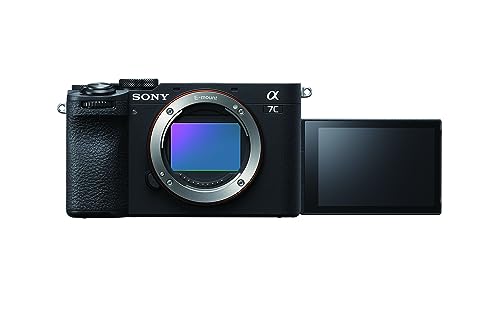
Sony a7C II (Black, Body) — Best compact full-frame for discreet work
Sony’s listing is admirably blunt: Alpha 7C II, full-frame, interchangeable lens camera, black. The concept inside that brevity is the most street-friendly equation in this guide — the largest sensor class here, carried in a body line designed around compactness. Full-frame files give street work its two favourite gifts: subject separation at moderate apertures, so a face lifts cleanly off a busy pavement, and high-sensitivity performance that keeps evening frames usable when smaller sensors would dissolve into grain and mush.
Because this is a body-only purchase, your lens choice writes the camera’s character. A small prime turns the a7C II into a near-compact that rides in a jacket pocket’s neighbourhood; a zoom makes it a versatile travel tool that happens to shoot stills beautifully. That freedom is the point. Street photographers who already know their focal length — and most do, fiercely — can build exactly the one-lens outfit they intend to carry for years.
Working style on the street rewards the a7C II’s rangefinder-ish compactness. It reads as an enthusiast’s camera rather than a professional rig, which softens strangers’ reactions in markets, stations and cafés. Carry it on a wrist strap, keep it in hand rather than buried in a bag, and the camera is ready inside the half-second the genre allows. Paired with a quiet prime, it becomes close to invisible — not by deception, but by ordinariness.
The compromises are the usual compact-body ones: smaller bodies balance best with smaller lenses, and a long day of shooting with a large zoom hung off the front will remind you why the C line exists. Photographers who shoot with gloves through winter, or who simply prefer a substantial grip, should handle one before committing. For everyone else, this is the full-frame street camera that asks the least of your shoulder.
- Sensor: Full-Frame, per listing title
- Lens system: interchangeable lens camera, body only, per listing title
- Colour: Black, per listing title
- Lens included: none — body-only purchase
- Stabilisation detail: Not stated in the listing title — verify with the manufacturer documentation
Strengths
- Full-frame separation and low-light files in a compact body.
- Body-only format lets you build a true one-lens street outfit.
- Understated shape draws less attention in public spaces.
Trade-offs
- No lens in the box, so the real starting cost includes glass.
- Compact grip suits smaller primes better than large zooms.
- Listing keeps specifications brief; confirm details before ordering.
Best for: street photographers who want full-frame quality in the least conspicuous interchangeable-lens package here.
Not suited for: buyers who need a lens included in the purchase to start shooting immediately.

Leica Q3 Compact Camera — Best fixed-lens statement piece
Leica’s listing gives the Q3 three words of description — compact digital camera — plus a model number, 19080, and a colour. That restraint suits a camera whose proposition you either feel immediately or not at all: a premium compact built around one fixed lens, one focal length, one way of seeing the street. The lens cannot be changed, and this guide will not soften that fact. Your framing tools become your feet, your anticipation and your willingness to let some frames go.
Photographers who thrive inside that constraint describe a peculiar freedom. When the focal length never changes, you stop seeing photographs at the scene and start seeing them down the street — pre-composed, waiting for the right stranger to walk into them. Zone focus, set-and-forget exposure and a camera that is always configured the same way turn reaction time into recognition time. The Q3’s compact form supports that discipline: it is a carry-everywhere object, and street photography rewards the camera that is present on the unremarkable Tuesday, not just the planned Saturday.
Ownership economics deserve honesty. A fixed-lens camera concentrates your entire budget into one body-and-lens unit; if your taste in focal length changes, the camera changes, wholesale. Leica ownership also carries the marque’s pricing gravity, and this guide makes no attempt to price the pick — check price on Amazon and weigh it against the interchangeable systems here, which spread the same money across a body and several lenses.
Choose the Q3 if you already know the constraint fits your eye, the way a writer chooses a notebook size. It is the most deliberate camera in this guide: the one that says the photograph was decided by the photographer, not assembled by a zoom ring in the moment.
- Type: compact digital camera, per listing title
- Model: 19080, per listing title
- Colour: Black, per listing title
- Lens: fixed — not interchangeable
- Sensor size: Not stated in the listing title — verify with the manufacturer documentation
Strengths
- One-lens discipline sharpens anticipation and pre-visualisation.
- Compact body encourages genuine everyday carry.
- Body and lens designed as a single matched unit.
Trade-offs
- Fixed lens means framing flexibility comes only from your feet.
- Whole budget concentrates in a single, non-expandable unit.
- Listing states few specifications; research the details first.
Best for: committed one-focal-length shooters who value a compact, design-led camera they will carry daily.
Not suited for: photographers who regularly switch between wide and telephoto views on the same walk.

Fujifilm X100VI (Black) — Best everyday carry for purists
Fujifilm’s listing is the shortest in this guide — X100VI Digital Camera, Black — because the X100 line long ago stopped needing an introduction to street photographers. This sixth generation carries the same founding idea: a fixed-lens compact with an APS-C-class large sensor, classic controls and a leaf-quiet presence, built to be the camera that is simply always with you. The lens does not come off. Everything the camera is, it is through that one window.
The X100 formula endures because it matches how street photographs actually happen. Most are taken within a few steps of where the photographer was already standing, at the distance conversation happens. A fixed moderate-wide lens frames that social distance naturally, and after a month of daily carry your feet learn its edges so completely that composition becomes reflex. Fujifilm’s film simulations add a second, quieter pleasure: photographs that leave the camera with a finished look, which suits shooters who publish quickly and edit reluctantly.
Scarcity and demand have made this line a cultural object, and that fame cuts against discretion slightly — other photographers will recognise it even if your subjects never do. The deeper consideration remains the fixed lens itself. Travel shooters who want one camera for street, landscape and family duty may chafe; street specialists tend to find the limitation is the feature.
Set against the Q3, the X100VI is the same philosophy at a different altitude of price and prestige, with Fujifilm’s colour science as its signature. Set against the interchangeable bodies here, it is a bet that you already know your focal length. If that bet sounds like relief rather than restriction, this is the street camera most owners describe with genuine affection.
- Type: digital camera with fixed lens, per the X100 line’s design and listing title
- Colour: Black, per listing title
- Lens: fixed — not interchangeable
- Sensor size: Not stated in the listing title — verify with the manufacturer documentation
- Stabilisation detail: Not stated in the listing title — verify with the manufacturer documentation
Strengths
- Everyday-carry size that makes daily street practice realistic.
- Fixed lens builds instinctive, reflex-level framing.
- Fujifilm colour looks reward shooters who dislike editing.
Trade-offs
- One focal length must serve every scene you meet.
- Fame makes it recognisable to fellow photographers.
- Listing is minimal; verify the specification in full first.
Best for: daily-carry street purists who want one fixed lens and finished-looking files straight from the camera.
Not suited for: travellers needing one camera to cover wide scenes and distant details on the same trip.

Nikon Z f Mirrorless Camera — Best retro-styled full-frame
Nikon’s listing leads with the two facts that define the Z f: full-frame, and iconic styling. Underneath the heritage dress sits a modern mirrorless stills/video camera in the Z system, sold here as a Nikon USA model. For street photographers, the styling is not nostalgia for its own sake. Bodies in this design language put exposure controls on physical dials, and dials change street behaviour: you set the camera by touch while watching the scene, glancing down only to confirm, so the decisive gesture happens in front of a photographer who never really looked away.
Full-frame capture supplies the files to match the ritual. Shallow depth of field isolates a subject from layered street clutter, and the large sensor’s low-light headroom extends the working day into the blue hour and the sodium-lit evening, when street photographs often turn most atmospheric. The Z mount in front of that sensor opens Nikon’s modern lens catalogue, including the compact primes that keep a retro body feeling balanced rather than front-heavy.
Presence is the Z f’s interesting trade. It is beautiful, and beauty attracts attention: fellow photographers will nod at it, and some subjects will notice it precisely because it looks like a camera from a more deliberate era. Many street shooters count that a fair exchange — a handsome, obviously filmic camera can read as less threatening than a black professional brick, and its old-school manner invites curiosity rather than suspicion.
Video sits in the listing too, stills/video both, which suits the growing number of street photographers who also shoot short observational clips. But the Z f’s heart is stills shot slowly-fast: deliberate settings, instant execution. If that rhythm describes your best days out, this is the full-frame body here shaped most closely around it.
- Sensor: Full-Frame, per listing title
- Type: mirrorless stills/video camera, per listing title
- Design: iconic styling, per listing title
- Model status: Nikon USA Model, per listing title
- Lens included: Not stated in the listing title — verify with the manufacturer documentation
Strengths
- Physical dials keep exposure changes tactile and eyes-up.
- Full-frame files handle dusk and layered scenes gracefully.
- Heritage looks can soften how strangers read the camera.
Trade-offs
- Distinctive styling draws attention from camera enthusiasts.
- Dial-led layout asks film-era habits some shooters lack.
- Confirm whether a lens is bundled before assuming the kit.
Best for: photographers who set exposure by touch and want full-frame quality inside a classic-handling body.
Not suited for: shooters who prefer to bury settings in menus and keep the camera as anonymous as possible.

Canon EOS R8 with RF 24-50mm Lens — Best ready-to-shoot RF kit
Convenience opens this review: the R8 is the only camera in the guide sold with a lens in the listing, Canon’s RF 24-50mm f/4.5-6.3 IS STM. A zoom spanning 24mm to 50mm covers the street photographer’s working range in one ring — wide enough for environmental scenes that place a subject inside a location, long enough for a half-length portrait of a market trader who has agreed to pose. For a photographer entering Canon’s RF system from scratch, the box opens and the walking starts.
The zoom’s modest maximum aperture deserves plain speech. Variable-aperture kit zooms ask the sensor to do the low-light work, and on a large-sensor body that trade is more forgiving than it would be on a small one: raise the sensitivity, accept the lens’s convenience, and keep shooting into the evening. What the zoom returns is flexibility — the ability to answer an unexpected scene across the square without a lens change performed one-handed in a crowd.
Street purists will eventually replace or supplement it with a fast prime, and the R8’s role is to make that a choice rather than a prerequisite. Learn the genre on the zoom, discover which end of its range your photographs cluster at, and let your own archive tell you which prime to buy. That evidence-based path saves the classic beginner’s error of purchasing a celebrated focal length that turns out to suit somebody else’s eye.
As a system entry the kit also hedges your bets. If street work becomes your life, the RF mount grows with you; if it remains one genre among several, the same body and zoom cover travel, family and events without embarrassment. Versatility is unfashionable in street circles, which is exactly why it is worth stating plainly here.
- Lens included: RF 24-50mm f/4.5-6.3 IS STM, per listing title
- Colour: Black, per listing title
- Type: mirrorless camera with lens kit, per listing title
- Sensor size: Not stated in the listing title — verify with the manufacturer documentation
- Stabilisation: IS appears in the bundled lens name, per listing title
Strengths
- Only pick ready to shoot on delivery, lens included.
- 24-50mm range spans the classic street distances.
- Lets your archive, not fashion, choose your first prime.
Trade-offs
- Modest zoom apertures lean on the sensor after dark.
- Zoom convenience can delay learning one focal length deeply.
- Serious street work will likely add a prime lens later.
Best for: photographers entering the RF system who want to start walking and shooting the day the camera arrives.
Not suited for: low-light specialists who need a fast prime’s aperture from the very first evening.

FUJIFILM X-T5 (Black, Body) — Best APS-C resolution and stabilisation
Fujifilm’s X-T5 listing is the most informative in this guide, and its numbers argue that APS-C belongs in a big-sensor conversation: a 40MP APS-C X-Trans CMOS 5 HR BSI sensor, with 7-stop in-body image stabilisation. Forty megapixels on the street means cropping freedom — shoot the scene at the distance courtesy allows, then find the tighter composition inside the frame at home without the file disintegrating. For photographers who exhibit or print, that resolution is not vanity; it is insurance bought at the moment of exposure.
Stabilisation earns its keep in the genre’s favourite light. Dusk streets, neon reflections, interiors of markets and stations — these are places where shutter speeds sag, and seven stops of stabilisation, per the listing, let you keep sensitivity lower and files cleaner while shooting handheld. A stabilised body also steadies every adapted or older lens you mount, which matters to the many street shooters who collect characterful glass.
The X-T5 wears Fujifilm’s dial-led design language, sharing the Z f’s eyes-up virtue in a smaller format. Its APS-C sensor keeps the whole system — body and lenses — more compact than full-frame equivalents at similar reach, a genuine street advantage measured in hours carried rather than grams quoted. Fujifilm’s colour rendering, the house signature, gives files a finished character that reduces editing to selection.
Body-only pricing means the lens budget remains yours to allocate, and the X system offers a deep bench of small primes made for exactly this work. Pair the X-T5 with one fast prime and you have the most resolution-rich, stabilised APS-C street outfit in this guide; pair it with two and you have a travel system that still slips into a small bag.
- Sensor: 40MP APS-C X-Trans CMOS 5 HR BSI, per listing title
- Stabilisation: 7-stop in-body image stabilisation, per listing title
- Type: mirrorless digital camera body, per listing title
- Colour: Black, per listing title
- Lens included: none — body-only purchase
Strengths
- 40MP files allow confident cropping after the moment.
- Strong stabilisation extends handheld shooting into dusk.
- Compact system size suits all-day, every-day carrying.
Trade-offs
- APS-C depth of field separates subjects less than full-frame.
- Body-only purchase still needs a lens budget on top.
- High resolution rewards steady technique and good glass.
Best for: street photographers who crop, print and shoot handheld in low light, and prefer a compact system.
Not suited for: buyers chasing the shallowest possible depth of field at moderate apertures.
How Do the Six Compare on the Street?
| Pick | Sensor per listing | Lens arrangement | Street character |
|---|---|---|---|
| Sony a7C II | Full-frame | Interchangeable, body only | Smallest full-frame presence |
| Leica Q3 | Not stated in the listing title | Fixed lens compact | One-lens discipline, premium design |
| Fujifilm X100VI | Not stated in the listing title | Fixed lens compact | Everyday-carry purist’s choice |
| Nikon Z f | Full-frame | Interchangeable | Dial-led heritage handling |
| Canon EOS R8 kit | Not stated in the listing title | 24-50mm zoom included | Ready-to-shoot versatility |
| Fujifilm X-T5 | 40MP APS-C | Interchangeable, body only | Resolution plus stabilisation |
The table exposes the guide’s real fork: fixed or interchangeable, full-frame or APS-C, dials or screens. None of those axes has a correct side — only the side that matches the photographer you already are on your best days out.
What Does a Big Sensor Actually Change on the Street?
Three things, in descending order of daily importance. First, depth of field: a larger sensor at the same framing and aperture renders backgrounds softer, and the street is nothing but backgrounds — signage, crowds, traffic — competing with your subject. That separation lets a single face hold a frame that would otherwise dissolve into noise. Second, low-light grace: dusk is the genre’s golden hour, and large sensors keep colours honest and shadows detailed at the sensitivity settings dusk demands. Third, tonal smoothness in harsh light, where a face half in sun and half in shade keeps gradation instead of snapping to black and white.
What a big sensor does not change is equally worth engraving. It does not improve your timing, your nerve or your eye for the frame’s edges. It slightly worsens your invisibility, since larger sensors usually mean larger lenses. And it punishes sloppy focus more visibly, because shallow depth of field forgives nothing. The photographers who benefit most are those whose technique already strains against a smaller sensor’s limits; everyone else is buying headroom they may take a year to need.
APS-C narrows the gap more than forum arguments admit. The X-T5’s 40MP sensor and stabilisation, or the X100VI’s carry-everywhere size, deliver files that satisfy most street purposes entirely. Full-frame’s margin shows at the extremes — the darkest alleys, the widest apertures, the largest prints — and whether those extremes are your home territory is a question only your archive can answer.
How Do You Choose Between a Fixed Lens and a System?
Answer with your feet. Fixed-lens shooters compose by walking: the frame is whatever the scene looks like from where their chosen distance stands, and they accept the photographs that distance cannot make. The Q3 and X100VI reward that acceptance with simplicity — no lens decisions, no bag of glass, a camera configured identically every morning. Photographers who pre-visualise, who return to the same corners and wait, tend to flourish inside the constraint.
System shooters compose by selection. A wide prime for the market’s density, a short telephoto for compressing layers across a square, a zoom for travel days when anything might happen — the a7C II, Z f, R8 and X-T5 all serve that temperament. The cost is carried weight and decision friction: every lens in the bag is a question asked at the worst possible moment, which is why experienced system shooters still walk out with one lens mounted and the rest left at home surprisingly often.
A useful test: review your last hundred photographs and count the focal lengths. If one dominates overwhelmingly, a fixed-lens camera is not a limitation but a description of you. If they spread evenly, buy the system and stop apologising for versatility. Your archive is a more honest adviser than any review, including this one.
Which Habits Make Any of These Cameras Disappear?
Discretion is a behaviour before it is a specification. Carry the camera in your hand or across your body, never raising it from a bag like a drawn weapon. Set exposure and focus zone before the scene, so the act of photographing becomes a single small motion instead of a flurry of adjustments. Shoot, lower the camera, and continue what you were doing — most subjects read the photographer’s calm, not the camera’s size.
Body choice supports the behaviour at the margins. Compact forms like the a7C II and X100VI read as hobbyist equipment; the Z f reads as a beautiful old camera; a large body with a large zoom reads as an assignment. None of these readings is deception — they are the ordinary social signals every object sends — and choosing among them is simply choosing which signal your work benefits from.
Respect closes the subject. Some scenes withdraw consent through a look, a gesture, a turned shoulder, and the ethical street photographer honours the withdrawal regardless of what the law permits. The cameras in this guide will take the photograph either way; the reputation you build on your streets, and the access it grants tomorrow, depends on the frames you decline.
How Should You Set the Camera Before the Scene Happens?
Street photography is exposure management performed in advance. Many experienced shooters pick an aperture for the depth of field the scene needs, let shutter speed float above a safe floor, and cap automatic sensitivity at the highest value their sensor keeps clean — a ceiling a large sensor raises considerably. Set this way, the camera becomes a pointing instrument: frame, focus, fire, with no parameter demanding attention at the decisive moment.
Zone focusing remains the genre’s oldest accelerant. Pre-focus at the distance where your subjects will be — the far side of a crossing, the doorway’s pool of light — stop down enough to hold a band of sharpness, and photographs become a matter of timing alone. Large sensors narrow that band at wide apertures, which is why street shooters often stop a full-frame camera down further than pride suggests and let the sensor’s low-light quality pay the difference.
Whatever system you adopt, keep it identical for weeks. Fluency — settings changed by touch, results predicted before review — is what converts a capable camera into an invisible one. The dials of the Z f and X-T5 exist to make that fluency tactile; the compact bodies make it portable; the discipline itself is yours to build.
What Light Should You Hunt, and When?
The street’s best light is directional and low: early morning raking across façades, late afternoon slicing between buildings, and the blue minutes after sunset when signage takes over from the sky. Large sensors widen every one of those windows, holding shadow detail in the morning’s contrast and colour in the evening’s gloom. Plan walks around light rather than locations; the same corner at three hours is three different photographs, two of them forgettable.
Overcast days flatten the street into soft, shadowless description — ideal for colour work, markets and portraits of strangers, less kind to the graphic light-and-shadow compositions that need hard sun. Rain is the connoisseur’s weather: reflections double every light source, umbrellas simplify faces into shapes, and crowds thin to the committed. None of the listings here claims weather sealing, so check manufacturer documentation for your pick’s rating and protect the camera accordingly; a plastic sleeve has saved more rainy masterpieces than any specification.
Night separates the sensors. At full dark the street becomes pools of artificial light in blackness, and the large sensor’s sensitivity range decides whether you photograph the pools’ inhabitants or merely their silhouettes. Both are legitimate photographs; the camera should be chosen for the one you actually intend.
How Do You Build a Street Practice That Lasts?
Repetition is the entire secret. Walk the same route at the same hour until the street stops performing for you and starts confiding: the shopkeeper’s routine, the light’s seasonal drift, the corner where something eventually always happens. A daily-carry camera — the X100VI’s whole thesis — makes that repetition effortless, while a system body rewards the planned expedition. Either way, the practice is measured in months of ordinary walks, not in gear acquired.
Edit cruelly and late. Shoot freely, then wait a week before judging, because the photographer’s memory of the moment flatters frames the image itself cannot support. Keep a small, growing set of the work that survives that cold review; it will teach you your real focal length, your real distances and your real subjects faster than any tutorial. Most photographers discover they photograph three themes obsessively. The discovery is the style.
Share carefully, print occasionally. A printed street photograph exposes everything a screen forgives — focus, tones, the frame’s untidy corner — and printing your best dozen each year will improve your shooting more than the next camera body. These six cameras all produce files that print well at honest sizes; the discipline to print is, again, the photographer’s contribution.
How Close Should You Get, and How Do You Ask Without Asking?
Distance is the street photographer’s grammar. Photographs taken from across the street describe a scene; photographs taken at conversational distance join it. Large-sensor cameras tempt their owners toward distance, because a fast lens and a crop can rescue a far frame, but the rescued frame rarely carries the intimacy that makes a viewer stop. Work closer than comfort suggests, and let the wide end of your courage — not the long end of a zoom — decide the composition.
Consent on the street is a spectrum handled in real time. Much public photography proceeds without explicit permission, sustained by the photographer’s openness: camera visible, intentions obvious, no skulking. When a subject engages — a look, a question, a smile — that engagement is an invitation to be honest about what you are doing, and often to make the portrait properly, with the subject’s collaboration. The cameras here support both modes equally; the photographer’s conduct decides which mode a given afternoon takes.
Practical courtesy scales surprisingly well. A nod after the shutter, a shown screen when someone is curious, a card or contact offered when a portrait lands well — these small repayments keep a neighbourhood friendly across years of return visits. Photographers who work one district long-term are effectively borrowing its life daily, and the ones who repay in prints and patience find doors opening that no lens could buy.
Colour or Black and White: Which Serves Your Streets?
The monochrome tradition in street photography is partly history — film, newspapers, the great archives — and partly discipline: removing colour forces a photograph to survive on light, gesture and geometry alone. Large sensors serve that discipline well, because their tonal range keeps grey scales smooth in the contrasty light where monochrome thrives. Photographers who convert everything for a season usually emerge with sharper eyes for light, whatever they shoot afterwards.
Colour argues back with information. The red coat in the grey crowd, the green grocer’s awning against brick, the exact blue of the hour after sunset — colour is often the subject, not a distraction from it. Fujifilm’s film simulations exist precisely because colour rendering is an aesthetic signature, and the modern street increasingly speaks in colour: signage, screens and clothing design a palette no monochrome conversion should casually discard.
Choose per project rather than per photograph. A series in one treatment coheres; a feed that alternates randomly looks undecided. Many photographers shoot colour files — every camera here does — and convert during editing when a body of work asks for it, keeping the decision reversible and the archive complete. The sensor records; the photographer decides what the record means.
How Do You Work a Single Corner Until It Gives You a Photograph?
The fishing technique inverts the hunting instinct: instead of chasing scenes, you find a stage — a doorway’s shaft of light, a billboard’s backdrop, a crossing’s geometry — set the camera for it, and wait for the cast to arrive. Zone focus and pre-set exposure, the habits described earlier, exist to serve this patience. A fixed-lens camera is the natural fishing instrument, since the stage never needs reframing, but any of the six works once its lens is chosen and left alone.
Choosing the stage is the skill. Look for layered backgrounds that reward a subject’s arrival: foreground shadow, lit middle ground, textured distance. Watch the stage empty for a minute and note what it lacks — usually one figure, correctly placed, in clothing that separates from the backdrop. Then wait without fidgeting, camera ready, attention loose. The wait is the photograph’s real exposure time; the shutter’s fraction of a second is a formality.
Know when to abandon the stage. Light moves, crowds thin, and a corner that promised everything at four o’clock may be empty of meaning by five. Experienced fishers give a stage a honest span — twenty minutes, say — then walk, because the street’s generosity is unevenly distributed and loyalty to a dead corner is just standing still with better branding. The walk itself, camera in hand and settings still set, frequently delivers the photograph the stage withheld.
What Changes When You Travel With Only One Camera?
Travel compresses every decision in this guide. One body, carried all day in unfamiliar light, must cover the dawn market and the midnight bar street. The compact picks — a7C II with a small prime, the X100VI, the Q3 — were practically designed for this constraint, trading flexibility for the certainty of presence. A camera in the hotel safe has a perfect specification and takes no photographs; travel rewards the outfit that never feels like luggage.
Unfamiliar cities also change the social equation. A tourist with a camera is the most ordinary sight in any much-visited place, and that ordinariness is camouflage the home-street photographer does not enjoy. Use it respectfully: the same courtesies apply, doubled where language is shared imperfectly. Learn the local sensitivities — some places guard religious sites, markets or children more strictly than your home streets do — and let a refused photograph go with a smile.
Practical travel discipline finishes the picture: batteries charged nightly, cards backed up to a second device, the camera’s clock set to local time so sequences stay truthful. Large files from large sensors fill cards faster than holiday habits expect, and the X-T5’s resolution in particular rewards a deliberate card routine. None of this is glamorous; all of it is the difference between an archive and a anecdote about the photographs that were lost.
How Should You Judge Your Own Street Photographs?
Apply the stranger test: would this frame hold someone who was not there, who owes the moment nothing? Sentiment inflates photographs of places we loved and people we found charming; the image must survive without the memory’s subsidy. Frames that pass usually contain a relationship — between figures, between a figure and the light, between foreground and distance — that a viewer can discover rather than be told about.
Judge the edges as harshly as the centre. Street photographs die at their borders: the half-person entering pointlessly, the sign fragmenting into nonsense letters, the bright distraction pulling the eye out of the frame. Large sensors and wide apertures can blur some sins away, but composition is decided at the moment of exposure, and the habit of one final border-check before the shutter is worth more than any lens in this guide.
Finally, judge in bodies of work. A single strong frame proves luck or talent ambiguously; twelve frames that speak to each other prove a way of seeing. The cameras here are instruments for building such bodies of work over years, and the wisest purchase is the one whose handling disappears fastest into your habits, leaving only the seeing behind.
Which Accessories Earn Their Place in a Street Bag?
Almost none, and that restraint is the point. A wrist strap or a simple neck strap, one spare battery, one spare card and a lens cloth cover the genuine needs of a day’s street work. Everything beyond that list must argue for its weight against the photographs that tired shoulders and slow access will cost. Street photography’s equipment failures are rarely technical; they are failures of presence, caused by a camera buried under accessories in a bag that takes ten seconds to open.
The exceptions prove their worth in specific conditions. A small, fast prime is an accessory that transforms a system body — the a7C II, Z f and X-T5 all become different cameras with one mounted — and it is the single upgrade this guide endorses without hesitation. A compact rain cover or even a clear shower cap protects a body whose listing promises no weather rating, and a soft-release or grip accessory can steady a compact body for hands that find it small. Beyond that short list, spend on shoes, film-stock-like presets if you love them, and the coffee that keeps a fishing vigil pleasant.
Phones deserve a footnote: they are the street camera everyone already carries, and their photographs have won their place in the genre’s present. What the six cameras here offer beyond the phone is control — depth of field, tactile settings, viewfinders, files that print large — and for photographers who feel the phone’s automation making their decisions, that control is the entire purchase. The honest comparison is never sensor against sensor; it is intention against convenience.
How Does the Viewfinder Change the Photograph?
Shooting through a viewfinder and shooting from a screen are different physical acts that produce different photographs. The viewfinder excludes the world outside the frame, steadies the camera against the face and signals unmistakably to subjects that a photograph is being taken. The screen includes the surroundings, allows waist-level and overhead angles, and reads as casual — closer to checking a message than making a portrait. Skilled street photographers use both deliberately, choosing the act that fits the scene’s social temperature.
Hybrid designs and tilting screens among modern bodies — check your pick’s manufacturer documentation for its exact arrangement — let a photographer compose at waist level in the manner of the old twin-lens cameras, an angle that flatters subjects and lowers the photographer’s profile simultaneously. The waist-level view also changes composition itself: foregrounds grow, skies shrink, and the street’s ground plane — puddles, shadows, painted markings — enters the frame’s design.
Whichever you favour, practise until the choice is instant. The scene that needs the discreet screen will not wait while you unfold it, and the scene that needs the viewfinder’s concentration punishes the photographer’s distraction equally. Fluency, once more, is the real feature; the hardware in this guide merely offers two dialects of it, and your fluency in either will matter more than which body delivered it.
What Should Your First Month With the Camera Look Like?
Give the camera one job at a time. Week one is for carrying it everywhere and changing nothing: factory settings, the kit lens or fixed lens as it stands, photographs of whatever the day offers. The point is not the photographs; it is the thousand small frictions — the dial that turns the wrong way in your hand, the menu you cannot find at dusk — revealing themselves while the stakes are low. Note them literally, in the notebook or phone you also carry, because week two exists to fix exactly those frictions and no others.
Weeks three and four narrow the experiment. Choose one neighbourhood and one hour, and work only there, only then. The narrowing feels like deprivation and functions like tuition: with place and light held constant, the only variable left is you, and your progress becomes visible in the contact sheets week over week. By the month’s end you will know whether the camera has disappeared into your habits — the true test of any street tool — and precisely which single accessory, usually a prime lens or a better strap, the work is actually asking for. Buy that, and nothing else, and begin the second month.
Common Mistakes
Buying the largest sensor and the largest lens, then leaving the combination at home because the walk felt like an expedition, is the genre’s defining error — the carried camera always wins. Chasing strangers with a telephoto from a fixed bench produces photographs that look hunted, because they were; the genre’s life is at conversational distance. Reviewing every frame on the rear screen after shooting surrenders the next three scenes, which arrived while your eyes were down.
Two quieter mistakes deserve mention. Shooting everything at the widest aperture because the lens allows it dissolves the street itself — the context that makes the subject mean something — into coloured fog. And imitating a famous photographer’s exact kit and corners produces competent copies of a life you are not living; your own streets, walked daily, hold better photographs than their landmarks visited once.
Final Recommendation
Let your archive and your temperament arbitrate. The Sony a7C II is the full-frame answer for photographers who prize discretion and already own — or plan to own — one small prime. The Leica Q3 and Fujifilm X100VI serve the fixed-lens faithful, the Leica as the premium design object, the Fujifilm as the beloved everyday carry. Nikon’s Z f is the dial-lover’s full-frame, Canon’s R8 kit the pragmatic entry that shoots on day one, and Fujifilm’s X-T5 the APS-C overachiever whose resolution and stabilisation close most of the gap its sensor size opens.
If a decision must be forced: daily walkers take the X100VI, system builders take the a7C II or X-T5 by sensor preference, romantics take the Z f, design devotees take the Q3, and pragmatists take the R8 kit home tonight and start walking before dinner, while the light is still deciding what it wants to be.
Frequently Asked Questions
Is full-frame really necessary for street photography?
No — it is advantageous, not necessary. Full-frame bodies here (a7C II, Z f) offer shallower depth of field and stronger low-light files, while the APS-C X-T5 counters with 40MP resolution, stabilisation and a smaller system. Great street archives exist on every format. What matters is that the sensor be large enough for the light you actually shoot in: a photographer who works bright mornings will feel no deficit in APS-C, while a photographer devoted to night markets and unlit side streets will feel full-frame’s headroom every single outing. Match the sensor to your hours, not to a hierarchy.
Why would anyone buy a camera whose lens cannot be changed?
Because the constraint simplifies everything: one focal length learned to reflex level, no lens decisions in the moment, and a compact camera that gets carried daily. The Q3 and X100VI exist for photographers who find that freedom inside the limit. There is also a compositional dividend: when the frame never changes, you begin composing before you arrive, seeing the fixed rectangle laid over the street as you walk, so photographs are recognised rather than constructed. Photographers who have lived with a fixed lens for a year rarely describe it as the camera with fewer options; they describe it as the camera that finally stopped interrupting them.
Which of these is the most discreet?
The compact bodies — a7C II and X100VI — read least like professional equipment, and behaviour matters more than hardware: a camera carried calmly in hand draws less attention than a small camera raised suddenly from a bag. Dress and pace play their part too; the photographer who matches the street’s rhythm, waits at crossings and lingers like a local becomes part of the scenery in a way no camera specification can arrange, and that belonging is the deepest discretion of all.
Does stabilisation matter for street work?
At dusk and indoors, yes. The X-T5’s 7-stop in-body stabilisation, per its listing, keeps handheld shutter speeds usable in the low light where street photographs turn atmospheric, without pushing sensitivity as far. Remember its limit: stabilisation stills the camera, not the subject, so a walking crowd will blur at slow speeds no matter how steady the body — sometimes a gift, sometimes a flaw.
What lens should a system buyer choose first?
Let your existing photographs answer: the focal length you already favour, in the fastest compact prime your budget allows. The R8’s bundled 24-50mm zoom is a sensible instrument for discovering that answer before spending on primes. Resist buying two primes at once; one lens, used for a full season, teaches more about your eye than a bag of options used in rotation, and the second purchase — when the season ends — will be made with evidence instead of hope.
Related Guides
Keep exploring by subject: begin with entry-level cameras for portraits when the strangers become sitters, hand the youngest walkers point and shoot cameras for kids so they can start their own archive, and take the long view with cameras to take hiking when the street becomes a trail.


