Our Top Picks


What's inside
- Three families that should never be confused
- Bands and rules: FRS, GMRS, and PMR446
- Range: the advertised number and the usable number
- Channels and privacy codes: organisation, not secrecy
- Transmit power in a wrist sized device
- Battery life, standby time, and charging reality
- Durability: water ratings, case size, and straps
- Useful extra features and decorative ones
- Real uses, described honestly
- The GMRS licence question in plain language
- Buying mistakes that repeat every season
- Teaching a group to use radio well
- How to judge a specification sheet in ten minutes
- Care, storage, and keeping a small fleet alive
- Environmental cost and buying once
- Check prices on Amazon
- Final judgement for wrist worn radio
As an Amazon Associate I earn from qualifying purchases. This post may contain affiliate links at no extra cost to you.
For this guide to two way radio watches, the disclosure that belongs to this topic alone comes first, written plainly for families, event crews, and outdoor groups comparing wrist worn radios. As an Amazon Associate, this site earns from qualifying purchases. The analysis below draws on published specifications, regulator guidance, and manufacturer manuals, and it separates documented radio behaviour from the optimistic range figures printed on retail packaging.
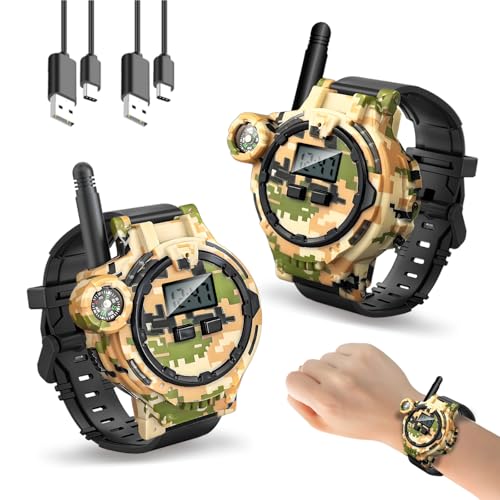
A walkie talkie watch is a two way radio built into a wrist worn case. Press a push to talk button, speak, release the button, and listen for a reply on the same channel. That simple exchange hides a surprising amount of regulation and physics. The radio band it uses decides whether a licence is needed. Its transmit power, antenna size, and surroundings decide how far a voice actually travels. Its case size decides whether a child can wear it for a whole afternoon or an adult can operate its buttons while wearing gloves.
Confusion starts with the name itself, because three different product families borrow similar language. A true radio watch contains its own transmitter and receiver and can talk directly to a compatible unit with no phone, no network, and no subscription. A smartwatch may offer a walkie talkie style app that sends voice through a paired phone and a data network. A children location watch may offer voice calls through a cellular connection and a parent app. Those three designs solve different problems, fail in different places, and carry different ongoing costs, so the first task is to decide which family a listing actually belongs to.
Three families that should never be confused
The direct radio watch works peer to peer. Two units on the same channel and the same privacy code hear each other within radio range, whether or not any mobile network exists at the campsite or ski slope. That independence is its great strength for family groups moving around a defined area. Its great limit is also clear: once terrain, buildings, or distance break the radio path, there is no network to carry the message further, and no store and forward system to deliver it later.
A smartwatch voice app behaves more like a short voice message or a live call routed through servers and a phone connection. It can span continents when the network cooperates, which a wrist radio cannot do. It also depends on accounts, compatible devices, charged phones, and coverage. On a mountain with no signal, the app offers nothing, while a pair of radio watches on a shared channel can still exchange a call about lunch or a meeting point. Readers weighing that connected route can compare the broader category through best gps smartwatches, where satellite positioning and phone linked features receive separate attention.
A children location watch centres on a parent knowing where a child is, usually through cellular positioning and an app, with voice calls to approved contacts. That is a safeguarding tool with a subscription and a network dependency, not a group radio. It does not let a whole scout group share a channel, and its battery budget is spent heavily on location reporting. Buying one in the expectation of open channel group talk leads to disappointment, just as buying a radio watch in the expectation of location tracking does. The radio watch has no inherent knowledge of where its wearer stands.
Why the distinction matters for cost and privacy
Direct radio carries no per message charge and needs no account, but anyone else on the same channel and code within range can listen. A network watch service routes communication through accounts and approved contacts, which changes both privacy and setup. For a warehouse team coordinating within one building, open channel radio is efficient and every member hears the same instruction at once. For a child contacting a parent privately, an approved contact model fits better. The technology choice follows the social shape of the group, not just the shape of the device.
Emergency expectations also diverge. A radio watch can call only the people tuned to its channel who happen to be in range. It is not a substitute for a phone in a genuine emergency where outside help is needed, and it carries no automatic location beacon unless a specific model documents such a feature. A cellular watch may reach a parent far away but fails without coverage. Sensible families carry the communication tool that matches the place: radio for the group on site, phone coverage checked in advance for anything beyond the group.
Bands and rules: FRS, GMRS, and PMR446
In the United States, most consumer wrist radios operate in the Family Radio Service, called FRS, or the General Mobile Radio Service, called GMRS. FRS is licence free for personal use under the rules of the Federal Communications Commission, with equipment that must be certified for the service, use a fixed antenna, and stay within the power limits for the channel in use. GMRS shares some channels with FRS but permits higher power and other advantages, and it requires a licence. That licence covers the holder and immediate family members under the current United States arrangement, lasts for a defined term, and involves an application through the regulator rather than a test.
In much of Europe, the comparable licence free system is PMR446. It uses frequencies around 446 megahertz, a transmit power limit of half a watt, fixed antennas, and a defined channel plan that has expanded from the original analogue channels to include more channels and digital modes in some markets. The key point for buyers is regional: a radio built and certified for the United States band plan is not legal to operate as a licence free radio in Europe, and a PMR446 radio is not an FRS radio. The frequencies differ, the channel numbering differs, and the rules travel with the place of use, not with the passport of the owner.
This regional split is the most expensive mistake in the category. A family that buys attractive wrist radios while travelling and brings them home may own devices they cannot lawfully use in their home country. A group that mixes radios bought in different regions will find that the channel numbers do not line up and the units cannot hear each other at all, even when the cases look identical. The band and region should be the first line checked in any listing, before colour, battery claims, or the number of extra features in the box.
Power limits that depend on the channel
Under the current United States rules, FRS channels carry different maximum power depending on the channel group. The main channels permit up to two watts effective radiated power, while the narrower interstitial channels are limited to half a watt. A specification sheet that simply prints a single power figure may be quoting the highest channel figure, while everyday use on a low power channel runs at a quarter of that output. GMRS handheld equipment can be permitted higher power on its main channels, subject to the licence and the equipment authorisation, although wrist worn designs rarely exploit high power because battery size and heat set tighter practical limits.
PMR446 holds its half watt limit across its plan. That figure sounds small beside a two watt claim, yet real range depends on far more than the transmitter alone. Antenna efficiency on a wrist worn device is modest in every region, because the antenna must fit inside or around a small case and it operates close to the human body, which absorbs radio energy. A well designed half watt PMR446 watch on open ground can give a perfectly serviceable family range, while a poorly designed higher power unit inside a concrete building can fail between floors.
Range: the advertised number and the usable number
Retail packaging for consumer radios often advertises ranges measured in tens of miles or kilometres. Those figures describe ideal conditions: elevated ground, clear line of sight, no buildings, no dense forest, and sometimes a path over water. They are not fabricated from nothing, but they describe a mountaintop conversation, not a conversation between two children in different parts of a shopping district. Radio waves at these ultra high frequencies travel mostly in straight lines and are blocked or weakened by terrain, metal structures, reinforced concrete, and even thick wet foliage.
A realistic planning picture looks different. In a dense city, a wrist radio may manage only a few streets, sometimes less than a kilometre, because every building interrupts the path and electrical noise competes with weak signals. In suburbs and open parkland, one to three kilometres is a more plausible working expectation for many consumer units, varying with elevation and clutter. Across a lake, over a ridge to ridge path, or down a ski slope with clear sight lines, much longer contacts are possible. The honest unit of range is therefore the environment, not the box.
Height helps more than almost any other variable. Raising a radio from waist level to a hilltop can transform its reach because the path clears obstacles. A wearer standing on a campsite rise may talk to the whole valley, while the same wearer in a dip behind a ridge reaches nobody. Groups should agree on this behaviour in advance, so a lost contact is understood as a geometry problem rather than a broken device. Moving to higher or more open ground is the first remedy when a call fails, ahead of shouting into the microphone, which only distorts the transmitted audio.
Antennas, bodies, and why wrist radios start with a handicap
A full size handheld radio can carry a longer antenna matched to its band. A watch cannot. Its antenna is short, folded into a compact case, and held against a wrist that detunes and absorbs it. Manufacturers work within those limits, and modern receiver design is sensitive enough to make wrist radios genuinely useful, but no circuit removes the physics. Expect a wrist radio to underperform a good handheld radio of similar power in difficult terrain, and expect it to shine where convenience keeps it worn and ready while a handheld sits forgotten in a backpack.
Orientation matters a little as well. A wrist held naturally at the side places the antenna close to the body and low to the ground. Raising the wrist to speak, which the microphone position encourages anyway, lifts the antenna and improves the path. Metal watch straps, nearby vehicles, and steel framed buildings all perturb the signal in ways a specification sheet cannot capture. Field expectations should therefore be set by a short trial in the actual place of use, walking the routes the group will really cover and noting the dead spots before the day depends on contact.
Channels and privacy codes: organisation, not secrecy
FRS and GMRS radios in the United States offer a channel plan that consumer devices commonly present as twenty two channels, with some models adding further GMRS repeater related options that wrist designs seldom include. PMR446 devices present their own channel count under that plan. More channels help groups avoid a busy frequency at a crowded event, yet the total pool is shared with every other radio user in the area. A channel is a public room, not a private line.
Privacy codes refine that room. CTCSS uses a low frequency tone sent with the voice; DCS uses a digital code. A radio set to a code will keep its speaker quiet until it hears a transmission carrying the matching code, which filters out other groups sharing the channel. The word privacy misleads many buyers. The code does not encrypt anything and does not stop anyone from hearing the conversation. A radio with no code set, or set to scan, can receive every transmission on the channel. Codes organise listening; they do not create secrecy, and sensitive information should never be spoken on these services with privacy in mind.
Groups should choose a main channel and code, agree a fallback channel in case the first is crowded or unusable, and write both down somewhere that does not depend on the radios themselves. Children should learn that changing the channel for fun cuts them off from the group as completely as walking away. Many models offer a channel lock for exactly that reason, and locking the settings after a morning check prevents the small accidental button presses that fragment a group across different codes by lunchtime.
When two brands refuse to agree
Compatibility across brands is generally good when the band, channel, and code all match, because the services rest on shared technical standards. The friction lies in numbering. One maker may label a code by a number that another maker assigns differently, especially where CTCSS tones and DCS codes are combined into a single long list. Documentation from both makers may be needed to align a mixed fleet. A short compatibility check at home, with every unit in the group, is worth more than an assumption made from matching channel numbers on the dial.
Digital PMR446 variants add another layer. A digital radio and an analogue radio on a similar frequency cannot understand each other unless the digital unit also supports the analogue mode. Fleets that mix generations of equipment should confirm mode compatibility explicitly. For most family buyers, staying within one mode and one regional system keeps life simple, and simplicity is a feature in a device meant to be operated by a tired child in gloves at dusk.
Transmit power in a wrist sized device
Consumer wrist radios typically transmit between half a watt and two watts, depending on region, channel, and design. That range reflects a deliberate compromise. Higher power extends reach under some conditions and drains the battery far faster, generates more heat in a case worn against skin, and still cannot overcome a hill in the way. Lower power preserves battery and remains adequate for the short distances where wrist radios are actually used: a family spread across a campsite, skiers regrouping on one slope, marshals along a short event course.
Doubling power does not double range. Radio path loss grows steeply with distance, so a step from half a watt to two watts, a fourfold rise, buys a useful but modest extension in open conditions and even less where buildings dominate. Receiver sensitivity, antenna efficiency, and the noise floor of the environment often matter as much as the headline wattage. A specification sheet that leads with power while saying nothing about battery capacity, receiver performance, or water resistance is telling the least important part of the story in the largest type.
Duty cycle completes the picture. A radio spends most of a day receiving or standing by, and only brief moments transmitting, yet those moments draw the heaviest current. A group that talks constantly, perhaps an event team coordinating a gate, will exhaust a small wrist battery far sooner than a family exchanging a dozen short calls. Published talk time figures rest on assumed ratios of standby, reception, and transmission, and those ratios rarely match a busy working day. Planning should use the published figures as an upper guide and carry a charging plan for heavy use.
Battery life, standby time, and charging reality
Battery claims in this category mix three different numbers that should be read separately. Standby time describes how long the radio can sit switched on, listening quietly with the screen mostly asleep. Receive time adds the cost of powering the speaker for incoming calls. Talk time is the most demanding, with the transmitter running. A claim of several days almost always refers to standby under favourable settings, not to several days of active conversation. The manual for a specific model should state the test ratio behind its figures, and a listing that quotes only the largest number is withholding the useful part.
Cell size inside a watch case is small, so energy management shapes the whole design. A louder speaker, a brighter colour screen, a torch, and frequent channel scanning all draw from the same small reserve. Features that seem free in a feature list are paid for in hours. Buyers for multi day camping should value a model that sips power with its display off and wakes reliably on an incoming call over a model with a vivid screen that needs a cable every night.
USB charging has become the common arrangement, which suits travel because the same power bank that serves a phone can serve the radios. The details still vary. Some models charge through a common USB connector on the case, some through a small cradle, and some through a proprietary clip that is easy to lose and hard to replace on a trip. A cradle also creates a single point of failure for a whole set if only one is packed. Checking the charging method, and whether the connector cover preserves the water resistance rating after repeated use, belongs on the shortlist for any group heading outdoors.
Cold weather, spare units, and charging discipline
Lithium cells lose effective capacity in cold conditions, and a ski group will feel that loss by afternoon. Keeping a spare radio warm inside a jacket, rotating units, or topping up charge during a lodge break all help. Heat has the opposite problem: a radio left on a sunny dashboard ages its battery and can become uncomfortable to wear. None of this is unique to radio watches, but the small cell leaves less margin for abuse than the large pack in a full size handheld.
Charging discipline decides reliability more than chemistry does. A set of radios that returns to the same charging point every night, with one person responsible for confirming every unit shows a charging indication, will be ready each morning. A set scattered across tents and pockets will not. Event teams learn this quickly and appoint a radio keeper. Families heading to a festival can borrow the habit with very little effort: one bag, one cable set, one evening routine, and a morning channel check before anyone disperses.
Durability: water ratings, case size, and straps
Water resistance in this category is usually described with an IP code. The second digit describes liquid protection. A rating around IPX4 indicates resistance to splashing water from any direction, enough for rain during a walk. Higher figures indicate stronger protection, with IPX7 describing temporary immersion under defined test conditions. Dust protection is the first digit when present, and a full code such as IP67 describes a dust tight case with immersion resistance under its test terms. These are laboratory definitions with limits on depth, duration, and water movement, not a promise that a device will survive a swim, a hot shower, or a fall into a stream against rocks.
Buttons complicate water resistance. Pressing a push to talk button while the case is wet, or opening a charging cover with damp hands, can admit moisture that a sealed case would otherwise exclude. After wet use, drying the case and checking the covers before charging is a habit worth teaching every wearer, especially children who will treat the watch as indestructible because it survived one rainy afternoon.
Impact resistance is less standardised. Some models are built as rugged outdoor tools with thick cases and recessed screens; others are light toys with thin shells that crack when dropped on pavement. The intended wearer decides how much that matters. A radio for a warehouse team that climbs ladders needs a tougher case than a radio for a grandparent gardening within sight of the house, and the price difference between those designs reflects materials as much as radio performance.
Fit for children and adults is not the same problem
A child wrist is narrow, and a case that suits an adult can overhang a small wrist, catch on clothing, and rotate so the microphone points at the ground. Case width, lug to lug length, thickness, and total weight should be compared with the wearer, not with a photograph beside a coin. Strap material matters through a long day: soft silicone tolerates sweat and rain, while fabric straps can stay damp and chafe after wet weather. A strap with enough holes or adjustment range for the smallest wrist in the group prevents the radio ending the day carried in a hand, where it is soon set down and lost.
Adult fit brings different concerns. A worker wearing gloves needs a push to talk button that can be found by touch and pressed without looking, with enough resistance to avoid accidental transmission in a pocket or against a seat belt. A skier needs the same under thicker gloves. Screen legibility in bright sun, button spacing, and the ability to lock the keypad all matter more in those settings than a long list of novelty tones. Shoppers comparing wrist worn tech more broadly will find fit and strap reasoning in best affordable smartwatches that transfers well, even though the radio models here have no app ecosystem to consider.
Hearing the radio is part of fit too. A small speaker pressed against a sleeve delivers little volume. Wearing the watch outside a cuff in noisy settings, choosing a model with a documented speaker output, or pairing a compatible earpiece where the design allows one can decide whether calls are understood at a fairground or beside a busy road. Volume claims should be treated cautiously unless the maker states a measurement method, but maximum volume in a quiet shop tells almost nothing about intelligibility in wind.
Useful extra features and decorative ones
VOX, or voice activated transmission, lets the radio send when the wearer speaks, without a button press. It serves cyclists, climbers belaying a partner, warehouse staff holding boxes, and parents carrying a child. It also misfires. Wind, traffic, laughter, and a nearby conversation can open the transmitter, broadcasting sound the wearer never intended to share and blocking the channel for others. A VOX sensitivity setting and a headset microphone improve matters. For most groups, VOX is a specialist tool to enable deliberately, not a default to leave running.
A small torch built into the case earns its place at campsites, where finding a tent zip or a path marker without a free hand is a genuine need. An SOS function needs closer reading: on a direct radio it usually means an alarm tone sent on the current channel to the group, not a call to emergency services. That can still be valuable, since a child who cannot explain a problem can at least summon the group loudly, but adults should understand exactly what the button does on the model in hand and teach its use without overstating its reach.
Channel scan helps a group find activity or check whether a fallback channel is clear. Call tones help attract attention before speech. A vibrate alert helps in quiet theatres backstage or in a library event where a loud speaker would disturb others. A keypad lock, already mentioned, prevents pocket changes. Weather band reception appears on some United States models and can be genuinely useful outdoors, while games, step counters, and novelty voice changers add cost and battery drain without improving the radio. The feature list should be read as a budget: every addition spends money, case space, and energy that could have gone to the receiver, the speaker, or the cell.
Earpieces, headsets, and shared channels at work
Some radio watches accept a wired earpiece or a small headset, which improves privacy of listening in public and clarity in noise, though the transmitted voice remains audible to anyone monitoring the channel with the code. For event staff, an earpiece also keeps instructions discreet in front of an audience. Cable routing under clothing, strain relief at the connector, and whether the earpiece disables the case speaker should be checked in the manual. Wireless earpiece support is uncommon in this category and should never be assumed from a smartwatch comparison.
Readers whose interest is actually in listening rather than two way radio may be better served by the category at best am fm radio headphones, which covers receive only headsets for work and leisure and avoids the licensing and channel questions entirely.
Real uses, described honestly
Families camping and walking
A family spread between tents, a camp shop, and a lakeside path is close to the ideal case for wrist radios. Distances are short, terrain is partly open, and the group shares one plan. Children gain a sense of independence without a phone, parents gain a direct call that does not depend on campsite coverage, and everyone hears the same message about dinner or a meeting point. The limits appear when part of the group walks behind a ridge or into a deep wooded valley, so the family should agree a physical meeting point and a time as a backup that does not rely on radio contact at all.
Ski groups and mountain days
Skiing separates groups quickly, and phones are awkward with gloves, cold batteries, and patchy resort coverage. A wrist radio on a locked channel lets a group regroup at a lift, warn about a closed run, or confirm which restaurant has been chosen. Slopes can also help radio, because a downhill path often has clear sight lines. The reverse is true between valleys: a ridge between two wearers can block contact completely, even when the map distance looks small. Resorts in different countries also sit under different radio rules, so a set bought for home use may not be the set to pack for a trip abroad.
Event teams, schools, and small venues
For marshals, backstage crews, car park teams, and school fair organisers, the value of radio is that one message reaches every listener at once. A wrist format suits people whose hands are busy and who move constantly within a compact site. The constraints are channel congestion and discipline. At a large public event, many groups share the same licence free channels, privacy codes only filter what a team hears, and a busy channel can delay an urgent call. Teams with safeguarding or safety critical duties should assess whether licence free consumer equipment is appropriate at all, or whether a licensed business radio system with assigned frequencies is the responsible choice.
Warehouses, workshops, and yards
Small warehouses and yards present hard radio conditions: metal racking, vehicles, and machinery reflect and absorb signals, creating pockets of poor coverage inside a modest building. Wrist radios can still serve a picking team or a yard pair working within sight of the same structure, and their convenience encourages staff to keep them on. A coverage walk before adoption is essential, including the cold store, the loading bay, and the far corner behind the racking. Where coverage fails, a different system, perhaps a network based one indoors, may serve better than a stronger licence free radio fighting the same metal.
Outdoor workers comparing connected wearables for shift use may also look at best multisport smartwatches for the training and durability side of wrist devices, while remembering that a sports watch without a radio cannot replace channel based group communication.
The GMRS licence question in plain language
Buyers in the United States sometimes avoid GMRS because the word licence sounds like an examination. Under the current arrangement it is an application and fee process through the Federal Communications Commission, with a licence term of ten years, and it covers the licensee and immediate family members for personal GMRS use. It does not cover friends, employees, or an event team as a group; each of those situations needs its own analysis under the rules. Because regulations and fees can change, the regulator current guidance is the source to check before relying on any summary, including this one.
Many wrist radios are sold as FRS equipment precisely because FRS avoids that step. Others are GMRS capable, and using their GMRS only functions, higher power settings, or repeater features without a licence is not made lawful by owning the hardware. Listings do not always make the boundary obvious. A buyer should identify the service the device is authorised for, which channels and power levels belong to which service, and whether the household is willing to hold the licence before paying for capability that depends on it.
Outside the United States, the licence question changes completely. PMR446 is licence free within its rules in the regions that adopt it, while other countries run their own personal radio services with their own bands. There is no worldwide consumer radio band for this product class. A device that is legal somewhere is not legal everywhere, and enforcement aside, the practical failure is simpler: radios from different systems cannot talk to each other.
Buying mistakes that repeat every season
The first repeat mistake is believing the box range and planning a city day around it. The second is mixing regions: FRS or GMRS units on one side of an ocean, PMR446 units on the other, and a group that discovers the mismatch at the meeting point. The third is treating privacy codes as secrecy and speaking accordingly. The fourth is buying the smallest, cutest case for a child without checking whether the strap closes on a small wrist or whether the buttons are too stiff for small fingers.
Further mistakes are quieter. A set with a proprietary charging clip gets separated from its only clip. A model with no channel lock drifts to another code in a pocket. A VOX feature left on broadcasts a family argument to the whole campsite channel. A torch that shares the talk button confuses a child in the dark. A water rating earned in a laboratory gets trusted in a swimming pool. Every one of these failures is visible in the documentation before purchase, which is why manuals and full specification sheets deserve more attention than the feature icons on a carton.
Price tier mistakes run in both directions. The cheapest sets often cut the receiver, speaker, and case quality, so their usable range and clarity fall well short of better sets on the same legal power. The most expensive sets sometimes spend the difference on screens and novelty features rather than radio fundamentals. The middle of the market, from makers who publish complete radio specifications, regional certification, battery test conditions, and a clear manual, is usually where the dependable value sits.
A short pre purchase checklist
- Confirm the regional system first: FRS or GMRS for the United States, PMR446 for the relevant European markets, and never plan to mix them.
- Decide whether a GMRS licence is needed for the features being paid for, and confirm current rules with the regulator.
- Translate the advertised range into the actual environment: city blocks, woodland, open slope, or warehouse, and set expectations accordingly.
- Check transmit power by channel where the maker publishes it, and read battery figures with their standby, receive, and transmit ratio.
- Match channel counts and privacy code numbering across every brand in the group, then plan a home compatibility check.
- Compare case width, thickness, weight, and strap adjustment range with the smallest and largest wrists in the group.
- Read the IP rating digits and their limits, and check how charging covers and buttons affect real wet weather use.
- Confirm the charging method, pack spare cables or cradles, and decide who owns the nightly charging routine.
- Choose deliberate extras: VOX for genuine hands free need, a torch for camp use, an SOS tone whose exact behaviour is understood, and a channel lock for children.
- Agree a main channel, a fallback channel, and a non radio meeting plan before the first outing depends on contact.
Teaching a group to use radio well
Good equipment fails in undisciplined hands. A short group briefing before the first outing pays for itself within hours. Each wearer should know how to check the channel and code, how to lock and unlock the controls, and how to make a call: press, pause briefly so the first word is not clipped, speak across the microphone at a normal level, state who is calling and who is called, then release and wait. Overlapping transmissions on a shared channel produce nothing useful for anyone, so a reply should wait for a clear gap.
Children learn radio manners quickly when they are framed as part of the adventure. Short messages, listening before speaking, and keeping the channel free for adults coordinating something urgent are habits that make the whole group safer. A family call sign or simple first names reduce confusion when several groups share a campsite channel, and an agreed word for a genuine problem, distinct from everyday chat, helps an adult listener judge urgency in a single sentence.
Adults need one extra rule: never treat the radio as proof of safety. A successful call at nine in the morning says nothing about coverage in the valley the group enters at noon. Check in times, physical meeting points, and a written note of the plan left with someone outside the group remain the foundation. The radio is a convenience layered on top of that foundation, and the day it fails, the foundation is what brings everyone back together.
Sound quality and speaking technique
Most disappointment with small radios is really disappointment with audio technique. Shouting raises distortion without adding useful signal. Holding the watch too far away lets wind and crowd noise swamp the voice, while pressing it against the mouth blocks the microphone opening on many designs. A distance of a few centimetres, a normal speaking voice, and short sentences with the key fact repeated once will beat volume every time. Numbers deserve special care: a time, a gate number, or a channel number should be said slowly and confirmed by the listener repeating it back.
Incoming audio improves with similar attention. Turning the wrist so the speaker faces the ear, stepping out of wind or away from a road for the length of a call, and asking the sender to repeat rather than guessing all preserve accuracy. In a noisy warehouse, an earpiece may be the difference between a useful system and an abandoned one. None of these techniques appears on a specification sheet, yet together they can matter more than a modest difference in transmit power between two models.
How to judge a specification sheet in ten minutes
A complete listing or manual should answer a fixed set of questions without detective work. Which regional service and band does the radio use, and what certification supports that claim. How many channels are offered, and which privacy code systems are supported, with a code table available. What is the transmit power, and does it vary by channel. What battery capacity is fitted, what do the endurance figures assume, and how does the unit charge. What are the case dimensions, weight, strap range, and IP rating. Which features are present, stated plainly enough that an SOS function or a VOX mode can be understood before purchase.
Gaps in that list are information. A maker who will not state the band plan clearly may be selling grey import stock intended for another region. A maker who quotes range without any conditions and power without a channel reference is marketing rather than documenting. A maker who publishes a proper manual, a code compatibility table, and spare strap or charging accessory availability is signalling that the product is meant to be kept and used in a fleet, which is exactly the life a group radio leads.
Longevity matters because groups expand. A family that buys two units this year may want two more next year, and an event team may replace one damaged unit. Choosing a model from a range that remains available, with stable channel and code numbering, protects that future purchase. An obscure discontinued set can strand its owners with radios that no new unit can join cleanly, at least not without a careful code translation exercise.
Care, storage, and keeping a small fleet alive
A radio watch leads a harder life than most wrist devices. It is worn in rain, dropped on trails, left in hot cars, and handed to children whose idea of care is still developing. A few habits extend its service considerably. Rinse salt and mud away only in the manner the manual permits, dry the case before charging, and inspect the charging cover seal for grit that could hold it open. Check straps for cracked holes and worn spring bars before a trip rather than during one, because a failed strap in deep grass usually means a lost radio.
Storage between seasons matters for the battery. A lithium cell left fully flat for months can lose capacity or fail to accept charge, while a cell stored fully charged in a hot place ages faster than one stored partly charged in a cool drawer. The manual guidance for the specific model should govern, but the general habit is simple: charge the set before a period of storage if the maker advises it, note the date, and run a full function check a week before the next trip. That check should include every unit transmitting and receiving on the group channel, every strap and cover inspected, and every charging cable accounted for.
Spare parts decide whether a small fault ends a radio life. Replacement straps, charging clips, and covers are available for some ranges and unobtainable for others. A group that depends on its radios, such as a school with a set for trips, should confirm spare availability at purchase and consider holding one spare unit for every handful in service. That spare also solves the compatibility problem when a single unit fails mid season and the exact model has been revised.
Safeguarding and sensible rules for children
Because licence free channels are open, children should be taught that strangers can sometimes hear and occasionally speak on the same channel. The group rule is straightforward: never share a full name, a home address, a school name, or a location beyond the group agreed meeting language, and end any exchange with an unknown voice by switching to the fallback channel and telling an adult. A privacy code reduces how often other voices are heard, but it does not change the open nature of the service, and adults should not describe it to children as a secret line.
Adults supervising a group should also decide in advance who monitors the channel. A radio that nobody is assigned to listen to gives a false sense of cover. Rotating the monitoring duty on a school trip or at a camp, keeping one adult unit at the base point, and logging check in times on paper turn a set of gadgets into a modest communication system. The equipment remains simple; the organisation around it is what makes it dependable.
Environmental cost and buying once
Small radios are easy to treat as disposable novelties, yet each contains a battery, a circuit board, and a case that will outlast its usefulness if it is discarded carelessly. Buying a documented model that can serve several seasons, accept a replacement strap, and join extra units later is the lower waste choice as well as the more reliable one. When a radio does reach the end of its life, its battery and electronics belong in the appropriate recycling stream rather than household waste, under whatever local scheme applies.
Packaging claims deserve the same scepticism here as range claims. A maker who publishes repair and spare information, a clear manual, and honest regional certification is easier to trust on environmental statements than a maker whose only document is a folded leaflet of feature icons. Longevity is the most concrete environmental feature in this category, and it is visible in exactly the documentation habits this guide has used as a quality signal throughout.
When a wrist radio is the wrong tool entirely
Some communication problems should not be solved with this category at all. A lone hiker crossing remote country needs a device intended for emergency signalling through a satellite or a phone network where available, not a short range group radio with nobody listening. A large festival with safety critical coordination needs a professionally planned radio system. A parent whose real need is to know where a young child is needs a location product, with its subscription and coverage limits understood. Naming the wrong tool early saves money and, in the serious cases, prevents a false sense of security.
The opposite error also exists. A family that buys phones and data plans for a simple campsite problem may spend far more than the task requires and still lose contact when coverage fades. The wrist radio earns its place in the narrow, well defined middle ground: a group, a bounded area, a shared channel, and messages that matter for coordination rather than for rescue. Judged inside that ground, a good model is not a toy or a gadget. It is a small, honest piece of field equipment.
A note on second hand sets and gifts
Used radio watches appear often after holidays and school trips, and they can be good value when the regional system is correct for the buyer country. The checks are stricter than for a new set. Confirm that every unit charges, holds a channel setting, and can both send and receive with the others in the set. Inspect straps and charging covers, since those parts wear first and may no longer be sold. Ask whether the charging clip or cradle is included, because a missing proprietary charger can cost more in time than the radios saved in money.
Gifts need the same regional check, with an extra social complication: a well meant present bought abroad may be unusable at home, and returning it across borders can be impractical. A gift buyer should order from a seller in the region where the radios will be used, keep the manual and code table with the set, and include the group first channel choice in the card. That small note turns a novelty present into equipment a family can use on its first morning outdoors.
Check prices on Amazon
Live listings for the shortlist in this guide are pulled from Amazon below, so prices and availability are always current at the moment you look.



Final judgement for wrist worn radio
The right walkie talkie watch is the one whose band is legal where it will be used, whose realistic range covers the ground the group actually crosses, whose battery and charging routine fit the length of the day, and whose case and strap stay comfortable on the wrist that must wear it. Channels and privacy codes should be understood as organisation rather than secrecy, GMRS licensing should be settled before its features are paid for, and no advertised distance should survive contact with a city, a forest, or a ridge without being discounted heavily.
Choose the regional system first, the fit second, and the feature list last, and a small radio worn on the wrist will do the modest, useful job it was built for: keeping a group in voice contact, without a network, at the moment a raised hand and a shout are no longer enough.