What's inside
- Key Takeaways
- Quick Picks
- How Did We Choose These Commuter Laptop Backpacks?
- What Makes a Backpack Genuinely Good for Commuting?
- Which Commuter Laptop Backpacks Earned a Full Review?
- How Do the Six Commuter Picks Compare Side by Side?
- What Mistakes Do Commuters Make When Choosing a Backpack?
- How Should You Organise a Commuter Bag for Speed at Gates and Desks?
- How Do You Keep a Commuter Backpack Presentable for Years?
- How Does Each Pick Behave Across the Seasons of a Commuting Year?
- What Changes When the Commute Is Cycled or Walked Rather Than Ridden?
- How Should the Laptop Sleeve in a Commuter Bag Actually Protect the Machine?
- What Should a Commuter Bag Do When the Journey Goes Wrong?
- What Belongs in a Well-Run Commuter Backpack, Day After Day?
- How Does Each Pick Settle Into Office Life Once the Journey Ends?
- How Much Weight Should a Daily Commute Actually Put on Your Back?
- Which Commuter Backpack Fits Which Kind of Working Week?
- Final Recommendation
- Frequently Asked Questions
- Related Guides
As an Amazon Associate I earn from qualifying purchases. This post may contain affiliate links at no extra cost to you.
widgetverdict.com is reader-supported. When you buy through links on our site, we may earn an affiliate commission.
A commuter backpack is judged twice a day, in the worst conditions of the day: once in the crush of the morning train, once in the rain on the walk from the station. The best commuter laptop backpacks are designed for exactly those verdicts — slim enough to keep close in a packed carriage, weatherproof enough to cross an exposed platform in November, organised enough that a laptop, a charger and a set of keys can be found in the dark of a winter evening without emptying the bag onto a pavement. This guide compares six packs built for the daily journey to work, from an outdoor-bred North Face with reflective detailing for cyclists and walkers, to a featherweight Lenovo for multi-leg journeys, to an expandable business pack that swallows a 17-inch machine. Each is judged by the commute itself: carriage manners, weather behaviour, security in crowds, and how the carry feels at the end of a working week rather than at the start of one.
Where to buy: you will find an Amazon link on every pick in the reviews below, each one checked while this guide was assembled. Commuter bags are often sold in several colourways with identical construction, so a sold-out colour is a cosmetic problem rather than a functional one — the same model in another finish carries identically.
Key Takeaways
- THE NORTH FACE Surge is the complete commuter package here: a 15-inch laptop sleeve, water-repellent finish and reflective details for the walk or ride at either end of the train journey.
- The Borealis Commuter pairs a large main compartment with the same trail-bred carry comfort, for commuters whose bag doubles as their day luggage.
- Carhartt’s Classic 21L brings workwear toughness and a dedicated organisational compartment to a 15-inch laptop carry.
- The BANGE Business Smart Backpack adds waterproof fabric and a USB charging port for phone-dependent journeys.
- The hk Business Backpack expands when the day demands it and fits 17-inch laptops in 900D waterproof fabric.
- The Lenovo B210 remains the lightest, simplest answer for commutes built from several short legs.
Quick Picks
| Pick | Badge | Why it earns its place |
|---|---|---|
| THE NORTH FACE Surge Commuter Backpack | Best overall commuter | Water-repellent daypack with a 15-inch sleeve and reflective touches for low-light station walks. |
| THE NORTH FACE Borealis Commuter Backpack | Best for big daily loads | Large main compartment and a proven carry system for commuters who haul a full day in one bag. |
| Carhartt Classic 21L Backpack | Best rugged commuter | Water-resistant workwear build, a 15-inch sleeve and an organisational compartment that survives site and office alike. |
| BANGE Business Smart Backpack | Best for phone charging | Waterproof fabric and a USB charging port in a business profile cut for a 15.6-inch laptop. |
| hk Business Backpack 17 Inch | Best expandable option | Slim on ordinary days, expandable on heavy ones, with 900D waterproof fabric around a 17-inch sleeve. |
| Lenovo B210 Laptop Backpack | Best lightweight commuter | Water-repellent and featherweight, for journeys stitched together from buses, trains and stairs. |
How Did We Choose These Commuter Laptop Backpacks?
Commuting imposes a specific set of stresses, and our selection followed them one by one. Carriage manners came first: a commuter bag is worn in other people’s space, swung in narrow aisles and rested on laps and luggage racks, so profiles that stay close to the body scored over expedition shapes. Weather came second, because the commute is the part of the working day that happens outdoors regardless of the forecast; water-repellent or waterproof fabric was effectively a requirement, not a bonus. Third was retrieval speed — the ability to reach a laptop at a gate, a pass in a pocket and a phone before it stops ringing, without a pavement unpacking ceremony.
Security in crowds shaped the shortlist too. A bag worn behind you in a packed carriage is a bag you cannot watch, so protected pockets and close-fitting designs earned their places, and we favoured layouts that let valuables ride against the back. Finally, we weighted end-of-week comfort: commuter loads are not the heaviest, but they are carried daily, on tired shoulders, often with a walk at each end. A pack that feels fine on Monday and miserable by Friday failed our test even when its feature list impressed, which is why two North Face designs — a brand that builds for distance — anchor this guide.
What Makes a Backpack Genuinely Good for Commuting?
The honest answer is a collection of unglamorous traits. The bag should stand or lean tidily in a footwell rather than collapsing into a puddle of fabric around your ankles. Its zippers should be operable one-handed, because the other hand is holding a rail, a coffee or a phone. Its laptop compartment should open without exposing the entire contents of the bag to the carriage, because commuters retrieve machines in public constantly — at security gates, in station cafés, on trains with tables. And its silhouette should be defensible: in a crush, a slim bag is a courtesy to everyone around you and a security feature for yourself, since there is less of it beyond your awareness.
Beyond the carriage, the walk matters. Reflective detailing, like the Surge’s, is a small feature with an outsized effect for anyone whose commute includes unlit roads in winter. A water-repellent shell decides whether a wet arrival means a damp laptop sleeve or merely a damp bag. And the carry home at the end of a long day — when the bag somehow weighs more than it did at dawn — is where strap padding earns its money. Judge a commuter bag by the journey’s worst ten minutes, not its best, and most of the choices in this category make themselves.
There is one more test, and it is the one commuters actually apply without naming it: the bag must not add a problem to a day that already has enough. Every friction a bag introduces — a zipper that needs two hands at the gate, a strap that slips at the crossing, a pocket that hides the pass it was meant to present — is repeated twice daily until it feels like a personal failing of the journey itself. The bags in this guide were filtered for the absence of those frictions as much as for the presence of features, because in commuter equipment, the highest achievement is invisibility: a bag that is never the reason the morning went badly, never the object of a single thought between the front door and the office door.
Which Commuter Laptop Backpacks Earned a Full Review?
Six packs, reviewed in Quick Picks order, each closing with the commute it suits and the commute where its limits appear.

THE NORTH FACE Surge Commuter Backpack — Best overall commuter
The Surge is what a commuter pack looks like when a company that builds for mountains turns its attention to the 8:04 to the city. The laptop rides in a dedicated sleeve for 15-inch machines, the water-repellent finish handles the platform dash, and reflective details pick up headlights on the unlit stretch between the station and home — a detail that sounds minor in a listing and feels significant on a January evening. The Timber Tan finish gives it a warmer, less technical look than the usual black commuter armour, which helps it sit comfortably in offices where outdoor gear can look like it took a wrong turning.
The carry system is the deeper story. North Face shapes its straps and back panels for people who walk distance, and commuters walk more distance than they credit: station approaches, platform lengths, office corridors, the long way round when the lift is out. Across a week those metres accumulate, and the Surge’s structured support is why it tops this guide rather than merely appearing in it. The main compartment takes a workday’s full kit — documents, a layer, lunch — without the bag losing its carriage manners. Its compromises are the premium-tier ones of size and presence: it is a fuller pack than a minimalist needs, and on a truly packed carriage you will be glad of the slim profile it keeps only when it is not overfilled. Pack it with discipline and it is the most complete commuter here.
- Laptop fit: 15-inch laptop sleeve
- Design notes: water-repellent finish, reflective details, Timber Tan colourway
- Carry style: rail commuting with walks at both ends, cycle-friendly detailing
Strengths
- Reflective touches genuinely help on dark station approaches.
- Carry comfort holds across a full week of twice-daily journeys.
- Water-repellent shell shrugs off platform weather without a cover.
Trade-offs
- Fuller structure than a light-load commuter will ever fill.
- Overpacking quickly costs it the slim carriage profile.
- Outdoor styling, even softened, may not suit the most formal offices.
Best for: rail commuters with real walks at both ends of the journey. Pass on it if your commute is a five-minute stroll from a car park, where its distance-bred support is capability you will never call on.
THE NORTH FACE Borealis Commuter Backpack — Best for big daily loads
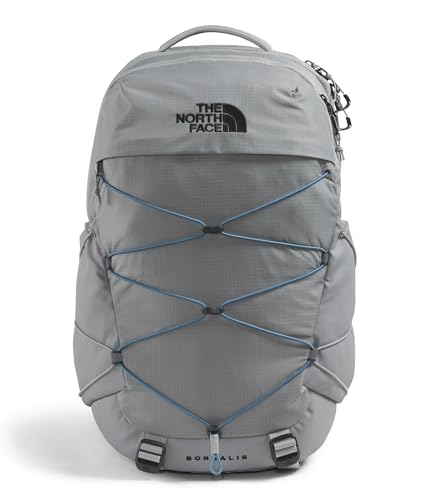
Where the Surge is the commuter refined, the Borealis Commuter is the commuter enlarged. Its large main compartment is the headline: this is the pack for the worker whose bag is also their day luggage — gym kit for the lunchtime session, a change of shoes, the thick file that will not fit in a slim business bag, plus the laptop in its own sleeve. The Concrete colourway keeps the bigger silhouette looking urban rather than expeditionary, and the water-repellent finish covers the outdoor legs of the journey.
The reason a large commuter bag works here, when large bags usually fail commuters, is the carry. A big load in a badly supported bag is a misery by the second transfer; the Borealis’s outdoor-derived straps and back panel keep a heavy day feeling organised rather than endured. In the carriage it asks for a little more awareness — a fuller pack claims a fuller share of the crush — and between the seats it prefers the luggage rack to the footwell on its biggest days. For the commuter whose alternative is a backpack plus a second bag, consolidating into the Borealis is a genuine quality-of-life upgrade: one bag to guard, one bag to grab when the train reaches the platform, one bag to take through the gate.
- Laptop fit: dedicated laptop sleeve
- Design notes: large main compartment, water-repellent finish, Concrete colourway
- Carry style: heavy daily loads, gym-plus-office days, one-bag commuting
Strengths
- Capacity absorbs gym kit and files that defeat slim business packs.
- Support system keeps consolidated loads comfortable across transfers.
- One-bag discipline simplifies gates, racks and crowded carriages.
Trade-offs
- Full loads claim real space in a packed carriage.
- Size is wasted on laptop-and-documents commuters.
- Prefers the luggage rack to a cramped footwell on heavy days.
Best for: commuters who currently juggle a second bag for gym or work kit. Pass on it if your load is a laptop and a notebook, because its capacity will tempt you to carry weight you never needed.

Carhartt Classic 21L Backpack — Best rugged commuter
Carhartt builds for people whose work is physical, and the Classic 21L carries that DNA into the commute: a water-resistant build, a 15-inch laptop sleeve protected inside a bag that expects to be set down on real floors, and an organisational compartment that keeps the day’s tools — pens, cards, keys, a phone — in assigned places. The black finish and the workwear silhouette give it a particular kind of office camouflage: it looks as right on a site visit as at a desk, which is exactly the double life many of its owners lead.
The 21-litre size is a considered middle. It is enough for the laptop, documents, a layer and lunch without inviting the everything-plus-the-sink packing that larger bags encourage, and it keeps the carriage profile civilised. What the Carhartt offers that sleeker business packs do not is tolerance for rough handling: the bag that gets dropped in a van footwell, hung on a site-office hook and rained on between the two is the bag this design brief began with. Its limits are polish and airflow — the styling is workwear-honest rather than boardroom-sleek, and the back panel prioritises durability over ventilation on hot journeys. For commuters whose route mixes office and site, desk and depot, it is the most truthful bag in this guide.
- Laptop fit: 15-inch laptop sleeve
- Design notes: 21L body, water-resistant build, organisational compartment
- Carry style: mixed office-and-site commutes, durable daily workhorse
Strengths
- Workwear construction tolerates floors, vans and site cabins.
- Organisational compartment keeps daily tools in fixed places.
- Mid-size capacity stays civilised in crowded carriages.
Trade-offs
- Utilitarian styling may underdress in formal corporate settings.
- Back panel favours toughness over hot-weather airflow.
- Capacity ceiling shows on gym-kit days.
Best for: commuters splitting time between desks and physical workplaces. Pass on it if your office dress code is sharp tailoring, where a sleeker business pack will match the room better.

BANGE Business Smart Backpack — Best for phone charging
The BANGE starts from the modern commuter’s quiet dependency: the phone that holds the ticket, the pass, the payment method and the messages from the office, all draining steadily from the moment the alarm went off. Its USB charging port lets a power bank inside the bag feed that phone while you walk, which turns the station approach into charging time rather than battery anxiety. Around that feature sits a waterproof business backpack cut for a 15.6-inch laptop, with a profile tidy enough for client-facing days.
Waterproofing is the second half of its commuter logic. The walk from the station is the wettest part of a working day, and a bag that keeps its contents dry through a genuine downpour — not merely a drizzle — changes what weather you are willing to commute through. The business styling carries into meetings without a costume change, and the internal layout suits the documents-and-devices load of an ordinary office day. Its boundaries are capacity and formality of a different kind: it is a defined-load bag that resists gym kit and bulk, and its smart, tech-forward look may feel over-specified to commuters who want a bag that disappears. For the phone-dependent rail commuter, it solves the two problems — charge and rain — that define their journey.
- Laptop fit: 15.6-inch laptop accommodation
- Design notes: waterproof fabric, USB charging port (power bank not included), business profile
- Carry style: rail commuting, client days, phone-heavy journeys
Strengths
- Charging port converts walking time into phone battery.
- Waterproof build takes the station walk out of the weather gamble.
- Smart profile walks from platform to meeting room unchanged.
Trade-offs
- Defined capacity resists bulky extras and gym kit.
- Charging depends on a power bank you supply yourself.
- Tech-forward styling will not vanish into traditional offices.
Best for: commuters whose phone is their ticket, pass and wallet in one. Give it a miss when your kit runs bulky, or when your route is short enough that battery and rain never become questions.

hk Business Backpack 17 Inch — Best expandable option
The hk Business Backpack answers the commuter’s variable week with a variable bag. On ordinary days it rides slim, the way a business pack should; on the days the day demands more — the laptop plus the presentation materials plus the overnight layer for the trip that appeared in the calendar at noon — it expands to meet the load instead of forcing a second bag. That expansion is wrapped around a 17-inch laptop fit, in 900D waterproof fabric, with a USB charging port for the phone on the move.
The 17-inch fit matters beyond gamers: plenty of mobile workstations and older business machines exceed the 15.6-inch sleeves that dominate this category, and their owners are usually told to shop in a different, louder aisle. The hk gives them a business-looking answer. The 900D fabric is the durability headline — a heavy-duty weave that shrugs off the abrasion of racks, footwells and baggage belts better than lighter shells. The compromises ride along honestly: expanded, the bag is a substantial object in a carriage; the utilitarian branding lacks the polish of the BANGE; and a 17-inch-capable shell is more structure than a 14-inch laptop needs. For the commuter whose week genuinely varies, it is the most adaptable tool here.
- Laptop fit: 17-inch laptop accommodation
- Design notes: slim-and-expandable body, 900D waterproof fabric, USB charging port
- Carry style: variable work weeks, big-laptop commuting, overnight business trips
Strengths
- Expansion absorbs irregular loads without a second bag.
- Rare business-styled home for a 17-inch laptop.
- Heavy-duty fabric tolerates racks, belts and footwells.
Trade-offs
- Expanded mode is bulky in a packed carriage.
- Finish is functional rather than luxurious.
- Oversized shell for anyone carrying a compact laptop.
Best for: commuters with a 17-inch machine or a week that changes size daily. Look elsewhere when your kit is small and unchanging, where the B210 or the BANGE will carry it with less structure.

Lenovo B210 Laptop Backpack — Best lightweight commuter
Some commutes are not a journey but a sequence: a bus, a platform change, a train, a staircase, a ten-minute walk, each leg short and each transfer a small negotiation with whatever you are carrying. The B210 is built for that sequence. It is water-repellent, clean-lined and so light that the bag itself nearly vanishes from the equation, leaving only the 15.6-inch laptop and a minimal kit as the weight your shoulders account for. Lenovo designed it as the bag its own laptops would choose, and the restraint shows everywhere: no dangling straps to catch on gates, no bulk to apologise for in a crush.
In commuter service, its virtues compound quietly. It is the bag that never makes a transfer harder, never dominates a footwell, never arrives at the office looking like outdoor equipment. Its internal world is deliberately small — laptop, charger, documents, a paperback — and commuters whose kit matches that list will find it close to perfect. Those whose day includes gym clothes, a lunch box and a file stack will find its ceiling within the first week, and no amount of clever packing changes the geometry. The B210 is not a lesser commuter bag; it is a specialised one, specialised for the multi-leg, light-load journey that defines commuting for a great many city workers.
- Laptop fit: 15.6-inch laptop or tablet compartment
- Design notes: water-repellent finish, lightweight build, minimal styling
- Carry style: multi-leg urban commutes, light daily kits
Strengths
- Featherweight shell makes transfers and stairs noticeably easier.
- Clean styling passes in any office without comment.
- Water-repellent surface handles the daily platform drizzle.
Trade-offs
- Small capacity excludes gym kit and bulky lunches.
- Minimal organisation needs a pouch for cables and small items.
- Light padding suits civilised handling rather than rough treatment.
Best for: multi-transfer city commuters carrying a defined, minimal kit. Pass on it if your day needs one bag to hold everything including the gym, where the Borealis Commuter is the honest answer.
How Do the Six Commuter Picks Compare Side by Side?
| Pick | Laptop fit (per listing) | Standout trait | Watch out for |
|---|---|---|---|
| THE NORTH FACE Surge | 15 inch | Reflective details, distance-bred carry | Fuller structure |
| THE NORTH FACE Borealis Commuter | Laptop sleeve, large main | One-bag capacity for heavy days | Carriage footprint when full |
| Carhartt Classic 21L | 15 inch | Workwear durability, organiser | Utilitarian styling |
| BANGE Business Smart | 15.6 inch | Waterproof fabric, USB port | Defined capacity |
| hk Business 17 Inch | 17 inch | Expandable 900D waterproof body | Bulk when expanded |
| Lenovo B210 | 15.6 inch | Lightest multi-leg carry | Small internal volume |
Match the bag to the journey’s shape. Long walks at both ends favour the Surge; a second bag’s worth of kit favours the Borealis Commuter; a site-and-office mix favours the Carhartt; rain and a hungry phone favour the BANGE; a big laptop or a shape-shifting week favours the hk; and a chain of short transfers favours the B210. The wrong commuter bag is rarely a bad bag — it is a good bag assigned to the wrong journey.
What Mistakes Do Commuters Make When Choosing a Backpack?
The most common is buying for the office and forgetting the journey. A bag can be perfect at a desk and wrong everywhere between home and that desk: too bulky for the carriage, too thirsty for the rain, too slow to open at the gate. Judge the bag on the platform, not the showroom. The second mistake is ignoring the return leg. Loads grow during the day — post, shopping, the layer you took off at noon — and a bag packed to its zipper at dawn becomes a daily wrestling match by six. Leave a margin, or choose the expandable hk and let the margin be built in.
A third mistake is leaving valuables in the most accessible pocket. The front pouch of a backpack in a crowd is public space; wallets and phones belong against your back or in an inside pocket, a habit that costs nothing and that the close-fitting designs in this guide are built to support. Finally, commuters underestimate their own walking distance and buy straps for a stroll when their journey is a hike in disguise. Add up the week’s walking honestly — the Surge and Borealis exist for the totals that surprise people. A related oversight is buying for the current job’s route and forgetting that routes change: the bag that survives a job change, a house move and a new station without becoming wrong is worth a small premium in versatility, which is why adaptable designs recur throughout this guide’s recommendations.
How Should You Organise a Commuter Bag for Speed at Gates and Desks?
Give every daily object a fixed address and defend the system for a fortnight until it becomes reflex. The travel pass belongs in the same small pocket every day, reachable without taking the bag off; the phone rides where your hand falls naturally; the laptop charger lives in one compartment so that arriving at a desk is a thirty-second setup rather than an excavation. On trains with tables, the bag’s laptop compartment should be reachable from the seat — a layout point worth checking in the first week, because a bag that must be fully opened and unpacked to free the machine will train you to avoid working on the train at all.
Keep a small permanent kit inside the bag so mornings require no decisions: a spare charging cable, a pen, tissues, a compact umbrella in wet seasons, and any medication the day cannot proceed without. Commuters who run this system describe the same benefit in different words — the bag stops being a thing they pack and becomes a thing they pick up, and the mental load of the journey drops accordingly. The bag you carry twice a day, five days a week, should be the most systematised object you own.
Seasonal items rotate through that system on a calendar rather than on impulse: the umbrella and the gloves arrive in autumn, the sunglasses and the lighter layer in spring, and the monthly load audit described elsewhere in this guide is the moment to make the swap. Commuters who run the rotation find their bag stays the same comfortable weight all year, while everyone else’s quietly gains a season’s worth of stranded objects. The system sounds fussy in print and feels like nothing in practice — a minute of attention a month, repaid in every gate, platform and desk arrival where the right object is simply where your hand already knew it would be.
How Do You Keep a Commuter Backpack Presentable for Years?
Commuting grime is a specific cocktail — platform dust, carriage floors, rain, coffee — and it accumulates at the base and the straps first. A weekly wipe of the base panel and a monthly empty-and-shake keeps it from setting into the fabric. Let the bag dry standing open after wet journeys rather than zipped in a hallway corner; padding that stays damp develops the smell that eventually retires more commuter bags than torn fabric does. Zippers benefit from an occasional clean along the teeth, especially after a beach-path or grit-heavy winter, because most slider failures begin as grit being forced through a dirty track twice a day.
Rotate the load where you can. The commuter who occasionally takes a briefcase or a tote gives the backpack’s foam a day to recover its shape, and foam that recovers keeps its cushioning for years instead of months. Check the strap roots each season — they carry the bag’s whole life — and treat early fraying as a repair, not a countdown. A commuter backpack that is maintained like this outlasts the job it was bought for, which is the quiet standard the six picks in this guide were chosen to meet.
One more habit belongs to the laptop rather than to the bag: shut the machine down, or at least sleep it properly, before it goes into the sleeve. A laptop left running in a padded compartment on a warm train cooks itself gently and arrives with a drained battery and a hot chassis, and no sleeve padding can protect a machine from its own heat. The ten seconds the shutdown takes is the cheapest protection in this entire guide, and the commuters who adopt it stop telling stories about laptops that died mysteriously in transit.
How Does Each Pick Behave Across the Seasons of a Commuting Year?
Winter tests the Surge hardest and flatters it most. The reflective detailing stops being a specification and becomes part of how you are seen on the unlit road by the station, the water-repellent shell meets sleet without ceremony, and the structured straps sit comfortably over a heavy coat where flimsy straps slide and twist. In summer the same structure breathes less freely than a minimal pack, and the Surge’s owner trades a warmer back for the year’s other three seasons of composure — a trade most northern commuters accept without thinking twice.
The Borealis Commuter’s seasons are about volume. Autumn adds layers, winter adds a change of shoes for the office, and its large main compartment absorbs the year’s swelling without the bag ever needing a companion. The Carhartt’s seasons are about surfaces: it is the bag that winter grit, site mud and platform slush cannot embarrass, wiped down in seconds and returned to service, while sleeker packs accumulate the season as visible wear. The BANGE’s waterproofing earns its keep in the spring and autumn rain belts, and its charging port matters most in winter, when cold batteries drain fastest and the phone is also a torch for the walk home.
The hk’s year is defined by the calendar rather than the weather: the conference month, the audit week, the sudden overnight trip, when expansion turns a bag bought for ordinary Tuesdays into the bag that handles the extraordinary ones without a purchase in between. The B210’s seasons are the mild ones it was born for — the spring and summer of light kits and quick transfers — and its owner simply accepts a larger companion or a rain cover for the year’s extremes. Reading the six this way underlines the guide’s recurring advice: a commuter bag is bought for a whole year of journeys, and the season you are standing in when you shop is the least reliable witness of what you need.
What Changes When the Commute Is Cycled or Walked Rather Than Ridden?
Cyclists ask things of a backpack that train passengers never do. The bag must stay planted when the rider leans, its straps must not migrate under pedalling arms, and its base must clear the rear wheel’s spray line — which is why the Surge’s reflective detailing and secure, structured carry translate so naturally to the bike. A sternum strap, where a pack offers one, stops the load swaying at junctions, and a water-repellent shell is not optional on a bicycle in traffic: road spray arrives from below as faithfully as rain arrives from above. Walkers ask a simpler question — how does it feel at minute forty — and the answer is written in strap width, padding density and back-panel airflow, the trio this guide keeps returning to because distance exposes all three.
Both groups should weigh visibility as equipment rather than as styling. Reflective elements and lighter colourways register with drivers in the half-light when most commuting happens, and a bag that offers them, like the Surge in this guide, is making a safety contribution that never appears in a capacity figure. Both groups should also protect the laptop against a different accident profile: a cyclist’s bag may meet the road, a walker’s bag swings against railings and gateposts, and in both cases a padded sleeve set against the back panel, as these six provide, is the difference between an anecdote and an insurance claim.
How Should the Laptop Sleeve in a Commuter Bag Actually Protect the Machine?
Commuting accidents are mundane: the bag set down hard on a platform, the carriage jolt that slides it off a seat, the gate that catches a corner. A commuter sleeve earns its name by defending against those, which means padding on the faces, reinforcement at the corners, and ideally a raised base that keeps the machine’s edge off the bag’s floor where the set-down shock arrives. The sleeve should also open independently, because a commuter retrieves the laptop in public more often than any other user — at gates, in cafés, at hot desks — and a design that requires the whole bag to gape open exposes everything else you own to the room each time.
Fit is the other half of protection. A sleeve that lets a laptop slosh lets it gather momentum in every jolt; a sleeve so tight that the zipper scrapes the corners twice a day trades impact risk for abrasion certainty. The honest fit is snug with a centimetre of grace, which is why this guide repeats the measuring advice across categories: know your machine’s width, depth and thickness, and match them to the compartment rather than to the screen size printed on a box. The six picks here span 15-inch, 15.6-inch and 17-inch fits precisely because commuters’ machines do.
What Should a Commuter Bag Do When the Journey Goes Wrong?
Every commuter knows the day the railway gives up: the cancelled service, the replacement bus, the hour on a platform that was planned as twenty minutes at a desk. A good commuter bag quietly improves those days. It holds a paperback or a tablet where a hand can reach it during the wait. It keeps a charger accessible so a dying phone can be revived from a platform socket without unpacking the bag at your feet. It stands beside you rather than collapsing, so its contents stay off wet concrete. And it carries the layer you packed for the office’s air conditioning, which on a stranded platform becomes the difference between discomfort and misery.
The picks here meet that bad day in their own ways: the Borealis Commuter’s capacity means the layer and the book are already inside; the BANGE’s charging port keeps the phone — the day’s information lifeline — alive through the delay; the B210’s lightness makes the replacement-bus shuffle and the long walk to a different station a smaller ordeal; the Carhartt tolerates being set down on whatever surface the disruption provides. None of this appears in a feature list, yet commuters remember their bags by their worst journeys, and a bag chosen with the bad day in mind is a bag that never gets blamed for it.
What Belongs in a Well-Run Commuter Backpack, Day After Day?
The permanent kit, the objects that live in the bag rather than being packed into it, is what turns a backpack into a system. A spare phone cable and a compact power bank — the BANGE and the hk are built around exactly this pairing. A pen that works, because the one offered never does. A pack of tissues and any daily medication. A compact umbrella through the wet half of the year, riding in a side pocket where its drips stay outside the main compartment. A reusable shopping bag, folded flat, for the evening errand that otherwise means carrying a plastic bag in each hand alongside the backpack. And the laptop charger question, which deserves thought: commuters who can leave a charger at the desk transform their daily load, while those who hot-desk carry it forever, and should choose a bag whose layout gives the brick a home away from the laptop’s lid.
Around that permanent core, the daily layer rotates: documents, lunch, a book, a layer. The discipline is to keep the two layers separate in your mind and in the bag’s compartments, so that emptying the daily layer each evening never disturbs the system underneath. Commuters who run this arrangement stop experiencing the morning hunt for objects, because the hunt’s objects never move. It is a small domestic technology, invisible to everyone else, and it is worth more across a year of journeys than any single feature a bag can be bought for.
How Does Each Pick Settle Into Office Life Once the Journey Ends?
A commuter bag’s second job begins at the office door, and the six divide by how gracefully they do it. The Surge slides into the working day like it was designed in the building: structured enough to stand beside a desk without slumping, outdoors enough in its detailing that nobody mistakes it for a briefcase, and organised so the laptop’s exit and return are silent operations. Its Timber Tan finish reads as a deliberate style choice in most workplaces, warmer than the default black and less fragile-looking than lighter colours.
The Borealis Commuter lives larger at the office — it is the bag that holds the day’s second act, the gym session or the evening class, and its size under a desk is the price of that consolidation. The Carhartt settles anywhere without ceremony: under a desk, on a site cabin floor, on a hook by a door it was designed to be hung on, and its organiser means the desk setup is the same in every location the week invents. The BANGE presents the most meeting-ready face of the six, the bag whose owner is never apologising for it in a client room, and its internal order suits the worker whose desk is wherever the morning’s calendar says.
The hk’s office life is about readiness: expanded for the trip, slimmed for the ordinary day, it is the bag of the commuter whose job keeps changing the question. The B210, finally, is the bag that disappears most completely — under a desk, on a hook, in a locker — because disappearing is its design brief, and for hot-desking workers who are allocated nothing permanent, a bag that stores small and light is a genuine working advantage. The journey chooses the shortlist, but the destination casts a vote too, and weighing both halves of the day is how a commuter ends up with a bag that never feels like a compromise in either place.
How Much Weight Should a Daily Commute Actually Put on Your Back?
Less than most commuters carry, and the bag is partly to blame. Loads creep: the charger that could live at the desk, the book finished last week, the umbrella kept through a dry month, the documents that were going to be filed. A monthly audit — empty the bag completely, question every object, repack only what the coming month needs — reliably removes a surprising amount of weight, and the picks in this guide reward the audit differently. The B210 enforces it by geometry, refusing the creep outright. The expandable hk accommodates it, which is a kindness on the heavy week and a temptation across the ordinary ones. The Borealis Commuter absorbs it so willingly that its owner must supply the discipline the bag declines to.
The physical guidance is simple to state and worth obeying: keep the total — bag, machine, kit — to a load you can carry up a flight of station stairs without your shoulders filing a complaint, keep the heaviest items against your back where these bags put their sleeves, and wear both straps even for the short platform walk, because the one-strap carry is how commuter shoulders accumulate their grievances across a year. A commuter bag is a health-adjacent purchase whether it advertises itself as one or not; the kindest feature any of these six offers is the one that keeps a twice-daily load feeling, at the end of a long week, like no load at all.
Which Commuter Backpack Fits Which Kind of Working Week?
The five-day office worker with a fixed desk has the easiest brief in this guide: the load is stable, the route is memorised, and the choice turns on comfort and weather, which is why the Surge and the B210 serve so many of them — one for the walker, one for the transfer-hopper. The hybrid worker, in the office three days and gone again, benefits from a bag that lives packed: the permanent kit stays in place across the home days, the laptop slides in on office mornings, and the BANGE’s order or the Carhartt’s organiser keeps that rhythm frictionless. The field worker — part desk, part site, part client — needs the Carhartt’s tolerance or the hk’s adaptability, because their bag’s environment changes faster than its contents do.
The travelling worker, whose commute is sometimes to another city entirely, should read the Borealis Commuter and the hk as their shortlist: capacity for the overnight layer, structure for the station, and a laptop compartment that opens cleanly at security. The new graduate, buying a first work bag on a first salary, gets the most future-proof value from the B210’s restraint or the BANGE’s polish, both of which will still look correct when the job changes. Across every pattern, the method holds: describe the week honestly, match the bag to its worst regular day, and let the easier days take care of themselves.
Final Recommendation
For the archetypal rail commute — a walk, a train, a walk — the Surge is the most complete answer here, with the reflective detailing and distance-bred carry that journey quietly demands. Consolidate a second bag’s worth of kit into the Borealis Commuter, take the Carhartt when the week mixes sites with desks, the BANGE when rain and a draining phone define your mornings, the hk when your laptop is large or your week changes size, and the B210 when your commute is a chain of short hops with a light kit. Choose by the journey you actually make on the wettest, darkest, most crowded day of the year, and the bag will feel right on all the easier days too — that is the whole secret of a commuter pack, and it never changes. The commuters who love their bags, years in, rarely praise a feature; they say the journey got easier and stayed easier, which is the sound of a hundred small decisions — sleeve, straps, pockets, profile — all quietly agreeing with the life they were bought for.
Frequently Asked Questions
Is a slim or a large backpack better for a train commute?
Slim, unless your load genuinely forbids it. A slim bag is easier to guard in a crowd, easier to stow, and politer in a packed carriage. The exception is the commuter consolidating gym kit or work gear, where the Borealis Commuter’s capacity prevents a second bag — and one large bag is still better carriage economics than two medium ones.
How waterproof does a commuter backpack need to be?
Match it to your exposed walking time. A water-repellent finish covers short dashes between station and office for most of the year. If your walk is long or your region’s rain is serious, the fully waterproof builds of the BANGE and the hk remove the gamble, and an inner dry sleeve for the laptop is a sensible belt-and-braces habit in the wettest months.
Where should valuables ride in a commuter backpack?
Against your back or in an internal pocket — never in the front pouch, which in a crowd is effectively public. Wallets, phones and passes should be reachable by you through habit and awkward for anyone else by design, which is why close-fitting layouts and protected pockets feature throughout this guide’s picks.
Can a commuter backpack double as an overnight business bag?
The larger picks can. The Borealis Commuter and the expandable hk both absorb a change of clothes and a wash bag alongside the laptop for a night away, and the BANGE’s smart profile suits the trip’s meetings. Beyond one night, a dedicated travel bag earns its place, but for the single-night trip the right commuter pack removes a purchase entirely.
What strap features matter most for a walking commute?
Width and padding density first, because they decide how a load feels at minute twenty rather than minute two; then a back panel that lets some air move, and straps that stay centred on the shoulder instead of sliding outward. The North Face pair in this guide show what distance-bred design looks like, and the difference is cumulative across a working week.
Does a commuter backpack need a sternum or waist strap?
For most rail-and-platform commutes, no: the loads are moderate and the walking legs are short enough that well-shaped shoulder straps carry the day, which is why several picks here manage without chest hardware. The exception is the long walking or cycling commute, where a sternum strap stops the shoulder straps drifting and the load swaying, and turns a forty-minute walk from a series of small adjustments into a single settled carry. If your journey includes that kind of distance, treat strap stabilisation as a feature worth shopping for deliberately.
How often should a commuter backpack be replaced?
When its structure goes, not when its fashion does: straps that have compressed flat, a laptop sleeve whose padding no longer springs back, or zippers that split under ordinary loads are the honest retirement signals. With the care described above, a well-chosen commuter pack should serve several years of twice-daily journeys before any of those signals appears.
Related Guides
For the neighbouring choices, see Best Gamer Laptop Backpacks for large machines and heavy chargers, Best Backpacks For Women Laptop for women-specific fits, and Best Backpacks For Travel Anti Theft Laptop University when the journey becomes a trip rather than a commute.


