What's inside
- Key Takeaways
- Quick Picks
- How Did We Choose These Anti-Theft Travel and University Backpacks?
- What Do Anti-Theft Features Actually Do, Feature by Feature?
- Which Anti-Theft Laptop Backpacks Earned a Full Review?
- How Do the Six Anti-Theft Picks Compare Side by Side?
- What Mistakes Do Travellers and Students Make With Anti-Theft Backpacks?
- How Should You Pack and Carry an Anti-Theft Backpack Day to Day?
- How Do You Keep an Anti-Theft Backpack Working for Years?
- How Does Each Pick Handle the Specific Moments Travellers and Students Worry About?
- What Should Students Specifically Do Differently From Travellers?
- How Do You Travel Through an Airport With a Laptop Backpack, Step by Step?
- What Role Does the Bag Itself Play Beyond Its Security Features?
- How Should You Choose Between Layout Security, Locks and Compactness?
- What Does a Sensible Security Routine Look Like on a Real Trip?
- Final Recommendation
- Frequently Asked Questions
- Related Guides
As an Amazon Associate I earn from qualifying purchases. This post may contain affiliate links at no extra cost to you.
widgetverdict.com is reader-supported. When you buy through links on our site, we may earn an affiliate commission.
Travel and university share an uncomfortable truth: your backpack will spend time where you cannot watch it. It rides behind you in a packed metro carriage, sleeps in a hostel dorm, waits under a lecture-hall seat and sits in a café while you order. The best backpacks for travel anti theft laptop university use are designed for exactly that exposure — hidden zippers that sit against your back, slash-resistant fabrics, pockets positioned where a stranger’s hand cannot wander, locks that raise the effort a casual thief needs, and laptop compartments that open flat at airport security so the machine never leaves your sight for long. This guide compares six such backpacks, from a TSA-friendly SWISSGEAR built for 17-inch machines to a 20-litre flight-approved daypack, and it is careful about one thing throughout: anti-theft here means design features that discourage opportunistic theft, described honestly — no backpack makes anything theft-proof, and any guide claiming otherwise is selling you a feeling instead of a bag.
Where to buy: the six designs below each carry a checked Amazon link in their review and in the Quick Picks table. If a colourway has sold out, the same model’s construction — its pockets, zippers and sleeve — is unchanged in another finish, so choose by the security layout first.
Buy it a few weeks before the trip or the term, not a few days: the habits these designs reward — the assigned pockets, the lock set by reflex, the fluent openings — need ordinary days to become automatic, and a bag whose system is learned at home will protect its owner abroad far better than a technically superior bag first opened in a departure lounge.
Key Takeaways
- The SWISSGEAR 1900 ScanSmart is the travel benchmark here: a TSA-friendly layout that opens flat for screening, fits most 17-inch laptops and adds a TabletSafe pocket.
- The BANGE Anti-Theft Backpack pairs waterproof fabric with protected access and a USB3.0 charging port for city travel days.
- Volher’s slim anti-theft design suits students moving between crowded transit and campus.
- The Tzowla Anti-Theft Laptop Backpack covers a 15.6-inch machine in a water-resistant build for men and women at university and beyond.
- SHRRADOO’s anti-theft backpack adds a combination lock, a concrete answer to shared dorms and hostels.
- The SUIKIHUM is the compact flight-approved option: 20 litres, a padded sleeve sized at 15.6 inches and a daypack’s manners.
Quick Picks
| Pick | Badge | Why it earns its place |
|---|---|---|
| Volher Anti Theft Laptop Backpack | Best for campus crowds | Slim, water-resistant and security-minded, for students crossing packed cities daily. |
| BANGE Anti-Theft Backpack | Best city travel design | Waterproof fabric, protected access and a USB3.0 port in a fashion-forward travel shape. |
| SWISSGEAR 1900 ScanSmart Backpack | Best for air travel | TSA-friendly flat opening, room for most 17-inch laptops and a dedicated tablet pocket. |
| Tzowla Anti-Theft Laptop Backpack | Best all-round student pick | A 15.6-inch, water-resistant anti-theft design that suits university and business travel alike. |
| SHRRADOO Anti Theft Backpack | Best for shared living | A combination lock guards the main compartment in dorms, hostels and shared houses. |
| SUIKIHUM Anti Theft Laptop Backpack | Best compact flight bag | 20 litres, flight approved, with a padded 15.6-inch laptop sleeve. |
How Did We Choose These Anti-Theft Travel and University Backpacks?
We started by defining the threat honestly, because the definition decides the design. The realistic risk to a traveller’s or a student’s bag is opportunistic: a hand into an open front pocket in a crowd, a zipper worked quietly on a train, a bag opened while its owner sleeps or queues. Against that threat, specific design features genuinely help — zippers and pockets placed against the wearer’s back, compartments without external access, slash-resistant panels, lockable closures — and every pick here was required to offer at least one such feature in its actual construction, not merely in its name. Bags whose anti-theft claim dissolved on inspection were cut.
The second filter was the double life in the keyword itself: travel and university. A pick had to function in both worlds or excel honestly in one — the SWISSGEAR’s airport manners, the SHRRADOO’s dorm lock, the SUIKIHUM’s flight-approved size — while carrying a laptop properly in a padded compartment in all cases. Water resistance mattered because both lives happen outdoors in all weathers. And we kept the language discipline this category demands: features are described as what they are — design choices that discourage and delay opportunistic theft — because a reader who understands the real protection can use it well, while a reader sold an absolute promise will use the bag carelessly and be worse off than with no promise at all.
What Do Anti-Theft Features Actually Do, Feature by Feature?
Hidden zippers are the foundation. When a compartment’s zipper sits against your back or under a flap, a thief behind you cannot work it without touching you, and that contact is the deterrent — most opportunistic theft depends on the victim feeling nothing. Slash-resistant fabric answers a different attack, the blade drawn across a bag in a crowd to spill its contents; panels built to resist cutting turn that silent attack into a difficult, noticeable one. RFID-blocking pockets, where a design includes them, address the skimming of card and passport data at close range — a quieter, rarer risk, worth having where offered and not worth buying a bag for alone.
Lockable zippers and combination locks, like the SHRRADOO’s, protect the stationary bag: the dorm room, the hostel, the office corner, where the threat is an unhurried hand rather than a crowd. A lock will not stop someone taking the whole bag, and it is not sold here as doing so; it stops the casual opening that accounts for most losses in shared spaces. TSA-friendly layouts, like the SWISSGEAR’s ScanSmart design, protect by process — the laptop screens flat without leaving your hands for a separate bin rummage, shortening the most chaotic, distraction-rich moment of air travel. Read every anti-theft claim through this feature-by-feature lens and the category becomes honest: a set of specific answers to specific moments, which used together with ordinary awareness, cover the ways bags are actually lost.
One more feature deserves a calm word, because marketing shouts about it: the cut-resistant strap and the cable that tethers a bag to furniture. Straps reinforced against cutting exist on some designs in the wider market, and tethering has its place in a hostel dorm at night. Neither appears as a headline claim for the six picks here, and neither is necessary for the protection this guide recommends — layout, locks and habits cover the realistic risks for travellers and students — but a reader comparing beyond this list should apply the same test to them as to every feature above: which specific moment does this answer, and is that moment one my life actually contains? Features that pass that test are equipment; features that fail it are weight.
Which Anti-Theft Laptop Backpacks Earned a Full Review?
Six designs in Quick Picks order, each closing with the journey it protects and the limits of that protection.

Volher Anti Theft Laptop Backpack — Best for campus crowds
The Volher’s security is architectural: a slim body whose access points are arranged to be awkward for anyone but the wearer, worn close so that the bag’s openings ride where a stranger’s hand would have to cross your own awareness to reach them. For a student, that architecture matches the actual geography of risk — the packed bus to campus, the crush at the station gates, the festival crowd on the way home — far better than a heavy lock on an exposed pocket would. The water-resistant fabric and the business-travel polish let the same bag walk into a placement interview without changing character.
Day to day, it behaves as a disciplined slim pack: laptop in its section, documents and a layer in the main space, the phone-and-documents tier in protected pockets. Its slimness is both the security feature and the limit — there is little surface for a thief to work on, and equally little room for the owner to overpack, so bulky days belong to a bigger bag. As an introduction to anti-theft design for a student whose life is crowds and campuses, it is the most proportionate pick here: protection that comes from layout, worn every day without effort, rather than from hardware that must be remembered and locked.
- Laptop fit: dedicated laptop section in a slim body
- Design notes: anti-theft layout with protected access, water-resistant fabric
- Carry style: crowded transit, university routes, business travel
Strengths
- Protected access layout suits the crowds students actually move through.
- Slim profile is easy to keep close and under awareness.
- Presentable finish crosses from campus to placement settings.
Trade-offs
- Trim capacity fills quickly beyond a defined daily kit.
- Layout-based security still depends on the wearer’s habits.
- Fewer quick-access external pockets than a conventional pack.
Best for: students and city travellers whose risk is the crowd itself. If your main concern is a bag left in shared rooms, the SHRRADOO’s lock answers that different problem more directly.

BANGE Anti-Theft Backpack — Best city travel design
BANGE designs for the modern city traveller, and this anti-theft backpack shows it: waterproof fabric, a fashion-conscious silhouette that does not advertise itself as security equipment, protected access to the main compartment, and a USB3.0 charging port so a power bank inside can keep a phone — the traveller’s map, ticket and translator — alive through a day of navigation. It is a bag for the trip that is mostly city: metros, museums, coworking desks, evening trains to the next stop.
The waterproofing deserves its emphasis in a travel context, because a traveller cannot choose their weather and a soaked itinerary day with a damp laptop is a genuine trip-spoiler; this shell removes that worry at the fabric level. The security layout works with the same quietness — valuables ride protected, the bag’s public face offers little to work on, and its fashion-forward looks mean it photographs as a style choice rather than as a vault, which in tourist districts is itself a mild security advantage. Its limits are capacity and rough country: it is a city bag, happiest with a defined load, and trail-and-hostel travellers with bulkier kits should look at the SWISSGEAR or the SHRRADOO. For the urban itinerary, it is the most complete design here.
- Laptop fit: laptop compartment for travel machines
- Design notes: waterproof fabric, anti-theft access layout, USB3.0 charging port
- Carry style: city breaks, business travel, metro-heavy itineraries
Strengths
- Waterproof shell takes unfamiliar cities’ weather out of the equation.
- Charging port sustains the phone a traveller navigates by.
- Understated styling avoids advertising valuable contents.
Trade-offs
- City-shaped capacity resists bulky or outdoor loads.
- Charging depends on your own power bank.
- Less suited to hostel-and-trail itineraries than the bigger picks.
Best for: city travellers and business riders who navigate by phone. If your trip is hostels, hikes and a week’s wardrobe, choose the SWISSGEAR’s scale instead.

SWISSGEAR 1900 ScanSmart Backpack — Best for air travel
The SWISSGEAR 1900 is built around the airport moment. Its ScanSmart layout opens flat so the laptop — and this bag fits most 17-inch machines — can be screened without being removed into a separate tray ballet, keeping the most expensive object you own in your hands and in your sight through the most distracted minutes of travel. A TabletSafe pocket protects the second screen most travellers now carry, and the whole design carries SWISSGEAR’s travel-luggage heritage: this is a bag from people who think about journeys professionally.
Beyond the airport, the 1900 settles into work and university life as a substantial, organised carrier — the size that swallows a 17-inch laptop also swallows a day of books or a night of clothes, which is why it recurs in travellers’ recommendations year after year. Its security contribution is the traveller’s combination: protected organisation, a bag that stays composed and closed in crowds, and a screening process that never separates you from the machine. The honest costs are size and weight: it is a lot of backpack for a small laptop or a light day, and its travel scale claims real room in overhead bins and under seats. For the flyer with a big laptop, though, it remains the reference design in this guide — the pick the others are compared against whenever an itinerary includes an airport.
- Laptop fit: most 17-inch laptops, lay-flat ScanSmart compartment
- Design notes: TSA-friendly opening, TabletSafe pocket, travel-luggage construction
- Carry style: air travel, work trips, university with a large laptop
Strengths
- Flat-opening screening keeps the laptop in your hands at security.
- Genuine room for 17-inch machines and their travel loads.
- Tablet pocket protects the second screen travellers carry.
Trade-offs
- Substantial size and weight for light days or small laptops.
- Claims real space in cabins and crowded carriages.
- Travel scale can tempt overpacking beyond shoulder comfort.
Best for: air travellers carrying a 17-inch laptop who want the calmest security routine available. If your journeys are ground-level and your machine is smaller, the Tzowla or the SUIKIHUM will feel more proportionate.

Tzowla Anti-Theft Laptop Backpack — Best all-round student pick
The Tzowla is the balanced entry in this guide: an anti-theft backpack for a 15.6-inch laptop, water resistant, designed for men and women across business travel and university life, without specialising so hard in either that the other suffers. Its security comes from the category’s proven layout ideas — protected pockets and access arranged for crowds — applied to a bag that otherwise behaves like a good everyday backpack, which is precisely what a student needs: protection that does not require a separate routine to maintain.
On campus it carries the standard day — laptop, books, layer, bottle — with the valuables tier tucked where the design intends, and on trips it steps up as a cabin-friendly companion for weekends and study travel. The water resistance covers both lives’ weather. Its compromises are those of the all-rounder: it does not open flat like the SWISSGEAR, does not lock like the SHRRADOO, and does not slim down like the Volher, so a traveller with one dominant need should buy that need’s specialist. For the student whose risks are general — crowds, shared spaces, weather, travel — and whose budget prefers one bag to three, the Tzowla is the sensible centre of this guide.
- Laptop fit: 15.6-inch laptop compartment
- Design notes: anti-theft layout, water-resistant build, unisex design
- Carry style: university days, business travel, general city use
Strengths
- Balanced protection suits mixed student and travel life.
- Water resistance covers campus and city weather alike.
- Everyday manners require no special routine to benefit from.
Trade-offs
- No flat-opening airport layout like the SWISSGEAR’s.
- No lock for stationary shared-space security.
- All-round shape is less slim in crowds than the Volher.
Best for: students who want one anti-theft bag for the whole of university life. If airports dominate your year, step up to the SWISSGEAR; if dorm security dominates, the SHRRADOO.
SHRRADOO Anti Theft Backpack — Best for shared living
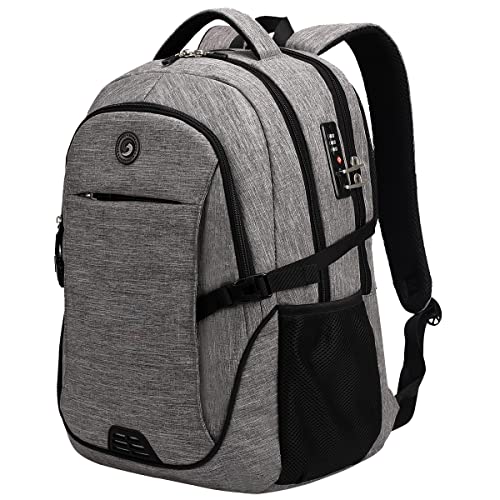
The SHRRADOO’s defining feature is a small piece of hardware with a specific job: a combination lock for the main compartment. Its context is not the street but the room — the dorm during a party, the hostel dormitory, the shared house where guests drift through, the library table during a long break. In those places the threat is an unhurried, casual opening, and a locked compartment answers it directly: not by making the bag impregnable, which no lock on fabric can do, but by making the casual attempt fail and the serious attempt obvious, slow and loud enough to abandon.
Around the lock sits a travel laptop backpack for men and women, sized for college and high-school loads as well as university — laptop, books and the day’s bulk in a body that also travels home at weekends. The lock’s discipline is the bag’s one demand: it protects only when used, so its owner builds the two-second habit of locking when the bag is left, the way one locks a bicycle. Students who live in genuinely shared spaces will find that habit easy to keep, because the environment reminds them daily. For the solitary traveller in private rooms, the lock is surplus; for the dorm resident, it is the feature that turns a good backpack into the right one.
- Laptop fit: laptop compartment for college loads
- Design notes: combination lock on the main compartment, travel-and-college body
- Carry style: dorms, hostels, shared houses, campus days
Strengths
- Lock answers the shared-room risk no layout feature can.
- College-sized capacity handles books and weekend loads together.
- Visible deterrent discourages the casual attempt entirely.
Trade-offs
- Lock protects only when the owner uses it.
- A locked bag can still be taken whole — it guards contents, not the bag.
- Hardware adds a little weight and one more routine to keep.
Best for: students and travellers living in dorms, hostels and shared houses. If your bag never leaves your sight or your private room, the lock is weight you can spend elsewhere.

SUIKIHUM Anti Theft Laptop Backpack — Best compact flight bag
The SUIKIHUM makes the compact case: 20 litres, flight approved, a padded sleeve cut for 15.6-inch machines, water-resistant fabric and anti-theft design in a black daypack that behaves as well on a campus as in a cabin. It is the pick for the traveller who flies light and the student whose load is defined — the bag as personal item, the laptop protected inside it, the day’s needs met without a gram of structure wasted on loads that never materialise.
Its size is its security philosophy as much as its travel convenience. A compact bag stays close, moves through crowds without swinging into strangers, slides under an airline seat where its owner can feel it with a foot, and invites the packing discipline that keeps valuables few and known. The padded sleeve does the laptop’s protection properly within that small footprint, which is the detail compact bags most often cheat on. The limits are the honest ones of 20 litres: no big textbooks, no week’s wardrobe, no 17-inch machine. For the light traveller and the digital student, it is the most efficient design in this guide — everything the brief requires, and nothing it does not.
- Laptop fit: padded 15.6-inch sleeve against the back panel
- Design notes: 20L body, flight approved, water-resistant daypack build
- Carry style: light air travel, campus days, personal-item flying
Strengths
- Flight-approved size keeps the laptop under the seat and in reach.
- Compact body is inherently easier to guard in crowds.
- Proper padded sleeve, where many compact bags cheat.
Trade-offs
- 20 litres excludes bulky textbooks and long-trip loads.
- No room for 17-inch laptops.
- Light structure prefers civilised handling.
Best for: light travellers and digital-first students who fly with a personal item only. If your loads are large or your laptop is a 17-inch, the SWISSGEAR is your end of this guide.
How Do the Six Anti-Theft Picks Compare Side by Side?
| Pick | Laptop fit (per listing) | Standout trait | Watch out for |
|---|---|---|---|
| Volher Anti Theft | Slim laptop section | Protected access in a slim body | Trim capacity |
| BANGE Anti-Theft | Travel laptop compartment | Waterproof fabric, USB3.0 port | City-shaped loads only |
| SWISSGEAR 1900 ScanSmart | Most 17 inch | TSA-friendly flat opening | Size and weight |
| Tzowla Anti-Theft | 15.6 inch | Balanced student all-rounder | No lock, no flat opening |
| SHRRADOO Anti Theft | College laptop compartment | Combination lock | Lock must be used to work |
| SUIKIHUM Anti Theft | 15.6 inch, padded sleeve | 20L flight-approved compactness | Small total capacity |
Match the design to the moment you actually fear. Crowds point to the Volher and the Tzowla; city weather and navigation point to the BANGE; airports and big laptops point to the SWISSGEAR; shared rooms point to the SHRRADOO’s lock; and light, personal-item flying points to the SUIKIHUM. Every pick assumes the same partner in protection — an owner whose habits agree with the design — because that partnership, not any single feature, is what anti-theft really is.
What Mistakes Do Travellers and Students Make With Anti-Theft Backpacks?
The first mistake is believing the label instead of the layout. A bag called anti-theft whose main zipper sits exposed on its outer face offers a name, not a design; check where the zippers and pockets actually are, as this guide’s picks were checked. The second mistake is the opposite — buying real features and then defeating them with habits: the hidden pocket left unzipped, the lock never set, the bag left open on a café chair while its owner is at the counter. Design and behaviour are one system, and the weakest half sets the level.
A third mistake is concentrating everything in the bag and carrying it everywhere. Passport, cards, phone and laptop all in one place means one loss is a total loss; experienced travellers split the criticals — a card and some cash on the person, documents backed up digitally, the laptop in the bag — so that no single event ruins a trip. Finally, travellers mistake the destination’s reputation for a risk assessment. Opportunistic theft follows crowds and distraction, not postcodes: the festival, the festival train and the festival queue are the exposure, in any city on earth, and that is where these designs earn their keep.
Students make one further mistake that travellers rarely do: treating the familiar as the safe. The shared kitchen, the society social, the library at midnight feel like home territory, and the bag is left open, unlocked and unattended in them for hours at a time — yet those rooms host the exact rotating cast of near-strangers that a lockable compartment and a protected back pocket were designed around. Familiarity lowers guard without lowering risk, and the student who runs the same quiet routine in familiar rooms as in foreign stations is the one whose degree passes without the story everyone else seems to have about the bag that was emptied in their own building.
How Should You Pack and Carry an Anti-Theft Backpack Day to Day?
Assign valuables to the protected places permanently: documents and cards in the pocket that rides against your back, the laptop in its compartment, the phone where your hand — and only your hand — falls naturally. Keep the bag’s public face boring: nothing valuable in outer pouches, nothing dangling, zips closed as a reflex rather than as a decision. In transit, the bag belongs in contact with you — between your feet on a train, on your lap in a café, against your leg in a queue — because contact is the sensor every one of these designs assumes.
At the destination, the routine changes from carrying to parking, and parking has its own rules: bag closed and, where the design offers one, locked; bag in the room’s least public corner; bag never the place where the only copy of anything irreplaceable sleeps. Students should treat the library and the lecture hall with the same system as travellers treat the hostel — shared space is shared space, whatever the postcode — and the SHRRADOO’s lock and the hidden pockets across this guide exist precisely for those parked hours. Practised for a week, all of this becomes invisible habit, which is the point: security that depends on vigilance fails, and security that becomes routine works.
One packing refinement belongs to this category alone: rehearse the bag’s openings before you need them. Know, without looking, which zip frees the laptop, which pocket holds the documents, and how the lock behaves, because the moments these bags are designed for — the security belt, the crowded platform, the dark dorm corridor — are moments when fumbling advertises exactly where the valuables live. Fluency is a security feature the owner supplies, and it costs one quiet evening of practice at home, after which the bag’s design and the owner’s hands work as the single system they were meant to be.
How Do You Keep an Anti-Theft Backpack Working for Years?
The security features are mechanical, and they age like mechanisms. Zippers that protect by position must keep gliding — a stiff, gritty zipper gets left half-open, and a half-open hidden pocket is just a pocket — so clean the tracks and work the sliders before they resist. A combination lock should be exercised and its code kept somewhere recoverable that is not a note inside the bag it locks. Slash-resistant and waterproof fabrics keep their properties longest when the bag is dried after wet journeys and stored unloaded, rather than left as a damp, stuffed archive of the last trip.
The laptop compartment deserves the same discipline as in every guide in this cluster: empty it weekly, evict the grit, and let the padding recover by not storing the bag under a permanent load. A traveller’s bag also earns a post-trip ritual — full emptying, a wipe inside and out, zips and lock checked, rain kit restocked — that returns it to readiness and catches the small wear while it is still a repair. Bags maintained this way protect for years; bags treated as indestructible eventually demonstrate otherwise at the least convenient border crossing available.
Hidden pockets and protected zips need one specific check in that ritual: work each concealed zipper fully, because a concealed track that is never used gathers grit undisturbed and can stiffen into uselessness precisely where its owner can least see it failing. The back-panel pocket in particular lives against clothing, seats and walls, collecting the fine dust of journeys, and a monthly clean of its track keeps the bag’s most important security feature as fluent as the day it arrived. Maintenance in this category is not separate from security; it is security, continued by other means.
How Does Each Pick Handle the Specific Moments Travellers and Students Worry About?
Picture the night train, because it concentrates every risk in this category into one carriage. The Volher’s owner sleeps lightly with the bag’s protected side against the seat and its slim body in contact with a leg — the layout doing quietly what layout can. The BANGE’s owner has the phone charging from the bag and the waterproof shell between the laptop and whatever the journey’s weather does at the next open-air platform. The SWISSGEAR’s owner is not on this train at all; they flew, and their anxious moment was the security belt, which the ScanSmart layout shortened to a zip and a walk. Each design is a bet about which moment matters most, and the bets are different enough that choosing among them is really choosing which moment you want handled best.
The Tzowla’s moment is the ordinary crowded day, repeated hundreds of times a year, where nothing dramatic happens and the design’s value is that nothing dramatic keeps not happening. The SHRRADOO’s moment is the dorm party — the bag in the corner of a room full of near-strangers, its lock converting a worry into a non-event. The SUIKIHUM’s moment is the budget flight and the hostel bunk: a compact bag under the seat or at the foot of the bed, small enough to stay in its owner’s physical awareness through the whole trip. A buyer who can name their moment from this list has effectively chosen their bag; a buyer who cannot should take the Tzowla’s balance or the SWISSGEAR’s scale and let breadth cover the uncertainty.
What Should Students Specifically Do Differently From Travellers?
A student’s exposure is chronic rather than episodic: the same routes, the same rooms, the same shared spaces, five days a week for years. That changes the security arithmetic. A traveller’s bag faces strangers; a student’s bag faces acquaintances-of-acquaintances, the friend-of-a-friend in the shared kitchen, the unknown guest at the house party — which is why the stationary protections, the SHRRADOO’s lock and the hidden pockets across this guide, matter more at university than their modest appearance suggests. Chronic exposure also means habits must be effortless: a security routine that requires daily determination will be abandoned by November, while one built into the bag’s layout — valuables in the back pocket because that is where they live — survives the whole degree.
Students also carry differently across the year: term-time loads of books, vacation loads of laundry and gifts, placement loads of documents and kit. A bag chosen for university should be read against that whole cycle, which favours the adaptable bodies of the Tzowla, the SHRRADOO and the SWISSGEAR for most students, with the slim Volher and compact SUIKIHUM serving the digital-first courses whose loads never swell. And students should mark their bags — a name inside, a distinctive tag — because a campus is a sea of similar backpacks, and recovering a mistaken bag from a lecture hall is a likelier event than most theft scenarios this guide discusses.
How Do You Travel Through an Airport With a Laptop Backpack, Step by Step?
Before the airport: charge everything, back up the laptop, and pack the bag so the security moment is pre-decided — laptop in its compartment, liquids and electronics where the rules of your route expect them, documents in the back pocket against your spine. At the belt: bag opened as its design intends — flat, for the SWISSGEAR; conventionally, for the others — with the laptop never surrendered to a stranger’s handling and your eyes on the tray line during the distraction-rich seconds when bags and owners are separated by the scanner. That separation is the airport’s one genuinely risky moment for belongings, and the defence is positioning: send the bag through as you are ready to walk through yourself, so the reunion is immediate.
After security, the repack is a ritual worth doing completely before moving: laptop zipped home, documents counted back into the back pocket, phone in hand. In the terminal, the bag stays in contact — between the feet at the gate, on the lap or between the knees at the café — and on the aircraft it goes under the seat in front where possible, which is where the SUIKIHUM’s flight-approved size and the SWISSGEAR’s composed shape both earn their design briefs. None of this requires suspicion of everyone; it requires a system that runs the same way every trip, so that the one trip where something is off, you notice.
Arrivals deserve the same discipline as departures, because tired travellers at unfamiliar kerbs are the statistic nobody wants to join. Bag on the back, zipped, before you leave the terminal’s light; documents counted once more before the taxi, not during it; and the first evening’s reset done at the accommodation before the exploration begins. The journey’s last mile is where good systems quietly finish their work, and the traveller who treats arrival as part of the security routine, rather than as its end, comes home with the same complete set of belongings they left with — which is, in the end, the only metric this entire category is judged by.
What Role Does the Bag Itself Play Beyond Its Security Features?
It is worth stepping back from the security lens, because a backpack that is bought for protection still has to be a backpack for the other twenty-three hours of the day. The laptop must ride padded and reachable; the straps must carry a traveller’s or a student’s real load across real distances; the fabric must meet weather as a daily event rather than as an emergency. The six picks here were held to that ordinary standard as firmly as to the security one, which is why the guide includes a luggage-bred SWISSGEAR and a campus-mannered Tzowla alongside the more specialised designs: an anti-theft bag that is a bad backpack will be replaced by a good backpack with no protection at all, and its owner will be worse off than if the category had been honest with them from the start.
The same realism applies to price and longevity in this category. Security features are not exotic technology — they are layout, fabric and a lock — and they should not command a fantasy premium or excuse flimsy construction elsewhere. A well-chosen anti-theft backpack should last a degree or a travelling era, its zips and lock maintained as this guide describes, and its protection should be the kind that never needs to announce itself: the trip where nothing happened, the term where nothing went missing, the crowd that was just a crowd. That quiet outcome, repeated, is the entire return on the purchase.
There is a final, unfashionable point in this bag’s favour that deserves stating before the recommendations: most owners will never be able to prove their anti-theft backpack worked. Protection that succeeds is invisible — the hand that found a hidden zipper and moved on, the casual opening that met a lock and became a shrug — and the owner simply experiences a travelling life, and a university life, in which the bad story never happened to them. Buying for an invisible success requires a small act of trust in design over drama, and it is the same trust that makes people lock doors in safe neighbourhoods: not fear, but the cheap, permanent removal of a whole category of regret.
How Should You Choose Between Layout Security, Locks and Compactness?
Think of the three strategies as answers to three different verbs. Layout security — hidden zippers, back-side pockets, resistant fabrics — answers moving: it protects the bag while it is worn, in the crowd, in motion. Locks answer leaving: they protect the bag while it is stationary and unwatched, in the room, in the locker area. Compactness answers holding: a small bag stays in contact and in awareness, under the seat and against the leg, shrinking the number of moments when it is neither worn nor watched. Most real lives contain all three verbs, which is why several picks here blend strategies — the SUIKIHUM is compact with a protected layout, the SHRRADOO locks a travel-sized body — and why the honest question is not which strategy is best but which verb dominates your week.
For the student, leaving and moving share the week almost equally, and the Tzowla’s balance or the SHRRADOO’s lock-plus-body covers the pair. For the city traveller, moving dominates, and the Volher and the BANGE are built for exactly that verb. For the flyer, holding dominates — the bag is a personal item in constant contact — with one great moving moment at security, which is the SWISSGEAR’s speciality. Name your dominant verb before you shop and the category’s confusing variety resolves into a shortlist of two, between which comfort, size and taste can fairly decide.
Price should be read through the same lens. The strategies cost differently to build — a lock is hardware, a hidden layout is pattern-cutting, a lay-flat travel construction is engineering — and a traveller paying for the strategy their life does not use is buying a feature as a souvenir. Read the six prices as six different answers rather than as one ladder: the SUIKIHUM’s compact efficiency and the SWISSGEAR’s travel scale are not better and worse versions of one bag, and the money saved by choosing the strategy that matches your dominant verb is better spent on the trip, the term and the small accessories — a power bank for the BANGE’s port, a spare cable for the dorm — that complete the system the bag begins.
What Does a Sensible Security Routine Look Like on a Real Trip?
Day one sets the pattern. The bag is packed with the system already described — documents against the back, laptop in its compartment, a card and cash separated onto your person — and from then on the trip runs on placements rather than decisions: the bag between your feet on the airport train, the bag zipped before it is set down, the bag locked in the hostel while you shower, the bag’s public pockets holding only what you could lose without pain. In the evening, a thirty-second reset restores the system: documents counted home, zips closed, the next day’s needs staged. The routine sounds like effort in print; in practice it becomes as automatic as locking a front door, and for the same reason — it is a habit attached to transitions, not a vigilance sustained all day.
The routine’s real test is the tired day, the delayed, rained-on, plans-collapsed day when every system begs to be skipped. That is the day the design features repay their inclusion, because a hidden pocket protects even when its owner is too tired to think, and a lock set by reflex at the door protects the bag through the whole distracted evening. Travellers who build the routine in calm conditions find it holds in bad ones; travellers who rely on being careful discover that careful is a resource travel depletes. Choose the bag whose features forgive tiredness — which is to say, any of these six used as designed — and the trip’s security stops depending on your best self showing up every day.
Final Recommendation
Flyers with big laptops should take the SWISSGEAR 1900 and enjoy the calmest airport routine in this guide. City travellers will find the BANGE the most complete urban design, students in crowds the Volher the most proportionate, students in shared rooms the SHRRADOO’s lock the most concrete, all-round university life the Tzowla the most balanced, and light flyers the SUIKIHUM the most efficient. Whichever you choose, choose it for its layout rather than its label, pair it with the habits this guide describes, and understand what you own: not a promise that nothing can be taken, but a well-designed raising of the effort, the noise and the time that taking it would require — which, in the real world of crowds and shared rooms, is what protection has always meant. Travel and university will both test the bag in their own ways — the crowd, the dorm, the delayed platform, the long term — and a design chosen honestly, for real features and real habits, passes those tests so quietly that its owner may never know which moments it handled. That unknowing is the success this category exists to deliver.
Frequently Asked Questions
Can a backpack really stop theft?
No backpack can guarantee that, and this guide does not claim otherwise. What the designs here do is discourage and delay the opportunistic theft that accounts for most losses: hidden zippers deny a quiet hand in a crowd, resistant fabrics defeat a quick slash, locks defeat a casual opening in a shared room. Combined with ordinary awareness — keeping the bag in contact, keeping valuables against your back — they change the odds meaningfully, which is the honest promise of the category. Think of the features as buying time and noise: an opportunistic attempt that would have taken three silent seconds now takes thirty obvious ones, and in a crowd or a shared room, thirty obvious seconds is usually the whole difference between an attempt and an abandonment.
What is a TSA-friendly laptop backpack?
It is a design, like the SWISSGEAR’s ScanSmart layout, whose laptop compartment unzips to lie flat so the machine can pass through airport screening inside the bag rather than in a separate tray. The benefit is control: the laptop stays in your hands and in your sight through the most distracted part of the journey, and repacking afterwards is a single zip instead of a scramble.
Is a combination lock on a backpack worth it at university?
For students in dorms and shared houses, yes — the SHRRADOO’s lock addresses the most common university scenario, which is not a street theft but a bag left in a shared space during a party, a society event or a long library break. It will not stop the whole bag being carried away, so pair it with sensible parking habits, but against the casual opening it is the most direct feature in this guide.
Where should I keep my passport and cards in an anti-theft backpack?
In the pocket that rides against your back, zipped, every time — and not all of your security in one place. Keep a payment card and a small amount of cash on your person separately, and keep digital copies of documents backed up, so that the loss of any single item, however well protected, cannot end a trip. The bag’s protected pockets are one layer of a system, and the system is the protection.
Does water resistance matter for an anti-theft bag?
It matters for the same bag’s other job: the laptop inside is usually the most valuable and most weather-sensitive object you own, and both travel and university life happen outdoors in all seasons. The water-resistant and waterproof builds across these six picks protect the machine from the journey’s weather while their layouts protect it from the journey’s crowds.
Should I use the bag’s lock on trains and in cafés too?
A lock’s best work is stationary and semi-private: dorms, hostels, offices, a bag left with a friend’s pile of luggage. In public transit and cafés, contact beats hardware — a locked bag that is out of your sight and reach can still be carried away, while an unlocked bag between your feet is under your protection. Use each tool for its moment: layout and contact while moving, the lock while parked, and never let the presence of one excuse the absence of the other.
Do anti-theft backpacks look different from ordinary ones?
The better designs in this guide mostly do not, and that is deliberate. A bag that advertises itself as a security product also advertises that its contents are worth securing, so the Volher, the BANGE and the Tzowla all present as ordinary, even stylish, backpacks whose protected layouts are discovered by handling rather than by looking. The visible exception is a lock, and even that reads as travel equipment rather than as a warning.
Which size should a student choose for university and travel combined?
Let the laptop decide first — machines in the 15.6-inch class are served by the Tzowla, the Volher and the compact SUIKIHUM, while a 17-inch machine points to the SWISSGEAR — then let the load decide among those: defined daily kits suit the slim and compact designs, while book-heavy courses and weekend loads want the larger bodies. One bag can serve both lives well when its size is chosen by the heavier of the two, not by the lighter.
Related Guides
For the neighbouring decisions, start with Best 42 Smart TVs for the home screen, Best 55 Inch 4K TVs for the step up in size, and Best 65 Inch Smart TVs for the full living-room upgrade.