What's inside
- Key Takeaways
- Quick Picks
- How We Chose These Picks
- Full-Frame, Half-Frame or Panorama — Which Format Should a Beginner Choose First?
- How Do You Load, Shoot and Finish a First Roll Without Wasting It?
- What Should You Check Before Buying Any Renewed Film Camera?
- Which Film Stock Should Your First Five Rolls Be?
- Common Mistakes
- Should Your First Camera Be New, or a Checked Classic?
- Final Recommendation
- Frequently Asked Questions
- Related Guides
As an Amazon Associate I earn from qualifying purchases. This post may contain affiliate links at no extra cost to you.
widgetverdict.com is reader-supported. When you buy through links on our site, we may earn an affiliate commission.
Here is the fact that shapes everything about the best beginner 35mm film cameras in 2026, stated before any product name appears: every camera in this guide that carries a purchase link is a model in current production, built new by Kodak or RETO and sold with fresh plastic, fresh seals and a maker’s box. That is not a limitation we are apologising for. It is the honest state of the beginner film market. The famous teaching cameras of the film era — the Canon AE-1 and the Pentax K1000 — survive on Amazon only as renewed listings, refurbished by third parties to standards that vary from seller to seller, so they appear below as prose-only entries: described in full, praised where praise is earned, and paired with the inspection routine any renewed body deserves before money changes hands.
That split creates two genuinely different first-camera paths, and beginners should pick between them with open eyes. Path one is the new reusable camera: light, simple, focus-free or nearly so, forgiving of mistakes, and cheap to feed while you learn whether film suits you at all. Path two is the renewed classic SLR: a real interchangeable-lens camera with a real light meter and manual controls that teach exposure properly, bought with the understanding that a forty-year-old machine needs checking the way a used car needs checking. Neither path is the “right” one. The wrong move is drifting into path two while believing you are on path one — paying classic-SLR money for a body whose seals have turned to tar and whose meter died during the first Obama administration.
Film itself is the other half of the beginner equation, and it deserves a paragraph before the cameras do. A 35mm roll gives you 24 or 36 exposures; half-frame cameras double that count by recording two smaller frames on each standard frame of film. Developing and scanning at a lab costs money per roll, every roll, forever, so the camera body is honestly the smallest expense in this hobby. Beginners who understand that on day one make calmer choices: they buy the camera that gets them shooting this weekend, keep notes on what they exposed, and let the second camera — there is usually a second camera — be the informed purchase.
Key Takeaways
- Every linked pick here is a new, currently produced Kodak or RETO reusable camera — no renewed stock hides behind a purchase link in this guide.
- Half-frame models such as the EKTAR H35 and H35N double your frames per roll, which halves the cost of your learning mistakes.
- The Canon AE-1 and Pentax K1000 remain superb teachers but reach Amazon as renewed listings, so they are covered without links and with a full pre-purchase inspection checklist.
- Focus-free lenses remove one variable while you learn exposure and composition; two-zone focus, as on the Snapic A1, is the gentle next step up.
- The Snapic A1 bundle that includes a roll of Kodak Ultramax 400 is the only pick here that can shoot the day it arrives, because film is excluded from every other box.
- Budget for developing and scanning from the start — the roll you finish matters more than the camera you finish it in.
Quick Picks
| Pick | Badge | Why it made the cut |
|---|---|---|
| Kodak EKTAR H35 Half Frame Film Camera (Sage) | Best first roll | Half-frame economy and focus-free simplicity in a featherweight body. |
| Kodak Snapic A1 35mm Film Camera (Rhino Grey) | Best step-up starter | Two-zone focusing teaches distance judgement without a rangefinder’s fuss. |
| Kodak EC35 35mm Film Camera | Best with flash built in | Built-in flash and a sliding lens cover aimed squarely at first-time shooters. |
| Kodak EKTAR H35N Half Frame Film Camera | Best creative half-frame | Adds a bulb mode and a built-in star filter to the H35 formula. |
| RETO PANO 35mm Film Camera | Best wide view | A 22mm wide lens and switchable panorama format for landscape-minded beginners. |
| Kodak Snapic A1 Film Camera Bundle with Film | Best ready-to-shoot kit | The Snapic A1 plus a 24-exposure roll of Ultramax 400 in one box. |
| Canon AE-1 | Prose-only: the classic teacher | The manual-focus SLR generations learned on; sold renewed, so inspect before buying. |
| Pentax K1000 | Prose-only: the mechanical purist | All-mechanical student camera; renewed listings only, condition is everything. |
How We Chose These Picks
A beginner camera earns its place by removing friction, not by winning specification contests. Our first filter was availability in honest form: a model had to be buyable new from a current production line, or else be such an important teaching camera that excluding it would mislead readers — which is precisely the AE-1 and K1000 situation, handled by covering them without links. Within the new cameras, we weighted forgiveness highest. Focus-free lenses, automatic or absent metering decisions, and bodies light enough to be carried daily all outranked exotic features, because the beginner’s real enemy is the camera left at home.
Running cost came second. Half-frame cameras stretch a roll twice as far, and that arithmetic matters more to a student burning through frames while learning than any lens sharpness figure. Third came honesty of scope: every pick below states plainly what its listing title does and does not claim, and where a title is silent about a feature beginners often assume — a self-timer, a tripod socket, a particular shutter range — the specification box says so rather than filling the gap with folklore from review sites. Film-era knowledge is full of inherited half-truths, and a buying guide should not launder them into facts.
Finally, we kept the set small and genuinely differentiated. Two of the six linked cameras are half-frame, two are straightforward full-frame point-and-shoots with different focusing philosophies, one is a panoramic wide-angle specialist, and one is a bundle whose entire argument is that film is in the box. If two picks had made the same argument, one of them would have been cut.
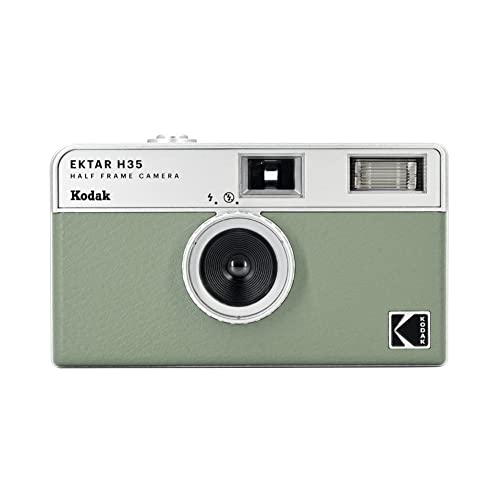
Kodak EKTAR H35 Half Frame Film Camera (Sage) — Best first roll
The EKTAR H35 built its reputation on a single piece of arithmetic that every film beginner feels in their wallet: it is a half-frame camera, exposing two vertical frames where a normal 35mm camera exposes one, so a roll bought for 36 exposures delivers roughly 72 smaller photographs. For someone whose first three rolls are mostly tuition — frames spent learning how light behaves, how labs scan, how their own eye composes — doubling the class size at no extra film cost is the kindest feature a camera can offer. The listing describes the H35 as reusable, focus-free, lightweight and easy to use, and that quartet of adjectives is the whole design brief. There is no focusing to get wrong, no exposure mode to mis-set, and almost no weight to resent on a long walk.
Shooting with a focus-free half-frame camera teaches a particular discipline that beginners rarely expect to enjoy. Because the lens is fixed and everything from arm’s length outward is acceptably sharp, the photographer’s only real decisions are where to stand and when to press. Composition stops being a settings problem and becomes a seeing problem, which is the correct order for learning. The vertical native orientation of half-frame also suits the way most beginners actually share photographs now — tall frames for phone screens — and pairs of adjacent frames can be scanned together as diptychs, a small creative bonus that owners discover quickly and then use constantly.
The honest limitations follow from the same simplicity. Each frame uses half the negative area, so enlargements and heavy cropping show grain sooner than full-frame work; a beginner planning wall-sized prints is asking the wrong camera. The listing title does not mention a built-in flash for this original H35, and the specification box below records that silence rather than assuming one — evening and indoor shooting should be planned around available light or confirmed against the manufacturer’s documentation before purchase. Film and the AAA battery are explicitly not included, per the title, so the box alone does not make a photograph; add a roll and a battery to the same order.
- Format: 35mm half-frame — two frames per standard exposure
- Focusing: Focus-free, per the listing title
- Flash: Not stated in the listing title — verify with the manufacturer documentation
- Power: AAA battery, not included
- Film: Not included
- Finish: Sage
Strengths
- Roughly twice the frames per roll, which makes experimentation feel affordable.
- Focus-free operation removes the most common beginner failure mode entirely.
- Lightweight body that genuinely disappears into a jacket pocket or tote bag.
Trade-offs
- Half-size negatives show grain earlier when enlarged or cropped hard.
- No flash is promised in the listing title, so dim interiors are a planning problem.
- Nothing to adjust means nothing to grow into once the basics click.
Best for: a first-time film shooter who wants the lowest cost per lesson and a camera that never asks a technical question back.
Not suited for: large exhibition prints from single frames — the half-frame negative runs out of resolution well before a full-frame one does.
Owners tend to fall for the diptych habit within a roll or two, pairing a wide scene with a detail from inside it. If that rhythm sounds appealing, check price on Amazon for the Sage finish and put a roll of colour film in the same basket, because the camera cannot begin its work without one.

Kodak Snapic A1 35mm Film Camera (Rhino Grey) — Best step-up starter
The Snapic A1 occupies the thoughtful middle ground of this guide: still a reusable, lightweight, compact 35mm camera, but with 2-zone focus in place of the fixed-focus free-for-all. Two zones sounds modest, and it is — deliberately. The photographer chooses between a near setting and a far setting, usually marked with pictograms of a head-and-shoulders portrait and a mountain scene, and that single small decision teaches the habit that separates photographers from button-pressers: estimating how far away your subject actually is. Beginners who spend a summer with zone focusing start pacing out distances in cafés and on platforms without noticing they are doing it, and that instinct transfers to every camera they will ever own afterwards.
Because the Snapic shoots full-frame 35mm rather than half-frame, each photograph gets the entire negative, and prints and scans hold up better when a favourite frame deserves enlargement. The trade is running cost: 24 or 36 exposures per roll instead of the H35’s doubled count. Which side of that trade suits you depends on temperament. Methodical shooters who compose carefully rarely feel the difference; promiscuous shooters who burn frames to find frames will feel it by the third roll. The Rhino Grey finish is the sober choice in the range, a dark neutral that does not announce itself across a room.
The listing is explicit that film and the AAA battery are not included, so the same advice given for the H35 applies with equal force here: the camera, a battery and at least one roll belong in the same order, or the unboxing ends in a shopping trip. The title does not state a built-in flash, and we record that in the specification box rather than guessing — anyone whose social life happens mainly after dark should verify flash provision against Kodak’s documentation before committing, because a camera without flash in a dim restaurant is a camera watching other people take photographs.
- Format: 35mm full-frame, reusable
- Focusing: 2-zone focus, per the listing title
- Flash: Not stated in the listing title — verify with the manufacturer documentation
- Power: AAA battery, not included
- Film: Not included
- Finish: Rhino Grey
Strengths
- Zone focusing builds real distance-estimation skill while staying nearly foolproof.
- Full-frame negatives enlarge and crop more gracefully than half-frame ones.
- Compact, lightweight shell suits everyday carry rather than special occasions only.
Trade-offs
- Standard frame count per roll means standard developing bills.
- Two zones still punish a misjudged portrait distance with soft focus.
- Flash provision is unconfirmed by the title, so night shooting is uncertain.
Best for: the beginner who already knows focus-free feels too passive and wants one meaningful decision to make per frame.
Not suited for: close-up work at conversational distances in dim rooms, where a two-zone system and an unconfirmed flash leave no margin.
Think of the A1 as the bicycle with one gear change: still simple, but your legs learn something. Check price on Amazon, and if the bundle version reviewed further down is close in cost on the day, its included film roll is worth weighing seriously.

Kodak EC35 35mm Film Camera — Best with flash built in
The EC35 is the pick that read the beginner brief most literally: its listing title actually contains the words “Beginner Friendly”, alongside focus-free operation, a built-in flash and a slide cover, in Avocado Green. Each of those details answers a real first-camera anxiety. The built-in flash answers the birthday-dinner problem — most beginners shoot indoors, at night, at people they love, and a camera that cannot light that scene fails its owner at exactly the moments that matter most. The slide cover answers the pocket problem: sliding a protective cover over the lens guards the one part of a cheap camera that scratches easily, and on many cameras of this class the cover doubles as the on-off gesture, making the camera’s state obvious at a glance.
Focus-free optics keep the EC35 honest about its mission. Portraits at a metre or two, group shots across a table, street scenes and holiday landscapes all land in the generous zone of acceptable sharpness, while true close-ups soften — a fair bargain for a camera that never once asks its owner to estimate a distance or turn a ring. The camera runs on an AA battery rather than the AAA cells of its H35 cousins, a mundane detail with a practical upside: AA batteries are the easiest cells on earth to replace in a hurry, sold in petrol stations and corner shops on every continent.
Film and the AA battery are excluded from the box, as the title states, so the same one-order discipline applies. What the EC35 asks in return for its friendliness is acceptance of its ceiling: there is no panorama mode, no bulb setting, no second focusing zone, nothing to unlock later. One evening suffices to learn every control on this camera, and for a large share of beginners that simplicity removes the barrier that stops first rolls ever being shot. The learning it offers is about film stocks, light and timing rather than controls, and those lessons are the durable ones.
- Format: 35mm full-frame, reusable
- Focusing: Focus-free, per the listing title
- Flash: Built-in flash, per the listing title
- Cover: Slide cover over the lens
- Power: AA battery, not included
- Film: Not included
- Finish: Avocado Green (Single)
Strengths
- Built-in flash covers the indoor social shooting beginners actually do most.
- Sliding cover protects the lens and makes the camera’s state obvious.
- AA power is replaceable anywhere on earth within minutes.
Trade-offs
- Focus-free lens softens genuine close-ups.
- No creative modes to graduate to once confidence arrives.
- Standard frames per roll, so developing costs run at the normal rate.
Best for: a social shooter whose film life will happen at dinners, parties and family gatherings rather than on landscape trips.
Not suited for: deliberate long-exposure or panoramic work — the feature set contains neither a bulb mode nor a wide format.
If your camera roll on your phone is ninety percent people at tables, this is your film camera wearing a name tag. Check price on Amazon and add a twin-pack of AA cells and a first roll before checkout, because neither rides along in the box.

Kodak EKTAR H35N Half Frame Film Camera — Best creative half-frame
The H35N is what happens when the half-frame idea grows a playful streak. It keeps the original H35’s economy — two frames per exposure, focus-free lens, reusable body — and adds, per its listing title, a bulb function, a built-in star filter and a coated, improved lens, finished here in Striped Black. Each addition targets a specific beginner curiosity. The bulb function holds the shutter open for as long as the photographer dictates, which is the doorway to light trails, night streets, fairground rides and all the long-exposure mischief that fixed-shutter cameras cannot attempt. The star filter turns point lights — streetlamps, candles, harbour reflections — into radiating starbursts without any accessory purchase, an effect that is admittedly kitsch and undeniably fun on a night walk.
The coated, improved lens matters in a quieter way. Coatings tame flare and lift contrast when shooting toward the light, and half-frame negatives, being small, benefit from every scrap of optical help they can get when scanned and enlarged. None of this changes the fundamental H35 bargain: twice the frames, half the negative area, grain arriving earlier in big prints. The N simply spends that bargain more creatively. A beginner who suspects they are a night owl — who photographs cities after dark and likes their pictures a little theatrical — will use the bulb mode weekly; a daylight documentary shooter will barely touch it, and for that shooter the plainer H35 remains the smarter buy.
Film and the AAA battery are again excluded per the title, and bulb shooting makes one accessory close to mandatory: the camera must be held still during long exposures, braced on a wall, a bench or a tripod, because hand-held bulb frames are abstract art whether you intended them or not. The listing title does not state a tripod socket or a cable-release thread, so the specification box records that silence — plan to brace the body rather than assuming hardware the title never promises.
- Format: 35mm half-frame, reusable
- Focusing: Focus-free, per the listing title
- Special modes: Bulb function; built-in star filter
- Lens: Coated, improved lens, per the listing title
- Tripod socket: Not stated in the listing title — verify with the manufacturer documentation
- Power: AAA battery, not included
- Film: Not included
- Finish: Striped Black
Strengths
- Bulb mode unlocks night and long-exposure photography the base H35 cannot attempt.
- Star filter delivers a distinctive effect with zero extra accessories.
- Half-frame economy still applies to every roll.
Trade-offs
- Small negatives plus night grain is a combination that tests scanning quality.
- Bulb shooting demands a braced camera; handheld attempts blur.
- The creative extras are wasted on purely daylight, snapshot-style shooting.
Best for: the night-leaning beginner who wants half-frame economy and a shutter that stays open on command.
Not suited for: big, clean enlargements — half-frame area plus long-exposure grain caps print size quickly.
Picture a riverside at blue hour, the camera resting on a railing, lights doubling themselves in the water as starbursts. That is the H35N’s home turf. Check price on Amazon if it sounds like yours, and budget for a small support or at least a beanbag alongside the first rolls.

RETO PANO 35mm Film Camera — Best wide view
Every other linked camera in this guide sees the world through a conventional field of view. The RETO PANO, in Sheer White, is built around a 22mm wide lens and a switchable panorama format, and that changes the photographs a beginner takes from the very first roll. A 22mm lens swallows whole rooms, entire facades and wide valleys without the photographer retreating into traffic or off a cliff edge; the panorama switch crops the frame into a cinematic letterbox that flatters coastlines, city skylines and long tables of friends. RETO describes cinematic modes and an easy switch between formats, plus a lens cover and a built-in flash, so the wide view does not come at the cost of the indoor usefulness the EC35 trades on.
Wide lenses teach their own lessons, some of them stern. A 22mm frame includes everything, including the clutter at the edges you did not notice, the tilted horizon you did not level and your own shadow at noon. Beginners often find their first wide rolls messy, then discover the discipline the lens is teaching: move closer, level the camera, and let one strong subject anchor the sweep. Panoramas reward patience at the scan stage too — tell your lab the roll mixes formats if your switch produced both, because frame spacing confuses fully automatic scanning setups and a note in the order saves a confused email exchange.
The PANO runs on an AAA battery that is not included, and film is excluded as well, per the title. Focusing details are not stated in the listing title, so the specification box records that honestly instead of borrowing assumptions from the camera’s siblings; anyone for whom the focusing method is a deciding factor should confirm it in RETO’s documentation. What the title does promise — the wide lens, the panorama switch, the flash, the cover — is a coherent package aimed at travellers, and it is the only pick in this guide whose argument is a way of seeing rather than a way of saving money or simplifying controls.
- Format: 35mm, reusable, with switchable panorama mode
- Lens: 22mm wide lens, per the listing title
- Modes: Cinematic modes with an easy format switch
- Flash: Built-in flash, per the listing title
- Focusing: Not stated in the listing title — verify with the manufacturer documentation
- Power: AAA battery, not included
- Film: Not included
- Finish: Sheer White
Strengths
- 22mm lens captures interiors and landscapes that defeat normal lenses indoors and out.
- Panorama switch adds a genuinely different format, not a menu gimmick.
- Built-in flash keeps the wide view usable after sunset.
Trade-offs
- Wide frames punish tilted horizons and edge clutter without mercy.
- Mixed-format rolls need a note to the lab to scan correctly.
- Portraits at close range distort faces unflatteringly at 22mm.
Best for: travellers and landscape leaners who compose in sweeps rather than details.
Not suited for: flattering close portraits — a 22mm lens stretches faces near the edges in ways nobody thanks you for.
If your phone gallery is mostly horizons, harbours and big rooms, the PANO speaks your language natively. Check price on Amazon, and order film in the same basket; a panoramic camera with an empty chamber is just a white brick with ambitions.

Kodak Snapic A1 Film Camera Bundle with Film — Best ready-to-shoot kit
This bundle exists to solve the single most common beginner disappointment in this entire guide: the camera arrives, the box opens, and nothing can be photographed because film was a separate purchase nobody made. Here, the Snapic A1 in Rhino Grey arrives with a roll of Kodak Ultramax 400 with 24 exposures, per the listing title, so the distance between delivery and first frame is the time it takes to load a roll and fit a battery. Ultramax 400 is a sensible first film for a zone-focus camera — a versatile colour stock whose speed suits mixed daylight and indoor shooting, forgiving of the exposure approximations a simple camera makes.
The camera itself is the same Snapic A1 reviewed above: reusable, lightweight and compact, with 2-zone focus teaching distance estimation and a full-frame negative that enlarges kindly. Buying it as a bundle rather than alone is a statement about which problem you would rather have. The standalone camera leaves film choice open — some beginners want to start on black and white, or on a slower fine-grain stock for a sunny trip — while the bundle trades that choice for immediacy. Neither is wrong; they suit different kinds of first weekend. A gift purchase, though, should almost always be the bundle, because a gift that cannot be used until a second purchase arrives is a gift with homework attached.
One detail still needs attention at checkout: the bundle’s title names the film but the camera still wants its AAA battery, and the title of the standalone camera states the battery is not included — assume the same here and add a battery rather than discovering its absence at a birthday party. Twenty-four exposures is also a short roll by film standards; treat it as the training roll it is, shoot it fully within a week or two while the learning is fresh, and get it developed promptly so the feedback loop between pressing the shutter and seeing results stays tight enough to teach from.
- Format: 35mm full-frame, reusable
- Focusing: 2-zone focus, per the listing title
- Included film: Kodak Ultramax 400, 24 exposures, per the listing title
- Flash: Not stated in the listing title — verify with the manufacturer documentation
- Power: AAA battery — treat as not included and add one to the order
- Finish: Rhino Grey
Strengths
- Film in the box means the camera shoots the day it arrives.
- Ultramax 400 is a forgiving, versatile first stock for mixed light.
- The underlying A1 remains a sound step-up starter once the first roll ends.
Trade-offs
- The included roll is 24 exposures — a sampler, not a supply.
- Film choice is made for you; black-and-white starters must buy separately anyway.
- The battery question still needs solving at checkout.
Best for: gift buyers and impatient beginners who want the first frame exposed within the hour.
Not suited for: a long trip’s only film supply — one 24-exposure roll runs out before the second day of any real holiday.
As a present, this is the version that gets used at the party instead of admired and shelved. Check price on Amazon, add the battery, and consider a second roll in the same order so the momentum survives the first development envelope.
Canon AE-1 — Prose-only: the classic teacher
The AE-1 is the camera that taught the late twentieth century to photograph, and its absence of a purchase link here needs its explanation stated plainly: on Amazon it is sold as a renewed listing, refurbished by third-party sellers, and a renewed forty-year-old camera is a lottery ticket whose odds depend entirely on the individual body and the honesty of its refurbishment. So this entry teaches instead of selling. What the AE-1 offers a beginner is the complete grammar of photography in one machine — shutter-priority automatic exposure with manual override, a proper through-the-lens meter, interchangeable lenses, and a viewfinder that shows you exactly the frame the film will receive. A season with an AE-1 teaches more transferable skill than a year with any camera in the linked list above.
Buying one renewed is a skill in itself, and the checks are learnable. Light seals first: the foam strips sealing the film door degrade into sticky crumbs, leaking light onto film as orange streaks, so ask whether seals have been replaced and inspect the door channels for black goo or fresh foam. Battery second: the AE-1’s electronics, including its meter and shutter, depend on a single battery, so confirm the battery compartment is free of green corrosion and that the battery check responds. Meter third: point the camera at a bright scene and a dark one and watch the viewfinder needle or display react sensibly to both. Add the shutter at several speeds, listening for the difference between fast and slow, and the film advance for smoothness, and you have the core inspection — five minutes that separate a serviced classic from a shelf ornament.
The AE-1’s teaching value is real, but so is the patience it demands: no autofocus, no program mode holding your hand, and a body weight that makes the Kodak reusables feel like toys. Beginners who thrive on it tend to be the methodical sort who enjoy machinery. Everyone else should start new, start simple, and let an AE-1 be the graduation present they buy themselves later — checked, sealed and metered, in that order.
- Format: 35mm SLR, interchangeable lenses
- Exposure: Shutter-priority automatic with manual control (general model knowledge)
- Availability: Renewed listings on Amazon — no link in this guide
- Pre-purchase checks: Light seals, battery compartment, meter response, shutter speeds, film advance
Strengths
- Teaches the full exposure grammar that every later camera assumes.
- Interchangeable lenses open portrait, wide and telephoto paths in one system.
- Huge knowledge base — every fault it can develop is documented somewhere.
Trade-offs
- Renewed condition varies wildly between individual bodies and sellers.
- Electronics depend on the battery; a dead cell means a dead camera.
- Heavy and deliberate compared with every new camera in this guide.
Best for: the methodical beginner who wants to learn photography as a craft, machinery included.
Deadline work collapses here because renewed stock arrives without any warranty standing behind it or any promise of readiness.
Pentax K1000 — Prose-only: the mechanical purist
If the AE-1 is the classic classroom, the K1000 is the classic workbench: an all-mechanical SLR whose battery powers nothing but the light meter, leaving the shutter entirely to springs and gears. That architecture is exactly why generations of photography students were issued K1000s — there is almost nothing electronic to fail, the controls are reduced to shutter speed, aperture and focus, and the meter’s needle in the viewfinder makes the relationship between light and settings visible as a physical swing. It is also, on Amazon, a renewed-only proposition, which is why it stands here without a link, in the same honest category as the AE-1.
The renewed inspection for a K1000 rhymes with the AE-1’s but emphasises different verses. Seals matter again — the door foam is the same age and dies the same death. Shutter speeds matter more: work through the dial from the slowest setting to the fastest, firing each, and listen for a clean progression rather than a camera that sounds identical at every speed, which suggests the slow speeds have gummed into one. The meter needle is the third check: with a battery fitted, the needle should centre in even light, swing when you point at a window, and settle rather than jitter. A dead meter does not kill a K1000 — the camera still shoots, meterless, which is more than an AE-1 can claim — but a beginner buying a teacher should buy one whose teacher’s voice works.
Choose between the two prose-only classics by temperament. The AE-1’s automation helps a beginner get keepers sooner; the K1000’s austerity builds understanding faster and forgives neglect better. Both demand the renewed buyer’s five-minute discipline, and both reward it with something no new reusable camera can offer: the feeling of a machine built to be repaired rather than replaced. Start simple if you are unsure — the linked cameras above will still be there, new in their boxes, when a K1000-shaped curiosity arrives.
- Format: 35mm SLR, interchangeable lenses
- Operation: Fully mechanical shutter; battery serves the meter only (general model knowledge)
- Availability: Renewed listings on Amazon — no link in this guide
- Pre-purchase checks: Light seals, full shutter-speed range, meter needle response, advance smoothness
Strengths
- Shoots without a battery — only the meter goes silent.
- The minimal control set is a complete photography course in three dials.
- Mechanical construction shrugs off decades in a way electronics cannot.
Trade-offs
- Renewed examples vary; seals and slow shutter speeds are the usual casualties.
- No automatic exposure of any kind to rescue a rushed frame.
- Substantial weight next to the modern reusable cameras.
Best for: the beginner who learns by taking mechanisms seriously and wants a camera that outlives batteries.
Not suited for: fast-moving subjects shot on instinct — manual everything means missed frames while skills form.
Full-Frame, Half-Frame or Panorama — Which Format Should a Beginner Choose First?
Format is the decision hiding underneath every pick above, so it deserves direct treatment. Full-frame 35mm — the Snapic A1 and the EC35 — gives each photograph the whole negative, the best enlargement potential and the simplest relationship with labs, at the standard number of frames per roll. Half-frame — the H35 pair — doubles the frames and halves the negative, trading ultimate print size for a running cost that makes prolific learning painless. Panorama — the RETO PANO — keeps the full frame’s height decision in the photographer’s hands via its switch, producing letterbox images that suit scenery and strain portraits.
Match format to your dominant subject and the answer usually resolves itself. People and everyday scenes: full-frame, because faces deserve negative area. Sheer volume of practice, travel journals, zines and social sharing: half-frame, because the frames are plentiful and the native orientation is vertical. Landscapes and architecture: panorama tempts, though a full-frame camera can always be cropped later while a panorama frame cannot be un-cropped. Beginners paralysed by the choice should default to whichever camera they will carry most — format debates dissolve the first time the perfect frame appears while the “better” camera sits at home.
How Do You Load, Shoot and Finish a First Roll Without Wasting It?
Loading is the ritual that intimidates newcomers most, and it is a two-minute skill. Open the back, drop the cassette into the chamber, pull the leader across to the take-up spool until it catches, close the door and advance twice while watching the rewind knob turn — that turning knob is your proof the film is moving, on every camera in this guide. Shoot the first roll in forgiving conditions: daylight, ordinary subjects, no once-in-a-lifetime events riding on frame twelve. Keep a notebook or a phone note of what each frame was and what the light was doing; when the scans return, that log converts a pile of surprises into a lesson plan.
Finishing matters as much as starting. Rewind fully before opening the back — the rewind knob will spin freely and the tension will release when the leader leaves the take-up spool — and never open a camera mid-roll on a suspicion, because light fogs every frame still outside the cassette. Send the roll out promptly; film shot in January and developed in September teaches nothing, because you will remember none of the decisions that produced it. Beginners improve fastest on a tight loop: shoot a roll a week, review it hard, write down two mistakes, and make the next roll answer them.
What Should You Check Before Buying Any Renewed Film Camera?
The prose-only classics above generalise into a checklist worth keeping for any renewed or second-hand body, from any seller, anywhere. Seals: look inside the film door channels for foam that is crumbling, sticky or missing, and budget for replacement if it is tired. Battery: open the compartment and reject corrosion on sight — green crust means leaked cells and possibly damaged contacts beyond it. Meter: fit a fresh battery, then point the camera at a bright window and a dark corner and demand a needle or display that responds to both. Shutter: fire every speed and listen for a progression, especially the slow speeds that gum up first. Advance and rewind: both should move with even resistance, never grinding, never slipping. Glass: shine a light through the lens and look for fungus webs, haze or cleaning scratches.
Then read the renewed listing itself the way you would read a contract. Who refurbished it, what does their process claim to include, and what is the return path if the meter dies in week two? A seller who describes seal replacement and shutter testing by name is a different proposition from one selling “vintage vibes, untested”. Price your risk accordingly, and remember that a serviced body from a camera shop — with a short warranty and a human behind a counter — is a legitimate third route between Amazon renewed and brand new, even though it appears in no table here.
Which Film Stock Should Your First Five Rolls Be?
Beginners agonise over film choice with an intensity the subject does not deserve, because the first five rolls have one job: to teach. Any fresh, versatile colour stock in the 400-speed class does that job — it tolerates the exposure guesses of simple cameras, works in daylight and under kitchen lighting alike, and is handled by every lab on earth without special instructions. Consistency beats variety at this stage. Shooting five different stocks in your first five rolls scrambles the feedback, because when a frame surprises you, you cannot tell whether the camera, the light or the emulsion is responsible. One stock, five rolls, notes taken: that is a curriculum. Variety is the reward afterwards.
Black and white earns an early exception for one specific kind of learner — the one who finds colour a distraction from light itself. Monochrome simplifies every frame into brightness and shape, developing at home is genuinely feasible in a bathroom with modest equipment, and the discipline transfers back to colour work later. Half-frame shooters should also think about grain earlier than full-frame shooters do: small negatives enlarge grain, so a fine-grain stock flatters the H35 pair on bright days, while a fast, grainy stock in a half-frame camera at dusk produces atmosphere whether you wanted it or not. Match the emulsion to the negative size and the light, in that order, and the results stop looking accidental.
Expiry dates deserve a calm word, because beginners meet discounted short-dated film early and wonder whether it is a bargain or a trap. Fresh film stored cool behaves predictably; film near or past its date usually still works, shifting colour and losing a little speed as it ages. For learning rolls, predictable beats cheap — save the expired-film experiments for month six, when you can recognise what the film did versus what you did. Store your working stock in a drawer away from radiators and car dashboards, shoot it within the season you bought it, and the chemistry will hold up its end of the bargain every time.
Common Mistakes
The classic first-roll mistake is opening the back to check whether the film is advancing, which fogs the frames already exposed and answers the question by destroying the evidence. Trust the rewind knob instead. Close behind it comes buying the camera alone — no film, no battery — and losing a week’s enthusiasm to delivery schedules; every linked pick in this guide states its exclusions in its title, so read titles the way pilots read checklists.
Flash discipline causes the third family of failures. Beginners either never use the built-in flash indoors, producing orange murk, or use nothing else, producing startled-deer portraits at noon. Learn what your camera has — the EC35 and PANO state a built-in flash in their titles, the H35 and Snapic titles are silent — and plan the evening around the truth rather than the hope. A quieter mistake is hoarding the first roll unshot for a special occasion. Special occasions deserve a practised photographer; burn the first two rolls on pavements, pets and park benches so the wedding roll lands in skilled hands.
Finally, beginners chronically under-budget the back end of the process. Developing and scanning are recurring costs that dwarf the price difference between any two cameras in this guide within a few months, which is why the half-frame picks exist and why choosing a lab — local or mail-in — belongs in week one, not after the fifth roll is sitting in a drawer going stale.
Should Your First Camera Be New, or a Checked Classic?
Strip away the product names and the beginner decision is really about where you want your uncertainty to live. A new reusable camera concentrates all uncertainty in the photographs: the machine is a known quantity, so every strange frame is information about light, film or your own eye. A renewed classic spreads uncertainty across machine and image alike — a light leak might be a seal, a dead frame might be a tired shutter — and interpreting results takes longer because the camera itself is a variable. For pure learning speed, the new camera wins, and it is not close. The classic wins on a different axis entirely: depth of control, lens choice, and the possibility that the camera you learn on is also the camera you keep for a decade.
There is a hybrid sequence that suits many readers of this guide, and it is worth stating as plainly as the picks themselves. Begin new and simple, shoot six rolls with discipline, and read the scans hard. By roll six you will know whether film is a phase or a practice — and if it is a practice, you will shop for a renewed AE-1 or K1000 with a photographer’s eye, able to run the inspection checks as someone who understands what a meter is for. The beginners who regret their first camera are rarely the ones who started too simply; they are the ones who started too expensively, in either direction, before knowing what they actually enjoyed shooting.
Final Recommendation
Start where your temperament points. The purely curious should take the EKTAR H35 and its doubled frames, and learn photography at half price per lesson. Social shooters belong with the EC35 and its built-in flash. The distance-curious graduate early to the Snapic A1 — or its film-included bundle as a gift — while night owls and horizon chasers split toward the H35N and the RETO PANO respectively. And the methodical few who know already that machinery is half the pleasure should skip the new shelf entirely, run the seal-battery-meter ritual on a renewed AE-1 or K1000, and learn the craft the slow, permanent way. Whichever door you choose, choose it this week: film skill is built by rolls finished, not by cameras compared.
Frequently Asked Questions
Is film photography expensive to start in 2026?
The cameras in this guide are among the cheapest routes into any photographic system, but the honest recurring cost is film plus developing and scanning, roll after roll. Half-frame cameras halve the per-frame cost, and shooting deliberately — one roll a week, reviewed properly — keeps the hobby cheaper than most people fear while teaching faster than binge shooting does.
Why are the Canon AE-1 and Pentax K1000 not linked for purchase?
Because their Amazon listings are renewed stock: refurbished by third parties, with condition that varies body to body. A link from us would imply a confidence in an individual used camera that nobody can honestly hold. They are covered in full above, with the inspection checks — seals, battery compartment, meter, shutter speeds — that make a renewed purchase a calculated decision instead of a gamble.
What film should a beginner load first?
A versatile colour stock in the 400-speed class is the standard advice, and the Snapic bundle’s included Ultramax 400 shows why: it copes with daylight and tolerable indoor light, forgives simple cameras’ exposure guesses, and every lab handles it. Once one roll has taught you your camera’s habits, branch into slower fine-grain stocks for bright trips or black and white for its own sake.
Do these cameras need batteries to work?
The new reusable cameras use a single AA or AAA cell, mostly to power the flash and metering where fitted — and the titles are explicit that the battery is not included, so add one to the order. The K1000’s shutter is fully mechanical and fires with no battery at all; only its meter sleeps. The AE-1 sits at the other pole, electronically dependent on its battery for shutter and meter alike.
Can a lab develop half-frame and panorama rolls normally?
Yes — the film is standard 35mm, and any lab develops it identically. The difference arrives at scanning: half-frame rolls yield twice as many frames, and mixed-format panorama rolls can confuse automated scanning, so mention the format when you drop the roll off. A one-line note saves rescans and keeps adjacent half-frame pairs together if you want them scanned as diptychs.
How long will a reusable plastic camera last?
These are light, simple mechanisms with few failure points, and owners routinely run them for years of weekend use. Their enemies are sand, immersion and being sat on, rather than any internal wear clock. Treat the camera like a paperback book rather than a power tool and it will outlast your beginner phase comfortably — which is all it was ever asked to do. When one finally does tire, its replacement costs less than a few months of developing, which is precisely the economic logic that makes these simple cameras such rational teachers.
Related Guides
Beginners who catch the automation bug after a season of focus-free shooting should look at compacts that focus, wind and flash entirely by themselves in our guide to automatic compact film cameras that handle everything. When the urge for interchangeable lenses and a proper SLR arrives, the EF-mount lineage is traced in our roundup of Canon EOS film cameras from Rebel kits to the EOS-1V. And for the full sweep of the autofocus era — the flagships and the people’s cameras alike — our history-minded survey of the best autofocus 35mm film cameras of all time picks the story up where the AE-1 left it.


