What's inside
- Key Takeaways
- Quick Picks
- How We Chose the Best 12 Camera High Definition Security Cameras
- Comparison
- How do you actually expand a kit to twelve cameras?
- How much footage will the hard drive really hold?
- What does the installation weekend actually look like?
- Where should the recorder itself live?
- How do you divide twelve viewpoints across a real property?
- What separates a kit that lasts a decade from one that lasts a season?
- How do detection and alerts work across twelve channels?
- Common Mistakes
- Final Recommendation
- Frequently Asked Questions
- Related Guides
As an Amazon Associate I earn from qualifying purchases. This post may contain affiliate links at no extra cost to you.
widgetverdict.com is reader-supported. When you buy through links on our site, we may earn an affiliate commission.
Where to buy: The best 12 camera high definition security cameras are kits, and the kits below are sold through Amazon, where you can check price on Amazon and confirm exactly how many cameras, what hard drive size, and which recorder the box in front of you contains — kit configurations vary, and the details matter more here than in any other camera category. One pick is covered in prose only, without a link, since its bundle could not be confirmed.
Here is the misunderstanding this entire guide exists to correct: almost nobody searching for the best 12 camera high definition security cameras is actually shopping for a box with twelve cameras in it. They are shopping for a property that needs about twelve viewpoints — and the industry sells that coverage as a recorder with a channel count, plus a starter set of cameras, plus room to grow. A “16-channel” kit with eight cameras in the box is not a trick; it is the standard shape of the product, and it is usually the smart way to buy, because the recorder outlives several generations of cameras and the empty channels are where your future viewpoints plug in. Read this guide and you will be able to decode any kit listing in the category: channels, cameras included, drive size, and the honest cost of reaching twelve working viewpoints.
The five linked kits below are all built around network video recorders — NVRs — with Power over Ethernet or, in one case, a Wi-Fi design, and they split into two philosophies. Reolink’s systems dominate the list because the brand has made the kit its home ground: wired PoE cameras, a recorder with a real hard drive, person and vehicle detection, and no subscription anywhere in the design. The Hiseeu kit argues the other side: a wireless camera fleet for buildings where running Ethernet to every viewpoint is the deal-breaker. The sixth pick, covered in prose, represents the traditional CCTV brands’ approach. Between them, every route to a twelve-viewpoint property is mapped, with the arithmetic of expansion spelled out for each. If you read nothing else, read the comparison table and the expansion section: they contain the two skills — reading a kit’s real contents, and pricing the road to twelve — that transfer to every listing in this category, including the ones not named here.
One commitment before the picks: every kit below is described with its box contents stated separately from its capacity. When a kit is called “16-channel with eight cameras,” both numbers appear, every time, because the distance between them is precisely where buyers get confused — and where the honest value of these systems actually lives. A buyer who masters that one distinction can walk past a wall of kit boxes, in any store or any listing page, and know within a minute which three deserve a second look — and that fluency, more than any single recommendation below, is what a twelve-camera purchase actually requires.
Key Takeaways
- Channels are capacity, cameras are contents: a 16-channel recorder with 8 cameras included covers 8 viewpoints today and accepts 8 more later, at the cost of the cameras alone.
- Reaching twelve viewpoints usually means buying a 16-channel kit with 8 cameras and adding 4 cameras — or an 8-camera kit on a 16-channel recorder from the same family — so confirm the recorder’s channel count before anything else.
- PoE wiring powers each camera through its Ethernet cable, records around the clock to the recorder’s hard drive, and owes nothing to Wi-Fi or subscriptions.
- Hard drive size is retention: the included 2TB and 4TB drives hold days to weeks of multi-camera recording, and larger or additional drives extend that window.
- Detection has moved into the cameras and recorder — person, vehicle, and on better kits pet recognition — so alerts no longer require a cloud plan.
- Cable is the real installation budget: your time, your drill, and your cable runs, far more than the price difference between kits.
- Record on all channels, alert on few: person and vehicle tags make twelve cameras searchable, but only a short alert roster keeps the owner’s attention worth having.
Quick Picks
| Kit | Badge | Why it earns its place |
|---|---|---|
| Reolink RLK16-1200D8-A 12MP System | Best route to twelve | A 16-channel recorder with 8 cameras in 12MP detail — add four cameras and the twelve-viewpoint system is complete. |
| Reolink RLK16-800B8 | Best 4K value system | 16 channels, 8 bullet cameras, and a 4TB drive: the classic expandable backbone for a large property. |
| Reolink RLK8-800D4 | Best mid-size foundation | An 8-channel, 4-camera 4K turret kit for homes that will grow to eight viewpoints, not twelve. |
| Reolink RLK8-800PT4 | Best with tracking cameras | Pan-tilt auto-tracking cameras on an 8-channel recorder for yards where subjects move across open ground. |
| Hiseeu 4K 16CH NVR Kit | Best no-cable-run system | A 16-channel recorder with 8 Wi-Fi cameras for buildings where Ethernet runs are impractical. |
| Lorex 4K 16-Channel Fusion System | Traditional CCTV alternative | A long-established brand’s wired system with local recording and a broad camera ecosystem. |
How We Chose the Best 12 Camera High Definition Security Cameras
Kit evaluation starts with the recorder, because the recorder is the ten-year purchase and the cameras are the consumables. We checked channel count first — the ceiling on the whole system — then the recorder’s drive bays and maximum supported capacity, because retention is bought there. Next came the cameras in the box: their resolution class, whether detection for people and vehicles runs on the camera or not at all, and the night design, since a twelve-viewpoint property will have cameras in full darkness at its edges. PoE simplicity counted heavily: a single cable per camera carrying power and data is the reason this category exists, and kits that honor that simplicity end to end — recorder ports, included cable lengths, camera connectors — were favored over kits that reintroduce power adapters at every viewpoint.
Expansion honesty was the second filter. A kit earns a place in a twelve-camera guide only if its path to twelve is real: spare channels, additional cameras actually sold for the system, and a recorder interface that treats a mixed fleet — bullets here, a turret there, a tracking camera at the gate — as normal. We also weighed the viewing software, because a twelve-camera household lives in its recorder’s app and desktop client; timeline search across channels, synchronized playback, and sane user permissions for family members all mattered. Finally, the no-subscription test: every pick here records locally and charges nothing monthly for its core function, which remains the category’s founding advantage over app cameras.
What did not decide anything: the raw camera count in a headline. Several kits advertise big numbers that dissolve into fewer channels or cameras on inspection, and any kit whose listing could not state its box contents plainly was set aside regardless of its other virtues. In a category built on arithmetic, candor about numbers is the first specification. That standard is also why this guide names ceilings as loudly as capacities: an 8-channel recorder in a twelve-camera guide is not an embarrassment to be footnoted but a boundary to be printed in the same size type as the headline, because the buyer it protects — the one whose count is truly twelve — is exactly the buyer the headline attracted.
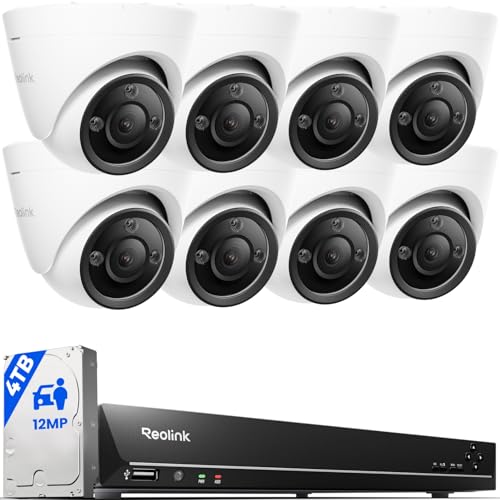
Reolink RLK16-1200D8-A 12MP System — Best route to twelve
If the destination is genuinely twelve viewpoints, start here and do the arithmetic in the open. The recorder offers 16 channels. The box contains 8 cameras. Your property gets 8 working viewpoints on install day, 8 spare channels wait in the recorder, and the road to twelve is exactly four additional compatible cameras — no new recorder, no rewiring of the core, no second system. The cameras themselves record in 12MP detail, the sharpest in this guide, with person, vehicle, and pet detection, two-way talk, and spotlights for color night recording. A 4TB hard drive is fitted for the around-the-clock recording that is the entire point of a wired system. This is the kit for the buyer who counted their viewpoints honestly — front, back, both sides, garage, gate, and the corners in between — and arrived at a number near twelve.
The 12MP resolution deserves a calibrated word. At kit distances — across a yard, down a drive — the extra detail over the 4K kits below is visible in exactly the situations that justify it: faces at the far post, plate characters at the gate, the zoomed crop of a recorded event rather than the live whole-frame view. It also writes larger files, so the 4TB drive holds fewer days than it would behind 4K cameras, and owners planning long retention should price a larger drive into the build from the start. Detection quality is the quieter headline: with pet recognition joining person and vehicle, the farm-and-garden false alerts that plague lesser systems fall away, and the recorder’s timeline becomes a document you can search rather than a swamp you must drain.
Installation is the standard PoE discipline: one Ethernet run per camera, home-run to the recorder, camera powered through the same cable. Twelve viewpoints means twelve runs, and the honest planning unit is an afternoon per handful of cameras, not per camera. Buy this kit when the property is large, the viewpoints are counted, and the system is expected to serve a decade — it is the most complete expression of the category in this guide.
A word about who should not let the 12MP headline rush them: the owner whose viewpoints are mostly close work — porches, doors, a short drive — will rarely cash the resolution’s cheque, because at ten feet every kit in this guide identifies a face. The 1200D8-A earns its premium at the property’s long edges, and buyers should audit their own viewpoint list for long edges before paying for them. Where two or more posts sit beyond a driveway’s length from the subject, the premium is already justified; where none do, the 4K backbone below is the same architecture with the savings available for the four added cameras this buyer will need anyway.
- Recorder: 16 channels, 4TB hard drive fitted
- Cameras in box: 8 PoE cameras, 12MP class
- Path to twelve: add any 4 compatible cameras
- Detection: person, vehicle, and pet, on-camera
- Night: spotlights with color recording, infrared fallback
- Fees: none — local recording, app viewing included
Strengths
- The only pick where twelve viewpoints is a shopping list, not a project.
- Sharpest detail in the guide for gate and far-post identification.
- Pet-aware detection suits farms, gardens, and dog-owning homes.
Trade-offs
- 12MP files shorten retention on the included drive.
- Highest commitment in the guide, in cost and cable alike.
- Eight spare channels tempt scope creep beyond the plan.
Best for: large properties that genuinely counted twelve viewpoints. Not suited for: small homes, renters, or anyone whose real count is five.
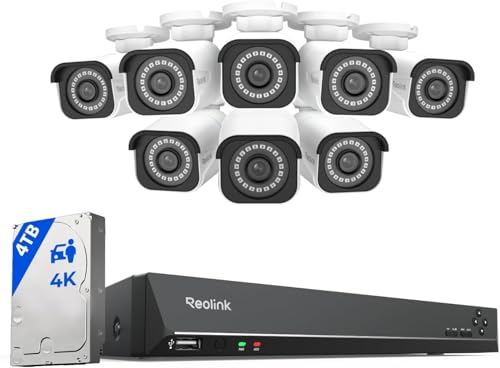
Reolink RLK16-800B8 — Best 4K value system
The RLK16-800B8 is the category’s classic backbone, and its numbers tell the same honest story in a slightly older dialect: a 16-channel recorder, 8 bullet cameras in the box, a 4TB hard drive, and 4K recording with person and vehicle detection. For the twelve-viewpoint buyer, the path is identical to the 12MP kit’s — add four cameras — at a gentler cost of entry, with the difference paid in resolution headroom rather than in any structural compromise. The bullet form factor suits eaves and wall mounts where a visible camera is part of the deterrent, and the system’s long presence in the market means additional cameras, replacement parts, and owner knowledge are all easy to find.
Judged against its 12MP sibling, this kit’s 4K images are the category’s sweet spot for most properties: identification-grade at driveway and yard distances, kinder to storage, and kinder to the network if footage is ever pulled across it. Retention on the 4TB drive stretches further than the 12MP kit’s, which matters to owners who review incidents weeks later — the landlord, the site manager, the household that travels. What the kit does not add is pet detection, so animal traffic will write more entries in the timeline; zones and sensitivity, set per camera, carry that load instead.
As a foundation it is deliberately unglamorous: no tracking theatrics, no wireless shortcuts, just sixteen channels of wired reliability that ask for cable and repay it with a decade of indifference to weather, Wi-Fi, and subscription tiers. Properties that will grow — a workshop this year, a gate camera next — should buy the recorder headroom now, because channels cannot be added later at any price. That single sentence is the whole case for this kit, and it is a strong one.
Long ownership is where this kit quietly separates itself from flashier launches. The recorder’s interface has been refined across generations rather than reinvented, the camera connectors are the standard weatherproof PoE fittings, and the second-hand and spare-parts ecosystem around the 800-series is the deepest in this guide. A system expected to run a decade should be boring in exactly these ways. Owners report the same arc repeatedly: an ambitious first weekend, a month of zone tuning, and then years in which the system’s only appearances are the alerts it was bought to send. For infrastructure, that is the highest praise available.
- Recorder: 16 channels, 4TB hard drive fitted
- Cameras in box: 8 PoE bullet cameras, 4K class
- Path to twelve: add any 4 compatible cameras
- Detection: person and vehicle, on-camera
- Night: infrared with spotlight-assisted models in family
- Fees: none — local recording throughout
Strengths
- Sixteen channels of headroom at the category’s value point.
- 4K detail balances identification against retention.
- Mature system with easy additional-camera availability.
Trade-offs
- No pet detection; animals will log more events.
- Bullet style is visible — a plus for deterrence, a minus for discretion.
- Eight cameras still to cable on day one.
Best for: growing properties that want 4K and maximum channel headroom. Not suited for: buyers needing pet-aware alerts or invisible cameras.

Reolink RLK8-800D4 — Best mid-size foundation
Not every reader of a twelve-camera guide needs twelve cameras, and this kit is the guide’s act of honesty toward them. The RLK8-800D4 pairs an 8-channel recorder with 4 turret cameras in the box and a 2TB drive. Its ceiling is eight viewpoints — stated plainly, because a buyer who truly needs twelve must not buy this recorder, and a buyer whose real count is five, six, or seven should not pay for sixteen channels they will never wire. The turret (eyeball) form factor is the discreet one: harder to knock out of aim than a bullet, less obtrusive on a house’s face, and well suited to porches and soffits.
Within its ceiling, the kit gives away nothing that matters. The cameras record in 4K with person and vehicle detection, the PoE wiring is the same one-cable discipline, and the recorder’s software is the same family interface as its larger siblings — so an owner who learns this system has learned the upgrade path too, should a future property demand it. The 2TB drive is the honest constraint: four cameras recording around the clock will cycle it in a span measured in weeks rather than months, and owners who keep footage longer should fit a larger drive at install, while the cables are being run anyway and every panel is open.
Include this kit in a twelve-camera guide? Yes — as the control group. It demonstrates what the money buys when the channel race is refused: the same detection, the same wiring discipline, the same freedom from subscriptions, at the size most houses actually are. Count your viewpoints before you count a seller’s channels, and if the count is seven, this — not a sixteen-channel monument — is the correct purchase, with four cameras to add as the garden, garage, and gate demand them.
The turret cameras deserve their own sentence in a category dominated by bullets, because their ball-in-socket design solves a real irritation: a bullet camera’s aim can be knocked askew by a ladder, a ball, or a determined bird, while a turret’s enclosed ball holds its aim and shrugs off casual contact. On a finished house, where the cameras are part of the facade, that robustness plus the smaller visual footprint is why turrets have quietly become the default residential choice. The D4 kit is where that preference and the right-sized recorder meet, and for the five-to-eight-viewpoint majority it is not the compromise pick in this guide — it is the correct one.
- Recorder: 8 channels, 2TB hard drive fitted
- Cameras in box: 4 PoE turret cameras, 4K class
- Ceiling: 8 viewpoints total — not a twelve-camera base
- Detection: person and vehicle, on-camera
- Night: infrared, turret housings resist re-aiming
- Fees: none — local recording throughout
Strengths
- Right-sized foundation for the majority of real houses.
- Discreet turret cameras suit finished homes.
- Same software family as the larger kits — skills transfer.
Trade-offs
- Hard ceiling at eight viewpoints.
- 2TB drive is the shortest retention in the guide.
- Only four cameras included; most buyers add more immediately.
Best for: homes with five to eight real viewpoints. Not suited for: any property whose honest count reaches double figures.

Reolink RLK8-800PT4 — Best with tracking cameras
This kit exists for the geometry that fixed cameras serve worst: the open yard, the long L-shaped plot, the parking area where the story moves. Its four included cameras are pan-and-tilt models that rotate through 355 degrees, tilt through 50, and auto-track a detected subject across the ground, keeping the person or vehicle in frame instead of waving goodbye at its edge. They record in 4K, carry spotlights for color night work, and detect people and vehicles, on an 8-channel recorder with a 2TB drive. The arithmetic is the same shape as the turret kit’s — 4 cameras included, 8 channels of ceiling — but each camera covers the ground of two fixed units where the sightlines are open, so the effective coverage of the four can rival a six-camera fixed layout on the right property.
The tracking bargain must be stated with the same clarity as the channel arithmetic. A camera following one subject is not watching its home position; a second event behind it goes unseen until it returns. Motors are moving parts in outdoor weather, with a service life fixed cameras do not have to think about. And tracking works best against open ground — a yard crossed by paths and fences gives the camera a subject it can follow, while a cluttered garden gives it a series of occlusions to lose the subject behind. None of this is hidden by the maker, and none of it disqualifies the kit; it defines the property it is for.
For the twelve-viewpoint planner, this kit plays a supporting role worth understanding: in a large Reolink build, one or two tracking cameras at the open approaches, surrounded by fixed cameras on the doors and corners, is the connoisseur’s layout — and because the recorder family is shared, these cameras can join the 16-channel systems above as the added units. Bought as a standalone four, they suit the smallholding, the yard-and-workshop property, the house whose back land is one big open question.
Owners of tracking cameras develop one habit that fixed-camera owners should steal: they rehearse the patrol. The camera’s preset positions and tracking sensitivity are set by walking the ground oneself, at day and at night, watching where the camera follows well and where it hesitates at a hedge line — then adjusting the home position so the camera’s idle gaze covers the likeliest entry rather than the prettiest view. Fifteen minutes of that rehearsal is the difference between a tracking camera that performs and one that merely moves. In a twelve-viewpoint build, that same rehearsal, applied per camera, is what turns a collection of viewpoints into a system with a doctrine.
- Recorder: 8 channels, 2TB hard drive fitted
- Cameras in box: 4 PoE pan-tilt cameras, 4K class
- Movement: 355° pan, 50° tilt, auto-tracking
- Detection: person and vehicle, on-camera
- Night: spotlights with color recording
- Fees: none — local recording throughout
Strengths
- Follows subjects across open ground instead of losing them.
- Four cameras can cover a six-camera fixed layout’s ground.
- Compatible as additions to the larger Reolink recorders.
Trade-offs
- Looks one way at a time; second events wait.
- Motors add a wear item fixed cameras lack.
- Ceiling of eight channels, like the turret kit.
Best for: open yards, smallholdings, and parking areas. Not suited for: cluttered gardens or properties needing many simultaneous views.

Hiseeu 4K 16CH NVR Kit — Best no-cable-run system
Every kit above assumes you can run Ethernet to the viewpoints. The Hiseeu kit is for the buildings where that assumption fails — the finished interior with no attic access, the rental commercial unit, the outbuilding across a concrete yard — because its eight included cameras connect to the 16-channel recorder over Wi-Fi instead of cable, each needing only a power outlet near its mount. The recorder carries a 3TB drive, the cameras record in the 4K class with color night vision and two-way audio, and the channel count gives the same expansion story as the big Reolinks: 8 cameras in the box, 16 channels of ceiling, twelve viewpoints reached by adding four. On paper, it is the twelve-camera system without the cable bill, and for the right building that is not a compromise but the only viable design.
The wireless tax, familiar from this site’s wireless guide, applies in full and should be priced honestly. Each camera still needs power, so “no cable runs” really means “no Ethernet runs” — outlets near eight viewpoints is its own constraint, and extension leads draped across a workshop are not an install. Wi-Fi range through a large building taxes the far cameras, and the recorder’s position becomes a network decision as much as a security one. Continuous recording over Wi-Fi also shares airtime with everything else in the building, so a busy office network and a busy camera fleet will negotiate, sometimes audibly, in the form of a stuttering live view — while the recording itself, buffered and local, survives better than the viewing experience suggests.
Judged on its own ground, the kit delivers the category’s essentials — local recording, no subscriptions, real channel headroom, detection-equipped cameras — to the properties the wired kits cannot serve. Buyers who can run cable should still run cable; buyers who cannot are not being sold a lesser philosophy, only a different transport for the same one. That distinction is the most useful sentence in this review, and it is the standard the whole wireless-kit segment should be held to.
Practical placement counsel for this kit differs from the wired kits in one respect: the recorder wants the building’s center, not its corner office, because every camera’s signal crosses the space between. Owners should survey with the recorder temporarily placed, check each camera’s connection quality from its intended mount, and only then commit the recorder to its shelf. A spare access point dedicated to the camera fleet is a legitimate part of this kit’s real budget on larger premises — still cheaper than a single day of a cabling contractor, which is the comparison that justifies the entire wireless-kit idea.
- Recorder: 16 channels, 3TB hard drive fitted
- Cameras in box: 8 Wi-Fi cameras, 4K class (8MP)
- Path to twelve: add any 4 compatible cameras
- Power per camera: local outlet required — no PoE
- Detection: motion with smart alerts, two-way audio
- Fees: none — local recording throughout
Strengths
- Twelve-viewpoint capacity without a single Ethernet run.
- 3TB drive and 16 channels match the wired kits’ backbone.
- Suits finished buildings and rental units.
Trade-offs
- Every camera still needs an outlet nearby.
- Far cameras depend on building Wi-Fi quality.
- Live view can stutter on busy shared networks.
Best for: finished or rented buildings where cable cannot go. Not suited for: new builds or anywhere Ethernet is easy — wire those.
Lorex 4K 16-Channel Fusion System — Traditional CCTV alternative
Lorex represents the older road into this category: a company from the professional CCTV world, selling wired recorder systems with local storage, no subscriptions, and a camera catalog deep enough to furnish almost any property. Its 16-channel Fusion-class systems pair the recorder with a starter set of 4K cameras — the exact count varies by bundle, so read the box as carefully as this guide has taught you — and the Fusion name marks the ability to add compatible Wi-Fi cameras alongside the wired fleet, a hybrid the pure-PoE kits do not offer. For buyers who want a traditional security brand’s dealer network and accessory depth behind their system, this is the name that belongs on the shortlist. It is covered in prose here because no matching pool listing was confirmed for a specific bundle.
The ownership character differs from Reolink’s in emphasis rather than philosophy. The software leans utilitarian, the camera range leans professional — varifocal lenses, larger housings, deterrence models with warning lights and sirens — and the documentation assumes a reader comfortable with CCTV vocabulary. None of that is a flaw; it is a lineage. A property manager replacing an aging analog system will feel at home here in a way the app-first brands do not attempt. The same channel arithmetic applies with full force: confirm the recorder’s channels, count the cameras in the bundle, price the additions to twelve, and let that total — never the headline — carry the comparison.
There is also a service dimension that rarely appears in kit comparisons and matters at year five: what happens when one camera dies. In the Lorex and Reolink ecosystems alike, a single replacement camera can be bought, connected, and adopted by the recorder without touching the rest of the fleet — the system treats cameras as citizens, not as a matched set that must age together. Buyers comparing a traditional brand against a newcomer should weigh that replaceability heavily, because a twelve-viewpoint system will, across a decade, bury at least one camera, and the cost of that funeral is set by the ecosystem chosen today.
- Recorder: 16 channels, local hard-drive recording
- Cameras in box: bundle-dependent — verify count per listing
- Expansion: wired cameras plus compatible Wi-Fi additions
- Detection: person and vehicle on supporting cameras
- Night: infrared, deterrence models available in range
- Fees: none — local recording throughout
Strengths
- Professional CCTV lineage with a deep camera catalog.
- Hybrid wired-plus-Wi-Fi expansion flexibility.
- No subscriptions, ever, by design.
Trade-offs
- Bundle contents vary — the buyer must verify every count.
- Software and docs assume CCTV familiarity.
- Specific bundle availability shifts often.
Best for: property managers and CCTV upgraders who value catalog depth. Not suited for: first-time buyers wanting the simplest app experience.
Comparison
| Kit | Channels | Cameras in box | Drive | To reach 12 viewpoints |
|---|---|---|---|---|
| Reolink RLK16-1200D8-A | 16 | 8 (12MP) | 4TB | Add 4 cameras |
| Reolink RLK16-800B8 | 16 | 8 (4K bullet) | 4TB | Add 4 cameras |
| Reolink RLK8-800D4 | 8 | 4 (4K turret) | 2TB | Cannot — ceiling is 8 |
| Reolink RLK8-800PT4 | 8 | 4 (4K tracking) | 2TB | Cannot — ceiling is 8 |
| Hiseeu 4K 16CH Kit | 16 | 8 (Wi-Fi) | 3TB | Add 4 cameras |
| Lorex Fusion 16CH | 16 | Bundle varies | Varies | Add cameras to 12 |
How do you actually expand a kit to twelve cameras?
The procedure is mechanical, and stating it plainly removes the category’s last mystery. First, confirm the recorder’s channel count from the recorder’s own specification, not the kit’s headline — channels live in the NVR. Second, count the cameras in the box. The difference is your expansion room. Third, buy additional cameras from the same system family, checking three compatibilities: the camera’s resolution does not exceed what the recorder supports per channel, its detection features are ones the recorder’s software can display, and its connector matches — PoE cameras for PoE ports, the maker’s Wi-Fi models for wireless expansion. Fourth, run the new cable or place the new camera, connect it, and the recorder discovers it; assign its channel a name that describes the viewpoint, set its recording schedule and detection zones, and the system has grown.
Two expansion disciplines separate smooth growth from a drawer of regrets. Keep a channel map — a written list of which channel watches what, which cable run feeds it, and when it was installed — because at twelve cameras nobody remembers, and troubleshooting without a map is archaeology. And expand in the order of the property’s risk, not the order of cable convenience: the unobserved approach first, the decorative second view of the driveway last. A system that grows by risk stays balanced at every size, including the sizes it pauses at for a year.
How much footage will the hard drive really hold?
Retention is arithmetic wearing a trench coat: cameras times bitrate times hours, divided by drive size. Modern compression helps enormously, and real-world figures for a kit recording continuously land in a band owners can plan around — a 2TB drive behind four 4K cameras holds a span of weeks at typical settings; a 4TB drive behind eight cameras holds a similar span, because the camera count doubled with the drive. Twelve cameras at higher resolutions compress that window again, which is why the 12MP kit’s review flagged a larger drive as a starting purchase for retention-focused owners. Motion-only recording stretches every figure severalfold, at the cost of the uneventful hours — a trade many properties accept happily and evidentiary installs refuse.
The planning question is not “how much can it hold” but “how old is the oldest footage I might need.” Package disputes age out in days; a pattern of trespass surfaces across weeks; an insurance question after a holiday can reach back a month. Choose the drive for the oldest plausible need, remember that recorders accept larger and additional drives within their stated limits, and treat the included drive as the floor of the design rather than its ceiling.
What does the installation weekend actually look like?
Day one belongs to the recorder and the easy cameras. Set the NVR up indoors where it will live — ventilated, on a battery backup if the property’s power flickers, connected to the router and a monitor for setup. Bench-test every camera on a short cable before any camera meets a wall; a dead unit discovered at the recorder costs minutes, and the same unit discovered at the top of a ladder costs the afternoon. Then run cable to the nearest viewpoints, mount, aim, and focus the system’s core: the doors and the driveway, live before dark. Day two takes the far posts — the gate, the outbuildings, the long side wall — where the runs are longer and the drilling is slower, and where a helper with a phone watching the live view earns their lunch at every mount.
Close the weekend with the unglamorous hour that decides whether the system is a tool or a decoration: name every channel by its viewpoint, set detection zones per camera, test the app from outside the house network, export one clip to prove you can, and write the channel map. Twelve viewpoints installed in a weekend is ambitious but real for a prepared property; twelve viewpoints installed and understood is the standard this guide recommends, even if it takes the second weekend to finish the paperwork. Cable discipline shows in the details nobody photographs: runs labeled at the recorder end, service loops left at each camera so a future replacement does not demand a new run, connectors booted against the weather, and no run stapled where a future ladder will crush it. The systems that reach year ten without a dead channel are, without exception, the ones whose installer spent that unglamorous care on day one — the recorder and cameras merely had to survive, while the cabling had to be right forever.
Where should the recorder itself live?
The NVR is the system’s memory and its map of your blind spots, and it deserves a deliberate home. Choose a ventilated, dust-moderate spot with power and router access — a utility room shelf, a ventilated cabinet, an office corner — and avoid the two traditional errors: the attic, where summer heat cooks hard drives, and the obvious spot beside the front door’s alarm panel, where an intruder’s first grab can take the evidence with it. A small uninterruptible power supply under the recorder is the highest-value accessory in this entire category: it carries the system through the flickers and short outages that otherwise carve gaps into the timeline, and it lets the recorder shut down gracefully in a long outage instead of corrupting a drive mid-write.
Physical security extends to the account. Change the admin password at setup, create separate viewing accounts for family members rather than sharing the master login, and keep the recorder’s firmware current on the maker’s schedule. If remote viewing is enabled, it should be enabled knowingly, through the maker’s app, with the account protected accordingly. A twelve-camera system knows when the house is empty and which door nobody watches; treat that knowledge with the respect you would give a spare set of keys, because functionally that is what it is.
How do you divide twelve viewpoints across a real property?
Start from the approaches, not the architecture. Every property has a small set of ways in: the front path and door, the driveway and garage, the back door, the side gates, the garden’s far boundary, and the outbuildings. Assign the first camera to each true approach before any viewpoint earns a companion view, because breadth of coverage beats depth until every approach has eyes. Then spend the remaining channels on the overlaps and the assets: the companion view on the driveway that reads plates while the first reads faces, the camera inside the garage or workshop where the valuable tools live, the view of the meter and the bins where disputes are born.
A worked example for a detached house with a drive and a workshop: front door, driveway wide, driveway gate, garage interior, workshop door, back door, back garden wide, left side gate, right side path, rear boundary, porch parcel spot, and one tracking camera roaming the open back land. Twelve, exactly, with no viewpoint bought twice and no approach left blind. Your property’s list will differ in every detail and match in structure — approaches first, assets second, ornaments never — and writing it before shopping is the single act that makes the rest of this guide’s advice fall into place.
What separates a kit that lasts a decade from one that lasts a season?
Three unglamorous properties, all visible before purchase. Replaceability: cameras are individual citizens that can be swapped one at a time, as the Lorex review noted, rather than a matched set hostage to a discontinued bundle. Headroom: channels, drive bays, and per-channel resolution limits all sit above the day-one configuration, so growth is a purchase rather than a replacement. And documentation: a maker that publishes its compatibility lists, firmware notes, and expansion rules is a maker planning to support the system in year seven. Kits that fail these tests are not necessarily bad cameras — they are bad infrastructure, and a twelve-viewpoint property is infrastructure whether its owner uses the word or not.
The owner’s half of longevity is a short ritual: a quarterly glance at each channel’s view for the spider web, the shifted aim, the tree that grew into the frame; a yearly check of the drive’s health report in the recorder’s menu; and a password and firmware review on the same calendar page. Systems that receive that hour a year routinely outlive systems that were twice as expensive and never touched. The kits in this guide were chosen to reward that ritual rather than punish it — every one keeps its footage local, its parts replaceable, and its owner in charge.
How do detection and alerts work across twelve channels?
A dozen cameras recording everything would bury any owner in raw motion, so the modern kit’s detection is not a luxury — it is the filing system. On the Reolink picks, classification happens at the camera: people and vehicles (and pets on the flagship) are tagged as they are recorded, and the recorder’s timeline can be filtered to show only the tags you care about across all channels at once. That single capability is what makes a twelve-camera system reviewable by a human: the question “show me every person near the workshop this week” becomes a filter, not a fortnight of scrubbing. Alerts follow the same logic per channel, and the discipline is to alert on few channels and record on all — the gate and the doors may ping a phone, while the boundary cameras simply file their tagged footage in silence.
Set the alert roster by consequence, not by coverage. A person at the back door at 3 a.m. is a phone-waking event; a vehicle on the driveway at noon is a timeline entry. Owners who alert on everything own a system they mute within a month, and a muted twelve-camera system is worse than a trusted four-camera one, because the footage exists but the attention does not. The kits here give you the tagging to make that distinction cleanly; making it is the owner’s one irreplaceable job.
Common Mistakes
Reading the headline as the box contents. “16CH” describes the recorder; the cameras are a separate number, and confusing them is the category’s founding error. Buying an 8-channel recorder for a 12-viewpoint property. Channels cannot be added later — the ceiling is cast at purchase, and it is the one specification that can never be upgraded around. Counting cameras before counting viewpoints. Walk the property and list the approaches first; the kit size follows the list, never the reverse. Forgetting the drive in the budget. Retention lives in the hard drive, and a system that overwrites the incident before anyone reviews it has failed at its only job. Skipping the bench test. Every camera, on a short cable, at the recorder, before a single hole is drilled. Leaving the recorder’s password at default. A twelve-camera system is a map of your property’s blind spots; secure the box that holds it, put it on a backup battery, and keep its firmware current. Alerting on all twelve channels. Record everything, tag everything, but let only the consequential viewpoints — the doors, the gate, the workshop — reach your phone; a system that pings for every boundary crossing trains its owner to ignore the one ping that mattered.
Final Recommendation
For the buyer this guide is named for — the property that counted its viewpoints and arrived near twelve — the Reolink RLK16-1200D8-A is the complete answer: sixteen channels, eight sharp cameras today, four additions tomorrow, and nothing monthly ever. The RLK16-800B8 makes the same structural promise at 4K with a gentler entry, and for many properties its balance of detail and retention is the wiser spend. The Hiseeu kit carries the same architecture into buildings that cannot be cabled, and Lorex serves the buyer who wants the professional lineage. The two 8-channel Reolinks close the guide as its conscience: buy them gladly when the honest count is eight or fewer, and refuse them firmly when it is not. Count viewpoints, buy channels above the count, and let the cameras follow — that is the entire doctrine of this category, and every kit above rewards it.
One last piece of arithmetic for the road: price the finished system, not the starter box. Kit, plus the added cameras to reach your count, plus the drive that matches your retention, plus cable and the battery backup — that total, compared across the five systems honestly, is the only price in this category. The kits above were ranked with that total in view, which is why the value backbone and the flagship can both be right answers for different properties. Do the full sum for your own list of viewpoints, and the category’s fog — channels, bundles, headlines — burns off completely.
Frequently Asked Questions
Does a 16-channel kit come with 16 cameras?
Almost never, and the exceptions prove the rule by being small systems sold complete. The channel count is the recorder’s capacity; the camera count is a separate number, typically 4 or 8 in the kits here. Sellers are not lying when they headline the channel count — it is the system’s defining specification — but a buyer who budgets from the headline alone will under-buy cameras, cable, and installation time in exactly the proportions this guide exists to correct. Reaching twelve viewpoints on a 16-channel kit with 8 cameras means adding 4 cameras — which is normal, planned, and priced into this guide’s recommendations.
Can I mix camera types on one recorder?
Within the same system family, yes — bullets, turrets, and tracking cameras coexist on the Reolink recorders here, and choosing the form per viewpoint is good practice. The sensible fleet is usually boring at the doors, where fixed turrets and bullets do the identification work, and exotic only where the geometry demands it — one tracking camera on the open land, perhaps one wide specialty view at the gate. Fleets assembled the other way, exotic everywhere, spend their owners’ maintenance budget on motors and novelty while the front door gets the leftover attention. Cross-brand mixing is where compatibility frays; verify per model before buying, and expect detection features to be the first casualty of a mixed fleet.
How long can the Ethernet runs be?
PoE runs follow Ethernet’s standard limit of about 100 meters per run from recorder to camera, which covers the overwhelming majority of houses and small commercial sites. Longer properties use a PoE switch mid-run or step up to the recorder’s extended options — plan runs on a property sketch before ordering cable. While sketching, mark the runs that cross the property’s difficult geography — the concrete yard, the finished ceiling, the long exterior wall — because those runs decide the installation weekend’s true length, and a kit chosen with the sketch in hand (including, where a crossing is impossible, one wireless addition on a hybrid-capable system) will not stall on day two with three cameras left in their boxes.
Do these systems work without internet?
Recording, yes — that is their founding virtue, and the one that most separates this category from app cameras. The practical test is worth performing once: pull the internet cable from the recorder, wait a day, and confirm that every channel’s footage is intact and searchable. Systems that pass that test — every pick in this guide is built to — can be trusted with the outages, router failures, and provider arguments that a decade of ownership guarantees. The recorder and cameras form a local system that records around the clock with no connection at all. Internet is needed for remote viewing in the app and for alerts reaching your phone away from home; the footage itself never depends on it.
What happens when the hard drive fills up?
The recorder overwrites the oldest footage and keeps recording — nothing stops, nothing is lost except age. That is why drive sizing is retention sizing: the fill point is the horizon of your system’s memory, and the guide’s advice is to set that horizon deliberately rather than discover it after an incident. The companion habit is export: any clip that matters gets copied off the recorder the week it happens, because a system designed to forget on schedule — which every recorder is — cannot also serve as the family archive. Keep the exports with the property’s documents, named by date and channel, and the channel map you wrote at install becomes the index that makes them findable years later.
Can I view twelve cameras on my phone?
Yes — the apps here show multi-camera grids and let you tap into any single view, with timeline playback per channel. On a twelve-camera system the grid is a situational tool — is anything moving anywhere — while investigations belong to the single-channel timeline, ideally on the recorder’s own monitor where the full resolution and the synchronized multi-channel playback live. Owners who try to conduct a serious review on a phone grid end up exporting clips and working at a desk anyway; starting there saves the detour. A monitor on the recorder itself remains the better tool for reviewing a full evening across channels, and most owners end up using both: phone for alerts, desk for investigations.
Related Guides
Continue with our small-screen backup camera picks for the vehicle, the affordable dash cameras that record the road with the same loop discipline, and the trail and game cameras built for the far corners of a property.


