What's inside
- Key Takeaways
- Quick Picks
- How We Chose These Picks
- Comparison
- What Is a TV Tuner in a Projector, Exactly?
- What Can You Watch With an Antenna and the Emerson?
- Which Streaming Platform Suits Your Household — Roku TV or Google TV?
- How Do You Set Up a Streaming Projector for the First Evening?
- What Should Antenna Buyers Check Before Ordering the Emerson?
- How Does Broadcast Television Change the Feel of a Big Screen?
- What Happens to Each Kind of Projector When the Internet Fails?
- How Should a Household Introduce a Projector to Older Viewers?
- Why Do Dorms, Workshops and Second Rooms Suit the Tuner Pick So Well?
- Common Mistakes
- Final Recommendation
- Frequently Asked Questions
- Related Guides
As an Amazon Associate I earn from qualifying purchases. This post may contain affiliate links at no extra cost to you.
widgetverdict.com is reader-supported. When you buy through links on our site, we may earn an affiliate commission.
One honest sentence must open any guide to the best projectors with tv tuner, because the keyword itself hides a confusion that shops exploit daily: a television tuner is a piece of hardware that receives broadcast signals from an antenna, and a smart television operating system is software that streams over Wi-Fi, and the two are not the same thing at all. Of the six projectors below, exactly one — the Emerson EVP-2504 — has a real TV tuner in its title. The other five run Roku TV or Google TV, which are excellent streaming platforms and are not tuners, and this guide will never call them tuners.
That distinction decides what a household can actually watch. A tuner connected to an antenna receives local broadcast channels — news, sport, public television — with no subscription, no account and no internet connection involved. A streaming projector receives whatever its apps and your broadband provide, which is a larger library by far but a dependent one: no network, no picture. Cord-cutters, rural households, emergency-preparedness planners and anyone keeping a room independent of the internet need the first machine. Everyone else is usually better served by the five streaming machines, honestly labelled.
The Emerson also carries a DVD player inside the same cabinet, a combination that sounds nostalgic until a household inventories its shelves and finds two decades of discs that no streaming catalogue has fully replaced. Native 720p resolution, stated plainly in its title, sets its picture expectations at a level this review will describe without embarrassment or inflation. It is a different species from the 1080P streaming projectors below it, and comparing them as if they were rivals for the same evening would mislead both audiences.
Read the headings in this guide as labels with legal weight. Where a heading says TV tuner, a tuner exists in the title. Where a heading says Roku TV or Google TV, an operating system exists and a tuner does not. The comparison table repeats the distinction, the frequently asked questions repeat it again, and any reader who skims only the badges will still buy the right category of machine, which is precisely what honest labelling is for.
Key Takeaways
- Only the Emerson EVP-2504 has a real TV tuner in its title — one pick out of six, stated here so no reader can miss it.
- Roku TV and Google TV are streaming operating systems, not tuners; the five smart picks below need Wi-Fi and accounts, not an antenna.
- The Emerson pairs its tuner with a built-in DVD player, native 720p, pictures up to 120 inches and a stated 30,000-hour LED.
- The three Roku TV picks — two Aurzen D1R models and the BIGASUO — bring auto focus and keystone to streaming projection.
- The two HAPPRUN picks run licensed Google TV, with the outdoor model stating 1,500 ANSI lumens in its title.
- An antenna, where broadcast viewing is the goal, is an accessory decision made alongside the Emerson, not a feature any streaming pick can grow later.
Quick Picks
| Pick | Badge | Why it earns its place |
|---|---|---|
| Emerson EVP-2504 Projector with TV Tuner | REAL TV TUNER — plus built-in DVD player | The guide’s only true tuner pick: antenna broadcast reception and a DVD player in one cabinet, native 720p, up to 120 inches. |
| Aurzen Roku TV D1R Cube 1080P | Roku TV streaming — NOT a tuner | A sealed-engine 1080P FHD projector with Roku TV built in, auto focus and keystone, and pictures from 40 to 150 inches. |
| Aurzen Roku TV D1R Smart Outdoor Projector | Roku TV streaming — NOT a tuner | An outdoor-leaning portable with Roku TV, all top apps, 1080P FHD, auto focus, keystone and zoom for home and garden. |
| BIGASUO Roku TV Smart Projector 1080P | Roku TV streaming — NOT a tuner | A native 1080P portable with Roku TV built in, auto focus, auto keystone and a 160-degree rotating body. |
| HAPPRUN Native 1080P Google TV Bluetooth Projector | Google TV streaming — NOT a tuner | Officially licensed Google TV with ten thousand plus apps, 4K decoding, Dolby and AirPlay, and outdoor-ready positioning. |
| HAPPRUN Google TV Outdoor 4K Projector | Google TV streaming — NOT a tuner | A 1,500 ANSI Google TV projector with auto focus and keystone and Dolby Audio for indoor theatre and outdoor nights. |
How We Chose These Picks
Verification of the headline claim came before every other judgement. Each candidate’s title was read for one specific thing — a tuner — and only the Emerson’s title contains it. Rather than padding the guide with five more near-misses described in tuner language, we filled the remaining places with the machines shoppers actually meet beside it in search results: Roku TV and Google TV projectors, labelled by their operating systems in every heading, badge and table row, with the difference taught openly instead of exploited.
That structure serves both audiences honestly. The antenna household gets its one true pick reviewed in depth, with its DVD player, its native 720p honesty and its input cupboard examined properly. The streaming household gets five current machines compared on the criteria that matter to streaming — platform, focus automation, rotation, stated brightness and outdoor readiness — without a single one of them borrowing credibility from a tuner it does not contain.
Platform was scored as a household decision, not a specification. Roku TV’s simplicity suits families who want the projector to behave like the television it replaces, with one remote and a home screen a grandparent can navigate. Google TV’s app breadth and casting friendships suit households already living in Google’s or Apple’s ecosystems — the HAPPRUN titles name ten thousand plus apps and AirPlay respectively. Neither platform receives broadcast signals, and both sections of this guide repeat that fact wherever a hurried reader might blur it.
Geometry and focus automation earned the next column, because portable streaming projectors migrate constantly and a machine that focuses and squares itself gets used more than a marginally brighter one that demands a ritual. Stated brightness was credited only where a title prints it, which in this guide means the HAPPRUN outdoor model’s 1,500 ANSI lumens stands alone and the other streaming picks are judged without invented figures.
Finally, every pick was required to make sense as an answer to this keyword’s underlying need, which is television on a big screen without a television. The Emerson answers it with broadcast hardware and discs. The five streaming machines answer it with platforms and broadband. A guide that confused those answers would fail both, so this one keeps them in separate, clearly named lanes from the first paragraph to the last question.

Emerson EVP-2504 Projector with TV Tuner — REAL TV TUNER — plus built-in DVD player
Here is the guide’s one genuine article: a movie projector whose title names a TV tuner outright, meaning hardware that receives over-the-air broadcast television when an antenna is connected. Local news at breakfast, a Sunday game, public broadcasting in the evening — all of it available with no subscription, no streaming account and no dependence on the household’s internet behaving itself. In a market where the words TV in a product name usually describe software, the Emerson’s tuner is hardware, and that difference is the entire reason this projector leads the guide.
The built-in DVD player doubles the independence. A household’s disc library — the children’s films bought across a decade, the box sets, the home-video transfers — plays from the same cabinet that receives broadcasts, so a room can run a complete evening’s entertainment during an internet outage, at a cabin, in a dorm or in any space where broadband is a rumour. Emerson, a name with a long history in affordable home electronics, has essentially built the self-contained television room that streaming forgot.
Picture honesty matters here, so let the title speak: native 720p, with 1080p supported, and pictures up to 120 inches. Native 720p is a real step below the 1080P machines below, and on large screens with detailed content the difference shows. For broadcast television — much of which is transmitted at resolutions that sit comfortably inside that canvas — and for DVDs, whose native detail the machine matches rather than invents, the specification is coherent rather than deficient. Buyers should simply know which library they are feeding it.
The input cupboard is the widest in this guide: dual HDMI, USB, Micro SD, VGA and AV, with Bluetooth 5.3 for audio. That spread welcomes the laptop, the legacy games console, the camera card and the ageing video player in a single afternoon, which suits the same households that value a tuner — households whose equipment spans decades and whose media lives on physical things. A stated 30,000-hour LED light source promises that the machine will outlast several generations of the devices plugged into it.
An antenna decision rides along with this purchase, and it belongs in the open. The tuner receives what an antenna gathers, so placement — ideally with a path toward the broadcast towers, often near a window or higher in the building — decides the channel harvest as much as the projector does. Buyers in strong-signal areas will find the experience almost unfairly simple. Buyers at the fringe should expect to experiment with antenna position, as every tuner owner since the age of rabbit ears has done.
Choose the Emerson when broadcast independence is the point: the cabin, the workshop, the spare room without a network drop, the emergency shelf, the grandparent’s house where the antenna already works and the discs already live. Choose anything else in this guide when the library lives in apps. Both choices are respectable. Only one of them is a tuner, and this review’s job is to make sure nobody buys the other five believing otherwise.
- Tuner: TV tuner stated in listing title — the only one here
- Disc player: DVD player built in, per title
- Resolution language: native 720p, 1080p supported
- Maximum picture: up to 120 inches stated
- Inputs: dual HDMI, USB, Micro SD, VGA, AV
- Light: 30,000-hour LED stated; Bluetooth 5.3
Strengths
- A real broadcast tuner, unique in this guide
- Built-in DVD player frees the disc library
- Six input types welcome decades of sources
Trade-offs
- Native 720p sits below the 1080P picks
- No streaming platform named in its title
- Reception depends on antenna and signal area
Best for: a cabin, spare room or cord-free household wanting antenna channels and DVDs in one cabinet.
Not suited for: an app-first household whose library lives entirely in streaming subscriptions.

Aurzen Roku TV D1R Cube 1080P — Roku TV streaming — NOT a tuner
The label leads, as it will for every streaming pick here: the Aurzen D1R Cube runs Roku TV, an operating system, and contains no broadcast tuner. What it offers instead is the most television-like streaming experience in this guide — Roku TV built in, with the platform’s famously simple home screen driving a 1080P FHD picture — inside a cube whose sealed optical engine is a genuinely thoughtful piece of engineering for a portable machine.
A sealed optical engine deserves explanation, because it solves the portable projector’s quiet enemy. Dust that enters an open light path settles where the picture is made, and its shadows grow on every image thereafter. Sealing the engine keeps the interior clean across years of being carried between rooms, gardens and relatives’ houses, which is precisely the life a cube-shaped portable is bought to live. Among the streaming five, this is the pick whose longevity argument is physical rather than digital.
Auto focus and auto keystone, both stated, complete the portability story: set the cube down, let it sharpen and square itself, and start the film. The stated picture range of 40 to 150 inches spans the honest territory of a machine like this, from a child’s bedroom wall to a garden sheet with the neighbours’ children arranged on blankets. A 10W Dolby Audio specification in the title gives its sound a stated figure most rivals here omit, though a cube this size still welcomes a Bluetooth partner when the audience outgrows it.
Roku TV’s character is the deciding factor for many households. Families replacing a television rather than adding a gadget find its interface immediately legible: channels as apps, one remote, search across services. Grandparents and guests operate it without instruction, which is a feature no specification table captures and every host appreciates by the second evening. Wi-Fi and Bluetooth, both stated, cover the network and the audio escape routes.
Gift positioning appears in the title — a movie gift — and the cube earns it more honestly than most, because the recipient needs nothing else in the house except Wi-Fi to be watching within the hour. What the recipient cannot do is plug in an antenna and receive local broadcasts, and any giver whose household specifically wants broadcast channels should return to the Emerson above rather than assume the word TV in Roku TV promises it.
Between the two Aurzen picks, the Cube is the indoor anchor: sealed engine, the widest stated size range, and a form that sits happily on a shelf all year. The outdoor sibling below trades some of that settled character for garden intent. Households choosing the Cube are choosing the streaming projector as a permanent television substitute, and on those terms its specification is the most coherent in the Aurzen pair.
- Tuner: none — Roku TV is a streaming platform, not a tuner
- Platform: Roku TV built in, per title
- Resolution language: 1080P FHD stated
- Engine: sealed optical engine stated
- Correction: auto focus and keystone stated
- Picture range: 40 to 150 inches; 10W Dolby Audio
Strengths
- Sealed engine resists dust across years
- Roku TV simplicity suits whole households
- Auto focus and keystone ease every setup
Trade-offs
- No tuner — antenna channels are unavailable
- No brightness figure printed in its title
- Streaming ends when the network does
Best for: a household replacing a television with a simple, sealed, self-focusing streaming projector.
Not suited for: anyone whose plan begins with connecting an antenna for local broadcast channels.

Aurzen Roku TV D1R Smart Outdoor Projector — Roku TV streaming — NOT a tuner
Same platform, different posture: this D1R carries Roku TV — again, a streaming operating system and not a tuner — into the garden. The title leans outdoors in its first line, promises all top apps, states 1080P FHD with Dolby Audio, and lists auto focus, auto keystone and zoom among its tools. Where its Cube sibling is a shelf citizen, this machine is built for the migration between a living room and a lawn, and its specification should be read with a sheet screen and a summer evening in mind.
Outdoor projection rewards exactly the automation this title advertises. Garden setups are improvised by nature — a table here, a sheet there, the light failing while the audience assembles — and a projector that focuses and squares itself while the host is still untangling an extension lead earns its keep before the film begins. Zoom adds the final forgiveness, letting the picture be sized from wherever the table had to stand rather than from where a fixed lens would demand.
Roku TV’s presence outdoors has a practical consequence worth stating: the garden needs the network too. A router’s reach, tested with a phone at the projector’s intended spot before the first screening, decides whether the evening runs smoothly, and households at the edge of their Wi-Fi map should plan for that honestly. Broadcast households face no such question — but broadcast requires the Emerson and an antenna, and no amount of wishing turns this Aurzen’s platform into a receiver.
Portability in the title is the honest headline. This is a mini projector for home and outdoor movies, sized for carrying and quick deployment rather than for installation, and its natural audience is the family whose cinema appears on Friday and vanishes by Monday. Judged on that duty, the combination of a familiar platform, self-managing geometry and a stated Full HD picture is coherent and complete.
Dolby Audio, named in the title, starts the sound story, and Bluetooth extends it toward a portable speaker placed with the audience — a meaningful upgrade outdoors, where sound disperses into open air instead of reflecting off walls toward the listeners. Hosts who place the speaker near the sheet and the projector behind the blankets will find the whole illusion holds together better than either specification suggests alone.
Choose this Aurzen over the Cube when the projector’s home is a cupboard between outings rather than a shelf in daily service, and when the garden is a genuine half of its working life. Choose it over the Emerson only when the household’s library demonstrably lives in apps — because the one thing this pleasant machine will never do, on any evening, in any garden, is tune a broadcast channel.
- Tuner: none — Roku TV is a streaming platform, not a tuner
- Platform: Roku TV built in, all top apps stated
- Resolution language: 1080P FHD stated
- Correction: auto focus, keystone and zoom stated
- Audio: Dolby Audio stated; Wi-Fi and Bluetooth
- Positioning: portable, home and outdoor movies
Strengths
- Outdoor intent with self-managing geometry
- Zoom forgives improvised garden placement
- Roku TV keeps the interface guest-proof
Trade-offs
- No tuner — antenna channels are unavailable
- Garden use depends on Wi-Fi reach
- No brightness figure printed in its title
Best for: a family whose film nights migrate between the living room and the garden all summer.
Not suited for: a rural household relying on antenna broadcasts where broadband is unreliable.

BIGASUO Roku TV Smart Projector 1080P — Roku TV streaming — NOT a tuner
BIGASUO’s entry keeps the guide’s labelling rule intact: Roku TV built in means a streaming platform lives inside this portable projector, and no broadcast tuner does. Within that honest frame, its title assembles a likeable specification — native 1080P wording, auto focus, auto keystone and a body that rotates through 160 degrees — aimed at households whose projector is aimed, in turn, at whatever wall or ceiling the evening provides.
Native 1080P language distinguishes this title from support-only wording elsewhere in the portable class, and the guide repeats the claim as the seller states it. A native Full HD canvas suits the streaming library these machines actually show: series, films and sport delivered by apps at the resolutions those apps favour. Combined with Roku TV’s straightforward interface, the BIGASUO reads as a machine designed to be understood in one evening and operated by the whole household thereafter.
Rotation through 160 degrees is the playful specification with a serious purpose. Bedrooms and dens rarely offer the ideal projector position, and a body that tilts its picture toward a ceiling or a high wall without a mount, a stack of books or a prayer gives the machine rooms its rivals cannot easily serve. Children watching from bed, in particular, understand the appeal instantly, and parents will recognise the setup time it saves nightly.
Auto focus and auto keystone repeat the theme of forgiveness that runs through the streaming five. Each repositioning — and a rotating portable invites repositioning — would otherwise cost a session of manual sharpening and squaring. Here the machine absorbs that cost itself, which is why portables with this automation suite get used on ordinary Tuesdays rather than being saved for occasions that justify the effort.
Both wireless standards appear in the title, covering the platform’s lifeline and the audio upgrade path. What the title does not state is a brightness figure, so none is claimed here; judge the machine, as with its Aurzen cousins, in a darkened room at the sizes portable projectors serve honestly, and confirm any figure you need on the listing itself before ordering.
Against the Aurzen pair, the BIGASUO’s argument is rotation plus native wording at a portable brief. Households that will genuinely tilt the picture toward ceilings and odd walls should weight that heavily. Households that will park a projector on one shelf forever should weight the Cube’s sealed engine instead. Neither household should weight the word TV in its platform’s name as evidence of a tuner, because in this machine, as in its two Roku siblings, that word describes software alone.
- Tuner: none — Roku TV is a streaming platform, not a tuner
- Platform: Roku TV built in, per title
- Resolution language: native 1080P stated
- Rotation: 160 degrees stated
- Correction: auto focus and auto keystone stated
- Wireless: Wi-Fi and Bluetooth stated
Strengths
- Native 1080P wording in its title
- 160-degree rotation serves ceilings and dens
- Auto focus and keystone forgive handling
Trade-offs
- No tuner — antenna channels are unavailable
- No brightness figure printed in its title
- No sealed engine claim in its title
Best for: a bedroom or den where the picture regularly tilts toward a ceiling or a high wall.
Not suited for: a buyer shopping for broadcast reception who has mistaken a platform name for hardware.

HAPPRUN Native 1080P Google TV Bluetooth Projector — Google TV streaming — NOT a tuner
HAPPRUN flies the other platform flag: officially licensed Google TV, per its title, which is a streaming operating system and — the guide’s refrain, repeated because the keyword demands it — not a television tuner. The licensing phrase matters in its own right. Projectors running sanctioned Google TV receive the platform’s genuine app catalogue and behaviour, and this title quantifies the result at ten thousand plus apps, a library no broadcast schedule and no disc shelf can rival for sheer breadth.
Native 1080P with 4K decoding describes the picture pipeline precisely: a Full HD canvas that accepts higher-resolution sources gracefully, which is how modern streaming actually arrives. Dolby and AirPlay in the same title signal a machine friendly to both Android and Apple households, a diplomatic specification for families whose phones were not all bought from the same shop. A console friendship is claimed too, with PS5 compatibility named, so the projector can moonlight as the games room’s big screen.
Outdoor readiness appears in the title alongside plug and play, and the pairing is coherent: a machine intended to be carried out, connected quickly and understood immediately. Google TV’s voice-led, profile-aware interface suits that speed, since a host can find the film by asking for it while the audience is still arranging chairs. Bluetooth covers the speaker pairing that outdoor sound almost always wants.
The platform choice is the real decision between this HAPPRUN and the Roku three. Households already invested in Google services, casting habits and Android phones will feel at home instantly; households with Apple devices will note the AirPlay welcome. Households wanting local broadcast channels will note, once more, that neither ecosystem contains a tuner, and that the Emerson remains the only door in this guide to antenna television.
Brightness goes unprinted in this title, so the guide claims none and judges the machine on platform, pipeline and portability. Buyers for whom a stated figure is a condition of purchase should look at its sibling below, where HAPPRUN prints 1,500 ANSI lumens in the name, and accept the outdoor flagship positioning that comes with it.
As the guide’s first Google TV representative, this HAPPRUN earns its place on breadth and diplomacy: the largest stated app count, the friendliest cross-ecosystem title and a native Full HD claim. It is the streaming pick for households whose digital life is already organised around accounts and apps — which is to say, the household the Emerson’s tuner was never designed to serve.
- Tuner: none — Google TV is a streaming platform, not a tuner
- Platform: officially licensed Google TV stated
- Apps: 10,000 plus apps stated in title
- Resolution language: native 1080P, 4K decoding
- Fellowships: Dolby and AirPlay named; PS5 compatible
- Positioning: outdoor ready, plug and play
Strengths
- Licensed Google TV with a stated app count
- AirPlay welcomes Apple households too
- Native 1080P with 4K decoding pipeline
Trade-offs
- No tuner — antenna channels are unavailable
- No brightness figure printed in its title
- Platform breadth needs accounts to unlock
Best for: an app-centred household wanting licensed Google TV breadth in a portable native 1080P machine.
Not suited for: an off-grid room where streaming accounts and broadband simply do not reach.
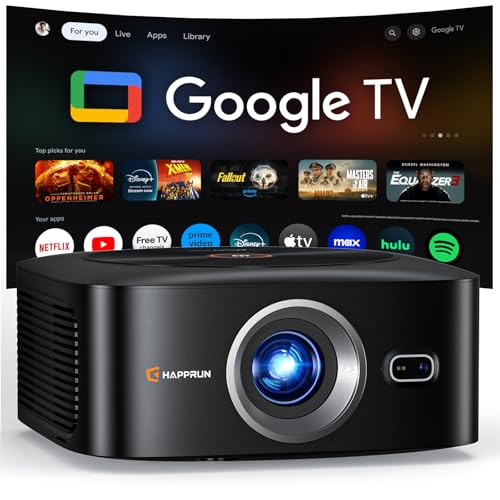
HAPPRUN Google TV Outdoor 4K Projector — Google TV streaming — NOT a tuner
HAPPRUN’s second entry is the streaming five’s stated-brightness flagship, and its label still reads Google TV — a platform, not a tuner — because honesty does not relax for flagships. The title prints 1,500 ANSI lumens, the only ANSI figure among the streaming picks, and surrounds it with an outdoor 4K positioning, auto focus and keystone, Dolby Audio and a stated suitability spanning phone, TV stick, PC and console sources.
ANSI wording deserves its customary respect. A brightness figure expressed in ANSI lumens belongs to a measured dialect that buyers can compare against other ANSI-rated machines with some confidence, unlike the unqualified lumen claims scattered across the portable class. At 1,500 ANSI, this HAPPRUN is specified for darkened rooms and outdoor evenings rather than for sunlit halls, and its outdoor title should be read in that honest frame: dusk onwards, with a screen or sheet and an audience that understands the genre.
The 4K language in its name sits beside a Full HD description in the same title, and the careful reading is the one this guide has practised throughout: the machine is a Full HD projector in the 4K ecosystem, accepting and presenting the household’s 4K-era sources, rather than a native 4K canvas. Buyers who hold that distinction clearly will judge its picture fairly at outdoor sizes, where brightness, darkness and distance matter more than the last increment of resolution.
Auto focus and auto keystone repeat the forgiveness suite, and outdoors they matter most of all, because garden geometry is negotiated in failing light on uneven ground. Dolby Audio starts the sound, Wi-Fi and Bluetooth carry the platform and the speaker options, and the source list — phone, stick, PC, PS5-class consoles — covers the devices a family actually carries into a garden in the streaming age.
Indoor home theatre is named in the title as well, and the dual citizenship is believable: a machine bright enough by ANSI measure for a dark living room, automated enough for a garden, and platform-complete enough to need no accessories beyond a surface. Among the streaming five, this is the pick for households that refuse to choose between the two venues and want one stated specification to plan both around.
It remains, at the end, a streaming machine, and the guide closes its reviews by returning to the distinction that organised them. If the household’s dream evening is a local broadcast on a big screen with no internet involved, only the Emerson can host it. If the dream is the whole streaming library under a darkening sky, this HAPPRUN is the best-specified door in the guide to exactly that evening.
- Tuner: none — Google TV is a streaming platform, not a tuner
- Platform: officially licensed Google TV stated
- Brightness: 1500 ANSI lumens stated in title
- Correction: auto focus and keystone stated
- Audio: Dolby Audio stated; Wi-Fi and Bluetooth
- Sources named: phone, TV stick, PC, PS5
Strengths
- Only ANSI brightness figure among streaming picks
- Google TV breadth with Dolby Audio
- Indoor theatre and outdoor duties both named
Trade-offs
- No tuner — antenna channels are unavailable
- 4K wording needs the careful reading given here
- Outdoor evenings still begin at dusk
Best for: a household splitting viewing between a dark living room and outdoor nights on one stated specification.
Not suited for: a daylight venue, or any buyer whose first requirement is receiving broadcast television.
Comparison
| Pick | Headline facts from its listing title | Room it suits first |
|---|---|---|
| Emerson EVP-2504 Projector with TV Tuner | REAL TV tuner, DVD player, native 720p, 120 inch, 30,000-hour LED | A cabin or spare room on antenna and discs |
| Aurzen Roku TV D1R Cube 1080P | Roku TV streaming (not a tuner), sealed engine, auto focus, 40–150 inch | A living room replacing its television |
| Aurzen Roku TV D1R Smart Outdoor Projector | Roku TV streaming (not a tuner), 1080P FHD, zoom, outdoor portable | A garden film night in summer |
| BIGASUO Roku TV Smart Projector 1080P | Roku TV streaming (not a tuner), native 1080P, 160-degree rotation | A bedroom aiming at walls and ceilings |
| HAPPRUN Native 1080P Google TV Bluetooth Projector | Google TV streaming (not a tuner), 10,000 plus apps, AirPlay, native 1080P | An app-centred family room |
| HAPPRUN Google TV Outdoor 4K Projector | Google TV streaming (not a tuner), 1500 ANSI lumens, auto focus | A dark theatre and outdoor evenings |
What Is a TV Tuner in a Projector, Exactly?
A tuner is receiver hardware. Connected to an antenna, it pulls broadcast television signals out of the air, decodes the channels your area transmits, and hands the picture to the projector — the same job the tuner inside an ordinary television performs. It needs no internet, no subscription and no account, because broadcasting is one-to-many by design: the signal exists whether or not your household connects to anything, and the tuner’s only task is to catch it well.
Only one title in this guide contains that hardware claim, the Emerson EVP-2504, and the guide has labelled the fact relentlessly because search results blur it relentlessly. When a streaming projector’s name contains the words TV — Roku TV, Google TV — those words describe the software’s ancestry and interface, not a receiver. A buyer who learns to ask one question — does the title say tuner, or does it name a platform? — will never be mis-sold on this keyword again.
What Can You Watch With an Antenna and the Emerson?
Whatever your area broadcasts: the local channels carrying news, weather and sport, the national networks’ over-the-air feeds and public television, all received free once an antenna is in place. The harvest depends on geography — distance to transmitters, terrain, the antenna’s position — and a first evening of experimentation with antenna placement is part of the tuner owner’s rite of passage, exactly as it was for television households for half a century.
Pair the broadcasts with the Emerson’s built-in DVD player and the room gains a second, independent library that also ignores the internet entirely. That combination is why this unassuming machine keeps a constituency streaming cannot argue away: cabins, workshops, guest rooms, storm-season shelves and grandparents’ houses all contain evenings where the network is absent, unwanted or simply not the point.
Which Streaming Platform Suits Your Household — Roku TV or Google TV?
Choose by the household’s habits rather than by specification. Roku TV, in the two Aurzen picks and the BIGASUO, behaves like a television first: a simple home screen, apps presented as channels, and an interface that guests and grandparents operate without a tutorial. Households replacing a TV, or sharing the projector across generations, usually settle fastest there.
Google TV, in the two HAPPRUN picks, behaves like a library first: profiles, recommendations and an app catalogue the first HAPPRUN quantifies at ten thousand plus, with AirPlay named on that model for Apple households and licensed status stated on both. Households already organised around streaming accounts and casting will feel the difference nightly. Neither platform, to close the point this guide exists to make, receives a single broadcast channel.
How Do You Set Up a Streaming Projector for the First Evening?
Position before platform. Place the projector where its picture lands square at the size the room wants, let the auto focus and keystone systems fitted to every streaming pick here do their work, and only then join the network and sign in. Geometry settled first means the sign-in screens, the updates and the first film all happen on a picture that already looks right, which quietly teaches the household that the machine is easy.
Test the network at the projector’s real position, especially outdoors, where the Aurzen D1R Outdoor and the HAPPRUN outdoor model will live at the edge of the router’s manners. A film that buffers at the climax teaches the opposite lesson. Finally, pair the Bluetooth speaker before the audience arrives and place it near the screen; sound anchored to the picture completes the television illusion these machines are honestly selling.
What Should Antenna Buyers Check Before Ordering the Emerson?
Confirm the broadcast landscape first: which channels your area transmits and how far the transmitters sit, because a tuner harvests what geography offers. Then plan the antenna’s position with the same care as the projector’s — height and a window’s direction routinely matter more than the antenna’s size — and remember the antenna itself is an accessory purchase alongside the machine, not an item any title here bundles.
Check the room’s sources against the Emerson’s generous input list as well. Dual HDMI, USB, Micro SD, VGA and AV cover modern and legacy equipment in one sweep, and households with older players will find that list is half the reason to buy. Set expectations by the title’s own honesty — native 720p, 1080p supported, up to 120 inches — and the machine will meet them precisely, which is all any honest pick in this guide promises.
How Does Broadcast Television Change the Feel of a Big Screen?
Streaming trained households to choose everything, and broadcast quietly offers the opposite pleasure: a schedule, shared with everyone else in the region watching the same channel at the same moment. Local news watched on a wall-sized screen has a civic quality no personalised feed reproduces, and live sport through an antenna arrives with a directness that streaming’s delay quietly erodes — neighbours cheer a fraction before a streaming household hears why, a small thing that fans notice every single season.
There is also the discipline of enough. An antenna household’s channel list is finite, local and identical every evening, which ends the forty-minute scroll that streaming abundance imposes on tired families. The Emerson’s owner chooses among what the air provides, watches it at the size a projector gives, and finishes the evening when the programme finishes. For some households that finitude is a limitation. For a growing number, describing it honestly, it is the feature.
None of this argues that broadcast replaces the library. It argues that the two sources feel different enough that a household should choose between them deliberately, with eyes open, rather than discovering after a purchase that the machine it bought speaks only one of the two languages. That deliberation is the whole editorial purpose of this guide, and it is why the tuner pick and the streaming picks share a page without ever sharing a label.
What Happens to Each Kind of Projector When the Internet Fails?
The question sounds like a disaster drill and functions as an ordinary-weekend test. Streaming projectors — all five here — become elegant paperweights for content purposes when the broadband dies, able to show only what a connected source carries locally. The Emerson keeps working through its tuner and its disc player, indifferent to the outage, which is why it anchors cabins, storm shelves and rooms belonging to people who simply dislike depending on infrastructure they cannot see.
Households should weight that resilience by their own geography and temperament rather than by drama. A city apartment with resilient fibre may go years without caring. A rural house at the end of a temperamental line cares several times a year, and a household that keeps elderly relatives entertained through every weather event cares most of all. The tuner’s value is not nostalgia; it is a probability calculation each family must run for itself.
The pragmatic middle is common and respectable: streaming for the library, the Emerson’s category for the independence, whether in the same house or in the second location where the family actually spends its offline hours. Guides that insist one technology must win misunderstand how households actually live, which is in layers — and this guide’s six picks were chosen to cover the layers without confusing them.
How Should a Household Introduce a Projector to Older Viewers?
Older viewers judge a projector by whether it behaves like the television it replaces, and the two ends of this guide answer that test in opposite ways. The Emerson speaks their native language entirely: channels from an antenna, discs from a shelf, inputs for the equipment already owned, and no account, password or home-screen negotiation anywhere in the evening. For a grandparent’s room, that familiarity can outweigh every specification the streaming picks win on.
Roku TV makes the streaming side’s strongest case to the same audience, because its interface was designed to feel like television rather than like a computer. The Aurzen Cube in particular — set down once, self-focusing, one remote — can be taught in a single visit and operated thereafter without a support call. Google TV rewards the already-converted more than the newcomer, and families choosing for an older relative should weigh teaching time as a real cost beside the purchase.
Whichever category is chosen, set it up completely before handing it over: channels scanned or accounts signed in, the remote’s essential buttons walked through once, and the first evening watched together. A projector that arrives as a working appliance earns trust; a projector that arrives as a project earns a cupboard. The distinction matters more, at this end of the family, than any figure printed in any title in this guide.
Why Do Dorms, Workshops and Second Rooms Suit the Tuner Pick So Well?
Secondary rooms share a pattern: they lack the main house’s infrastructure but host real viewing. A dorm room has no cable contract and a student with a disc collection. A workshop wants the game on while hands are busy and Wi-Fi passwords are nobody’s priority. A guest room needs to entertain a visitor without enrolling them in the household’s accounts. The Emerson’s combination — antenna channels, discs, and inputs for whatever a guest carries — answers that pattern in one cabinet, which is why tuner projectors persist in exactly the rooms technology writers forget to visit.
Streaming picks serve second rooms differently, by extending the household’s existing accounts into them, and for rooms inside the main home’s network and habits that is usually the richer answer. The choice, once again, is not quality but category: independence versus extension. A household that can say which of those its second room needs has already made the decision this guide exists to clarify.
Common Mistakes
Reading a platform name as a tuner
is the founding mistake of this keyword, and it is made in good faith by tired shoppers every day. Roku TV is not a tuner. Google TV is not a tuner. The word television inside a software brand describes an interface, and a household that orders a streaming projector for antenna channels will discover the difference at the exact moment the antenna is plugged into a port that does not exist. This guide has repeated the distinction in every section so that its readers discover it here instead, for free.
Assuming the Emerson’s streaming rivals must be inferior because they lack a tuner inverts the truth for most households. Five of the six picks stream libraries no antenna can approach, at higher native resolutions, with self-managing focus. They are not failed tuner projectors; they are successful streaming projectors, and a buyer whose life runs on apps should choose among them without a flicker of guilt — having first confirmed that broadcast independence is genuinely not on the household’s list.
Judging the Emerson by streaming criteria commits the mirror-image error. Its native 720p and absent platform look like deficiencies until the evening the internet fails, the cabin weekend arrives or the disc shelf is finally opened, at which point its tuner and DVD player become the only specifications in the guide still working. Categories first, comparisons second, is the discipline this keyword demands of everyone.
Forgetting the antenna in the budget and the plan strands more tuner buyers than any reception problem. The Emerson receives what an antenna gathers; a household that spends its whole budget on the projector and nothing on placement, cable and a suitable antenna has bought a receiver with nothing to receive. Treat the two as one purchase, position both with care, and the broadcast harvest will justify the pairing.
Finally, letting children and guests inherit the confusion. A household that calls its streaming projector the TV tuner teaches the error to everyone who uses it, and the next purchase repeats it. Name machines by what they do — the tuner projector, the Roku projector, the Google TV projector — and the whole family’s future shopping gets sharper for free.
Final Recommendation
If broadcast television is the requirement, the recommendation is singular and short: buy the Emerson EVP-2504, the only pick in this guide with a TV tuner, and budget the antenna beside it. Its DVD player, wide inputs and stated LED life make it a complete off-grid television room, and its native 720p is the honest price of that independence. No other pick here should be bought for that job, whatever its name suggests at a glance.
If streaming is the requirement, choose the platform your household already speaks. Roku TV households should take the Aurzen D1R Cube for settled rooms — sealed engine, wide stated size range — the Aurzen Outdoor for garden duty, or the rotating BIGASUO for bedrooms and ceilings. Google TV households should take the first HAPPRUN for app breadth and AirPlay diplomacy, or its outdoor sibling when a stated ANSI brightness figure is needed to plan around.
Households honestly torn between the two worlds can own the answer in two parts, as many do: a streaming projector for the library, and the Emerson where independence matters. What no household should do is buy one machine believing it is the other, because the disappointment is entirely preventable and this guide has now prevented it in writing about nine times.
Antenna or apps — name which one your evenings actually run on, buy the machine whose title honestly matches that answer, and the big screen will deliver television exactly as promised, by air or by broadband, with no port left searching for a signal it was never built to receive. Keep the labels straight — tuner for hardware, platform for software — and every future projector purchase your household makes, at any size and in any room, starts from the truth instead of from a product name’s polite ambiguity. That habit, once learned, is the most valuable thing in this entire guide, and unlike any projector in it, it never needs replacing, updating or plugging in at all.
Frequently Asked Questions
Which of these projectors has a real TV tuner?
Only the Emerson EVP-2504. Its title states a TV tuner outright, alongside a built-in DVD player. The Aurzen and BIGASUO picks run Roku TV and the HAPPRUN picks run Google TV, and those are streaming platforms, not tuners.
Can a Roku TV or Google TV projector receive antenna channels?
No. A streaming platform has no broadcast receiver inside it, so connecting an antenna gives it nothing to tune. Antenna viewing in this guide begins and ends with the Emerson, used with a suitable antenna placed for your area’s transmitters.
Does the Emerson need the internet?
No. Its tuner receives broadcasts through an antenna and its DVD player reads discs, so both of its headline functions work with no network at all. Its HDMI and other inputs also accept whatever sources a household connects directly.
Is the Emerson’s 720p picture a problem?
Its title states native 720p with 1080p supported, and this guide reports that plainly. Broadcast television and DVDs sit comfortably inside that canvas. Buyers whose library is high-resolution streaming should choose among the native 1080P picks instead.
Which streaming pick states a brightness figure?
The HAPPRUN Google TV Outdoor model, at 1,500 ANSI lumens in its title. The other streaming titles print no brightness figure, so this guide claims none for them and directs buyers to their listings for any figure they require.
Can I add a tuner to a streaming projector later?
An external tuner box is a separate accessory that would feed a projector through HDMI like any other source; it is not a feature the streaming picks grow internally. Households certain they want broadcast built in should simply buy the Emerson, where the tuner already lives.
Related Guides
Broadcast questions often arrive beside contrast questions, so the survey of LCoS projectors in the premium tier covers the high-end alternative for dark rooms, the guide to interactive projectors for classrooms and meeting rooms takes projection into teaching spaces, and the round-up of real estate cameras under a mid-range budget serves households documenting the rooms all this equipment lives in.


