What's inside
- Key Takeaways
- Quick Picks
- How We Chose These Picks
- Set or Separate Desk: What Is Actually in These Boxes?
- Does Height Adjustment Matter, or Is It a Gimmick?
- What Should Parents Measure Before Ordering?
- Which Home School Desks Fit Which Children and Rooms?
- How Do the Six Compare on Contents, Adjustment and Storage?
- How Should You Set Up a Child’s School Desk at Home?
- How Much Storage Does Homework Actually Generate?
- Adjustable Mechanism or Wooden Furniture: Which Serves a Family Longer?
- Where in the Home Does a School Desk Earn Its Keep?
- How Do You Keep a Child’s Desk From Becoming a Shelf?
- What Happens When a Child Outgrows the Desk?
- What Mistakes Do Parents Keep Making When Buying a School Desk?
- Final Recommendation
- Frequently Asked Questions
- Related Guides
As an Amazon Associate I earn from qualifying purchases. This post may contain affiliate links at no extra cost to you.
widgetverdict.com is reader-supported. When you buy through links on our site, we may earn an affiliate commission.
Where to buy: Amazon carries all six desks reviewed below, with links on each name in the Quick Picks table and again in the detailed reviews. Read the “what is in the box” line in each review carefully — five of these are desk-and-chair sets, and one is a desk alone.
The market for the best school desks for home has a shape parents should know before they shop: it is dominated by children’s desk-and-chair sets, and this guide reflects that honestly. Five of the six picks below are sets in which the chair is part of the product, sized and sold together with the desk for a child of a stated age range. The sixth, the Lufeiya, is a small desk sold on its own, with no chair included, and it is reviewed as such. Nothing in this guide pretends a set is a standalone desk or that the separate desk includes a seat it does not.
What separates the sets is how they expect a child to grow and work. Two adjust in height — the Rengue and the GITAWUSA — so the desk can be raised as its owner lengthens. The Rengue adds a tilting desktop and a built-in LED light; the GITAWUSA answers with a graffiti-friendly tabletop and a side bookshelf. The wooden sets — UTEX, XNKL and BOLUO — trade adjustment for hutches, shelves, drawers and cabinets, betting that storage and a furniture feel matter more than a rising frame. Age ranges quoted in this guide are the manufacturers’ own figures from the titles, given so parents can match a desk to a child, not as developmental advice.
This guide makes no claims about learning outcomes, posture or health, because desks do not come with evidence for such claims and the titles here do not make them either. What can be judged is concrete: what is in the box, what adjusts, what stores, what the surface does, and which room each desk suits. Parents furnishing a shared homework-and-office corner may also want the grown-up end of the room covered — Best Roll-Around Computer Desks for Home handles the mobile adult option elsewhere in this batch of guides.
Key Takeaways
- Five of the six picks are children’s desk-and-chair sets; the Lufeiya is a 32-inch desk sold alone, with no chair in the box.
- Height adjustment appears on the Rengue and GITAWUSA sets; the wooden UTEX, XNKL and BOLUO sets are fixed-height furniture with storage instead.
- The Rengue’s desktop tilts to 55 degrees and it carries an LED light with three modes and adjustable brightness, per its title.
- Age ranges are manufacturer-stated: 3 to 12 years on the GITAWUSA, 5 to 12 on the UTEX, and 8 to 10 on the BOLUO.
- Storage divides the field: a drawer and hook on the Rengue, a side bookshelf on the GITAWUSA, a hutch and cork board on the UTEX, a hutch shelf on the XNKL, a drawer and cabinet on the BOLUO, fabric drawers on the Lufeiya.
- No educational or health benefit is claimed for any desk in this guide; the comparisons rest on contents, adjustment, storage and size.
Quick Picks
| Pick | Badge | Why it earns its place |
|---|---|---|
| Rengue Kids Desk and Chair Set | Tilting top, LED light | A height-adjustable set in grey whose desktop tilts to 55 degrees, with an LED light, a storage drawer and a metal hook. |
| GITAWUSA Kids Desk and Chair Set | Graffiti-friendly top | A height-adjustable set rated by its maker for ages 3 to 12, with a graffiti tabletop, side bookshelf and storage. |
| UTEX Wooden Kids Desk and Chair Set | Hutch and cork board | A wooden set for ages 5 to 12 with a hutch, cork bulletin board, multi-zone storage and water-based paint. |
| XNKL Kids Study Desk and Chair Set | Wooden hutch set | A wooden children’s desk and chair with a storage shelf and hutch for home school use. |
| BOLUO Wooden Kids Desk with Storage | Drawer and cabinet | A white wooden desk and chair set for ages 8 to 10, with a drawer and a cabinet for books and supplies. |
| Lufeiya 32in Kids Desk with Drawers | Desk only, no chair | A 32-inch white desk with fabric storage drawers and a bag — sold without a chair, for homes that already have one. |
How We Chose These Picks
The first rule was truthful labelling. Every pick is described as what its title says it is: a set where a set is sold, a lone desk where a lone desk is sold. That sounds basic, but listings in this category blur the line constantly, and a parent who orders a “desk” expecting a chair — or a set expecting a full-size desk — has been failed by the guide before the box even opens. The reviews below repeat the box contents wherever the distinction matters.
The second screen was the growth question. Children change size faster than furniture wears out, so the two height-adjustable sets earned prominent places, and the fixed wooden sets were chosen for what they offer instead: hutches, cabinets and a solidity that suits a desk expected to be handed down to a younger sibling. Age ranges are quoted from the titles as the makers’ own guidance, and the reviews note where a range is narrow — the BOLUO’s 8 to 10 years — because a narrow range is a shorter service life, honestly stated.
The third consideration was storage realism. Homework generates paper, books, devices and an archaeology of pencils, and a school desk without storage exports that chaos to the kitchen table. Each pick here stores something, from the Rengue’s drawer and hook to the BOLUO’s cabinet. Parents whose own work shares the room may find the household’s other half in Best Standing Desks for Tall People, at the opposite end of the size spectrum.
Set or Separate Desk: What Is Actually in These Boxes?
A desk-and-chair set is a matched system: the chair’s height suits the desk’s height because the maker designed them together, and for younger children that matching removes a real shopping problem. The Rengue, GITAWUSA, UTEX, XNKL and BOLUO all work this way. The set’s weakness is the same as its strength — when the child outgrows one piece, the matched logic of the pair dissolves, and the chair usually reaches its limit before the desk does.
A separate desk, like the 32-inch Lufeiya, inverts the arrangement: buy the desk, pair it with whatever chair the household already owns or chooses next, and replace each piece on its own schedule. That flexibility suits families with a good chair already, or with several children who will rotate through the same desk with different chairs. It also means the parent is responsible for the match — a desk at one height and a chair at another is a mismatch no amount of storage drawers will fix.
There is a budget shape to the distinction too, even in a guide that quotes no prices. A set concentrates the whole purchase in one box and one decision, which makes it the simpler gift, the simpler delivery and the simpler return if the size proves wrong. A separate desk spreads the spending across two decisions that can be made months apart, and lets a household upgrade the chair — the piece children outgrow and wear out fastest — without touching the desk. Grandparents, take note: a set is the present that arrives complete; a desk-only gift silently assigns the chair to someone else’s list.
Neither format is superior; they answer different household situations. What matters is knowing which you are buying, which is why this guide states the format in the Quick Picks table, in every review’s specification list, and in the comparison table at the end. If a listing’s photographs show a chair beside a desk-only product, the photographs are staging, and the title is the truth.
Does Height Adjustment Matter, or Is It a Gimmick?
It matters in proportion to how long the desk must serve. A height-adjustable set like the Rengue or GITAWUSA can be set low for a small child and raised in steps across several school years, which spreads the purchase across more of a childhood. The mechanism’s value is not daily fiddling — most families will adjust a few times a year — but the desk’s ability to remain the right size in year three, when a fixed desk bought for year one may have become a knees-under-chin compromise.
Fixed wooden sets answer the same problem differently: they are sized for a stated age band and built to be handed down. The UTEX’s 5-to-12 range is generous for a fixed set; the BOLUO’s 8-to-10 is candidly narrow, suiting a family with a child in that window now and perhaps a sibling approaching it. A fixed desk also has nothing to wobble, loosen or be adjusted wrong by an enthusiastic eight-year-old with access to the crank.
One more adjustment reality deserves stating: the person who operates the mechanism is usually the parent, whatever the marketing photographs show. Young children should not be raising and lowering a desk unsupervised, both because the fit is a judgement call and because moving furniture and small fingers are a poor combination. Treat the adjustment as a termly parental task — check the fit, set the height, tighten what needs tightening — and the mechanism will serve quietly for years.
The honest way to choose is by the household’s timeline. One child, long horizon: adjustment earns its keep. Several children in sequence: a sturdy fixed set, handed down, may serve the family longer than any single adjustable desk. Either way, match the desk to the child’s current size at setup, not to a size they will grow into — a desk that fits next year fits badly all of this year.
What Should Parents Measure Before Ordering?
The child’s seated measurements come first: feet supported, knees comfortable, forearms able to rest on the surface without the shoulders climbing. On the adjustable sets, that measurement simply sets the starting height. On the fixed sets, it is the purchase decision itself — compare the child’s fit against the maker’s stated age range, and treat the range as the maker’s guidance rather than a guarantee, since children of the same age arrive in many sizes.
The room comes second. A set with a hutch — UTEX or XNKL — needs wall height and reads as a substantial piece; a set with a side bookshelf, the GITAWUSA, needs width; the Lufeiya needs the least room of all and fits the corner of a bedroom where a set would crowd. Measure the floor patch and the wall together, and remember the chair’s pulled-out position: the working footprint of any school desk is the desk plus a child-sized chair plus a child getting in and out of it, repeatedly, at speed.
Finally, measure the household’s storage overflow. Books, a tablet or laptop, art supplies and the paper tide of school life will live at this desk or somewhere worse. The BOLUO’s cabinet, the UTEX’s multi-zone hutch storage and the GITAWUSA’s bookshelf are answers of increasing size; the Rengue’s single drawer and hook answer for a tidier, more digital homework life. Parents of a child whose work lives partly at a family desk may also appreciate the adult-sized options in Best Office Desks for Large People for the overspill that no child’s desk should have to absorb.
Which Home School Desks Fit Which Children and Rooms?
The reviews take the six in order: the two adjustable sets first, then the three wooden storage sets, then the desk that arrives without a chair.
Rengue Kids Desk and Chair Set — Tilting top, LED light
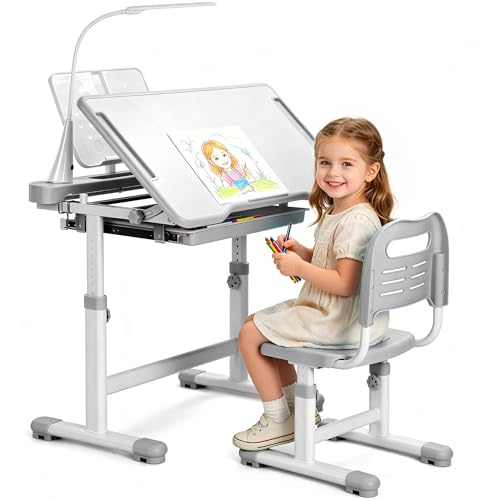
The Rengue is the most feature-dense set in this guide, and its title reads like a checklist: a height-adjustable children’s desk and chair, a desktop that tilts to 55 degrees, an LED light with three modes and adjustable brightness, a storage drawer and a metal hook, in grey. It is a set — the chair is included and matched to the desk — aimed at the child whose homework mixes reading, writing and drawing in the same session.
The tilting desktop is the feature with a daily job. Flat for a laptop or a worksheet, angled for a book or a sketchpad, it lets the surface follow the task rather than the child rearranging themselves around a fixed plane. The 55-degree figure is the maker’s stated maximum tilt. The LED light, with its three modes and brightness adjustment, handles the evening homework shift in rooms where the ceiling light is behind the child and the desk sits in its own shadow — a common arrangement in bedrooms, and the one this feature quietly solves.
Storage is deliberately light: one drawer and a hook for a bag or headphones. That suits a homework life that is mostly books and a tablet, with the school bag living on the hook instead of the floor. Families drowning in art supplies and paper should look at the cabinet and hutch models below instead. The grey finish is the most neutral in the guide, suiting shared rooms and hand-me-downs across siblings of any taste.
- Format: desk and chair set — chair included
- Adjustment: height adjustable; desktop tilts to 55 degrees, per the title
- Light: LED with three modes and adjustable brightness
- Storage: one drawer and a metal hook
- Finish: grey
- Age range: not stated in the title; judge fit from the listing’s dimensions
Strengths
- The tilting desktop serves reading, writing and drawing without rearranging the room.
- Built-in LED lighting solves the shadowed-bedroom-desk problem directly.
- Height adjustment lets the set track a growing child across school years.
Trade-offs
- One drawer is light storage for a paper-heavy homework life.
- The title states no age range, so sizing homework falls to the parent.
- More features mean more parts for a child to fiddle with mid-homework.
Best for: a child whose homework mixes books, drawing and screen work at one desk, in a room with indifferent light.
Not suited for: a household needing cabinet-scale storage for art supplies and paper archives.
On the Rengue listing, check the height range against your child’s current size so the set starts at a setting that fits today.

GITAWUSA Kids Desk and Chair Set — Graffiti-friendly top
The GITAWUSA set leads with the most child-honest feature in this guide: a graffiti tabletop. This is a height-adjustable desk and chair set, rated by its maker for ages 3 to 12, with a side bookshelf and storage, in grey — and a surface designed for the child who draws on the desk whether the desk invites it or not. A top that welcomes doodling, notes and workings-out converts a discipline problem into a feature, and for younger children especially, that conversion is worth more than another drawer.
The stated age range, 3 to 12 years, is the widest in the guide, and the height adjustment is what makes such a range plausible: the same set can sit low for a small child’s first drawing years and rise toward pre-teen homework. Parents should still treat the range as the maker’s framing — a desk that suits a three-year-old and a twelve-year-old at their respective sizes is a desk whose adjustment does the heavy lifting, and the listing’s height figures are the place to verify it.
The side bookshelf gives the set its storage character: books and supplies stand vertically at the desk’s flank rather than competing for the surface. In a bedroom corner, that bookshelf makes the desk a small study station rather than a table with ambitions. Grey keeps it neutral for hand-me-downs. For the child who treats every surface as a sketchbook and every book as a desk resident, this is the set designed by people who have met that child.
- Format: desk and chair set — chair included
- Adjustment: height adjustable
- Age range: 3 to 12 years, manufacturer-stated
- Surface: graffiti tabletop, per the title
- Storage: side bookshelf and storage
- Finish: grey
Strengths
- A graffiti-friendly surface ends the daily war over drawing on the desk.
- The widest maker-stated age range in the guide, backed by height adjustment.
- A side bookshelf keeps books upright and off the working surface.
Trade-offs
- A doodle-welcoming top will look busy in a room styled for calm.
- The broad age range needs verifying against the listing’s actual height figures.
- Storage is bookshelf-led; small-item clutter still needs a home.
Best for: a young, drawing-prone child expected to use one set across many school years.
Not suited for: a parent who wants the desk to look pristine and untouched between homework sessions.
Check the GITAWUSA listing for the adjustable height span, and confirm the graffiti surface’s care instructions before the first marker appears.

UTEX Wooden Kids Desk and Chair Set — Hutch and cork board
The UTEX is the wooden, furniture-first answer among the sets: a kids’ desk and chair with a hutch and storage, a cork bulletin board, multi-zone storage and water-based paint, for ages 5 to 12 by its maker’s statement. Where the adjustable sets are mechanisms, the UTEX is a small piece of case furniture — a desk with a back and shelves that turns a bedroom wall into a study corner with a sense of place.
The cork bulletin board is the detail children actually use daily: timetables, spelling lists, the drawing that earned pride of place, pinned at eye level above the work surface. The hutch’s multi-zone storage — the maker’s phrase — divides the desk’s vertical space into compartments for books, supplies and the small equipment of school life, so the surface below can stay a surface. Water-based paint is a finish detail parents of younger children in the 5-to-12 band may appreciate as a stated material choice.
The chair is described in the title as ergonomic; this guide repeats that as the maker’s own description of its chair design and makes no further claim from it. What can be assessed is the arrangement: a fixed wooden set, sized for the stated age band, with the storage to keep a child’s whole school kit in one footprint. Families furnishing a room for the long middle years of childhood — and expecting the desk to be handed down — are the UTEX’s natural buyers.
- Format: wooden desk and chair set — chair included
- Age range: 5 to 12 years, manufacturer-stated
- Storage: hutch with multi-zone storage
- Extras: cork bulletin board; water-based paint finish
- Adjustment: fixed-height furniture; no height adjustment is claimed in the title
Strengths
- A hutch and cork board give the desk a complete study-corner presence.
- Multi-zone storage keeps books, supplies and surface in separate places.
- Wooden construction suits hand-me-down service across siblings.
Trade-offs
- Fixed height: the desk fits its age band rather than adjusting beyond it.
- The hutch needs wall height and makes the set the least movable here.
- No tilting surface or built-in light, unlike the Rengue.
Best for: a child between five and twelve whose bedroom needs one furniture piece to be desk, shelves and noticeboard at once.
Not suited for: a family wanting a desk that adjusts in height as the child grows.
The UTEX listing’s dimensions will tell you whether the hutch fits your wall; measure the ceiling line as well as the floor.
XNKL Kids Study Desk and Chair Set — Wooden hutch set
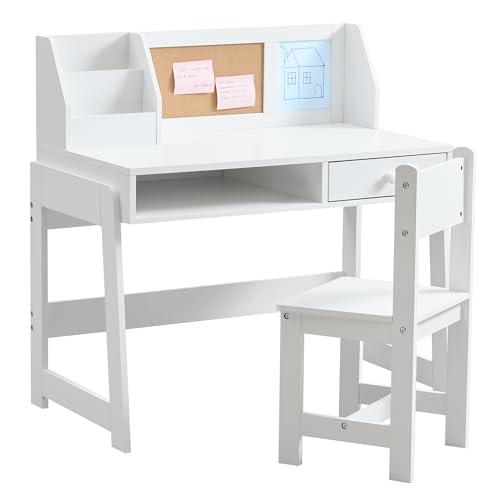
The XNKL is the quiet wooden alternative to the UTEX: a children’s desk and chair set in wood, with a storage shelf and a hutch, described by its maker as a writing table for home school. Its title is shorter on specifics than its wooden rival’s — no age range, no bulletin board, no finish claims — and the review treats it accordingly: a wooden hutch set whose storage-led layout is its proposition, with the details to be confirmed on the listing.
What the hutch-and-shelf arrangement offers is the same study-corner logic as the UTEX: books and supplies rise above the surface, the writing plane stays clear, and the whole reads as furniture in a bedroom rather than equipment. For home-school households, where the desk works a full school day rather than an evening homework hour, that furniture quality matters — the desk is a place a child spends serious time, and a wooden set with a hutch gives the place definition.
The absence of a stated age range is the XNKL’s main homework assignment for parents. Without the maker’s band, sizing must come from the listing’s dimensions compared against the child, which is the more reliable method anyway but takes ten minutes the UTEX’s stated range saves. Families choosing between the two wooden hutch sets are really choosing between the UTEX’s documented extras and the XNKL’s simpler proposition, and the listings’ photographs of shelf layout will settle it better than any prose can.
- Format: wooden desk and chair set — chair included
- Storage: storage shelf and hutch
- Positioning: home school writing table, per the maker
- Age range: not stated in the title; size from the listing’s dimensions
- Adjustment: no height adjustment is claimed in the title
Strengths
- A wooden hutch set that turns a bedroom wall into a defined study place.
- Shelf storage above the surface keeps the writing plane clear.
- A straightforward proposition without feature clutter.
Trade-offs
- No age range in the title, so sizing needs the listing’s measurements.
- No extras like a cork board or light are claimed.
- Fixed format: no adjustment is mentioned in the title.
Best for: a home-school household wanting a wooden desk and chair with hutch storage and no gimmicks.
Not suited for: a parent who wants the sizing decision made for them by a stated age range.
On the XNKL listing, work from the dimension panel: desk height and chair height against your child’s measurements decide this one.

BOLUO Wooden Kids Desk with Storage — Drawer and cabinet
The BOLUO is the storage maximalist among the wooden sets: a white wooden desk and chair set with a drawer and a cabinet, sized by its maker for children of 8 to 10 years. That age band is the narrowest in this guide, and the review treats it as honest targeting rather than a flaw — this is a desk for the later primary years, when homework becomes book-heavy and project-based, and when a child can be trusted with a cabinet of their own supplies.
The drawer-and-cabinet pairing stores differently from the hutch sets. Instead of rising above the surface, the BOLUO’s storage sits in the desk’s body: a drawer for the daily tools, a cabinet for the bulk — books, folders, the art portfolio, the science kit. For a child whose work generates volume rather than display, enclosed storage beats open shelves, because the mess closes behind a door and the room keeps its calm. White keeps the piece light in a bedroom and suits the girls’ and boys’ rooms the maker mentions without committing to either’s décor.
The narrow age window deserves its practical reading: buy it for a child in the window now, ideally with a younger sibling approaching the window behind them, and the desk’s service life doubles. Bought for a five-year-old to grow into, it will fit badly for years; bought for an eleven-year-old, it is nearly outgrown on arrival. The maker’s candour about the band is the feature — use it as instructed.
- Format: wooden desk and chair set — chair included
- Age range: 8 to 10 years, manufacturer-stated
- Storage: drawer and cabinet in the desk body
- Finish: white
- Adjustment: no height adjustment is claimed in the title
Strengths
- A cabinet swallows bulky supplies that shelves and drawers cannot.
- The maker states a precise age band, making the sizing decision honest.
- White wooden furniture suits most children’s bedrooms without a theme.
Trade-offs
- The 8-to-10 window is the shortest service span in the guide for a single child.
- No hutch, so nothing stores above the surface.
- No adjustment or tilting features are claimed.
Best for: a child currently eight to ten, with book- and project-heavy homework and a sibling queue behind them.
Not suited for: a five-year-old’s first desk, which the maker’s own age band rules out.
Check the BOLUO listing’s cabinet dimensions against the bulkiest items — binders and portfolios — that you expect it to hold.

Lufeiya 32in Kids Desk with Drawers — Desk only, no chair
The Lufeiya is the guide’s deliberate exception, and its review begins with the fact its badge states: this is a desk only. No chair is included. The product is a 32-inch white desk with fabric storage drawers and a storage bag, positioned by its maker for bedrooms and small spaces, and usable as a study, writing or vanity table. A household with a suitable chair already — or with a specific chair in mind — gets exactly the piece it is missing and pays for nothing it is not.
Thirty-two inches is a compact surface, sized for a laptop or a homework spread rather than both empires at once, and the fabric drawers suit the light clutter of a child’s desk: chargers, notebooks, craft supplies, the soft archaeology of a school bag. Fabric storage also keeps the desk light and movable, which in a small bedroom that rearranges itself seasonally is a genuine virtue. The storage bag extends that soft-storage logic to the desk’s side.
The Lufeiya’s flexibility is its argument: desk today as a child’s study table, tomorrow as a vanity or a spare-room writing surface, with no matched chair tying it to one age or one child. Its limit is the same flexibility’s price — the parent must solve the chair pairing, and a chair at the wrong height will undermine the desk no matter how well it stores. Judge it as furniture-plus-freedom, and pair it deliberately.
- Format: desk only — no chair included
- Size: 32 inches
- Storage: fabric drawers and a storage bag
- Finish: white
- Positioning: bedroom study, writing or vanity use in small spaces, per the maker
Strengths
- The smallest footprint in the guide, for bedrooms where a set cannot fit.
- Fabric drawers keep it light, movable and forgiving of rearrangement.
- No chair in the box means no paying for a seat you already own.
Trade-offs
- No chair included: the pairing, and its height match, are your responsibility.
- Thirty-two inches limits simultaneous laptop-plus-paper working.
- Fabric drawers will not take the weight of a book collection.
Best for: a household with a chair already, needing a compact desk for a small bedroom corner.
Not suited for: a parent wanting a complete, matched desk-and-chair solution in one box.
Before ordering the Lufeiya, measure your existing chair’s seat height against the desk’s height on the listing — that match is the whole purchase.
How Do the Six Compare on Contents, Adjustment and Storage?
| Pick | In the box | Adjustment | Maker-stated age range | Storage |
|---|---|---|---|---|
| Rengue | Desk and chair set | Height adjustable; desktop tilts to 55 degrees; LED light | Not stated in title | Drawer and metal hook |
| GITAWUSA | Desk and chair set | Height adjustable | 3 to 12 years | Side bookshelf and storage |
| UTEX | Wooden desk and chair set | Fixed | 5 to 12 years | Hutch, multi-zone storage, cork board |
| XNKL | Wooden desk and chair set | Fixed; none claimed | Not stated in title | Storage shelf and hutch |
| BOLUO | Wooden desk and chair set | Fixed; none claimed | 8 to 10 years | Drawer and cabinet |
| Lufeiya | Desk only, no chair | Fixed | Not stated in title | Fabric drawers and bag |
The table’s most important column is the first. Five sets and one separate desk are different products wearing similar names, and every other comparison — adjustment, storage, age range — only makes sense once the box contents are straight. Age ranges, where they appear, are the manufacturers’ own statements; where they do not appear, the listing’s dimensions carry the decision.
How Should You Set Up a Child’s School Desk at Home?
Start with the fit, on the day the desk arrives, while adjustment is still easy and returns are still possible. Seat the child at the desk: feet supported rather than dangling, the surface at a height where forearms rest without shoulders rising, the chair — included or existing — matched to that height. On the Rengue and GITAWUSA, set the adjustment to that fit and note the setting; you will revisit it as the child grows, roughly when shoes change size.
Then organise by the school day’s actual traffic. Books in the bookshelf, hutch or cabinet; the day’s tools in the drawer; the bag on the Rengue’s hook or beside the Lufeiya rather than on the floor in the doorway. Pin the timetable where the desk offers a board — the UTEX’s cork board exists for exactly this — or on the wall above the sets that do not. A desk whose organisation mirrors the school day takes two minutes to reset each evening, and a two-minute reset is one a child will actually perform.
Decide the desk’s relationship with screens before the first evening. A laptop or tablet will live at most of these desks some of the time, and the parent who plans its home — the drawer, the hutch shelf, the hook-side bag — prevents the device from annexing the surface permanently. The tilting Rengue returns to flat for a laptop; the wooden sets hold a tablet among their shelves; the Lufeiya’s small top forces the question most sharply, since a laptop and a workbook cannot both reign over 32 inches. Agree the rotation early and the desk serves both its analogue and digital duties without either evicting the other.
Light the desk for the evening shift. The Rengue’s built-in LED covers this; the other sets need the room’s light audited — a desk placed so the child’s own shadow falls across the page will generate complaints that sound like homework complaints. A small lamp, placed on the hutch or the room’s furniture rather than eating the work surface, completes most setups.
How Much Storage Does Homework Actually Generate?
More than the brochures photograph, and in awkward shapes. The daily layer is thin — a few books, a pencil case, the current worksheets — and any drawer in this guide handles it, from the Rengue’s single drawer to the Lufeiya’s fabric pair. The weekly layer is where desks diverge: library books, a project folder, art materials, the instrument case that has nowhere else to live. Hutch shelves and the GITAWUSA’s side bookshelf absorb this layer vertically; the BOLUO’s cabinet absorbs it in bulk; the lighter-storage desks export it to the room, where it becomes someone else’s problem, usually the floor’s.
The yearly layer — finished workbooks, certificates, the art portfolio too good to recycle — should not live in the desk at all. Parents who let the desk become the archive find the working storage slowly consumed by history, until the current term’s books are stacked on the floor beside a desk full of last year’s. A box in a cupboard, emptied into once a term, keeps every desk in this guide working at its best; the desk’s own storage is for the living school year, not the museum of it.
Judge the six by your child’s actual generation rate. A tidy, tablet-based homework life fits the Rengue’s drawer-and-hook economy happily for years. A project-based curriculum with physical materials will overwhelm it by half-term and belongs on the UTEX’s shelves or in the BOLUO’s cabinet. The desk cannot change the homework; it can only be honest about how much of it the room must hold.
Adjustable Mechanism or Wooden Furniture: Which Serves a Family Longer?
The adjustable sets — Rengue and GITAWUSA — serve one child across time. Their promise is continuity: the same desk, re-fitted at intervals, from the early school years toward the pre-teen ones, with the GITAWUSA’s maker stating the full 3-to-12 span outright. Their costs are mechanical: moving parts that must be operated sensibly, locked or tightened where the design requires, and kept free of the small debris childhood generates. A family with one child, or children spaced far apart, gets the most from this bargain.
The wooden sets — UTEX, XNKL, BOLUO — serve several children across time. A fixed desk sized for a stated band fits each child in turn as they pass through the band, and wooden construction tolerates the hand-me-down journey: a fresh chair pad, a wiped surface, and the desk begins its second or third childhood looking like furniture rather than equipment. Their costs are the fixed fit itself — each child gets the desk at the size it is, with the chair and the child’s own growth doing the adapting.
The Lufeiya escapes the comparison by being neither: a light, movable, chair-less desk that serves whoever currently needs a small surface, child or adult, and can be re-deployed around the home as needs shift. In a family whose rooms change function yearly, that redeployability may out-serve both philosophies. The honest question is not which format is best but which timeline your household is actually on.
Where in the Home Does a School Desk Earn Its Keep?
The child’s bedroom is the default, and for the hutch sets it is usually the right one: the desk defines a study corner, the storage keeps school life out of the family’s shared rooms, and homework happens where the child can close a door on distractions — or have one closed for them. Bedroom placement favours the self-contained sets with real storage, the UTEX and XNKL above all, because everything the school day needs must live within that one room’s footprint.
The shared-room placement — a corner of the living room or kitchen — suits younger children whose homework is supervised by proximity, and it favours the compact and the movable: the Lufeiya, which can be repositioned as the household’s evening rearranges itself, or the Rengue, whose light and tilt make a self-contained station of a small footprint. What shared placement demands is a reset ritual, because the desk’s clutter is on public display; the sets with doors and drawers — BOLUO’s cabinet above all — close over the evidence most completely.
The landing, hallway and spare-corner placements are the honest remainder, and they reward the desks with built-in light and modest depth. Wherever the desk lands, audit the same three things: light that does not throw the child’s shadow over the page, a chair position that does not block a thoroughfare, and storage sufficient that the desk’s overflow does not colonise the nearest family surface. Get those right and even a landing becomes a study; get them wrong and the best desk in this guide becomes a shelf with a chair.
How Do You Keep a Child’s Desk From Becoming a Shelf?
By defending the surface with the same rule adults’ writing desks use: the top is for today’s work only, and everything else has an assigned home below, beside or above it. The sets here make that rule enforceable in proportion to their storage — the BOLUO’s cabinet and the UTEX’s hutch give a child somewhere to put things that is not the surface, while the Rengue’s single drawer demands a tidier rotation, with the school bag on its hook carrying the overflow by design.
The reset ritual matters more than the furniture. Two minutes at the end of homework — books to the shelf, tools to the drawer, tomorrow’s bag packed and hooked — keeps any of these desks ready for the morning, and a desk that is ready in the morning gets used without a negotiation. Parents who perform the reset with the child for the first fortnight usually find the habit outlives the supervision; parents who rely on weekend excavations find the desk buried again by Wednesday, whatever its storage promised.
What Happens When a Child Outgrows the Desk?
Plan for it at purchase, because it is the one certainty in this category. The adjustable sets postpone the day by years; the fixed sets schedule it by their age bands; the Lufeiya sidesteps it by becoming a vanity, a spare-room surface or a younger cousin’s first desk. A wooden set in good condition has a second life with siblings, cousins or another family, and the neutral finishes in this guide — the greys, the white BOLUO and Lufeiya — hand down more gracefully than themed or coloured furniture would.
The chair usually retires first. On a set, that moment breaks the matched pairing, and the practical households replace the chair and keep the desk for its remaining span, accepting a mix-and-match final phase. This is another quiet argument for the Lufeiya’s format in reverse: a desk bought without a chair never has a pairing to break. None of this should haunt the purchase — a desk that serves three good years and hands down has done its work — but buying with the exit in mind keeps the category’s costs honest.
What Mistakes Do Parents Keep Making When Buying a School Desk?
The first is the box mistake: ordering a desk-only product like the Lufeiya while picturing a set, or a set while picturing a full-size desk. Read the title, not the staged photograph. The second is buying for the age the child will be — a desk fitted to next year’s size fits badly for twelve months, which in a child’s school life is an era. The makers’ age bands exist to prevent exactly this; respect the narrow ones, like the BOLUO’s, as much as the wide ones.
The third mistake is storage optimism: choosing the lightest-storage desk, like the single-drawer Rengue, for a child whose homework generates paper by the ream. The fourth is placing the desk where the room has space rather than where the light is, then blaming the child’s concentration. And the fifth is forgetting the chair in the budget and the plan when buying a desk-only product — the Lufeiya is a good desk that becomes a bad setup the moment it is paired with a dining chair at the wrong height.
Final Recommendation
For most families, the choice narrows by format. Among the adjustable sets, the Rengue is the feature-complete pick — tilting top, light, drawer, hook — and the GITAWUSA is the long-service pick, with the widest stated age range and a surface that forgives a drawing child. Among the wooden sets, the UTEX offers the fullest study corner, the XNKL the same idea more simply, and the BOLUO the best enclosed storage for a child squarely in its stated years. The Lufeiya stands alone, correctly, for the household that needs a compact desk and already owns its chair.
Buy the desk that fits the child who exists today, in the room that exists today, with storage for the homework that actually comes home. Children change sizes and schools change demands, but a desk chosen honestly for the present will serve the present completely — and that, not a promise about the future, is what a school desk at home is for.
A last practical word: involve the child in the final choice between the two or three finalists your own shortlist produces. A desk a child helped choose gets sat at with noticeably less negotiation, and in this category the difference between the leading sets is small enough that the child’s preference is a legitimate tiebreaker. The furniture serves the habit; the habit is the point.
Frequently Asked Questions
Do all of these desks come with a chair?
No. Five are desk-and-chair sets — the Rengue, GITAWUSA, UTEX, XNKL and BOLUO — where the chair is part of the product. The Lufeiya is a desk only, with no chair included, and its review and the comparison table both state that plainly. Always read the box contents in the title rather than trusting listing photographs, which often stage chairs beside desk-only products.
How much should I trust the age ranges?
Treat them as the manufacturer’s own sizing guidance, useful for shortlisting and no more. The GITAWUSA states 3 to 12 years, the UTEX 5 to 12, and the BOLUO a narrow 8 to 10. Children vary more than age bands do, so confirm with the listing’s dimensions and your child’s actual measurements before ordering — especially at the edges of a band.
Is height adjustment worth it for a child’s desk?
It is worth it when one child will use the desk across several years, because the desk can be re-fitted as they grow; the Rengue and GITAWUSA offer it. In a household where desks are handed down between siblings at different ages, a sturdy fixed set sized for a stated band — the UTEX or BOLUO pattern — can serve the family just as long by passing from child to child.
What does the Rengue’s tilting desktop actually do?
It angles the work surface, to a stated maximum of 55 degrees, so books, worksheets and drawing paper can be propped toward the reader instead of lying flat. It is a convenience for mixed homework — reading, writing and drawing at one desk — and the surface returns to flat for a laptop or a board game. The feature is mechanical, not medical, and this guide makes no further claim for it.
Which desk suits a home-school day rather than evening homework?
The wooden hutch sets, particularly the XNKL — which its maker positions for home school — and the UTEX, because a full school day generates more books, materials and projects than an evening’s homework, and their shelves, hutches and cabinets absorb that volume. The adjustable sets suit home school too, but their lighter storage will need supplementing from the room’s own furniture.
Which of these desks takes up the least room?
The Lufeiya, at 32 inches wide with no chair of its own to house — though its working footprint still includes whatever chair you pair with it. Among the sets, the adjustable models in grey are comparatively compact, while the hutch sets, the UTEX and XNKL, claim the most wall and floor in exchange for their storage. Measure the full working footprint — desk, chair pulled out, child in motion — rather than the desk’s catalogue rectangle.
Are the grey adjustable sets suitable for a shared siblings’ desk?
They can be, with one honest caveat: two children of different sizes sharing one adjustable desk means the height gets changed between users, which is quick on a well-designed mechanism and a friction point on a stiff one. The Rengue’s light and tilt serve whoever sits down; the GITAWUSA’s bookshelf serves both children’s books at once. Households where siblings homework simultaneously, rather than in shifts, need two desks — and the compact Lufeiya plus an existing chair is the cheapest honest way to add the second.
Can the Lufeiya work for an older child or a small adult?
Its maker positions it broadly — study, writing and vanity use in small spaces — and at 32 inches it can serve as a compact laptop or writing desk beyond childhood, provided the chair pairing is right. What it will not do is grow: there is no adjustment and no chair, so its suitability rests entirely on the fixed dimensions suiting the user who sits at it.
Related Guides
- Best Roll-Around Computer Desks for Home
- Best Standing Desks for Tall People
- Best Office Desks for Large People
- Best Home Office Desks For Two


