What's inside
- Where to Buy
- Key Takeaways
- Quick Picks
- How We Chose These Picks
- Comparison
- How to Choose a Trail Camera for Birds
- Why Does Trigger Speed Matter More for Birds Than for Deer?
- Where Exactly Should a Trail Camera Point at a Birdbath?
- How Long Can a Trail Camera Be Left at a Bird Post?
- Common Mistakes When Siting a Trail Camera for Birds
- Final Recommendation
- Frequently Asked Questions
- Related Guides
As an Amazon Associate I earn from qualifying purchases. This post may contain affiliate links at no extra cost to you.
widgetverdict.com is reader-supported. When you buy through links on our site, we may earn an affiliate commission.
Where to Buy
Trail cameras are sold under shifting bundle names, so each listing page below is the place to settle contents before money moves. The Misstech Solar Trail Camera page lets you check price on Amazon for the 4K solar model with local storage. Anyone comparing the Wi-Fi option should open the KJK Trail Camera 4K 64MP listing and read its current Amazon figure alongside the included card note. The GardePro A3S carries its own price on its product page, as does the WOSPORTS 64MP No-Glow Trail Camera. For the cellular Loatos 4G LTE Trail Camera, Amazon’s listing is where the delivered cost appears, and the MAXDONE Solar Trail Camera page shows the figure for the Wi-Fi Bluetooth solar version.
Choosing the best trail cameras for bird watching starts with a deliberate exclusion: no feeder cameras appear in this guide. A feeder camera films birds that come to a device; a trail camera disappears into a place birds already use — the rim of a birdbath, the bank where a stream slows, the fence line along a dawn flight path — and records behaviour that no perch-mounted lens will ever see. Ground-feeding species, bathing birds, fledglings taking their first baths, the heron that stalks the pond at first light: these are trail camera subjects, and they demand a different set of virtues from the camera that watches them.
Those virtues are printed, unevenly, across the six titles below. Trigger speed decides whether a fast bird is a portrait or a tail feather leaving the frame, and the stated figures run from 0.1 seconds to 0.2 seconds. Night behaviour splits the set between models that name no-glow illumination — invisible to birds and mammals alike — and models that simply promise night vision. Waterproof ratings, where printed, run from IP66 to IP67. Connectivity divides three ways: the Loatos sends pictures over a 4G LTE cellular link with a built-in SIM, several models offer Wi-Fi or Bluetooth for short-range retrieval, and two deliberately offer neither, asking their owners to walk out and swap a card like trappers of an older century.
That walk is worth romanticising for exactly one sentence, because the rest of this guide is practical: a trail camera for birds is a waiting instrument, and its quality is measured in weeks of unattended reliability. Solar panels on three of these models stretch that waiting; local storage on another removes subscription questions; a wide stated viewing angle on two of them forgives imperfect aim at a bath or a log. Read the reviews with your own site in mind — the bath, the pond edge, the gap in the hedge — because the right camera here is the one whose stated strengths match a specific patch of ground you already know.
Key Takeaways
- Trigger speeds are stated for four models: Misstech, KJK and GardePro each claim 0.1s, while WOSPORTS claims 0.2S — the difference between a landing bird framed and a landing bird half-gone.
- No-glow night illumination is named by GardePro, with a 100ft range, and by WOSPORTS; the remaining titles say night vision without describing the glow, so after-dark discretion varies across the set.
- Only the Loatos is cellular, with a built-in SIM and unlimited data stated in its title, plus 2K live view — every other model retrieves footage by proximity, card or local network.
- Waterproof figures, where printed, are IP66 for Misstech and MAXDONE and IP67 for KJK; GardePro, WOSPORTS and Loatos leave the rating to documentation or general waterproof wording.
- Solar power appears on Misstech, Loatos (a stated 4W panel) and MAXDONE, which also prints a 6000mAh battery and a bundled 32GB card; the other three make no solar claim in their titles.
Quick Picks
| Pick | Badge | Why it earns a place |
|---|---|---|
| Misstech Solar Trail Camera 4K | Solar with local storage | 4K and 64MP claims, a 0.1s trigger, IP66 sealing and app control with no monthly fee stated. |
| KJK Trail Camera 4K 64MP | Wide view, card included | 130-degree wide angle, IP67 sealing, Wi-Fi Bluetooth retrieval and a 32GB SD card in the listing. |
| GardePro A3S Trail Camera | No-glow specialist | 1296P video with sound, a 100ft no-glow night range and a 0.1s trigger in a non-cellular body. |
| WOSPORTS 64MP No-Glow Trail Camera | Deliberately unconnected | 4K and 64MP claims, no-glow night vision, a 2.0-inch LCD and no cellular or Wi-Fi radios at all. |
| Loatos 4G LTE Cellular Trail Camera | Live view from anywhere | Built-in SIM with unlimited data stated, AI detection, 2K live view and a 4W solar panel. |
| MAXDONE Solar Trail Camera 4K | Battery figure printed | 6000mAh battery, 32GB card included, Wi-Fi Bluetooth retrieval and IP66 sealing around a 4K sensor claim. |
How We Chose These Picks
The shortlist began with a habitat test rather than a specification test. Each candidate had to make sense at a bird site that is not a feeder: a bath, a pond margin, a dust-bathing hollow, a roost approach. Models designed purely as feeder cameras were set aside, however good their footage, because the brief here is the wider garden and the woodland edge. What survived were six true trail cameras whose titles describe motion activation, night capability and weather sealing in some combination — the three legs every unattended bird post stands on.
Trigger claims were then weighed against bird behaviour specifically. A deer gives a camera time; a dipping blackbird does not. The stated 0.1s triggers in this set promise to catch the splash rather than its aftermath, and the single 0.2S claim is reviewed with that gap acknowledged rather than smoothed over. Still resolution figures — 64MP recurs — were treated as the makers’ stated claims and recorded as such, with the reviews concentrating on the working details a birdwatcher can actually plan around: angle of view, night range, retrieval method and power.
Retrieval method received its own pass because it shapes the owner’s whole routine. A cellular camera turns birdwatching into a phone habit and suits distant or second properties; Wi-Fi and Bluetooth models reward a weekly walk with a phone in hand; card-only models demand the walk and a card reader, and repay it with total independence from networks and accounts. None of these is the correct answer in general. Each is the correct answer for a particular distance between the camera post and the owner’s back door.
Power closed the selection. Three solar models promise to stretch deployments across a season; the others rely on their internal arrangements and the owner’s visiting schedule. For bird work, where a camera may guard a bath through an entire breeding season, that difference is not a footnote — it decides whether the camera is still awake for the fledging week, which is usually the week the whole deployment was for.

Misstech Solar Trail Camera 4K — Solar with local storage
Misstech’s headline is a small manifesto for the subscription-free trail camera: 4K video, 64MP stills, clear night vision, a 0.1s motion-activated trigger, app control, IP66 waterproofing, local storage and — printed as a feature, because owners have learned to ask — no monthly fee. Aimed at a birdbath or a pond edge, that combination reads as a season-long post that minds its own business: the sun maintains it, the card holds its evidence, and the app lets its owner review the week without unstrapping the camera from its tree.
The 0.1s trigger is the figure birdwatchers should circle. Bathing and drinking visits are brief, and the opening second contains the behaviour that identifies both species and mood — the cautious sip-and-look rhythm of a nervous migrant, the communal plunge of finches who bathe in parties. A camera that wakes in a tenth of a second stands a chance of keeping those openings; the Misstech states that speed outright, matching the fastest claims in this guide, and its solar supply means the speed is available in month three as reliably as in week one, provided the panel sees sky.
Local storage deserves its defence in an age of clouds. Footage of your own garden, held on a card in the camera, involves no account, no upload queue and no ongoing arrangement of any kind, and for many owners that simplicity is the feature. The cost is retrieval discipline: the card must be visited, swapped or downloaded via the app at intervals the owner chooses. Misstech’s app control softens that cost, letting a phone pull the recent highlights during a garden round while the bulk archive waits for a card swap on a dry day.
IP66 sealing suits the bath-side posting this camera invites, shrugging off splashes, driven rain and dust. The title does not describe its night illumination as no-glow, so discreetness after dark is a documentation question rather than a promise, and no viewing angle is printed. Those two silences keep the Misstech from being the complete bird camera on paper — yet for a sunny bath post where its panel, trigger and fee-free storage all align, it is a coherently argued instrument.
- Video: 4K
- Still claim: 64MP
- Trigger: 0.1s Motion-Activated
- Night capability: Clear Night Vision
- Sealing: IP66 Waterproof
- Storage: Local Storage; No Monthly Fee (as stated)
- Control: App Control
- Night illumination type: Not stated in the listing title — verify with the manufacturer documentation
Strengths
- A 0.1s stated trigger matches the fastest in this guide, vital for brief bathing visits.
- Solar power plus local storage removes both charging trips and monthly fees.
- IP66 sealing is printed, giving splash-zone mounting at a bath a stated basis.
Trade-offs
- Night illumination is not described as no-glow, so after-dark discretion is unconfirmed.
- No viewing angle is printed, making aim at a small bath a matter of trial.
- App retrieval still requires the owner to visit within range or swap the card.
Best for: a birdbath or pond post in decent sun, where a fast trigger, solar upkeep and fee-free local storage can run a whole breeding season. Not suited for: a roost or nest approach watched mainly after dark, because this title does not state the no-glow illumination that the GardePro and WOSPORTS listings name explicitly.
Misstech’s natural deployment is the long one. Strap it at knee height facing the bath’s shallow end — where birds actually stand — rather than the deep middle they avoid, and angle it slightly downward so the frame holds water, rim and the grass approach in one composition. Then resist improving it. Every repositioning restarts the local birds’ suspicion of the changed object, and a solar camera’s gift is that it never needs visiting for power; let weeks pass, let the regulars forget it entirely, and the footage deepens from visitors tolerating a camera to residents ignoring one, which is when the bathing parties and the dawn heron arrive on record.
A word on the app routine: make retrieval part of an existing garden round — the evening watering, the Sunday seed run — rather than a special expedition. Habits that attach to existing habits survive; the card that requires its own ceremony eventually stays in the camera until it overwrites the fledging week you were waiting for.

KJK Trail Camera 4K 64MP — Wide view, card included
KJK prints the widest eye in this guide: a 130-degree wide angle, stated in its title beside 4K video, 64MP stills, a 0.1s trigger, IP67 waterproofing, Wi-Fi Bluetooth connectivity and a 32GB SD card included. For bird work that angle is a philosophy. A birdbath, a fallen log, a dust hollow — these are stages with several entrances, and a wide camera watches the whole stage rather than gambling on one doorway. What the frame loses in magnification it recovers in context: the approach, the queue, the lookout posted while others bathe.
IP67 is the strongest sealing figure printed in this set, one step beyond the IP66 pair, and it suits the wettest posts a birdwatcher keeps: the pond margin that floods in a storm week, the bath stand in the sprinkler’s arc, the low bank where mist sits until mid-morning. Ratings describe survival of immersion under stated conditions rather than a lifetime guarantee, yet as a planning figure IP67 lets an owner choose the honest site — the place birds use — instead of the sheltered compromise a lesser-sealed camera would impose.
The included 32GB card and the Wi-Fi Bluetooth pairing describe an owner experience aimed at the garden’s scale. Walk out with a phone, pull the week’s clips over a short-range link, and leave the camera sealed and strapped; on the monthly visit, swap the card the listing already supplied a first example of. No cellular reach is claimed and none should be assumed: this is a camera for a property its owner walks daily, where retrieval is a pleasure rather than a logistics problem.
Night vision is claimed without the words no-glow, so the KJK shares the Misstech’s open question after dark, and its still and video figures are the maker’s stated claims, recorded here as such. Within those bounds, the package is the most completely specified garden trail camera in the guide — widest view, strongest sealing number, a card in the box — and for the classic birdbath deployment on a home property, that completeness is a persuasive argument.
- Video: 4K
- Still claim: 64MP
- Viewing angle: 130° Wide Angle
- Trigger: 0.1s Trigger Motion Activated
- Sealing: IP67 Waterproof
- Connectivity: WiFi Bluetooth
- Included media: 32GB SD Card
- Night illumination type: Not stated in the listing title — verify with the manufacturer documentation
Strengths
- The 130-degree stated angle watches a whole bath or log rather than one entrance.
- IP67 is the highest sealing figure printed among these six listings.
- A 32GB card is included, so the camera can be deployed the day it arrives.
Trade-offs
- Night vision is not labelled no-glow, leaving discreet species an unconfirmed question.
- No solar supply is claimed, so battery visits set the deployment rhythm.
- The wide angle that captures context also renders small birds smaller in frame.
Best for: a home garden’s birdbath or log stage, walked daily, where a wide frame, IP67 sealing and phone retrieval fit the owner’s routine. Not suited for: a remote woodland post visited monthly, because this title claims neither solar power nor a cellular link to bridge the weeks between visits.
The wide angle invites a composition trick borrowed from stage photography: place the attraction slightly off-centre. A bath centred in a 130-degree frame wastes the edges on grass; a bath placed a third in, with the approach path and a lookout branch inside the frame, records the social choreography around the water — who waits, who displaces whom, who bathes only when the lookout is posted. Those relationships are the difference between a species list and a piece of natural history, and the KJK’s stated view is built to capture them.
Use the Bluetooth and Wi-Fi link as your framing rehearsal. On deployment day, stand at the camera with your phone, view what it views, and adjust the strap by finger-widths until the stage sits where you intended. Five minutes of that alignment saves a fortnight of footage cropped by guesswork — the most common and most avoidable disappointment in trail camera birding.
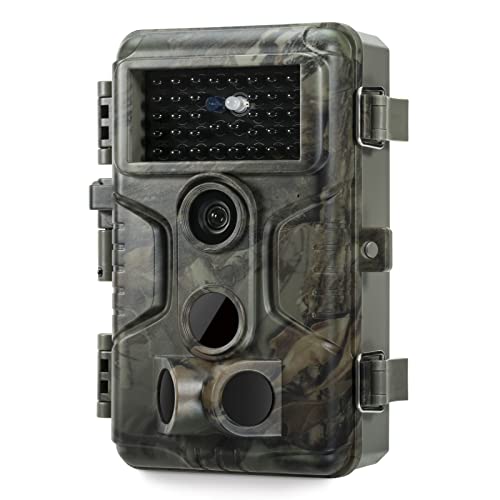
GardePro A3S Trail Camera — No-glow specialist
GardePro’s A3S is the night watchman of this set. Its title pairs 1296P HD video with sound and 64MP photographs with the figures that matter after dark: a 100ft no-glow night vision range and a 0.1s trigger, in a body that is pointedly non-cellular. No-glow illumination emits infrared that neither birds nor mammals can see, so the camera can light a roost approach, a bath at midnight or an owl’s hunting perch without announcing itself in a faint red shimmer. For the watcher whose curiosity peaks when the garden empties of people, this is the specification that decides the purchase.
Video with sound is the second, quieter distinction. Trail cameras are usually mute, and birding is half listening. A recording that carries the splash, the contact calls of a bathing flock and the alarm note that empties the bath a half-second before a cat enters the frame is a richer document than silent footage of the same minute. The A3S states sound in its headline, the only model here to do so, and owners who review with headphones report that the audio track often identifies the species that the night frame merely suggests.
The 1296P video figure sits below the 4K claims elsewhere in this guide, and the review will not inflate it. What the A3S trades in resolution it returns in night range and trigger parity — the same 0.1s as the fastest here — plus the freedom of a non-cellular design: no SIM, no data arrangement, nothing between the camera and its card. In a wood or a large garden where coverage is doubtful anyway, that independence is a feature, and the card-swap walk it imposes is the same walk birdwatchers take for pleasure.
Waterproofing is not given a number in the title, and no solar option is claimed, so the documentation check and the battery routine belong in an A3S owner’s planning. Its case rests on a clear specialisation: the most completely described night instrument in this guide, with sound, aimed at the hours and the species — owls, night drinkers, dawn-first arrivals — that the daylight cameras meet only at the edges of their competence.
- Video: 1296P HD Video with Sound
- Still claim: 64MP Photo
- Trigger: 0.1s Trigger
- Night vision: 100ft No-Glow Night Vision
- Cellular: Non-Cellular (as stated in the listing title)
- Activation: Motion Activated
- Sealing number: Not stated in the listing title — verify with the manufacturer documentation
- Solar supply: Not stated in the listing title — verify with the manufacturer documentation
Strengths
- A stated 100ft no-glow range lights night subjects without visible red glow.
- Sound recording adds calls and splashes that silent rivals cannot document.
- The 0.1s trigger keeps night and day reaction speed equal to the fastest here.
Trade-offs
- Video resolution of 1296P trails the 4K claims of four other models in this guide.
- No numbered sealing rating appears in the title for the wettest pond-side posts.
- Retrieval means walking to the camera; no Wi-Fi, Bluetooth or cellular is claimed.
Best for: a watcher focused on roosts, owls and night drinkers, who values a stated no-glow range and sound over headline video resolution. Not suited for: a birdwatcher whose main quarry is fine daytime plumage detail for identification, because the 1296P video stated here sits below the 4K listings of the Misstech, KJK and MAXDONE models.
Deploy the A3S where darkness is the point. A bath that hosts a nightly mammal procession, a fence post an owl uses between hunting passes, the gap in the hedge where the dawn chorus assembles before first light — these posts reward no-glow patience. Set the camera a little farther back than a daylight model, since its stated night range reaches 100ft, and let the wider night frame include the approach routes; nocturnal behaviour is mostly arrival and departure, and the middle of the frame is the least interesting part of it.
The sound capability suggests a reviewing ritual: once a week, listen before you watch. Play the night’s clips with the screen dimmed and note what the ear catches — wingbeats, calls, the scuffle of something leaving in a hurry. Birding began as a listening discipline long before it became a photographic one, and this camera, alone in the set, honours both halves of the tradition.

WOSPORTS 64MP No-Glow Trail Camera — Deliberately unconnected
WOSPORTS prints its philosophy in parentheses: Non-Cellular, Non-WiFi. Around that declaration its title arranges 64MP stills, 4K video, a 0.2S trigger, no-glow night vision, a 2.0-inch LCD and a 120-degree wide view. This is the trail camera for the owner who has considered connected devices and declined them — no account, no app, no radio signature, just a camera that watches a place and keeps its footage on a card until its owner walks out, opens it, and reviews the catch on the little screen under the same tree.
That built-in LCD, easy to overlook among grander claims, is the model’s field instrument. Framing a bath or a log is guesswork with a blind camera; with a screen, the owner composes on the spot, checks the first test frames standing at the post, and walks away knowing the deployment is right. Reviewing in the field has a second virtue: a disappointing week is diagnosed immediately — angle, obstruction, a branch grown across the lens — rather than discovered at a desk after the moment has passed for good.
The 0.2S trigger is the honest compromise in the specification, twice the stated figure of the 0.1s models, and the review should translate it into bird terms plainly. For drinking, bathing, perching and ground-feeding behaviour — visits measured in seconds — a fifth of a second costs the opening sip at most. For flight shots and the explosive instant of a hawk strike, it costs the event. WOSPORTS buyers should therefore aim this camera at behaviour rather than arrivals, a discipline its wide 120-degree view supports by keeping settled subjects in frame for their whole visit.
No-glow night vision completes a package that is, in the best sense, old-fashioned: sealed, silent, unconnected and patient. No waterproof number is printed in the title, so exposed posts deserve a documentation check, and no solar help is claimed. What is offered instead is sovereignty — a camera answerable to nobody’s network — and for remote corners of large properties, allotments and woodland permissions where signals fear to tread, sovereignty is the specification that matters.
- Still claim: 64MP
- Video: 4K
- Trigger: 0.2S Trigger Motion Activated
- Night vision: No-Glow Night Vision
- Screen: 2.0-inch LCD
- Viewing angle: 120° Wide
- Connectivity: Non-Cellular, Non-WiFi (as stated)
- Sealing number: Not stated in the listing title — verify with the manufacturer documentation
Strengths
- No-glow night vision brings discreet after-dark recording without any network.
- The built-in 2.0-inch LCD allows framing and review standing at the post.
- A 120-degree view keeps settled, feeding birds in frame through long visits.
Trade-offs
- The stated 0.2S trigger is the slowest here, costing flight instants and arrivals.
- Every review and adjustment requires a physical visit; there is no remote link.
- No ingress number is printed for posts exposed to flooding or driven rain.
Best for: an owner who wants a completely unconnected camera for a woodland corner or allotment, framing it by its own screen and collecting cards on foot. Not suited for: a watcher hoping to freeze hawks stooping or swifts arriving at speed, because the stated 0.2S trigger is twice the figure of the 0.1s models in this guide.
The WOSPORTS rewards a diary habit. Because every retrieval is a walk, make the walk count: note the weather, the water level in the bath, which plants have come into flower beside the post. When the card is finally read at home, those notes turn a folder of clips into a dated natural history of one small territory. Owners of connected cameras, spoiled by instant delivery, rarely build that record; the unconnected camera’s supposed inconvenience is, practised properly, a method.
Choose its post for behaviour with a long dwell time. A dust-bathing hollow on a warm afternoon, a log where fledglings are fed, a ground-feeding station under a shrub — at such stages the fifth-of-a-second delay vanishes into irrelevance, and the wide, no-glow, screen-checked frame does its quiet work for weeks between visits.

Loatos 4G LTE Cellular Trail Camera — Live view from anywhere
Loatos removes the walk. Its title describes a 4G LTE cellular trail camera with a built-in SIM card and unlimited data, AI detection, 2K live view, a 4W solar panel and night vision in a waterproof body. Each element serves the same idea: a camera posted somewhere its owner is not — a second property, a distant wood, a reserve corner under the owner’s care — that reports like a correspondent rather than waiting like a trap. Live view is the headline act: open the app and look through the camera now, at the bath, in the rain, from another country.
AI detection in a cellular camera earns its keep as a filter. A camera that sends everything sends too much; a camera that recognises animals and flags the interesting arrivals turns a data stream into a briefing. The stated unlimited data removes the rationing anxiety that makes owners of metered cameras disable their own features, and the built-in SIM removes the procurement errand that delays deployments. Together they describe the most completely connected package in this guide by a considerable distance.
The 4W solar panel is the largest stated panel figure in the set — a watt more than the only other printed figure belongs to a feeder in a different guide — and it matters because cellular radios are hungry. Transmitting clips and holding a live view cost energy that a card camera never spends, so a generous panel is not decoration on this model; it is the difference between a correspondent who files all season and one who falls silent in the third week. Placement discipline still applies, but the hardware starts with a stated advantage.
Video resolution is 2K rather than the 4K claimed by several rivals, no trigger speed is printed in the title, and the waterproof claim carries no number. Those are the honest costs of the connected design, and they define its buyer precisely: someone for whom seeing the distant post live, today, from anywhere, outweighs the finest plumage detail — the warden, the second-home owner, the birdwatcher whose favourite wood is an hour from their door.
- Connectivity: 4G LTE Cellular; Built-in SIM Card; Unlimited Data (as stated)
- Detection: AI Detection
- Live view: 2K Live View
- Video: 2K (live view as stated in the title)
- Power: 4W Solar Powered
- Night capability: Night Vision; Motion Activated; Waterproof (as stated)
- Trigger speed: Not stated in the listing title — verify with the manufacturer documentation
- Sealing number: Not stated in the listing title — verify with the manufacturer documentation
Strengths
- Cellular live view turns a distant post into a window the owner can open anywhere.
- Built-in SIM with unlimited data stated removes both setup errands and rationing.
- The 4W solar panel is the largest stated panel figure among these six cameras.
Trade-offs
- 2K resolution trails the 4K claims of the Misstech, KJK, WOSPORTS and MAXDONE listings.
- No trigger speed is printed, so fast-arrival performance cannot be planned from the title.
- Cellular service presumes coverage at the post; a signal-free wood defeats its premise.
Best for: an owner whose bird post sits far from home — a second property, a reserve, a distant wood — and who wants live view and AI-flagged arrivals delivered by cellular link. Not suited for: a watcher posting a camera in a deep valley or dense wood with no reliable mobile signal, because the 4G LTE design stated here depends on coverage the site cannot offer.
A cellular camera changes the ethics of checking. Because looking costs nothing and disturbs nothing, owners peek often — and should let that ease deepen their patience rather than their interference. Resist the urge to visit and adjust after every quiet day; the live view exists so the post can be left alone for longer, not managed more nervously. The birds repay undisturbed weeks with behaviour no visited camera ever records, and the correspondent model, properly trusted, becomes the least intrusive instrument in this entire guide.
Site the Loatos with two skies in mind: the sun’s, for its 4W panel, and the network’s, for its radio. A clearing edge often serves both — open above, covered at ground level where the birds want shelter. Test the signal standing at the post before the strap is tightened, and let a strong, sunlit edge of woodland become the permanent address of your furthest, most faithful reporter.

MAXDONE Solar Trail Camera 4K — Battery figure printed
MAXDONE prints the number its solar rivals withhold: a 6000mAh battery, named in the title beside 4K video, 64MP stills, night vision, IP66 waterproofing, Wi-Fi Bluetooth connectivity and a 32GB memory card included. A stated battery capacity converts deployment planning from folklore into arithmetic. The owner can reason about how the camera’s appetite and the panel’s harvest balance across a dull month, and can compare that figure directly against any rival willing to print its own — which, in this guide, is none of them.
The combination around the battery is the garden-friendly one. Wi-Fi and Bluetooth handle retrieval on the weekly round, the included card means the first deployment needs no shopping trip, and IP66 sealing covers the splashes and storms of a bath-side or fence-line post. No monthly arrangement is implied by anything in the title, and no cellular reach is claimed; this is a home-property camera engineered to be left alone between pleasant visits, with its energy budget printed on the box for the owner to judge.
Night vision is claimed without the no-glow description that GardePro and WOSPORTS print, so the MAXDONE’s after-dark discretion is a question for its documentation. No trigger speed is stated either, which places it with the Loatos in the group whose reaction time a buyer cannot verify from the headline. For bathing, drinking and feeding behaviour those silences may matter little; for a post aimed at a flight line they argue for one of the stated 0.1s models instead.
What remains is a specification with an unusually practical centre of gravity. The 4K and 64MP figures match the set’s headline claims, the sealing matches the solar Misstech, and the battery figure exceeds every rival in usefulness simply by existing. Birdwatchers are natural record-keepers, and a maker who prints the number record-keepers ask for has understood its audience. The MAXDONE is the planner’s camera in this guide: every quantity it states can be written in a notebook and planned around.
- Video: 4K
- Still claim: 64MP
- Battery: 6000mAh Battery
- Sealing: IP66 Waterproof
- Connectivity: WiFi Bluetooth
- Included media: 32GB Memory Card
- Activation: Night Vision Motion Activated (as stated)
- Trigger speed: Not stated in the listing title — verify with the manufacturer documentation
Strengths
- The stated 6000mAh battery makes deployment length plannable in real numbers.
- Solar power, a bundled 32GB card and IP66 sealing complete a ready garden kit.
- Wi-Fi Bluetooth retrieval suits a weekly round without any cellular arrangement.
Trade-offs
- Trigger speed is unstated, so flight-line and arrival work cannot be planned from the title.
- Night vision is not described as no-glow, unlike the GardePro and WOSPORTS listings.
- Its app-based retrieval still depends on the owner walking within range regularly.
Best for: a methodical home birdwatcher who plans deployments by stated capacity and wants solar upkeep, a card in the box and phone retrieval on a weekly round. Not suited for: a watcher siting a camera on a fast flight path, because this title prints no trigger speed while three rivals in this guide state 0.1s outright.
MAXDONE’s printed battery invites an experiment worth running once: the deployment log. Record the mounting date, the panel’s aspect, the retrieval dates and the battery’s state at each visit. By the second season the log predicts, for your garden’s actual light, how long this camera can be trusted at each post — knowledge no review can give you, because no review shares your trees. Instruments that state their quantities reward owners who keep score, and this is the only camera in the set whose energy quantity can be scored at all.
Pair that discipline with the included card’s limits. A 32GB card at a busy bath fills faster than new owners expect during fledging season, when every resident brings its entire family to the water hourly. Schedule the fledging fortnight as a weekly-visit period in the log, and the planner’s camera will not miss the very week it was bought to witness.
Comparison
| Camera | Video stated | Trigger stated | Night claim in title | Retrieval |
|---|---|---|---|---|
| Misstech Solar | 4K | 0.1s | Night vision (glow unstated) | App control; local storage |
| KJK 4K 64MP | 4K | 0.1s | Night vision (glow unstated) | WiFi Bluetooth; 32GB card included |
| GardePro A3S | 1296P with sound | 0.1s | 100ft No-Glow | Card only; non-cellular |
| WOSPORTS 64MP | 4K | 0.2S | No-Glow | Card only; built-in LCD; no radios |
| Loatos 4G LTE | 2K live view | Not stated in the listing title | Night vision (glow unstated) | Cellular; built-in SIM; unlimited data stated |
| MAXDONE Solar | 4K | Not stated in the listing title | Night vision (glow unstated) | WiFi Bluetooth; 32GB card included |
How to Choose a Trail Camera for Birds
Choose the post before the camera, and be specific: not ‘the garden’ but the shallow end of the bath, the third fence post, the log by the gate. Each post has a light direction, a distance to the subject and a visiting rhythm, and those three facts select the camera more reliably than any ranking. A sunny bath walked past daily suits the solar, app-retrieved models. A night post suits the no-glow pair. A post an hour away suits the cellular Loatos or it suits nobody, because an unvisited card camera an hour away is a diary nobody reads.
Trigger speed is the second decision, and it is a decision about behaviour. Settled behaviour — bathing, drinking, feeding, preening — forgives any trigger in this guide, including the WOSPORTS’ stated 0.2S. Arrivals forgive nothing: a bird that lands, drinks once and leaves inside a second gives a slow camera a portrait of empty water. If your post is a flight line, a nest approach or a hawk-watched bath where visits are snatched, confine your shortlist to the three models that print 0.1s and accept their other compromises as the price of the opening frame.
Night requirements come third, and they divide on a single word: glow. Standard infrared illumination can show as a dull red shimmer that some mammals notice and most birds ignore, while no-glow emitters are invisible to both. For a bath visited by relaxed daytime species, ordinary night vision suffices. For roosts, owl perches and nervous night drinkers, the two listings that print no-glow — GardePro with its stated 100ft range, WOSPORTS with its screen and silence — are the defensible choices, and the others’ night claims should be read as brightness promises, not invisibility promises.
Finally, plan the energy and the evidence together. Solar models still need sky; cellular models still need signal; card models still need visits. Write the deployment down — post, date, retrieval day — and choose the camera whose stated arrangements match the plan you will actually keep. A trail camera’s footage is only ever as good as the routine that surrounds it, and the routine is the one specification entirely in the buyer’s hands.
Why Does Trigger Speed Matter More for Birds Than for Deer?
Because birds live at a different tempo. A deer steps into a clearing and remains, giving even a leisurely camera a sequence of usable frames. A small bird’s visit to water is a series of commitments measured in fractions: the landing, the first dip, the look around, the decision to stay or go. The information a birdwatcher wants — species, sex, age, condition — is distributed across those fractions, and a camera that wakes after them has photographed the venue rather than the visitor. That is why the stated figures in this guide, 0.1s against 0.2S, deserve the weight the reviews give them.
Position can repay part of a slower trigger’s debt. Aim a camera along a bath rather than across it, so an arriving bird crosses the sensor’s view during its approach instead of appearing from nowhere at the centre, and the effective warning grows. Pre-wetting a dry dust hollow, or keeping a bath filled to a constant level, also lengthens visits themselves. Technique cannot turn a 0.2S camera into a 0.1s one, but a thoughtfully staged post narrows the gap until the remaining difference matters only to flight specialists.
Where Exactly Should a Trail Camera Point at a Birdbath?
At the shallow end, from low, along the axis birds themselves use. Most baths have a beach — a gently sloping entry where small birds stand to drink and bathe — and that beach is the stage. A camera at knee height, a short distance back, angled slightly down, frames the beach, the waterline and a strip of the approach grass where arrivals land before committing. Centring the deep middle of the bath, by contrast, records reflections and the backs of birds facing away.
Height carries a second lesson: a camera looking down steeply foreshortens every bird into a puzzle of crowns and backs, while a low camera meets them at their own level and shows faces, bills and eye stripes — the identification features. Gardeners who mount trail cameras at chest height for convenience spend the season identifying hats. Kneel when you strap the camera, see what it sees at bird height, and the footage improves more than any resolution step could achieve.
How Long Can a Trail Camera Be Left at a Bird Post?
As long as its energy, its storage and the birds’ tolerance allow — and the three run out in that order for most owners. Solar models in honest sun, like the Misstech, Loatos and MAXDONE here, push the energy limit toward a whole season. Storage fills by activity rather than by date: a quiet woodland card lasts months, a fledging-season bath card can fill in weeks. The birds’ tolerance, once the camera has weathered into the scenery, is effectively unlimited, provided visits to the post are calm, brief and predictable in their timing.
Seasonality rewrites every post’s value across the year, and a camera left in place documents the rewrite faithfully. The bath that hosts crowds in a dry June may stand ignored in a wet October when puddles offer easier drinking, while the hedge gap that seemed empty all summer becomes a motorway in the first frost week, when berries ripen along it. Owners who keep cameras running through the unfashionable months learn their ground’s true calendar rather than its holiday brochure, and that knowledge compounds: next year’s posts are chosen from evidence, this year’s surprises become next year’s expectations, and the garden reveals itself as a place with seasons inside seasons — the week of the first fledglings, the fortnight of the moult, the single cold morning when fieldfares descend like a rumour made feathered.
The practical answer is a rhythm rather than a duration. Visit on a schedule the site can absorb — weekly for garden posts, monthly for distant ones — swap or download, check the strap and the lens for webs and weather, and leave everything else untouched. Deployments fail from fussing more often than from neglect. A camera left to its rhythm becomes part of the place; a camera adjusted after every quiet day remains a stranger that the shyest species never forgive.
Common Mistakes When Siting a Trail Camera for Birds
Aiming at where birds are wished for, rather than where they already go, wastes more deployments than any hardware flaw. A new bath, a new log, a feeder pole installed for the camera’s benefit will all be adopted eventually, but the camera bought for this season’s fledglings should watch the scruffy, established places — the leaking tap’s puddle, the old stump, the gap in the hedge worn by years of wings. Survey first with your own eyes at dawn for a week; the birds will show you the posts, and every camera in this guide works better as a witness than as an attraction.
Forgetting the sun’s path across the frame is the second classic error. A camera facing east photographs the dawn arrivals it most wants as silhouettes against the glare, and a camera facing west repeats the injury at dusk. North- or south-facing posts, with the light arriving over the camera’s shoulder for the hours that matter, turn the same hardware into a portraitist. The solar models add their own demand: their panels need the sky their lenses may not, so check both orientations before the strap is cut to length.
A third mistake is reviewing too eagerly and disturbing the post daily. Fresh human scent, a changed silhouette, a strap re-tied at a new angle — residents notice all of it, and the shy species simply move their bathing to the neighbour’s garden for a week. Retrieval methods exist on a spectrum of disturbance for a reason: the cellular and app models let the post settle, and even card cameras repay a disciplined, infrequent visiting rhythm with footage of animals that have forgotten the camera exists.
Last, owners underrate the small maintenance of water itself. A bath that dries out by Wednesday hosts no Friday footage regardless of the camera guarding it, and a bath allowed to turn green teaches birds to drink elsewhere. The camera and the water are one system. Keep the water fresh, the beach clean and the level constant, and the finest trail camera ever made — which is to say, a reliable one watching a reliable place — will do the rest.
Final Recommendation
Match the camera to the ground you actually have. For a sunny home bath and a fee-free season, the Misstech’s solar local storage is the natural post; for the same bath with wider context and the strongest stated sealing, the KJK earns its place; for the night shift — roosts, owls, sound — the GardePro A3S stands apart; for a signal-free wood where sovereignty matters, the WOSPORTS keeps its own counsel; for the distant property, the Loatos reports live over its cellular link; and for the planner who wants the battery printed before the promise, the MAXDONE states its capacity and its card. Choose the post, honour its light, and leave the camera alone long enough for the birds to forget it — the footage that follows will show you a garden you have lived beside for years without ever quite seeing.
Frequently Asked Questions
Which of these cameras can send bird photos to a phone remotely?
Only the Loatos claims a cellular link, with a built-in SIM and unlimited data stated in its title, plus 2K live view. The Misstech offers app control and the KJK and MAXDONE offer Wi-Fi Bluetooth retrieval, all of which work at short range rather than from another town.
What does no-glow night vision mean for birdwatching?
The infrared illumination is invisible to birds and mammals, so a roost or night bath can be lit without a visible red shimmer. GardePro states a 100ft no-glow range and WOSPORTS states no-glow night vision; the other titles claim night vision without describing the glow.
Is 4K necessary in a trail camera for birds?
It helps with small, distant subjects in daylight, and four models here claim it. GardePro’s 1296P model counters with sound and the strongest stated night package, while the cellular Loatos offers 2K live view — evidence that working bird cameras trade resolution against night craft, audio and reach in different proportions.
How waterproof are these cameras for a pond-side post?
KJK prints IP67, and Misstech and MAXDONE print IP66. GardePro and WOSPORTS print no number in their titles, and Loatos states waterproof without a figure, so those three deserve a documentation check before a flood-prone site is chosen.
Why would anyone choose a camera with no Wi-Fi or cellular at all?
The WOSPORTS design removes accounts, apps and radio dependence entirely, frames shots on its own LCD screen and keeps footage on a card. For allotments, woodland permissions and anywhere signals are poor, that independence is a working feature rather than a missing one.
Related Guides
Watching birds away from home ground calls for different tools again. The garden feeder specialists are compared in the best backyard bird cameras, where solar feeders film the perch all day, walkers who carry the watch with them will find their shortlist in the best lightweight cameras for birding, weighed honestly from pocket to flagship, and the reach specialists gather in the best super zoom point and shoot cameras for birding, from 40x to 125x.


