What's inside
- Where to Buy
- Key Takeaways
- Quick Picks
- How We Chose These Picks
- Comparison
- How to Choose a Printer for T-Shirt Heat Transfers
- Light Fabric or Dark Fabric: Why the Paper Changes Everything
- How Do You Press a Transfer That Survives the Wash?
- Why Must the Design Be Mirrored, and What Else Goes Wrong at the Press?
- What Does a Small Shirt Run Look Like From Order to Delivery?
- Which Blank Shirts Take Transfers Best?
- How Do You Handle Sizes, Reorders and Repeat Designs?
- What Are the Common Mistakes in T-Shirt Transfer Printing?
- How Should a New Seller Spend the First Month?
- Final Recommendation
- Frequently Asked Questions
- Related Guides
As an Amazon Associate I earn from qualifying purchases. This post may contain affiliate links at no extra cost to you.
widgetverdict.com is reader-supported. When you buy through links on our site, we may earn an affiliate commission.
Where to Buy
Every machine below is a standard inkjet assessed for garment work, and each name opens its Amazon listing. Sellers printing chest designs at full width should start with the Epson EcoTank Photo ET-8550, the wide-format tank model, and the Epson Expression Photo HD XP-15000, its cartridge counterpart. Volume producers at standard sizes will want the Epson EcoTank ET-4800, the Canon MegaTank G3270 and the Canon MAXIFY GX2020 MegaTank open for comparison, while the Canon PIXMA TR7120 serves the one-off gift-shirt desk. Read the listings for the two machines that match your order book, then decide.
Anyone hunting for the best printers for heat transfers for t-shirts deserves the truth before the product names: no printer on this page is a t-shirt printer. Shirts are printed by a partnership — transfer paper designed for fabric, an ordinary inkjet to print the design onto that paper, and heat to move the design onto the garment. The printer is one partner of three, and this guide’s job is to judge that partner by the standards garment work actually imposes: how large a design it can print in one piece, what its ink system does to the cost of a production run, and how its colour holds up once the shirt starts cycling through the wash.
Garment printing has its own physics, and it differs from paper crafts in ways that reorder a buyer’s priorities. A shirt flexes, stretches and abrades; a design that survives a tote bag’s gentle life can crack on a chest that breathes. Shirts come in white, black and every colour between, and the transfer paper — not the printer — changes completely between light and dark fabric. Shirts get washed, weekly, for years, and wash survival is decided by paper quality, pressing discipline and ink character working together. The reviews below keep returning to those three garment facts, because a printer bought for shirts should be bought with a wardrobe in mind, not a scrapbook.
The six picks divide cleanly. Two Epson photo machines print six colours up to 13 x 19 inches — wide enough for a full adult chest design in a single sheet — one with refillable tanks (ET-8550) and one with cartridges (XP-15000). Three tank machines cover standard-size production at three business weights: the ET-4800 with its office fittings, the G3270 as the compact family unit, and the GX2020 as the duplex business build. The TR7120 closes the list as the cartridge all-in-one for people whose shirt printing is measured in birthdays per year rather than orders per week. Same partnership, six different scales of ambition.
Key Takeaways
- No dedicated t-shirt transfer printer exists — the system is fabric transfer paper, a standard inkjet and a heat press, and this guide judges the inkjet’s share.
- Full-width adult chest designs need the two 13 x 19 inch machines: the tank-fed ET-8550 or the cartridge-fed XP-15000.
- Dark shirts are a paper decision, not a printer decision — dark-fabric transfer paper carries the opaque layer that keeps colours honest.
- Wash durability is built from paper quality, correct pressing and ink character together; no printer guarantees it alone.
- Tank machines dominate production economics; the ET-4800, G3270 and GX2020 divide that territory by business size.
- The TR7120’s cartridge convenience fits gift-shirt volumes, and its feeder helps digitise hand-drawn designs.
Quick Picks
| Pick | Badge | Why it earns a place |
|---|---|---|
| Epson EcoTank Photo ET-8550 | Full-Width Production Pick | Six-colour tank printing up to 13 x 19 inches for one-piece adult chest designs. |
| Epson EcoTank ET-4800 | Seller’s Office Pick | Cartridge-free standard-size printing with feeder, fax and Ethernet for a shirt business’s paperwork. |
| Canon MegaTank G3270 | Compact Volume Pick | A refillable-tank all-in-one sized for weekly standard-format shirt runs at home. |
| Canon MAXIFY GX2020 MegaTank | Steady Production Pick | A duplex MegaTank with business build for sellers whose runs keep growing. |
| Epson Expression Photo HD XP-15000 | Full-Width Occasional Pick | Six-colour 13 x 19 inch output on cartridges, for wide designs printed in bursts. |
| Canon PIXMA TR7120 | Gift-Shirt Pick | A white cartridge inkjet with a document feeder for one-off personalised shirts. |
How We Chose These Picks
Garment work supplied the criteria, in the order a shirt seller meets them. Design size came first, because it is binary: a chest artwork either fits the sheet or gets tiled, seamed or shrunk, and only two machines here print the 13 x 19 inch sheets that swallow adult designs whole. Ink economics came second, because a seller’s margin lives in the per-shirt cost, and tank systems change that cost’s shape completely compared with cartridges. Colour capability came third — six-colour printing on the photo pair matters for the photographic shirts, band artwork and shaded illustrations that dominate personalised garment orders.
The supporting functions were judged by the selling life around the shirts. A document feeder scans the hand-drawn artwork customers bring in; duplex prints the care cards and invoices; Ethernet keeps a small shop’s printer reachable from every desk. Those features appear across the ET-4800, GX2020 and TR7120 titles in different combinations, and the reviews weigh them as business infrastructure rather than decoration. What no title states — feed-path design, media weights, ink chemistry — no review invents; garment makers will confirm paper behaviour with the test-print routine this guide teaches, on their own blanks, before an order depends on it.
One deliberate exclusion shapes the list: there is no laser machine here. Heat transfer papers for garments divide sharply by printer type, the inkjet family owns the craft and small-seller end of that market, and all six of these inkjets print the standard inkjet transfer papers sold for home and small-studio shirt work. A buyer with a laser printer and garment ambitions needs laser-specific transfer paper and a different conversation — the FAQ at the end points that way honestly rather than letting the assumption slide.

Epson EcoTank Photo ET-8550 — Full-Width Production Pick
For a shirt seller, the ET-8550’s title reads like a production specification: wireless wide-format all-in-one, cartridge-free six-colour photo printing with scan and copy, up to 16 pages per minute, output up to 13 x 19 inches, aimed at creators and home studios. The garment translation is direct. Thirteen by nineteen is the sheet that takes an adult chest design — the band artwork, the photographic front, the oversized typography piece — in one piece, at full scale, without a seam hiding in the artwork or a shrunken compromise where the design’s confidence used to be. Six colours carry the photographic shirts that four-colour machines flatten. Tanks turn a fifty-shirt run’s ink from a budget event into a line item.
Production rhythm is where this machine separates itself from the merely capable. A seller’s week is batches: ten shirts for a team, thirty for an event, a standing design restocked as sizes sell through. Bottled ink, a wide sheet path and a studio-tier build suit that rhythm — the printer becomes the calm end of the production line while the press, with its per-shirt minutes of heat and handling, sets the pace. Scanning at the same station matters more than it sounds: customer artwork arrives as photographs, sketches and phone pictures of sketches, and the desk that digitises, sizes and prints without moving rooms keeps orders flowing.
The garment caveats are this guide’s standing ones, and they bind here too. The title promises no feed specification, so your transfer paper’s passage through this machine gets proven with test sheets on your blanks before a customer’s deadline rides on it. Sixteen pages per minute describes documents, not photo-quality wide sheets, which will emerge at their own deliberate pace — schedule production accordingly. And wash durability, the quality customers actually judge in month three, will be decided by your paper, your pressing and your ink settings working together; the ET-8550 gives that partnership the strongest printing partner in this guide, which is all any printer can honestly offer.
- Maximum print size: Up to 13 x 19 inches
- Colour system: 6-colour cartridge-free tank printing
- Functions: Print, scan, copy — wireless all-in-one
- Stated speed: Up to 16 ppm
- Positioning: Creators and home studios
- Feed path for coated transfer sheets: Not stated in the listing title — verify with the manufacturer documentation
Strengths
- Adult chest designs print whole, at scale, without seams.
- Six-colour output serves photographic and shaded artwork.
- Tank ink economics protect a seller’s per-shirt margin.
Trade-offs
- Wide body and wide sheets are wasted on pocket-logo work.
- Photo-quality wide output is unhurried — batch scheduling required.
- Paper handling must be proven on your own blanks first.
Best for: a shirt seller or studio printing full-width photographic designs as a weekly business. Not suited for: a maker whose designs never exceed pocket or left-chest size — the 13 x 19 inch sheet capacity and six-colour system answer a problem that desk does not have.
Sellers building a production station can open the ET-8550’s Amazon page to check the current price and the ink supplied in the present bundle.
Set this machine up like the production equipment it is. Dedicate one saved profile per transfer paper you run — light-fabric and dark-fabric papers separately — with the mirroring preference stored in the profile so a shirt can never leave unmirrored by forgetfulness. Keep a pressed reference shirt from each paper batch hanging by the press; when a customer asks how a design will look after washing, the honest answer is hanging there, laundered ten times, instead of being promised from a screen. Wide-format sellers live on repeat corporate and team orders, and repeat orders are won by exactly that kind of demonstrable consistency.

Epson EcoTank ET-4800 — Seller’s Office Pick
Most shirt businesses are one room where making and administering collide, and the ET-4800 is built for that room: a wireless colour all-in-one supertank with cartridge-free printing, scan, copy and fax, up to 10 pages per minute, an auto document feeder and Ethernet, aimed at home and small offices. Read it as a shirt seller and the feature list rearranges itself. The tank keeps standard-size designs cheap to produce in weekly volume. The feeder digests the order forms, supplier sheets and hand-drawn customer artwork that accumulate around a selling operation. Ethernet puts the printer on the shop network by wire, indifferent to the wireless dead spots that haunt rooms full of shelving and stock.
Standard format is this pick’s honest boundary, and for a large share of sellers it is no boundary at all. Left-chest logos, children’s shirts, sleeve prints, tote-and-shirt combination designs and the entire world of text-based personalisation live within standard sheets. A seller whose catalogue reads that way gains the ET-4800’s business fittings without paying the wide-format pair’s desk tax, and gains them in a machine exercised daily by paperwork — which keeps its ink system in the regular motion that produces consistent colour from the first shirt of a batch to the last.
Choose it with the catalogue in hand, though. The day a best-selling design outgrows the sheet — the day a customer wants the artwork across the whole chest — the ET-4800’s ceiling becomes the business’s ceiling, and no setting changes that. Its title also keeps the guide’s usual silences: no feed-path promises for coated stock, so blanks get tested before orders depend on them. As the office heart of a standard-size shirt operation, though, it is the most completely fitted machine in this guide, and its fax — yes, fax — will surprise nobody who has supplied schools, clubs and local government, institutions whose order processes still run on it.
- Functions: Print, scan, copy, fax — cartridge-free supertank
- Stated speed: Up to 10 ppm
- Document feeder: ADF stated in the title
- Connection: Wireless and Ethernet
- Maximum sheet size: Standard sizes — wide-format not stated in the listing title
- Feed path for coated transfer sheets: Not stated in the listing title — verify with the manufacturer documentation
Strengths
- Feeder and wired networking run the business around the shirts.
- Daily office use keeps ink fresh for consistent batch colour.
- Tank supply holds standard-size production costs down.
Trade-offs
- Standard format caps design size at the sheet’s edge.
- Office fittings are wasted on a pure hobby desk.
- Coated-sheet behaviour joins the standing test-print rule.
Best for: a small shirt business printing standard-size designs whose office work shares the same machine. Not suited for: full-width adult chest artwork — standard sheets cannot carry it in one piece, so wide-design sellers belong with the ET-8550 or XP-15000.
Shop owners fitting out a one-room operation can look over the ET-4800’s Amazon listing for today’s price and current package details.
Exploit the feeder for the archive every shirt business eventually needs. Scan every customer’s supplied artwork, every signed approval and every final design version into a folder named by order, and the reorder that arrives eighteen months later — same design, new sizes, a reunion shirt run — becomes a printing job instead of an archaeology dig. Sellers discover that their back catalogue is their most profitable catalogue, because the design work is already paid for; the ET-4800’s unglamorous scanner is the tool that keeps that catalogue findable.

Canon MegaTank G3270 — Compact Volume Pick
The G3270 is the home-scale answer to the same production question: a Canon MegaTank all-in-one, wireless, with print, copy and scan, a refillable tank system and a compact desktop design for home and office. Its shirt profile is the kitchen-table business — the parent selling personalised family shirts online, the hobbyist whose market stall runs monthly, the small club volunteer producing team shirts each season. Tank ink makes their weekly or monthly runs affordable; the compact body lets the printer share a room that also contains the press, the blank stock and ordinary domestic life; the scanner digitises the hand-drawn designs that personalisation customers specialise in supplying.
Volume honesty defines this pick’s happiness. At a few dozen shirts a month, the G3270’s economics and scale are beautifully matched: ink costs stay low, the machine stays exercised, and the standard sheet size covers the children’s designs, chest logos and text work that dominate home-scale orders. Push toward daily hundreds and the compact build’s limits announce themselves — this is a desktop all-in-one, not a production engine, and its natural batch is the evening run, not the warehouse shift. Sellers should buy it for the order book they have, with the GX2020’s graduation path in mind if the book thickens.
Standard cautions, garment edition: designs cap at standard sheet dimensions, so full-width adult fronts are out of scope by geometry; the title states neither duplex nor feed specifics, so transfer paper earns its test sheets on your blanks before a paying deadline; and a household machine shared with homework needs its coated stock stored separately, by the press, where no one can load a transfer sheet for a school worksheet. Observe those three and the G3270 is the friendliest entry into selling shirts that this guide can offer.
- Functions: Print, copy, scan — wireless all-in-one
- Ink system: Refillable tank system (MegaTank)
- Form: Compact desktop design
- Positioning: Home and office use
- Maximum sheet size: Standard sizes — wide-format not stated in the listing title
- Duplex: Not stated in the listing title — verify with the manufacturer documentation
Strengths
- Low ink costs suit a home seller’s weekly shirt batches.
- Scanner handles customers’ hand-drawn artwork in-house.
- Compact footprint shares domestic space with the press.
Trade-offs
- Compact build suits evening batches, not warehouse shifts.
- Standard sheets exclude one-piece adult chest designs.
- Household sharing demands strict transfer-paper separation.
Best for: a home-based seller printing standard-size shirts in weekly batches. Not suited for: high daily volumes — a compact desktop all-in-one asked to run hundreds of sheets a day is being measured against a job the GX2020 class exists to do.
Home sellers can visit the G3270’s Amazon page to check the current price and the ink included with the present offer.
Grow into this machine with a production notebook from the first order: design name, paper brand, profile, press settings, blank supplier, and a note after the first wash of your own sample. Home sellers scale on memory until memory fails at order forty; the notebook is what turns a kitchen-table operation into a small business with reproducible quality. Keep one sample shirt from every design you sell, washed repeatedly, and let those samples — not optimism — answer customers’ durability questions at the market stall.

Canon MAXIFY GX2020 MegaTank — Steady Production Pick
Between the home seller and the full studio sits the growing operation, and the GX2020 is its machine in this guide: a Canon MegaTank MAXIFY all-in-one with print, copy and scan, duplex printing, a refillable tank system and wireless connection in a compact desktop body, positioned for home and office. The MAXIFY line’s small-business engineering is the point. Transfer production is repetitive feeding of coated, unforgiving stock, batch after batch, and a machine built for offices that print all day brings a steadiness to that repetition that light-duty models promise less convincingly across a long season.
Duplex, irrelevant to the shirts themselves, earns its mention as a tier signal and a paperwork tool: the growing seller prints care cards, invoices, packing slips and the occasional two-sided lookbook, and a machine that handles the business’s documents at the same standard as its transfers consolidates the desk. Tank supply completes the production profile — ink bought in bottles, costs per shirt held down, and a machine exercised daily, which garment colour consistency quietly depends on. A printer used every day prints the same red on Friday as on Monday; a printer woken monthly has to remember itself first, and shirts reveal the difference.
Its boundaries mirror the other standard-format picks, and a growing seller should read them as a growth map rather than a criticism. Standard sheets cap the catalogue at standard designs; the wide pair waits when the catalogue outgrows them. No feeder is named in the title, so paperwork stacks scan page by page, unlike the ET-4800’s arrangement. And the title’s feed silence means coated stock gets the standing test on your blanks. Within those lines, the GX2020 is the pick for the seller whose problem is no longer starting but sustaining — more orders, same quality, week after week.
- Functions: Print, copy, scan — wireless all-in-one
- Ink system: Refillable tank system (MegaTank)
- Duplex: Duplex printing stated in the title
- Form: Compact desktop design, home and office positioning
- Document feeder: Not stated in the listing title — verify with the manufacturer documentation
- Feed path for coated transfer sheets: Not stated in the listing title — verify with the manufacturer documentation
Strengths
- Business build steadies long runs of coated transfer stock.
- Daily use keeps batch colour consistent across the week.
- Duplex and tank supply cover the growing seller’s paperwork.
Trade-offs
- No feeder named — artwork and forms scan one page at a time.
- Standard format ceiling applies to the whole catalogue.
- More machine than a monthly hobby habit will exercise.
Best for: a growing seller printing shirt batches most days who needs business-build reliability at standard sizes. Not suited for: one-piece wide chest designs — the standard-format sheet path sets a hard geometric limit no profile can widen.
Sellers in the growth stage can examine the GX2020’s listing on Amazon to weigh the present price against their weekly order count.
Put the GX2020 on a production rota and it will behave like staff: stock counted before the run, sheets printed in the morning when the room is cool, pressing batched after. Growing sellers often discover their bottleneck was never the printer’s speed but the choreography around it — blanks unfolded, sizes sorted, finished shirts cooled and stacked without touching wet designs. A steady machine rewards a steady system, and the sellers who build both find their ceiling moves from the equipment to the order book, which is where a business wants its ceiling to be.
Epson Expression Photo HD XP-15000 — Full-Width Occasional Pick
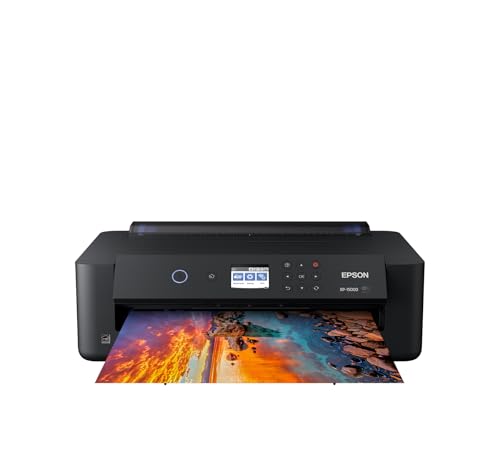
The XP-15000 holds the wide-format door open for the non-production buyer: a wireless wide-format inkjet with six-colour photo printing, up to 9.2 pages per minute, output to 13 x 19 inches and automatic two-sided printing, aimed at photographers and home studios. Its garment reader prints wide but rarely — the band member producing a dozen full-front shirts for a tour, the family reunion organiser whose annual design spans the chest, the photographer whose wearable prints are a sideline to paper prints. For that calendar, cartridges beat tanks: sealed ink that waits patiently between projects, no standing-ink routine, and full six-colour wide output whenever the occasion arrives.
Photographic shirts are this machine’s home ground. Six colours at wide format reproduce the gradients, skin tones and shadow detail that shirt artwork increasingly contains, and a design printed at full chest scale in one sheet avoids the tiled seam that announces an amateur production across a room. Auto two-sided printing covers the occasion’s paperwork — order lists, size tallies, care instructions — while the event itself is being organised. The 9.2 ppm figure is a document pace; wide photo sheets will take minutes each, which an occasional producer schedules around rather than suffers from.
Honesty about rhythm completes the review. A dozen wide shirts a month is this machine’s delight; a hundred a week would make its cartridge costs a business problem and its pace a bottleneck, and that reader should be standing in front of the ET-8550 instead. The title’s feed silence applies the standing test-sheet rule to coated stock. And occasional wide printing has one specific hazard worth naming: the first sheet after a quiet month is a test sheet whether you call it one or not, so spend it deliberately on a proof rather than accidentally on the run’s first real design.
- Maximum print size: Up to 13 x 19 inches
- Colour system: 6-colour wide-format photo inkjet
- Stated speed: Up to 9.2 ppm
- Duplex: Auto 2-sided printing stated
- Connection: Wireless
- Feed path for coated transfer sheets: Not stated in the listing title — verify with the manufacturer documentation
Strengths
- Full-width, six-colour shirt designs without tank commitment.
- Cartridges tolerate long quiet gaps between projects.
- Two-sided printing handles the event paperwork around orders.
Trade-offs
- Weekly production volumes make cartridge costs bite hard.
- Wide photo sheets print slowly — deadlines need headroom.
- First sheet after idle months should always be a proof.
Best for: an occasional producer whose wide designs arrive in event-sized bursts. Not suited for: a standing weekly catalogue — sustained wide-format volume belongs on the tank-fed ET-8550, whose ink economics were built for exactly that calendar.
Event producers can pull up the XP-15000’s Amazon page to see today’s price and the cartridges in the current package.
Occasional wide printing rewards a pre-flight ritual borrowed from photographers: the day before production, print one full-size proof on plain paper, hold it against an actual shirt on an actual person, and judge scale with your eyes. Chest designs fail by proportion more often than by colour — artwork that looked commanding on screen can sit timidly on a torso, or overwhelm it — and the proof costs a sheet of plain paper to correct. Then print the transfers, press a single sample, wash it if the timeline allows, and only then commit the batch.

Canon PIXMA TR7120 — Gift-Shirt Pick
Not every shirt is merchandise. The TR7120 serves the gift economy: a wireless colour inkjet with duplex printing, copier and scanner, an auto document feeder, a compact white design and an intuitive control panel — the machine for the grandparent printing birthday shirts with the children’s own drawings on them, the teacher making class shirts, the friend group producing matching weekend tees. Cartridge ink fits this life exactly, because the print volume is a handful of shirts per occasion and the machine’s other 350 days are spent as a well-mannered household all-in-one.
The feeder plays an unexpected starring role in gift shirts specifically. The artwork for these projects is overwhelmingly physical — drawings, hand-lettered names, a child’s painting of the family dog — and a feeder turns a stack of such originals into digital files in one session, ready to be sized, mirrored and arranged. White compact styling keeps the machine welcome in the domestic rooms where gift projects actually happen. And duplex, plus the household functions, mean the printer earns its place year-round instead of being a single-purpose guest in the house.
The boundaries are the gift scale’s boundaries, stated without apology. Cartridge costs make a nonsense of production volumes — a seller printing fifty shirts a week on this machine would spend the profit on ink, which is why this guide’s tank picks exist. Standard format limits designs to standard sheets, ruling out the full-chest one-piece artwork of the wide pair. The title names no feed specifics, so the standing test applies. But for its true reader — occasional, personal, standard-size, heartfelt — the TR7120 is not a compromise at all; it is the correct tool, and the shirts it makes will be kept long after production shirts are forgotten.
- Functions: Print, copy, scan with auto document feeder
- Ink system: Cartridge inkjet
- Duplex: Duplex printing stated in the title
- Colour and form: White, compact, intuitive control panel
- Maximum sheet size: Standard sizes — wide-format not stated in the listing title
- Feed path for coated transfer sheets: Not stated in the listing title — verify with the manufacturer documentation
Strengths
- Feeder digitises stacks of hand-drawn gift artwork quickly.
- Cartridge convenience matches a few-shirts-per-occasion calendar.
- Full household all-in-one value between shirt projects.
Trade-offs
- Production volumes would surrender their margin to cartridges.
- Standard sheets exclude one-piece full-chest designs.
- Compact build expects projects, not production shifts.
Best for: families, teachers and friend groups printing personalised shirts for occasions at standard sizes. Not suited for: a selling operation — per-sheet cartridge costs and a light-duty build both argue for the tank machines the moment shirts become a weekly business.
Gift makers can check the TR7120’s Amazon listing for the current price and the starter cartridges included at present.
One gift-shirt habit protects more occasions than any other: print and press a full day early. The birthday shirt needed at nine on Saturday should exist by Friday evening, because every failure in this craft — a dry cartridge, a mis-mirrored name, a paper brand sulking — is a ten-minute fix with a day in hand and a small heartbreak without one. The TR7120’s household virtues make that early start easy to arrange; the machine is already there, already familiar, waiting only for the drawing to come out of the school bag.
Comparison
| Pick | Design ceiling | Ink system | Garment character |
|---|---|---|---|
| Epson EcoTank Photo ET-8550 | 13 x 19 in, one piece | 6-colour tank | Full-width production |
| Epson EcoTank ET-4800 | Standard sheets | Cartridge-free tank | Seller’s combined office and bench |
| Canon MegaTank G3270 | Standard sheets | Refillable tank | Home-scale weekly batches |
| Canon MAXIFY GX2020 | Standard sheets | Refillable tank | Growing daily production |
| Epson Expression Photo HD XP-15000 | 13 x 19 in, one piece | 6-colour cartridges | Full-width event bursts |
| Canon PIXMA TR7120 | Standard sheets | Cartridges | Occasional gift shirts |
The table divides on the only two questions garment printing really asks a printer. How big is the design — which splits the list into the wide pair and everyone else — and how often do you print, which splits each size class into tank and cartridge answers. Everything else in a shirt operation — paper for light or dark fabric, press quality, washing survival — is decided off this table entirely, in the paper aisle and at the press. Buyers who internalise that division stop shopping for a mythical shirt printer and start assembling a system, which is the moment their results improve.
How to Choose a Printer for T-Shirt Heat Transfers
Measure the artwork, not the shirt. A design’s bounding box decides the format class: chest-spanning artwork needs the 13 x 19 inch pair, while logos, children’s designs and text personalisation live inside standard sheets and unlock the cheaper, smaller machines. If your catalogue mixes both, count the mix honestly — a seller whose wide designs are one in twenty can tile or outsource those and save substantially, while a seller whose identity is the full-front print should buy wide first and never look back.
Then forecast the wash, because the customer will. Decide what your shirts must survive — a child’s party shirt worn for a season, or a work shirt laundered weekly for years — and let that standard drive your paper choice and pressing discipline, which this guide’s later sections cover. The printer’s contribution to durability is consistency: the same colour density on shirt forty as shirt one, which is an argument for machines exercised regularly and ink systems you can afford to keep fresh. Finally, count shirts per month and let the number choose the ink system without sentiment: production counts belong to tanks, occasion counts belong to cartridges, and the crossover is where your own arithmetic says the cartridge premium overtakes the tank machine’s higher shelf price.
Light Fabric or Dark Fabric: Why the Paper Changes Everything
A white shirt is a printing surface that helps you: transparent transfer paper lets the garment’s own white become the design’s white, colours sit directly on the fibres, and the finished piece has almost no perceptible film around the artwork. A black shirt helps not at all. The same transparent paper on black produces a design that vanishes into the fabric, so dark-fabric papers carry their own opaque white layer — the design prints onto that layer, the layer transfers as a fine panel, and colours stay honest on any garment colour. Two papers, two trimming habits, two feels on the chest: dark-fabric transfers usually need closer trimming or a cutting machine’s contour work, because any unprinted margin of the opaque layer shows as a border.
The printer’s role in this divide is smaller than buyers expect, and saying so protects wallets. The same machine in this guide prints both papers; what changes is the paper, its profile and its trimming, not the hardware. Sellers should therefore stock and master one paper family at a time — most begin on light fabrics, where the process forgives more — and add dark-fabric work as a deliberate second skill, with its own saved profile and its own pressed samples, rather than discovering its differences on a customer’s black hoodie order.
How Do You Press a Transfer That Survives the Wash?
Follow the paper maker’s specification as if it were a recipe from a chemist, because it is one. Temperature, pressure and dwell time are tuned to that paper’s coating; the general shape of the process is universal — pre-press the garment briefly to drive out moisture and wrinkles, position the trimmed design, press at the specified heat and time, peel at the stage the maker directs (hot, warm or cold varies by paper), and let the finished shirt cool undisturbed. Each paper’s numbers differ, which is why this guide prints none: the specification on your paper’s packaging outranks any figure remembered from a video.
Wash survival is then defended in the laundry guidance you hand the customer. First wash after the maker’s curing interval, garment inside out, gentle handling of the design area, and no iron directly on the print — these habits, printed on a care card from the same printer that made the shirt, are the difference between a design that fades by spring and one that outlasts the garment’s fashion life. Sellers should wash-test their own samples relentlessly: one shirt from every paper-and-blank combination, laundered repeatedly and inspected, tells you what your customers will see in month three while you can still change suppliers.
Why Must the Design Be Mirrored, and What Else Goes Wrong at the Press?
Because the transfer flips the image as it moves from paper to fabric. Print a design unmirrored and it arrives on the shirt backwards — lettering most obviously, but also every asymmetric artwork — perfectly bonded and entirely wrong. Printer profiles for transfer work should store the mirror setting so the step cannot be forgotten, and any design containing words should be proofed on plain paper, held up to a mirror or a window, before a coated sheet is committed. It is the oldest mistake in the craft and it claims experienced sellers on rushed Fridays as reliably as it claims beginners.
The press adds its own failure gallery. Cold spots from an uneven platen leave pale patches that wash out first; excessive dwell scorches paper edges into the design; insufficient pressure bonds the centre and abandons the corners; peeling at the wrong temperature tears the release halfway. Nearly all of these are cured by the same unglamorous routine — a test press on a scrap blank whenever paper, blank or settings change, and a notebook entry for what worked. The printer delivered its half faithfully in every one of those failures, which is why this guide keeps insisting the system, not the machine, is the product.
What Does a Small Shirt Run Look Like From Order to Delivery?
It starts with artwork hygiene: the design sized to the garment sizes actually ordered — a chest print that flatters a medium can crowd a small and vanish on a double-extra-large, and thoughtful sellers scale or cap sizes deliberately — then mirrored, profiled and test-printed once on plain paper. Sheets print in a single session per design where possible, because identical conditions give identical colour, and the printed sheets rest flat and protected while the blanks are prepared: counted, inspected, sorted by size, each given its moisture-removing pre-press immediately before its design is placed.
Pressing proceeds garment by garment with the finished shirts cooling separately, never stacked warm, and a final inspection under good light catches the corner lift or faint patch while re-pressing can still rescue it. Delivery adds the care card and, for sellers, the paperwork the office-capable picks in this guide exist to produce. Run this way, a twenty-shirt order is an afternoon of calm, repeatable motions; run improvisationally, it is an evening of surprises. The printer’s contribution to that calm is simply to be the same machine every time — which is a property of the whole guide’s tank-fed regulars, exercised daily and profiled once, properly.
Which Blank Shirts Take Transfers Best?
The blank is half the product, and it is chosen by fibre and surface rather than by brand loyalty. Smooth, tightly woven fabrics present the transfer with a flat, even bed; heavily textured or loose-weave garments let the design bridge across surface irregularities and crack along them later. Cotton and cotton-rich blends are the traditional home ground of craft transfer papers, while some papers are formulated for synthetics and stretch fabrics — the paper maker’s fabric guidance, again, outranks habit, because a paper pressed onto a fabric it was never designed for fails in the wash no matter how disciplined the pressing was.
Stretch deserves its own warning. A design on a shirt that stretches across the chest lives a harder life than the same design on a relaxed fit, and sellers learn to size artwork for the garment as worn, not as folded — and to warn customers, kindly and in writing, that a size too small is a durability choice as much as a fashion one. Keep a sample of every blank line you sell, pressed with your bestselling design and washed with your own laundry for a month. The blanks that survive become the catalogue; the blanks that crack become a story you tell other sellers, at no cost to your customers.
How Do You Handle Sizes, Reorders and Repeat Designs?
By treating every design as a small archive. The file, its sizes per garment size, the paper it was printed on, the profile and the pressing notes belong together in one folder per design, named so a reorder eighteen months later starts with printing rather than reconstruction. Repeat business is the profit engine of personalised garments — the team that reorders annually, the family whose reunion design evolves yearly, the business whose staff shirts wear out in rotation — and the seller who can reproduce last year’s shirt exactly, colour for colour, owns an advantage no advertising buys.
Size handling inside a run rewards a similar system. Print sheets grouped by garment size, label each sheet’s size on its protective sleeve, and press in the same grouped order, so a moment’s distraction cannot marry a small design to an extra-large shirt. Check each finished garment against the order’s size list before it cools into the delivery pile. These are bookkeeping virtues rather than printing virtues, but shirt customers experience them as quality — the right design, the right size, the same as last time — and they are the reason the office-capable machines in this guide, with their feeders and filing-friendly functions, keep appearing in sellers’ recommendations.
What Are the Common Mistakes in T-Shirt Transfer Printing?
Judging the result at the printer instead of after the wash leads the list. A transfer can look magnificent on the sheet and merely fine on the shirt, or fine on the shirt and gone by the fifth laundry cycle; the only honest inspection points are the pressed sample and the washed sample, and sellers who skip the second are outsourcing their quality control to their customers’ washing machines. Mirroring failures follow, as the previous section confessed, with un-proofed lettering as their usual vehicle.
Buying by printer alone is the strategic error underneath the tactical ones: money spent upgrading a printer while the press wanders ten degrees and the paper changes brands monthly is money spent polishing the strongest link in the chain. Fourth comes size blindness — one design file pressed onto every garment size unchanged — which customers read instantly as carelessness even when the printing is flawless. And last, stacking or folding freshly pressed shirts while warm, bonding neighbours to each other in storage; an error discovered at delivery, in front of the customer, at maximum embarrassment per shirt.
How Should a New Seller Spend the First Month?
On evidence, not inventory. Week one belongs to paper: one light-fabric paper, printed, pressed and washed on your own blanks until the routine is boring. Week two adds repetition — a full small batch of one design, timed and costed honestly, so the per-shirt arithmetic stops being theoretical. Week three is the dark-fabric experiment, learned on your own garments before it is sold to anyone. Week four is the catalogue decision: which designs, which blanks, which sizes, at prices built from the month’s real numbers rather than from competitors’ guesses.
Sellers who spend the first month this way launch smaller and last longer, because every claim they later make to customers — about colour, about washing, about reorders — rests on something they personally watched happen. The printer chosen from this guide will have become, by then, simply the machine in the corner that behaves; and that unglamorous familiarity, far more than any specification in any title, is what a shirt business is actually built on.
Keep one more archive while the month unfolds: a failure drawer. Every mis-mirrored sheet, every pale corner, every cracked sample belongs in it, labelled with its cause once diagnosed. New sellers hide their failures and repeat them; working sellers file them and stop repeating them, and the drawer — ridiculous as it sounds — becomes the most instructive object in the room within a single season.
Final Recommendation
Sort yourself by design size and order book, and the choice makes itself. Full-width photographic production belongs to the ET-8550; full-width work in occasional bursts belongs to the XP-15000. A standard-size selling operation belongs to the ET-4800 when office work shares the desk, to the G3270 at home scale, and to the GX2020 when daily batches need business-build steadiness. Gift and occasion shirts belong to the TR7120, which asks only to be started a day early. Whichever machine you choose, wash-test a sample before a customer’s order depends on it — and may your tenth wash look as bold as your first press.
Frequently Asked Questions
Can any inkjet printer print t-shirt transfers?
Most standard inkjets can print inkjet transfer paper, and all six picks in this guide are inkjets chosen for format and ink economics. What decides success is the paper pairing and the pressing: use paper made for your printer type and fabric colour, follow its pressing specification, and test on a blank before producing for anyone else.
What size transfer can these printers make?
The ET-8550 and XP-15000 print up to 13 x 19 inches, enough for a full adult chest design in one piece. The other four picks work at standard sheet sizes, which cover logos, children’s designs, sleeves and text personalisation. Designs larger than the sheet must be tiled in sections or reduced.
Why did my design print backwards on the shirt?
The image was not mirrored before printing. Transfers flip the artwork during pressing, so the file must be flipped first — store the mirror setting in your transfer profile, and proof any lettering on plain paper before using a coated sheet.
How long will a heat transfer design last?
It depends on the paper quality, the pressing accuracy and the laundry habits that follow — which is why this guide refuses to hang a number on any printer. Correctly pressed transfers on quality paper, washed inside out per the care guidance, serve for a garment’s ordinary life; poor pressing fails within a few washes regardless of the printer used.
Can I print on black shirts with these machines?
Yes — with dark-fabric transfer paper, which carries an opaque layer the design prints onto. The printer’s job is unchanged; the paper, its trimming and its pressing routine are what adapt. Master light-fabric work first, then add dark garments as a separate, separately tested product line.
Should I scale one design across all shirt sizes?
Thoughtfully, not automatically. A chest design proportioned for a medium usually needs modest scaling to sit right on a small and a double-extra-large; thoughtful sellers set two or three size variants of the artwork and note them in the design’s archive. What matters is that the choice is deliberate and recorded, so reorders match the original run exactly.
Is a heat press necessary, or can I use an iron?
An iron can produce acceptable one-off shirts and is how most gift makers start. A press delivers even pressure and accurate, repeatable temperature across the whole design, which is what consistent release and wash durability require. Anyone selling shirts should treat a press as essential equipment and buy the printer tier that leaves budget for it.
Related Guides
Production questions continue in the best banner printers for 4 x 10 banners for signage at event scale, while the projection guides open with the best projectors for 3d projection mapping and continue in the best projectors for house mapping for readers trading fabric for facades.