What's inside
- Where to Buy
- Key Takeaways
- Quick Picks
- How We Chose These Picks
- Comparison
- How to Choose a Printer for Heat Transfer Craft Work
- Dye or Pigment Ink: What Changes on a Transfer?
- How Do You Test a Printer With Transfer Paper Before a Big Project?
- Why Does the Press Matter as Much as the Printer?
- Which Craft Projects Suit Which Format?
- How Do You Build a Repeatable Transfer Workflow at a Craft Desk?
- What Changes When You Sell Transfers Instead of Gifting Them?
- What Are the Common Mistakes in Heat Transfer Craft Printing?
- How Should Transfer Paper and Finished Pieces Be Stored?
- Final Recommendation
- Frequently Asked Questions
- Related Guides
As an Amazon Associate I earn from qualifying purchases. This post may contain affiliate links at no extra cost to you.
widgetverdict.com is reader-supported. When you buy through links on our site, we may earn an affiliate commission.
Where to Buy
The six machines below are ordinary printers judged by an unusual job, and every name opens its Amazon listing. Wide-format crafters should begin with the Epson EcoTank Photo ET-8550 and the Epson Expression Photo HD XP-15000, the two 13 x 19 inch photo machines. Tank-value routes run through the Canon MegaTank G3270 and the Canon MAXIFY GX2020 MegaTank, while the Epson EcoTank ET-4800 adds fax and Ethernet to the tank idea and the Canon PIXMA TR7120 covers the cartridge corner. Compare the two or three that fit your craft table, then confirm the current offer on their pages.
Start with a correction this whole guide depends on, because the phrase “best heat transfer craft printers” smuggles in a false premise: there is no such thing as a dedicated heat transfer printer. No machine in this guide — and no mainstream machine anywhere — prints a heat transfer by itself. A heat transfer is a system with three parts: a sheet of transfer paper coated to release its image under heat, an ordinary printer that prints onto that sheet with ordinary ink, and a heat press or iron that moves the image onto fabric, wood blanks or a tote bag. The printer’s role is real but partial, and buying well means judging standard printers by the handful of traits that transfer work actually stresses.
Those traits are the spine of the reviews below. First, the paper path: transfer sheets are thicker and stiffer than office paper, coated on one side, and happiest travelling straight rather than bending sharply around rollers. Second, the ink: dye-based inks sink into transfer coatings with vivid colour, while pigment inks sit more stubbornly and are often favoured where wash resistance matters — a distinction of general printing knowledge that shapes craft results more than any printer badge. Third, size: a transfer cannot be larger than the sheet, and the sheet cannot be larger than the printer, which is why the two wide-format Epsons in this guide matter to crafters making adult-size designs. Judge every pick against those three axes and the marketing fog around “craft printers” clears quickly.
The six machines divide by ink system and format. Two Epson photo printers print six colours at up to 13 x 19 inches — the EcoTank ET-8550 with refillable tanks, the XP-15000 with cartridges. Two Canon MegaTank machines bring bottled-ink economics to standard sizes, the family-sized G3270 and the duplex GX2020. The Epson ET-4800 adds an office-flavoured tank package with a document feeder and Ethernet, and the Canon TR7120 closes the list as the white cartridge all-in-one for occasional crafters. None of them knows it is printing a transfer; all of them can, with the right paper and a press beside them.
Key Takeaways
- There is no dedicated heat transfer printer: the system is transfer paper plus a standard printer plus heat, and this guide judges the printer’s third of that system.
- The ET-8550 and XP-15000 print six colours at up to 13 x 19 inches — the size ceiling that decides adult garment and large tote designs.
- Tank machines (ET-8550, ET-4800, G3270, GX2020) suit crafters printing transfer sheets regularly; cartridge machines suit occasional projects.
- Transfer paper travels best through forgiving paper paths — no title here states a rear straight-through feed, so spec boxes record that silence.
- Ink character matters at the level of general knowledge: dye for vivid colour, pigment-leaning systems where wash durability is the priority.
- Every pick is also a full household printer — scanning artwork and printing patterns are part of the same craft desk.
Quick Picks
| Pick | Badge | Why it earns a place |
|---|---|---|
| Epson EcoTank Photo ET-8550 | Wide-Format Tank Pick | Six-colour cartridge-free photo printing up to 13 x 19 inches for creators and home studios. |
| Epson Expression Photo HD XP-15000 | Wide-Format Cartridge Pick | Six-colour wide-format photo printing to 13 x 19 inches with auto two-sided document printing. |
| Canon MegaTank G3270 | Family Tank Pick | A compact refillable-tank all-in-one for regular craft printing at standard sizes. |
| Epson EcoTank ET-4800 | Office-Flavoured Tank Pick | Cartridge-free printing with scan, copy, fax, a document feeder and Ethernet. |
| Canon MAXIFY GX2020 MegaTank | Duplex Tank Pick | A MegaTank all-in-one with duplex for crafters whose desk also runs documents. |
| Canon PIXMA TR7120 | Occasional Crafter Pick | A white cartridge inkjet with duplex and a document feeder for project-by-project printing. |
How We Chose These Picks
Because no pick is a transfer printer by design, selection had to be argued from transfer work’s real demands rather than from category labels. Format came first: two wide-format machines anchor the guide because sheet size is the one constraint no technique can cheat — a design wider than the printer is a design in two pieces, with a seam to hide. Ink system came second, splitting the list between tank machines whose bottled economics reward regular sheet printing and cartridge machines whose sealed convenience rewards occasional projects. All-in-one functions came third, and they are not filler in a craft context: the scanner is how a child’s drawing, a vintage label or a hand-lettered phrase becomes printable artwork, and it earns its desk space weekly in a working craft room.
Honesty about the paper path governed what the reviews claim. Transfer sheets are the divas of printer paper — thick, coated, intolerant of sharp bends and of being loaded the wrong side up — yet none of these six titles describes its feed arrangement, rear tray or maximum media weight. So no review below promises a straight-through path or a cardstock rating; each spec box records the silence, and the how-to sections teach the testing routine that settles the question on your own machine with your own paper. That restraint is deliberate. A guide that invented feed specifications would send crafters into projects with confidence the hardware never earned.
What the titles do state was weighted heavily: six-colour printing on the two photo machines, because transfers of photographs and shaded artwork spend colour gamut the way four-colour machines cannot; stated speeds where given, because a craft fair run of forty tote designs is a production job; and duplex where named, not because transfers use it, but because it tells you the machine’s document tier for the craft business paperwork that surrounds the making.

Epson EcoTank Photo ET-8550 — Wide-Format Tank Pick
The ET-8550 is the machine crafters graduate to, and its title explains why in one breath: a wireless wide-format all-in-one tank printer with cartridge-free six-colour photo printing, scanning and copying, speeds up to 16 pages per minute, and output up to 13 x 19 inches, aimed at creators and home studios. Translate that into transfer terms. Six colours mean photographs and shaded illustrations transfer with their gradients intact rather than posterised into bands. Thirteen-by-nineteen sheets mean an adult garment front, a large tote panel or a cushion cover prints in one piece, seam-free. Tanks mean the ink for a craft-fair production run arrives in bottles, at a per-sheet cost that leaves the project’s margin alive.
The EcoTank arrangement suits transfer work in a subtler way too: the machine is designed to be refilled and kept, a studio fixture rather than a consumable chassis, and crafters who print weekly will exercise it often enough to keep its ink system in the regular use it prefers. Scanning and copying at the same desk close the craft loop — source artwork in, transfer sheet out, heat press beside — without the design ever leaving the room. Sixteen pages per minute is a document figure rather than a photo figure, and photo-quality sheets will travel slower; the honest reading is that the machine has headroom, not that a stack of transfers appears at document speed.
Now the discipline this guide applies to every pick: the title says nothing about a rear feed or straight-through path, so nothing is claimed. Wide-format photo printers as a class tend to court thick media, but your transfer paper’s behaviour in this specific machine is a question only a test sheet answers — run one before the project, at the project’s settings, and judge the result under the press. Buy the ET-8550 for its verified virtues — format, colour count, tank economics — and let that single test sheet confirm the fourth.
- Maximum print size: Up to 13 x 19 inches
- Colour system: 6-colour cartridge-free tank printing
- Functions: Print, scan, copy — wireless all-in-one
- Stated speed: Up to 16 ppm
- Positioning: Creators and home studios
- Rear straight-through feed: Not stated in the listing title — verify with the manufacturer documentation
Strengths
- One-piece transfers at adult garment and large tote scale.
- Six colours preserve photographic gradients through the transfer.
- Bottled tank ink keeps production-run sheet costs sane.
Trade-offs
- Wide-format body claims real craft-desk territory.
- Feed behaviour with coated transfer sheets needs a personal test.
- Tank value only materialises for crafters who print regularly.
Best for: a creator or home studio producing large photographic transfers weekly. Not suited for: a crafter whose projects never exceed letter size — the 13 x 19 inch format and six-colour system would sit mostly unused on a small-project desk.
Studio crafters ready for wide format can open the ET-8550’s Amazon listing to check the current price and the ink bottles included in the present package.
Working method matters at this size. Large transfer sheets are expensive enough that a misfeed stings, so develop the wide-format habits early: load single sheets deliberately, support the sheet’s exit so a long print does not droop and drag, and proof big designs first at small scale on plain paper to catch composition errors while they are cheap. Save named profiles for each transfer paper brand you adopt — size, quality setting, colour handling — because the difference between a tote that sells and a tote that seconds-bin is usually a profile remembered rather than a printer upgraded.
Epson Expression Photo HD XP-15000 — Wide-Format Cartridge Pick
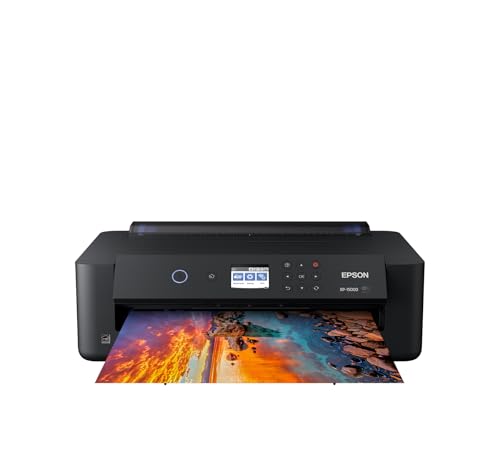
The XP-15000 is the ET-8550’s wide-format alternative from the cartridge world: a wireless wide-format inkjet with six-colour photo printing, speeds up to 9.2 pages per minute, output to 13 x 19 inches, automatic two-sided printing, and a title aimed at photographers and home studios. The transfer case mirrors its tank sibling’s — one-piece large designs, six-colour fidelity for photographic work — with the economics inverted. Cartridges cost more per sheet and arrive sealed and effortless; for a crafter whose transfer projects arrive monthly rather than weekly, that trade is not a flaw but a fit.
Think about who that crafter is. The studio that presses personalised cushions at Christmas, photo totes for family occasions and a small run of event garments each summer prints transfers in bursts separated by quiet months. A cartridge machine tolerates those quiet months with less sulking than standing ink systems sometimes do, wakes for the project, and asks nothing between whiles except desk space. Auto two-sided printing, useless for the transfer sheet itself, serves the burst’s paperwork — care cards, price lists, the event order forms — on the same machine.
The shared cautions apply unchanged: the title names no rear feed or media-weight rating, so transfer-sheet behaviour gets verified by test print, not assumed from the photo-printer badge. And the 9.2 ppm figure is a document speed; photo-quality output at 13 x 19 will take its own unhurried time, which matters when a project deadline involves twenty large sheets. Schedule wide-format work the way photographers schedule printing — started early, proofed once, then run in a calm batch — and the XP-15000’s pace stops being a specification and becomes simply the room’s rhythm.
- Maximum print size: Up to 13 x 19 inches
- Colour system: 6-colour wide-format photo inkjet
- Stated speed: Up to 9.2 ppm
- Duplex: Auto 2-sided printing stated
- Connection: Wireless
- Rear straight-through feed: Not stated in the listing title — verify with the manufacturer documentation
Strengths
- Full wide-format, six-colour output without tank commitment.
- Cartridge convenience suits bursty, seasonal project calendars.
- Auto two-sided printing covers the paperwork around projects.
Trade-offs
- Cartridge costs punish weekly production volumes.
- Slower stated speed than the tank flagship — large runs need scheduling.
- Transfer paper handling must be proven by your own test sheet.
Best for: a photographer-crafter making large photo transfers in seasonal bursts. Not suited for: weekly market production — at sustained sheet volumes, cartridge pricing steadily outruns the tank machines in this guide.
Seasonal makers can look at the XP-15000’s Amazon page to see today’s price and which cartridges the current package includes.
One cartridge-era skill protects transfer quality here: watch colour consistency across a cartridge’s life. A long project printed half on a fresh cartridge and half on its replacement can shift subtly mid-run, and transfers reveal shifts cruelly once pressed, because there is no reprint once heat has done its work. For matched sets — a run of identical totes, a team’s garments — start the run on a fresh cartridge set, keep one spare set in the drawer, and proof the first pressed piece against the design before the batch proceeds. The machine rewards that little production discipline with sets that actually match.

Canon MegaTank G3270 — Family Tank Pick
Most craft transfers are not wide-format. They are letter-size and smaller: a child’s garment front, a tote pocket design, quilt labels, apron logos, personalised napkins for a wedding table. The Canon MegaTank G3270 serves exactly that majority from a compact wireless all-in-one body — print, copy and scan, a refillable tank system, a desktop footprint aimed at home and office. Its transfer virtues are the tank’s virtues at family scale: bottled ink economics for a crafter who prints sheets every week, a machine small enough to share the craft table with the press rather than annexing the room, and a scanner that turns the family’s own drawings into printable artwork.
The G3270’s craft personality is regularity. A tank machine earns its keep through use, and the household that prints transfers steadily — school projects, club garments, a small seller’s weekly orders — keeps the ink moving, the costs low and the machine familiar. Familiarity is an underrated transfer specification: the crafter who knows precisely how this printer handles their chosen paper brand, which side loads up, which profile flatters skin tones, produces consistent results that a technically superior stranger-machine would not match for a month.
Limits are the standard-size limits, and they should be named plainly. Designs cap at the machine’s standard sheet sizes, so adult garment fronts at full width are the wide-format Epsons’ territory; a G3270 owner designs within the sheet or tiles deliberately. The title states no duplex and no feed-path details, so transfer-paper behaviour joins the guide’s standing test-sheet rule. None of that diminishes the pick for its intended desk: the majority of home craft transfers, printed regularly, at sane ink cost, on a machine the whole household also uses for everything else.
- Functions: Print, copy, scan — wireless all-in-one
- Ink system: Refillable tank system (MegaTank)
- Form: Compact desktop design
- Positioning: Home and office use
- Maximum transfer sheet size: Standard sizes — wide-format not stated in the listing title
- Duplex: Not stated in the listing title — verify with the manufacturer documentation
Strengths
- Bottled ink economics for weekly family-scale transfer printing.
- Scanner turns household artwork into transfer designs in-house.
- Compact body shares a craft table with the press comfortably.
Trade-offs
- Standard sheet sizes cap single-piece design dimensions.
- Feed behaviour with coated sheets is a test-sheet question.
- No duplex stated, for the document work around the crafting.
Best for: a family or small seller printing letter-size transfers every week. Not suited for: full-width adult garment fronts in one piece — the standard-format body cannot carry a 13 x 19 inch sheet, whatever the design software allows.
Households weighing the family route can visit the G3270’s listing on Amazon to check the current price and included ink arrangement.
A practical ritual for shared household machines: keep transfer paper in its own unmistakable sleeve, stored beside the press rather than in the printer’s paper drawer. The classic home-craft accident is a transfer sheet loaded unknowingly for a homework print — an expensive, coated sheet wasted, and a design’s mirror image haunting a school essay. Physical separation prevents it completely. The G3270 will serve both the household and the craft desk faithfully for years, provided the two paper families never meet in the same tray.

Epson EcoTank ET-4800 — Office-Flavoured Tank Pick
The ET-4800 is the tank machine wearing office clothes: a wireless colour all-in-one supertank with cartridge-free print, scan, copy and fax, speeds up to 10 pages per minute, an auto document feeder and Ethernet, positioned for home and small offices. Its craft reader is the seller whose making has become a business — the market-stall and online-shop crafter whose week includes invoices, postage labels and order paperwork alongside the transfers themselves. For that reader, the feeder and the wired network connection are not office garnish; they are the infrastructure of the selling half of the craft.
The transfer half remains a standard-size, tank-fed story: bottled ink economics for regular sheet production, four-function convenience at one desk, and a machine that stays exercised because the business prints on it daily. That daily exercise is quietly valuable for transfer quality — an ink system in constant gentle use delivers consistent colour, and consistency across a product line of pressed designs is what separates a shop’s output from a hobbyist’s lucky batch. If your craft has a storefront, physical or digital, the ET-4800’s blend deserves its place on the shortlist.
Boundaries, stated as this guide states them everywhere: no wide format, so designs live within standard sheets; no feed-path claims in the title, so transfer paper gets its test sheet before the first customer order depends on it; and the fax, feeder and Ethernet that justify the machine are worthless to a pure hobbyist, who should save the difference and take the G3270. The ET-4800 is a business-shaped tool. Bought by a business, it disappears into productive routine; bought for a hobby desk, it is an office machine waiting for an office.
- Functions: Print, scan, copy, fax — cartridge-free supertank
- Stated speed: Up to 10 ppm
- Document feeder: ADF stated in the title
- Connection: Wireless and Ethernet
- Positioning: Home and small offices
- Rear straight-through feed: Not stated in the listing title — verify with the manufacturer documentation
Strengths
- Feeder and Ethernet serve the paperwork half of a craft business.
- Daily business use keeps ink fresh and colour consistent.
- Tank economics cover regular transfer sheet production.
Trade-offs
- Standard format only — large designs belong to the wide pair.
- Office features add cost a hobby desk will never recover.
- Transfer sheet handling still requires the standing test.
Best for: a selling crafter whose printer must run a small business as well as a craft table. Not suited for: pure hobby use — fax, feeder and Ethernet are business infrastructure, and a hobbyist pays for them without ever switching them on.
Craft sellers comparing business-ready tanks can pull up the ET-4800’s Amazon page to see the present price and package.
One business habit multiplies this machine’s value: separate profiles for product lines. Save one named setting for your light-fabric transfer paper, another for the dark-fabric paper if you run it, another for ordinary documents, and name them so a helper can print correctly without you in the room. Craft businesses stall on exactly this kind of tacit knowledge — the settings that live in the founder’s fingers — and the ET-4800’s office discipline, applied to profiles and paperwork alike, is how a one-table operation starts behaving like a small firm.

Canon MAXIFY GX2020 MegaTank — Duplex Tank Pick
The GX2020 brings the MAXIFY line’s small-office build to the craft table: a Canon MegaTank all-in-one with print, copy and scan, duplex printing stated, a refillable tank system and wireless connection in a compact desktop body. Its craft profile sits between the G3270’s family ease and the ET-4800’s office apparatus — no feeder or fax in the title, but duplex and a business-grade engine that treats a forty-sheet transfer run as an ordinary morning rather than an endurance event. Sellers whose volume has outgrown a family machine but whose paperwork has not yet grown office-sized will recognise their desk in that description.
Duplex deserves its honest sentence: it does nothing for a transfer, which is printed once, on one coated side, and pressed. What duplex signals is the tier of machine underneath — a printer engineered for offices that print all day, with the feed reliability and duty temperament that transfer production quietly depends on. Coated sheets are unforgiving stock; a machine built for business volume handles repetitive feeding with a steadiness light-duty models cannot promise across a craft-fair season. Judge the GX2020 on that steadiness and its tank economics, not on the duplex line itself.
The standing cautions complete the picture. Standard format caps design size as with every non-wide pick here. The title’s silence on feed path means the test sheet decides transfer-paper compatibility, as it does across this guide. And the MAXIFY’s office respectability creates the household hazard the G3270 review named in reverse: this machine will be borrowed for documents, cheerfully and often, so the transfer paper’s separate storage matters even more. Keep the coated stock by the press, and the GX2020 can serve two masters without confusing their papers.
- Functions: Print, copy, scan — wireless all-in-one
- Ink system: Refillable tank system (MegaTank)
- Duplex: Duplex printing stated in the title
- Form: Compact desktop design, home and office positioning
- Document feeder: Not stated in the listing title — verify with the manufacturer documentation
- Rear straight-through feed: Not stated in the listing title — verify with the manufacturer documentation
Strengths
- Office-grade build steadies long runs of coated transfer stock.
- Tank refills keep a growing seller’s sheet costs controlled.
- Duplex covers the craft business’s ordinary documents well.
Trade-offs
- No feeder named, unlike the ET-4800’s office package.
- Standard format ceiling applies to every design.
- Its document talents invite borrowing — guard the transfer stock.
Best for: a growing craft seller printing transfer runs weekly who wants business-build steadiness without a full office feature set. Not suited for: wide-format designs — like the other standard-format picks, its sheets top out below the 13 x 19 inch class entirely.
Sellers stepping up from a family machine can examine the GX2020’s Amazon listing to weigh today’s price against their weekly sheet count.
Schedule the GX2020’s craft work the way its office ancestors scheduled reports: in batches, at a set hour, with stock counted before the run begins. Transfer production fails socially more often than mechanically — a run started without counting sheets discovers its shortage at sheet thirty-one of forty, with the press hot and the market stall opening at nine. Count, then print, then press, in that order, and the machine’s business temperament becomes the business’s temperament too.

Canon PIXMA TR7120 — Occasional Crafter Pick
The TR7120 closes the list as the cartridge route at standard size: a wireless colour inkjet with duplex printing, a copier and scanner, an auto document feeder, a compact design and an intuitive control panel, finished in white. Its craft reader is the occasional maker — the aunt producing personalised aprons at Christmas, the teacher pressing class totes in June, the hobbyist whose transfer projects arrive as events rather than as a production calendar. For that reader, sealed cartridges are the right ink system: no standing bottles, no tank maintenance rhythm, just a machine that wakes for the project and behaves.
The feeder is this pick’s quiet craft asset, and it works on the input side: stacks of children’s drawings, a class’s worth of hand-lettered names, a pile of vintage labels can be scanned in a session rather than page by page, building the artwork library the projects draw on. White compact styling suits the kitchen-table reality of occasional crafting, where the printer shares space with domestic life and a black office monolith would be resented between projects. Judge the TR7120 as domestic infrastructure that crafts beautifully on demand, not as a production machine manqué.
The limits are volume’s limits, and they are structural rather than fixable. Cartridge ink makes every transfer sheet cost visibly more than the tank machines’ sheets, so a project habit that grows weekly will outgrow this printer’s economics within a season — the guide’s tank picks exist for that graduation. Standard format caps design size, the title names no feed-path specifics so the test-sheet rule applies, and a compact home build expects project-sized runs rather than market-eve marathons. Within its true brief — occasional, heartfelt, standard-size — it is exactly right.
- Functions: Print, copy, scan with auto document feeder
- Ink system: Cartridge inkjet
- Duplex: Duplex printing stated in the title
- Colour and form: White, compact, intuitive control panel
- Maximum transfer sheet size: Standard sizes — wide-format not stated in the listing title
- Rear straight-through feed: Not stated in the listing title — verify with the manufacturer documentation
Strengths
- Sealed cartridges suit project-by-project crafting calendars.
- The feeder speeds scanning of drawings and lettering for designs.
- White compact body lives happily in domestic space.
Trade-offs
- Per-sheet ink costs climb steeply if projects become weekly.
- Compact home build is not a production-run machine.
- Standard format limits single-piece design size.
Best for: an occasional crafter whose transfer projects arrive as seasonal events at standard sizes. Not suited for: a weekly seller’s production — cartridge economics and a light-duty build both point that reader to the tank machines above.
Occasional makers can check the TR7120’s Amazon page for the current price and the starter cartridges in the present package.
Because occasional projects concentrate risk — the aprons are needed Saturday, the totes on the last school day — the TR7120’s owner should adopt the event printer’s one golden rule: print the transfer sheets a full day before pressing. A spare day absorbs every ordinary accident, from a cartridge running dry mid-design to a paper brand misbehaving, and converts deadline panic into a calm reprint. Machines bought for events earn their love in exactly that margin, and owners who protect it rarely have a craft disaster story to tell.
Comparison
| Pick | Format ceiling | Ink system | Craft character |
|---|---|---|---|
| Epson EcoTank Photo ET-8550 | 13 x 19 in | 6-colour tank | Wide photographic production |
| Epson Expression Photo HD XP-15000 | 13 x 19 in | 6-colour cartridges | Wide photographic projects in bursts |
| Canon MegaTank G3270 | Standard sizes | Refillable tank | Weekly family-scale transfers |
| Epson EcoTank ET-4800 | Standard sizes | Cartridge-free tank | Craft business with office paperwork |
| Canon MAXIFY GX2020 | Standard sizes | Refillable tank | Growing seller, business-build steadiness |
| Canon PIXMA TR7120 | Standard sizes | Cartridges | Occasional seasonal projects |
Two decisions organise the table. Format first: if your designs outgrow a standard sheet, only the top two rows exist for you, and the choice between them is ink economics — tanks for regular production, cartridges for bursts. If your designs live at standard sizes, the lower four rows divide by rhythm instead: weekly family work, business paperwork, growing volume, or occasional events. Notice that no row competes on transfer-specific features, because there are none; the system you are buying into is paper, ink character and press, with the printer as its engine.
How to Choose a Printer for Heat Transfer Craft Work
Let the sheet decide first. Measure your largest real design — not your most ambitious imagined one — and let its dimensions choose the format class. Most home craft transfers fit standard sheets with room to spare, and buying wide format for a single annual project rents a great deal of desk to a single afternoon. If the measurement genuinely exceeds standard sizes regularly, the two Epson photo machines are your shortlist and the decision between them is purely how often you print: regularly enough and tanks repay you; in bursts and cartridges forgive the gaps.
Keep the press in the same conversation from the start. A crafter with no press yet should budget the system whole — printer, first paper packs, press — rather than spending everything on the printer and pressing with an iron for a year while blaming the machine for the iron’s uneven results. The printer choices in this guide span a wide range of prices, and choosing one tier down to fund a competent press is, for transfer quality specifically, one of the smartest trades available anywhere in this category.
Let the paper choose second. Buy your intended transfer paper before finalising the printer if you possibly can, because paper brands differ in thickness and stiffness, and the pairing of a specific paper with a specific feed path is the combination you will actually live with. A test sheet through a friend’s machine, a studio’s machine or a returned-unit gamble avoided is worth more than any review — including this one. Third, count your rhythm honestly: sheets per month, months per year. That single number predicts whether tank economics or cartridge convenience will feel right by Christmas, and it is the number crafters most often flatter themselves about, in both directions.
Dye or Pigment Ink: What Changes on a Transfer?
At the level of general printing knowledge — the level this guide is entitled to teach — the distinction runs like this. Dye inks dissolve their colour into the liquid, soak into coatings and fibres, and reward the crafter with vivid, blended colour, especially in photographic work. Pigment inks suspend solid particles that sit closer to the surface, and they are traditionally favoured where water and light resistance matter most, which in craft terms means wash durability on garments and outdoor items. Transfer papers are formulated with particular ink behaviour in mind, and the paper maker’s own guidance about which ink family their sheets prefer outranks any general rule.
What does that mean at the buying desk? It means the ink question is answered by your paper and your project, not by a printer badge. A crafter pressing photographic cushions that will live indoors optimises for colour richness; a crafter pressing work aprons washed weekly optimises for survival. Read your chosen paper’s specification, note which ink character it asks for, and then read printer documentation with that single question in hand. The six titles in this guide do not state ink chemistry, so no review above assigns a family to a machine — the documentation and the paper maker divide that honour between them.
How Do You Test a Printer With Transfer Paper Before a Big Project?
Buy one pack of your intended paper and sacrifice its first sheets to science. Print a test design that includes the elements your real work uses — a photograph with skin tones if you press portraits, fine lettering if you press names, a solid block of your darkest colour — then press it onto a scrap of the real target material, wash it if the project will be washed, and judge the result in daylight. That single cycle tests feed behaviour, colour, release and durability together, and it costs one sheet and one tote blank to learn what a failed production run would teach at forty times the price.
Record everything while you test: which tray or feed you loaded, which side faced up, the exact profile and quality setting, the press temperature and time the paper maker specifies. Transfer work has many small variables and a short memory defeats it; the crafter with a notebook page per paper brand repeats successes on demand, while the crafter relying on recollection re-tests forever. When the test pleases you, print the project’s sheets in the same session if you can — identical conditions are a quality feature no printer can sell you afterwards.
Why Does the Press Matter as Much as the Printer?
Because the printer only writes the image; the press publishes it. Temperature accuracy, even pressure and correct timing decide whether a transfer releases completely, bonds durably and keeps its colours — and they explain why two crafters with identical printers produce work of visibly different quality. A swing-away press with a reliable thermostat is the usual graduation from the household iron, whose uneven soleplate and wandering temperature leave the classic transfer scars: one corner pale, one edge scorched, a centre that washes out by spring.
Budget thinking should follow that reality. A crafter choosing between a more expensive printer and a better press, with transfer quality as the goal, will usually gain more from the press — the printer differences within this guide are about format and economics, while the press differences are about whether the image survives the garment’s tenth wash. Buy the printer your sheet size and rhythm require, then put the serious money and the serious practice into the heat half of the system, where the craft is actually decided.
Which Craft Projects Suit Which Format?
Standard sheets carry a surprising share of the craft world. Quilt labels, personalised hand towels, apron chest logos, tote pocket art, cushion centre panels, baby garments, pet bandanas, wedding napkins and the entire universe of children’s clothing designs live comfortably within a letter-size transfer, usually with room for two or three small designs ganged onto one sheet. A crafter whose project list reads like that paragraph loses nothing to the standard-format machines in this guide, and gains their lower ink costs and smaller footprints every single week.
Wide format earns its desk when the designs themselves grow: adult garment fronts printed as one artwork, large tote panels, cushion covers pressed as a single image, wall hangings and fabric posters, team kits where the design spans the chest. The dividing question is never the garment’s size but the artwork’s bounding box, and crafters should measure their three largest recurring designs before shopping. If two of the three exceed a standard sheet, the wide machines stop being aspirational and become simply correct — and tiling two sheets into one design, with its seam hidden in the artwork, remains the honourable workaround for the one-off oversize project on a standard machine.
How Do You Build a Repeatable Transfer Workflow at a Craft Desk?
Arrange the room in the order the work flows: artwork and printer together, paper storage dry and flat between printer and press, the press on a surface that can take its heat and weight without complaint, and a cooling and inspection area where finished pieces land one at a time. Transfers fail at handoffs — a printed sheet carried across a steamy kitchen, a pressed garment folded onto its neighbour while still warm — and a desk laid out as a one-direction path removes most handoffs by geography rather than by vigilance.
Then standardise the invisible parts. One notebook or file holds, for each paper brand, the printer profile, the press settings, the peel timing and a pressed sample swatch; new projects start from the nearest recorded success instead of from memory. Batch by paper type when a session mixes projects, so settings change once rather than per piece. And photograph finished work beside its settings note — when a customer reorders a design eight months later, the crafter who can reproduce it exactly owns a business advantage that no printer specification can confer.
What Changes When You Sell Transfers Instead of Gifting Them?
Consistency becomes the product. A gift forgives a slightly pale corner; a paying customer compares this tote against the photograph and against the last one they bought, and both comparisons must pass. Selling therefore promotes the unglamorous disciplines in this guide — saved profiles, recorded press settings, test sheets on every new paper batch, wash tests on every new blank garment line — from good habits into the business’s actual quality system. It also changes the printer arithmetic: per-sheet ink cost stops being an abstraction and becomes margin, which is why the tank machines dominate the selling half of this guide’s recommendations.
Selling adds a paperwork shadow, too: order records, care instructions included with each piece, design files archived by customer and date. The all-in-one functions that look like filler on a hobby desk — the ET-4800’s feeder, the GX2020’s duplex — become the infrastructure of that shadow. Crafters crossing from gifting to selling usually feel the transition first not at the press but at the desk, in the hour after making, and choosing a printer that anticipates that hour is one of the kinder decisions a growing maker can make for their future self.
What Are the Common Mistakes in Heat Transfer Craft Printing?
Forgetting to mirror the image ruins more first projects than every other error combined: text printed unmirrored presses onto fabric backwards, perfectly bonded and perfectly unreadable. Print one proof on plain paper, hold it against the target, and check the mirroring with your eyes before the coated sheets come out. A close second is loading transfer paper upside down — the coated side is the printing side, it often feels subtly different to the fingertip, and a pack’s worth of designs printed on the backing is a tuition fee nobody needs to pay twice.
Skipping the test sheet with a new paper brand follows naturally; brands differ enough that last season’s settings are this season’s disappointment. Fourth comes judging colour on screen or on the unpressed sheet — transfers shift under heat, and only the pressed, cooled, daylight-judged result counts. And finally, pressing impatience: peeling too hot or too cold for the paper’s instructions, lifting the press early, stacking freshly pressed garments so residual heat bonds them to each other. The printer’s part of this craft is the calm part; most disasters in the category happen within arm’s reach of a hot press and a hurried hand.
How Should Transfer Paper and Finished Pieces Be Stored?
Transfer paper is a coated product with a shelf temperament: it wants to be flat, dry, sealed in its pack and out of sunlight, in the room where it will be used so its temperature and humidity match the printer’s. Sheets stored in a damp craft cupboard or beside the press’s heat absorb exactly the moisture that later shows up as patchy release and colours that wander. Keep the working pack closed between sessions, keep unopened stock in its original wrapping, and rotate oldest-first — paper bought for last Christmas’s projects should not be the paper trusted with this Christmas’s orders without a test sheet’s blessing.
Finished transfers deserve equal care in the other direction. Pressed garments should cool fully before folding, cure according to the paper maker’s guidance before washing, and ship or store flat where the design cannot crack against a crease. Include a care card with anything that leaves the house — wash inside out, follow the temperature the paper maker specifies — because the customer’s laundry habits are the final, uncontrollable stage of your production process, and a card is the only instruction that travels with the garment into that stage.
One sentence for the crafter upgrading from a borrowed or ancient machine: keep the old printer until one full project has survived printing, pressing and washing on the new one. Transfer systems are chains, and a new link changes the behaviour of the whole chain in small ways that only a complete cycle reveals.
Final Recommendation
Choose by sheet and rhythm, and the names sort themselves. Large photographic work printed regularly belongs to the ET-8550; the same work in seasonal bursts belongs to the XP-15000. Weekly family-scale transfers belong to the G3270, a craft business’s combined making-and-paperwork belongs to the ET-4800, growing seller volume belongs to the GX2020, and heartfelt occasional projects belong to the TR7120. Whichever machine arrives, spend its first afternoon on test sheets rather than triumphs — and may your first pressed tote come off the platen with every corner bonded and every letter reading the right way round.
Frequently Asked Questions
Is there a printer made specifically for heat transfers?
No dedicated category exists. Heat transfer is a system — transfer paper, a standard printer and a heat press or iron — and the printers in this guide are ordinary inkjets judged by format, ink system and paper handling. Anyone selling a machine as a special transfer printer is describing a standard printer plus paper, and the paper is doing the special part.
What size printer do I need for adult garment designs?
It depends on the design’s dimensions, not the garment’s. Full-width chest designs typically exceed standard sheets, which is why this guide’s two 13 x 19 inch machines — the ET-8550 and XP-15000 — anchor the wide end. Smaller logos, pocket designs and children’s garments fit standard sheets on any pick here.
Can I use transfer paper in a laser printer?
Only paper made and labelled for laser use. Inkjet transfer paper in a laser machine can melt under fuser heat and damage the printer. This guide’s six picks are inkjets; whatever printer you use, the paper’s own packaging decides compatibility, and it should be obeyed exactly.
Why do my transfers fade after washing?
Common causes live in the pressing and the paper rather than the printer: insufficient press time or temperature for the paper’s specification, peeling at the wrong stage, or a paper-and-ink pairing the paper maker advises against. Test-press and wash a scrap piece before any garment that matters, following the paper maker’s timings exactly.
Do I need a heat press, or will an iron work?
An iron works for small, occasional projects and teaches the process cheaply. A press earns its place through even pressure and accurate, repeatable temperature — the two variables behind consistent release and wash durability. Most regular crafters graduate to a press before they upgrade their printer, and this guide’s testing sections assume press timings from the paper maker either way.
Can I print transfers for dark fabrics with these machines?
Yes, with the correct paper. Dark-fabric transfer papers carry an opaque white layer that the design prints onto, so colours stay true on black and navy garments; light-fabric papers are transparent and rely on the garment’s own whiteness. The printer’s job is identical in both cases — the paper does the adapting — but the two papers trim, weed and press differently, so learn one at a time and record its settings before adding the other.
Which pick is best for a complete beginner?
For standard-size projects, the G3270’s tank economy forgives the test sheets and mistakes that learning consumes, while the TR7120 suits beginners whose projects are occasional events. Begin with one paper brand, one target material and a notebook — the combination teaches faster than any machine upgrade.
Related Guides
Garment-focused work continues in the best printers for heat transfers for t-shirts, wide-format ambitions are served by the best banner printers for 4 x 10 banners, and the mapping guides begin with the best projectors for 3d projection mapping for readers whose canvas is a wall rather than a shirt.