What's inside
- Where to Buy
- Key Takeaways
- Quick Picks
- How We Chose These Picks
- How Does Sensor Size Change an Independent Shoot in Practice?
- What Should You Test During the First Weekend With a New Camera?
- Comparison
- How to Choose
- Should an Independent Film Be Shot on a Camcorder at All?
- What Does a Two-Person Crew Actually Need on Set?
- Common Mistakes
- Final Recommendation
- Frequently Asked Questions
- Related Guides
As an Amazon Associate I earn from qualifying purchases. This post may contain affiliate links at no extra cost to you.
[SITE_DOMAIN] is reader-supported. When you buy through links on our site, we may earn an affiliate commission.
Where to Buy
Start your shortlist on the listings themselves, because bundle contents decide real value in this class. The Canon XA60 ships with a shoulder bag in its bundle, while the Canon XA65 pairs its body with a 200ES bag instead. The Canon XA70 includes a 64GB memory card, the Panasonic AG-CX370 is listed on its own professional terms, the Sony FDR-AX53 keeps its listing strikingly plain, and the Sony FX30 is a body that expects lenses to be chosen separately. Open each page, confirm what is actually in the box this week, and price the missing pieces before comparing headline figures.
Independent filmmaking rewards cameras that disappear into the work, and the best prosumer cameras for independent filmmakers are the ones a two-person crew can carry up a stairwell, power through a long interview, and trust when a scene cannot be repeated. Prosumer is an awkward word, but it names a real territory: below the rental-house cinema bodies, above the family camcorder, exactly where most short films, micro-budget features, documentaries and funded web series are actually shot. The six cameras below occupy that territory in two distinct shapes. Four are camcorders with fixed zooms, balanced handles and audio connections built for production sound. Two are interchangeable-lens cinema bodies that ask you to build a rig and repay you with a different kind of image.
That split is the spine of this guide. A camcorder filmmaker thinks in terms of readiness: the camera wakes fast, the zoom covers the room, the microphone plugs straight in, and a whole day fits on cards that are already in the slots. A cinema-body filmmaker thinks in terms of control: the lens choice sets the look, focus is a craft decision, and the camera is the centre of a small system rather than a complete answer. Neither mindset is more serious than the other. Features get made both ways every year, and the honest question is which mindset matches the script in your hand.
One discipline runs through every section that follows. Only what each listing title actually states is treated as specification here. Where a title is silent about recording limits, bitrates, battery endurance or stabilisation behaviour, the spec box says so in plain words instead of filling the gap with borrowed knowledge. Independent productions run on thin margins, and a camera bought on an assumed feature is a production problem waiting for its first day of shooting.
Key Takeaways
- Three Canon XA camcorders anchor the ready-to-shoot end: 20x zooms on the XA60 and XA65, a 1-inch sensor and 15x zoom on the XA70.
- The Panasonic AG-CX370 is the network-minded outlier, with NDI|HX2 and auto-tracking printed in its title.
- Sony’s FDR-AX53 keeps the simplest listing here — a 4K HD camcorder and nothing more claimed.
- The Sony FX30 is the lone interchangeable-lens cinema body, a Super 35 Cinema Line camera sold as a body.
- Dual SD slots appear in the XA60 title; dual XLR audio appears in the XA65 title; read bundles before comparing bodies.
- Audio connections, not resolution, separate the production-ready picks from the merely capable ones.
Quick Picks
| Pick | Badge | Why it made the cut |
|---|---|---|
| Canon XA60 | Best all-round indie camcorder | 4K UHD, 20x optical zoom, UVC livestreaming and dual SD slots in one bundled kit. |
| Canon XA65 | Best for production sound | Dual XLR audio and 3G-SDI join the 20x zoom for crews who record dialogue seriously. |
| Canon XA70 | Best larger-sensor camcorder | A 1-inch 4K CMOS sensor with Dual-Pixel CMOS AF and 15x optical zoom. |
| Panasonic AG-CX370 | Best for streamed productions | NDI|HX2 and auto-tracking suit multi-camera shoots fed into a network workflow. |
| Sony FDR-AX53 | Best understated workhorse | A 4K HD camcorder whose plain listing hides a reputation built on steady handheld footage. |
| Sony FX30 | Best cinema-body starter | A Super 35 Cinema Line body with a 20.1 MP sensor effective for movies, ready to rig. |
How We Chose These Picks
Selection began with the shooting day, not the spec sheet. An independent production day is long, under-crewed and allergic to fuss: locations change, light changes faster, and the person operating the camera is often also directing, producing and making the tea. Candidates were judged first on how little friction they add to that day. Fixed-zoom camcorders scored for readiness and reach; the cinema body scored for the control it hands a crew that has time to use it.
Audio was weighted as heavily as image, because independent films are forgiven soft frames far more readily than unintelligible dialogue. Titles that state XLR inputs, professional outputs or streaming connections earned their emphasis in the text; titles that stay silent about audio were not credited with connections they may or may not have, and their spec boxes record the silence honestly.
Bundle contents were read as part of the product. A shoulder bag, a memory card or a case changes what a filmmaker must still buy before the first shoot day, and on a micro-budget that difference is real money. Where a listing names its extras, the review names them too; where it does not, nothing is assumed.
Finally, each camera had to serve a recognisable kind of independent production: the interview-led documentary, the narrative short, the streamed performance, the one-person feature. A camera that served none of those plainly did not belong here, however impressive its marketing. The six that remain each own a clear job.

Canon XA60 — Best all-round indie camcorder
The XA60 reads like a checklist written by someone who has actually crewed a small film. Its title states a professional 4K UHD camcorder with a 20x optical zoom, UVC livestreaming, dual SD slots, image stabilisation, a 3.5-inch LCD and an OLED EVF, bundled with a shoulder bag and extras. For an independent filmmaker, that combination answers the four questions every shoot day asks: Can I frame it? Can I record it safely? Can I see it properly? Can I carry it there? The zoom reaches across a hall or tightens on a face without a lens change. The dual slots give media redundancy or relay recording, the quiet insurance policy of documentary work. The EVF matters outdoors, where a screen washes out and a missed exposure costs a take that will not come back.
Consider how this camera behaves on a narrative short shot in a borrowed house. Morning exteriors through the EVF, exposure judged without squinting at a sunlit screen. Interior dialogue on the zoom’s middle range, stabilisation smoothing the small corrections as the operator edges around furniture. A pickup shot across the garden at full telephoto, compressing the background into something that looks art-directed. Nothing in that day required a lens swap, a rig rebuild or a media panic, and on a two-day shoot with a volunteer crew, that absence of friction is worth more than a marginally larger sensor.
The UVC livestreaming in the title widens the camera’s working life beyond the film itself. Cast read-throughs streamed to a remote producer, a behind-the-scenes feed for funders, a live Q and A after a festival screening — a camera that connects as a USB video device earns its keep in the long administrative tail of independent production, not only on set. It also moonlights: the same body that shoots your short on Saturday can stream a client’s event on Sunday, and many prosumer cameras pay for themselves exactly that way.
Judged as a filmmaker’s first serious camcorder, the XA60’s argument is completeness. Filmmakers who want that completeness can check the Canon XA60 bundle on Amazon and note precisely which extras the current bundle lists before ordering.
- Format: Professional 4K UHD camcorder, per the listing title
- Zoom: 20x optical zoom, per the listing title
- Media: Dual SD slots, per the listing title
- Viewing: 3.5-inch LCD and OLED EVF, per the listing title
- Streaming: UVC livestreaming, per the listing title
- Audio inputs: Not stated in the listing title — verify with the manufacturer documentation
Strengths
- Dual SD slots give a documentary day media redundancy without extra hardware.
- OLED EVF keeps exposure judgement honest in bright exterior light.
- 20x optical zoom covers a whole location from one position.
Trade-offs
- Fixed lens: no fast prime for shallow-focus night interiors.
- Title does not state XLR inputs, so production audio connections need verifying.
- Bundle extras vary in usefulness; the bag may duplicate one you own.
Best for: a first-feature or documentary crew wanting one complete 4K camcorder with dual-slot media safety.
Not suited for: a production whose look depends on interchangeable cinema lenses and wide-aperture primes.
The XA60 also teaches good habits. Dual slots encourage the backup discipline that separates finished films from cautionary tales. The EVF encourages checking exposure rather than trusting a bright screen. The fixed zoom encourages moving the camera instead of cropping later. A young filmmaker could do worse than learn the craft on a tool that quietly rewards all three.
Where it sits against its own siblings is instructive. The XA65 below adds the professional audio and SDI connections a dialogue-heavy production craves; the XA70 trades zoom reach for a larger sensor. The XA60 is the balanced middle — the camera to buy when the production has a bit of everything and a crew of almost nobody.
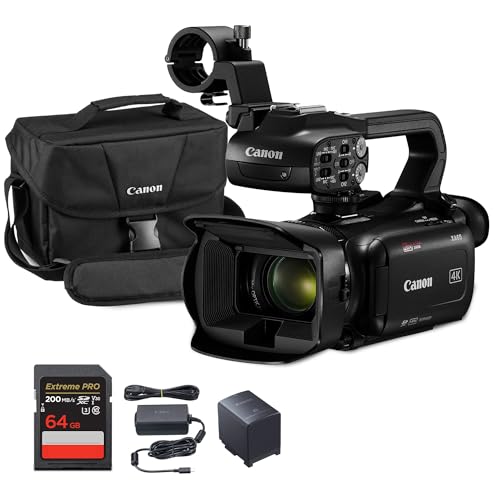
Canon XA65 — Best for production sound
Dialogue is where independent films live or die, and the XA65 is the pick whose title takes dialogue most seriously. It states a professional UHD 4K camcorder with a 20x optical zoom, 3G-SDI output, dual XLR audio, a 3.5-inch touchscreen, USB-C, optical image stabilisation and live streaming, bundled with a 200ES bag and more. Dual XLR is the headline for a filmmaker: balanced microphone connections, proper level control, the ability to put a boom microphone on one channel and a wireless receiver on the other and record a scene the way sound recordists have worked for decades. On a narrative short, that single feature can remove the separate audio recorder, the syncing session and a whole category of things going quietly wrong.
Picture a two-hander scene in a rented café before opening hours. The boom operator feeds channel one; a lavalier on the quieter actor feeds channel two as insurance. The director watches the touchscreen framing while the camera’s stabilisation absorbs the small movements of a handheld two-shot. Later, in the edit, every take arrives with its production sound already married to the picture. Shoots that cannot afford a dedicated sound recordist — which is most shoots at this level — are exactly the shoots that benefit from audio architecture built into the camera rather than bolted on.
The 3G-SDI connection extends the argument to the monitoring side. SDI is the professional video world’s sturdy, locking, long-cable standard; a director’s monitor across the room, a feed to a small switcher for a streamed performance, a client display at a commercial shoot — all become simple cable runs instead of adapter puzzles. Combined with the live streaming named in the title, the XA65 crosses between set work and broadcast-adjacent work without changing bodies.
Crews whose scripts are wall-to-wall dialogue can look at the Canon XA65 on Amazon and count the audio connections their current setup wishes it had.
- Format: Professional UHD 4K camcorder, per the listing title
- Zoom: 20x optical zoom, per the listing title
- Audio: Dual XLR audio inputs, per the listing title
- Output: 3G-SDI, per the listing title
- Viewing: 3.5-inch touchscreen, per the listing title
- Sensor size: Not stated in the listing title — verify with the manufacturer documentation
Strengths
- Dual XLR inputs let a boom and a wireless run together with proper levels.
- 3G-SDI feeds professional monitors and switchers over locking cables.
- Touchscreen framing suits small crews where the operator also directs.
Trade-offs
- Fixed zoom lens only — no interchangeable glass for specialised looks.
- Sensor size is not stated in the title, so low-light expectations need documentation.
- Streaming and SDI features are wasted on purely offline, single-camera shoots.
Best for: dialogue-driven shorts and features recording production sound directly into the camera.
Not suited for: a silent, visual-essay production that records wild sound separately and never uses XLR.
There is a subtler benefit to recording sound in-camera that new filmmakers underestimate: confidence on set. When the director can hear, through the camera, that the take’s dialogue is clean, the whole crew relaxes and performances improve. The XA65’s connections make that confidence routine rather than lucky.
It is also the natural step up within this guide for XA60 admirers whose productions grew a boom operator. The shared 20x zoom and camcorder handling mean the upgrade changes the audio and monitoring story without forcing the crew to relearn the camera.

Canon XA70 — Best larger-sensor camcorder
The XA70 makes its case with a sensor. The title states a UHD 4K30 professional camcorder built around a 1-inch 4K UHD CMOS sensor, with Dual-Pixel CMOS AF, a 15x optical zoom, a stated 600x digital zoom, USB live streaming and XLR inputs, bundled with a 64GB memory card and more. In camcorder land, one inch is a meaningful step up: more light gathered per frame, a shallower depth of field available when the story wants a face separated from its background, and a fighting chance in the dim practical-lit interiors where independent films actually shoot. The camcorder shape remains — fixed zoom, production connections, no rig required — but the image moves a class closer to the cinema bodies.
Dual-Pixel CMOS AF deserves its sentence, because autofocus is the solo filmmaker’s silent crew member. An interview subject who leans forward mid-answer, an actor crossing a room in an unbroken take, a documentary contributor walking and talking through their workplace — a dependable continuous autofocus keeps those moments usable without a focus puller. Crews of one or two, which is to say most independent crews, feel that assistance in every scene.
The zoom trade should be read honestly. Fifteen times optical is less reach than the 20x lenses on its siblings, and the 600x digital figure in the title is digital magnification, which enlarges pixels rather than gathering more scene detail; treat it as a framing convenience for distant subjects, not as optical quality. What the XA70 buys with that trade is the sensor, and for filmmakers whose scenes are conversations in rooms rather than subjects across fields, it is the right exchange.
The bundled 64GB card makes the box genuinely shoot-ready, a small thing that matters when the camera arrives two days before a location day. Narrative crews drawn to the bigger sensor can see the Canon XA70 bundle on Amazon and confirm the card and extras in the current listing.
- Sensor: 1-inch 4K UHD CMOS sensor, per the listing title
- Autofocus: Dual-Pixel CMOS AF, per the listing title
- Zoom: 15x optical zoom, 600x digital zoom, per the listing title
- Audio: XLR inputs, per the listing title
- Streaming: USB live streaming, per the listing title
- Frame rates beyond 4K30: Not stated in the listing title — verify with the manufacturer documentation
Strengths
- 1-inch sensor gives camcorder convenience a larger-sensor image.
- Dual-Pixel CMOS AF supports solo operators filming moving subjects.
- XLR inputs keep production sound inside the camera workflow.
Trade-offs
- 15x optical zoom reaches less far than the 20x XA60 and XA65.
- The 600x figure is digital zoom, with the softness digital magnification brings.
- Title states 4K30; higher frame rates are not claimed in the listing.
Best for: narrative and interview-led films wanting a larger sensor without leaving camcorder handling.
Not suited for: a wildlife or sports-leaning shoot that needs the longest possible optical reach.
Low-light realism belongs here too. A 1-inch sensor helps in a lamp-lit room; it does not turn night into day, and filmmakers should still light faces rather than ask any camcorder to perform miracles. What the sensor buys is a cleaner image at the light levels a small LED panel and practical lamps can actually produce — which is precisely the lighting package an independent production owns.
As the top Canon in this set, the XA70 also suits the filmmaker who rents cinema bodies for flagship projects but wants an owned camera that never embarrasses the B-camera position beside them. Its footage needs to sit next to bigger cameras in an edit, and the sensor is its credential for that seat.

Panasonic AG-CX370 — Best for streamed productions
The AG-CX370 arrives from a different branch of the family tree: the broadcast camcorder. Its title is terse — a Panasonic UHD 4K pro camcorder with NDI|HX2 and auto-tracking, in black — and those two stated features point at a particular kind of independent production: the multi-camera, network-fed shoot. NDI carries video over ordinary network cabling into software switchers and streaming setups, so a small crew can run a three-camera performance, conference or worship film without a van full of dedicated video cable. Auto-tracking adds a camera operator’s most repetitive job — keeping a moving presenter centred — to the camera’s own workload.
Imagine the independent team’s bread-and-butter commission: filming a local theatre production or a training day that must also stream to remote attendees. One operator runs the main camera; the CX370, mounted high at the back, follows the speaker across the stage on its own, feeding the stream through the network. The film gets its coverage, the stream gets its framing, and nobody had to hire a third camera operator. Productions increasingly earn their budgets from exactly this hybrid of recording and live delivery, and a camera designed for it is not a luxury.
The professional camcorder form carries the usual virtues this guide has praised — fixed zoom readiness, long recording posture, handling designed for hours rather than minutes — even though this listing’s title declines to enumerate them. In keeping with this guide’s discipline, the spec box below records only what the title states and marks the rest for documentation, because a broadcast-class camera’s detailed connections deserve verification against Panasonic’s own papers before a production is planned around them.
Teams whose independent work blends filming with live delivery can check the Panasonic AG-CX370 on Amazon and then read Panasonic’s documentation for the connection panel their workflow needs.
- Format: UHD 4K pro camcorder, per the listing title
- Network video: NDI|HX2, per the listing title
- Tracking: Auto-tracking, per the listing title
- Colour: Black, per the listing title
- Zoom range: Not stated in the listing title — verify with the manufacturer documentation
- Audio inputs: Not stated in the listing title — verify with the manufacturer documentation
Strengths
- NDI|HX2 feeds multi-camera streaming over network cabling.
- Auto-tracking follows a presenter without a dedicated operator.
- Broadcast camcorder lineage suits long, formal event days.
Trade-offs
- Title is brief; zoom, audio and media details all need documentation checks.
- Network features add little to a single-camera offline narrative shoot.
- Auto-tracking follows one subject logic; complex scenes still need an operator.
Best for: independent teams filming performances, talks and training that also stream live.
Not suited for: a narrative short with no streaming element and a crew member on every camera.
There is also a future-proofing argument a young production company should hear. Clients increasingly ask for the stream and the film in the same breath, and turning down the streaming half means turning down the commission. Owning one network-native camera keeps that door open, and the CX370 is this guide’s representative of that increasingly ordinary requirement.
Used as a pure recording camera it remains a serious tool, but its premium logic is the network. Buy it for the hybrid workflow and it earns; buy it ignoring the hybrid workflow and its siblings in this guide make simpler sense.
Sony FDR-AX53 — Best understated workhorse
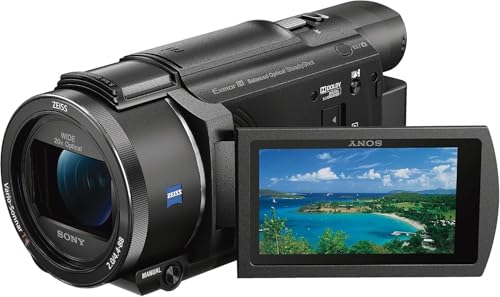
Read this listing title and you will learn almost nothing: Sony FDR-AX53/B, a 4K HD video recording camcorder, in black. No zoom figure, no sensor size, no connections, no bundle. This review therefore refuses to invent a specification sheet for it, and the spec box below is mostly the standard not-stated sentence — which is itself useful information about how this camera is sold. What can be discussed honestly is its role: a compact camcorder from Sony’s long-running Handycam line, bought for years by exactly the people this guide serves, and widely used for the handheld, follow-the-action filming where a small steady camera matters more than a rig.
The independent-filmmaking case for such a camera is about presence. A feature’s second unit grabbing street texture, a documentarian filming inside a family kitchen where a cinema rig would change the room’s behaviour, a director scouting and shooting test scenes with the same tool — in all of these, the small camcorder is not the compromise camera but the appropriate one. Subjects relax around it. Locations tolerate it. It fits in a jacket-adjacent bag and is rolling before a bigger camera has finished being built.
Handheld stability is the working quality owners of this class of Sony camcorder talk about most, but since the listing title does not name a stabilisation system, this guide will not name one either. The practical advice stands regardless of the mechanism: test any camcorder’s handheld footage at the zoom lengths you actually use, because that test, not a brochure, tells you whether your walking shots will be usable.
Filmmakers who need a discreet, always-along camera can look at the Sony FDR-AX53 on Amazon, treating its listing page as the starting point for the detailed specification its title omits.
- Format: 4K HD video recording camcorder, per the listing title
- Colour: Black, per the listing title
- Model: FDRAX53/B, per the listing title
- Zoom range: Not stated in the listing title — verify with the manufacturer documentation
- Sensor size: Not stated in the listing title — verify with the manufacturer documentation
- Audio inputs: Not stated in the listing title — verify with the manufacturer documentation
Strengths
- Compact camcorder form films discreetly in homes and public places.
- Long-established Handycam line with a deep base of working owners.
- Simple, unbundled listing: you buy the camera, not a pile of extras.
Trade-offs
- Title states almost nothing — every key specification needs verification.
- No bundle, so bag, media and accessories are separate purchases.
- Production audio connections are not stated and must be checked.
Best for: a documentarian or second-unit shooter wanting a small, discreet 4K camcorder that is always along.
Not suited for: a dialogue-heavy narrative needing stated XLR audio and SDI monitoring from the title onward.
There is a discipline lesson in this camera’s inclusion. Independent filmmakers love to research flagship bodies, yet a remarkable amount of finished independent work is shot on cameras exactly like this one, by people who spent their research time on scripts and locations instead. The AX53’s plain listing is almost a philosophy: the camera as appliance, the film as the point.
Pair it thoughtfully and it shines brighter: as the B-camera beside an XA-series Canon for interviews, or as the scout-and-texture camera feeding a cinema body’s main coverage. Roles, not rankings, are how working kits are actually built.

Sony FX30 — Best cinema-body starter
Every other pick in this guide is a complete camera; the FX30 is a beginning. Its title states a Sony Cinema Line FX30 Super 35 camera in grey, with a 20.1 MP Exmor R APS-C image sensor effective for movies. Cinema Line is Sony’s professional filmmaking family, and the FX30 is its entry rung: an interchangeable-lens body designed to be built into a rig — monitor, matte box, follow focus, external audio — and to grow with its owner from first short to funded feature without the body becoming the ceiling. The sensor phrase matters too: effective for movies means the body was specified around filmmaking rather than adapted from a stills camera.
Super 35 is the historical size of cinema film frames, and it shapes the FX30’s working character. Depth of field sits in the range generations of filmmakers learned on: enough separation to guide the eye, enough depth to hold two actors in a conversation without a focus-pulling virtuoso. Lenses for the format are plentiful at every budget, and a young filmmaker can begin with one modest prime and build a set over years, each purchase remaining useful when a larger Cinema Line body eventually arrives.
The cost of admission is everything the camcorders include by default. There is no fixed zoom to lean on, no stated production audio in the body-first workflow, and handheld shooting expects support gear. A first FX30 budget that spends everything on the body has bought a beautiful paperweight; the honest budget includes a lens, media, power and sound from day one. This guide states that plainly because the FX30 attracts exactly the ambitious beginners most likely to make that mistake.
For the filmmaker whose ambition is the cinema craft itself — lighting, lensing, grading, building a crew’s skills around a real system — this is the guide’s long-term investment pick. Those filmmakers can check the Sony FX30 body on Amazon and price the first lens in the same visit, as the body alone cannot shoot a frame.
- Line: Sony Cinema Line, per the listing title
- Sensor: Super 35 / APS-C Exmor R, 20.1 MP effective for movies, per the listing title
- Configuration: Camera body — lenses sold separately, per the listing title
- Colour: Gray, per the listing title
- Recording formats: Not stated in the listing title — verify with the manufacturer documentation
- Audio inputs: Not stated in the listing title — verify with the manufacturer documentation
Strengths
- Cinema Line body that grows from first short to funded feature.
- Super 35 format matches the classic cinema depth-of-field feel.
- Interchangeable lenses let each production choose its own look.
Trade-offs
- Body only: lens, media, power and audio are all additional budget.
- No fixed zoom — reframing means moving or swapping lenses.
- Expects rigging and support; not a grab-and-go camcorder.
Best for: an aspiring cinema filmmaker building a lens-based rig meant to last several productions.
Not suited for: a one-person documentary crew needing instant readiness and a 20x zoom in one hand.
The FX30’s deepest virtue is educational. Working with chosen lenses, manual exposure discipline and a rig teaches the grammar of cinematography in a way a do-everything camcorder politely hides. Filmmakers who serve that apprenticeship come out the other side able to shoot on anything — including, ironically, the camcorders in this guide, which they will then use with a cinematographer’s eye.
It is therefore the pick for the reader who recognises their own five-year plan in it. Everyone else is better served by the completeness above it in this list, and there is no shame in that ordering: most finished films are shot on the complete cameras, while most cinematography careers are built on bodies like this.
How Does Sensor Size Change an Independent Shoot in Practice?
Sensor size is the specification filmmakers discuss most and understand least, because its effects arrive disguised as other problems. A larger sensor, like the 1-inch chip stated in the XA70’s title or the Super 35 sensor in the FX30, gathers light across a bigger area and separates a subject from its background more readily at a given framing. On an independent shoot, that translates into interviews where a messy room softens behind the speaker, night exteriors where a face holds together under street lighting, and interiors where the window behind the subject does not demand to be in perfect focus. None of that requires the audience to know what a sensor is; they simply feel that the film looks considered.
The smaller-sensor camcorders answer with depth. When everything from the speaker to the workshop behind them stays legible, a documentary gains context: viewers see the tools, the photographs on the wall, the colleague working in the background. Many respected documentary traditions prefer exactly that legibility, and it comes free with the XA60 and XA65 format. It also forgives focus errors, because more of the scene sits within acceptable sharpness. A solo operator filming a moving subject through a real location will lose fewer takes to soft focus on a deeper-field camera, and lost takes are the currency small productions can least afford.
Low light splits the difference honestly. Larger sensors generally hold cleaner images as light falls, but independent interiors are rarely lit by sensor size alone; they are lit by a filmmaker who owns one decent LED panel and knows to place a subject near a window. The XA70’s stated sensor gives its owner more headroom in those rooms, while the FX30’s Super 35 format, paired with a fast lens the owner must budget for, goes further still. The correct reading is not that small sensors fail after dark, but that each step up in sensor size buys forgiveness — and forgiveness is worth paying for only when the script actually spends its evenings in dim places.
There is also a lens-economics angle that rarely surfaces in reviews. A fixed-zoom camcorder’s lens was designed for its sensor, covers its whole range from the day the box opens, and never asks for another purchase. An interchangeable-lens body’s sensor is the start of a collection, and the collection’s cost, weight and decision fatigue belong in any honest comparison. Filmmakers who love choosing lenses will pay gladly; filmmakers who love choosing locations would rather the camera stopped asking questions. Both temperaments make good films, and this guide’s six picks are arranged so that each temperament can recognise itself.
What Should You Test During the First Weekend With a New Camera?
Test the day you actually shoot, not the day you dream about. Set the camera up in the kind of room your production uses, record a friend reading a page of dialogue at the distance your interviews happen, and listen to the whole recording on headphones without touching a phone. You are checking four things at once: whether the audio path you plan to use is clean, whether the framing at your working zoom feels right, whether the image at your room’s real light level pleases you, and whether you can operate every control the day requires without opening a manual. Any failure found on that weekend is a lesson; the same failure found on a location day is a loss.
Then run the endurance test nobody enjoys. Record continuously for the length of your longest planned take, on the media you actually bought, powered the way you actually plan to power it. Note what the camera reports, what the files look like when they land on the computer, and how long the offload takes. Productions are quietly killed by workflow surprises — a file structure the editor hates, an offload that takes longer than the lunch break, a battery that gives up during the best answer of the day. A camera whose title is silent about record limits, as several here are, deserves this test most of all.
Finally, practise the failure drills. Swap media mid-day and confirm the camera returns to recording exactly as expected. Change the audio source and confirm the meters move. Rebuild the FX30’s rig from its bag against a clock, or run the camcorder from case to first frame the same way. Independent sets have no spare crew to absorb fumbling, and the confidence that comes from rehearsed hands shows up on screen as calmer performances from everyone in front of the lens.
Comparison
| Camera | Form | Stated headline | Production it suits |
|---|---|---|---|
| Canon XA60 | Camcorder | 20x zoom, dual SD, OLED EVF | All-round documentary and shorts |
| Canon XA65 | Camcorder | Dual XLR, 3G-SDI, 20x zoom | Dialogue-led narrative |
| Canon XA70 | Camcorder | 1-inch sensor, Dual-Pixel AF, 15x zoom | Low-light interiors, interviews |
| Panasonic AG-CX370 | Pro camcorder | NDI|HX2, auto-tracking | Streamed multi-camera events |
| Sony FDR-AX53 | Camcorder | 4K HD recording, plain listing | Discreet handheld and B-camera work |
| Sony FX30 | Cinema body | Super 35, 20.1 MP for movies | Rig-built cinema productions |
How to Choose
Begin with your sound plan, because it eliminates half the list cleanly. If dialogue will be recorded into the camera from booms and wireless receivers, the stated XLR inputs on the XA65 and XA70 are your shortlist. If sound will be handled by a recordist or added in post, the XA60’s completeness or the FX30’s cinema path come back into play. Independent films rarely fail on resolution; they fail in the dialogue edit, so let audio cast the first vote.
Next, count your crew honestly. A crew of one needs readiness and autofocus assistance; a crew of three can exploit a cinema body’s control. Then count your locations: many small rooms favour camcorder zooms, while controlled sets favour lenses. Finally, price the whole system — body, lenses or media, bag, power, sound — rather than the headline item, because the system is what shows up on the shoot day.
Should an Independent Film Be Shot on a Camcorder at All?
Yes, and the question only sounds provocative because marketing has taught filmmakers to equate cinema with interchangeable lenses. The camcorder’s virtues — readiness, reach, integrated sound, stamina — are production virtues, and productions are where films succeed or collapse. Festival programmes every year contain camcorder-shot work whose audiences never once wondered what captured it, because the story, the performances and the sound carried them. The camera’s job is to not be the problem, and camcorders are engineered to be exactly that.
The counter-consideration is visual signature. A film competing on look — a moody genre short, a cinematographer’s calling card — may genuinely need lens character and shallow focus that fixed zooms cannot give. That is a real need, not vanity, and it is what the FX30 exists for. The error is not choosing either tool; the error is choosing the cinema body for a production whose schedule needed a camcorder, or the camcorder for a production whose entire pitch was its images.
A pragmatic middle path deserves naming: own the camcorder, rent the cinema body. Ownership covers the hundred ordinary days — documentaries, client work, tests, second units — while rental covers the twelve days a year a flagship look is worth paying for. Many working independent filmmakers run precisely that economy, and it flatters neither ego nor spec sheet, only the bank balance and the finished films.
What Does a Two-Person Crew Actually Need on Set?
Less than gear forums suggest, and more than a camera bag holds. Beyond the camera itself: sound that is monitored on headphones, not assumed; light enough to shape one face in one room; power and media for twice the planned day; and a tripod that pans without fighting back. Notice that every camera in this guide serves that list differently — the camcorders fold sound and reach into the body, the FX30 asks you to assemble them around it — but the list itself does not change with budget.
Rehearse the workflow before the shoot day, with the actual camera, in a room like the location. Time how long media offloads take. Learn where the audio meters live. Discover the menu that hides the setting you need. A two-person crew has no spare hands for a manual, and the thirty minutes of rehearsal will repay themselves in the first hour on set.
Also decide, before the day, who touches what. One person owns the camera’s settings; the other owns sound levels and the log. Overlapping ownership is how a format setting gets changed mid-day and half the footage arrives in a different shape. Small crews survive on clarity, and the camera you choose should be one whose controls your designated owner genuinely understands.
Common Mistakes
Spending the whole budget on the body. A camera without media, power, sound and light is a sculpture. Price the working system first and let the body be whatever remains — which is why the bundled camcorders in this guide deserve more respect than spec-sheet culture gives them.
Ignoring the audio path until the edit. Dialogue recorded badly cannot be repaired into good, only into slightly less bad. Choose the camera whose stated connections match your microphone plan, and monitor on headphones from the first rehearsal take onward.
Believing digital zoom figures. A 600x digital zoom enlarges pixels; it does not see farther in any useful sense. Judge reach by the optical figure, and treat digital numbers as framing conveniences for distant, forgiving subjects.
Buying a cinema body for a camcorder schedule. If the production has nine locations in two days and a crew of two, a rig that takes twenty minutes to rebuild is a schedule failure wearing professional clothing. Match the tool to the day you actually have.
Skipping the media discipline. Single-card recording of an unrepeatable interview is gambling, whatever the camera. Dual slots, nightly offloads and verified backups are production habits, and they cost almost nothing beside a lost scene.
Final Recommendation
For most independent filmmakers reading this guide, the Canon XA60 is the starting point: complete, dual-slotted, EVF-equipped and bundled, ready to shoot a documentary or a short the week it arrives. Step to the XA65 when dialogue recording into the camera is the production’s backbone, and to the XA70 when interiors and low light argue for the larger sensor. Choose the Panasonic AG-CX370 when the work streams as well as records. Keep the Sony FDR-AX53 in mind for discreet, always-along filming. And choose the Sony FX30 when the ambition is cinematography itself and the budget honestly includes the lenses and rig it requires. The right pick is the one whose working day matches yours.
Whichever body leaves with you, spend the first weekend learning it on material that does not matter — a friend’s rehearsal, a street market, a family afternoon — so that the first day it matters, your hands already know it. Cameras do not make filmmakers, but familiarity quietly does.
Frequently Asked Questions
Is a camcorder or a cinema body better for a first feature?
It depends on the feature’s shape. A dialogue-led, multi-location first feature with a tiny crew is usually better served by a camcorder such as the XA65, whose stated dual XLR inputs keep sound simple. A visually driven feature with controlled locations rewards the FX30’s lens-based path. Decide from the script and schedule, not from aspiration.
Why do three Canon XA models appear together?
Because they divide the work cleanly. The XA60 is the balanced all-rounder with dual SD slots and an OLED EVF, the XA65 adds dual XLR audio and 3G-SDI for production sound and monitoring, and the XA70 trades zoom reach for a 1-inch sensor and Dual-Pixel CMOS AF. Reading the three titles side by side shows exactly what each step changes.
Does the FX30 come with a lens?
Its listing presents it as a Cinema Line camera body, and no lens is named in the title. Budget for at least one lens, media and power before planning a shoot, and verify the exact box contents on the listing page, since body-only listings assume you already own or will separately buy the glass.
What does NDI on the Panasonic AG-CX370 actually help with?
NDI carries the camera’s video over a network connection into compatible switchers and streaming software, which simplifies multi-camera live production: fewer specialised cables, easier routing, and a feed that recording and streaming can share. For a purely offline single-camera film it adds little, which is why that pick is aimed at hybrid productions.
Can these cameras livestream a premiere or Q and A?
Several titles say so directly: the XA60 lists UVC livestreaming, the XA65 lists live streaming, and the XA70 lists USB live streaming. The Panasonic’s NDI serves network-based streaming setups. Connection details and software compatibility still deserve a check against the manufacturer documentation for your exact platform.
How much should be budgeted beyond the camera?
As a working rule, plan meaningful additional spend on sound, media, power, a bag and basic light before calling the kit complete. Bundled picks such as the XA60 and XA70 cover some of that in the box; the FX30 body covers none of it. Productions that budget the system, not the body, are the ones that start shooting on schedule.
A closing word about longevity, because prosumer cameras are often owned longer than any other tool in an independent kit. Scripts change, crews change, delivery platforms change their requirements with cheerful regularity, yet a well-chosen camcorder or cinema body keeps answering the only question that never changes: can we get the scene, cleanly, today? The Canon trio answer it with completeness, connections and sensor respectively; the Panasonic answers it for the streamed age; the little Sony answers it by simply being present; the FX30 answers it by growing alongside its owner’s ambitions. Judge the six by the scenes you are actually scheduled to shoot in the next two years, and the purchase will still look wise when the third year arrives with a different script and the same dependable camera waiting in its bag.
Support the purchase properly once it is made. Register the warranty, learn the manufacturer’s firmware update rhythm, buy the second battery before the second location day rather than after the first failure, and keep the manual — the real one, from the manufacturer’s documentation — somewhere the whole crew can reach it. Independent productions run on accumulated small reliabilities, and a camera that is maintained, understood and rehearsed with is worth more on set than a nominally superior body that arrived last week and still surprises its operator.
One last practical habit separates productions that finish from productions that drift: keep a shooting log from the first day, noting which camera settings, lenses and audio arrangements served each scene well. Memory rewrites itself generously after a long day; the log does not. When the second unit day or the sequel shoot arrives months later, that notebook will match the look and sound of the original footage faster than any amount of squinting at monitors, and it will remind the crew which of the camera’s features genuinely earned their place — knowledge that makes the next purchase, whenever it comes, the easiest decision of the whole production.
Treat the log as part of the footage itself: back it up with the cards, hand it to the editor with the drives, and let it travel with the project into the archive. Years later, when a funder, a festival or a follow-up film asks how a scene was achieved, the answer will be sitting in that file rather than in somebody’s fading recollection.
Insurance deserves thirty seconds of any producer’s attention as well. A camera kit that travels to borrowed houses, hired halls and other people’s workplaces is a kit exposed to knocks, spills and the occasional disappearing act, and productions have been ended by losses far smaller than a camera body. Photograph the kit, record serial numbers in the production file, and make sure somebody other than the owner knows where that record lives. It is the least cinematic task in filmmaking, and on the one day it matters, it matters more than any lens.
Related Guides
Several of these bodies reappear in our documentary filmmaking camera guide, where long interviews and observational days set the priorities. When the same kit has to stay small and unobtrusive at home, the family video camera recommendations show the simpler end of the range.


