What's inside
- Where to Buy
- Key Takeaways
- Quick Picks
- How We Chose These Picks
- Comparison
- How to Choose
- Why Does Optical Zoom Matter More Than Any Number on the Box?
- What Should a Family Film Besides the Big Occasions?
- How Do You Hand a Camcorder Down Without Losing the Footage?
- Common Mistakes
- Final Recommendation
- Frequently Asked Questions
- Related Guides
As an Amazon Associate I earn from qualifying purchases. This post may contain affiliate links at no extra cost to you.
[SITE_DOMAIN] is reader-supported. When you buy through links on our site, we may earn an affiliate commission.
Where to Buy
Family camcorders are sold in bundles more often than not, so read what each box actually contains before comparing the cameras. The Sony FDR-AX53 is listed on its own, plainly, with no bundle at all. The ORDRO 4K Camcorder includes a 32GB memory card, the kimire 1080P Camcorder arrives with two batteries, the ZYDIIE 4K Camcorder adds a remote control, a 32GB card and two batteries, and the two unbranded camcorders — the 4K model with a microphone in its bundle and the 5K model with WiFi in its title — each list their own collection of card, batteries and microphone. The extras decide how much more a family must spend before the first school play.
Family filming has exactly one rule, and it is not about resolution: the camera must be ready before the moment ends. The best video cameras for family life are therefore judged by a parent’s arithmetic, not a filmmaker’s — how fast the camera wakes, how steady it stays in one tired hand while the other hand holds a toddler, a programme and a cup of tea, and how forgiving it is when nobody has time to adjust anything. The school play allows no second take. The first steps happened this morning. A dedicated camcorder earns its place in a phone-owning household by being the device that is charged, empty-carded and waiting by the door for exactly those moments.
The six cameras below span the honest range of that job. At the top sits a long-established Sony camcorder bought by families who film everything for a decade. In the middle are named budget camcorders with optical zoom, touchscreens and sensible bundles. At the far end are two unbranded models whose listing titles make very large claims — and this guide treats those claims exactly as what they are: claims printed by a seller, repeated here with the words the listing claims attached, and weighed against the limitations of the technology they name. A family guide that repeated marketing numbers as verified facts would fail its readers at the exact moment they trusted it most.
One more framing note before the picks. A phone is a wonderful camera that is also a phone — interrupted by calls, full of other people’s messages, and usually in the wrong person’s pocket at the crucial moment. Every camera below exists to be the opposite: a single-purpose, shareable, lendable family instrument that a grandparent can operate and a teenager can be trusted with. Judge them by that standard and the right one will be obvious.
Key Takeaways
- Sony’s FDR-AX53 leads on trust: an established 4K camcorder from a major maker, listed without bundle fuss.
- The ORDRO is the only budget pick here whose title states an optical zoom — 10x — alongside its 4K recording.
- The kimire is the honest HD option: 1080P recording, a rotating screen and two batteries in the box.
- ZYDIIE’s bundle is the most complete of the budget set: remote, card, two batteries and a touchscreen that rotates.
- The unbranded models’ headline megapixel and zoom figures are listing claims — the guide reports them as claims, with the digital-zoom caveat attached.
- Optical zoom, a second battery and a card in the box matter more to family filming than any megapixel headline.
Quick Picks
| Pick | Badge | Why it made the cut |
|---|---|---|
| Sony FDR-AX53 | Best for a decade of family filming | An established Sony 4K HD camcorder with a plain, bundle-free listing. |
| ORDRO 4K Camcorder | Best budget optical zoom | 10x optical zoom, a 3-inch IPS touchscreen and a 32GB card included. |
| kimire 1080P Camcorder | Best simple HD starter | Full HD recording, a 270-degree rotating screen and two batteries included. |
| ZYDIIE 4K Camcorder | Best budget bundle | Remote control, 32GB card, two batteries and a rotating touchscreen in one box. |
| Unbranded 4K Camcorder with Microphone | Best claim-checked experiment | A microphone, remote, card and two batteries — with headline figures treated as listing claims. |
| Unbranded 5K Camcorder with WiFi | Best feature-list budget pick | WiFi, webcam use and a rotating touch screen, with its 5K headline read as a claim. |
How We Chose These Picks
Selection began with the school-hall test: a parent in row nine, a small figure on a distant stage, one hand free. Cameras were credited for what serves that parent — real optical zoom that reaches the stage, screens that can be seen from an angle, batteries that survive the whole show, and handling simple enough to pass to the person in the next seat. Resolution headlines were read last and trusted least, which is the correct order for this category and the reverse of how these products are usually marketed.
Bundle contents were treated as part of the camera, because for a family they are. A second battery is the difference between filming the second half and apologising for missing it; a card in the box is the difference between filming tonight and filming after a shopping trip. Where a title lists its extras, the review weighs them; where it does not, nothing is assumed.
Claim discipline was applied hardest where it matters most. Two of these listings print very large megapixel figures and digital zoom numbers. Those figures appear in this guide only inside the phrase the listing claims, accompanied by the explanation of what digital zoom actually does — enlarge the middle of the picture and discard the rest — because a parent choosing between a claimed figure and a real optical zoom deserves to know which one will still look clear at the school play.
Finally, each camera had to suit a recognisable family: the decade-long archivists, the budget-conscious first-time buyers, the grandparents, the vlogging teenager. A camera that served none of those households plainly did not belong here.
Sony FDR-AX53 — Best for a decade of family filming
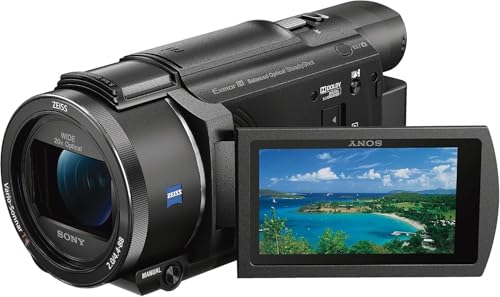
Start where most serious family filming starts: with the camera other parents recommend in the playground, usually while filming something with it. The AX53’s listing is almost comically plain — Sony FDRAX53/B, a 4K HD video recording camcorder, in black — and this review will honour that plainness by not inventing a specification sheet for it. What the title does establish is the essentials: a proper camcorder, from the maker that effectively defined the home camcorder, recording in 4K HD. Everything else a family needs to know about this camera is about behaviour rather than numbers, and behaviour is where its reputation was built.
That behaviour, in a parent’s hands, is about steadiness and forgiveness. Family filming is done one-handed, at arm’s length, while walking backwards in front of a toddler or craning over the shoulder of the parent in front. It is done at the long end of a zoom from the back of a hall. It is done in school-gym light that flatters nobody. A camcorder from Sony’s long-running line was shaped by decades of exactly this abuse, and the reason these cameras are handed down, lent out and still working at a child’s graduation is that they were built for the way families actually film rather than the way brochures imagine.
The ownership experience around the camera matters as much as the camera. A major maker’s camcorder means a manual that answers questions, accessories that exist, a battery you can replace in five years, and a repair route if the worst happens in year three. Family archives are decade-long projects; the camera that records a first day at school should plausibly still be the camera recording the last one, and buying into an established line is how that continuity is purchased. The unbranded models below can be excellent value; none of them can promise a decade of support, and families should weigh that difference with open eyes.
The plain listing also means doing one piece of homework: its detailed specifications — zoom range, stabilisation system, connections — are for Sony’s documentation and the listing page to confirm, and the spec box below records that honestly rather than borrowing figures from other sources. What does not need confirming is the role: this is the guide’s recommendation for the family that films everything and wants one purchase to cover the era.
Parents building the long-term family archive can look at the Sony FDR-AX53 on Amazon and then read Sony’s own specification for the zoom and stabilisation details its title omits.
- Format: 4K HD video recording camcorder, per the listing title
- Maker and model: Sony FDRAX53/B, per the listing title
- Colour: Black, per the listing title
- Zoom range: Not stated in the listing title — verify with the manufacturer documentation
- Stabilisation system: Not stated in the listing title — verify with the manufacturer documentation
- Bundle contents: Not stated in the listing title — verify with the manufacturer documentation
Strengths
- Established major-maker camcorder with a decade-scale support ecosystem.
- Camcorder form shaped by generations of one-handed family filming.
- 4K HD recording covers both today’s screens and the archive’s future.
Trade-offs
- Title states almost nothing — key details need Sony’s documentation.
- No bundle: bag, spare battery and media are separate purchases.
- Costs more of the family budget than the budget picks below.
Best for: a family wanting one trusted camcorder to cover childhood from first steps to graduation.
Not suited for: a household filming one holiday and wanting the smallest possible outlay.
Think of the purchase the way its owners describe it: not as buying a camera but as appointing the family’s memory-keeper. It lives in the same drawer, goes to every recital, survives being lent to an uncle, and its footage — years of it, in one consistent format — becomes the archive the family actually watches. Consistency across a childhood is a feature no single specification can name, and it is the deepest reason this plain-listed camera leads a guide full of louder claims.
Pair it with the boring accessories and the appointment is complete: the second battery, the decent-sized card, the small bag that lives by the door. Family filming fails on logistics far more often than on image quality, and this camera’s owners are usually the parents who solved the logistics once and never thought about them again.

ORDRO 4K Camcorder — Best budget optical zoom
The ORDRO earns its place with three words most budget listings avoid: optical zoom, quantified. Its title states a 4K camcorder with a 10x optical zoom, 30MP and 24FPS recording figures, a 3-inch IPS screen — described as a 3.0-inch IPS touch screen — a 32GB memory card included, and a vlogging camera positioning. The optical zoom is the headline that matters. Ten times optical means the lens genuinely magnifies the stage: from row nine, a child in the school play becomes a framed performer rather than a bright smudge, with the picture’s detail intact because the lens, not software, did the work. In a category addicted to digital zoom arithmetic, a stated optical figure is a mark of seriousness.
The recording figures deserve the same careful reading this guide gives every claim. The title states 4K recording at 24FPS and a 30MP figure; families should understand 24 frames per second as a cinematic cadence that suits performances and posed moments, while fast playground motion is kinder at higher frame rates the title does not claim. Judge the camera by whether its stated cadence matches your filming: plays, birthdays, ceremonies and holidays — yes; a small footballer’s every sprint — with managed expectations.
The touchscreen and the included card complete a genuinely family-ready box. A 3-inch IPS touch screen that can be operated by the grandparent who did not grow up with menus is worth more than a specification nobody in the house can reach, and the card in the box means the camera films the day it arrives — a small mercy that budget buyers, burned before by cameras that needed a shopping list before their first frame, will appreciate at full value.
Vlogging positioning, also in the title, suits the older child in the family: the same camera that films the play can be turned around for the teenager’s channel experiments, and a household camera that serves two generations gets used — and therefore justified — twice as often.
Families wanting real zoom without the flagship spend can check the ORDRO 4K Camcorder on Amazon and confirm the card and accessories in the current listing.
- Recording: 4K at 24FPS, per the listing title
- Zoom: 10X optical zoom lens, per the listing title
- Photo figure: 30MP, per the listing title
- Screen: 3.0-inch IPS touch screen, per the listing title
- Included: 32GB memory card, per the listing title
- Second battery: Not stated in the listing title — verify with the manufacturer documentation
Strengths
- Stated 10x optical zoom genuinely reaches the school stage.
- Touchscreen operation suits every generation of the family.
- Card included: the camera films the day it arrives.
Trade-offs
- 24FPS cadence is less kind to fast playground motion.
- A second battery is not stated in the title.
- Budget maker support is thinner than the Sony’s ecosystem.
Best for: a budget-conscious family whose filming centres on plays, birthdays and ceremonies.
Not suited for: a sports-day specialist needing high frame rates for fast action.
The ORDRO also teaches the category’s most useful lesson in a single purchase: that the honest mid-priced camcorder — real zoom, stated figures, card in the box — is where family value actually lives. It will not be handed down for a decade like the Sony might, but it will film this year’s nativity beautifully, and for many families this year is the brief.
Keep its card backed up like any family camera’s: the footage of a childhood is irreplaceable at every price point, and the discipline of copying it somewhere safe costs nothing but the habit.
kimire 1080P Camcorder — Best simple HD starter
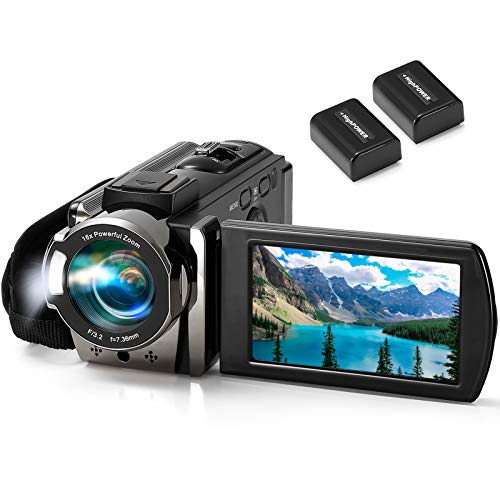
The kimire is the guide’s lesson in enough. Its title states a video camera camcorder recording Full HD 1080P at 15FPS, with a 24MP figure, a 3.0-inch LCD that rotates 270 degrees, a 16x digital zoom, and two batteries included, in black. Every clause of that deserves a family’s honest attention. Full HD is enough for the screens families watch on and kind to the storage they keep. The rotating screen is a genuine family feature — it turns for the selfie-style birthday message, angles for the low shot of a toddler, and folds to show grandparents exactly what is being filmed. And two batteries in the box quietly solve the most common family filming failure of all: the camera that dies during the second half.
The cautions belong in the open, and this guide puts them here rather than in a footnote. The stated frame rate is 15FPS, which is low: movement will look steppier than the television the family is used to, and fast action will smear its story. The 16x zoom is digital, which means it enlarges the centre of the picture and throws away detail to do it — usable for a closer look, visibly softer than any optical zoom. And the 24MP figure is a stills number in a listing whose video is 1080P, a distinction marketing hopes buyers will blur. None of this disqualifies the camera; all of it defines it. It is a gentle-pace camera: ceremonies, posed moments, grandparents’ messages, the slow theatre of family life, filmed simply and shared easily.
Within that definition, its virtues are real. Simplicity is a feature when the operator is a ten-year-old or an eighty-year-old; this class of camcorder asks almost nothing of its user beyond point, zoom modestly, and press the red button. The rotating screen makes it the family’s message camera — the birthday greeting to the relative abroad, the thank-you video, the reading of a story for a grandchild in another timezone — tasks where being seen and heard clearly matters more than any frame rate.
It is also, honestly, the camera to buy when the alternative is no camera: the household that wants the play filmed by something that is not a parent’s nearly-full phone, at an outlay that does not require a family meeting. Bought with its limits understood, it will be used constantly, and a used camera beats a superior specification sitting in a drawer of good intentions.
Families wanting the simplest possible start can look at the kimire 1080P Camcorder on Amazon and note the two batteries among its listed contents.
- Recording: Full HD 1080P at 15FPS, per the listing title
- Photo figure: 24MP, per the listing title
- Screen: 3.0-inch LCD, 270-degree rotation, per the listing title
- Zoom: 16X digital zoom, per the listing title
- Included: 2 batteries, per the listing title
- Colour: Black, per the listing title
Strengths
- Rotating screen serves messages, selfies and low toddler angles.
- Two batteries included solve the mid-show shutdown.
- Simple operation suits the youngest and oldest operators.
Trade-offs
- Stated 15FPS makes fast movement look steppy.
- Digital zoom softens the picture as it enlarges it.
- 1080P ceiling, where other picks state 4K recording.
Best for: gentle-pace family filming — messages, ceremonies, birthdays — by operators of every age.
Not suited for: sports days or any filming where the subject moves fast.
There is a tenderness argument for this camera that specifications miss. The rotating screen turns the camcorder into a correspondence device: families separated by oceans use exactly this class of camera to send long, unhurried video letters, because it asks nothing of the sender and flatters nobody and simply carries a face and a voice across the world. If that is your family’s need, the kimire is not the budget compromise; it is the correct instrument.
Set expectations at the box-opening, film a test afternoon in the garden, and let everyone in the house learn its one red button. A camera the whole family can operate is a camera that gets operated by the whole family, and the archive grows accordingly.
ZYDIIE 4K Camcorder — Best budget bundle
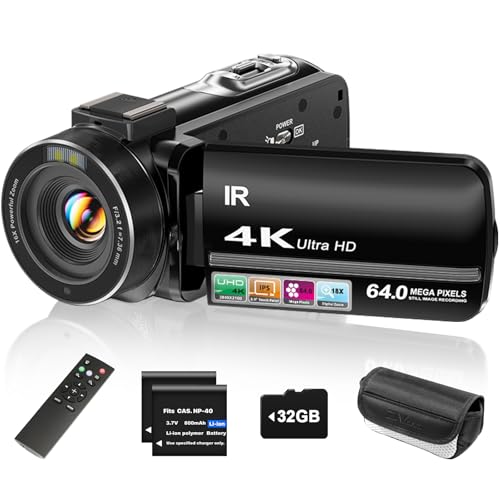
The ZYDIIE’s title is a bundle inventory wearing a camera’s name: a 4K video camera camcorder with a UHD 64MP vlogging claim, an 18x digital zoom, a 3-inch IPS touchscreen rotating 270 degrees, night vision, a remote control, a 32GB card and two batteries, aimed at YouTube filming. Sort the claims the way this guide has taught. The bundle is real and genuinely useful — remote, card and two batteries are the three accessories family filming actually consumes. The touchscreen’s rotation serves the vlogging and message work the title aims at. Night vision, in this class, means infrared-assisted filming in darkness, useful for the novelty of a sleeping-baby check or a garden wildlife experiment rather than for cinema. And the two headline numbers need their labels: the listing claims 64MP, and the zoom is digital.
Digital zoom first, because it decides the school-play question. An 18x digital zoom enlarges the middle of the image electronically; the farther it reaches, the softer and grainier the picture becomes, because no new detail is being gathered — the same information is simply being spread thinner. For a closer look at a candlelit cake or a pet across the garden, that trade is acceptable and even fun. For reading a child’s expression across a hall, the ORDRO’s stated 10x optical zoom will return a clearer picture at the same framing, and families choosing between these two should choose by that single distinction if the play is their main event.
The megapixel claim needs the same calm treatment. The listing claims UHD 64MP for a camera whose working life is video; megapixel figures in this class describe a stills or interpolated number, not the detail in the moving picture, and families should compare these cameras on their stated video recording and zoom type — the figures that govern the footage — rather than on the largest number on the box. This guide reports the claim because the listing makes it, and declines to build any recommendation on it.
What remains, once the claims are labelled, is a likeable and complete little kit. The remote control is the unsung family feature: it lets the whole family be in the film — the group shot at the holiday house, the Christmas morning scene with nobody missing behind the camera — started and stopped from the sofa. Two batteries and a card complete the readiness story. As a first camcorder for a vlogging teenager or a family that films itself as much as its children, the bundle’s completeness is its honest argument.
Families who film themselves as often as their children can check the ZYDIIE 4K Camcorder on Amazon and inventory the remote, card and batteries the title lists.
- Recording: 4K video camera, per the listing title
- Photo claim: UHD 64MP, as claimed in the listing title
- Zoom: 18x digital zoom, per the listing title
- Screen: 3-inch 270-degree rotation IPS touchscreen, per the listing title
- Included: Night vision, remote control, 32GB card, 2 batteries, per the listing title
- Optical zoom: Not stated in the listing title — verify with the manufacturer documentation
Strengths
- Remote control puts the whole family in the film.
- Card and two batteries make the box genuinely complete.
- Rotating touchscreen suits vlogging and family messages.
Trade-offs
- 18x zoom is digital: reach comes with softness.
- The 64MP figure is a listing claim, not a video-detail measure.
- Night vision is infrared novelty, not low-light cinema.
Best for: a vlogging teenager or a self-filming family wanting the most complete budget bundle.
Not suited for: a parent whose main event is a distant stage needing optical reach.
The ZYDIIE also suits the holiday house pattern: left on the shelf, charged, card inside, remote in the drawer, ready for whoever picks it up. Family technology succeeds when it is communal and obvious, and a complete bundle in one box is how a camera becomes the house’s camera rather than one person’s gadget.
Film the test weekend, watch the footage on the television rather than the little screen, and calibrate the family’s expectations to what the television shows. Budget cameras earn affection exactly in proportion to how honestly they were bought.

Unbranded 4K Camcorder with Microphone — Best claim-checked experiment
This camera has no brand name in its listing, and its title is a festival of figures: a camcorder video camera claiming 4K Ultra recording and 80MP, for YouTube vlogging, with IR night vision, an 18X digital zoom, a 3.0 IPS screen, and a bundle of a 32GB SD card, two batteries, a microphone and a remote control. This section will do the listing the courtesy of taking its bundle seriously and its numbers literally — as claims. The listing claims 80MP; the listing claims 18X zoom, and specifies that the zoom is digital. Those two sentences, read properly, contain the whole review.
Digital zoom is the limitation to understand before any other. When this camera zooms to 18X, it is not gathering eighteen times more scene; it is enlarging the centre of its picture and discarding the edges, so detail thins exactly as the subject grows. At modest digital zoom the effect is gentle; at the headline figure the picture will be soft, and a face across a hall will be a suggestion rather than a portrait. Families should therefore treat the zoom as a framing convenience for near and middle distances — the birthday table, the garden, the pet — and not as the school-play solution that an optical zoom, like the ORDRO’s stated 10x, genuinely is. The megapixel claim deserves the same filing: the listing claims a very large stills figure, and the moving picture’s quality will be decided by the camera’s video recording and lens, not by that number.
Now the bundle, which is this camera’s honest substance. A microphone is included — and for family filming, a microphone in the box is a more valuable inclusion than any megapixel, because the vows, the play’s one line, the grandparent’s story are all audio events that a distant built-in microphone would thin into echo. A remote control, a card and two batteries complete a kit that can film a family event the day it arrives, by a family that has never owned a camcorder. That completeness, at the budget end, is a real service.
The unbranded nature cuts both ways and should be weighed without snobbery. There is no established support ecosystem behind this camera, no certainty of a replacement battery in four years, no manual written by a documentation department. Against that, the outlay is small enough that many families will rationally treat it as a two-or-three-year instrument — the camera for the toddler era, replaced when the children are older and the filming gets serious. Bought on those terms, with its claims filed as claims, it is a defensible experiment. Bought believing the headline numbers are verified specifications, it will disappoint precisely where it promised most.
Families curious about the budget frontier can look at this 4K camcorder bundle on Amazon and read its title with the claim-checking habits this section models.
- Recording claim: 4K Ultra, as claimed in the listing title
- Photo claim: 80MP, as claimed in the listing title
- Zoom: 18X digital zoom, per the listing title
- Screen: 3.0 IPS screen, per the listing title
- Included: IR night vision, 32GB SD card, 2 batteries, microphone, remote control, per the listing title
- Brand: Not stated in the listing title — verify with the manufacturer documentation
Strengths
- Included microphone serves speeches, plays and stories.
- Card, two batteries and remote complete the box.
- Small outlay suits a defined few years of family filming.
Trade-offs
- Headline figures are listing claims, not verified specifications.
- 18X zoom is digital and softens as it reaches.
- Unbranded support and long-term parts are uncertain.
Best for: a family wanting a complete, inexpensive kit — microphone included — for near and middle-distance filming.
Not suited for: a decade-long archive project or distant-stage filming that needs optical zoom.
One practical ritual protects buyers of any claim-heavy camera: film the return-window test. In the first days, shoot the actual subjects at the actual distances — the stage from row nine, the toddler across the room, the evening garden — and watch the results on the family television. If the pictures match the family’s hopes, the claims no longer matter. If they do not, the discovery was made while returning the camera was still a simple decision. That test, applied honestly, is worth more than any review, including this one.
And copy its footage off the card with the same discipline as any camera’s. Whatever its badge or lack of one, it will hold afternoons that cannot be repeated.

Unbranded 5K Camcorder with WiFi — Best feature-list budget pick
The second unbranded camera in this guide leads with the largest recording claim of the set — a 5K video camera camcorder with a UHD 64MP vlogging figure — and then lists a genuinely interesting set of family features: a 3-inch touch screen rotating 270 degrees, IR night vision, a 16X zoom, WiFi, webcam function, HD connection, and a bundle with a 32GB card, two batteries and a microphone. As with its sibling above, the discipline is to sort claims from features. The listing claims 5K recording and 64MP stills; those are the seller’s figures, reported here as claims, and the camera’s real family value sits in the plainer words underneath them.
Those plainer words are good ones. WiFi in a family camcorder means the holiday footage can move to a phone for sharing without a cable hunt through the kitchen drawer — the difference, in practice, between relatives seeing the school play this week and seeing it never. The webcam function gives the camera a second career at the desk: the grandparent’s video calls, the teenager’s streaming experiments, filmed through a real camcorder rather than a laptop’s apologetic lens. The rotating touchscreen serves the message-and-vlog work, and the included microphone again deserves its emphasis: in this class, a microphone in the box is the single inclusion most likely to improve the family’s actual footage.
The zoom is stated as 16X without the word optical in the title — and the sibling listings in this guide that mean digital say so, while the one that means optical, the ORDRO, says that. Families should therefore treat this camera’s reach with the digital-zoom understanding developed above: fine for framing the near and middle distances, softening as it stretches, and not a substitute for optical reach at the back of a hall. The title’s silence on the word optical is itself information, and this guide reads it aloud rather than letting a large number do quiet work.
Support expectations should match the sibling’s: unbranded, bundle-rich, claim-heavy, and best bought as a defined-term instrument whose test footage — filmed in the return window, watched on the television — the family has actually approved. On those terms, its feature list is the most modern in the budget set: the camera for the family whose filming life is half camcorder, half connected device, and whose sharing happens the same evening.
Connected families can see this 5K camcorder on Amazon and weigh its WiFi and webcam features against its claim-based headline figures.
- Recording claim: 5K UHD, as claimed in the listing title
- Photo claim: 64MP, as claimed in the listing title
- Zoom: 16X zoom — type not stated as optical in the listing title
- Screen: 3-inch 270-degree rotatable touch screen, per the listing title
- Features: IR night vision, WiFi, webcam function, per the listing title
- Included: 32GB card, 2 batteries, microphone, per the listing title
Strengths
- WiFi sharing gets footage to relatives the same evening.
- Webcam function gives the camera a desk career too.
- Microphone, card and two batteries complete the bundle.
Trade-offs
- 5K and 64MP figures are listing claims, not verified measures.
- Zoom type is not stated as optical; expect digital behaviour.
- Unbranded long-term support is uncertain.
Best for: a sharing-focused family wanting WiFi, webcam duty and a complete bundle at the budget end.
Not suited for: an archivist building a verified-specification, decade-long family record.
The two unbranded cameras in this guide, taken together, mark where the budget frontier currently sits: astonishing feature lists, complete bundles, and headline numbers that must be read as the sellers’ claims they are. Families who read them that way — and test the footage before the return window closes — can come away with genuinely useful cameras. Families who read the largest number as a promise will be disappointed by physics, which does not negotiate.
That reading skill, once learned on a camcorder, transfers to every technology purchase a household makes, which may be the most durable thing this camera ever teaches its owners.
Comparison
| Camera | Recording as titled | Zoom as titled | In the box as titled |
|---|---|---|---|
| Sony FDR-AX53 | 4K HD | Not stated in the listing title | Not stated in the listing title |
| ORDRO 4K | 4K at 24FPS | 10X optical | 32GB card |
| kimire 1080P | Full HD 1080P at 15FPS | 16X digital | 2 batteries |
| ZYDIIE 4K | 4K | 18x digital | Remote, 32GB card, 2 batteries |
| Unbranded 4K | 4K Ultra, listing claim | 18X digital | Card, 2 batteries, microphone, remote |
| Unbranded 5K | 5K, listing claim | 16X, type not stated as optical | 32GB card, 2 batteries, microphone |
How to Choose
Choose by your family’s main event. If it is the distant stage, optical zoom is the whole conversation: the ORDRO states it, the Sony’s documentation should be consulted for it, and the digital-zoom models should be understood as near-field cameras whatever their numbers say. If the main event is the living room — messages, birthdays, the family filming itself — bundles, rotating screens and remotes matter more, and the ZYDIIE and unbranded kits compete on completeness. If the camera must serve a decade, the Sony’s ecosystem is the argument. And whatever you choose, run the television test in the return window: footage watched at family size is the only specification that cannot lie to you.
Budget the second battery and the backup habit alongside the camera. Family filming’s failures are logistical — flat battery, full card, footage stranded on the only copy — and both are cheaper to prevent than any camera upgrade.
Why Does Optical Zoom Matter More Than Any Number on the Box?
Because of what a zoom is for. A family zooms to bring a distant child closer — the stage, the pitch, the far end of the beach — and there are only two ways to do it. An optical zoom moves glass: the lens genuinely magnifies the scene, and the picture arrives with its detail intact, so a face at ten times zoom is a face. A digital zoom moves arithmetic: it enlarges the middle of the picture the sensor already captured and discards the rest, so the same face arrives larger and softer, built from less information the farther it reaches. Both are called zoom on the box. Only one of them survives the school hall.
This is why the guide you are reading keeps returning to a distinction the marketing would rather blur, and why the ORDRO’s modest stated 10x optical figure outweighs the larger digital numbers around it for stage work. It is also why the unbranded cameras’ claims are handled as claims: a listing that prints 80MP or 96MP-class figures beside a digital zoom is describing its arithmetic, not its optics, and a family that understands the difference will choose well at any budget.
The practical test is simple enough for a shop or a return window. Zoom fully onto a face or a page of text at the distance your family actually films, and look at the result on a television. Optical reach will still be readable; digital reach will be a watercolour of itself. Let your eyes, at your distance, settle what the numbers argue about.
What Should a Family Film Besides the Big Occasions?
The ordinary Tuesday. Archives built only from birthdays and holidays describe a family that seems to live in a party, and the footage descendants actually treasure is the unposed record: the kitchen at breakfast, the walk to school, the grandparent shelling peas and telling the story nobody wrote down. A dedicated camcorder’s deepest virtue is that it can be left charged and ready for those unremarkable moments, grabbed without ceremony and forgiven its imperfect framing, because the moment’s value is its truth rather than its polish.
That philosophy rearranges buying priorities one final time. The camera for ordinary Tuesdays should be the one the whole household will actually pick up — light enough, simple enough, already charged, with its card already inside. For some families that is the little kimire with its rotating screen; for others the communal ZYDIIE with its remote; for the decade archivists, the Sony that lives by the door. The big occasions will be filmed by whatever camera the ordinary days have made familiar, which is the strongest argument in this guide for buying the camera your family will use weekly rather than the one that wins an annual comparison.
Back the ordinary footage up with the same care as the occasions. In thirty years, nobody will wish they had filmed fewer breakfasts.
How Do You Hand a Camcorder Down Without Losing the Footage?
Family cameras outlive their first owners’ interest in them, and the handover deserves a plan. The footage is the inheritance; the camera is merely its current custodian. Keep the archive somewhere that is not the camera — copied to a computer, a drive or a family cloud folder, in ordinary formats with the dates in the file names — and the camera can be lent, dropped, upgraded or handed to the next generation without a single memory riding on its survival. Families who treat the card as the archive eventually lose both the card and the argument about whose job the copying was.
The handover itself is a small ceremony worth performing properly. Show the new keeper the one red button, the zoom’s manners, the battery rotation and the drawer where the charger lives. Film one ordinary afternoon together, watch it on the television that evening, and let the new keeper’s questions surface while the old keeper is still in the room to answer them. Every camera in this guide — from the Sony appointed for a decade to the unbranded experiment — becomes more valuable in a household where two generations can operate it, because the archive stops depending on one person’s presence at every occasion.
And keep filming the elders on whatever camera is at hand, at every opportunity the family gets. The questions grandchildren will ask are already known — what was her voice like, how did he laugh, what did the old house look like from inside — and they are all answerable, but only by footage and recordings made before anyone thought to miss them. A family camcorder, honestly chosen and constantly used, is how those answers come to exist.
Common Mistakes
Choosing by the largest megapixel figure. In this category those figures are listing claims about stills or interpolation, not measures of the moving picture. Compare stated video recording and zoom type instead — the numbers that govern the footage your family will actually watch.
Believing a digital zoom reaches a stage. It enlarges; it does not reach. A parent in row nine needs optical zoom, and discovering the difference during the play is discovering it a year too early to fix and a moment too late to forgive.
Filming the whole holiday on one battery and one card, with the only copy of everything on that card. The second battery and the nightly copy are the cheapest insurance in family life; buy both before the trip, not the memoir of the trip.
Leaving the camera in a drawer between occasions. Unfamiliar cameras get fumbled at the crucial moment. A camcorder that films ordinary weeks is already in the operator’s hands — charged, understood and pointed the right way — when the extraordinary one arrives.
Never watching the footage on the television. Small screens flatter everything. The family television is where softness, echo and shaky framing confess themselves, and a camera judged there during its return window is a camera the family will trust for years.
Final Recommendation
For the family that films everything and plans to keep filming it, the Sony FDR-AX53 is the appointment to make: an established camcorder whose support ecosystem matches the archive’s timescale. For the budget family whose year turns on school plays, the ORDRO’s stated optical zoom is the wisest spend in the guide. The kimire serves gentle-pace filming and video letters with disarming simplicity; the ZYDIIE gives the self-filming family and the vlogging teenager the most complete little bundle; and the two unbranded cameras are reasonable experiments for households that read their claims as claims, test the footage on the television, and value the included microphones and complete kits. Choose by your main event, verify on your own screen, and then film the ordinary days like they matter — because they are the ones that will.
Charge it tonight, whichever one it is. The next unrepeatable moment is not waiting for a better camera; it is waiting for a ready one.
Frequently Asked Questions
Why buy a camcorder when a phone films in 4K?
For readiness, reach and peace. A camcorder is charged, empty-carded and dedicated; it zooms optically toward the stage without a case or a clip-on lens; it can be handed to a grandparent without handing over your messages; and nobody’s phone call interrupts the school play. Phones are superb cameras that are busy being phones. The camcorder’s whole job is the filming.
Are the big megapixel numbers on budget camcorders real?
They are listing claims, and this guide reports them in those words. Figures such as the 80MP claimed by one unbranded model describe a stills or interpolated number, not the detail in the moving picture. Judge these cameras by their stated video recording, their zoom type and your own test footage on a television — the measures that govern what your family will watch.
What is wrong with digital zoom?
Nothing, within its limits — and everything beyond them. Digital zoom enlarges the centre of the picture and discards the edges, so detail thins as the subject grows. For the birthday table it is a convenience; for a face across a school hall it produces a soft suggestion where an optical zoom, like the ORDRO’s stated 10x, produces a portrait. Match the zoom type to your distance.
Which camera is best for school plays?
The ORDRO, on its title’s evidence: a stated 10x optical zoom reaches the stage with detail intact, and its touchscreen and included card suit a parent filming from a seat. The Sony is the step up for families wanting the established maker’s ecosystem — confirm its zoom in Sony’s documentation. The digital-zoom models are better kept for nearer subjects.
How many batteries does a family need?
Two, minimum, and the listings that include the second one — the kimire, the ZYDIIE and both unbranded bundles — are saving you the most predictable disappointment in family filming. A ceremony does not pause for a charger. Rotate the pair, keep both charged, and the camera stops having a curfew.
Is the Sony worth it over the budget picks?
For a decade-long archive, yes: the established maker’s support, parts and documentation are what a ten-year project actually consumes, and its camcorder lineage was shaped by family filming itself. For a defined few years of birthdays and holidays, the budget picks — honestly bought, with their claims understood — serve perfectly well. The timescale, not the filming, makes the decision.
Keep a small notebook with the camera, or a note on the family phone, recording the unglamorous facts future viewers will bless you for: who is in the film, where it was taken, what the occasion actually was. Footage without names becomes anonymous within a generation; footage with them becomes a family document. The cameras above will preserve the faces faithfully — the notebook preserves what the faces meant, and together they are the archive your grandchildren will one day sit down to watch, probably on a screen none of us has imagined yet, grateful for every ordinary Tuesday somebody bothered to record.
Finally, share the footage while the people in it can still enjoy being shared. The archive’s future audience matters, but its present one — the grandparent watching this morning’s first steps tonight, the sibling abroad at the birthday table by video — is where a family camera pays its daily dividend. A camera that is used, shared and understood beats a superior one that is saved for occasions, every single week of a childhood.
That dividend, compounded across birthdays and breakfasts alike, is the real return on every camera in this guide — and it starts the moment the box is opened, not the moment the specification is perfected.
Open the box this week, then — and let the first film be something gloriously ordinary.
One more household rule, learned by every filming family the slightly hard way: the camera belongs to whoever is filming, and nobody else adjusts it mid-moment. Pass it charged, pass it kindly, and let the person holding it make their own framing mistakes in peace — the footage will be the better for the laughter around it, and the next family occasion will find a queue of volunteers rather than a row of critics. That, more than any claim printed on any box in this guide, is what a family camera is actually for.
Related Guides
When the family’s filming ambitions grow toward proper productions, our prosumer camera guide for independent filmmakers shows where the camcorder road leads. The same cameras’ serious side — long interviews and observational days — is covered in the documentary filmmaking camera guide.
Related guides
- Best Thermal Imaging Cameras Hunting: Six Handheld Thermal Monoculars for Night Observation
- Best Mirrorless Cameras for Bird Photography: Crop Reach, Fast Bursts and the Lens Question Answered First
- Best 4K Cameras Travel Shooters Actually Carry
- Best 1080 Webcams: Six Full HD Cameras Judged on Light, Focus and Voice


