What's inside
- Key Takeaways
- Quick Picks
- How Did We Judge Desks With Nothing to Adjust?
- How Long a Desk Do You Actually Need?
- What Does the Industrial Look Do to a Room?
- How Do You Set Up a Fixed Desk So the Day Stays Comfortable?
- Who Should Not Buy a Fixed Industrial Desk?
- How Do You Assemble and Place a Heavy Slab Desk Without Regret?
- What Happens to One of These Desks Over Ten Years?
- Six Industrial Desks, Measured Against Each Other
- Where Do the Tower, the Printer and the Rest of the Machine Live?
- What Mistakes Do People Make When Buying a Fixed Desk?
- How Do You Choose Between the Two Tribesigns Desks?
- Final Recommendation
- Frequently Asked Questions
- Related Guides
As an Amazon Associate I earn from qualifying purchases. This post may contain affiliate links at no extra cost to you.
widgetverdict.com is reader-supported. When you buy through links on our site, we may earn an affiliate commission.
Where to buy: Amazon sells all six desks in this roundup, and none of them plugs in, rises, tilts or folds. That is the point. The industrial desk is the oldest idea in office furniture — a slab of wood on a frame of steel — restated for the home office: long tops, exposed metal legs, rustic finishes, and a promise that the desk will hold still and hold weight while everything electronic on top of it changes around it. Check the listing for the current figure before ordering; what follows compares the desks on the dimensions and materials their titles actually state.
The best industrial desks are bought by people who have stopped believing in desk features. After a decade of monitor arms, cable grommets, USB hubs and height presets, a certain kind of buyer wants the opposite: a surface that is only a surface, wide enough for two monitors and a notebook, strong enough to lean on, plain enough to outlast three laptops and two jobs. The industrial style — wood tones against black steel — is partly fashion, but the fashion is riding on a genuinely useful architecture: thick tops, simple leg frames, no mechanisms to fail, and lengths that run from 55 inches to a frankly room-dominating 78.7.
Because the architecture is simple, the differences between these six desks are honest ones: length first, then top material — one pick here is solid wood among five wood-finish surfaces — then frame and finish. There is no adjustability to compare, no motor to rate. What there is to judge is proportion: which length fits which room and which workload, what a rustic finish does to a small space’s light, and how much desk a person actually needs before the desk starts needing the room. This guide takes those questions in order, and it is frank about the category’s limits — if you want to stand, store or roll, other categories serve you, and the guide points to them where they matter.
Key Takeaways
- Length is the category’s master specification: this roundup runs from 55 inches to the IBF’s 78.7-inch extra-long top.
- Five picks are wood-finish tops on metal frames; the SXXjiaju is the solid-wood exception at 55 inches.
- Only the Tribesigns 63in states a load figure in its title — a 300 lb capacity on an extra-thickened top.
- Fixed height is the deal: no pick here adjusts, so chair fit and posture must come from the chair.
- Finishes cluster into rustic browns and grey oaks; the colour decision is a room-light decision as much as a taste one.
Quick Picks
| Pick | Badge | Why it earns its place |
|---|---|---|
| IBF 78.7in Extra Long Industrial Desk | The room-length workbench | 78.7 inches of rustic brown wood-and-metal surface for dual monitors and everything after them. |
| Tribesigns 55in Industrial Executive Desk | The compact executive | A 55-inch rustic top on strong metal legs that doubles as a small conference table. |
| BON AUGURE 60in Industrial Desk | The grey-oak middle | Sixty inches of dark grey oak over a sturdy metal frame, in the roundup’s calmest finish. |
| SXXjiaju 55in Solid Wood Desk | The real-wood purist | A solid wood 55-inch top with a metal frame — the material upgrade of the roundup. |
| Tribesigns 63in Heavy-Duty Industrial Desk | The stated-strength pick | An extra-thickened 63-inch top with a title-stated 300 lb capacity, vintage brown and black. |
| HSH 60in Rustic Gray Industrial Desk | The living-room diplomat | Sixty inches of dark gray oak and metal, styled to work in bedrooms and living rooms as well as studies. |
How Did We Judge Desks With Nothing to Adjust?
By proportion, material and honesty, in that order. Proportion first because a fixed desk is a permanent piece of room geometry: its length decides how much of the wall it annexes, how many workstations it can host, and whether the room still functions around it. A 78.7-inch desk is not a bigger version of a 55-inch desk; it is a different land claim, and the reviews below treat length as a lifestyle decision before treating it as a specification. Buyers should too — the tape measure is the most important review tool in this entire category.
Material second. The titles here divide into wood-finish surfaces — the majority, described as rustic wood or oak tones over the board beneath — and the SXXjiaju’s solid wood, stated plainly as real wood in its title. That distinction governs how a top ages, how it takes a knock, how it can be repaired, and how it feels under your forearms in February. Frames are steel throughout the roundup, and the differences are of gauge and geometry rather than kind; where a title makes a strength claim, as the Tribesigns 63in does with its thickened top and 300 lb capacity, the review credits the claim as stated and notes where rivals leave the figure unpublished.
Honesty third, because fixed furniture invites inflated language. “Executive” in these titles means a clean, legroom-friendly slab, not a desk with drawers and a modesty panel; “industrial” means the wood-and-steel look, not a factory rating. Where a title leaves a dimension or a capacity unstated, the spec boxes below say so in this article’s own words rather than borrowing a rival’s numbers. Readers furnishing rooms where the desk must also store the work should pair this guide with our Best Standing Desks with Storage roundup, where the drawers and cabinets live.
How Long a Desk Do You Actually Need?
Count the objects that must live on the top simultaneously, at their real widths, and let the sum argue. A laptop is fifteen inches of the budget. A single external monitor on its stand is twenty-odd. A second monitor doubles that line item. A notebook opened beside the keyboard is another twelve; a desk lamp’s base, six; the printer that someone is hoping to keep on the desk rather than under it, sixteen and an argument. Most single-worker setups land honestly between 47 and 63 inches of need — which is why the 55-to-63-inch band holds four of this roundup’s six picks.
The 78.7-inch IBF answers a different census: two people working side by side, or one person whose work physically spreads — the designer with reference boards, the crafter with a cutting mat, the teacher marking thirty exercise books in piles, the dual-monitor worker whose hobby is a third screen and a soldering iron. Length beyond need is not waste, exactly; it becomes the household’s landing strip, the place parcels, laundry and other people’s laptops accumulate. Some households love that. Others discover that a shorter desk enforces a tidiness a long one never will, and that the enforcement was the feature they actually needed.
Depth deserves one sentence of its own, because these titles mostly leave it unstated: a desk’s front-to-back measure decides monitor distance and legroom, and it is the figure to confirm in the manufacturer’s documentation before ordering any pick here whose title omits it. Length gets the headline, but depth is where your knees and your eye strain live.
What Does the Industrial Look Do to a Room?
It darkens and grounds it, in proportions the buyer controls through finish. Rustic browns — the IBF, the Tribesigns pair, the SXXjiaju — warm a room and forgive the visual company of books, leather and houseplants; they also absorb light, and a brown 63-inch slab in a small north-facing room can lower the room’s whole register by a shade. The grey oaks — BON AUGURE’s dark grey oak, HSH’s dark gray oak — sit cooler and quieter, closer to the Scandinavian end of the industrial family, and they coexist more peacefully with grey sofas, pale walls and the general palette of rental flats.
The black steel frame is the constant, and it is doing more work than decoration. Visually, a dark frame recedes: the eye reads the top as a floating slab and the legs as shadow, which is why these desks photograph larger in length and smaller in bulk than an equivalent all-wood desk. Practically, the open frame is legroom, air circulation for a tower PC on the floor, and nothing to bark a shin on except the legs themselves. It is also why the style travels between rooms so well — the same desk reads as study furniture, dining overflow or bedroom workstation depending on what stands around it, a versatility the HSH title states outright.
What the look does not survive is clutter asymmetry. A clean industrial slab is a stage; everything on it is cast. Owners who work in a permanent scatter of paper should know the style will exhibit the scatter handsomely rather than hide it — there are no drawers in this roundup to sweep it into, which is a considered absence, not an oversight, and the storage-minded should follow the link in the judging section above.
One more room effect, easy to miss in a showroom photograph: these desks are honest about their undersides. There is no modesty panel, no cable tray, no drawer block — the seated worker’s legs, the tower’s lights and the power strip’s small red eye are all part of the room’s visible life. In a study that is a virtue; the room looks like work happens there. In a living room it is the reason the HSH’s diplomacy and the grey finishes exist, and the reason a buyer furnishing a shared room should picture the desk occupied — chair pushed in, legs under it, cables run — rather than empty. Empty is how it will look for the first hour. Occupied is how it will look for the next ten years, and the finishes that forgive occupation are the greys and the mid-browns, in that order.
How Do You Set Up a Fixed Desk So the Day Stays Comfortable?
A fixed desk outsources every ergonomic decision to the chair and the accessories, so set those up with the seriousness the desk has declined to provide. Chair height first: feet flat, thighs level, and the chair’s arms — if it has them — slipping just under the top or meeting it without a negotiation. Then the screen: on a fixed desk, monitor height is a stand, a stack of books or an arm’s job, and the top of the screen wants to sit near eye level rather than at the downward angle a laptop alone imposes. The industrial slab’s thickness and strength make it an unusually good citizen here — it will carry a monitor arm’s clamp or a shelf riser without complaint.
Cable management is the second setup act, and the open frame makes it visible, which is a discipline in itself. A power strip mounted under the top’s rear edge, leads run down one leg, the tower on the floor to the side rather than under your knees: the industrial desk shows all of it, so it rewards doing it once and properly. Households that teach or present from the desk should note that this furniture is the fixed counterpart of the training-room world — our Best Classroom Computer Desks guide covers the flip-top tables built when the same room must reconfigure daily.
Lighting finishes the setup. A long desk invites the lamp to live at its far end, which is a mistake the length encourages: light belongs near the work, not near the geography. Place the lamp behind the screen’s shoulder for screen work, or over the notebook for paper work, and let the far end of a long desk be the dim end — the end where finished work goes to wait. The desk will not help you with any of this. That is its character: it provides the slab, the strength and the stillness, and everything else is yours.
Who Should Not Buy a Fixed Industrial Desk?
Anyone whose body has already filed a request for standing. A fixed desk at sitting height is a commitment renewed every morning, and the workers who alternate posture — for comfort, for energy, on advice — will find no lever here to pull. Those readers belong with the height-adjustable categories, and the stability-minded among them should start with our Best Non-Wobbly Standing Desks roundup, where dual motors and four-leg frames do the standing without the shake. The industrial desk’s stillness is a virtue only for work that is itself still.
Anyone furnishing a room that reconfigures — the training room, the multi-use classroom, the hall that hosts examinations in June and weddings in July — should also pass. These desks assemble into permanence; they do not nest, fold or roll to the wall. And anyone whose work is mostly paper should count the drawers in this roundup — there are none — and decide whether a separate pedestal is an acceptable second purchase, because for paper-heavy work it will become a necessary one. The category’s honesty about what it omits is its charm; buy it for the slab, and only for the slab.
How Do You Assemble and Place a Heavy Slab Desk Without Regret?
Assemble it where it will live. That sentence sounds obvious and is ignored constantly, because the box is lighter than the desk and the hallway is nearer than the study. A 63-inch slab with its frame attached does not turn staircase corners gracefully, and the 78.7-inch IBF should be regarded as a room’s resident from the moment its top leaves the cardboard. Clear the wall, lay the top face-down on the rug it will stand on, build the frame onto it, and recruit the second person before the flip rather than after the first attempt has explained why they were needed.
Placement has one rule that outranks aesthetics: the long wall with the sockets. An industrial desk’s open frame displays its cables as part of the furniture, so the desk belongs where the power already is — the wall with the outlets at its own end of the room — and not across the floor from them at the end of an extension lead’s grey pilgrimage. Window light is the second consideration, and it argues for the desk perpendicular to the window rather than facing it or backing onto it: side light neither blinds the worker nor turns the screen into a mirror, and it lets the long top run into the room’s depth instead of across its width.
Levelling is the third act, and old houses make it a real one. A rigid steel frame on an uneven floor rocks on two diagonal feet with a patience that will outlast yours; adjustable feet or a folded shim under the proud leg ends it in a minute, but only if it is done on day one, before the monitors arrive to make every adjustment a negotiation with gravity and glass. Do the boring ten minutes — level, cable, lamp — before the first working hour, and the desk will repay you by never being thought about again, which is the highest praise fixed furniture can earn.
What Happens to One of These Desks Over Ten Years?
Less than happens to any other desk category, which is the ownership argument in full. There is no motor to tire, no spring to fade, no electronics to be orphaned by an app store. The frame’s enemies are loose bolts — a yearly minute with the hex key the box included — and the floor’s slow movement under its feet. The top’s biography is the interesting half. Wood-finish surfaces record the decade in their edges: the corner where the laptop’s heat lived, the ring a thousand mugs negotiated. They cannot be refinished, only replaced or accepted, and acceptance comes easier than expected — a work surface’s scars read as tenure, not damage, in a room that works for a living.
The solid-wood SXXjiaju writes the opposite biography: its scars can be sanded out at year five and the top returned to something like youth, at the price of an afternoon and a tin of oil. Which biography a buyer prefers is a genuine temperament question. Some owners want the desk to remember; others want it to forget on request. Both are buying the same decade of stillness underneath.
The decade’s other change is the room’s, not the desk’s. A fixed slab outlasts the chairs around it — expect two chairs to a desk — and the setups on top of it: three laptops, two monitor generations, one printer that finally moved to the hall. The desk’s length, chosen by the census method in the buying section, is the decision that must survive all of those successions, which is why this guide keeps returning to the tape measure. Finishes can be lived with; proportions must be lived in. Choose the proportion for the worker you will be in five years — more screen or less, solo or paired — and the industrial desk will still be the right shape when that worker arrives.

IBF 78.7in Extra Long Industrial Desk — The room-length workbench
Seventy-eight point seven inches is not a desk dimension; it is a wall’s dimension, and the IBF should be bought with a wall in mind. Across that span the rustic brown top hosts the setups smaller desks merely describe: dual monitors with genuine space between them and the wall, a laptop beside a drawing tablet beside a reference book opened flat, or two complete workstations sharing one slab — the couple working from home at either end, meeting in the middle over coffee. The title’s own census — study, writing, dual-monitor workstation, gaming — reads like a list of rooms because at this length the desk is less furniture than infrastructure.
The wood-and-metal construction matters more at this span than at any other. A long top is a beam, and beams announce their weakness in the middle, where an elbow leans during a phone call. The industrial formula — a substantial top on a steel frame — is the category’s answer, though this title publishes no load figure, so the middle’s manners under a leaning adult are a question for the manufacturer’s documentation rather than a number this review will invent. What can be said from the architecture is that the design at least takes the problem seriously, which a long top on four decorative legs would not.
Who should hesitate is equally clear. This desk will dominate any room under about twelve feet in its longest dimension, and it converts a spare bedroom into a study with no appeal process — the bed that was also in that room becomes the desk’s guest. It is also a two-person assembly and a two-person move, forever. Buyers whose tenancy is temporary or whose rooms are small should take the same idea at 60 or 63 inches and keep their options. Buyers with the wall, the workload and the tenure should take the length and never think about desk space again.
- Length: 78.7 inches, extra long
- Construction: wood and metal, rustic brown
- Stated roles: study, writing, dual-monitor workstation, gaming
- Load capacity: unpublished in the title; the maker’s documentation carries it
- Depth: likewise unstated in the title
Strengths
- The longest top here — two workstations or one sprawling one, honestly served.
- Industrial wood-and-steel build suits the span better than decorative legs would.
- One purchase ends the desk-space question for years.
Trade-offs
- Annexes a wall; small rooms become its room.
- No stated load figure for a top whose middle will be leaned on.
- A two-person move at every house change, without exception.
Best for: a dual-monitor worker — or two workers — with a long wall and a settled address.
Not suited for: a small spare room that must stay a bedroom first and a study second.
Check the IBF 78.7in desk on Amazon if your wall is long, your setup is wide and your tenancy is not ending soon.

Tribesigns 55in Industrial Executive Desk — The compact executive
At 55 inches, the smaller Tribesigns is the roundup’s entry point to the industrial idea, and its title adds a role the others do not claim: small conference table. That second job explains the design’s priorities — a clean rustic top, strong metal legs, nothing underneath to interrupt the knees of people sitting on any side. A desk that can host a laptop all week and a three-person meeting on Friday, in a small office or a flat’s dining corner, is a genuinely different object from a desk that only faces a wall, and buyers with client-facing work should notice which of the six claims it.
As a workstation, 55 inches is the honest single-person measure: laptop or one monitor, notebook, lamp, coffee, and no theatrical margin. The executive word in the title should be read in the category’s dialect — it means the slab is clean and the legroom uninterrupted, not that drawers, returns or modesty panels are hiding anywhere. There is no storage in this desk, and the work’s paper will live in a pedestal or a shelf that the buyer supplies separately.
The title publishes neither a load figure nor a depth, so both belong on the pre-order checklist in the manufacturer’s documentation. What the title does promise — strong metal legs — is the right promise for the size, because a 55-inch desk gets used as a leaning post, a footrest’s accomplice and occasionally a step to the high shelf, whatever the manual says. For a first industrial desk in a modest room, this is the proportion that teaches the category’s virtues without annexing the wall.
- Length: 55 inches
- Frame: strong metal legs, per the title
- Finish: rustic
- Stated roles: home office, study, writing, small conference table
- Load capacity: not specified in the title — verify it in the manufacturer’s documentation
Strengths
- Doubles as a small meeting table, with knee room on every side.
- The category’s virtues at the roundup’s most modest footprint.
- Clean slab suits client-facing corners and dining-room offices.
Trade-offs
- One monitor’s worth of width — dual screens will crowd it.
- No storage of any kind under the top.
- Load and depth figures are not published in the title.
Best for: a solo worker in a small office whose desk must occasionally become a meeting table.
Not suited for: a dual-monitor setup that needs width more than it needs knee room for guests.
See the Tribesigns 55in desk on Amazon if your desk faces clients as often as it faces a wall.
BON AUGURE 60in Industrial Desk — The grey-oak middle
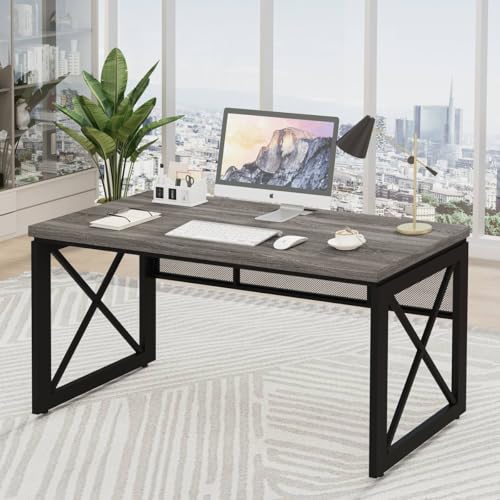
BON AUGURE’s desk occupies the roundup’s centre of gravity: sixty inches long, a sturdy metal frame by its title’s account, and a dark grey oak finish that is the calmest colour in this guide. Sixty inches is where a single workstation stops negotiating — a monitor and a laptop, or two monitors at a civilised spacing, with the notebook’s twelve inches still available — and the grey oak delivers that space in the register of a room that also contains a sofa, rather than the register of a workshop.
The finish deserves its paragraph because colour is this pick’s real argument. Rustic browns warm and darken; dark grey oak cools and quietens, and in the pale-walled, grey-sofabed reality of many home offices it is the finish that disappears into the room’s existing decisions instead of arguing with them. Buyers furnishing from scratch can go either way; buyers furnishing into a room that already exists should let the room vote, and in grey rooms this desk wins the vote before the dimensions are even discussed.
Beyond the finish, the proposition is the category’s standard one, plainly stated: rustic wood surface, sturdy metal under it, writing and working on top. The title publishes no load capacity and no depth, so the two figures join the pre-order checklist. Nothing about the desk reaches for a second job or a clever feature, and that restraint is its own recommendation for buyers who found the longer and louder picks exhausting — this is the industrial desk as background furniture, present, strong and quiet.
- Length: 60 inches
- Finish: dark grey oak
- Frame: sturdy metal, per the title
- Stated roles: home office writing and work table
- Depth: unstated in the title — consult the maker’s documentation
Strengths
- Sixty inches is the single-workstation size that ends negotiation.
- Grey oak coexists with pale, modern rooms better than rustic browns.
- A restrained, single-purpose design with no gimmicks to age badly.
Trade-offs
- No stated load capacity in the title.
- Grey finishes show dust more readily than mid-browns do.
- No storage, like the rest of the roundup — paper needs its own plan.
Best for: a worker furnishing into a grey, pale room that a rustic brown would argue with.
Not suited for: a warm-toned study where grey oak would sit like a stranger at the table.
Look at the BON AUGURE 60in desk on Amazon if sixty quiet inches in grey oak is the exact centre of your shortlist.

SXXjiaju 55in Solid Wood Desk — The real-wood purist
Five of this roundup’s tops are wood in finish; this one is wood in fact. The SXXjiaju’s title states solid wood and real wood twice over, and that material fact is the entire case for the desk. A solid top can be sanded when it scars, oiled when it dries, and repaired when a decade of mugs and monitor stands has written on it — it ages by acquiring a surface history rather than by peeling at the edges. For buyers who keep furniture for decades and distrust the whole concept of a finish film, this 55-inch desk is the only pick in the guide speaking their language.
The rustic brown tone and the metal frame keep it inside the industrial family visually, so the material upgrade does not cost the look. At 55 inches it is a one-person desk — a laptop or a single monitor with a notebook’s width to spare — and its modern simple design, per the title, suits the executive corner as readily as the study. Solid wood also brings a tactile difference no photograph conveys: the top is cool and dense under the forearms, and it sounds different when a mug lands on it, a small daily fact that owners of real wood mention with unreasonable affection.
The purist’s caveats are real wood’s own. Solid timber moves with the seasons and the heating, asks for coasters as a genuine rather than decorative discipline, and weighs more at assembly than its dimensions suggest. The title publishes no load figure and no depth. And 55 inches remains 55 inches: the material is an upgrade, the footprint is not. Buy this desk because you want the top to be timber for the next twenty years, not because you need more desk — for more desk, the length is elsewhere in this roundup.
- Length: 55 inches
- Top: solid wood, rustic brown, per the title
- Frame: metal, modern simple design
- Stated roles: home office, executive writing desk
- Load capacity: not specified in the title — verify it in the manufacturer’s documentation
Strengths
- The only solid-wood top here — sandable, oilable, repairable for decades.
- Industrial looks kept, with a metal frame under the timber.
- The cool, dense feel of real wood under daily work.
Trade-offs
- Solid wood wants coaster discipline and seasonal forgiveness.
- Heavier to assemble and move than its size suggests.
- Still 55 inches — material is upgraded, footprint is not.
Best for: a keeper of furniture who wants a top that can be refinished rather than replaced.
Not suited for: a renter who moves yearly and counts every kilogram at the staircase.
Check the SXXjiaju solid wood desk on Amazon if the word “solid” in a title is the one you have been scrolling for.

Tribesigns 63in Heavy-Duty Industrial Desk — The stated-strength pick
The second Tribesigns is the roundup’s heavyweight argument: 63 inches long, an extra-thickened tabletop, a metal frame, and — alone among the six — a load capacity stated in the title: 300 lb. That number changes the desk’s permitted life. Three hundred pounds is a dual-monitor setup, a desktop tower on the top rather than under it, a printer, a stack of reference books and an adult leaning on the front edge during a call, with margin. Every other pick here asks you to trust the architecture; this one publishes the arithmetic, and buyers whose setups are genuinely heavy should reward that with their attention.
The thickened top is the other half of the strength story. Thickness is what a long top uses to refuse the mid-span bounce that makes typing on lesser slabs feel like drumming on a boat deck, and it is also what gives monitor-arm clamps and shelf risers something substantial to bite. At 63 inches — three inches past the roundup’s 60-inch centre — the desk hosts two monitors and a laptop’s worth of sprawl, or one workstation plus the household’s second laptop, without the annexation drama of the 78.7-inch IBF.
The vintage brown and black palette is the warmest in the guide, and the title’s own room list — study, dorm, bedroom — is telling: this is a desk pitched at lived-in rooms rather than show offices. Its caveats are the category’s: no storage, no adjustment, and a weight at assembly that matches its intentions. But if the question at the top of your shortlist is “will it hold my setup, stated in writing,” this is the only desk in the roundup that answers in the title itself.
- Length: 63 inches
- Top: extra-thickened, per the title
- Load capacity: 300 lb, as stated in the listing title
- Finish: vintage brown and black
- Stated rooms: study room, dorm, bedroom
Strengths
- The only stated load capacity here — 300 lb of published reassurance.
- Thickened top resists mid-span bounce under heavy setups.
- 63 inches hosts dual monitors without annexing the whole wall.
Trade-offs
- Heavy to assemble and to move, by design.
- The warm vintage palette will not suit cool grey rooms.
- No drawers or storage beneath the slab.
Best for: a heavy setup — tower, printer, dual monitors — that wants its strength in writing.
Not suited for: a light laptop worker paying for capacity their work will never call on.
See the Tribesigns 63in heavy-duty desk on Amazon if the load figure is the first thing you look for in a listing.

HSH 60in Rustic Gray Industrial Desk — The living-room diplomat
HSH’s title reads like a room-by-room itinerary — living room, bedroom, study — and that itinerary is the design’s thesis: a 60-inch industrial desk in dark gray oak that can hold a workstation’s job without declaring itself office furniture in rooms that have other purposes. The metal-and-wood formula is the roundup’s standard one, but the styling leans Soho, per the title, which in practice means the proportions and finish are tuned to sit among sofas and bedframes rather than filing cabinets.
Sixty inches in a living room is a diplomatic size: long enough for a genuine workstation — monitor, laptop, the day’s paper — short enough to read as a console or writing table when the laptop closes. Households where the desk shares the room with the evening will feel the difference daily. The grey oak, like BON AUGURE’s, cools the industrial formula down; HSH’s dark gray oak pairs it with the explicit promise of size — “big long PC desk” in the title’s own words — for buyers who want the living-room manners without giving up workstation width.
The specification silence is the familiar one: no load figure and no depth in the title, both to be confirmed in the manufacturer’s documentation, and no storage under the top. Against the BON AUGURE — its nearest rival, same length, same grey family — the HSH’s case rests on its room diplomacy and styling rather than on any published mechanical difference, and buyers choosing between them should let the rooms they are furnishing cast the vote. In a dedicated study, either serves; in a living room that must forgive the desk nightly, this is the pick shaped for the forgiveness.
- Length: 60 inches
- Finish: dark gray oak, rustic gray
- Construction: metal and wood
- Stated rooms: living room, bedroom, study
- Load capacity: the title leaves this unspecified — the manufacturer’s documentation is the place to verify it
Strengths
- Styled and sized to live in living rooms and bedrooms, not only studies.
- Sixty inches keeps full workstation width behind the diplomacy.
- Grey oak finish calms the industrial look for shared rooms.
Trade-offs
- No load or depth figures published in the title.
- Diplomatic styling means a plainer presence in a dedicated office.
- No storage — shared rooms must hide work clutter elsewhere.
Best for: a living-room worker whose desk must clock off visually when the work does.
Not suited for: a dedicated study where a bolder, warmer statement piece was the point.
View the HSH 60in desk on Amazon if the desk’s hardest job is belonging in the room after hours.
Six Industrial Desks, Measured Against Each Other
| Pick | Length | Top material | Stated capacity | Defining trait |
|---|---|---|---|---|
| IBF Extra Long | 78.7 in | Wood finish, rustic brown | Not stated in title | Two workstations on one slab |
| Tribesigns 55in | 55 in | Rustic finish | Not stated in title | Doubles as a small conference table |
| BON AUGURE 60in | 60 in | Dark grey oak finish | Not stated in title | The calm grey centre of the range |
| SXXjiaju 55in | 55 in | Solid wood | Not stated in title | Real timber, repairable for decades |
| Tribesigns 63in | 63 in | Extra-thickened, vintage brown | 300 lb | Strength stated in the title |
| HSH 60in | 60 in | Dark gray oak finish | Not stated in title | Living-room diplomacy |
The table makes the category’s logic visible at a glance: one axis of length, one axis of material, and a single published strength figure. Most buyers should start at 60 or 63 inches and move only with a reason — down for a meeting-table double life or for solid wood, up for a second workstation. The finish decision, browns against greys, is the one you will see every day; the length decision is the one you will feel every day; the material decision is the one you will still be living with in twenty years.
Where Do the Tower, the Printer and the Rest of the Machine Live?
The industrial slab’s open frame quietly dictates a floor plan for everything that is not on the top. The tower PC belongs on the floor to the side — the side away from your feet’s swing — where the frame’s openness gives it air on all sides and the desk’s length keeps its cables short. Under the middle of the desk is the one bad address: knees, chair casters and the tower’s fans all want that territory, and only one of them can have it. A tower on the top is the alternative the Tribesigns 63in’s stated capacity explicitly permits, and it suits workers who swap drives and cables weekly; everyone else should keep the slab for the work and the floor for the machine.
The printer is the category’s longest-running negotiation. On the top, it eats the notebook’s territory and vibrates the slab during other people’s calls; under the top, it eats the legroom; in the hall, it becomes a shared household appliance with a walk attached. The honest answer for most home offices is a small separate stand or shelf — the industrial desk’s style forgives a companion piece, and a printer on its own furniture stops being the desk’s problem. Buyers whose census in the length section included the printer on the top should re-run the arithmetic with the printer housed separately and see whether a shorter, calmer desk emerges.
The rest of the machine — the router, the external drives, the charger’s brick, the headphone stand — collects at the top’s rear edge, and the long desks absorb that collection better than the short ones. This rear-edge colony is why depth, the dimension these titles mostly omit, matters out of proportion to its modesty: six extra centimetres of depth is the difference between a colony that lives behind the monitors and one that besieges them. Confirm the depth, house the printer separately, floor the tower to the side, and the slab stays what it was bought to be — a clear, strong, still place to work.
What Mistakes Do People Make When Buying a Fixed Desk?
The first is measuring the wall and not the room. A desk’s length is bought against a wall, but its life is lived in the room’s remaining floor: the chair’s roll-back, the door’s swing, the walkway behind the seated worker. A 78.7-inch desk in a room that leaves a corridor behind the chair is a triumph; the same desk sealing the room’s only path is a daily obstacle course. Sketch the floor plan with the chair occupied, not with the desk alone.
The second is assuming the chair will solve posture. A fixed desk is a fixed height, and the whole ergonomic burden — seat height, screen height, foot support — falls on everything that is not the desk. Buyers stepping down from an adjustable desk should budget the setup honestly: a chair that fits, a monitor stand or arm, possibly a footrest. The desk’s cheapness is real, but it is the slab that is cheap, not necessarily the workstation.
The third is forgetting the second purchase. No pick here stores anything, and paper, chargers and the day’s clutter will colonise the slab within a week unless a pedestal, a shelf or a drawer unit joins the order. Plan the storage at the same time as the desk, in the same finish family if the room cares, rather than discovering the need via a month of piles.
The fourth is buying length as insurance. Extra inches bought “in case” become the household’s dumping ground with a reliability that shorter desks never offer, because a short desk physically refuses the clutter. Buy the length your census of objects demands — the setup section’s arithmetic, done honestly — and let the desk’s limits do the tidying that willpower does not.
How Do You Choose Between the Two Tribesigns Desks?
Two picks share a maker and a surname, and the choice between them is the roundup’s most common head-to-head, so it deserves its own answer. The 55in is the social desk: compact, clean-legged, ready to host a small meeting with knee room on every side, and sized for one worker’s laptop-or-monitor setup in a room that has other duties. The 63in is the load-bearing desk: eight inches longer, a thickened top, and the stated 300 lb capacity that turns heavy setups from a hope into a specification. They are not a good-better ladder; they are two answers to two different first questions.
Ask the questions in order. Will other people sit at this desk, on its far side, with their knees under it? If yes, the 55in’s conference second life is worth more than eight inches. Will a tower, a printer and two monitors live on the top together, permanently? If yes, the 63in’s published capacity is the only reassurance in this guide that arrives in writing. If neither question bites — one worker, one screen, no meetings — the decision falls to the room: the 55in leaves a small room breathing, the 63in fills a larger one with intention, and either will be sat at happily for years. The wrong choice is buying the 63in’s strength for a meeting room, or the 55in’s sociability for a battlestation; the right one is simply the desk whose first question matches yours.
Final Recommendation
Start at the centre and move only with a reason. The Tribesigns 63in is the default recommendation for a heavy single workstation: the thickest top story, the only stated capacity in the roundup, and a length that hosts dual monitors without annexing the wall. The BON AUGURE and the HSH split the 60-inch grey vote between study-first and living-room-first rooms. Move down to 55 inches for the Tribesigns if the desk must host meetings, or for the SXXjiaju if the top must be timber. Move up to the IBF only when the census truly demands it — two workers, three screens, a craft that spreads. What none of these desks will do is change, and that is the purchase: a slab of wood on steel, bought once, at the length your work actually measures, still holding everything steady on the day the third laptop arrives to replace the second — furniture as the fixed point the rest of the setup revolves around. In a market addicted to features, the slab’s refusal to have any is the feature — and for the right room, it is enough.
Frequently Asked Questions
Is a fixed desk bad for posture?
A fixed desk is neutral; the workstation around it decides. With the chair set so your feet rest flat and your elbows sit near level with the top, and the screen raised to eye height on a stand or arm, a fixed desk supports a working day as well as an adjustable one set to the same geometry. What it cannot do is alternate — sitting is the only posture it offers, which is a preference question, not a defect.
How much weight can these desks hold?
Only one title here publishes a figure — 300 lb for the Tribesigns 63in. The others rely on the wood-and-steel architecture’s general reputation, and their capacities should be confirmed in the manufacturer’s documentation before a heavy setup — a tower and printer on the top — is committed to them. Ordinary laptop and monitor loads are the category’s home territory.
What is the difference between the wood finishes and solid wood?
A wood-finish top is a board wearing a wood-toned surface: consistent in colour, forgiving of spills, and repaired with difficulty once the surface is breached. A solid wood top — the SXXjiaju here — is timber through its thickness: it can be sanded, oiled and refinished, it moves slightly with the seasons, and it asks for coasters. Choose by how long you keep furniture and how your household treats surfaces.
Which length suits two monitors?
Sixty inches is the comfortable floor for two monitors plus a notebook’s working width; 63 inches adds breathing room, and 55 inches will host two screens only at the cost of everything else on the top. Two full workstations — two people, two setups — belong on the 78.7-inch IBF. Measure your monitors on their stands, not by their screen sizes, before deciding.
Do these desks come with cable management or storage?
No — the open industrial design omits both, deliberately. Cables are managed by the owner, usually with a strip mounted under the rear edge, and storage arrives as a separate pedestal or shelf. Buyers who want drawers integrated with the desk itself should look at desks designed around storage rather than around the slab.
Can an industrial desk work as a dining or meeting table?
The Tribesigns 55in claims the small-conference role in its title, and the open leg frames across this roundup leave knee room on all sides, which is the main requirement. Length decides the guest count; finishes decide whether the room believes it. In flats where one table must do everything, that double life is a genuine argument for the category.
Related Guides
The three guides below continue the desk decision in the directions this one deliberately did not go: rooms that reconfigure, desks that stand, and desks that store.
Keep reading: Best Classroom Computer Desks · Best Non-Wobbly Standing Desks · Best Standing Desks with Storage


