What's inside
- Key Takeaways
- Quick Picks
- How Did We Define “All Metal” for This Guide?
- Which All-Metal Cases Are Worth Your Money?
- How Do the Six Metal Cases Compare?
- What Should You Check Before Buying an All-Metal Case?
- How Do You Stop a Metal Case From Resonating?
- How Should You Care for Steel and Aluminium Panels?
- Why Has Glass Taken Over — and When Is Metal Still the Right Choice?
- What Are the Most Common Mistakes When Buying a Metal Case?
- Where Do All-Metal Cases Earn Their Keep in Real Life?
- How Does Panel Thickness Change What a Metal Case Feels Like?
- What Should You Know About Building Inside a Metal Case?
- How Long Do Metal Cases Really Last?
- Which Metal Case Fits Which Kind of Owner?
- Does an All-Metal Case Make Sense for a Gaming PC?
- What About Recycled Content and Repair — Does Metal Win There Too?
- How Do You Verify a Case Is Really All Metal Before It Arrives?
- Final Recommendation
- Frequently Asked Questions
- Related Guides
As an Amazon Associate I earn from qualifying purchases. This post may contain affiliate links at no extra cost to you.
widgetverdict.com is reader-supported. When you buy through links on our site, we may earn an affiliate commission.
Where to buy: The linked pick below goes to its Amazon listing; the remaining cases are covered as prose-only recommendations, so check your preferred retailer for the exact panel configuration before ordering.
Glass is beautiful, and glass is everywhere — which is precisely why the best all metal pc cases have become a specialist search. A metal case trades the showroom window for things a window cannot do: panels that shrug off knocks, a chassis that can be carried by its frame without a prayer, surfaces that do not shatter on a tiled floor, and a machine that keeps its dignity in a workshop, a studio or a child’s bedroom. Steel and aluminium also age differently from acrylic and glass. They dent rather than crack, scratch rather than spider, and can look honest after a decade of service.
Honesty about definitions matters in this guide, because “all metal” is a phrase marketing stretches. Almost every case ever sold has a steel frame; the question is what the visible, touchable surfaces are made of. Our standard for this list is strict: steel or aluminium exterior panels front, top and sides, a mesh or solid metal front rather than a plastic fascia dressed up to look like one, and plastic confined to feet, grommets, fan frames and the front-port surround. Cases with a tempered glass side were excluded even when the rest of the chassis was exemplary — a glass wall is many things, but it is not metal.
Key Takeaways
- True all-metal cases are rare because glass sells; expect steel mesh and solid steel panels rather than aluminium sculptures at sane prices.
- The ASUS Prime AP201 in mesh form is the easiest all-metal buy here — steel mesh wraps nearly the whole case.
- Steel is heavier than glass-and-plastic designs but far harder to break and easier to live with in rough environments.
- Check panel material in the specification, not the photos: many “metal” cases hide plastic front fascias.
- Metal panels can resonate; thicker steel and damped designs like the Pure Base 500 handle this best.
- Every pick uses standard motherboard formats, so the metal premium buys longevity rather than a dead end.
Quick Picks
| Pick | Badge | Why it earns its place |
|---|---|---|
| ASUS Prime AP201 (Mesh) | Best all-metal buy | Steel quasi-filter mesh wraps the case on nearly every side. |
| Cooler Master MasterBox NR400 | Best metal airflow value | A steel mesh front and steel panels in a compact, honest tower. |
| Fractal Design Define 7 | Most premium metal build | Dense steel construction with an aluminium front door and damping. |
| SilverStone FARA R1 | Lightest steel option | A simple steel chassis with a mesh front that is easy to move. |
| be quiet! Pure Base 500 | Quietest metal case | Solid steel panels with sound insulation for a hushed machine. |
| Fractal Design Define Mini C | Best small steel case | A compact solid-panel steel tower with damped, dense construction. |
How Did We Define “All Metal” for This Guide?
We started by disqualifying the two great impostors of this category. The first is the glass-sided case with a metal frame, which describes most of the modern market: whatever its other virtues, a build whose largest visible surface is glass is not an all-metal case, and including it would make this guide a lie with good SEO. The second impostor is subtler — the case whose front looks like brushed metal in photographs and turns out, on delivery, to be a plastic fascia with a metallic finish. Plastic fronts are not automatically bad products, but they are not what a reader typing this search wants to receive.
What survived had to meet the standard on every exterior face: front, both sides and top in steel or aluminium, with mesh counted as metal when the mesh itself is steel, as it is in the AP201 and the NR400. We then weighed the qualities that make metal worth choosing in the first place. Panel thickness and frame rigidity came first, because thin steel that oil-cans under a thumb delivers none of metal’s durability promise. Finish came second — powder coating that resists scratches, edges folded or rolled so they do not bite during a build. Airflow came third, because a sealed metal box is a durable oven, and the mesh-fronted picks here prove durability and breathing are compatible.
One linked pick and five prose-only recommendations is an unusual shape for our guides, and it reflects the market honestly: verified all-metal models are scarce enough that we would rather cover the right cases without links than pad the list with glass. Where a case exists in both glass and solid-panel versions — the Define 7 and Define Mini C are the famous examples — we mean the solid metal version, and we say so in its review. Check the variant before you buy; the glass twin is usually the one retailers photograph.
Which All-Metal Cases Are Worth Your Money?
The six below split into two families. The mesh family — AP201, NR400, FARA R1 — treats steel mesh as both armour and ventilation, and suits gaming hardware that needs to breathe. The solid family — Define 7, Pure Base 500, Define Mini C — treats steel panels as a shield against noise and the world, and suits work machines, shared spaces and anyone whose PC lives where life happens around it. Both families share the deeper promise of this guide: a case that will not be the first part of your build to fail, fade or embarrass you.
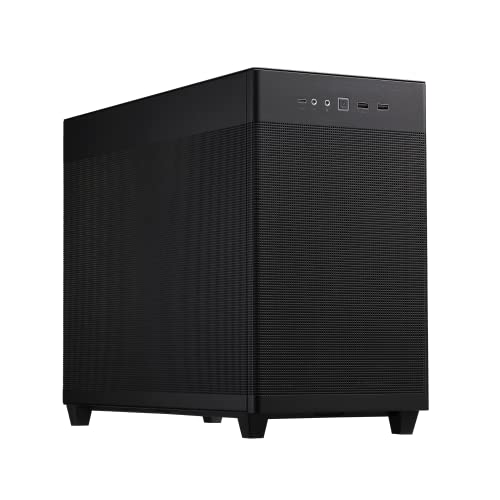
ASUS Prime AP201 (Mesh) — Best all-metal buy
The mesh AP201 is the most completely metal case in this guide in the way that matters day to day: nearly every surface your hands and eyes meet is steel. ASUS wrapped this 33-litre micro-ATX chassis in quasi-filter mesh panels — fine steel mesh that filters dust while it ventilates — so the front, sides and top are metal, breathable and tool-free to remove. There is no glass to baby, no acrylic to scratch, and no plastic fascia pretending to be something it is not. Pick it up and the impression is of a dense, single-material object, more appliance than ornament.
The metal construction serves the hardware rather than merely surviving it. Because the panels themselves are the ventilation, graphics cards up to about 338mm and radiators up to 360mm fit and breathe inside a case small enough for a shelf — clearances that embarrass larger glass towers. The mesh’s fine pitch does real filtering work, so the interior stays cleaner than an open-frame design, and when cleaning day comes the panels pop off without tools and can be brushed or rinsed and refitted in minutes. For a machine that will be moved, serviced and kept, that combination of armour and access is exactly why people search for metal cases.
The trade-offs are the honest shadows of its virtues. A mesh case shows its interior in silhouette and passes fan noise more freely than a damped solid case, so it rewards tidy cabling and sensible fan curves. It arrives with minimal fan hardware, trusting the panels to do the breathing, and hot builds should add a fan or two. And its compactness, while brilliant, still demands a planned build order. None of this dents its position: as an all-metal case you can buy today with total confidence in what it is made of, the AP201 stands alone at the top of this list.
- Form factor: micro-ATX, about 33 litres
- Panels: steel quasi-filter mesh, tool-free
- Graphics card clearance: up to about 338mm
- Radiator support: up to 360mm
- Glass content: none in this version
Strengths
- Steel mesh on nearly every surface — genuinely all-metal.
- Outstanding clearances for its footprint.
- Tool-free panels make cleaning and servicing effortless.
Trade-offs
- Mesh passes more noise than damped solid panels.
- Few fans included; hot builds should add one or two.
- Interior silhouette is visible through the mesh.
Best for: compact, powerful builds that need armour and airflow together. Not suited for: silence obsessives or anyone who wants a display-window build.
Cooler Master MasterBox NR400 — Best metal airflow value
The NR400 is the working mechanic’s answer in this guide: a compact tower whose front is a single broad sheet of steel mesh, whose side panel is solid steel, and whose entire design philosophy is that air and durability outrank decoration. Cooler Master built the NR series around unobstructed intake at a time when the industry was sealing fronts behind glass, and the NR400 remains one of the easiest recommendations in PC building for anyone who wants a metal case that cools like it means it. (A version with an optical drive bay exists for builders who still need one — a sentence that tells you everything about this case’s priorities.)
In use, the virtues compound quietly. The mesh front feeds fans without restriction, so mainstream and even fairly hot graphics cards hold their temperatures without fan heroics. The steel panels come off and go back on without flexing theatre, the interior layout is conventional in the best sense — everything where a builder’s hands expect it — and the whole object shrugs off the knocks of a working life: moved between rooms, serviced on a kitchen table, carried to a friend’s house. It is not light, but its weight is the honest kind, the weight of material rather than of ornament.
What it does not offer is theatre. There is no window, no lighting story, no design flourish to photograph; the front ports are workmanlike; cable space is adequate rather than generous. Builders who want their machine to look like anything other than a well-made tool should look elsewhere in this guide. But as a metal case bought for airflow per coin and years of uncomplaining service, the NR400 is the value anchor of the solid, sensible end of this market.
- Form factor: micro-ATX / ATX-class compact tower (check variant)
- Front: full steel mesh
- Side panel: solid steel
- Cooling focus: unrestricted front intake
- Variant note: optical-drive version available
Strengths
- Steel mesh front delivers genuine airflow.
- All-steel exterior with a tool-like build quality.
- Compact, conventional and easy to build in.
Trade-offs
- No window or lighting presentation at all.
- Cable room is adequate rather than generous.
- Styling is purely functional.
Best for: airflow-first builders who want steel everywhere and fuss nowhere. Not suited for: showcase builds or anyone who wants to see their components.
Fractal Design Define 7 — Most premium metal build
Specify the Define 7 with its solid steel side panel and you have the closest thing this market offers to a bank vault with fan mounts. Fractal’s Define line built its reputation on dense steel, sound-damping material bonded inside the panels, and an aluminium front door that opens with the kind of damped precision usually reserved for hi-fi equipment. The result is a case that feels less assembled than machined: heavy, silent in demeanour, and utterly indifferent to the chaos of the room around it. For a workstation, a recording space or a living-room machine that must disappear, this is the premium expression of what metal is for.
The engineering inside matches the exterior’s seriousness. The layout converts between an open configuration for airflow and a storage configuration with drive capacity that borders on the absurd, the top panel swaps between a solid damped cover and a ventilated one so you can choose your own balance of silence and cooling, and the build quality of small things — hinges, latches, the door’s swing — is the best in this guide by a distance. This is a case bought once and kept through platforms, and its weight and solidity are the physical form of that promise.
Its costs are literal and figurative. It is the heaviest case here and among the most expensive, its sealed-by-default configuration needs the ventilated top or an open door to cool genuinely hot hardware, and its sheer size swallows small desks. The glass-sided variant is the one most retailers push, so the solid-panel version must be specified deliberately. None of that argues against it for its intended owner: if your brief is a metal case as a long-term piece of equipment, the Define 7 is the benchmark the others are flattered to share a page with.
- Form factor: ATX / E-ATX-class tower
- Panels: steel with internal sound damping
- Front: aluminium door, reversible swing
- Top: interchangeable solid and ventilated panels
- Layout: convertible storage / open configurations
Strengths
- Densest, most refined metal construction here.
- Damped panels keep a powerful machine hushed.
- Convertible interior suits workstations and storage builds.
Trade-offs
- Heavy and large; measure your space first.
- Premium pricing among metal cases.
- Hot hardware needs the ventilated top configuration.
Best for: workstations, studios and keep-it-for-a-decade builds. Not suited for: tight budgets, small desks or frequent movers.
SilverStone FARA R1 — Lightest steel option
The FARA R1 answers a fair objection to this entire category: metal cases are heavy, and some machines need to move. SilverStone’s design keeps the all-steel promise — steel chassis, steel mesh front, solid steel side — while trimming the design to essentials so the finished case stays manageable to carry between home, office and events. The front mesh is generously open, the interior follows a clean modern layout with a power supply shroud, and the whole thing reads as a case designed by people who understood that “metal” and “minimal” are natural partners.
As a daily machine it behaves exactly as its specification suggests. Airflow through the mesh front is genuine, mainstream gaming hardware runs at sensible temperatures, and the steel panels take the knocks of a travelling life — the car boot, the office move, the LAN weekend — that would leave a glass panel in a bin bag. SilverStone’s long history in small and specialist cases shows in the details: the proportions are tidy, the panels seat cleanly, and nothing about the case feels like a larger design shrunk by an accountant.
The compromises are those of its weight class. Thinner steel than the Define 7 brings a little more flex and a little more resonance if fan curves are careless, the included hardware is minimal, and the interior is compact enough that long cards and big coolers need checking against the specification. It is a case for sensible hardware in a machine with an active life. Judged on that brief — all-metal, breathable, portable — the FARA R1 has few peers at any price.
- Form factor: ATX mid-tower
- Construction: steel chassis and panels
- Front: open steel mesh
- Interior: shrouded, modern layout
- Character: lightest all-metal pick here
Strengths
- All-steel build that stays easy to move.
- Mesh front keeps temperatures honest.
- Tidy proportions and clean panel fit.
Trade-offs
- Thinner steel than the premium picks.
- Minimal included fan hardware.
- Big components need clearance checks.
Best for: machines that travel — students, LAN players, shared spaces. Not suited for: maximum-size hardware or damping-focused silent builds.
be quiet! Pure Base 500 — Quietest metal case
Choose the Pure Base 500 in its solid-panel form and you get the introvert of this guide: steel panels lined with sound insulation, a design language of near-total restraint, and a single purpose — a powerful PC that does not announce itself. be quiet! built its name on the physics of silence, and this case applies the full treatment at a mainstream price: damped steel, a top cover that can be swapped between insulated and airflow versions, and fans from a company whose fan engineering is the reason the brand exists. In a bedroom, a home office or a recording corner, that adds up to the most civilised metal case here.
The metal construction is integral to the trick, not incidental to it. Dense steel panels resist vibration rather than amplifying it, the insulation absorbs the mid frequencies that make fan noise feel intrusive, and the sealed front — fed by considered side intakes — trades a little peak airflow for a great deal of calm. Mainstream gaming hardware runs perfectly well inside it; only the hottest builds, run in warm rooms with the insulated top fitted, will wish for the mesh-fronted picks instead. Knowing which side of that line your hardware sits on is the whole buying decision.
It will not suit everyone in this guide’s audience. There is no window in the version we recommend, the styling is deliberately anonymous, and builders chasing the lowest possible temperatures should take the NR400’s mesh over this case’s hush every time. But for the substantial audience that wants metal’s durability and silence’s mercy in one object, the Pure Base 500 is the most complete answer we know at its price.
- Form factor: ATX mid-tower
- Panels: steel with sound insulation (solid version)
- Top: interchangeable insulated / airflow covers
- Fans: be quiet! units included
- Character: silence-first metal design
Strengths
- Damped steel panels deliver real quiet.
- Quality fans included from a silence specialist.
- Restrained design suits bedrooms and offices.
Trade-offs
- Sealed front limits peak airflow.
- Solid version offers no view of the build.
- Anonymous styling will bore some buyers.
Best for: quiet rooms, work machines and light sleepers. Not suited for: the hottest hardware or showcase builders.
Fractal Design Define Mini C — Best small steel case
The Define Mini C takes the Define philosophy — dense steel, damped panels, zero theatre — and compresses it into a micro-ATX tower for builders whose space is limited but whose standards are not. In its solid-panel form it is steel on every face, insulated against noise, and built with the same panel fit and frame rigidity that make its big sibling feel like equipment rather than packaging. On a small desk or under it, the Mini C is the metal case that behaves like a piece of furniture: present, quiet and uncomplaining.
Inside, the compression is intelligent rather than merely tight. The shrouded layout keeps the visible chamber clean, airflow is directed with the help of Fractal’s fan placement, and the case accepts graphics cards and coolers sized for real gaming builds rather than apologetic ones. Sound damping in a small case earns its keep double, because a compact machine usually lives closer to its owner’s ears — on the desk, in the bedroom, beside the television. The Mini C’s whole design seems to understand the rooms it will live in.
Its limits are the family’s limits in miniature: weight is substantial for the size, the sealed panels ask for sensible hardware choices, and the glass variant is again the one most listings will try to sell you, so the solid steel version must be chosen on purpose. Expansion beyond micro-ATX is obviously out. Within its brief, though — small, steel, silent, serious — the Define Mini C closes this guide’s list as the compact counterpart to the Define 7’s full-size statement.
- Form factor: micro-ATX tower
- Panels: steel with sound damping (solid version)
- Interior: shrouded, tidy layout
- Character: compact Define formula
- Variant note: choose solid panel, not glass
Strengths
- Dense, damped steel in a compact footprint.
- Quiet manners for desk and bedroom use.
- Accepts genuinely capable gaming hardware.
Trade-offs
- Heavy for its size.
- Sealed design needs sensible hardware choices.
- Micro-ATX ceiling on expansion.
Best for: small desks that still want a serious, quiet machine. Not suited for: ATX builds or maximum-airflow gaming rigs.
How Do the Six Metal Cases Compare?
| Case | Size | Exterior material | Front style | Character |
|---|---|---|---|---|
| ASUS Prime AP201 (Mesh) | Micro-ATX, 33L | Steel mesh | Full mesh | Armour that breathes |
| Cooler Master NR400 | Compact tower | Steel | Steel mesh | Airflow workhorse |
| Fractal Design Define 7 | Full-size tower | Steel + aluminium door | Solid, damped | Premium vault |
| SilverStone FARA R1 | ATX mid-tower | Steel | Steel mesh | Portable steel |
| be quiet! Pure Base 500 | ATX mid-tower | Damped steel | Solid, insulated | Silence first |
| Fractal Design Define Mini C | Micro-ATX | Damped steel | Solid | Compact and hushed |
What Should You Check Before Buying an All-Metal Case?
Verify the material of every panel in the written specification, because photography lies fluently in this category. Look for the words steel or aluminium attached to the side panels and front specifically; a listing that says “metal frame” and goes quiet about the panels is telling you the answer. Check the variant name character by character — TG, Glass and Window in a model name mean the version in the basket is not the version this guide recommends, and the solid-panel twins of famous cases are frequently the harder ones to find in stock.
Weigh the machine, literally. A metal case’s weight is information: substantial steel reads as density and damping, and the Define-class cases are heavy because their panels are thick enough to resist resonance. But weight is also a commitment if the PC travels, which is why the FARA R1 exists in this guide. Match the mass to the life — a static workstation can wear the vault; a student machine that moves twice a year should wear the SilverStone.
Finally, plan the airflow honestly. Solid metal panels do not breathe, so a solid case must be fed by designed intakes and fans that suit them, and its cooling ceiling is lower than a mesh case’s. That is a fair trade for silence and armour with mainstream hardware, and a poor one for a flagship card in a warm room. The mesh picks exist for the hot builds; the solid picks exist for the calm rooms. Buying across that line — a sealed case for hot hardware, a mesh case for a recording studio — is the one real mistake this category offers.
How Do You Stop a Metal Case From Resonating?
Metal’s one acoustic vice is resonance: a large, thin panel is a drum skin waiting for a fan’s vibration or a drive’s hum to excite it. The damped picks in this guide solve it at the factory with insulation and mass, but any metal case can be civilised with a few habits. Start at the source — mount fans with the rubber or silicone fittings most cases and fan packs include, and never overtighten a fan screw into a panel, because a fan bolted hard against steel couples its vibration straight into the drum.
Set fan curves with resonance in mind. Many cases have a narrow speed band where a panel sings; a curve that passes through that band rather than parking on it removes the drone without removing the cooling. Keep the case on a solid surface, with all four feet in honest contact — a rocking case is a resonating case — and if a side panel still buzzes under load, a strip of the foam tape sold for draft-proofing, applied inside the panel’s edge, is the oldest and cheapest cure in PC building. Metal rewards this small attention with a solidity no plastic case can imitate.
How Should You Care for Steel and Aluminium Panels?
Metal cases forgive a great deal, but they keep receipts. Powder-coated steel — the finish on most picks here — wants nothing exotic: a soft cloth, mild soapy water for fingerprints, and drying afterwards so moisture never sits in seams or screw heads. Avoid abrasive pads, which cut through the coating and invite the rust that coated steel otherwise never meets. In humid rooms or coastal air, that coating is the case’s whole defence, so treat scratches that reach bare metal with a dab of clear lacquer or matching paint before the season turns.
Aluminium, where it appears on doors and trim, is softer and prouder: it scratches more easily than steel and shows it brightly, but it never rusts, and its scratches can be softened with careful polishing if they offend you. Mesh panels — the AP201’s skin, the NR400’s face — want a brush and, when truly clogged, a rinse and a thorough dry; their enemy is not damage but blockage, because a mesh panel at half its open area is a solid panel with none of solid’s excuses. Care for metal this way and it returns the favour for a decade: no yellowing plastic, no crazed acrylic, no glass to explain to a landlord.
Why Has Glass Taken Over — and When Is Metal Still the Right Choice?
Glass won the market for honest reasons: components became beautiful, lighting became a hobby, and a window sells both in a single photograph. For a static showpiece build in a safe room, glass is a legitimate pleasure and this guide begrudges nobody it. But the market’s swing left real needs unserved, and they are the needs this page exists for. Metal is the right choice when the machine is carried, knocked, stacked, serviced by other people, or installed where a shattered panel would be a safety issue rather than an inconvenience — workshops, classrooms, studios, children’s rooms, site offices and shared houses all qualify without stretching the definition.
Metal is also the right choice when the build’s value is in its service rather than its display: the home server that lives in a cupboard, the studio workstation that must be silent and invisible, the family PC that will be opened by three generations of curiosity. And it is the right choice for the long view, because a steel case’s failure modes are slow and repairable while glass’s are instant and total. Choose metal when the case is equipment. Choose it, in other words, for most of the machines most people actually live with.
What Are the Most Common Mistakes When Buying a Metal Case?
The first is buying the photograph: ordering a case whose listing showed a brushed-metal front and receiving a plastic fascia with a metallic paint, because the specification’s material line went unread. The second is its twin — ordering the glass variant of a case this guide recommended in steel, because the solid version shared a product page and the variant selector defaulted to the prettier twin. Both mistakes are prevented by the same thirty seconds of reading, and both are miserable to reverse once the build is done.
The third mistake is assuming metal means silent, or metal means cool, when it guarantees neither. A thin steel case can drum like a kettle and a sealed steel case can cook like an oven; the properties live in the thickness, the damping and the intake design, not in the material’s name. That is why this guide separates its mesh family from its solid family so deliberately. Match the metal to the mission — mesh for heat, damped solid for hush, portable steel for travel — and the material will keep every promise it made.
Where Do All-Metal Cases Earn Their Keep in Real Life?
Picture the machine in a school IT room, serviced by whoever is free, opened on a desk edge, carried down corridors twice a term. Glass does not belong there, and neither does a plastic fascia that cracks the first time a trolley clips it. Steel belongs there, which is why education and office fleets quietly never left metal even as the consumer market went to glass. The NR400 and the FARA R1 are the domestic versions of that fleet logic: cases that assume the world is careless and plan accordingly.
Now picture the workshop or garage build — the PC that runs the CNC, the parts catalogue or the music in a room with dust, vibration and the occasional elbow. A metal case shrugs off the environment that would sandblast acrylic and endanger glass, and its panels can be wiped down with the same cloth as the bench. The recording studio makes the opposite demand with the same answer: the Define 7 and Pure Base 500 earn their place there not despite being sealed steel but because of it, their damped mass standing between the microphones and the machine.
And picture the family PC in a shared house, where the case will be vacuumed around, knocked by toys, opened by a curious teenager and moved for every redecoration. That machine’s case is not a display object; it is protective equipment for everything inside it. Metal’s real-life case is simply that most computers live in the world rather than in photographs, and the world is made of knocks. Choose the material that matches the room, and the case stops being a risk you manage and becomes the protection it was always supposed to be.
How Does Panel Thickness Change What a Metal Case Feels Like?
Run a thumb across the side panel of a cheap case and press: the flex and faint oil-can pop you feel is thin steel telling the truth about itself. Panel thickness is the single specification that separates metal as a material from metal as a marketing word, because nearly every virtue in this guide scales with it. Thick panels resist dents, refuse to resonate, seat into their frames with a machined finality and make a case feel like one object rather than a kit of tins. Thin panels deliver the checklist — steel, tick — and none of the experience.
Manufacturers rarely print the gauge, so judge by proxy. Weight is the most honest proxy available: within a size class, the heavier steel case almost always carries the thicker panels, which is why the Define family’s heft is a feature and not an embarrassment. Review language is the second proxy — “dense”, “rigid” and “no flex” are the words that matter, while a review praising only a case’s looks is telling you where its budget went. Your own hands are the final proxy if you can reach a display model: press the panel, swing the door, work the latches.
This is also where the mesh picks play a cleverer game than they first appear to. A fine steel mesh panel, like the AP201’s skin, gains stiffness from its own geometry — hundreds of tiny pressed forms resist flex the way corrugation stiffens cardboard — so a mesh case can feel remarkably solid at a weight where a flat thin panel would feel like a biscuit tin. Material, thickness and form together decide the truth of a metal case; the word “steel” alone decides nothing.
What Should You Know About Building Inside a Metal Case?
Building in metal is a tactile pleasure with two small disciplines attached. The first is edges: quality cases fold, roll or deburr every edge, and all six picks here are safe to work in bare-handed, but the habit of running a fingertip lightly along a new tray before you start will tell you in seconds what class of case you bought. The second discipline is screws. Steel threads reward a screwdriver that fits and punish cross-threading permanently, so start every screw by hand, and treat resistance as information rather than a challenge.
Grounding and static follow their usual rules, with one metal-specific comfort: a steel chassis is an excellent earth path once the power supply is fitted and plugged in, so touching the frame genuinely discharges you — a small, real advantage over working inside plastic-rich cases. Cable management in solid-panel cases carries one extra consideration, which is that there is no window to forgive you and no window to reward you either; route for airflow and service access, not for an audience, and enjoy the peculiar freedom of a build only you will ever see.
Finally, mind the panels themselves during the build. A steel side panel leaned against a wall stays where you put it and forgives the lean; that is the whole point of the material. Set the panels somewhere they will not be stepped on — steel bends where glass breaks, and a bent panel is a panel that never quite seats again. Work with the material’s strengths and a metal case build is the calmest build there is: nothing fragile is ever in your hands.
How Long Do Metal Cases Really Last?
Ask the fleets. Offices and schools run steel cases for a decade and retire them for their ports, not their panels, and the domestic metal case inherits that entire lifespan. The components that age out of a case are standardised and replaceable — fans, filters, front-port boards on supported brands — while the structure itself has no known expiry: steel does not yellow in sunlight, fatigue under its own weight, or craze into a web of fine cracks the way ageing acrylic does. A powder coat may polish where hands touch it daily, and that is called patina on every other metal object you own.
Compare the failure clocks honestly. Glass fails instantly or not at all. Plastic fascias fade, embrittle and snap their clips one by one across the years. Thin steel dents and drums. Thick steel, damped steel and steel mesh — the three forms in this guide — simply continue, which is why the second-hand market is full of decade-old steel towers still in service and why “my old case” is so often a metal one. If your measure of a purchase includes the year 2035, this category is not a niche. It is the default that fashion interrupted.
Which Metal Case Fits Which Kind of Owner?
The practical buyer with a gaming build and no patience for fragility should start at the NR400, whose steel mesh front delivers the cooling of a modern airflow case with none of the window’s worries, or at the AP201 if the machine must also be small — the ASUS is the one pick here that a landlord, a parent and a LAN party would all approve of simultaneously. Between them they cover the mainstream of this category: metal as the sensible default rather than a specialist indulgence.
The quiet professional — the editor, the musician, the developer on calls all day — belongs to the damped family. The Pure Base 500 is the accessible entry, a case whose silence is engineered rather than hoped for; the Define 7 is the full commitment, bought when the machine is infrastructure and its decade of service is planned rather than accidental; the Define Mini C is the same argument at bedroom scale. All three ask the same question — how hot is your hardware, honestly — and reward an honest answer with years of calm.
The mover — the student between houses, the player whose machine lives in a car boot on weekends, the family whose PC migrates between rooms — should take the FARA R1 and its lighter steel, because the best case is the one that arrives intact. And the keeper, the buyer who resents replacing anything that still works, can choose any case on this page with confidence, because longevity is the one property all six genuinely share. Metal is a temperament as much as a material: it belongs to people who buy objects to keep them.
Does an All-Metal Case Make Sense for a Gaming PC?
It is the question this category is always asked, because gaming culture adopted glass so completely that a windowless gaming machine now reads as a statement. The practical answer is that the game cannot tell the difference. Frame rates are set by silicon and cooling, and the mesh family in this guide — AP201, NR400, FARA R1 — cools gaming hardware exactly as well as the glass-sided cases built on the same airflow principles, because their fronts are the same open area rendered in steel instead of plastic trim. What changes is everything around the game: the knocks survived, the noise contained or released, the machine’s odds of reaching its fifth year unbroken.
There is even a sense in which metal suits gaming’s real habits better. Gaming PCs are the machines most often carried — to friends, to events, between home and university — and the most often upgraded, which means their panels are removed more than any other category’s. Steel panels tolerate that life; glass tolerates it until it doesn’t. The player who has watched a side panel shatter on a driveway does not need this paragraph explained twice.
Choose glass when the build is a settled showpiece in a safe room and the view genuinely gives you pleasure — that is a real good, and this guide does not begrudge it. Choose metal when the machine works for a living, travels, shares its room with life, or is simply expected to last. Most gaming PCs, described honestly, do at least two of those things.
What About Recycled Content and Repair — Does Metal Win There Too?
Mostly, yes, and by a wider margin than buyers expect. Steel is the most recycled material in the industrial world, and a steel case at the end of its life enters that stream completely and profitably — magnets do the sorting, and nothing about a powder-coated panel prevents it. A glass-and-plastic case, by contrast, is a bonded mixture of materials that recycling handles poorly and landfill handles forever. If the machine’s whole lifecycle matters to you, the metal case is the only pick in the wider market whose ending is as tidy as its beginning.
Repair tells the same story during the case’s life rather than after it. A bent steel panel can be straightened well enough to seat; a dented door still closes; a stripped hole can be re-tapped or fitted with a larger screw by anyone with basic tools. Glass offers no repair state between perfect and replaced, and plastic clips fail in a way that glue rarely forgives. Add that fans, filters and feet are standard and replaceable across all six picks here, and the metal case emerges as the only design in its class that assumes it will be maintained rather than discarded. That assumption, compounded across a decade, is worth more than any single feature in this guide.
How Do You Verify a Case Is Really All Metal Before It Arrives?
Read the specification’s material lines for each panel separately — front, sides, top — and treat any panel the listing declines to describe as plastic until proven otherwise. Then cross-check the model’s own page on the manufacturer’s site, where the variant table usually states panel materials with a precision retailers blur, and confirm the exact variant code of the solid version, because the glass twin frequently shares the same product name with a two-letter suffix doing all the work.
Use weight as your lie detector. A genuinely all-steel tower of a given size lands in a predictable weight band, and a suspiciously light “metal” case is telling you its panels are thin, its fascia is plastic, or both. Finally, scan owner photographs rather than renders: real steel mesh shows its weave at glancing angles, real aluminium doors show their edge thickness, and real owners mention panel material constantly, because it is the reason they bought the case. Three minutes of this diligence is the entire cost of certainty in this category.
A closing note on expectations: an all-metal case will not photograph like the glass builds that dominate social feeds, and it is not trying to. Its satisfactions arrive on a different schedule — the panel that survives the house move, the door that still swings true in year six, the machine that can be handed down without a warning about the side window. Buyers who measure a case by its first week will always choose glass. Buyers who measure by its fifth year keep arriving at this page, and the six cases above are waiting for them with nothing to hide and nothing to shatter.
It is worth saying plainly that none of the six picks asks you to sacrifice a modern build to earn its material. Motherboard standards are current, radiator and card clearances match the hardware people actually buy, front connectivity is respectable, and the fans — where included — are standard sizes you can replace in minutes years from now. The all-metal brief, in other words, no longer requires nostalgia or compromise. It requires only that you read the variant name carefully and choose the family, mesh or solid, that matches the room the machine will live in.
Final Recommendation
Buy the ASUS Prime AP201 in mesh if you want one confident answer: it is the most completely metal case here, it breathes through its armour, and it fits hardware that shames larger boxes. Take the NR400 for airflow value in steel, the FARA R1 if the machine must travel, and the Define 7, Pure Base 500 or Define Mini C when silence and density matter more than the last degree of cooling. Whichever you choose, verify the solid-panel variant at the listing, and you will own the rare modern case that is exactly what it appears to be — metal, all the way through, built to be kept.
Frequently Asked Questions
Are all-metal PC cases heavier than glass ones?
Usually, yes — steel is dense, and the damped cases here add insulation mass on top. Expect a solid steel tower to outweigh a comparable glass-and-plastic design noticeably. The exceptions are mesh designs like the AP201 and lighter steel cases like the FARA R1, which keep weight sensible by using material only where it works.
Do metal cases cool worse than mesh-front glass cases?
Metal is not the variable — the front panel is. The mesh picks in this guide (AP201, NR400, FARA R1) cool as well as any glass-sided mesh case, because their fronts are open steel. Solid-panel metal cases trade some peak airflow for silence and protection, which suits mainstream hardware perfectly well.
Can a metal case be quieter than a glass case?
Yes, and the quietest cases in this guide prove it. Dense, damped steel blocks and absorbs sound that glass simply passes, and a solid steel panel has no seams of light or air around a window. The Pure Base 500 and the Define pair are quieter than almost any glass case at their prices.
Does aluminium matter, or is steel enough?
Steel is enough for almost everyone: it is stronger, cheaper and easier to damp. Aluminium earns its place in doors and trim — the Define 7’s front is the example here — where its lightness makes a large moving panel feel precise, and in premium designs where its finish is the point. Do not pay an aluminium premium for a frame you will never touch.
Will a steel case rust?
The powder coating on modern steel cases makes rust a non-issue in normal rooms. It becomes worth thinking about only if the coating is scratched through to bare metal in a humid environment — and even then, touching up the scratch with lacquer or paint closes the question. Aluminium panels, where fitted, cannot rust at all.
Why are there so few linked picks in this guide?
Because genuinely all-metal cases — steel or aluminium on every exterior face, no glass — are scarce, and our verified pool contained one that met the standard: the mesh AP201. Rather than dilute the definition with glass-sided cases, we covered the other five as prose-only recommendations. Check the solid-panel variant carefully wherever you buy them.
Related Guides
Continue with our other case roundups: best pc cases for airflow, best quiet pc cases and best micro atx pc cases.
Related guide: Best NZXT PC Cases
Related guide: Best Cooler Master PC Cases



[…] dust filtration, while anyone working to a strict case budget will find the companion roundup of the best PC cases around a hundred dollars useful. If your build leans the other way entirely, toward a screen-integrated all-in-one style […]