What's inside
- Where to Buy
- Key Takeaways
- Quick Picks
- How These Picks Were Chosen
- Comparison
- How to Choose a USB-C Portable Monitor
- Will One Cable Really Run a Portable Monitor From Your Laptop?
- Does Refresh Rate Matter on a Screen You Carry in a Bag?
- What Should You Test During the First Trip With a New Portable Screen?
- Common Mistakes When Buying a Portable Monitor
- Final Recommendation
- Frequently Asked Questions
- Related Guides
As an Amazon Associate I earn from qualifying purchases. This post may contain affiliate links at no extra cost to you.
[SITE_DOMAIN] is reader-supported. When you buy through links on our site, we may earn an affiliate commission.
Where to Buy
All six screens below are sold on Amazon, and each name here leads to its own listing. The MNN Portable Monitor 15.6-inch is the natural first click for anyone pricing a straightforward one-cable second screen, so look at its Amazon page to see today’s figure before weighing it against the rest. Anyone drawn to the KYY Portable Monitor 15.6-inch should open its listing and confirm the cover version shown there, since that bundled cover is half of its travel argument. The ASUS ZenScreen MB169CK carries the most recognisable brand name in the set, and its product page is where its current cost sits. Gamers will want the ARZOPA Z1FC 144Hz Portable Monitor page open in a second tab, because its refresh rate only matters if the number attached to it still looks sensible. The Lenovo L15 Portable Monitor rewards a slower read of its listing, where the stand and brightness details live. Finally, the MSI Pro MP165 E6 closes the set, and its page carries the tripod mount detail that photographs never quite explain.
Shoppers hunting for the best usb type c portable monitors usually want one thing above all: a second screen that runs from a single cable plugged into a laptop, with no power brick, no dock and no negotiation at the hotel desk. Every pick in this guide answers that wish in its title, yet the six answers differ in the details that decide daily happiness — refresh rate, brightness, stand design, colour coverage and whether a speaker or a protective case rides along. This guide reads those titles literally. Where a title states a figure, the review uses it. Where a title stays silent about something a buyer might assume, such as a charging wattage or a DisplayPort alt-mode line, the spec box records the silence in plain words rather than upgrading the screen on the manufacturer’s behalf.
A portable monitor also lives a harder life than a desk panel. It gets slid into laptop sleeves, propped on café tables, tilted against train windows and asked to work in rooms whose lighting nobody chose. That is why the reviews below keep returning to stands, covers and panel behaviour in bright rooms, and why a modest specification with a good kickstand can beat a flashier panel that wobbles on every surface. Weight and thickness figures, notably, appear in almost none of these titles, so treat any claim about a screen being the lightest here as marketing weather rather than measurement, and check the listing page if grams genuinely decide your purchase.
One more framing point before the picks themselves. A USB-C portable monitor is only as capable as the port it plugs into: the laptop’s port must carry a video signal for a one-cable setup to work at all, and a phone or console connected over the same cable may behave differently from the laptop you tested at home. The reviews assume a modern laptop with a video-capable USB-C port as the home base, then note where a title names extra hosts — a Switch, a PS5, an Xbox — as part of its stated audience.
Key Takeaways
- All six titles name USB-C, and five of the six also name HDMI, so every pick can serve a laptop over one cable and most can serve a console or older machine as well.
- Only one pick breaks the 60Hz pattern in its title: the ARZOPA Z1FC, which states 144Hz and a 16.1-inch panel.
- Brightness is stated in exactly one title — the Lenovo L15 at 250 nits — so the other five spec boxes record that figure as unstated rather than guessed.
- Stand design varies more than panel size: a 360-degree kickstand on the ASUS, a height-adjustable stand on the Lenovo, smart cases and covers elsewhere.
- Two picks name speakers in their titles, the KYY and the MSI, which matters for travellers who present or watch video without headphones.
Quick Picks
| Pick | Badge | Why it earns a place |
|---|---|---|
| MNN Portable Monitor 15.6-inch | One-cable starter | 15.6-inch FHD IPS with HDR, USB-C one-cable wording and a smart case in the title. |
| KYY Portable Monitor 15.6-inch | Cover-and-speaker traveller | FHD IPS with USB-C and HDMI, HDR, a speaker and a cover named in the title. |
| ASUS ZenScreen MB169CK | Kickstand design pick | Dual USB-C, a 360-degree kickstand and an anti-glare IPS panel from the ZenScreen line. |
| ARZOPA Z1FC 144Hz Portable Monitor | High-refresh outlier | 16.1-inch 144Hz panel with HDR and 106% sRGB stated in the title. |
| Lenovo L15 Portable Monitor | Stand-and-comfort pick | 250 nits, 60Hz, flicker-free wording and a height-adjustable stand in the title. |
| MSI Pro MP165 E6 | Tripod-mount flexibility | USB Type-C and HDMI, built-in speakers and tripod mount support in the title. |
How These Picks Were Chosen
The first filter was the port itself. A guide to USB-C portable monitors has no business including a screen that needs a separate power supply and a mini HDMI cable as its primary connection, so every survivor had to name USB-C in its title. That rule sounds obvious, yet it removes a long tail of portable displays that market themselves as travel screens while quietly depending on a wall outlet. The six that remain can all plausibly run the one-cable routine from a suitable laptop port, which is the experience the keyword promises.
Panel honesty came second. Each title here states 1080P or FHD, and each names IPS or prints enough panel language to describe the viewing experience without inventing a panel type. Where a title adds a colour figure — the ARZOPA’s 106% sRGB is the only percentage in the set — the review repeats that figure as printed. Where a title adds HDR, the review notes it as an HDR claim in the title’s own wording, because a portable panel’s HDR label and a television’s HDR performance are different animals and conflating them helps nobody.
The third pass looked at the physical object: how the screen stands up, what protects it in a bag, and what else it does besides display a picture. A 360-degree kickstand, a height-adjustable stand, a smart case that folds into a prop, a sleeve-style cover and a tripod mount all appear across these six titles, and those differences turn out to matter more on the road than a spec-sheet tie in resolution. A portable monitor that cannot hold its angle on a wobbly table fails at its only job, regardless of how good its panel is.
Finally, the set was balanced across intentions. One pick chases refresh rate for portable gaming, one chases stand ergonomics for long work sessions, one leans on brand and build, and the rest compete as honest all-rounders at the mainstream 15.6-inch size. A reader finishing this guide should be able to explain why each of the six exists, because a line-up of six near-identical screens would make the comparison table an exercise in coin-flipping.

MNN Portable Monitor 15.6-inch — One-cable starter
The MNN opens the guide because its title reads like the category’s founding promise: a 15.6-inch 1080P portable monitor on an IPS panel, with USB-C and HDMI, HDR, and the phrase one-cable attached directly to its USB-C connection. That wording is doing real work. It tells a traveller that the screen expects to draw both picture and power from the laptop’s port, which is the entire convenience argument for this class of product, and it tells them in the title rather than in a footnote three screens deep.
The stated audience is broad — PC, Mac, phone and Switch are all named — and the title adds a smart case and a low blue light mention. The smart case matters more than its two words suggest, because a case that folds into a stand removes the separate prop a bare panel needs, and a case that merely protects still earns its place in a bag that gets thrown into overhead bins. Low blue light wording signals an eye-comfort mode aimed at the evening spreadsheet session, though like all such modes it is a setting to try rather than a medical claim to lean on.
Who it suits is the first-time portable-monitor buyer who wants the standard recipe without a speciality surcharge: 15.6 inches to match a mainstream laptop, FHD resolution so text stays familiar, and two input families so the screen can moonlight with a console or a phone. Its silences are equally clear. The title states no refresh rate beyond what a reader might assume, names no speaker and prints no brightness figure, so anyone whose shortlist depends on those three items should treat the listing page as required reading and this screen as a maybe until they confirm them there.
- Size and resolution: 15.6 inches, 1080P FHD
- Panel type: IPS, HDR stated
- Inputs: USB-C (one-cable wording), HDMI
- Stated hosts: PC, Mac, phone, Switch
- Case: smart case included per title
- Eye comfort: low blue light mentioned
- Refresh rate: Not stated in the listing title — verify with the manufacturer documentation
- Brightness: Not stated in the listing title — verify with the manufacturer documentation
- Speakers: Not stated in the listing title — verify with the manufacturer documentation
Strengths
- The one-cable USB-C promise is printed in the title itself.
- A smart case is included, covering both protection and propping duties.
- PC, Mac, phone and Switch are all named as hosts.
Trade-offs
- No refresh rate figure appears in the title.
- No brightness figure appears in the title.
- No speaker is named, so audio likely routes through the laptop.
Best for: a first portable screen for a 15.6-inch laptop, carried in the same bag and run from one cable at desks, kitchens and hotel rooms. Not suited for: a bright-room shortlist that needs a confirmed 250-nit-class brightness figure before ordering, because this title never prints one and the Lenovo below is the pick that does.
Practical ownership of the MNN starts with the cable habit. Use the cable that arrives with the screen for the first week rather than the prettiest braided spare in your drawer, because portable monitors are fussy about which USB-C leads carry video reliably, and a known-good cable removes an entire category of flicker complaints. Learn the smart case’s fold positions at home, on a steady table, instead of debuting them on a departure-lounge bench. If the one-cable routine works at your desk, it will work anywhere the laptop’s port behaves the same way. When you are ready to order, glance at the MNN’s Amazon page for today’s number and match the 15.6-inch size against your laptop before the box ships.
KYY Portable Monitor 15.6-inch — Cover-and-speaker traveller
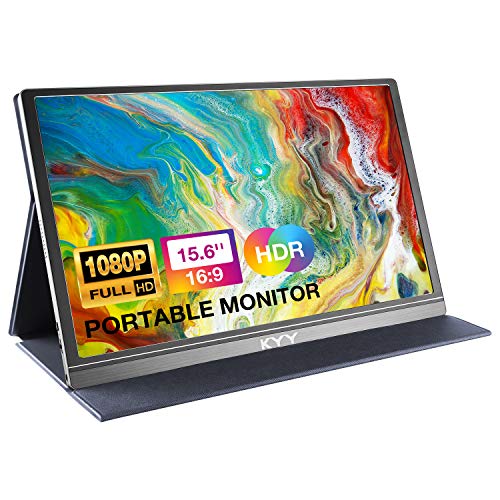
KYY’s entry describes itself with an unusually honest double identity: a 15.6-inch 1080P computer monitor and a screen extender, sold with a cover. The extender framing matters because it names the dominant real-world use — a laptop’s second display for documents, chat windows and reference material — rather than pretending every portable screen is a gaming panel in exile. The title then fills in the working specification: FHD IPS, USB-C and HDMI, HDR, and a speaker, which is one more built-in than most of this set can claim.
The speaker deserves its sentence. Portable monitors are routinely silent or nearly so, which is fine at a desk with laptop speakers nearby and genuinely annoying when the screen becomes the presentation display for a small room or the evening video screen in a hotel. A title that names a speaker outright is promising that the screen can carry sound on its own, and for travellers who show work to two or three people at a time, that promise can outweigh a spec-sheet advantage elsewhere. Volume and quality remain unquantified in the title, so expectations should stay at the level of audibility rather than cinema.
The cover completes the travel argument. KYY sells this screen with its cover as part of the product rather than as an accessory hunt afterwards, and a cover on a portable monitor usually doubles as the stand, which means the angle range of your working setup is partly decided by fabric and magnets. That arrangement suits desks and tables well and improvises poorly on soft surfaces, a trade the review of the ASUS below answers with a rigid kickstand instead. Neither approach is wrong; they suit different journeys.
Who it suits is the working traveller whose screen must present as well as extend: the consultant showing a deck across a small table, the teacher moving between classrooms, the remote worker whose hotel evenings include video that deserves sound. Buyers who game portably will note the title names HDR and calls the screen a gaming monitor among its uses, but states no refresh rate above the class norm, so the ARZOPA further down remains the refresh-rate answer in this guide.
- Size and resolution: 15.6 inches, 1080P FHD
- Panel type: IPS, HDR stated
- Inputs: USB-C, HDMI
- Audio: speaker named in the title
- Cover: included per title
- Positioning: laptop screen extender for travel
- Refresh rate: Not stated in the listing title — verify with the manufacturer documentation
- Brightness: Not stated in the listing title — verify with the manufacturer documentation
Strengths
- A built-in speaker is named, rare among these six titles.
- The bundled cover handles protection and propping in one piece.
- USB-C and HDMI cover both laptop and console connections.
Trade-offs
- Speaker output level is not quantified in the title.
- A cover-style stand improvises poorly on soft surfaces.
- No refresh rate figure is printed for gaming use.
Best for: a travelling presenter who needs a 15.6-inch second screen that can also carry sound for a small audience without extra hardware. Not suited for: a bed-and-sofa working style, because a cover stand needs a firm flat surface to hold its angle and a soft one defeats it.
Two habits make the KYY happier in service. First, decide your audio route before the trip: if the screen’s speaker will carry meetings, test it on a call at home at the volume a hotel room demands, not at desk whisper level. Second, treat the cover as part of the machine — keep its folding surfaces clean, since grit trapped in a cover eventually meets the panel it protects. Travellers who present often should also rehearse the two-minute setup: screen out, cover folded, cable in, display extended. When that drill feels boring, the KYY has become the tool it was sold as. Its Amazon page will show you the current figure when the drill sounds worth learning.

ASUS ZenScreen MB169CK — Kickstand design pick
The ZenScreen MB169CK makes its argument through industrial design rather than specification escalation. Its title states a 15.6-inch 1080p portable monitor with dual USB-C, a 360-degree kickstand, an anti-glare IPS panel and plug-and-play positioning as a travel display for MacBook and PC. Read that list slowly and a philosophy appears: ASUS is selling the object — how it stands, how its surface treats room light, how many identical ports it offers — as much as the picture.
Dual USB-C is the quietly important line. Two ports of the same modern type mean the cable can approach from whichever side the desk allows, and a traveller who has fought a one-sided port on a narrow café table understands that this is not a trivial convenience. It also simplifies the cable bag: one cable type, no HDMI lead kept for emergencies, provided the hosts in your life are USB-C machines. Buyers whose kit still includes HDMI-only devices should notice that this title, alone among the six, does not name HDMI at all.
The 360-degree kickstand answers the cover-stand question from the KYY review with rigid engineering. A kickstand that swings through a full circle can prop the screen at steep document angles, shallow drawing-board angles and everything between, and it does so on surfaces where a folding cover would slump. Anti-glare treatment on the IPS panel suits the same environments — bright offices, window seats, trade-show floors — where a glossy portable screen becomes a mirror that occasionally shows a spreadsheet.
Who it suits is the design-sensitive traveller whose hosts are modern and whose rooms are bright: the MacBook owner named in the title, the consultant who sets up in other people’s glass-walled offices, the writer who works in cafés and needs the screen to behave at any table. The title’s silences — no refresh figure, no brightness figure, no speaker — mark it as a screen bought for its manners rather than its numbers, and buyers should embrace that bargain knowingly or choose a louder specification elsewhere in this guide.
- Size and resolution: 15.6 inches, 1080p
- Panel type: IPS, anti-glare
- Inputs: dual USB-C
- Stand: 360-degree kickstand
- Positioning: plug and play travel display for MacBook and PC
- HDMI input: Not stated in the listing title — verify with the manufacturer documentation
- Refresh rate: Not stated in the listing title — verify with the manufacturer documentation
- Brightness: Not stated in the listing title — verify with the manufacturer documentation
- Speakers: Not stated in the listing title — verify with the manufacturer documentation
Strengths
- The 360-degree kickstand offers the widest angle range here.
- Dual USB-C allows the cable to approach from either side.
- Anti-glare IPS suits bright rooms and window seats.
Trade-offs
- HDMI is not named in the title for older hosts.
- No speaker is named in the title.
- Specification figures are sparse next to the Lenovo’s.
Best for: a MacBook or modern PC traveller who sets up in bright, borrowed rooms and values a rigid stand over a long feature list. Not suited for: a kit bag built around an HDMI-only console or older laptop, because this title names USB-C ports only and promises no HDMI input at all.
Ownership of the ZenScreen rewards a small experiment in the first week: find your two working angles, one for typing sessions and one for reading or presenting, and learn how far the kickstand travels between them without looking. Anti-glare panels also forgive a lazier cleaning routine than glossy ones, but a microfibre cloth in the sleeve still pays for itself the first time a fingerprint lands mid-presentation. If your hosts are all USB-C machines, this is the screen in the guide whose daily handling feels most considered. Open the ZenScreen’s Amazon listing to weigh that handling against the figure currently attached to it.

ARZOPA Z1FC 144Hz Portable Monitor — High-refresh outlier
Every line-up needs a pick that breaks its own pattern, and the Z1FC breaks two at once: it is the only 16.1-inch panel here and the only title that prints a refresh rate above the portable class’s usual ceiling, at 144Hz. Its full title describes a portable gaming monitor with 106% sRGB colour coverage, 1080P FHD resolution, HDR, an ultra-slim build, eye care wording and a kickstand, aimed at laptops, PCs, PS5, Mac and Xbox. That is a gaming specification that happens to travel, rather than a travel screen with a gaming adjective attached.
The 144Hz figure deserves a calm explanation in a portable context. A higher refresh rate only shows what the host sends: a PS5 or a gaming laptop feeding high-frame-rate modes will feel the smoothness in motion, while a work laptop driving documents at standard rates will show the same spreadsheets as any other pick here, just on a slightly larger canvas. The honest way to value this screen is as two products sharing a chassis — a very good travel monitor today, and a high-refresh portable gaming display on the days a capable host comes along.
Colour is the second headline. At 106% sRGB, this is the only title in the set that quantifies its gamut, which gives photo-adjacent travellers and streamers something concrete to hold onto. Combined with the extra half-inch of diagonal over the 15.6-inch crowd, the Z1FC makes a case as the creative’s portable: bigger, wider in colour, faster in motion. The kickstand keeps the physical story simple, and the eye care wording nods at the long sessions its gaming audience will actually have.
Who should hesitate? A buyer whose laptop port cannot feed high refresh rates gains the size and colour but not the headline speed, and a buyer who presents to clients may find the gaming framing beside the point. The title also leaves brightness unstated and names no speaker, so hotel-room video still routes through the laptop. None of that dims the central fact: if portable gaming is the errand, this is the only pick in the guide whose title was written for it.
- Size and resolution: 16.1 inches, 1080P FHD
- Refresh rate: 144Hz
- Colour: 106% sRGB
- HDR: stated in the title
- Stand: kickstand
- Stated hosts: laptop, PC, PS5, Mac, Xbox
- Eye care: mentioned in the title
- Brightness: Not stated in the listing title — verify with the manufacturer documentation
- Speakers: Not stated in the listing title — verify with the manufacturer documentation
- Inputs: Not stated in the listing title — verify with the manufacturer documentation
Strengths
- 144Hz is the highest refresh rate in this guide by a wide margin.
- 106% sRGB is the only quantified colour coverage here.
- 16.1 inches gives the largest canvas of the six.
Trade-offs
- High refresh only appears when the host can feed it.
- Input types are not itemised in the title.
- No speaker is named for hotel video use.
Best for: a portable gaming setup where a PS5 or a capable laptop travels with the screen and high-frame-rate modes are genuinely on the menu. Not suited for: a documents-only traveller hoping the 144Hz figure will sharpen text, because refresh rate does nothing for static pages and the money follows the wrong virtue.
Setting up the Z1FC well means verifying the mode, not admiring the box. After connecting a gaming host, open its display settings and confirm the higher rate is actually engaged, since many systems default to the polite rate and never mention the faster one waiting in a menu. Keep the kickstand angle steeper than you would for documents; fast motion reads better when the panel faces the eyes squarely. Players who split time between work and play might keep two cable routes — one for the laptop, one for the console — so switching hosts never involves digging behind the screen. The Z1FC’s Amazon page is the place to confirm its current figure before committing to the fastest panel in this set.

Lenovo L15 Portable Monitor — Stand-and-comfort pick
The Lenovo L15 writes the most complete specification in this guide, and the completeness itself is the review’s headline. Its title states a 15.6-inch Full HD IPS display, 250 nits of brightness, a 60Hz refresh rate, USB-C ports, a height-adjustable stand and flicker-free technology, finished in grey. In a category where rivals leave brightness and refresh to the imagination, Lenovo prints both, including a refresh figure that flatters nobody. That willingness to state the ordinary numbers is worth more to a careful buyer than a longer list of adjectives.
The height-adjustable stand is the physical counterpart to that honesty. Portable monitors usually sit low, propped at whatever angle a case allows, and the user’s neck pays the difference across a working week. A stand that raises the panel toward eye level turns a travel accessory into something closer to a real workstation component, especially for the hybrid worker who spends three days a week at a kitchen table or a spare-room desk. Height travel on a portable screen is rare enough that its presence in a title should move this pick up any shortlist where posture matters.
Flicker-free wording and the stated 250 nits complete a comfort-first portrait. The brightness figure is modest by desk-monitor standards and honest for the class: it suits indoor work, shaded rooms and evening sessions, and it will feel outmatched against direct sunlight through an office window. Flicker-free technology addresses a different discomfort, the low-level strain some users feel from dimming behaviour during long reading sessions. Neither claim turns the L15 into a medical device; both describe a screen tuned for hours rather than for spectacle.
Who it suits is the professional whose portable monitor is really a second workstation: the auditor, the analyst, the writer on a long assignment, anyone whose travel screen works eight-hour days. Gamers will read 60Hz and move on, correctly. Presenters will note the absence of a named speaker. But for the buyer who has suffered a wobbling, dim, low-slung travel screen and wants the grown-up alternative, the L15’s title reads like a point-by-point apology for the category’s usual compromises.
- Size and resolution: 15.6 inches, Full HD
- Panel type: IPS
- Brightness: 250 nits
- Refresh rate: 60Hz
- Inputs: USB-C ports
- Stand: height-adjustable
- Eye comfort: flicker-free technology stated
- Colour: grey finish
- HDMI input: Not stated in the listing title — verify with the manufacturer documentation
- Speakers: Not stated in the listing title — verify with the manufacturer documentation
Strengths
- Brightness and refresh rate are both stated in the title.
- The height-adjustable stand is unique among these six.
- Flicker-free wording suits long reading and writing days.
Trade-offs
- 60Hz closes the door on high-refresh gaming.
- 250 nits is an indoor figure, not a sunlight figure.
- HDMI is not named for older or console hosts.
Best for: a travelling professional who works full days on the road and wants the portable screen to rise to eye level like a proper workstation display. Not suited for: a sunlit conservatory desk, because a stated 250 nits will lose its argument with direct daylight no matter how good the panel is.
The L15 rewards owners who set it up like furniture rather than like a gadget. Spend the first session finding the height where your eyes meet the upper third of the panel, then mark the spot mentally so hotel desks get the same geometry as home. Pair it with the laptop on a stand if the pair will work together for weeks, because two screens at two heights undo the posture benefit the Lenovo was bought for. Readers sensitive to flicker should test the screen at the low brightness levels they actually use at night, since that is where dimming behaviour shows itself. When the workstation case convinces you, the L15’s listing on Amazon holds the current figure for the most completely specified screen here.

MSI Pro MP165 E6 — Tripod-mount flexibility
MSI’s MP165 E6 closes the reviews with the most eclectic title of the six: an ultra-slim and light 15.6-inch FHD IPS portable monitor with USB Type-C, HDMI, built-in speakers and tripod mount support, aimed at PC, Mac, PS5, PS4, Xbox and mobile, in metal grey. Most of that list is familiar by now. The tripod mount is not. It suggests a screen that expects to live part of its life off the desk entirely — raised on a tripod beside a camera, mounted above a workstation, or lifted to standing eye height in a workshop or a market stall.
That single feature rearranges the buying logic. Every other pick here negotiates with the surface it lands on; the MSI can leave the surface behind, provided the owner supplies the tripod or mount the title says it supports. For streamers, tutors recording lessons, exhibitors and anyone whose desk is already full, a screen that screws onto standard support gear solves a placement problem that kickstands and covers cannot. The title does not name the mount thread or a VESA pattern, so the listing page is the authority on exactly what it attaches to — a detail worth confirming before a mount is ordered alongside.
The rest of the specification is a sensible all-round recipe: both USB Type-C and HDMI for the widest host compatibility in the set alongside the MNN and KYY, built-in speakers so the mounted screen can also be heard, and an ultra-slim, light framing that suits a product meant to be carried between mounting points. The stated audience is the broadest here, reaching back to the PS4, which quietly acknowledges that portable screens often serve older machines in second rooms and spare setups.
Who it suits is the user whose screen has an unusual job: the teacher filming demonstrations, the streamer adding a chat display, the trader or tinkerer whose bench has no spare flat surface. Desk-bound buyers gain a fine all-rounder but pay for a mount thread they may never use, and the title leaves refresh rate and brightness unstated, so specification-first shoppers should do their confirming on the listing page. Judged on placement freedom, though, nothing else in this guide competes with it.
- Size and resolution: 15.6 inches, FHD 1080p
- Panel type: IPS
- Inputs: USB Type-C, HDMI
- Audio: built-in speakers
- Mounting: tripod mount support stated
- Stated hosts: PC, Mac, PS5, PS4, Xbox, mobile
- Finish: metal grey
- Refresh rate: Not stated in the listing title — verify with the manufacturer documentation
- Brightness: Not stated in the listing title — verify with the manufacturer documentation
- Mount thread size: Not stated in the listing title — verify with the manufacturer documentation
Strengths
- Tripod mount support frees the screen from desk surfaces.
- Built-in speakers pair with the mounted use cases.
- USB Type-C and HDMI cover the widest host range here.
Trade-offs
- The mount itself is not described as included.
- Refresh rate and brightness go unstated in the title.
- Desk-only buyers pay for placement freedom they may not use.
Best for: a streamer, teacher or bench worker who needs a 15.6-inch screen that can rise on a tripod instead of occupying scarce desk surface. Not suited for: an approval process that needs a printed brightness figure to approve a purchase for a bright room, because this title leaves that number to the listing page.
Plan the MSI’s placement before it arrives, because its best trick depends on hardware you may need to order with it. Decide whether it will live on a tripod, a desk arm or a shelf mount, confirm the fitting from the listing details, and route the cable with enough slack for the mounted height — a cable that reaches a desk easily can fall short of a screen raised a metre. Test the speakers from the mounted position too, since a screen above a desk projects sound differently from one sitting on it. Owners who think through the geometry first will understand within a day why this pick exists. Its Amazon page carries the current figure and the mounting details to check against your stand.
Comparison
| Pick | Size / Resolution | Refresh | Stand or case | Notable from title |
|---|---|---|---|---|
| MNN Portable Monitor | 15.6″ / 1080P FHD | Not stated in the listing title | Smart case | One-cable USB-C wording, HDR, low blue light |
| KYY Portable Monitor | 15.6″ / 1080P FHD | Not stated in the listing title | Cover | Speaker named, HDR, screen extender framing |
| ASUS ZenScreen MB169CK | 15.6″ / 1080p | Not stated in the listing title | 360 kickstand | Dual USB-C, anti-glare IPS |
| ARZOPA Z1FC | 16.1″ / 1080P FHD | 144Hz | Kickstand | 106% sRGB, HDR, gaming hosts named |
| Lenovo L15 | 15.6″ / Full HD | 60Hz | Height-adjustable stand | 250 nits, flicker-free technology |
| MSI Pro MP165 E6 | 15.6″ / FHD 1080p | Not stated in the listing title | Tripod mount support | Built-in speakers, PS4 among hosts |
Read the table by the column that matches your errand. Refresh separates one gaming pick from five work screens. The stand column separates six genuinely different answers to the question of how a screen stays upright in a borrowed room. The notable column is where personalities live: a speaker here, a colour figure there, a mount thread at the end. Resolution, the column shoppers usually start with, is the one column where this set refuses to differentiate, and that refusal is itself information — at 15.6 inches, FHD is the settled answer and the argument moves elsewhere.
Notice, too, how much of the table is carried by single stated figures. Only the Lenovo prints brightness, only the ARZOPA prints colour coverage and a high refresh rate, and four titles leave refresh unstated entirely. A buyer comparing across the wider market should hold every rival to the same standard applied here: a figure printed in a title is a commitment, and a figure absent from a title is a question to ask on the listing page, not a gap to fill with optimism.
How to Choose a USB-C Portable Monitor
Start with your laptop’s port, because it decides whether the one-cable dream is available at all. The port must carry a video signal for any of these screens to light up from a single lead, and older USB-C ports that handle only data and charging will leave the screen dark no matter how good it is. Check your machine’s documentation for video output over USB-C before ordering anything, and if the answer is no, the HDMI-equipped picks here — MNN, KYY, ARZOPA by its gaming hosts, and MSI — become the realistic shortlist with a second cable for power.
Next, choose your stand before your panel. Picture the three places the screen will work most: your desk, one travel surface, one awkward surface. A kickstand like the ASUS’s handles all three with composure. A cover or smart case handles the first two elegantly and the third reluctantly. A height-adjustable stand like the Lenovo’s transforms long sessions and travels as a slightly larger package. A tripod thread like the MSI’s ignores surfaces altogether. The right answer is the one that matches your actual geography, not the one that photographs best in a listing.
Then read the figures a title is willing to print and price the silences honestly. A stated brightness, a stated refresh rate and a stated colour percentage are commitments you can hold a seller to. Their absence is not evidence of a bad screen — several fine picks here are quiet about numbers — but it does mean your decision rests on the listing page and the return window rather than on the title. Buyers who dislike that uncertainty should weight the Lenovo and ARZOPA more heavily, since their titles do the most numerical talking.
Audio deserves a deliberate decision rather than a discovery. If the screen will ever present, teach or play video for more than one person, the two speaker-equipped picks — KYY and MSI — save you a Bluetooth speaker in the bag. If the screen is a private second display for documents, a silent panel costs nothing and the laptop’s own speakers sit closer to you anyway. Decide which life the screen will lead before the absence of a speaker decides for you mid-trip.
Cable length is the unglamorous detail that decides whether a portable setup feels elegant or improvised. A short lead forces the screen to hug the laptop’s side, which is fine on a train tray and cramped on a real desk, while a longer lead lets the portable panel sit where a second monitor should — far enough away that both screens can be read without turning the head like a spectator at a tennis match. Most of these screens ship with a lead chosen for tidiness rather than reach, so buyers who work at deep desks should budget for one longer full-featured USB-C cable from the start and keep the supplied lead in the travel sleeve, where its shortness becomes a virtue. The same logic applies to a small USB-C charger: a screen fed by a laptop that is itself plugged in will hold its brightness and behave predictably through a long day, while a battery-only chain invites dimming and power warnings at exactly the moment a presentation reaches its final slide.
Finally, match the screen size to the laptop it will accompany. A 15.6-inch portable beside a 13-inch laptop looks generous and works beautifully, though the pair’s combined footprint surprises owners of small bags. The ARZOPA’s 16.1 inches suits a 16-inch laptop’s owner who wants the second screen to feel like a sibling rather than a satellite. Measure the laptop sleeve you actually own; portable monitors are returned for bag geometry more often than for picture quality.
Will One Cable Really Run a Portable Monitor From Your Laptop?
For most modern laptops, yes — and the titles here are written around that expectation, with the MNN printing the one-cable phrase outright. The cable carries the picture one way and power the other, drawn from the laptop’s battery or its charger pass-through, and the screen lights without a brick of its own. The experience feels like a magic trick the first time and like furniture by the third, which is exactly what good tools do.
The conditions hide in the laptop, not the screen. The port needs to support video output, the cable needs to be a full-featured USB-C lead rather than a charge-only one, and a laptop running on battery will spend that battery faster with a second panel to feed. None of these conditions is exotic, but each has stranded a traveller who assumed rather than checked. A five-minute test at home with the supplied cable answers all three questions before they can become a hotel-room problem.
Phones and consoles follow their own rules under the same cable. The titles name phones, Switch, PS5 and Xbox among their hosts, yet a phone may mirror rather than extend, and a console will want the screen at a desk rather than in a lap. Treat those hosts as welcome versatility, test each one you care about during the return window, and let the laptop remain the reference setup the purchase was judged on.
Does Refresh Rate Matter on a Screen You Carry in a Bag?
For documents, no, and the honesty of that answer is why the Lenovo’s printed 60Hz should not scare a working traveller. Text, spreadsheets and video calls look identical at the class’s standard rate, and battery draw tends to be kinder. The refresh argument belongs entirely to motion: games, fast scrolling through dense timelines, and the general sense of fluidity a high-rate panel gives a capable host.
For portable gaming, the ARZOPA’s 144Hz is a genuine differentiator rather than a decoration, provided the host can feed it. A PS5 in a hotel room, a gaming laptop at a friend’s house, a handheld docked to a bigger screen — these are the evenings the faster panel earns its place. The catch is that the screen cannot raise a host’s output by itself, so the purchase only makes sense when a high-frame-rate source already exists in your travelling kit.
Between those poles sits the mixed user, who works all week and games on trips. For that reader the refresh figure is best treated as a tiebreaker after stand, size and audio have had their say, because those three will be felt every day while the refresh ceiling will be felt on gaming evenings only. Buy the screen for the life it will lead most often, and let the rarer life enjoy whatever the choice happens to give it.
What Should You Test During the First Trip With a New Portable Screen?
Test the setup drill in the place it will actually happen: a train table, a café counter, a relative’s kitchen. Time yourself from bag to working desktop, and notice what the stand does on a surface that is not your desk. A screen that needs three attempts and a book under one corner at home will need five attempts and a swear word abroad, and the return window is the cheapest time to learn that.
Test the light, too. Work for an hour in the brightest room you travel to, and an hour in the dimmest. Portable panels live closer to windows and further from curtains than desk monitors, and a screen that reads beautifully at home can wash out in a sunlit lounge. The anti-glare ASUS and the stated-brightness Lenovo exist precisely because this test eliminates rivals, so run it while elimination is still free.
Finally, test the failure modes. Sleep the laptop and wake it: does the screen return in the right arrangement? Unplug and replug: does the window layout survive? Pack the screen the way you will actually pack it, in the sleeve or bag it will live in, and carry it around the block. Portable monitors fail by inconvenience more often than by defect, and a first trip taken deliberately, at home, exposes inconvenience while it is still refundable.
Common Mistakes When Buying a Portable Monitor
Assuming every USB-C port carries video. Some ports charge and sync only. Confirm your laptop’s port specification before ordering, or the one-cable setup will fail on day one for reasons that have nothing to do with the screen.
Judging the stand from listing photographs. Photographs show a screen standing; they do not show it wobbling on a train table or slumping on a bed. Match the stand type to your real surfaces, not to the studio shot.
Paying for refresh rate your hosts cannot feed. A 144Hz panel behind a 60Hz laptop is a 60Hz panel with a nicer title. Inventory your sources first, then let the ceiling follow them.
Forgetting the audio plan. Four of these six titles name no speaker. If the screen must ever address a room, choose one of the two that can, or pack a speaker on purpose rather than by emergency purchase.
Buying a second screen wider than the bag. A 16.1-inch panel beside a small laptop sleeve is a daily wrestling match. Measure the bag, then admire the diagonal.
Final Recommendation
Most buyers should begin with the MNN for the classic one-cable recipe with a smart case, or the KYY if a speaker and a cover matter more than a case. The ASUS ZenScreen MB169CK is the design answer for bright rooms and modern all-USB-C kits, the Lenovo L15 is the professional’s answer with its adjustable stand and fully stated figures, the ARZOPA Z1FC is the gaming answer and the only high-refresh route here, and the MSI Pro MP165 E6 is the placement answer for anyone whose screen must rise above the desk on a mount.
Whichever of the six joins your bag, run the home test before the first real trip — one cable, one bright room, one full working day — and let that ordinary day, not the listing’s adjectives, cast the deciding vote on the screen you will carry for years.
Frequently Asked Questions
Can a USB-C portable monitor run without a power adapter?
Yes, when the laptop’s USB-C port carries video and supplies power, which is the arrangement the MNN’s one-cable wording describes. A laptop on battery will drain faster while feeding a second screen, so longer sessions still favour plugging the laptop in.
Do these screens work with a phone?
Several titles name phones among their hosts, including the MNN and the MSI. Expect mirroring rather than a true extended desktop on most phones, and test your particular handset during the return window if phone use is central to your plan.
Is 1080P sharp enough at 15.6 inches?
At portable working distances it is the class standard and reads comfortably for documents, code and video. Every pick in this guide states FHD or 1080P, so the sharper question is which stand, speaker and refresh combination surrounds that resolution.
What is the difference between a smart case and a kickstand?
A smart case or cover protects the panel in the bag and folds into a prop on the desk, while a kickstand like the ASUS’s is a rigid leg built into the screen. Cases travel softer; kickstands hold their angle on more surfaces.
Can I game on a portable monitor?
Yes, and the ARZOPA Z1FC is built for it with a stated 144Hz refresh rate and consoles named among its hosts. The other picks will display games happily at standard rates, which suits slower titles and casual sessions.
Will a portable monitor work with my older laptop over HDMI?
The MNN, KYY and MSI name HDMI in their titles, so they can accept an HDMI signal, though a separate power source for the screen may still be needed. The ASUS title names USB-C only, so HDMI-only owners should look elsewhere in this guide.
Related Guides
Portable screens lead several different lives once the laptop bag is unzipped, and the neighbouring guides follow two of them. Owners of Apple’s lightest laptop should continue to Best Portable Monitors for MacBook Air, where the pairing questions are specific to that machine. Travellers who want to cut the cable entirely will find the battery-powered argument in Best Portable Chargeable Monitors.


